Heritage · Country
Dominica Culture and Heritage
On a mountainous island the Kalinago called Wai'tukubuli, rivers fall from a national park where a lake still boils and a valley steams. Dominica keeps the last organized Kalinago community in the Caribbean, a living Kwéyòl culture, and remembrance customs shaped by Catholic faith and African memory.Written to last.
By Confinity Heritage Editorial · Updated 2026-07-31 · 8-minute readQuiet tools, kept out of the way.
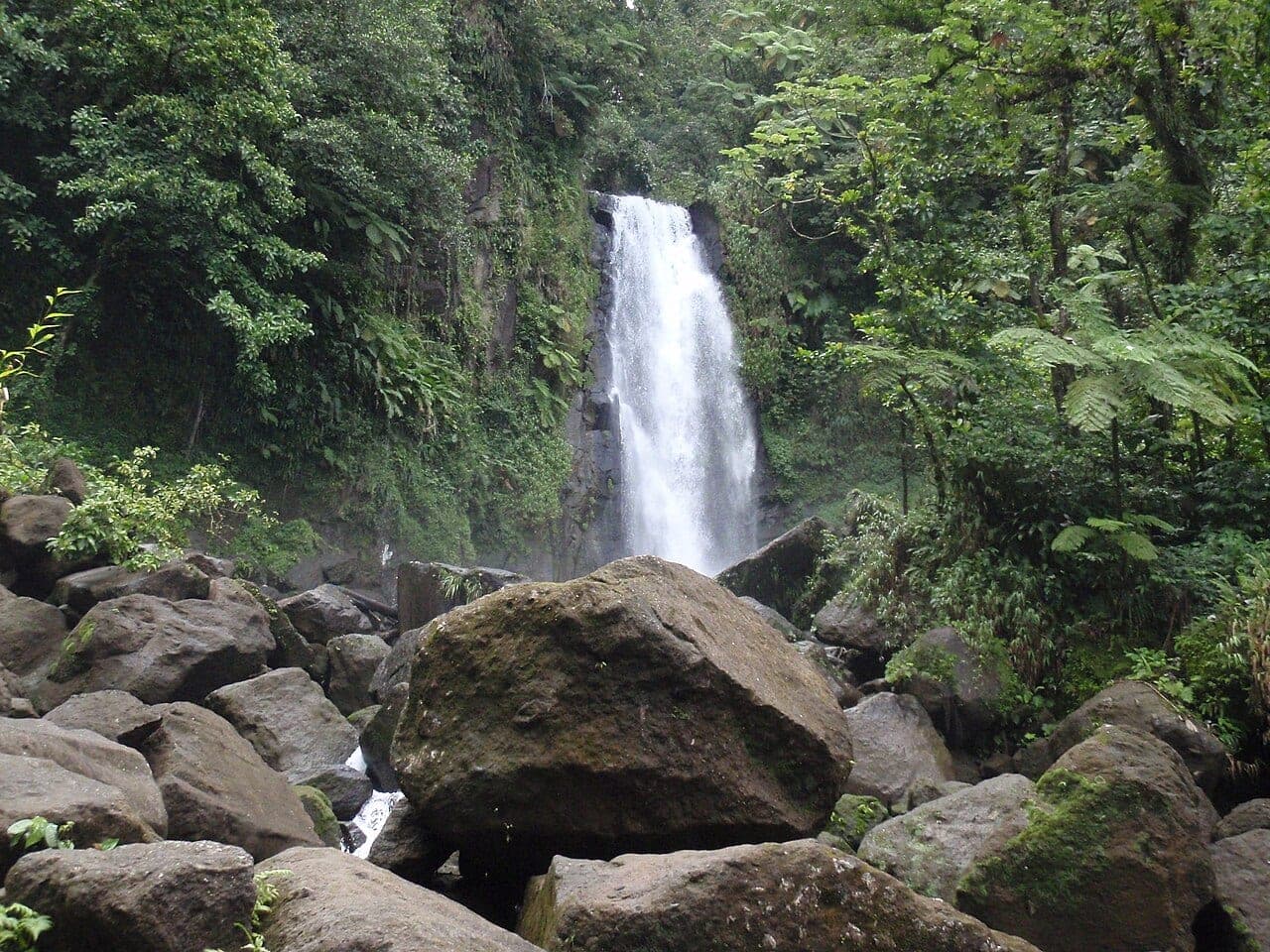
The Commonwealth of Dominica lies in the eastern Caribbean between Guadeloupe and Martinique, a young volcanic island whose spine of green mountains rises straight from the sea. Its people call it the Nature Isle, and the description is earned honestly: rainforest covers most of the interior, more than three hundred rivers thread the valleys, and hot springs and fumaroles vent from the ground where the earth is still forming. Long before Europeans arrived, the Indigenous Kalinago knew the island as Wai'tukubuli, a name usually rendered "tall is her body," and that older name still fits the terrain better than the one the maps carry today.
This is a place where memory sits close to the land. The last organized community of Indigenous Kalinago people in the Caribbean survives here in a coastal territory of eight hamlets, and the descendants of enslaved Africans who fled into the mountains left their mark on the place names and the culture that followed. Faith, family, and the ceremonies that carry people out of this life are woven through daily custom rather than reserved for special occasions. This archive gathers what Dominica remembers and how it keeps that memory alive, from a boiling lake protected by treaty to the wake songs sung on the nights after a death.
Dominica covers roughly 750 square kilometres and holds a population of about 72,000, one of the smallest in the independent Caribbean (Wikipedia). The capital, Roseau, sits on the sheltered western coast; Portsmouth, the second town, stands to the north on Prince Rupert's Bay. Almost everything about the island is shaped by its geology. It is one of the youngest islands in the Lesser Antilles, built and rebuilt by volcanic activity that has never fully stopped, leaving much of the interior forested and thinly settled.
That same volcanic character gives Dominica the natural features it is best known for. The Boiling Lake, a flooded fumarole whose grey water hovers between roughly 82 and 92 degrees Celsius, lies at the heart of Morne Trois Pitons National Park and is often called the second largest boiling lake in the world (Wikipedia). Nearby the Valley of Desolation steams with hot springs and boiling mud, while cooler places such as the Emerald Pool and the twin Trafalgar Falls draw visitors closer to Roseau. The economy leans on agriculture, small-scale services, and a form of nature tourism that treats the landscape as the main attraction.
Roseau is the administrative and commercial centre, a compact town of French colonial street plans, timber and stone houses, and a waterfront market. Its old grid runs down to the Roseau River, past gardens and a cathedral that mark the layers of French and British settlement.
Portsmouth anchors the north around the wide, calm waters of Prince Rupert's Bay. Once considered as a possible capital before disease in the surrounding wetlands discouraged the idea, it remains a fishing and trading town near the Cabrits peninsula and its ruined eighteenth-century fort.
Marigot lies on the east coast and belongs to the Kokoy-speaking, historically Methodist northeast, giving it a character distinct from the Catholic, French-influenced west. It sits near the island's main airport and the fishing communities of the windward shore.
The Kalinago Territory is not a city in the usual sense but the cultural heart of Indigenous Dominica, a coastal district of eight hamlets on the Atlantic side. Its administrative centre is Salybia, and it is governed by an elected Kalinago Chief and a council of five (Wikipedia).
The island's first known inhabitants were Arawak-speaking peoples, sometimes called the Taíno, who were later displaced or absorbed by the Kalinago, the Indigenous group Europeans long labelled Island Caribs. By the time of European contact the Kalinago held Dominica firmly, and its steep interior made the island a stronghold from which they resisted settlement far longer than on flatter neighbours. Christopher Columbus recorded the island on Sunday, 3 November 1493, and named it after the Latin for the Lord's Day (Wikipedia).
 In 1802 the West India Regiment mutinied at Fort Shirley against being treated as slaves rather than soldiers. The outcome was an Act of Parliament confirming that enlisted men of the regiment were free. Photograph by CareAhLine, CC0, via Wikimedia Commons.
For more than two centuries the terrain kept Europeans at the margins. The French established the first lasting settlements around 1690 and brought enslaved Africans to work coffee and other crops, and in 1748 the colonial powers even agreed to treat Dominica as neutral ground, an acknowledgement of Kalinago strength as much as of their own rivalry. Britain took formal control in 1763 following the Seven Years' War. This period must be recorded plainly: the plantation economy that both powers built rested on the enslavement of African people, and the profits of sugar and coffee were extracted from lives held in bondage.
Enslaved people resisted that system directly. Many fled into the mountainous interior and formed maroon communities known in the local speech as Neg Mawon, or free Black people, who raided estates and sheltered others escaping the plantations. Their leaders included Chief Jacko, born in West Africa and settled for decades on the high plateau still called Jacko Flats, and Chief Balla, both associated with the campaigns that colonial records name the Second Maroon War of 1812 to 1814. Jacko was killed by colonial rangers in 1814 after roughly forty years in the forest (Wikipedia). Slavery was abolished across the British Empire in 1834, and after a transitional period of forced apprenticeship, full emancipation followed in 1838. That year Dominica became the first British West Indian colony to have an elected legislature controlled by a majority of African descent.
The long road to self-government ran through the twentieth century, and on 3 November 1978, the anniversary of Columbus's sighting, Dominica became an independent republic within the Commonwealth (Wikipedia). Independence brought hardship as well as pride. Hurricane David struck in 1979 with severe loss of life, and in 2017 Hurricane Maria damaged the great majority of buildings on the island. Each recovery has drawn on the same communal habits that carried earlier generations through slavery and colonial hardship.
English is the official language of Dominica and the medium of school and government. Alongside it, most Dominicans speak Dominican Kwéyòl, a French-based creole that grew out of the plantation era and remains the everyday tongue of family and village life (Wikipedia). In parts of the northeast, around Marigot and Wesley, communities also speak Kokoy, an English-based creole reflecting a different pattern of settlement. Kwéyòl carries much of the island's oral memory, its proverbs, storytelling, and song, and cultural organizations now work to see it written and taught rather than left to fade.
The Kalinago language, once spoken across the island, has largely passed out of daily use, though words survive in place names, plant names, and craft vocabulary, and revival efforts within the territory aim to recover more. The island's own name reflects its layered past. Columbus applied Dominica for the Sunday on which he saw it, while the Kalinago name Wai'tukubuli, "tall is her body," described the high, ridged shape of the land itself. Both names remain in use, the older one carried as a mark of Indigenous continuity.
Dominican culture speaks most audibly through its music. In the 1970s the guitarist and bandleader Gordon Henderson and his group Exile One shaped cadence-lypso, a fusion of French Antillean cadence with Trinidadian calypso that gave the island a modern popular sound with roots in its own speech and rhythm (Wikipedia). A generation later the band Windward Caribbean Kulture, known as WCK and formed in 1988, drew on cadence-lypso, the accordion-led folk style called jing ping, soca, and zouk to create bouyon, a fast electronic dance music that has since spread across the region (Wikipedia). Since 1997 the World Creole Music Festival, held over the final weekend of October during the run-up to Independence, has gathered these homegrown styles alongside konpa, zouk, and other Creole sounds from across the francophone Caribbean (Wikipedia).
Kalinago craft gives the culture a second, older signature. The territory's weavers are known for the larouman basket, made from a split reed and worked in patterns of brown, white, and black that carry designs handed down within families. Dominican cuisine gathers African, Kalinago, and European threads into dishes such as callaloo, cassava bread of Kalinago origin, ground provisions, and salt fish. The mountain chicken, a frog once central to the national table, is now a protected symbol rather than a common meal, a reminder that heritage here includes what must now be conserved.
Roman Catholicism is the largest faith on the island, professed by a little over half the population and rooted in the long French presence of the colonial period (Wikipedia). Methodist, Pentecostal, Seventh-day Adventist, and other Protestant communities are also well established, particularly in the historically English-speaking northeast, and church calendars and the rhythms of Mass and prayer shape much of communal life.
Beneath and beside formal religion runs a current of Afro-Creole belief carried from West and Central Africa and reshaped in the Caribbean. Older understandings of spirits, healing plants, and the presence of the dead persist in rural custom and in the way families mark the passage of a life. Kalinago spirituality, closely tied to the forest, rivers, and ancestors, has similarly survived in quieter forms, often blended with Catholic practice rather than replaced by it. These layers coexist without contradiction for many Dominicans.
Death in Dominica is a communal event, and the customs around it draw on both Catholic liturgy and African memory. When someone dies, neighbours and kin gather at the family home for a wake, known in Kwéyòl-speaking communities as a veillée, an evening and night of prayer, hymn-singing, storytelling, food, and shared company meant to keep the bereaved from grieving alone. In the Catholic tradition the wake leads into a funeral Mass and burial, followed by a novena, nine successive evenings of prayer for the soul of the departed.
The Afro-Creole practice of the nine-night sits alongside these observances. Rooted in West African custom carried across the Atlantic, the nine-night gathering marks the ninth night after a death as the point when the spirit is understood to take its leave, and it is kept with singing, remembrance, and the sharing of food (Wikipedia). Mourning periods, dark clothing, and later memorial Masses extend remembrance well beyond the burial, and the Catholic calendar gives the island its days for the dead in the observances of All Saints and All Souls at the start of November, when families tend and light candles at graves.
Kalinago remembrance follows its own older thread. Traditional burial placed the dead in a flexed or fetal position, and Indigenous belief has long held the ancestors present in the living landscape of the territory. Today Kalinago families generally observe Christian funeral rites while retaining a distinct sense of continuity with those who came before, expressed in respect for burial grounds and the ceremonies that keep the community's identity intact.
Dominica's records are unusual in the Caribbean because a substantial Indigenous population survived here, and it keeps its own register.
The Kalinago Territory on the east coast, established in 1903, is communal land held by the Kalinago people, and membership is determined by descent and residence rather than by any national registry. The Kalinago Council maintains the record of who belongs, and it is the practical genealogy for that community, whose survival makes Dominica the only Caribbean island with a continuing Indigenous territory.
For everyone else the sources are colonial. The island changed hands repeatedly between France and Britain before 1763, so Catholic parish registers in French and Anglican ones in English both exist, and French place names and Kwéyòl survive on a British island. Civil registration dates from the nineteenth century and is held by the Registrar General in Roseau, with the Dominica National Documentation Centre and Kew holding the administrative series.
The slave registers of 1817 to 1834 name individuals as elsewhere in the British Caribbean, and are followed by the compensation records.
The recurring Dominican problem is weather. Hurricane David in 1979 and Hurricane Maria in 2017 each devastated the island, and Maria damaged or destroyed a very large part of the building stock along with records held in it. Digitisation of the surviving registers has become an explicit resilience measure rather than a convenience, which is a sentence that applies to more of the Caribbean every decade.
Dominica's central act of preservation is Morne Trois Pitons National Park, inscribed on the UNESCO World Heritage List in 1997 under the natural criteria for its geology and biodiversity (UNESCO). The park covers close to 7,000 hectares of tropical forest around a cluster of volcanoes, and it protects the Boiling Lake, the Valley of Desolation, the Emerald Pool, Titou Gorge, and the mountain lakes of Boeri and Freshwater, together holding some of the richest biodiversity in the Lesser Antilles, a listing that places an international obligation on the island to keep these features intact.
Cultural heritage is preserved through institutions of its own. The Kalinago Barana Autê, a model Kalinago village that opened in 2006 within the territory, presents traditional building, canoe carving, cassava preparation, and larouman weaving to visitors while giving the community a place to teach its own young people (Wikipedia). In Roseau, the Dominica Museum, housed in an old market building on the waterfront, holds collections on the island's geology, Indigenous history, the era of slavery, and Creole culture, serving as the country's principal keeper of the documentary and material record.
Because Dominica is small and its written record is scattered across colonial archives, church registers, and local memory, digital preservation matters here in practical terms. Government cultural bodies such as the island's Division of Culture publish material on national figures, music history, and traditional practice, while community and diaspora projects document Kwéyòl vocabulary, folk songs, and oral histories that might otherwise be lost as older speakers pass on.
For families, the same tools preserve personal memory. Photographs, recordings of wake songs and storytelling, and family trees reaching back through emancipation records can be gathered and held so that they survive the next storm. In a place where one weather system can erase physical archives in a night, keeping remembrance in durable, shareable form is practical insurance for cultural continuity.
Dominica's cultural reach now runs well beyond its own shores. Bouyon has grown from a local dance style into a genre with audiences across the Caribbean and its diaspora, and the World Creole Music Festival draws performers and visitors from the wider Creole-speaking world each October. The island's writers and artists, together with a substantial diaspora in the United Kingdom, the United States, and neighbouring islands, carry Dominican identity into new settings while supporting home.
The Nature Isle branding that shapes the island's tourism also shapes its self-image. Presenting Dominica as a place of forests, rivers, and geothermal wonders has encouraged development built around conservation rather than large resorts, and it has reinforced pride in the Kalinago and Kwéyòl heritage that distinguishes the island from its neighbours. Tested by climate pressures and migration, that identity still gives a small nation an outsized sense of who it is.
The clearest success is the survival of the Kalinago community itself. That an organized Indigenous population still governs its own territory more than five centuries after European contact is a rare outcome in a region where such communities were most often destroyed, and it gives Dominica a living link to the pre-Columbian Caribbean.
The Nature Isle model offers a second success. By protecting Morne Trois Pitons under UNESCO and building a visitor economy around trails, dive sites, and geothermal features rather than beach resorts, Dominica has tied its economic future to the conservation of its heritage, so that preserving the land and preserving livelihoods point in the same direction. The recovery that followed Hurricane Maria, when communities rebuilt homes and restored cultural events within a few years, shows the same instinct: a small island holding on to what makes it itself, through the wake songs and the festival, the larouman basket and the boiling lake, and passing that inheritance on.
In 1802 the West India Regiment mutinied at Fort Shirley against being treated as slaves rather than soldiers. The outcome was an Act of Parliament confirming that enlisted men of the regiment were free. Photograph by CareAhLine, CC0, via Wikimedia Commons.
For more than two centuries the terrain kept Europeans at the margins. The French established the first lasting settlements around 1690 and brought enslaved Africans to work coffee and other crops, and in 1748 the colonial powers even agreed to treat Dominica as neutral ground, an acknowledgement of Kalinago strength as much as of their own rivalry. Britain took formal control in 1763 following the Seven Years' War. This period must be recorded plainly: the plantation economy that both powers built rested on the enslavement of African people, and the profits of sugar and coffee were extracted from lives held in bondage.
Enslaved people resisted that system directly. Many fled into the mountainous interior and formed maroon communities known in the local speech as Neg Mawon, or free Black people, who raided estates and sheltered others escaping the plantations. Their leaders included Chief Jacko, born in West Africa and settled for decades on the high plateau still called Jacko Flats, and Chief Balla, both associated with the campaigns that colonial records name the Second Maroon War of 1812 to 1814. Jacko was killed by colonial rangers in 1814 after roughly forty years in the forest (Wikipedia). Slavery was abolished across the British Empire in 1834, and after a transitional period of forced apprenticeship, full emancipation followed in 1838. That year Dominica became the first British West Indian colony to have an elected legislature controlled by a majority of African descent.
The long road to self-government ran through the twentieth century, and on 3 November 1978, the anniversary of Columbus's sighting, Dominica became an independent republic within the Commonwealth (Wikipedia). Independence brought hardship as well as pride. Hurricane David struck in 1979 with severe loss of life, and in 2017 Hurricane Maria damaged the great majority of buildings on the island. Each recovery has drawn on the same communal habits that carried earlier generations through slavery and colonial hardship.
English is the official language of Dominica and the medium of school and government. Alongside it, most Dominicans speak Dominican Kwéyòl, a French-based creole that grew out of the plantation era and remains the everyday tongue of family and village life (Wikipedia). In parts of the northeast, around Marigot and Wesley, communities also speak Kokoy, an English-based creole reflecting a different pattern of settlement. Kwéyòl carries much of the island's oral memory, its proverbs, storytelling, and song, and cultural organizations now work to see it written and taught rather than left to fade.
The Kalinago language, once spoken across the island, has largely passed out of daily use, though words survive in place names, plant names, and craft vocabulary, and revival efforts within the territory aim to recover more. The island's own name reflects its layered past. Columbus applied Dominica for the Sunday on which he saw it, while the Kalinago name Wai'tukubuli, "tall is her body," described the high, ridged shape of the land itself. Both names remain in use, the older one carried as a mark of Indigenous continuity.
Dominican culture speaks most audibly through its music. In the 1970s the guitarist and bandleader Gordon Henderson and his group Exile One shaped cadence-lypso, a fusion of French Antillean cadence with Trinidadian calypso that gave the island a modern popular sound with roots in its own speech and rhythm (Wikipedia). A generation later the band Windward Caribbean Kulture, known as WCK and formed in 1988, drew on cadence-lypso, the accordion-led folk style called jing ping, soca, and zouk to create bouyon, a fast electronic dance music that has since spread across the region (Wikipedia). Since 1997 the World Creole Music Festival, held over the final weekend of October during the run-up to Independence, has gathered these homegrown styles alongside konpa, zouk, and other Creole sounds from across the francophone Caribbean (Wikipedia).
Kalinago craft gives the culture a second, older signature. The territory's weavers are known for the larouman basket, made from a split reed and worked in patterns of brown, white, and black that carry designs handed down within families. Dominican cuisine gathers African, Kalinago, and European threads into dishes such as callaloo, cassava bread of Kalinago origin, ground provisions, and salt fish. The mountain chicken, a frog once central to the national table, is now a protected symbol rather than a common meal, a reminder that heritage here includes what must now be conserved.
Roman Catholicism is the largest faith on the island, professed by a little over half the population and rooted in the long French presence of the colonial period (Wikipedia). Methodist, Pentecostal, Seventh-day Adventist, and other Protestant communities are also well established, particularly in the historically English-speaking northeast, and church calendars and the rhythms of Mass and prayer shape much of communal life.
Beneath and beside formal religion runs a current of Afro-Creole belief carried from West and Central Africa and reshaped in the Caribbean. Older understandings of spirits, healing plants, and the presence of the dead persist in rural custom and in the way families mark the passage of a life. Kalinago spirituality, closely tied to the forest, rivers, and ancestors, has similarly survived in quieter forms, often blended with Catholic practice rather than replaced by it. These layers coexist without contradiction for many Dominicans.
Death in Dominica is a communal event, and the customs around it draw on both Catholic liturgy and African memory. When someone dies, neighbours and kin gather at the family home for a wake, known in Kwéyòl-speaking communities as a veillée, an evening and night of prayer, hymn-singing, storytelling, food, and shared company meant to keep the bereaved from grieving alone. In the Catholic tradition the wake leads into a funeral Mass and burial, followed by a novena, nine successive evenings of prayer for the soul of the departed.
The Afro-Creole practice of the nine-night sits alongside these observances. Rooted in West African custom carried across the Atlantic, the nine-night gathering marks the ninth night after a death as the point when the spirit is understood to take its leave, and it is kept with singing, remembrance, and the sharing of food (Wikipedia). Mourning periods, dark clothing, and later memorial Masses extend remembrance well beyond the burial, and the Catholic calendar gives the island its days for the dead in the observances of All Saints and All Souls at the start of November, when families tend and light candles at graves.
Kalinago remembrance follows its own older thread. Traditional burial placed the dead in a flexed or fetal position, and Indigenous belief has long held the ancestors present in the living landscape of the territory. Today Kalinago families generally observe Christian funeral rites while retaining a distinct sense of continuity with those who came before, expressed in respect for burial grounds and the ceremonies that keep the community's identity intact.
Dominica's records are unusual in the Caribbean because a substantial Indigenous population survived here, and it keeps its own register.
The Kalinago Territory on the east coast, established in 1903, is communal land held by the Kalinago people, and membership is determined by descent and residence rather than by any national registry. The Kalinago Council maintains the record of who belongs, and it is the practical genealogy for that community, whose survival makes Dominica the only Caribbean island with a continuing Indigenous territory.
For everyone else the sources are colonial. The island changed hands repeatedly between France and Britain before 1763, so Catholic parish registers in French and Anglican ones in English both exist, and French place names and Kwéyòl survive on a British island. Civil registration dates from the nineteenth century and is held by the Registrar General in Roseau, with the Dominica National Documentation Centre and Kew holding the administrative series.
The slave registers of 1817 to 1834 name individuals as elsewhere in the British Caribbean, and are followed by the compensation records.
The recurring Dominican problem is weather. Hurricane David in 1979 and Hurricane Maria in 2017 each devastated the island, and Maria damaged or destroyed a very large part of the building stock along with records held in it. Digitisation of the surviving registers has become an explicit resilience measure rather than a convenience, which is a sentence that applies to more of the Caribbean every decade.
Dominica's central act of preservation is Morne Trois Pitons National Park, inscribed on the UNESCO World Heritage List in 1997 under the natural criteria for its geology and biodiversity (UNESCO). The park covers close to 7,000 hectares of tropical forest around a cluster of volcanoes, and it protects the Boiling Lake, the Valley of Desolation, the Emerald Pool, Titou Gorge, and the mountain lakes of Boeri and Freshwater, together holding some of the richest biodiversity in the Lesser Antilles, a listing that places an international obligation on the island to keep these features intact.
Cultural heritage is preserved through institutions of its own. The Kalinago Barana Autê, a model Kalinago village that opened in 2006 within the territory, presents traditional building, canoe carving, cassava preparation, and larouman weaving to visitors while giving the community a place to teach its own young people (Wikipedia). In Roseau, the Dominica Museum, housed in an old market building on the waterfront, holds collections on the island's geology, Indigenous history, the era of slavery, and Creole culture, serving as the country's principal keeper of the documentary and material record.
Because Dominica is small and its written record is scattered across colonial archives, church registers, and local memory, digital preservation matters here in practical terms. Government cultural bodies such as the island's Division of Culture publish material on national figures, music history, and traditional practice, while community and diaspora projects document Kwéyòl vocabulary, folk songs, and oral histories that might otherwise be lost as older speakers pass on.
For families, the same tools preserve personal memory. Photographs, recordings of wake songs and storytelling, and family trees reaching back through emancipation records can be gathered and held so that they survive the next storm. In a place where one weather system can erase physical archives in a night, keeping remembrance in durable, shareable form is practical insurance for cultural continuity.
Dominica's cultural reach now runs well beyond its own shores. Bouyon has grown from a local dance style into a genre with audiences across the Caribbean and its diaspora, and the World Creole Music Festival draws performers and visitors from the wider Creole-speaking world each October. The island's writers and artists, together with a substantial diaspora in the United Kingdom, the United States, and neighbouring islands, carry Dominican identity into new settings while supporting home.
The Nature Isle branding that shapes the island's tourism also shapes its self-image. Presenting Dominica as a place of forests, rivers, and geothermal wonders has encouraged development built around conservation rather than large resorts, and it has reinforced pride in the Kalinago and Kwéyòl heritage that distinguishes the island from its neighbours. Tested by climate pressures and migration, that identity still gives a small nation an outsized sense of who it is.
The clearest success is the survival of the Kalinago community itself. That an organized Indigenous population still governs its own territory more than five centuries after European contact is a rare outcome in a region where such communities were most often destroyed, and it gives Dominica a living link to the pre-Columbian Caribbean.
The Nature Isle model offers a second success. By protecting Morne Trois Pitons under UNESCO and building a visitor economy around trails, dive sites, and geothermal features rather than beach resorts, Dominica has tied its economic future to the conservation of its heritage, so that preserving the land and preserving livelihoods point in the same direction. The recovery that followed Hurricane Maria, when communities rebuilt homes and restored cultural events within a few years, shows the same instinct: a small island holding on to what makes it itself, through the wake songs and the festival, the larouman basket and the boiling lake, and passing that inheritance on.
National Overview
Notable Cities
Historical Foundations
Linguistic and Etymological Roots
Cultural Identity
Religion and Spirituality
Remembrance and Mourning Traditions
Tracing a Family in Dominica
Heritage Preservation Efforts
Digital Heritage
Contemporary Cultural Influences
Success Stories
References and resources
- Dominica - Wikipedia country overview.
- Morne Trois Pitons National Park - UNESCO World Heritage listing, inscribed 1997.
- Morne Trois Pitons National Park - Wikipedia entry on the park and Boiling Lake.
- Kalinago Territory - Wikipedia entry on the Indigenous territory.
- Chief Jacko - Wikipedia entry on the maroon leader.
- Cadence-lypso - Wikipedia entry on the genre and Exile One.
- Bouyon music - Wikipedia entry on the genre pioneered by WCK.
- World Creole Music Festival - Wikipedia entry on the festival.
- Nine nights - Wikipedia entry on the funerary tradition.