Heritage · Landmark
The Potala Palace: a palace above Lhasa
Above the Tibetan capital, a fortress of white and red stone climbs the Red Hill where Songtsen Gampo once built and the Fifth Dalai Lama rebuilt. Inside are the chapels, gold-cased tombs, and painted walls that made the Potala the winter home of the Dalai Lamas and the heart of Tibetan Buddhist life.Written to last.
By Confinity Heritage Editorial · Updated 2026-07-31 · 7-minute readQuiet tools, kept out of the way.
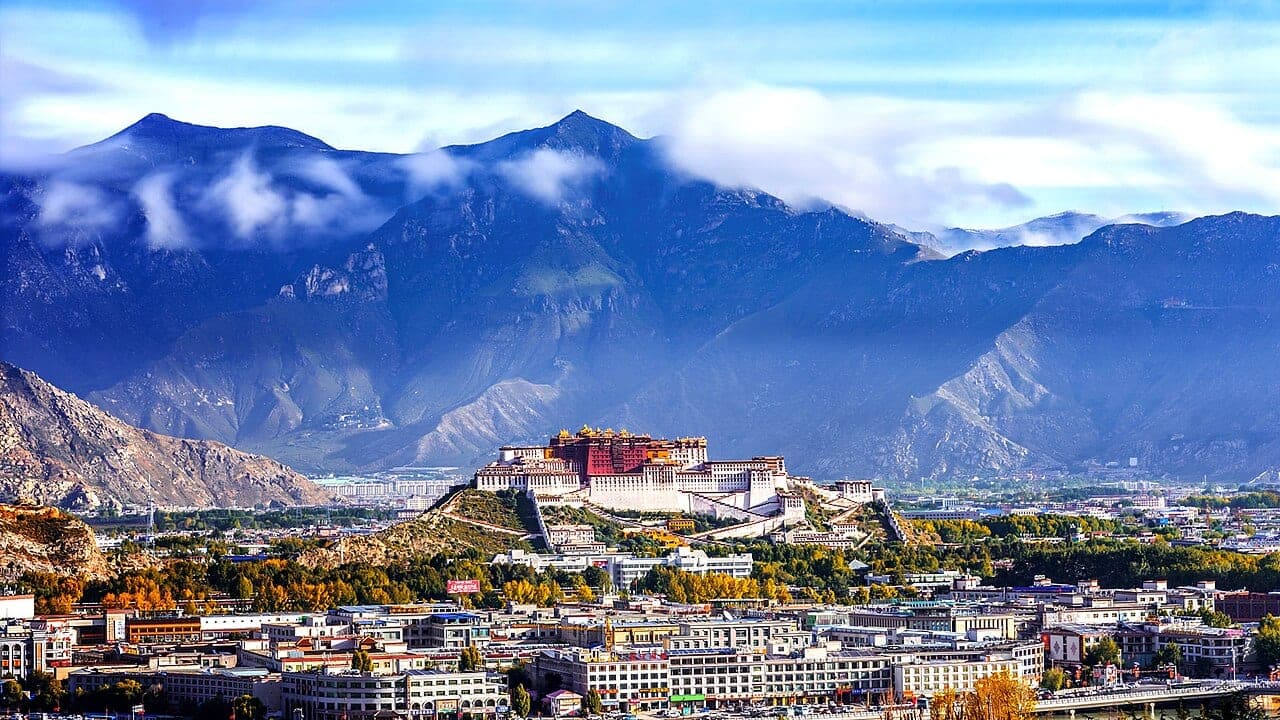
Seen from the valley floor, the Potala Palace reads less like a building than like an extension of the hill it crowns. Its walls climb Marpo Ri, the Red Hill at the centre of Lhasa, in tiers of whitewashed stone that give way, at the summit, to a block of deep ochre red and a crest of gilded roofs. On a hill already about 3,700 metres above sea level, it is among the highest palaces ever built, and for close to three centuries it was the winter residence of the Dalai Lamas and the seat from which Tibet was governed.
The name carries the meaning of the place. Potala derives from Mount Potalaka, described in Buddhist tradition as the mountain abode of Avalokiteshvara, the bodhisattva of compassion known in Tibet as Chenrezig, of whom the Dalai Lamas are held to be emanations. To build a palace and call it Potala was to name a hill in Lhasa after a sacred mountain, and to place at its heart the person Tibetans regarded as compassion made human. The structure that survives today holds chapels, assembly halls, the golden tombs of past Dalai Lamas, and collections of murals, scripture, and sculpture gathered over centuries.
The hill was sacred long before the present palace rose on it. In the seventh century Songtsen Gampo, the king who unified much of the Tibetan plateau and is credited with bringing Buddhism to it, is traditionally said to have built a palace and a meditation retreat on Marpo Ri around the year 637. Little of that early structure endured the centuries of war and weather that followed, but the site kept its associations, and a small cave linked to Songtsen Gampo is still preserved within the later building.
The Potala as it is known today belongs to the seventeenth century, and to one man's decision. Ngawang Lobsang Gyatso, the Fifth Dalai Lama (1617–1682), had by 1642 become the temporal as well as the spiritual authority in Tibet. On the advice of a counsellor who judged the hill an ideal seat of government, he began building on Marpo Ri in 1645. The lower, secular White Palace was substantially finished and occupied by 1649.
The Fifth Dalai Lama did not live to see the whole design completed. When he died in 1682 the work on the upper Red Palace was still unfinished, and his regent, Desi Sangye Gyatso, is recorded to have concealed the death for some years so that the building and the authority behind it would not falter. The Red Palace was completed in 1694. What began as a fortress on a king's hill had become, within a lifetime, the largest palace on the Tibetan plateau.
The Potala is really two palaces built as one, their names taken from the colour of their walls. The White Palace (Potrang Karpo), whitewashed and lower on the hill, held the secular functions: the living quarters of the Dalai Lama, government offices, a seminary, storerooms, and a printing house. The Red Palace (Potrang Marpo), painted deep ochre and rising at the centre and summit, was given over to religion, with its chapels, assembly halls, libraries, and the tombs of the Dalai Lamas.
 The White Palace held the government, the Red Palace the religious quarters and the tombs. The division is legible from outside. Photograph by Luca Galuzzi, CC BY-SA 2.5, via Wikimedia Commons.
The scale is considerable. The complex measures roughly 400 metres from east to west and about 350 metres from north to south, and rises some 117 metres above the hilltop, thirteen storeys in all. Within its walls are said to be more than a thousand rooms, along with something on the order of ten thousand shrines.
Its builders worked in stone, rammed earth, and timber, and to the demands of a high, seismically active plateau. The outer walls slope inward as they rise and are massively thick, averaging around three metres, and molten copper was poured into parts of the foundations to help bind the structure against earthquakes. The inward lean of the walls, the small windows deepening in tiers, and the flat gold roofs give the Potala the silhouette that has become the emblem of Lhasa.
Inside, the Potala is a sequence of dim, lamp-lit halls, their beams and pillars wrapped in cloth and their walls painted from floor to ceiling. The murals run to thousands of square metres and record the life of the Fifth Dalai Lama, the construction of the palace itself, scenes from Buddhist scripture, and portraits of teachers, kings, and deities. Together with statues, said to number in the hundreds of thousands across the building, thangka scroll-paintings, and ritual objects, they make the interior a gathered archive of Tibetan art.
The Red Palace holds what many pilgrims climb to see: the golden stupa-tombs, or chorten, of eight Dalai Lamas. In these reliquaries the embalmed remains of past Dalai Lamas are enclosed within tiered forms cased in gold and set with gems. The tomb of the Fifth Dalai Lama is the greatest of them, close to fifteen metres tall, sheathed in an immense quantity of gold and studded with thousands of pearls, coral, turquoise, and amber. The tomb of the Thirteenth Dalai Lama, completed in the 1930s, is nearly as tall.
The palace also served as a library and repository of learning. Among its holdings are woodblock-printed and hand-copied volumes of the Kangyur and Tengyur, the two great collections of the Tibetan Buddhist canon, together with palm-leaf manuscripts, seals, and ritual instruments kept in its chapels and stores.
For as long as it was a residence, the Potala was the point where religion and government met. From it the Ganden Phodrang, the administration founded by the Fifth Dalai Lama in 1642, conducted the affairs of Tibet, while the chapels above continued the round of ritual. The Dalai Lama wintered here and moved, in the warmer months, to the summer palace of Norbulingka across the city, and the two residences framed the rhythm of the year. Officials, monks, and petitioners climbed the great ramps to its gates, and the ceremonies of the Tibetan calendar centred on the hill.
The Fourteenth and current Dalai Lama, Tenzin Gyatso, lived in the Potala during the winters of his youth. He left Tibet in 1959, after which the palace ceased to be a residence and later became a state museum, which it remains, while also continuing as a site of pilgrimage. The broader political questions concerning Tibet's status and history are the subject of ongoing dispute among governments and communities, and this account describes the palace's role without taking a position on them.
The Potala's survival into the present owes much to sustained conservation. Major restoration campaigns were carried out from 1989 to 1994 and again from 2002, addressing the timber structure, the sloping walls, and the fabric of the murals, at considerable public expense. The building's age, its wooden interiors, and the sheer number of visitors it now draws make its protection a continuing task.
Because the structure is fragile, access is limited. Authorities cap the number of visitors admitted each day, with a raised ceiling of around 2,300 in the peak season, issue timed tickets, and hold the length of a visit inside the palace to roughly an hour, so that the floors and stairs are not worn faster than they can be repaired.
The site's standing was recognised internationally in 1994, when UNESCO inscribed the Potala Palace on the World Heritage List under cultural criteria for its architecture, its place in Tibetan history, and its religious significance. The inscription was later extended twice to take in two closely related sites in Lhasa: the Jokhang Temple Monastery in 2000, the holiest temple in Tibetan Buddhism, and Norbulingka, the Dalai Lamas' summer palace and garden, in 2001. Together they form the property now listed as the Historic Ensemble of the Potala Palace, Lhasa.
To stand below the Potala at dawn, as pilgrims turn prayer wheels along the kora path that circles the hill, is to see a building that has never stopped being a place of memory. Its tombs hold the remains of men through whom, in Tibetan understanding, compassion took successive human form. Its murals keep the faces of teachers long dead, and its chapels preserve the words of a canon copied and recopied by hand. The palace was built, in part, to remember.
That is the thread that ties a place like the Potala to any archive of a family or a people. Memory is not preserved by grand gestures alone but by return: the pilgrim who walks the same circuit each morning, the lamp refilled, the scripture read aloud again, the tomb kept bright. A building can hold the physical evidence of a life, the portrait and the relic and the written page, but it is the continued attention of the living that keeps those things meaningful rather than merely old. The Potala endures as stone and gold and pigment; it endures more truly as a place people still climb in order to remember. What it keeps, above the roof of the world, is not only the past of the Dalai Lamas but the practice of remembering itself.
The White Palace held the government, the Red Palace the religious quarters and the tombs. The division is legible from outside. Photograph by Luca Galuzzi, CC BY-SA 2.5, via Wikimedia Commons.
The scale is considerable. The complex measures roughly 400 metres from east to west and about 350 metres from north to south, and rises some 117 metres above the hilltop, thirteen storeys in all. Within its walls are said to be more than a thousand rooms, along with something on the order of ten thousand shrines.
Its builders worked in stone, rammed earth, and timber, and to the demands of a high, seismically active plateau. The outer walls slope inward as they rise and are massively thick, averaging around three metres, and molten copper was poured into parts of the foundations to help bind the structure against earthquakes. The inward lean of the walls, the small windows deepening in tiers, and the flat gold roofs give the Potala the silhouette that has become the emblem of Lhasa.
Inside, the Potala is a sequence of dim, lamp-lit halls, their beams and pillars wrapped in cloth and their walls painted from floor to ceiling. The murals run to thousands of square metres and record the life of the Fifth Dalai Lama, the construction of the palace itself, scenes from Buddhist scripture, and portraits of teachers, kings, and deities. Together with statues, said to number in the hundreds of thousands across the building, thangka scroll-paintings, and ritual objects, they make the interior a gathered archive of Tibetan art.
The Red Palace holds what many pilgrims climb to see: the golden stupa-tombs, or chorten, of eight Dalai Lamas. In these reliquaries the embalmed remains of past Dalai Lamas are enclosed within tiered forms cased in gold and set with gems. The tomb of the Fifth Dalai Lama is the greatest of them, close to fifteen metres tall, sheathed in an immense quantity of gold and studded with thousands of pearls, coral, turquoise, and amber. The tomb of the Thirteenth Dalai Lama, completed in the 1930s, is nearly as tall.
The palace also served as a library and repository of learning. Among its holdings are woodblock-printed and hand-copied volumes of the Kangyur and Tengyur, the two great collections of the Tibetan Buddhist canon, together with palm-leaf manuscripts, seals, and ritual instruments kept in its chapels and stores.
For as long as it was a residence, the Potala was the point where religion and government met. From it the Ganden Phodrang, the administration founded by the Fifth Dalai Lama in 1642, conducted the affairs of Tibet, while the chapels above continued the round of ritual. The Dalai Lama wintered here and moved, in the warmer months, to the summer palace of Norbulingka across the city, and the two residences framed the rhythm of the year. Officials, monks, and petitioners climbed the great ramps to its gates, and the ceremonies of the Tibetan calendar centred on the hill.
The Fourteenth and current Dalai Lama, Tenzin Gyatso, lived in the Potala during the winters of his youth. He left Tibet in 1959, after which the palace ceased to be a residence and later became a state museum, which it remains, while also continuing as a site of pilgrimage. The broader political questions concerning Tibet's status and history are the subject of ongoing dispute among governments and communities, and this account describes the palace's role without taking a position on them.
The Potala's survival into the present owes much to sustained conservation. Major restoration campaigns were carried out from 1989 to 1994 and again from 2002, addressing the timber structure, the sloping walls, and the fabric of the murals, at considerable public expense. The building's age, its wooden interiors, and the sheer number of visitors it now draws make its protection a continuing task.
Because the structure is fragile, access is limited. Authorities cap the number of visitors admitted each day, with a raised ceiling of around 2,300 in the peak season, issue timed tickets, and hold the length of a visit inside the palace to roughly an hour, so that the floors and stairs are not worn faster than they can be repaired.
The site's standing was recognised internationally in 1994, when UNESCO inscribed the Potala Palace on the World Heritage List under cultural criteria for its architecture, its place in Tibetan history, and its religious significance. The inscription was later extended twice to take in two closely related sites in Lhasa: the Jokhang Temple Monastery in 2000, the holiest temple in Tibetan Buddhism, and Norbulingka, the Dalai Lamas' summer palace and garden, in 2001. Together they form the property now listed as the Historic Ensemble of the Potala Palace, Lhasa.
To stand below the Potala at dawn, as pilgrims turn prayer wheels along the kora path that circles the hill, is to see a building that has never stopped being a place of memory. Its tombs hold the remains of men through whom, in Tibetan understanding, compassion took successive human form. Its murals keep the faces of teachers long dead, and its chapels preserve the words of a canon copied and recopied by hand. The palace was built, in part, to remember.
That is the thread that ties a place like the Potala to any archive of a family or a people. Memory is not preserved by grand gestures alone but by return: the pilgrim who walks the same circuit each morning, the lamp refilled, the scripture read aloud again, the tomb kept bright. A building can hold the physical evidence of a life, the portrait and the relic and the written page, but it is the continued attention of the living that keeps those things meaningful rather than merely old. The Potala endures as stone and gold and pigment; it endures more truly as a place people still climb in order to remember. What it keeps, above the roof of the world, is not only the past of the Dalai Lamas but the practice of remembering itself.
From Songtsen Gampo's hill to the Fifth Dalai Lama's palace
Two palaces on one hill