Heritage · Country
Macau Culture and Heritage
Portuguese traders settled a peninsula below a Chinese sea-goddess temple in the 1550s and never left, making Macau the oldest permanent European settlement in East Asia. A guide to its heritage, from the stone face of St Paul's and the wave-patterned pavements to Patuá, a creole down to roughly fifty native speakers.Written to last.
By Confinity Heritage Editorial · Updated 2026-08-17 · 8-minute readQuiet tools, kept out of the way.
There is a temple on the southwestern shore of the Macau peninsula, dedicated to the sea goddess A-Ma and older than any European presence in East Asia. When Portuguese sailors asked in the sixteenth century what the place was called, they were told, by the usual account, something like A-Ma Gau, the bay of A-Ma. They wrote down Macau, and the misunderstanding became the name of a territory. Four and a half centuries later the temple still burns coils of incense a few minutes' walk from Baroque churches, a Portuguese-paved square and a hillside fort built to repel the Dutch.
Macau is a place where two cultures did more than sit side by side. They intermarried, cooked together, argued in a language of their own making and buried their dead within sight of one another. The Portuguese settled here from the 1550s and stayed until 1999, longer than any other European foothold in Asia, and what they left behind is a hybrid rather than a colonial quarter: Catholic parishes on the same lanes as Chinese temples, a creole called Patuá now down to a handful of native speakers, and a cuisine with a fair claim to being the first fusion cooking anywhere. This guide follows that inheritance, and what a casino economy of extraordinary scale has done to the ground it sits on.
Macau is a special administrative region of the People's Republic of China on the western side of the Pearl River estuary, about sixty kilometres from Hong Kong and joined to the mainland at the north by a narrow isthmus (Britannica). It covers roughly 33 square kilometres, a figure that keeps rising as land is reclaimed, and holds around 680,000 people, which makes it one of the most densely populated territories on earth. The peninsula carries the historic city; south of it lie the former islands of Taipa and Coloane, now fused by the reclaimed strip called Cotai. Chinese and Portuguese are both official languages, though Cantonese is what almost everyone speaks and Portuguese is the first language of only a small minority. Portuguese administration ended on 20 December 1999, and the territory is governed under its own Basic Law within the framework of "one country, two systems", with a legal tradition still recognisably continental European.
The Macau peninsula. The old city, and effectively the whole of what UNESCO inscribed. Senado Square, Largo do Senado, opens off the main commercial street with pastel neoclassical facades on three sides and a floor of black and white calçada portuguesa laid in a wave pattern by Portuguese masons. From there a lane runs uphill to the Ruins of St Paul's, past St Dominic's Church and the Na Tcha temple, and on to the Mount Fortress and the Guia hill with its chapel and lighthouse.
Taipa. Once a separate island of firecracker factories and shipyards, Taipa keeps a village core of narrow lanes, the Pak Tai temple, and the five pale green Taipa Houses on the waterfront, colonial residences of the 1920s now run as museums of Macanese domestic life.
Coloane. The southern island, hillier and quieter, with the yellow and white chapel of St Francis Xavier at the centre of its village, a working fishing quay and the beaches of Hac Sa and Cheoc Van.
Cotai. Reclaimed from the channel between Taipa and Coloane from the 1990s onward, Cotai now carries the largest concentration of casino resorts in the world, built at a scale entirely unlike anything else in the territory.
Fishermen and traders from Fujian and Guangdong used the peninsula long before the Portuguese, and the A-Ma Temple, founded in 1488, predates them by decades. Portuguese ships reached the south China coast in the 1510s, and from about 1557 they were permitted to settle at Macau, paying an annual ground rent to Ming officials while Chinese sovereignty continued in principle. It became the pivot of a trade that ran Chinese silk to Japan for silver and Indian goods to Canton, and the base from which Jesuits including Matteo Ricci prepared for the mainland.
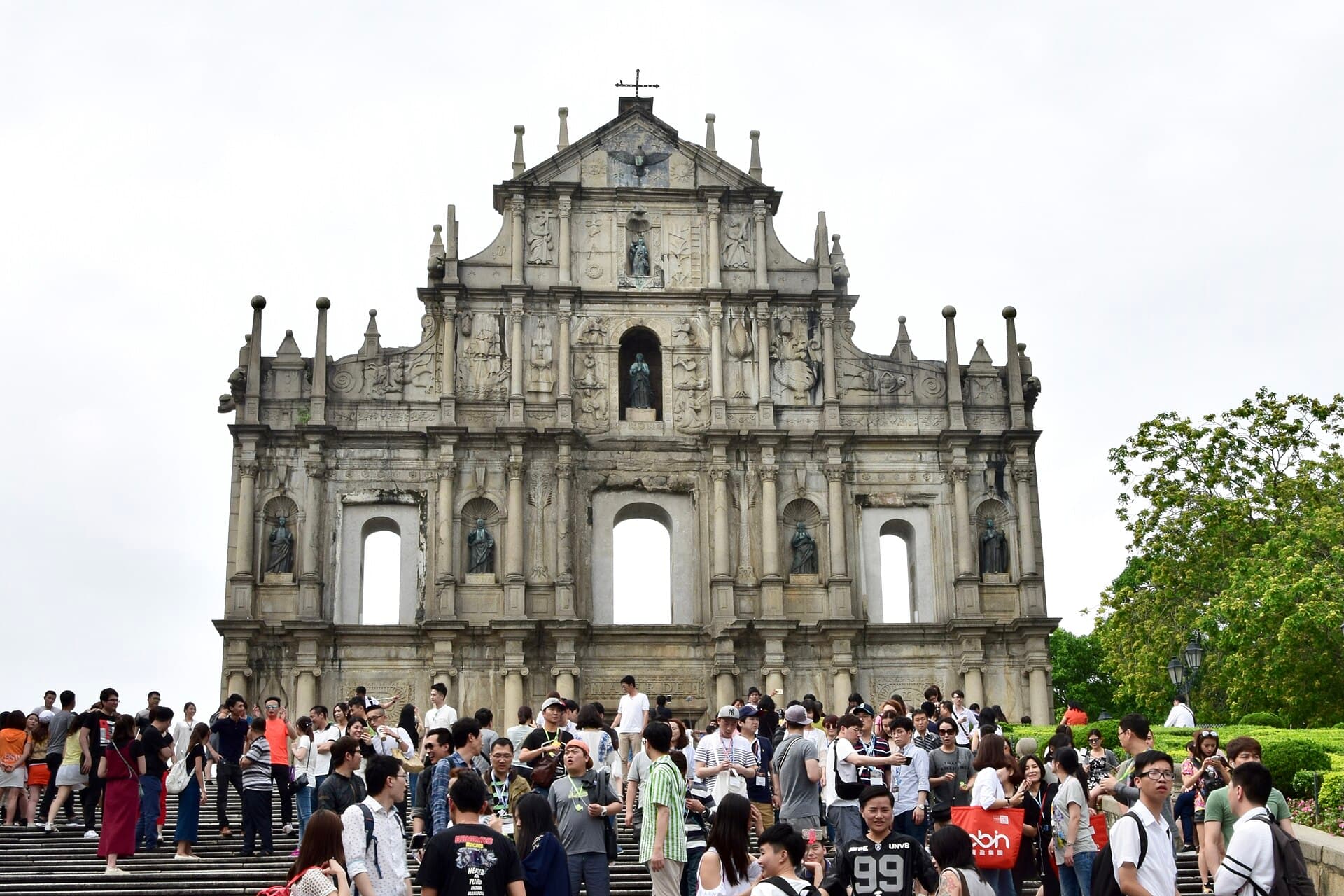
 Only the front wall of St Paul's survived the fire of 1835, and Macau kept the facade standing on its own rather than rebuilding behind it. Photograph by yeowatzup, CC BY 2.0, via Wikimedia Commons.
The city fortified itself. When a Dutch fleet attacked in 1622, the defence was decided by a cannon shot from the Mount Fortress, fired, so the story goes, by a Jesuit priest into the Dutch powder store. St Paul's College, founded in 1594 beside the Church of Mater Dei, taught Chinese, theology and astronomy and is often described as the first Western-style university in East Asia. The church's great stone front was completed around 1640; a fire during a typhoon in 1835 took everything behind it, leaving the facade standing alone on its staircase, which is how the city's best-known monument came to be a wall.
Macau's fortunes fell as Hong Kong's rose after 1841, and it settled into a quieter role: a refuge in the Second World War, when it stayed formally neutral and its population swelled with people fleeing occupied China and Hong Kong; a licensed gambling town from the 1930s; and, after Portugal's revolution of 1974, a Chinese territory under Portuguese administration by mutual description. A joint declaration in 1987 set the terms, and sovereignty transferred on 20 December 1999.
The name is a European rendering of a Cantonese phrase. Most accounts trace Macau to A-Ma Gau or Ma Kok, the bay or pavilion of A-Ma, the sea goddess whose temple the Portuguese found on arriving. The Chinese name of the territory, Ou Mun in Cantonese, means "gateway of the bay". The two names sit on the same passports.
Macau's own language is Patuá, also called Maquista or, affectionately, doci papiaçam, "sweet speech". It grew in Macanese households from Portuguese stock with Malay, Sinhalese, Cantonese, Japanese and Indian elements folded in, following the routes of Portugal's Asian trade, and it was spoken domestically for centuries while Portuguese served as the language of church and administration. UNESCO classified it as critically endangered, with the number of native speakers in Macau counted in the dozens (UNESCO World Atlas of Languages). Its survival now rests largely on one theatre company: Dóci Papiaçám di Macau has staged an original play in Patuá at the Macao Arts Festival almost every year since 1993, and Patuá theatre was added to China's national list of intangible cultural heritage in 2021, which is a rare thing for a language with so few speakers left. Portuguese itself remains official and appears on every street sign, in courts and in the civil service, and a scattering of Portuguese words has settled into local Cantonese.
The Macanese, in the sense the word carries here, are the community descended from Portuguese men and women of Chinese, Malay, Japanese, Indian and Timorese origin, formed over four centuries and numbering only some tens of thousands worldwide, most now living in Portugal, Brazil, Canada, the United States and Australia. Their identity travels in three things: family names, Patuá, and food.
Macanese cuisine has a reasonable claim to be the oldest sustained fusion cooking in the world, older than the term. It puts Portuguese technique and Iberian staples together with spices carried along Portugal's route through Africa, India, Malacca and Timor, and with Cantonese ingredients close at hand. Minchi, minced beef or pork with fried potato cubes, soy and a fried egg, is the household dish; African chicken arrives under a sauce of coconut, chillies and peanuts that exists nowhere in Africa; tacho is a winter stew of Portuguese and Chinese meats; serradura is a chilled pudding of cream and crushed biscuit. UNESCO named Macao a Creative City of Gastronomy in 2017, citing that four-hundred-year kitchen tradition (UNESCO Creative Cities). The recipes were kept in handwritten family books and passed between women, which is precisely why the cuisine is now considered at risk: the restaurants cooking it properly can be counted on two hands.
Walk five minutes in old Macau and you pass both faiths at work. The Diocese of Macau, erected in 1576, was for a long period the base for Catholic missions across China, Japan, Korea and Vietnam; St Joseph's Seminary, founded in 1728, trained the priests who went. St Dominic's, St Lawrence's and St Augustine's are working parish churches on the UNESCO list. A short walk from the Ruins of St Paul's is the Na Tcha temple, a small shrine to a Taoist child-deity built in 1888 in the shadow of the Catholic ruin, and the pair of them is the image Macau most often uses to describe itself.
Only the front wall of St Paul's survived the fire of 1835, and Macau kept the facade standing on its own rather than rebuilding behind it. Photograph by yeowatzup, CC BY 2.0, via Wikimedia Commons.
The city fortified itself. When a Dutch fleet attacked in 1622, the defence was decided by a cannon shot from the Mount Fortress, fired, so the story goes, by a Jesuit priest into the Dutch powder store. St Paul's College, founded in 1594 beside the Church of Mater Dei, taught Chinese, theology and astronomy and is often described as the first Western-style university in East Asia. The church's great stone front was completed around 1640; a fire during a typhoon in 1835 took everything behind it, leaving the facade standing alone on its staircase, which is how the city's best-known monument came to be a wall.
Macau's fortunes fell as Hong Kong's rose after 1841, and it settled into a quieter role: a refuge in the Second World War, when it stayed formally neutral and its population swelled with people fleeing occupied China and Hong Kong; a licensed gambling town from the 1930s; and, after Portugal's revolution of 1974, a Chinese territory under Portuguese administration by mutual description. A joint declaration in 1987 set the terms, and sovereignty transferred on 20 December 1999.
The name is a European rendering of a Cantonese phrase. Most accounts trace Macau to A-Ma Gau or Ma Kok, the bay or pavilion of A-Ma, the sea goddess whose temple the Portuguese found on arriving. The Chinese name of the territory, Ou Mun in Cantonese, means "gateway of the bay". The two names sit on the same passports.
Macau's own language is Patuá, also called Maquista or, affectionately, doci papiaçam, "sweet speech". It grew in Macanese households from Portuguese stock with Malay, Sinhalese, Cantonese, Japanese and Indian elements folded in, following the routes of Portugal's Asian trade, and it was spoken domestically for centuries while Portuguese served as the language of church and administration. UNESCO classified it as critically endangered, with the number of native speakers in Macau counted in the dozens (UNESCO World Atlas of Languages). Its survival now rests largely on one theatre company: Dóci Papiaçám di Macau has staged an original play in Patuá at the Macao Arts Festival almost every year since 1993, and Patuá theatre was added to China's national list of intangible cultural heritage in 2021, which is a rare thing for a language with so few speakers left. Portuguese itself remains official and appears on every street sign, in courts and in the civil service, and a scattering of Portuguese words has settled into local Cantonese.
The Macanese, in the sense the word carries here, are the community descended from Portuguese men and women of Chinese, Malay, Japanese, Indian and Timorese origin, formed over four centuries and numbering only some tens of thousands worldwide, most now living in Portugal, Brazil, Canada, the United States and Australia. Their identity travels in three things: family names, Patuá, and food.
Macanese cuisine has a reasonable claim to be the oldest sustained fusion cooking in the world, older than the term. It puts Portuguese technique and Iberian staples together with spices carried along Portugal's route through Africa, India, Malacca and Timor, and with Cantonese ingredients close at hand. Minchi, minced beef or pork with fried potato cubes, soy and a fried egg, is the household dish; African chicken arrives under a sauce of coconut, chillies and peanuts that exists nowhere in Africa; tacho is a winter stew of Portuguese and Chinese meats; serradura is a chilled pudding of cream and crushed biscuit. UNESCO named Macao a Creative City of Gastronomy in 2017, citing that four-hundred-year kitchen tradition (UNESCO Creative Cities). The recipes were kept in handwritten family books and passed between women, which is precisely why the cuisine is now considered at risk: the restaurants cooking it properly can be counted on two hands.
Walk five minutes in old Macau and you pass both faiths at work. The Diocese of Macau, erected in 1576, was for a long period the base for Catholic missions across China, Japan, Korea and Vietnam; St Joseph's Seminary, founded in 1728, trained the priests who went. St Dominic's, St Lawrence's and St Augustine's are working parish churches on the UNESCO list. A short walk from the Ruins of St Paul's is the Na Tcha temple, a small shrine to a Taoist child-deity built in 1888 in the shadow of the Catholic ruin, and the pair of them is the image Macau most often uses to describe itself.
 The A-Ma temple predates the Portuguese arrival, and the name Macau is generally taken to come from it. Photograph by Richard Mortel, CC BY 2.0, via Wikimedia Commons.
Chinese practice is the majority tradition. The A-Ma Temple keeps its prayer pavilions on the rock above the inner harbour; Kun Iam Tong, the temple of the goddess of mercy, has a garden where the first treaty between China and the United States was signed in 1844. Catholics are a minority of perhaps five per cent, but their calendar is public property: the Procession of the Passion of Our Lord, a Lenten rite going back some four centuries, carries a statue of Christ through the streets by candlelight, and the Procession of Our Lady of Fatima leaves St Dominic's each 13 May. Both are on Macao's intangible cultural heritage list.
Two systems of remembrance run in parallel here, and they have influenced each other without merging. Ching Ming in early April and Chong Yeung in the ninth lunar month are public holidays, and Macau families do what Cantonese families across the delta do: climb to the graves, weed and wash the stone, repaint the characters, set out roast pork, fruit, tea and wine, light incense and burn paper money and paper goods for the use of the dead. Ancestral tablets sit on home altars and in clan halls, and the seventh lunar month brings offerings for the wandering dead. Funerals in the Chinese tradition are followed by rites at seven-day intervals for forty-nine days, and cremation has largely replaced burial for reasons of space that any territory this small will recognise.
The Catholic calendar keeps its own days. All Souls, the second of November, brings Macanese and Portuguese families to the cemeteries with chrysanthemums and candles, and requiem Masses are said for the dead of a parish. The main Catholic ground is the Cemitério São Miguel Arcanjo, opened in 1854 on the slope below Guia hill after a cholera outbreak and given its small chapel of St Michael the Archangel in 1875. It is one of the more affecting places in the territory: tiled Portuguese family plots and Chinese Catholic graves in the same rows, inscriptions in Portuguese, Chinese and Latin, and photographs set into the stone in the southern European manner. Older still is the Old Protestant Cemetery, opened in 1821 for the English-speaking traders and their families whom neither the Catholic ground nor the Chinese hillsides would take, where the missionary and lexicographer Robert Morrison and the painter George Chinnery are buried.
The two traditions meet in the households that belong to both. Macanese Catholic families have long kept Ching Ming as well as All Souls, sweeping graves in April and returning with candles in November, and it is common for a Macanese funeral to include a rosary in Portuguese and offerings in the Chinese manner in the same week. That doubling is the clearest thing Macau has to say about itself. Two ways of holding on to a person, kept by the same family, neither one giving way.
Macau has been documented continuously by two administrations since 1557, and UNESCO has recognised the result.
The Historical Archives of Macao hold the Portuguese administrative record from the sixteenth century, and in 2017 UNESCO added the official records of Macao during the Qing dynasty, a series of Chinese and Portuguese documents covering the eighteenth and nineteenth centuries, to the Memory of the World Register. Those files document a small territory where two bureaucracies wrote about the same people in two languages for two hundred years.
Catholic parish registers begin in the sixteenth century, among the oldest in East Asia, and Portuguese civil registration follows.
The distinctive community is the Macanese, the Macaense, descended from Portuguese men and women from Malacca, Japan, Goa and China across four centuries, speaking Patuá, a creole now spoken by very few. Macanese families kept their own genealogies and the diaspora associations in Lisbon, California, Toronto and Brazil maintain them.
The Chinese record is the clan and the temple, as elsewhere in the Pearl River delta: zupu genealogies naming an ancestral village in Guangdong, and the Kiang Wu hospital and the merchant associations that ran community life under Portuguese administration.
The handover in 1999 kept the archives in place. The Macao Special Administrative Region maintains its own registration, and the Historic Centre's UNESCO inscription in 2005 covers the buildings that both communities used.
The Historic Centre of Macao was inscribed on the UNESCO World Heritage List in 2005: a linked group of more than twenty monuments and eight public squares running from the A-Ma Temple in the south to the Mount Fortress and Guia in the north, recognised as the record of the earliest and longest-lasting encounter between China and the West (UNESCO). The listing is unusual in that it is a lived-in city centre rather than a monument compound: parish churches still hold Mass, the temples still take offerings, and people live above the shops.
Protection sits with the Cultural Affairs Bureau under a Cultural Heritage Protection Law passed in 2013, which classifies buildings and sites, regulates works within the protected zones and created the territory's inventory of intangible heritage. The most serious test came over the Guia Lighthouse, built in 1865 and the oldest modern lighthouse on the China coast. Tall buildings proposed nearby would have blocked the view of the hill from the harbour; the World Heritage Committee raised the matter in 2007, and the Chief Executive issued Dispatch 83/2008 imposing height limits across eleven zones around the fortress (UNESCO, Historic Centre of Macao documents). Restoration work has been careful where it has been done well, and the Mandarin's House, a rambling nineteenth-century courtyard compound belonging to the family of the reformist thinker Zheng Guanying, took a UNESCO Asia-Pacific Award of Merit in 2010 after a long rescue from subdivided tenement use.
The central project is Macao Memory, an online archive launched by the Macao Foundation in 2019 that publishes historical photographs, postcards, maps, newspapers, documents and recorded interviews in Chinese and Portuguese, and has since drawn several million visits (Macao Memory). A companion site records the histories of local schools, which in a territory this size is close to a record of everyone's childhood. The Historical Archives of Macao holds the administrative record of four centuries and has been digitising and publishing it; the Cultural Affairs Bureau maintains an online register of classified properties and intangible heritage items with documentation of each; and the Macao Central Library has digitised long runs of the Portuguese and Chinese press. For the Macanese diaspora, now larger than the community remaining in Macau, these archives are the practical means by which a grandchild in Vancouver or Lisbon can find a street, a school photograph or a grave.
The defining fact of contemporary Macau is the casino. The gaming monopoly held for four decades by Stanley Ho's STDM ended with the liberalisation law of 2001, and from 2002 new concessions brought American and Australian operators, the Cotai reclamation and a scale of construction the territory had never seen. Macau passed Las Vegas in gaming revenue in 2006. Gaming taxes have supplied around eighty per cent of government revenue in recent years, funding free schooling, subsidised healthcare and an annual cash handout to residents (Britannica).
The consequences for heritage are mixed and worth stating plainly. The money has paid for conservation budgets and made Macau's World Heritage listing central to its tourism strategy. It has also driven land values, height pressure on protected sightlines and, in several documented cases, facade retention that keeps a front wall while replacing everything behind it. Housing costs rose sharply through the boom years before falling back after 2018, and the labour market reorganised itself around the resorts, which draws young Macanese away from the trades and kitchens that carry the older culture. Diversification away from gaming is now stated government policy, with heritage, gastronomy and performance among the named alternatives.
A living city inscribed. The Historic Centre of Macao entered the World Heritage List in 2005 as an inhabited urban core, with working churches, temples and homes inside the boundary.
A sightline defended. After the World Heritage Committee raised concerns in 2007, Macau imposed statutory height limits around the Guia Fortress and lighthouse, keeping the hill visible from the harbour.
A courtyard house pulled back from ruin. The Mandarin's House, subdivided among dozens of occupants and close to collapse, was restored over years of work and recognised by UNESCO in 2010.
A language kept on stage. Patuá has fewer native speakers than a village, yet an annual play in the creole has run since 1993 and now sits on China's national intangible heritage list.
The A-Ma temple predates the Portuguese arrival, and the name Macau is generally taken to come from it. Photograph by Richard Mortel, CC BY 2.0, via Wikimedia Commons.
Chinese practice is the majority tradition. The A-Ma Temple keeps its prayer pavilions on the rock above the inner harbour; Kun Iam Tong, the temple of the goddess of mercy, has a garden where the first treaty between China and the United States was signed in 1844. Catholics are a minority of perhaps five per cent, but their calendar is public property: the Procession of the Passion of Our Lord, a Lenten rite going back some four centuries, carries a statue of Christ through the streets by candlelight, and the Procession of Our Lady of Fatima leaves St Dominic's each 13 May. Both are on Macao's intangible cultural heritage list.
Two systems of remembrance run in parallel here, and they have influenced each other without merging. Ching Ming in early April and Chong Yeung in the ninth lunar month are public holidays, and Macau families do what Cantonese families across the delta do: climb to the graves, weed and wash the stone, repaint the characters, set out roast pork, fruit, tea and wine, light incense and burn paper money and paper goods for the use of the dead. Ancestral tablets sit on home altars and in clan halls, and the seventh lunar month brings offerings for the wandering dead. Funerals in the Chinese tradition are followed by rites at seven-day intervals for forty-nine days, and cremation has largely replaced burial for reasons of space that any territory this small will recognise.
The Catholic calendar keeps its own days. All Souls, the second of November, brings Macanese and Portuguese families to the cemeteries with chrysanthemums and candles, and requiem Masses are said for the dead of a parish. The main Catholic ground is the Cemitério São Miguel Arcanjo, opened in 1854 on the slope below Guia hill after a cholera outbreak and given its small chapel of St Michael the Archangel in 1875. It is one of the more affecting places in the territory: tiled Portuguese family plots and Chinese Catholic graves in the same rows, inscriptions in Portuguese, Chinese and Latin, and photographs set into the stone in the southern European manner. Older still is the Old Protestant Cemetery, opened in 1821 for the English-speaking traders and their families whom neither the Catholic ground nor the Chinese hillsides would take, where the missionary and lexicographer Robert Morrison and the painter George Chinnery are buried.
The two traditions meet in the households that belong to both. Macanese Catholic families have long kept Ching Ming as well as All Souls, sweeping graves in April and returning with candles in November, and it is common for a Macanese funeral to include a rosary in Portuguese and offerings in the Chinese manner in the same week. That doubling is the clearest thing Macau has to say about itself. Two ways of holding on to a person, kept by the same family, neither one giving way.
Macau has been documented continuously by two administrations since 1557, and UNESCO has recognised the result.
The Historical Archives of Macao hold the Portuguese administrative record from the sixteenth century, and in 2017 UNESCO added the official records of Macao during the Qing dynasty, a series of Chinese and Portuguese documents covering the eighteenth and nineteenth centuries, to the Memory of the World Register. Those files document a small territory where two bureaucracies wrote about the same people in two languages for two hundred years.
Catholic parish registers begin in the sixteenth century, among the oldest in East Asia, and Portuguese civil registration follows.
The distinctive community is the Macanese, the Macaense, descended from Portuguese men and women from Malacca, Japan, Goa and China across four centuries, speaking Patuá, a creole now spoken by very few. Macanese families kept their own genealogies and the diaspora associations in Lisbon, California, Toronto and Brazil maintain them.
The Chinese record is the clan and the temple, as elsewhere in the Pearl River delta: zupu genealogies naming an ancestral village in Guangdong, and the Kiang Wu hospital and the merchant associations that ran community life under Portuguese administration.
The handover in 1999 kept the archives in place. The Macao Special Administrative Region maintains its own registration, and the Historic Centre's UNESCO inscription in 2005 covers the buildings that both communities used.
The Historic Centre of Macao was inscribed on the UNESCO World Heritage List in 2005: a linked group of more than twenty monuments and eight public squares running from the A-Ma Temple in the south to the Mount Fortress and Guia in the north, recognised as the record of the earliest and longest-lasting encounter between China and the West (UNESCO). The listing is unusual in that it is a lived-in city centre rather than a monument compound: parish churches still hold Mass, the temples still take offerings, and people live above the shops.
Protection sits with the Cultural Affairs Bureau under a Cultural Heritage Protection Law passed in 2013, which classifies buildings and sites, regulates works within the protected zones and created the territory's inventory of intangible heritage. The most serious test came over the Guia Lighthouse, built in 1865 and the oldest modern lighthouse on the China coast. Tall buildings proposed nearby would have blocked the view of the hill from the harbour; the World Heritage Committee raised the matter in 2007, and the Chief Executive issued Dispatch 83/2008 imposing height limits across eleven zones around the fortress (UNESCO, Historic Centre of Macao documents). Restoration work has been careful where it has been done well, and the Mandarin's House, a rambling nineteenth-century courtyard compound belonging to the family of the reformist thinker Zheng Guanying, took a UNESCO Asia-Pacific Award of Merit in 2010 after a long rescue from subdivided tenement use.
The central project is Macao Memory, an online archive launched by the Macao Foundation in 2019 that publishes historical photographs, postcards, maps, newspapers, documents and recorded interviews in Chinese and Portuguese, and has since drawn several million visits (Macao Memory). A companion site records the histories of local schools, which in a territory this size is close to a record of everyone's childhood. The Historical Archives of Macao holds the administrative record of four centuries and has been digitising and publishing it; the Cultural Affairs Bureau maintains an online register of classified properties and intangible heritage items with documentation of each; and the Macao Central Library has digitised long runs of the Portuguese and Chinese press. For the Macanese diaspora, now larger than the community remaining in Macau, these archives are the practical means by which a grandchild in Vancouver or Lisbon can find a street, a school photograph or a grave.
The defining fact of contemporary Macau is the casino. The gaming monopoly held for four decades by Stanley Ho's STDM ended with the liberalisation law of 2001, and from 2002 new concessions brought American and Australian operators, the Cotai reclamation and a scale of construction the territory had never seen. Macau passed Las Vegas in gaming revenue in 2006. Gaming taxes have supplied around eighty per cent of government revenue in recent years, funding free schooling, subsidised healthcare and an annual cash handout to residents (Britannica).
The consequences for heritage are mixed and worth stating plainly. The money has paid for conservation budgets and made Macau's World Heritage listing central to its tourism strategy. It has also driven land values, height pressure on protected sightlines and, in several documented cases, facade retention that keeps a front wall while replacing everything behind it. Housing costs rose sharply through the boom years before falling back after 2018, and the labour market reorganised itself around the resorts, which draws young Macanese away from the trades and kitchens that carry the older culture. Diversification away from gaming is now stated government policy, with heritage, gastronomy and performance among the named alternatives.
A living city inscribed. The Historic Centre of Macao entered the World Heritage List in 2005 as an inhabited urban core, with working churches, temples and homes inside the boundary.
A sightline defended. After the World Heritage Committee raised concerns in 2007, Macau imposed statutory height limits around the Guia Fortress and lighthouse, keeping the hill visible from the harbour.
A courtyard house pulled back from ruin. The Mandarin's House, subdivided among dozens of occupants and close to collapse, was restored over years of work and recognised by UNESCO in 2010.
A language kept on stage. Patuá has fewer native speakers than a village, yet an annual play in the creole has run since 1993 and now sits on China's national intangible heritage list.
National Overview
Notable Cities
Historical Foundations
Linguistic and Etymological Roots
Cultural Identity
Religion and Spirituality
Remembrance and Mourning Traditions
Tracing a Family in Macau
Heritage Preservation Efforts
Digital Heritage
Contemporary Cultural Influences
Success Stories
References and resources
- UNESCO, Historic Centre of Macao: the 2005 inscription and its statement of value.
- UNESCO, Historic Centre of Macao, documents: the Guia Lighthouse case and the 2008 height limits.
- Encyclopaedia Britannica, Macau: geography, history and the gaming economy.
- Macao World Heritage, Cultural Affairs Bureau: the inscribed monuments and squares, building by building.
- Macao Memory: photographs, documents and oral histories in Chinese and Portuguese.
- UNESCO Creative Cities Network: Macao's 2017 designation for gastronomy.
- UNESCO World Atlas of Languages: the status of Macanese Patuá.
- Cultural Affairs Bureau of Macao: heritage classification, intangible heritage and the 2013 law.
- Historical Archives of Macao: four centuries of administrative records.
- Macao Government Tourism Office, heritage: the walking routes through the inscribed centre.