Heritage · Country
Tibet Culture and Heritage
A plateau above four thousand metres holding the Potala Palace, a canon of several hundred volumes translated from Sanskrit, and one of the longest living epic traditions on earth. This guide follows Tibetan heritage and above all the practices by which Tibetans accompany their dead.Written to last.
By Confinity Heritage Editorial · Updated 2026-08-17 · 8-minute readQuiet tools, kept out of the way.
Monks making a sand mandala work for days bent over a flat board, tapping coloured grains through narrow funnels until a diagram of remarkable precision covers it. When the ceremony ends, one of them draws a finger through the design, sweeps the sand into a heap and pours it into running water. The unmaking was always part of the making, and anyone who has watched it once has the shortest available lesson in what Tibetan Buddhism thinks about permanence.
That lesson runs through most of what follows: the forty-nine days a family counts after a death, the prayer flags left on a pass until the wind has worn the printing off them, the pilgrims who measure the road to Lhasa with their own bodies, one prostration at a time. Tibet also carries a political dispute that has run for more than seventy years, and this profile handles it by setting out the positions of the parties and leaving the argument where it stands. The rest belongs to the heritage.
Tibet names two different things, and the difference is worth stating first. The Tibet Autonomous Region of the People's Republic of China covers about 1,228,400 square kilometres, has Lhasa as its capital, and recorded 3,648,100 residents at the 2020 census, roughly 86 per cent of them Tibetan. The wider Tibetan cultural and linguistic area is larger, and it's what Tibetans generally mean by Bod: Ü-Tsang in the centre and west, Amdo in the north-east and Kham in the east, which reach beyond it into Qinghai, Sichuan, Gansu and Yunnan (Wikipedia). China's 2020 census counted 7,060,700 Tibetans, and at the 2010 count fewer than half lived inside the autonomous region. This page uses Tibet for the cultural area and names the autonomous region when the administrative unit is meant, since a page that stopped at the boundary would leave out Kumbum, Labrang, Derge and most of the Gesar bards. The land is the highest inhabited plateau on earth, and the thin dry air shapes the food, the building methods and the funeral customs alike.
The political status of Tibet is disputed, and it's stated here once. The People's Republic of China holds that Tibet has been part of China for centuries, and that the Agreement on Measures for the Peaceful Liberation of Tibet, signed in Beijing on 23 May 1951 and generally called the Seventeen Point Agreement, formalised that status and remains valid. The Central Tibetan Administration in Dharamsala, and many Tibetans inside Tibet and abroad, hold that Tibet was independent in practice between 1913 and 1951, that the delegation in Beijing signed without authority from Lhasa and under threat of force, and that the agreement therefore has no legal validity; the 14th Dalai Lama repudiated it on 26 March 1959 (Wikipedia). Historians disagree about the earlier arrangements, the priest-patron relationship with the Mongol court and the later Qing system of resident commissioners, and the disagreement is real within the scholarship.
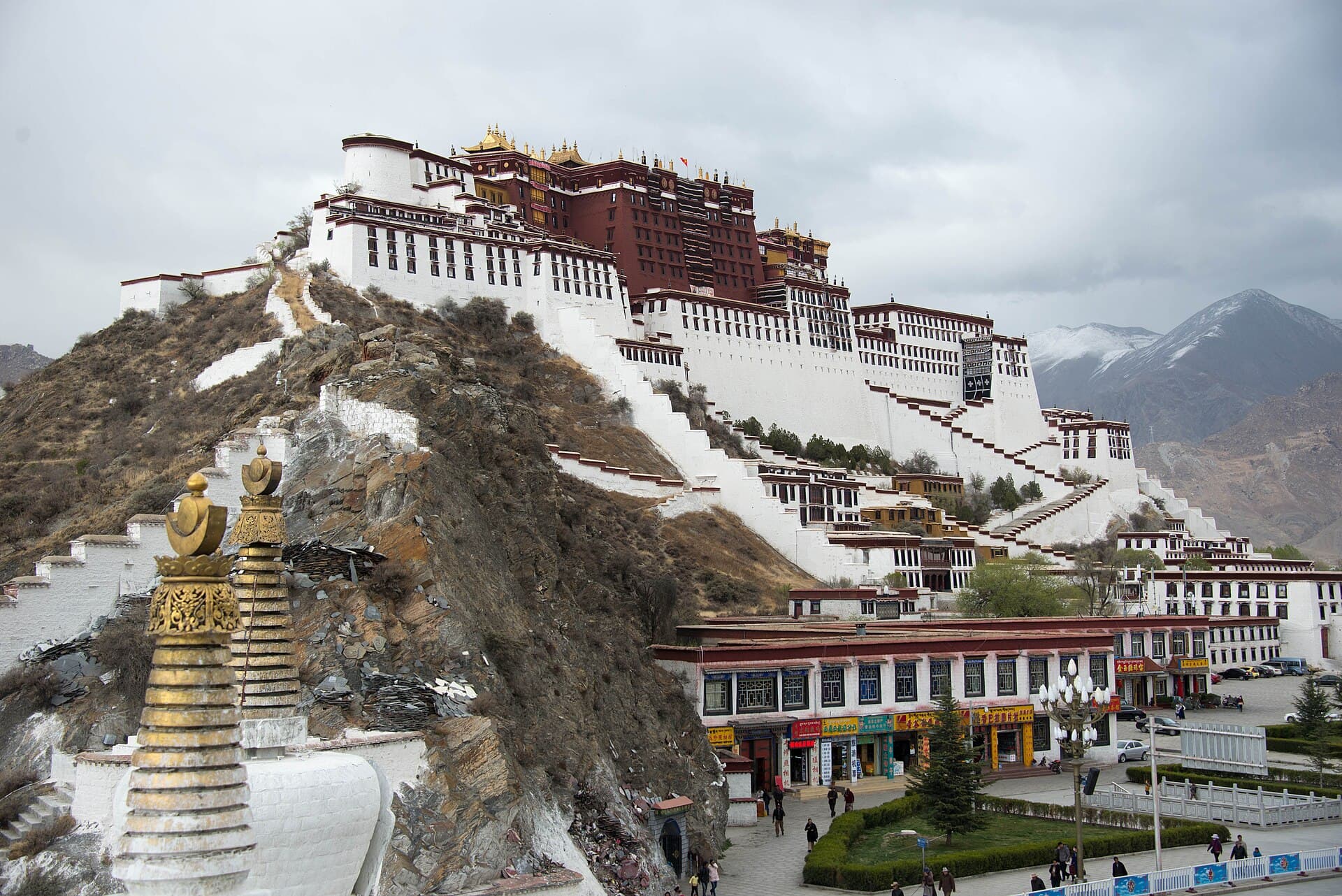
Lhasa. The Potala Palace stands on Red Mountain at about 3,700 metres, its present structure begun in 1645 for the 5th Dalai Lama on the site of a seventh-century fort, and it was the Dalai Lamas' winter residence until 1959. Below it the Jokhang, founded in the seventh century, remains the most venerated temple in Tibetan Buddhism, ringed by the Barkhor circuit pilgrims walk clockwise all day. Norbulingka, the summer palace, lies in gardens to the west, and Drepung, Sera and Ganden ring the valley.
Shigatse and Gyantse. Tashilhunpo, founded in 1447, has been the seat of the Panchen Lamas since the seventeenth century; at Gyantse the Kumbum of Palcho monastery, a stepped stupa of the 1420s, packs thousands of murals into its chapels.
Kumbum, Labrang and Derge. In Amdo, Kumbum was founded in 1583 at Tsongkhapa's birthplace and is the home of butter sculpture at its most elaborate; Labrang, founded in 1709 in Gansu, keeps one of the longest prayer-wheel corridors anywhere. In Kham, the Derge printing house of 1729 still prints scripture from carved woodblocks (Wikipedia).
The Yarlung kings unified the plateau in the seventh century, and under Songtsen Gampo the Tibetan Empire became a serious power in inner Asia. Buddhism arrived then and was established under Trisong Detsen, who founded Samye, the first monastery, around 779. The empire broke apart after 842, and monastic Buddhism was rebuilt from the tenth century in the period Tibetans call the later diffusion, when the schools took their present shape.
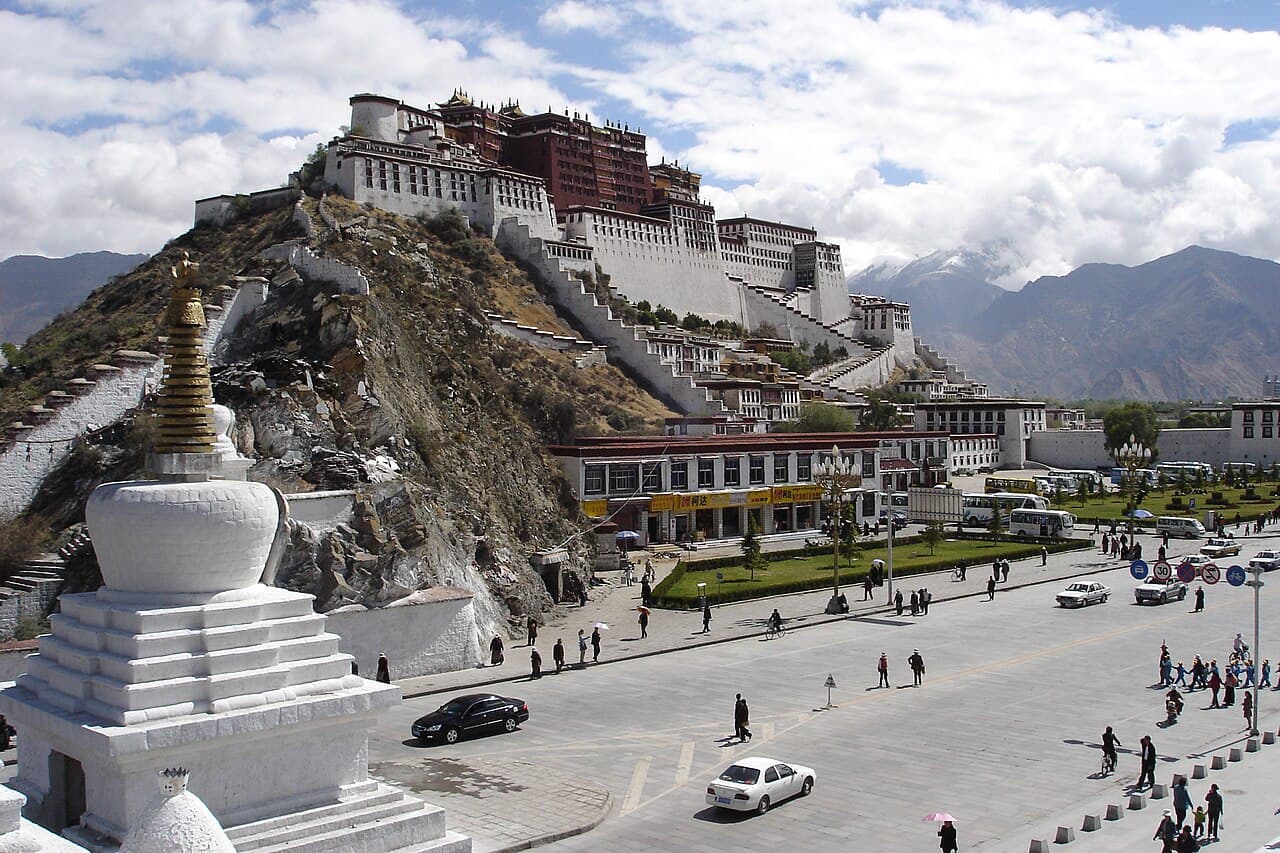 The Potala was the seat of the Dalai Lamas from the seventeenth century and holds the funerary stupas of eight of them. Photograph by Ondrej Zvacek, CC BY 2.5, via Wikimedia Commons.
Authority then moved among monastic houses and noble families. The Sakya hierarchs governed under Mongol patronage from the 1240s, an arrangement Tibetans describe as chö-yön, priest and patron. In 1642 the Mongol leader Gushri Khan installed the 5th Dalai Lama as ruler, founding the Ganden Phodrang government that lasted until 1959. Qing forces intervened in 1720, resident commissioners were posted from 1728, and in 1793 the Qianlong emperor introduced the golden urn. In 1913 the 13th Dalai Lama issued a proclamation his government treated as a declaration of independence, and Lhasa ran its own affairs until 1951.
The People's Liberation Army entered Chamdo in October 1950, and the Seventeen Point Agreement followed the next May. Protests in Lhasa on 10 March 1959 grew into a rising; Chinese forces shelled Norbulingka on 20 March, the Kashag was abolished, and the Dalai Lama, who had left the city on 17 March, reached India and was granted asylum. Casualty figures are disputed and should be read as a range: the Peace Research Institute Oslo gives about 10,000 Tibetan and 2,000 Chinese deaths, while the administration in exile has cited 85,000 to 87,000, from documents it says guerrillas captured and which the historian Warren W. Smith has argued was misread (Wikipedia). The autonomous region was established in 1965.
The Cultural Revolution then fell hardest on the monasteries. Tibetan exile institutions state that more than 6,000 monasteries and religious buildings were destroyed or left in ruins by 1976; scholars note that much of the destruction had begun after 1959 and that Tibetan Red Guards took part alongside Han ones. Reconstruction began after Hu Yaobang's visit to Lhasa in 1980.
Tibetan belongs to the Tibeto-Burman side of the Sino-Tibetan family, and what English calls Tibetan is really a group of related languages: the Ü-Tsang speech behind the Lhasa standard, Amdo, Kham, and the Ladakhi, Dzongkha and Sherpa varieties beyond the plateau. Speakers from Amdo and Lhasa often can't understand one another, and what holds them together is the written language, barely changed since the ninth century.
The script was created in the seventh century, traditionally by the minister Thonmi Sambhota at Songtsen Gampo's command, and modelled on an Indic alphabet descended from Brahmi; some scholars question whether Thonmi Sambhota existed, while agreeing on the derivation and the date. That script then carried one of the largest translation projects in world history: between the eighth and fourteenth centuries Tibetan translators, working with Indian scholars and to a vocabulary fixed in a royal glossary of 814, rendered the Indian Buddhist corpus into Tibetan. The result is a two-part canon, the Kangyur or translated word of the Buddha, roughly a hundred volumes, and the Tengyur or translated treatises, more than two hundred. Many Indian Buddhist works are now known only through these Tibetan versions, their Sanskrit originals lost.
The Tibetan name for the country is Bod; English Tibet arrived through Arabic and Turkic forms, and Lhasa means place of the gods.
Tibetan painting works to a strict discipline. A thangka is laid out on a grid of iconometric proportions before a line is drawn, its pigments ground from malachite, azurite and cinnabar, the cloth mounted in brocade. The painting and appliqué traditions of the Longwu valley in Qinghai were inscribed by UNESCO in 2009 as Regong arts (UNESCO). Butter sculpture is the seasonal counterpart, coloured yak butter worked by hand in cold water into figures shown at Monlam and then left to melt.
The Gesar epic is one of the longest living epic traditions anywhere. It tells of a hero sent down from heaven to subdue monsters and unite the tribes, and it's still sung by bards across Tibetan, Mongolian and Tu communities, some of whom describe their repertoire as received in dreams rather than learned. UNESCO inscribed it in 2009 along with Tibetan opera, the lhamo drama of song, dance, chant and masked performance that fills the Shoton festival in Lhasa (UNESCO).
Tsampa, barley roasted and ground to flour, is kneaded with butter tea in the bowl by hand and eaten across every region and class, so much so that tsampa eaters has served as a name Tibetans use for themselves.
Tibetan Buddhism runs in four schools that share a canon and differ in lineage and emphasis. Nyingma, the oldest, traces itself to Padmasambhava in the eighth century and to the terma, texts held to have been concealed and later rediscovered. Kagyu descends from Marpa, Milarepa and Gampopa, and its Karmapa line was the first identified as a chain of recognised reincarnations, the tulku system that later became general. Sakya was founded in 1073 by the Khon family, and Gelug by Tsongkhapa, whose school produced the Dalai and Panchen lines.
Bön is older and separate, and it's often left out of short accounts. Its followers trace it to the teacher Tonpa Shenrab and to Zhangzhung, the kingdom around Mount Kailash, and it keeps its own Kangyur and Tengyur alongside monasteries, iconography and a ritual calendar. Scholars argue about how much predates Buddhism and how much took shape in dialogue with it. The 14th Dalai Lama recognised Bön in 1979 as a distinct tradition with standing equal to the Buddhist schools, and its seat in exile is Menri monastery at Dolanji (Wikipedia).
Mount Kailash rises to 6,638 metres and has never been climbed. Buddhists, Hindus, Jains and Bönpo all hold it sacred, and pilgrims walk the 52-kilometre kora around its base, Bönpo anticlockwise and the others clockwise. Some make the circuit by prostration, lying full length, marking the spot with their fingers, standing, stepping to the mark and lying down again, turning a three-day walk into weeks.
Two succession disputes sit at the centre of religious life today. On 14 May 1995 the 14th Dalai Lama recognised the six-year-old Gedhun Choekyi Nyima as the 11th Panchen Lama; the boy and his family disappeared from public view three days later, and the Chinese government then selected Gyaincain Norbu by golden urn and has said that Gedhun Choekyi Nyima is a private citizen leading a normal life. The UN Committee on the Rights of the Child asked about him in 1996 and later sought an independent visit, which was not granted (Wikipedia). On 2 July 2025 the Dalai Lama stated that sole authority to recognise his successor rests with the Gaden Phodrang Trust (dalailama.com); China rejected that and maintains any successor must be found within China and approved by the state.
Tibetan practice treats dying as a passage with stages, and the family helps the person through it. The word is bardo, an intermediate state, and the text that describes it is the Bardo Thodol, meaning liberation through hearing in the intermediate state. Tradition attributes it to Padmasambhava in the eighth century, concealed and then revealed by the treasure-finder Karma Lingpa in the fourteenth; Walter Evans-Wentz published the first English version in 1927 as The Tibetan Book of the Dead (Wikipedia). It maps three stages: the clear light at the moment of death, the visionary phase, and the drift toward rebirth.
The period is forty-nine days, seven weeks of seven. Monks or a lama read to the dead through the early part of it, addressing the person by name and telling them what they're seeing and how to respond, while the family keeps butter lamps burning, gives alms and marks each seventh day. Skilled practitioners may perform phowa, the transference of consciousness, directing it out through the crown of the head at or just after death; many Tibetans learn the practice in life so it can be done for themselves.
Sky burial, jhator, is the ordinary funeral across much of the plateau, and it deserves a plain description. Most of Tibet lies above the tree line, so fuel for cremation is scarce, and the soil thaws only a few centimetres above permafrost, which makes digging a grave difficult. The body is carried to a designated site near a monastery, prepared there by specialists known as rogyapa, and given to the griffon and Himalayan vultures that gather. In Buddhist terms this is an act of generosity, the last the dead person can perform: the consciousness has gone, the body is an empty vessel, and offering it as food to living creatures earns merit and teaches impermanence to everyone present. Families do not usually attend, and photography at the sites is discouraged or forbidden. Cremation is used for high lamas and where wood allows, and water or ground burial in particular cases (Wikipedia).
The landscape holds the rest of the remembrance. Prayer flags are strung on passes, bridges and rooftops, often in a dead person's name, and left to fray, because the wind carrying the printed prayers away is the point of hanging them. Mani stones, slabs carved with om mani padme hum, are added to walls pilgrims pass on their left, and some run for hundreds of metres, built up one stone at a time over generations by people commemorating their dead. The remains of great teachers go into chörten, reliquary stupas, and the Red Palace of the Potala holds the gilded tombs of eight Dalai Lamas. For exile families the difficulty is distance: they often can't reach the ground where their parents were given to the birds.
Tibetan records are monastic and they were largely destroyed within living memory.
Monasteries were the archive. They held land deeds, tax registers, chronicles, and the biographies and reincarnation lineages that traced a tulku across lifetimes, which is a genealogy of a kind no other culture keeps. Aristocratic families kept their own histories, and the Ganden Phodrang government maintained tax and corvée registers naming households.
The destruction was near-total. Of the thousands of monasteries in Tibetan areas, the great majority were destroyed between 1959 and the end of the Cultural Revolution, and their libraries with them. What survived did so because it was hidden, buried, or carried into exile.
The exile archive is the substitute. The Library of Tibetan Works and Archives in Dharamsala, founded in 1970, has gathered manuscripts, oral histories and the testimony of refugees, and the Central Tibetan Administration maintains its own registration of the exile community, in India, Nepal, Bhutan and further afield, including the green book that records a person's contribution and identity.
Inside the Tibet Autonomous Region and the Tibetan areas of Qinghai, Sichuan and Gansu, the record is the Chinese hukou household registration, which is administrative and not open.
The sky burial, in which the body is given to vultures, means most Tibetan families have no grave to visit, so the record is the prayer, the name read at the monastery and the reincarnation line where there is one.
UNESCO inscribed the Potala Palace in 1994 as the Historic Ensemble of the Potala Palace, Lhasa, under criteria (i), (iv) and (vi), and extended the property twice, to take in the Jokhang Temple Monastery in 2000 and Norbulingka in 2001 (UNESCO). China has also secured intangible-heritage inscriptions for the Gesar epic tradition, Tibetan opera and Regong arts in 2009, and in 2018 for Lum medicinal bathing (UNESCO).
Monastery rebuilding from the early 1980s was carried out largely by local communities using their own labour and donations, and Chinese government figures put more than 1,700 sites of Tibetan Buddhist activity and around 46,000 monks and nuns in the autonomous region (State Council Information Office). Some later measures have been contested. From July 2016 authorities in Sêrtar county ordered Larung Gar reduced to 5,000 residents and about 1,500 dwellings demolished; they cited overcrowding, fire risk and social stability, and the European Parliament, the US State Department, UN human rights experts and Tibetan organisations objected (Wikipedia).
Language in education is the other live question. Tibetan is an official language of the autonomous region and Tibetan-medium primary schooling exists, but the balance with Chinese-medium instruction has been argued over for decades. On 6 February 2023 three UN special rapporteurs said they were alarmed that around a million Tibetan children were in a residential school system which, in their assessment, functioned as a large-scale assimilation programme; China rejected the characterisation (UN News). The shopkeeper Tashi Wangchuk, who appeared in a New York Times video in 2015 arguing for better Tibetan-language teaching, was detained in 2016, convicted of inciting separatism in May 2018 and released in January 2021 (Wikipedia).
Outside Tibet the exile institutions at Dharamsala have carried much of the load: the Tibetan Institute of Performing Arts from 1959, the Library of Tibetan Works and Archives from 1970, and the Norbulingka Institute for thangka painting.
The largest single project is the Buddhist Digital Resource Center, founded in 1999 by E. Gene Smith, who had spent decades in India gathering and reprinting books that left Tibet with the refugees. It has since scanned more than thirty million pages and holds around five million electronic texts, published openly and distributed on hard drives to monasteries with poor connectivity (BDRC). The language has moved online too: Tibetan has been in Unicode since 1996, has its own Wikipedia, and was among the 110 languages Google Translate added in June 2024 (Google).
The diaspora is small and widely spread. India holds the largest community, put at around 85,000 in 2019 and centred on Dharamsala and the southern settlements, with others in Nepal, Switzerland, the United States and Canada. Tibetan Buddhism has become a global religion, and the vocabulary of mandala, karma and bardo has entered ordinary English, sometimes accurately.
Tibetan-language cinema became a serious body of work through the director Pema Tseden, whose films from The Silent Holy Stones in 2005 to Balloon and Snow Leopard were made in Tibetan with Tibetan casts. Writers including Tsering Woeser and Tsering Yangzom Lama publish in Tibetan, Chinese and English, and momo shops and Losar mark out Tibetan neighbourhoods from Queens to Toronto.
A canon put online. The Buddhist Digital Resource Center has scanned more than thirty million pages of Tibetan literature, rebuilding a library that was scattered and in places lost.
A printing house that never stopped. Derge Parkhang in Kham has printed scripture from hand-carved woodblocks since 1729 and still works the same way.
Bön recognised in its own right. The pre-Buddhist tradition was acknowledged in 1979 as a distinct religion with equal standing, and rebuilt its principal monastery at Dolanji.
An epic still sung. The Gesar tradition was inscribed by UNESCO in 2009 as a living practice, with bards still performing across three peoples.
The Potala was the seat of the Dalai Lamas from the seventeenth century and holds the funerary stupas of eight of them. Photograph by Ondrej Zvacek, CC BY 2.5, via Wikimedia Commons.
Authority then moved among monastic houses and noble families. The Sakya hierarchs governed under Mongol patronage from the 1240s, an arrangement Tibetans describe as chö-yön, priest and patron. In 1642 the Mongol leader Gushri Khan installed the 5th Dalai Lama as ruler, founding the Ganden Phodrang government that lasted until 1959. Qing forces intervened in 1720, resident commissioners were posted from 1728, and in 1793 the Qianlong emperor introduced the golden urn. In 1913 the 13th Dalai Lama issued a proclamation his government treated as a declaration of independence, and Lhasa ran its own affairs until 1951.
The People's Liberation Army entered Chamdo in October 1950, and the Seventeen Point Agreement followed the next May. Protests in Lhasa on 10 March 1959 grew into a rising; Chinese forces shelled Norbulingka on 20 March, the Kashag was abolished, and the Dalai Lama, who had left the city on 17 March, reached India and was granted asylum. Casualty figures are disputed and should be read as a range: the Peace Research Institute Oslo gives about 10,000 Tibetan and 2,000 Chinese deaths, while the administration in exile has cited 85,000 to 87,000, from documents it says guerrillas captured and which the historian Warren W. Smith has argued was misread (Wikipedia). The autonomous region was established in 1965.
The Cultural Revolution then fell hardest on the monasteries. Tibetan exile institutions state that more than 6,000 monasteries and religious buildings were destroyed or left in ruins by 1976; scholars note that much of the destruction had begun after 1959 and that Tibetan Red Guards took part alongside Han ones. Reconstruction began after Hu Yaobang's visit to Lhasa in 1980.
Tibetan belongs to the Tibeto-Burman side of the Sino-Tibetan family, and what English calls Tibetan is really a group of related languages: the Ü-Tsang speech behind the Lhasa standard, Amdo, Kham, and the Ladakhi, Dzongkha and Sherpa varieties beyond the plateau. Speakers from Amdo and Lhasa often can't understand one another, and what holds them together is the written language, barely changed since the ninth century.
The script was created in the seventh century, traditionally by the minister Thonmi Sambhota at Songtsen Gampo's command, and modelled on an Indic alphabet descended from Brahmi; some scholars question whether Thonmi Sambhota existed, while agreeing on the derivation and the date. That script then carried one of the largest translation projects in world history: between the eighth and fourteenth centuries Tibetan translators, working with Indian scholars and to a vocabulary fixed in a royal glossary of 814, rendered the Indian Buddhist corpus into Tibetan. The result is a two-part canon, the Kangyur or translated word of the Buddha, roughly a hundred volumes, and the Tengyur or translated treatises, more than two hundred. Many Indian Buddhist works are now known only through these Tibetan versions, their Sanskrit originals lost.
The Tibetan name for the country is Bod; English Tibet arrived through Arabic and Turkic forms, and Lhasa means place of the gods.
Tibetan painting works to a strict discipline. A thangka is laid out on a grid of iconometric proportions before a line is drawn, its pigments ground from malachite, azurite and cinnabar, the cloth mounted in brocade. The painting and appliqué traditions of the Longwu valley in Qinghai were inscribed by UNESCO in 2009 as Regong arts (UNESCO). Butter sculpture is the seasonal counterpart, coloured yak butter worked by hand in cold water into figures shown at Monlam and then left to melt.
The Gesar epic is one of the longest living epic traditions anywhere. It tells of a hero sent down from heaven to subdue monsters and unite the tribes, and it's still sung by bards across Tibetan, Mongolian and Tu communities, some of whom describe their repertoire as received in dreams rather than learned. UNESCO inscribed it in 2009 along with Tibetan opera, the lhamo drama of song, dance, chant and masked performance that fills the Shoton festival in Lhasa (UNESCO).
Tsampa, barley roasted and ground to flour, is kneaded with butter tea in the bowl by hand and eaten across every region and class, so much so that tsampa eaters has served as a name Tibetans use for themselves.
Tibetan Buddhism runs in four schools that share a canon and differ in lineage and emphasis. Nyingma, the oldest, traces itself to Padmasambhava in the eighth century and to the terma, texts held to have been concealed and later rediscovered. Kagyu descends from Marpa, Milarepa and Gampopa, and its Karmapa line was the first identified as a chain of recognised reincarnations, the tulku system that later became general. Sakya was founded in 1073 by the Khon family, and Gelug by Tsongkhapa, whose school produced the Dalai and Panchen lines.
Bön is older and separate, and it's often left out of short accounts. Its followers trace it to the teacher Tonpa Shenrab and to Zhangzhung, the kingdom around Mount Kailash, and it keeps its own Kangyur and Tengyur alongside monasteries, iconography and a ritual calendar. Scholars argue about how much predates Buddhism and how much took shape in dialogue with it. The 14th Dalai Lama recognised Bön in 1979 as a distinct tradition with standing equal to the Buddhist schools, and its seat in exile is Menri monastery at Dolanji (Wikipedia).
Mount Kailash rises to 6,638 metres and has never been climbed. Buddhists, Hindus, Jains and Bönpo all hold it sacred, and pilgrims walk the 52-kilometre kora around its base, Bönpo anticlockwise and the others clockwise. Some make the circuit by prostration, lying full length, marking the spot with their fingers, standing, stepping to the mark and lying down again, turning a three-day walk into weeks.
Two succession disputes sit at the centre of religious life today. On 14 May 1995 the 14th Dalai Lama recognised the six-year-old Gedhun Choekyi Nyima as the 11th Panchen Lama; the boy and his family disappeared from public view three days later, and the Chinese government then selected Gyaincain Norbu by golden urn and has said that Gedhun Choekyi Nyima is a private citizen leading a normal life. The UN Committee on the Rights of the Child asked about him in 1996 and later sought an independent visit, which was not granted (Wikipedia). On 2 July 2025 the Dalai Lama stated that sole authority to recognise his successor rests with the Gaden Phodrang Trust (dalailama.com); China rejected that and maintains any successor must be found within China and approved by the state.
Tibetan practice treats dying as a passage with stages, and the family helps the person through it. The word is bardo, an intermediate state, and the text that describes it is the Bardo Thodol, meaning liberation through hearing in the intermediate state. Tradition attributes it to Padmasambhava in the eighth century, concealed and then revealed by the treasure-finder Karma Lingpa in the fourteenth; Walter Evans-Wentz published the first English version in 1927 as The Tibetan Book of the Dead (Wikipedia). It maps three stages: the clear light at the moment of death, the visionary phase, and the drift toward rebirth.
The period is forty-nine days, seven weeks of seven. Monks or a lama read to the dead through the early part of it, addressing the person by name and telling them what they're seeing and how to respond, while the family keeps butter lamps burning, gives alms and marks each seventh day. Skilled practitioners may perform phowa, the transference of consciousness, directing it out through the crown of the head at or just after death; many Tibetans learn the practice in life so it can be done for themselves.
Sky burial, jhator, is the ordinary funeral across much of the plateau, and it deserves a plain description. Most of Tibet lies above the tree line, so fuel for cremation is scarce, and the soil thaws only a few centimetres above permafrost, which makes digging a grave difficult. The body is carried to a designated site near a monastery, prepared there by specialists known as rogyapa, and given to the griffon and Himalayan vultures that gather. In Buddhist terms this is an act of generosity, the last the dead person can perform: the consciousness has gone, the body is an empty vessel, and offering it as food to living creatures earns merit and teaches impermanence to everyone present. Families do not usually attend, and photography at the sites is discouraged or forbidden. Cremation is used for high lamas and where wood allows, and water or ground burial in particular cases (Wikipedia).
The landscape holds the rest of the remembrance. Prayer flags are strung on passes, bridges and rooftops, often in a dead person's name, and left to fray, because the wind carrying the printed prayers away is the point of hanging them. Mani stones, slabs carved with om mani padme hum, are added to walls pilgrims pass on their left, and some run for hundreds of metres, built up one stone at a time over generations by people commemorating their dead. The remains of great teachers go into chörten, reliquary stupas, and the Red Palace of the Potala holds the gilded tombs of eight Dalai Lamas. For exile families the difficulty is distance: they often can't reach the ground where their parents were given to the birds.
Tibetan records are monastic and they were largely destroyed within living memory.
Monasteries were the archive. They held land deeds, tax registers, chronicles, and the biographies and reincarnation lineages that traced a tulku across lifetimes, which is a genealogy of a kind no other culture keeps. Aristocratic families kept their own histories, and the Ganden Phodrang government maintained tax and corvée registers naming households.
The destruction was near-total. Of the thousands of monasteries in Tibetan areas, the great majority were destroyed between 1959 and the end of the Cultural Revolution, and their libraries with them. What survived did so because it was hidden, buried, or carried into exile.
The exile archive is the substitute. The Library of Tibetan Works and Archives in Dharamsala, founded in 1970, has gathered manuscripts, oral histories and the testimony of refugees, and the Central Tibetan Administration maintains its own registration of the exile community, in India, Nepal, Bhutan and further afield, including the green book that records a person's contribution and identity.
Inside the Tibet Autonomous Region and the Tibetan areas of Qinghai, Sichuan and Gansu, the record is the Chinese hukou household registration, which is administrative and not open.
The sky burial, in which the body is given to vultures, means most Tibetan families have no grave to visit, so the record is the prayer, the name read at the monastery and the reincarnation line where there is one.
UNESCO inscribed the Potala Palace in 1994 as the Historic Ensemble of the Potala Palace, Lhasa, under criteria (i), (iv) and (vi), and extended the property twice, to take in the Jokhang Temple Monastery in 2000 and Norbulingka in 2001 (UNESCO). China has also secured intangible-heritage inscriptions for the Gesar epic tradition, Tibetan opera and Regong arts in 2009, and in 2018 for Lum medicinal bathing (UNESCO).
Monastery rebuilding from the early 1980s was carried out largely by local communities using their own labour and donations, and Chinese government figures put more than 1,700 sites of Tibetan Buddhist activity and around 46,000 monks and nuns in the autonomous region (State Council Information Office). Some later measures have been contested. From July 2016 authorities in Sêrtar county ordered Larung Gar reduced to 5,000 residents and about 1,500 dwellings demolished; they cited overcrowding, fire risk and social stability, and the European Parliament, the US State Department, UN human rights experts and Tibetan organisations objected (Wikipedia).
Language in education is the other live question. Tibetan is an official language of the autonomous region and Tibetan-medium primary schooling exists, but the balance with Chinese-medium instruction has been argued over for decades. On 6 February 2023 three UN special rapporteurs said they were alarmed that around a million Tibetan children were in a residential school system which, in their assessment, functioned as a large-scale assimilation programme; China rejected the characterisation (UN News). The shopkeeper Tashi Wangchuk, who appeared in a New York Times video in 2015 arguing for better Tibetan-language teaching, was detained in 2016, convicted of inciting separatism in May 2018 and released in January 2021 (Wikipedia).
Outside Tibet the exile institutions at Dharamsala have carried much of the load: the Tibetan Institute of Performing Arts from 1959, the Library of Tibetan Works and Archives from 1970, and the Norbulingka Institute for thangka painting.
The largest single project is the Buddhist Digital Resource Center, founded in 1999 by E. Gene Smith, who had spent decades in India gathering and reprinting books that left Tibet with the refugees. It has since scanned more than thirty million pages and holds around five million electronic texts, published openly and distributed on hard drives to monasteries with poor connectivity (BDRC). The language has moved online too: Tibetan has been in Unicode since 1996, has its own Wikipedia, and was among the 110 languages Google Translate added in June 2024 (Google).
The diaspora is small and widely spread. India holds the largest community, put at around 85,000 in 2019 and centred on Dharamsala and the southern settlements, with others in Nepal, Switzerland, the United States and Canada. Tibetan Buddhism has become a global religion, and the vocabulary of mandala, karma and bardo has entered ordinary English, sometimes accurately.
Tibetan-language cinema became a serious body of work through the director Pema Tseden, whose films from The Silent Holy Stones in 2005 to Balloon and Snow Leopard were made in Tibetan with Tibetan casts. Writers including Tsering Woeser and Tsering Yangzom Lama publish in Tibetan, Chinese and English, and momo shops and Losar mark out Tibetan neighbourhoods from Queens to Toronto.
A canon put online. The Buddhist Digital Resource Center has scanned more than thirty million pages of Tibetan literature, rebuilding a library that was scattered and in places lost.
A printing house that never stopped. Derge Parkhang in Kham has printed scripture from hand-carved woodblocks since 1729 and still works the same way.
Bön recognised in its own right. The pre-Buddhist tradition was acknowledged in 1979 as a distinct religion with equal standing, and rebuilt its principal monastery at Dolanji.
An epic still sung. The Gesar tradition was inscribed by UNESCO in 2009 as a living practice, with bards still performing across three peoples.
National Overview
Notable Cities
Historical Foundations
Linguistic and Etymological Roots
Cultural Identity
Religion and Spirituality
Remembrance and Mourning Traditions
Tracing a Family in Tibet
Heritage Preservation Efforts
Digital Heritage
Contemporary Cultural Influences
Success Stories
References and resources
- UNESCO, Historic Ensemble of the Potala Palace, Lhasa: inscribed 1994, extended 2000 and 2001.
- UNESCO: Gesar epic tradition, Tibetan opera, Regong arts (2009) and Lum medicinal bathing (2018).
- Seventeen Point Agreement and 1959 Tibetan uprising, Wikipedia: the competing positions and the casualty estimates.
- Gedhun Choekyi Nyima, Wikipedia and the Dalai Lama's succession statement.
- Bardo Thodol, Sky burial and Bon, Wikipedia.
- Buddhist Digital Resource Center, Tibetan and Himalayan Library and Derge Parkhang.
- Tibet Since 1951, State Council Information Office.
- UN News on the residential schools, Larung Gar and Tashi Wangchuk.
- Encyclopaedia Britannica, Tibet.