Culture · Essay
The Cold Food Festival: a fire ban kept for a man who refused a reward
For a day or three, no fire could be lit and everything was eaten cold, in penance for a duke who burned a forest down to flush out a loyal servant. On Jie Zitui, the festival Qingming absorbed, and where it still survives under another name.Written to last.
By Confinity Editorial · 2026-08-21 · 6-minute readQuiet tools, kept out of the way.
The story attached to this festival is one of the more uncomfortable in the Chinese repertoire, and the festival is an apology for it.
Chong'er, later Duke Wen of Jin, spent nineteen years in exile with a small group of retainers. During the worst of it, when the party was starving, one of them, Jie Zitui, is said to have cut flesh from his own thigh and cooked it so that his lord could eat.
When Chong'er eventually came into his inheritance, he rewarded the men who had gone with him and overlooked Jie Zitui. Jie made no complaint, took his mother, and went to live on a mountain.
Realising the omission, the duke went to fetch him. Jie would not come down. So the duke had the forest set alight on three sides, on the reasoning that a man will leave a burning wood. Jie Zitui did not. He and his mother were found dead at the foot of a tree.
In remorse, according to the tradition, the duke forbade the lighting of fires on the anniversary. Everybody would eat cold food, as Jie had not been able to eat at all.
Taken literally, the ban is severe. No fire means no cooking, no heating, no lamps: in a north Chinese spring, a genuinely cold day or, in some periods, three days or more.
Households therefore prepared in advance, making foods designed to be eaten cold, and the festival developed its own repertoire: cold noodles, barley gruel, sweet crisp fried pastries made beforehand and kept, spring vegetables. The hearth was put out at the appropriate moment and relit ceremonially afterwards, in some periods with new fire distributed from the court.
Han-dynasty officials complained about the practice as a health hazard and tried to restrict it more than once, which is a reliable indicator that it was widely kept.
Hanshi falls immediately before Qingming, and over centuries the two ran together.
The mechanism was practical. Both fell in the same week; both involved going out of the city; Hanshi had acquired grave-tending customs of its own, and Qingming had the outing, the kite-flying and the spring air. By the Tang dynasty the two were being treated as a single holiday period, and by the modern era the older name had largely gone, leaving Qingming as the tomb-sweeping day and the Cold Food Festival as an antiquarian note.
That is a specific and instructive kind of loss. Nothing was suppressed. No authority abolished it. It simply merged into the neighbouring festival, and the merged version kept the practices that were easier and dropped the one that was hard.
The observance persisted better outside China.
In Korea, Hansik remained one of the four principal annual holidays alongside Seollal, Dano and Chuseok. It falls 105 days after the winter solstice, and families visit the ancestral graves, tidy them, re-turf them where needed, and hold the rite at the graveside. The cold-food element survives in the name and, in places, in the food.
The Korean case is a familiar pattern: a Chinese observance retained in fuller form on the periphery than at the centre, after the centre had moved on.
A state-level festival commemorating a man who refused a reward is a strange thing to end up with.
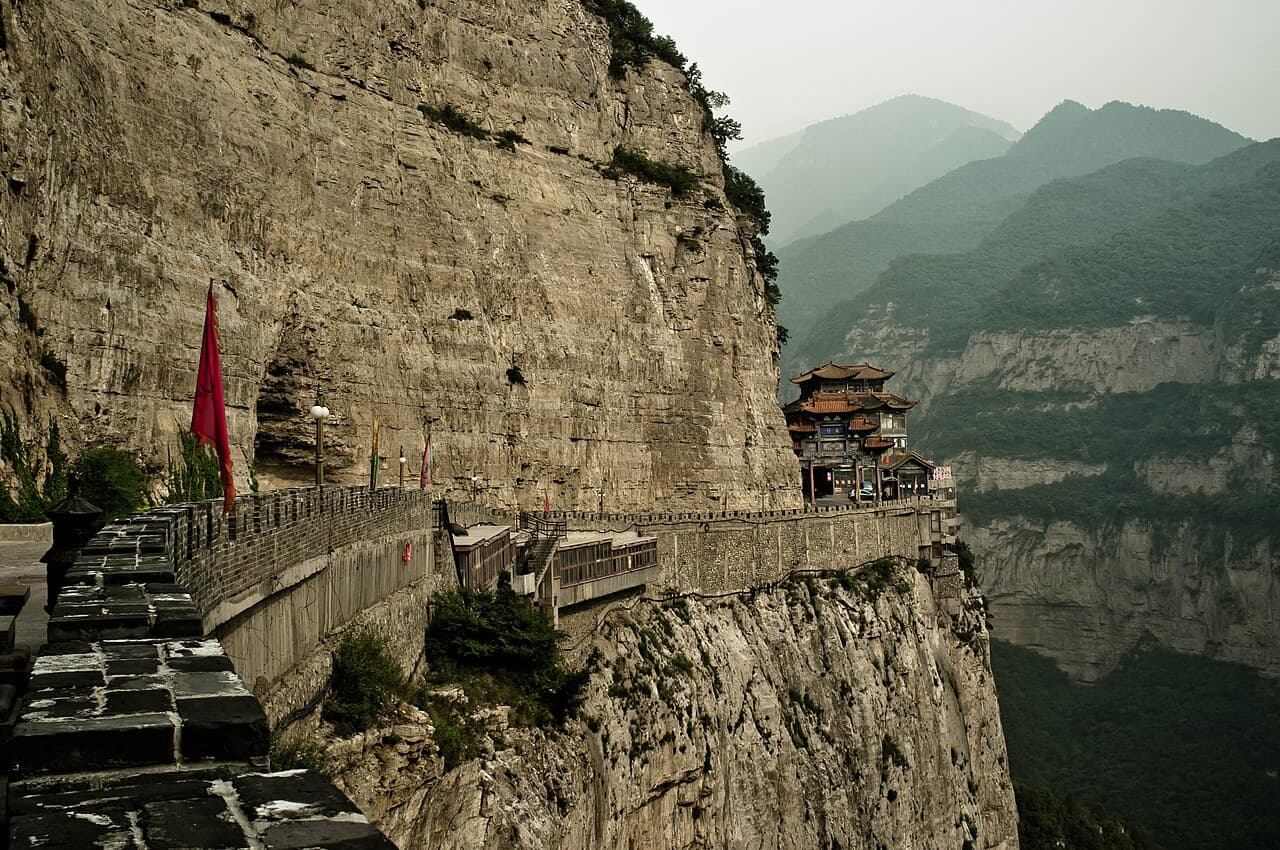 Mianshan in Shanxi, the mountain the tradition places the fire on. The site is now a park with temples to Jie Zitui on it. Photograph by Severin Stalder, CC BY-SA 3.0, via Wikimedia Commons.
Jie Zitui's virtue in the telling is not the thigh. It is that he asked for nothing afterwards and would not be persuaded to accept anything, and that his lord's attempt to compel his gratitude killed him. The moral runs against the grain of a court culture organised around patronage and preferment, and the festival institutionalised a permanent, annual, uncomfortable reminder aimed squarely at the powerful.
Later poets returned to it repeatedly, and Hanshi accumulated a body of verse about exile, loyalty and being overlooked, which is what a Chinese festival does when it has a good story attached.
Whether any of it happened is a separate question. Jie Zitui appears in the Zuo Zhuan without the fire, and the burning and the fire prohibition attach later. What the tradition does with him is more interesting than whether it is accurate.
The Cold Food Festival is a useful case because it shows the most common way a practice ends. Not persecution, not prohibition, not a generation deciding it no longer believes anything. Just adjacency: something similar and easier next door on the calendar, and a gradual transfer of the parts worth keeping.
The same process is running now on a domestic scale. Nobody decides to stop marking a grandparent's anniversary. It moves next to something else, gets folded into a family gathering that was happening anyway, and after two of those nobody is quite sure which date it was.
Mianshan in Shanxi, the mountain the tradition places the fire on. The site is now a park with temples to Jie Zitui on it. Photograph by Severin Stalder, CC BY-SA 3.0, via Wikimedia Commons.
Jie Zitui's virtue in the telling is not the thigh. It is that he asked for nothing afterwards and would not be persuaded to accept anything, and that his lord's attempt to compel his gratitude killed him. The moral runs against the grain of a court culture organised around patronage and preferment, and the festival institutionalised a permanent, annual, uncomfortable reminder aimed squarely at the powerful.
Later poets returned to it repeatedly, and Hanshi accumulated a body of verse about exile, loyalty and being overlooked, which is what a Chinese festival does when it has a good story attached.
Whether any of it happened is a separate question. Jie Zitui appears in the Zuo Zhuan without the fire, and the burning and the fire prohibition attach later. What the tradition does with him is more interesting than whether it is accurate.
The Cold Food Festival is a useful case because it shows the most common way a practice ends. Not persecution, not prohibition, not a generation deciding it no longer believes anything. Just adjacency: something similar and easier next door on the calendar, and a gradual transfer of the parts worth keeping.
The same process is running now on a domestic scale. Nobody decides to stop marking a grandparent's anniversary. It moves next to something else, gets folded into a family gathering that was happening anyway, and after two of those nobody is quite sure which date it was.
What the prohibition meant
How it disappeared into Qingming
Where it survived
What the story is actually about