Heritage · Museum
Rijksmuseum: Iconic Art, History & Exhibits
Rijksmuseum showcases a rich collection of artifacts, art, and cultural history. Explore exhibits, key highlights, and visitor information.Written to last.
By Confinity Heritage Editorial · Updated 2026-07-20 · 7-minute readQuiet tools, kept out of the way.
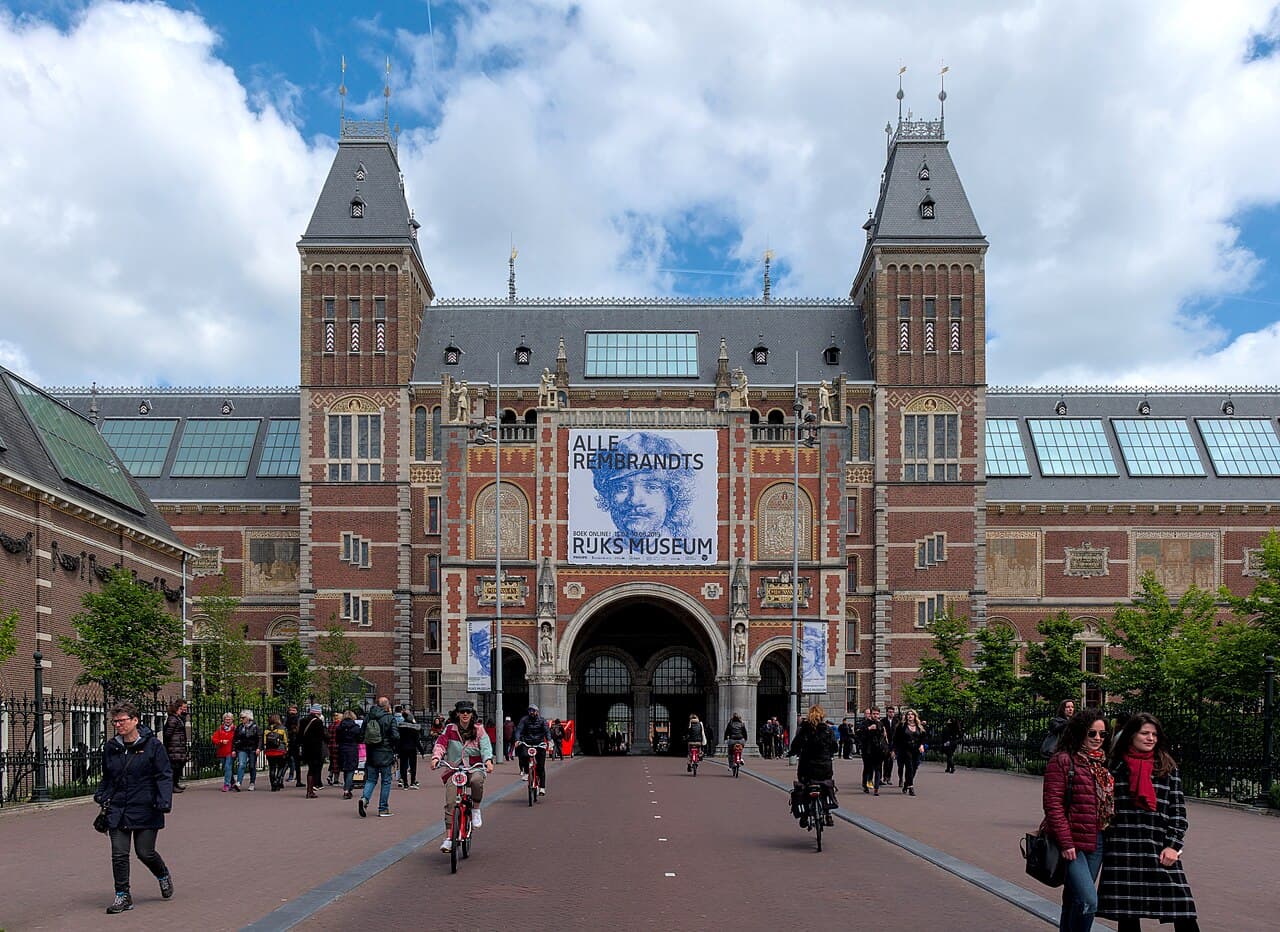
The Rijksmuseum is the national museum of the Netherlands, standing on Museumplein in Amsterdam with the country's foremost collection of art and history. Its galleries trace roughly eight centuries of Dutch life, from medieval devotional sculpture to twentieth-century design, with the Dutch Golden Age of the 1600s at their heart. The building itself, a brick-and-stone landmark by the architect Pierre Cuypers that opened in 1885, is part of the experience rather than a neutral container for it. At the far end of the museum's Gallery of Honour hangs Rembrandt's The Night Watch, the single work most closely tied to the institution and one of the most examined paintings anywhere. Around 2.7 million people visited in 2023, according to the museum's own year-end figures, making it the most-visited museum in the Netherlands.
The Rijksmuseum grew out of a decision taken in the young Batavian Republic. On 19 November 1798 the government resolved to establish a national museum along the French model then being set by the Louvre, and on 31 May 1800 the National Art Gallery (Nationale Kunstgalerij) opened its doors at Huis ten Bosch, a royal residence in The Hague. Amsterdam came later. Its first display gathered a little over 200 paintings and historical objects drawn from the collections of the former stadtholders and from national institutions, including holdings connected to the Dutch East India Company.
The move to Amsterdam came under French rule. In 1808 King Louis Napoleon, brother of Napoleon Bonaparte and installed as monarch of the Kingdom of Holland, ordered the collection transferred to his new capital. It was installed in the Royal Palace on the Dam, where the Royal Museum opened in 1809, and it absorbed important works owned by the city of Amsterdam, among them Rembrandt's The Night Watch. After the restoration of Dutch independence, King Willem I moved the collection in 1813 to the Trippenhuis, a grand seventeenth-century merchant's house on the Kloveniersburgwal canal, and the institution took the name by which it is still known: Rijksmuseum, literally the state, or national, museum.
The Trippenhuis was cramped and poorly suited to a growing national collection, and by the mid-1800s there were sustained calls for a purpose-built home. The decisive push came from Victor de Stuers, a lawyer and civil servant who in 1873 published a fierce essay, Holland op zijn smalst (roughly, "Holland at its narrowest"), in the journal De Gids, attacking the neglect of Dutch monuments and the poor condition of the national collections. The essay helped bring about a College of Royal Advisors on monuments and art in 1874, on which both de Stuers and Cuypers served, and the two men went on to shape the new museum together.
A design competition and years of debate followed before Pierre Cuypers, a Roman Catholic architect from Roermond already known for his church commissions, won the work. Construction began in 1876, and the new Rijksmuseum opened in 1885. The collection has expanded and been reorganised many times since, but the essential identity set in that era, a national museum of Dutch art and history in a monumental building near the edge of the old city, has held ever since. Today the museum is led by general director Taco Dibbits, who took the post in 2016.
The Rijksmuseum holds around one million objects and shows roughly 8,000 of them at any time, in galleries arranged broadly by period across a span running from about 1200 to 2000. The seventeenth century, the Dutch Golden Age, is the collection's centre of gravity, and the museum owns more than 2,000 paintings from that period alone.
The most concentrated stretch of masterpieces sits along the Gallery of Honour (Eregalerij), a long hall lined with works by Frans Hals, Jan Steen, Johannes Vermeer and Rembrandt van Rijn, ending at the room built for The Night Watch. The Rembrandt holdings extend well beyond that one canvas: they include The Jewish Bride, the group portrait known as The Syndics (the Sampling Officials of the Drapers' Guild), and several self-portraits that track the artist across his life.
The Vermeer group is small in number but exceptional in quality. The Rijksmuseum owns four of the fewer than forty paintings generally accepted as Vermeer's: The Milkmaid (about 1657–1658), The Little Street, The Love Letter and Woman Reading a Letter (also called Woman in Blue Reading a Letter). Together with the Mauritshuis in The Hague, this makes Amsterdam one of the two most important places in the world to see his work.
The collection is far more than a picture gallery. It covers Delftware, the blue-and-white earthenware for which the Dutch became known; furniture, silver and glass; arms and armour; costume; ship models and maritime instruments; and a large body of Asian art. The print room, the Rijksprentenkabinet, is one of the world's great collections of prints, drawings and photographs, holding hundreds of thousands of works on paper that are shown in rotation because light would fade them if they were on permanent display. Among the museum's best-known objects is the elaborately furnished dolls' house of Petronella Oortman, assembled around 1690 at a cost said to rival a real Amsterdam canal house, its miniature rooms fitted out by professional craftsmen. History galleries carry objects with sharper edges, too, such as the carved wooden coat of arms from the English flagship Royal Charles, seized by the Dutch fleet during the raid on the Medway in 1667.
The Asian art is shown in the Asian Pavilion, a separate building in the museum gardens designed by Cruz y Ortiz and opened with the 2013 reopening. Its holdings range across China, Japan, India, Indonesia, Vietnam and beyond, and cover several thousand years, from ancient bronzes and stone sculpture to lacquer, ceramics and screens. Because the pavilion stands apart from the main galleries, the works are arranged for their own sake rather than as a footnote to the Dutch story, though the trading networks that brought many Asian objects to the Netherlands are themselves part of that story. Elsewhere the special collections gather the everyday and the ceremonial side by side: model ships that once helped train shipwrights, cabinets of glass and silver, and the weaponry and dress of the Republic's militias and regents.
Cuypers designed the Rijksmuseum in a historicising style that fuses Gothic and Renaissance elements into something distinctly Dutch. Built largely of red brick with lighter stone dressings, the exterior carries towers, gables, sculpted figures, tiled tableaux and stained glass, and the interior was originally decorated with murals and rich colour rather than the white walls museums later favoured. Cuypers treated the building almost as a work of art in itself, a setting in which architecture, decoration and collection were meant to speak together.
 Cuypers gave the museum a form that looked to contemporaries like a cathedral, which in a Protestant country caused a row that lasted years. Photograph by Gerd Eichmann, CC BY-SA 4.0, via Wikimedia Commons.
Inside, the sequence of spaces was designed to build toward the collection's high point. Visitors pass through the vaulted Great Hall (Voorhal), whose stained-glass windows, mosaic floor and wall paintings present art, work and history as almost sacred subjects, with individual windows dedicated to Painting, Architecture and Sculpture. Beyond it runs the Gallery of Honour, and at its end, framed like an altarpiece, hangs The Night Watch. Much of this decoration had been painted over in the twentieth century, when tastes turned against Cuypers' ornament, and the reconstruction of his murals, floors and colour schemes was one of the central tasks of the most recent renovation.
Not everyone approved when the building first opened. Its Catholic and medieval flavour offended some Protestant sensibilities at the time, and King Willem III reportedly declined to enter what he is said to have dismissed as too much like a cloister or cathedral. That resistance faded, and the building is now protected as a national monument and counts among the most recognisable structures in Amsterdam. One of its most characteristic features is the vaulted passageway that runs straight through the centre of the building at ground level, open to the public and used by cyclists and pedestrians as a genuine city thoroughfare, a piece of Dutch urban integration rare among great museums.
The building's biggest transformation came in the twenty-first century. The museum closed in December 2003 for a renovation led by the Sevillian architects Antonio Cruz and Antonio Ortiz, whose plan stripped away decades of later partitions and additions to recover Cuypers' original spaces and decorative schemes while inserting modern climate control, a new entrance area beneath the central courtyards, and updated galleries. The project ran far longer and cost far more than first planned, partly because of a long dispute over the through-passage that ended with cyclists keeping their route. It reached completion at roughly €375 million, and the museum reopened on 13 April 2013, with Queen Beatrix performing the ceremony. A free-standing Asian Pavilion, also by Cruz y Ortiz, was added in the gardens as part of the work. Two years later, in 2015, the reborn museum was named European Museum of the Year by the European Museum Forum.
For the Netherlands the Rijksmuseum functions as a kind of national mirror. Its collection tells the country's story to itself and to visitors, and its central works have become shorthand for Dutch identity: Vermeer's quiet interiors, Hals's laughing sitters, and above all The Night Watch. The museum states its ambition plainly in its education work, aiming to reach every child in the Netherlands, and that reach was singled out by the jury when it awarded the museum its 2015 prize.
The Night Watch itself carries a large part of that meaning. Completed by Rembrandt in 1642, its full title is Militia Company of District II under the Command of Captain Frans Banninck Cocq, and at 363 by 437 centimetres it is a militia group portrait scaled and lit like history painting, the members caught mid-movement rather than posed in a neat row. The canvas has had a hard life. It was trimmed on all four sides in 1715 to fit a wall in Amsterdam's town hall, losing two figures at the left and part of its architecture, and it survived knife attacks in 1911 and 1975 and an acid attack in 1990.
Since 2019 the painting has been the subject of Operation Night Watch, described by the museum as the largest and most detailed research and conservation project ever devoted to it. The work is carried out in full view of visitors inside a purpose-built glass enclosure and streamed online, combining high-resolution imaging, scientific analysis of pigments and layers, and computer methods. In 2021 the research team used a seventeenth-century copy by Gerrit Lundens, together with a neural network, to reconstruct the strips cut away in 1715, temporarily restoring the picture's original composition for the public to see.
The museum's status also draws its most ambitious temporary exhibitions. In 2023 it staged a Vermeer retrospective that brought together 28 of the artist's paintings, the largest number ever assembled in one place, in a show that sold out its run and drew about 650,000 visitors, and which the museum called a once-in-a-lifetime event. The institution has also used its standing to confront harder parts of the national past. Its 2021 exhibition on slavery was the first major show the museum devoted to the subject, telling the history of Dutch involvement in slavery through the true stories of named individuals, from the enslaved to those who profited, and setting that history directly alongside the Golden Age art in the surrounding galleries. It was a deliberate move away from an uncomplicated celebration of national greatness and toward a fuller account of where the wealth of the period came from.
As the national museum, the Rijksmuseum is responsible not only for showing objects but for keeping them. Behind the galleries sit conservation studios and an art-history research library, the largest public library of its kind in the country, serving scholars from around the world. Continuing programmes of provenance research examine how objects entered the collection, including works looted during the Second World War and objects that arrived through the Dutch colonial system, and the museum has taken part in restitution of items whose ownership was found to be wrongful.
The Rijksmuseum has also become a reference point for open access to cultural heritage. Through its online platform Rijksstudio it has released high-resolution images of hundreds of thousands of works, around 700,000 by early 2021, free of copyright restrictions, so that anyone can study, download and reuse them without asking permission. The museum encourages that reuse rather than merely tolerating it, running an annual Rijksstudio Award that invites designers and makers to create new work from the digitised collection. Alongside this digital opening, the museum's Teekenschool (drawing school) and schools programmes carry the collection outward to children and teachers, part of the education mission for which it is regularly recognised.
Conservation runs through all of this. The same scientific work that keeps The Night Watch stable is applied across the collection, from panel paintings and prints to metalwork and textiles, and the findings feed back into what the public is told about the objects. Provenance and restitution work, meanwhile, treats an object's history of ownership as a matter of record rather than an embarrassment to be buried. Preservation here means both the physical care of fragile things and the wider effort to keep them honest, meaningful and available to the public rather than sealed away.
The Rijksmuseum sits at Museumstraat 1 on Museumplein, in the Museum Quarter of Amsterdam-Zuid. It anchors a compact cluster of institutions: the Van Gogh Museum and the Stedelijk Museum of modern and contemporary art are a few minutes' walk across the same square, and the Concertgebouw concert hall stands at its southern end. The nearest tram and public-transport stops carry the museum's own name, and the through-passage means visitors can walk beneath the building without a ticket.
Major temporary exhibitions, including the 2023 Vermeer show and the 2021 slavery exhibition, are staged in the Philips Wing and usually require a separate timed ticket on top of general admission. The museum gardens, laid out around the main building and dotted with architectural fragments and a rotating programme of sculpture, are free to enter and easy to overlook. The galleries are open daily, generally from 9:00 to 17:00, with timed-entry tickets that the museum recommends booking online in advance, particularly in summer and around major exhibitions when the Night Watch gallery draws crowds. Admission is free for visitors under 18; adult tickets are sold at published rates that are worth checking on the official site before a visit, since prices and opening details change. The building is fully accessible, with step-free entry, lifts to every floor and wheelchairs available to borrow. Early mornings and later afternoons are the quietest times, and it helps to see the best-known works first before moving on to the quieter rooms of Delftware, ship models, prints and Asian art that many visitors overlook.
Cuypers gave the museum a form that looked to contemporaries like a cathedral, which in a Protestant country caused a row that lasted years. Photograph by Gerd Eichmann, CC BY-SA 4.0, via Wikimedia Commons.
Inside, the sequence of spaces was designed to build toward the collection's high point. Visitors pass through the vaulted Great Hall (Voorhal), whose stained-glass windows, mosaic floor and wall paintings present art, work and history as almost sacred subjects, with individual windows dedicated to Painting, Architecture and Sculpture. Beyond it runs the Gallery of Honour, and at its end, framed like an altarpiece, hangs The Night Watch. Much of this decoration had been painted over in the twentieth century, when tastes turned against Cuypers' ornament, and the reconstruction of his murals, floors and colour schemes was one of the central tasks of the most recent renovation.
Not everyone approved when the building first opened. Its Catholic and medieval flavour offended some Protestant sensibilities at the time, and King Willem III reportedly declined to enter what he is said to have dismissed as too much like a cloister or cathedral. That resistance faded, and the building is now protected as a national monument and counts among the most recognisable structures in Amsterdam. One of its most characteristic features is the vaulted passageway that runs straight through the centre of the building at ground level, open to the public and used by cyclists and pedestrians as a genuine city thoroughfare, a piece of Dutch urban integration rare among great museums.
The building's biggest transformation came in the twenty-first century. The museum closed in December 2003 for a renovation led by the Sevillian architects Antonio Cruz and Antonio Ortiz, whose plan stripped away decades of later partitions and additions to recover Cuypers' original spaces and decorative schemes while inserting modern climate control, a new entrance area beneath the central courtyards, and updated galleries. The project ran far longer and cost far more than first planned, partly because of a long dispute over the through-passage that ended with cyclists keeping their route. It reached completion at roughly €375 million, and the museum reopened on 13 April 2013, with Queen Beatrix performing the ceremony. A free-standing Asian Pavilion, also by Cruz y Ortiz, was added in the gardens as part of the work. Two years later, in 2015, the reborn museum was named European Museum of the Year by the European Museum Forum.
For the Netherlands the Rijksmuseum functions as a kind of national mirror. Its collection tells the country's story to itself and to visitors, and its central works have become shorthand for Dutch identity: Vermeer's quiet interiors, Hals's laughing sitters, and above all The Night Watch. The museum states its ambition plainly in its education work, aiming to reach every child in the Netherlands, and that reach was singled out by the jury when it awarded the museum its 2015 prize.
The Night Watch itself carries a large part of that meaning. Completed by Rembrandt in 1642, its full title is Militia Company of District II under the Command of Captain Frans Banninck Cocq, and at 363 by 437 centimetres it is a militia group portrait scaled and lit like history painting, the members caught mid-movement rather than posed in a neat row. The canvas has had a hard life. It was trimmed on all four sides in 1715 to fit a wall in Amsterdam's town hall, losing two figures at the left and part of its architecture, and it survived knife attacks in 1911 and 1975 and an acid attack in 1990.
Since 2019 the painting has been the subject of Operation Night Watch, described by the museum as the largest and most detailed research and conservation project ever devoted to it. The work is carried out in full view of visitors inside a purpose-built glass enclosure and streamed online, combining high-resolution imaging, scientific analysis of pigments and layers, and computer methods. In 2021 the research team used a seventeenth-century copy by Gerrit Lundens, together with a neural network, to reconstruct the strips cut away in 1715, temporarily restoring the picture's original composition for the public to see.
The museum's status also draws its most ambitious temporary exhibitions. In 2023 it staged a Vermeer retrospective that brought together 28 of the artist's paintings, the largest number ever assembled in one place, in a show that sold out its run and drew about 650,000 visitors, and which the museum called a once-in-a-lifetime event. The institution has also used its standing to confront harder parts of the national past. Its 2021 exhibition on slavery was the first major show the museum devoted to the subject, telling the history of Dutch involvement in slavery through the true stories of named individuals, from the enslaved to those who profited, and setting that history directly alongside the Golden Age art in the surrounding galleries. It was a deliberate move away from an uncomplicated celebration of national greatness and toward a fuller account of where the wealth of the period came from.
As the national museum, the Rijksmuseum is responsible not only for showing objects but for keeping them. Behind the galleries sit conservation studios and an art-history research library, the largest public library of its kind in the country, serving scholars from around the world. Continuing programmes of provenance research examine how objects entered the collection, including works looted during the Second World War and objects that arrived through the Dutch colonial system, and the museum has taken part in restitution of items whose ownership was found to be wrongful.
The Rijksmuseum has also become a reference point for open access to cultural heritage. Through its online platform Rijksstudio it has released high-resolution images of hundreds of thousands of works, around 700,000 by early 2021, free of copyright restrictions, so that anyone can study, download and reuse them without asking permission. The museum encourages that reuse rather than merely tolerating it, running an annual Rijksstudio Award that invites designers and makers to create new work from the digitised collection. Alongside this digital opening, the museum's Teekenschool (drawing school) and schools programmes carry the collection outward to children and teachers, part of the education mission for which it is regularly recognised.
Conservation runs through all of this. The same scientific work that keeps The Night Watch stable is applied across the collection, from panel paintings and prints to metalwork and textiles, and the findings feed back into what the public is told about the objects. Provenance and restitution work, meanwhile, treats an object's history of ownership as a matter of record rather than an embarrassment to be buried. Preservation here means both the physical care of fragile things and the wider effort to keep them honest, meaningful and available to the public rather than sealed away.
The Rijksmuseum sits at Museumstraat 1 on Museumplein, in the Museum Quarter of Amsterdam-Zuid. It anchors a compact cluster of institutions: the Van Gogh Museum and the Stedelijk Museum of modern and contemporary art are a few minutes' walk across the same square, and the Concertgebouw concert hall stands at its southern end. The nearest tram and public-transport stops carry the museum's own name, and the through-passage means visitors can walk beneath the building without a ticket.
Major temporary exhibitions, including the 2023 Vermeer show and the 2021 slavery exhibition, are staged in the Philips Wing and usually require a separate timed ticket on top of general admission. The museum gardens, laid out around the main building and dotted with architectural fragments and a rotating programme of sculpture, are free to enter and easy to overlook. The galleries are open daily, generally from 9:00 to 17:00, with timed-entry tickets that the museum recommends booking online in advance, particularly in summer and around major exhibitions when the Night Watch gallery draws crowds. Admission is free for visitors under 18; adult tickets are sold at published rates that are worth checking on the official site before a visit, since prices and opening details change. The building is fully accessible, with step-free entry, lifts to every floor and wheelchairs available to borrow. Early mornings and later afternoons are the quietest times, and it helps to see the best-known works first before moving on to the quieter rooms of Delftware, ship models, prints and Asian art that many visitors overlook.
History and founding
The collection
The building