Heritage · Museum
The Smithsonian Institution: History and Visitor Guide
Founded in 1846 with the bequest of British scientist James Smithson, the Smithsonian in Washington, D.C. is the world's largest museum and research complex.Written to last.
By Confinity Heritage Editorial · Updated 2026-07-31 · 7-minute readQuiet tools, kept out of the way.
The Smithsonian Institution is the largest museum, education, and research complex in the world. Based in Washington, D.C., it counts 21 museums along with the National Zoo and a network of research centers, and almost all of them admit visitors free of charge. The whole enterprise traces back to one improbable gift: the fortune of a British scientist, James Smithson, who left his estate to a country he had never seen.
James Smithson (1765–1829) was an English chemist and mineralogist, the illegitimate son of the first Duke of Northumberland and elected to the Royal Society in his twenties. He never crossed the Atlantic, and he appears to have left no letters explaining his motives, yet his will directed that if his nephew died without heirs, the estate should pass to the United States to found in Washington, under his name, "an establishment for the increase and diffusion of knowledge" (Smithsonian). The nephew died childless in 1835, and the bequest crossed to a young republic that had no settled idea of what to do with it.
Congress accepted the gift after debate, and in 1838 the diplomat Richard Rush returned from Britain with the fortune converted into gold sovereigns, packed in sacks and worth roughly 500,000 dollars at the time, a sum reckoned at about 508,000 dollars once deposited (Britannica). Lawmakers then spent another decade debating what form the institution should take. President James K. Polk settled the matter by signing the founding Act of Congress on August 10, 1846 (Smithsonian).
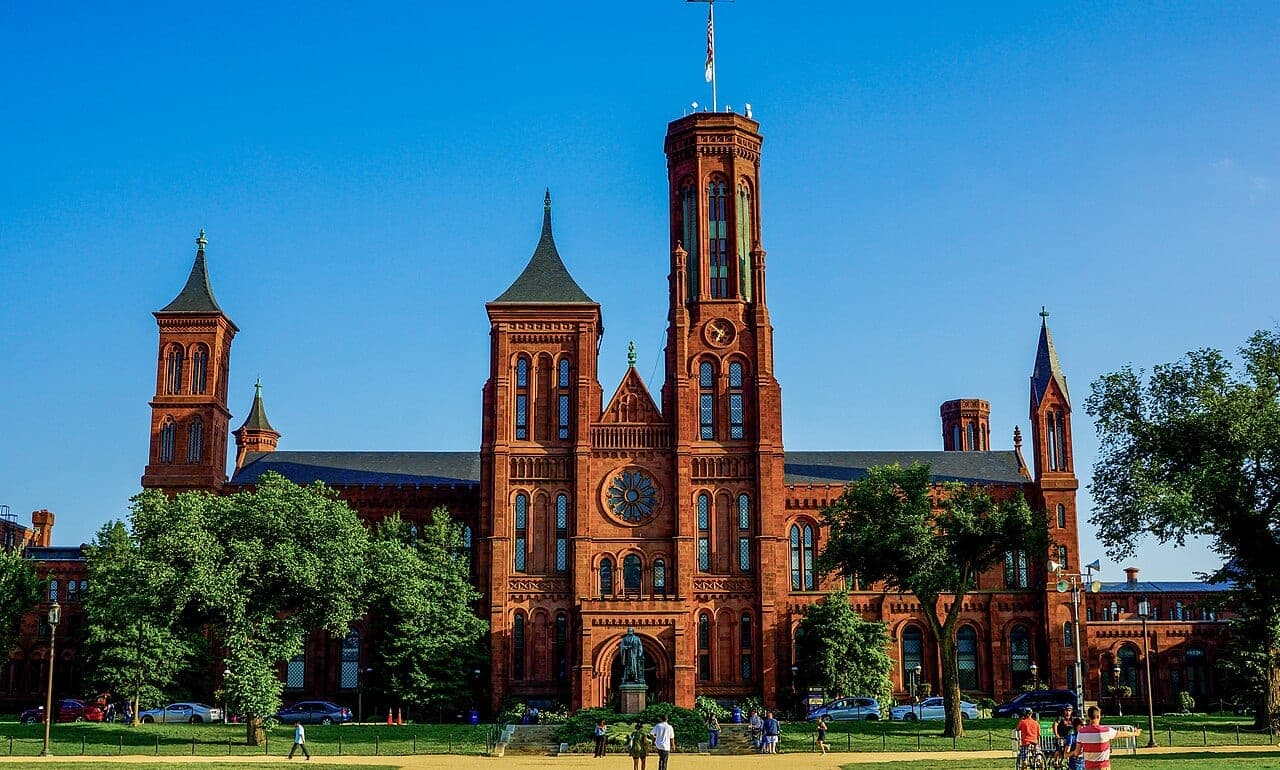
The Institution's first home, a red sandstone building in the Gothic and Romanesque Revival style now known simply as the Castle, was begun in 1849 and completed in 1855 to a design by James Renwick Jr. It still anchors the National Mall and holds the Smithsonian's administrative offices and main visitor center. From that single building the organization expanded steadily, absorbing national collections and adding museum after museum until it became the complex of today (Wikipedia).
The Smithsonian's museums are concentrated on and around the National Mall, with several others elsewhere in Washington and two in New York City. The National Air and Space Museum is among the most visited museums on earth, displaying the Wright brothers' 1903 Flyer, the Spirit of St. Louis, and the Apollo 11 command module. The National Museum of Natural History holds the Hope Diamond and its dinosaur halls alongside the bulk of the Institution's scientific specimens. The National Museum of American History keeps the original Star-Spangled Banner and the ruby slippers from the 1939 film of The Wizard of Oz.
 The Castle was the whole Smithsonian in 1855: museum, laboratory, library and the Secretary's family home. James Smithson's remains are in a crypt by the north door. Photograph by AgnosticPreachersKid, CC BY-SA 4.0, via Wikimedia Commons.
Newer additions have widened the story the Smithsonian tells. The National Museum of African American History and Culture opened on the Mall in 2016 and quickly became one of its busiest. The National Portrait Gallery, the Smithsonian American Art Museum, the Hirshhorn Museum for modern and contemporary art, the National Museum of the American Indian, and the National Museum of Asian Art (the Freer and Sackler galleries) each carry a distinct focus. Two further museums, devoted to the American Latino experience and to American women's history, have been authorized by Congress and are in development. Published counts vary between 19 and 21 depending on whether these and certain galleries are included.
Behind the public galleries lies a collection of remarkable size. The Smithsonian holds more than 155 million objects, artworks, and specimens, though figures range from roughly 154 to 157 million as the count grows and is tallied differently (Smithsonian facts). The overwhelming majority, on the order of 148 million items, belongs to the National Museum of Natural History and consists of biological, geological, and anthropological specimens rather than display pieces.
The Institution is also a research body in its own right. It operates a network of research centers, variously counted at nine or more than a dozen depending on the source, including the Smithsonian Astrophysical Observatory, the Smithsonian Tropical Research Institute in Panama, the Smithsonian Environmental Research Center, and the Conservation Biology Institute tied to the National Zoo. Its scientists study everything from distant galaxies to coral reefs, and much of the collection functions as a working archive for scholars worldwide rather than as exhibition material.
Americans often call the Smithsonian "the nation's attic", the place where the country keeps the objects it cannot bring itself to discard, from presidential portraits to spacecraft (Britannica). The nickname captures both the breadth of the holdings and the sense that they belong collectively to the public. Free admission is central to that idea. Almost all of the Smithsonian's roughly 30 million annual visits cost nothing, the main exception being the Cooper Hewitt design museum in New York. Funded largely by the federal government and by private gifts, the Institution treats access to knowledge as a public good, an aim written into Smithson's original phrase about the increase and diffusion of knowledge.
Most Smithsonian museums cluster along the National Mall between the Capitol and the Washington Monument, within walking distance of one another, and the Castle serves as a natural first stop for orientation and maps. Entry to the museums and the National Zoo is free, and no ticket is required for general admission, though a few popular sites use timed passes at peak periods and some special exhibitions are ticketed. Hours are generally daily from mid-morning, with closures on some holidays, so checking the official site before a visit is wise.
The Mall museums are reachable by the Washington Metro, with stops such as Smithsonian and L'Enfant Plaza nearby, and the buildings are designed for step-free access. Because no single visit can cover everything, most people choose a few museums rather than attempting the whole complex in a day. The National Zoo lies a short distance north in the Woodley Park area, and the two New York sites, Cooper Hewitt and the George Gustav Heye Center of the National Museum of the American Indian, extend the Smithsonian's reach beyond the capital.
The Castle was the whole Smithsonian in 1855: museum, laboratory, library and the Secretary's family home. James Smithson's remains are in a crypt by the north door. Photograph by AgnosticPreachersKid, CC BY-SA 4.0, via Wikimedia Commons.
Newer additions have widened the story the Smithsonian tells. The National Museum of African American History and Culture opened on the Mall in 2016 and quickly became one of its busiest. The National Portrait Gallery, the Smithsonian American Art Museum, the Hirshhorn Museum for modern and contemporary art, the National Museum of the American Indian, and the National Museum of Asian Art (the Freer and Sackler galleries) each carry a distinct focus. Two further museums, devoted to the American Latino experience and to American women's history, have been authorized by Congress and are in development. Published counts vary between 19 and 21 depending on whether these and certain galleries are included.
Behind the public galleries lies a collection of remarkable size. The Smithsonian holds more than 155 million objects, artworks, and specimens, though figures range from roughly 154 to 157 million as the count grows and is tallied differently (Smithsonian facts). The overwhelming majority, on the order of 148 million items, belongs to the National Museum of Natural History and consists of biological, geological, and anthropological specimens rather than display pieces.
The Institution is also a research body in its own right. It operates a network of research centers, variously counted at nine or more than a dozen depending on the source, including the Smithsonian Astrophysical Observatory, the Smithsonian Tropical Research Institute in Panama, the Smithsonian Environmental Research Center, and the Conservation Biology Institute tied to the National Zoo. Its scientists study everything from distant galaxies to coral reefs, and much of the collection functions as a working archive for scholars worldwide rather than as exhibition material.
Americans often call the Smithsonian "the nation's attic", the place where the country keeps the objects it cannot bring itself to discard, from presidential portraits to spacecraft (Britannica). The nickname captures both the breadth of the holdings and the sense that they belong collectively to the public. Free admission is central to that idea. Almost all of the Smithsonian's roughly 30 million annual visits cost nothing, the main exception being the Cooper Hewitt design museum in New York. Funded largely by the federal government and by private gifts, the Institution treats access to knowledge as a public good, an aim written into Smithson's original phrase about the increase and diffusion of knowledge.
Most Smithsonian museums cluster along the National Mall between the Capitol and the Washington Monument, within walking distance of one another, and the Castle serves as a natural first stop for orientation and maps. Entry to the museums and the National Zoo is free, and no ticket is required for general admission, though a few popular sites use timed passes at peak periods and some special exhibitions are ticketed. Hours are generally daily from mid-morning, with closures on some holidays, so checking the official site before a visit is wise.
The Mall museums are reachable by the Washington Metro, with stops such as Smithsonian and L'Enfant Plaza nearby, and the buildings are designed for step-free access. Because no single visit can cover everything, most people choose a few museums rather than attempting the whole complex in a day. The National Zoo lies a short distance north in the Woodley Park area, and the two New York sites, Cooper Hewitt and the George Gustav Heye Center of the National Museum of the American Indian, extend the Smithsonian's reach beyond the capital.
History
The museums
Research and collections
Cultural role
Visiting
References and resources
- Encyclopaedia Britannica: Smithsonian Institution: overview of the Institution's founding, museums, and role as the nation's attic.
- Smithsonian Institution (official): visitor information, museum listings, and current hours.
- Smithsonian: facts about the Institution: official counts of museums, research centers, and collection size.
- Smithsonian: Our History: the Smithson bequest and the 1846 founding Act of Congress.
- Wikipedia: Smithsonian Institution: detailed history, museum list, and collection figures with sources.