Heritage · Country
Netherlands Culture and Heritage
Since 1945, every one of the more than eight thousand American war dead buried at Margraten has been adopted by a Dutch family who tends the grave and keeps in touch with the soldier's relatives across the Atlantic. A guide to the Netherlands' heritage and to how the Dutch, a people who built their country out of the sea, remember and mourn.Written to last.
By Confinity Heritage Editorial · 2026-07-11 · 8-minute readQuiet tools, kept out of the way.
At the Netherlands American Cemetery near the village of Margraten, in the far south of the country, more than eight thousand American soldiers who died liberating the Dutch in 1944 and 1945 lie beneath white marble crosses and Stars of David. What makes the place unusual is not the graves but who visits them. In the first months after liberation, local people began adopting the graves, one family taking responsibility for one dead soldier, laying flowers, marking his birthday, and writing to his mother or widow in America. By the second post-war Memorial Day in 1946 every grave had been adopted, and the practice never stopped: today there is a waiting list of hundreds of Dutch families hoping for the honour, and the tradition was entered on the national inventory of intangible heritage in 2017.
That a small nation should keep faith so stubbornly with its dead, and with other people's dead, is of a piece with everything else about the Netherlands. This is a country that had to be made, most of it pumped and diked out of the sea and the river deltas, defended for a thousand years by water boards that are among the oldest democratic institutions in Europe. A people who built their own land, who lost three-quarters of their Jewish population in the Holocaust, and who stop dead in the street for two minutes every 4 May, have a relationship to memory that is worth following closely. This profile traces the heritage of the Netherlands and the ways the Dutch record, preserve and mourn.
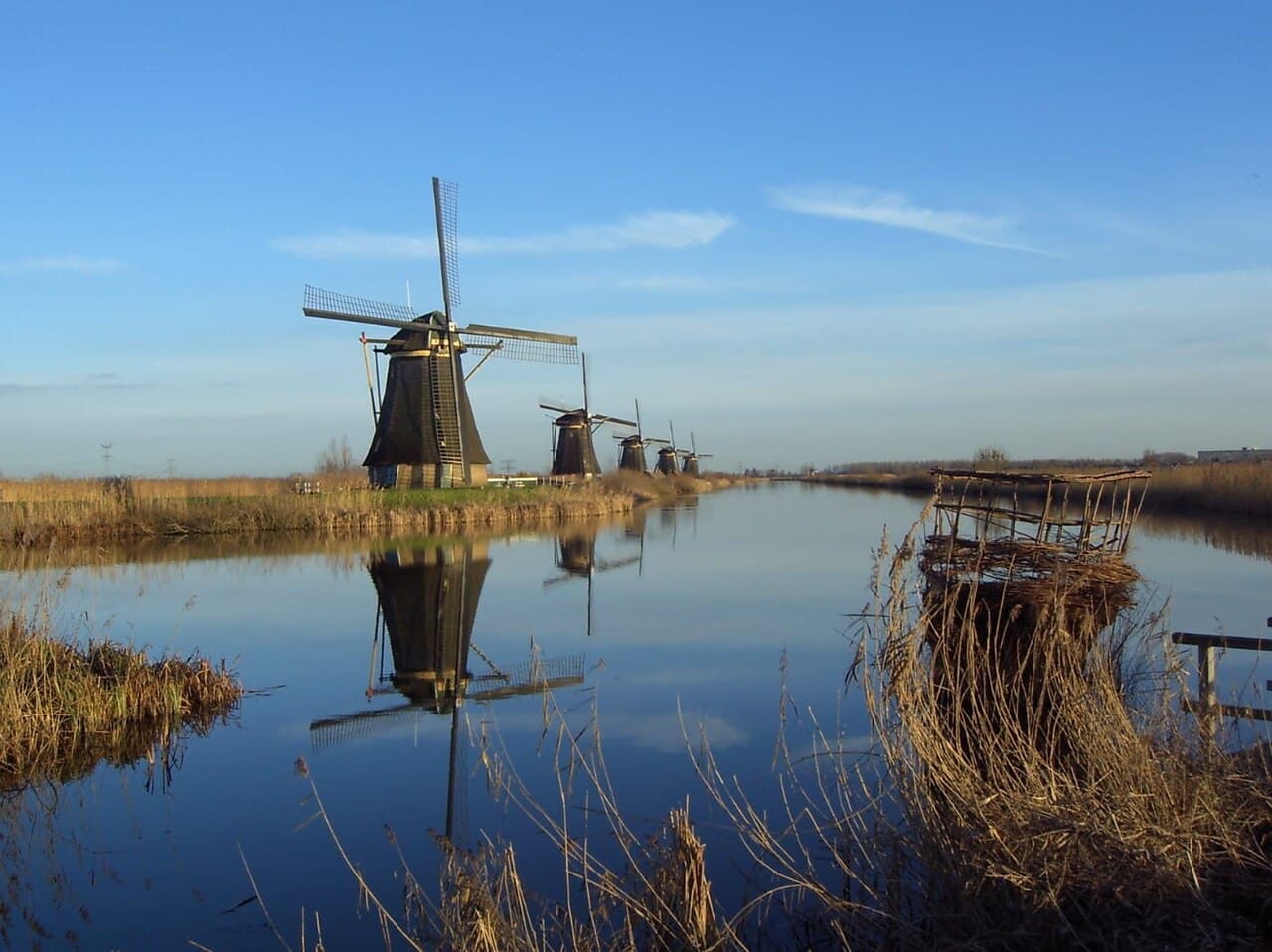
 The windmills of Kinderdijk, built around 1740 to drain the polder and a UNESCO World Heritage Site. CC0, via Wikimedia Commons.
The Netherlands is a small, flat and crowded country at the mouth of three great rivers, the Rhine, the Meuse and the Scheldt, where they empty into the North Sea. It covers about 41,500 square kilometres, and roughly a quarter of that lies below sea level, protected by a vast engineered system of dikes, dunes, pumping stations and storm barriers; the name itself means "the low countries". With nearly eighteen million people it is one of the most densely populated nations on earth, its cities strung together in the horseshoe-shaped conurbation of the Randstad, which links Amsterdam, Rotterdam, The Hague and Utrecht. Despite its size it is one of the world's largest exporters of agricultural produce, a feat of intensive, high-technology farming on reclaimed land.
The Kingdom of the Netherlands is a constitutional monarchy under King Willem-Alexander, who acceded in 2013, with a parliamentary democracy centred on the States General. Its constitutional arrangements are famously peculiar: Amsterdam is the capital named in the constitution, but the government, parliament, supreme court and royal working palace all sit in The Hague, which is also home to the International Court of Justice. The kingdom includes several islands in the Caribbean. Dutch society has long prided itself on tolerance, consensus-seeking, or the "polder model" of negotiated compromise, and a pragmatic liberalism that made it the first country to legalise same-sex marriage in 2001, though immigration and integration have become as contested here as anywhere in Europe.
Amsterdam. The capital grew from a thirteenth-century dam on the river Amstel into the commercial heart of the seventeenth-century world. Its concentric ring of canals, the Grachtengordel, dug in the Golden Age and now a UNESCO World Heritage Site, is lined with the tall gabled merchant houses that financed a global trading empire. The city holds the Rijksmuseum with Rembrandt's Night Watch, the Van Gogh Museum, the Anne Frank House on the Prinsengracht, and, since 2021, the National Holocaust Names Memorial.
The windmills of Kinderdijk, built around 1740 to drain the polder and a UNESCO World Heritage Site. CC0, via Wikimedia Commons.
The Netherlands is a small, flat and crowded country at the mouth of three great rivers, the Rhine, the Meuse and the Scheldt, where they empty into the North Sea. It covers about 41,500 square kilometres, and roughly a quarter of that lies below sea level, protected by a vast engineered system of dikes, dunes, pumping stations and storm barriers; the name itself means "the low countries". With nearly eighteen million people it is one of the most densely populated nations on earth, its cities strung together in the horseshoe-shaped conurbation of the Randstad, which links Amsterdam, Rotterdam, The Hague and Utrecht. Despite its size it is one of the world's largest exporters of agricultural produce, a feat of intensive, high-technology farming on reclaimed land.
The Kingdom of the Netherlands is a constitutional monarchy under King Willem-Alexander, who acceded in 2013, with a parliamentary democracy centred on the States General. Its constitutional arrangements are famously peculiar: Amsterdam is the capital named in the constitution, but the government, parliament, supreme court and royal working palace all sit in The Hague, which is also home to the International Court of Justice. The kingdom includes several islands in the Caribbean. Dutch society has long prided itself on tolerance, consensus-seeking, or the "polder model" of negotiated compromise, and a pragmatic liberalism that made it the first country to legalise same-sex marriage in 2001, though immigration and integration have become as contested here as anywhere in Europe.
Amsterdam. The capital grew from a thirteenth-century dam on the river Amstel into the commercial heart of the seventeenth-century world. Its concentric ring of canals, the Grachtengordel, dug in the Golden Age and now a UNESCO World Heritage Site, is lined with the tall gabled merchant houses that financed a global trading empire. The city holds the Rijksmuseum with Rembrandt's Night Watch, the Van Gogh Museum, the Anne Frank House on the Prinsengracht, and, since 2021, the National Holocaust Names Memorial.
 A brick bridge over the Reguliersgracht in central Amsterdam, part of the Golden Age canal ring. CC0, via Wikimedia Commons.
Rotterdam. The largest port in Europe was almost entirely destroyed by German bombing in May 1940, and rather than rebuild in replica it embraced bold modern architecture, so that today it has the most striking skyline in the country. A single surviving fragment, the burned-out heart of the old city, is marked by Ossip Zadkine's anguished statue "The Destroyed City", one of the great war memorials of the continent.
The Hague. The seat of government and the royal court, and the world's "city of peace and justice", home to the Peace Palace, the International Court of Justice and the International Criminal Court. Its Mauritshuis gallery holds Vermeer's "Girl with a Pearl Earring", and the nearby seaside resort of Scheveningen keeps its own maritime traditions.
Delft. A perfectly preserved small canal city, Delft is bound up with two of the country's icons: the blue-and-white pottery that carries its name, and William of Orange, the founder of the Dutch state, who was assassinated here in 1584 and whose tomb in the Nieuwe Kerk became the burial vault of the House of Orange. The painter Johannes Vermeer lived and worked in Delft his whole life.
Utrecht. The old ecclesiastical capital, seat of the medieval bishops who once ruled much of the northern Netherlands, is crowned by the Dom Tower, at 112 metres the tallest church tower in the country, standing apart from its cathedral since a storm destroyed the nave in 1674.
Maastricht. In the far south, close to Belgium and Germany, Maastricht is one of the oldest cities in the country, with Roman origins and a Catholic character quite unlike the Protestant north. It gave its name to the 1992 treaty that created the European Union.
The Romans held the southern Netherlands as the frontier of empire along the Rhine, a border now recognised as a World Heritage Site, while the northern coast was the land of the Frisians. In the Middle Ages the region was a patchwork of counties, duchies and prince-bishoprics, gradually gathered under the Dukes of Burgundy and then the Habsburgs. It grew rich on trade, cloth and herring, and its cities won a degree of self-government unusual in feudal Europe. The decisive rupture came in the later sixteenth century, when the Protestant provinces of the north rose against their Catholic Habsburg overlord, Philip II of Spain, in the Eighty Years' War that began in 1568. Led by William of Orange, the rebels declared independence, and though William was murdered in Delft in 1584, the Dutch Republic that emerged was recognised at last in the Peace of Westphalia in 1648.
The seventeenth century was the Dutch Golden Age, a period of astonishing wealth, art and science for so small a state. The Dutch East India Company, founded in 1602 and often called the first multinational corporation, and the world's first stock exchange, made Amsterdam the richest city in Europe; Rembrandt, Vermeer, Hals and hundreds of lesser masters painted a confident bourgeois society; and thinkers such as Spinoza, and the exiled Descartes, worked in a climate of relative tolerance that also drew Jewish and Huguenot refugees. Decline followed in the eighteenth century, and in 1795 the Republic fell to France under the Revolution; the modern Kingdom of the Netherlands was established after Napoleon's defeat in 1815. The country stayed neutral in the First World War but was overrun by Nazi Germany in May 1940. The occupation brought the deportation and murder of the great majority of Dutch Jews, the "hunger winter" of 1944 to 1945 in which thousands starved, and a liberation, completed only in May 1945, that the Dutch have commemorated ever since.
Dutch is a West Germanic language, a close cousin of German and, still more, of English, with which it shares much of its oldest vocabulary; the two diverged from a common ancestor more than a thousand years ago. The country's various names capture its history: "the Netherlands", the low lands, is the formal term, while "Holland", strictly only the two western provinces that dominated the Golden Age, is still used loosely for the whole. Place-names map the struggle with water and the pattern of settlement, with the "-dam" of Amsterdam and Rotterdam marking the river dams the towns grew around, the "-drecht" of river fords, and the endless "polders" of reclaimed land.
The Netherlands has a second official language, Frisian, spoken by several hundred thousand people in the northern province of Friesland, where it is taught in schools and used in local government; it is, of all the continental languages, the closest living relative of English. Regional tongues survive elsewhere too, the Low Saxon dialects of the northeast and the Limburgish of the far south, both recognised as regional languages. Standard Dutch was fixed in part by the great "States Bible", the Statenbijbel of 1637, a translation commissioned by the young Republic that did for Dutch something like what the King James Bible did for English. Dutch also travelled: it is the direct parent of Afrikaans in South Africa and left traces in the languages of former colonies from Indonesia to the Caribbean.
Dutch culture runs on bicycles, directness and an ingrained sense of the collective. There are more bikes than people, and the flat, ordered landscape is threaded with cycle paths; the bluntness that visitors sometimes find startling is understood at home as honesty and efficiency. Water is never far from the culture: the passion for skating on frozen canals produced the Elfstedentocht, the storied 200-kilometre "eleven cities tour" across Friesland, held only when the ice is thick enough, and the country's dominance of Olympic speed skating. Food is homely, gouda and edam cheeses, herring eaten raw with onions, the caramel-filled stroopwafel, and the pea soup and hutspot of winter.
The visual arts are perhaps the country's supreme achievement, an unbroken line from the Golden Age masters through Van Gogh to Mondrian and the De Stijl movement, and modern Dutch design and architecture carry the same reputation for clean, rational form. In football the Netherlands gave the world "Total Football" and Johan Cruyff, and the national team's orange shirts turn the whole country into one colour during a tournament. The calendar is punctuated by Sinterklaas in early December, the gift-giving feast that is the older Dutch counterpart to Christmas, and by King's Day on 27 April, when the nation dresses in orange, holds vast street flea markets and takes to the canals in boats. Windmills, tulips and Delftware are the tourist emblems, but each rests on real heritage, of drainage engineering, of the seventeenth-century bulb trade, and of a global ceramic industry.
A brick bridge over the Reguliersgracht in central Amsterdam, part of the Golden Age canal ring. CC0, via Wikimedia Commons.
Rotterdam. The largest port in Europe was almost entirely destroyed by German bombing in May 1940, and rather than rebuild in replica it embraced bold modern architecture, so that today it has the most striking skyline in the country. A single surviving fragment, the burned-out heart of the old city, is marked by Ossip Zadkine's anguished statue "The Destroyed City", one of the great war memorials of the continent.
The Hague. The seat of government and the royal court, and the world's "city of peace and justice", home to the Peace Palace, the International Court of Justice and the International Criminal Court. Its Mauritshuis gallery holds Vermeer's "Girl with a Pearl Earring", and the nearby seaside resort of Scheveningen keeps its own maritime traditions.
Delft. A perfectly preserved small canal city, Delft is bound up with two of the country's icons: the blue-and-white pottery that carries its name, and William of Orange, the founder of the Dutch state, who was assassinated here in 1584 and whose tomb in the Nieuwe Kerk became the burial vault of the House of Orange. The painter Johannes Vermeer lived and worked in Delft his whole life.
Utrecht. The old ecclesiastical capital, seat of the medieval bishops who once ruled much of the northern Netherlands, is crowned by the Dom Tower, at 112 metres the tallest church tower in the country, standing apart from its cathedral since a storm destroyed the nave in 1674.
Maastricht. In the far south, close to Belgium and Germany, Maastricht is one of the oldest cities in the country, with Roman origins and a Catholic character quite unlike the Protestant north. It gave its name to the 1992 treaty that created the European Union.
The Romans held the southern Netherlands as the frontier of empire along the Rhine, a border now recognised as a World Heritage Site, while the northern coast was the land of the Frisians. In the Middle Ages the region was a patchwork of counties, duchies and prince-bishoprics, gradually gathered under the Dukes of Burgundy and then the Habsburgs. It grew rich on trade, cloth and herring, and its cities won a degree of self-government unusual in feudal Europe. The decisive rupture came in the later sixteenth century, when the Protestant provinces of the north rose against their Catholic Habsburg overlord, Philip II of Spain, in the Eighty Years' War that began in 1568. Led by William of Orange, the rebels declared independence, and though William was murdered in Delft in 1584, the Dutch Republic that emerged was recognised at last in the Peace of Westphalia in 1648.
The seventeenth century was the Dutch Golden Age, a period of astonishing wealth, art and science for so small a state. The Dutch East India Company, founded in 1602 and often called the first multinational corporation, and the world's first stock exchange, made Amsterdam the richest city in Europe; Rembrandt, Vermeer, Hals and hundreds of lesser masters painted a confident bourgeois society; and thinkers such as Spinoza, and the exiled Descartes, worked in a climate of relative tolerance that also drew Jewish and Huguenot refugees. Decline followed in the eighteenth century, and in 1795 the Republic fell to France under the Revolution; the modern Kingdom of the Netherlands was established after Napoleon's defeat in 1815. The country stayed neutral in the First World War but was overrun by Nazi Germany in May 1940. The occupation brought the deportation and murder of the great majority of Dutch Jews, the "hunger winter" of 1944 to 1945 in which thousands starved, and a liberation, completed only in May 1945, that the Dutch have commemorated ever since.
Dutch is a West Germanic language, a close cousin of German and, still more, of English, with which it shares much of its oldest vocabulary; the two diverged from a common ancestor more than a thousand years ago. The country's various names capture its history: "the Netherlands", the low lands, is the formal term, while "Holland", strictly only the two western provinces that dominated the Golden Age, is still used loosely for the whole. Place-names map the struggle with water and the pattern of settlement, with the "-dam" of Amsterdam and Rotterdam marking the river dams the towns grew around, the "-drecht" of river fords, and the endless "polders" of reclaimed land.
The Netherlands has a second official language, Frisian, spoken by several hundred thousand people in the northern province of Friesland, where it is taught in schools and used in local government; it is, of all the continental languages, the closest living relative of English. Regional tongues survive elsewhere too, the Low Saxon dialects of the northeast and the Limburgish of the far south, both recognised as regional languages. Standard Dutch was fixed in part by the great "States Bible", the Statenbijbel of 1637, a translation commissioned by the young Republic that did for Dutch something like what the King James Bible did for English. Dutch also travelled: it is the direct parent of Afrikaans in South Africa and left traces in the languages of former colonies from Indonesia to the Caribbean.
Dutch culture runs on bicycles, directness and an ingrained sense of the collective. There are more bikes than people, and the flat, ordered landscape is threaded with cycle paths; the bluntness that visitors sometimes find startling is understood at home as honesty and efficiency. Water is never far from the culture: the passion for skating on frozen canals produced the Elfstedentocht, the storied 200-kilometre "eleven cities tour" across Friesland, held only when the ice is thick enough, and the country's dominance of Olympic speed skating. Food is homely, gouda and edam cheeses, herring eaten raw with onions, the caramel-filled stroopwafel, and the pea soup and hutspot of winter.
The visual arts are perhaps the country's supreme achievement, an unbroken line from the Golden Age masters through Van Gogh to Mondrian and the De Stijl movement, and modern Dutch design and architecture carry the same reputation for clean, rational form. In football the Netherlands gave the world "Total Football" and Johan Cruyff, and the national team's orange shirts turn the whole country into one colour during a tournament. The calendar is punctuated by Sinterklaas in early December, the gift-giving feast that is the older Dutch counterpart to Christmas, and by King's Day on 27 April, when the nation dresses in orange, holds vast street flea markets and takes to the canals in boats. Windmills, tulips and Delftware are the tourist emblems, but each rests on real heritage, of drainage engineering, of the seventeenth-century bulb trade, and of a global ceramic industry.
 Tulips at the Keukenhof gardens; the flower has been bound up with Dutch identity since the "tulip mania" of the 1630s. CC0, via Wikimedia Commons.
Religion divided the Netherlands more sharply, and more consequentially, than almost anything else in its history. The Reformation made the north Calvinist, and the Dutch Reformed Church was the public church of the Republic, though it never enjoyed a monopoly: the country's commercial pragmatism and its need for skilled immigrants produced a famous, if imperfect, tolerance, under which Catholics, Mennonites, Lutherans and a large Jewish community worshipped, sometimes in "hidden churches" behind ordinary façades. The south, around Maastricht and the provinces of Brabant and Limburg, remained solidly Catholic. From the late nineteenth century into the twentieth, Dutch society organised itself into "pillars", Catholic, Protestant, socialist and liberal, each with its own schools, newspapers, unions and broadcasters, a system of segmented coexistence known as verzuiling.
The pillars dissolved from the 1960s onward in one of the most rapid secularisations anywhere. The Netherlands is now among the least religious countries in Europe: a majority declare no religious affiliation, church attendance has collapsed, and many of the great churches have been converted to bookshops, concert halls and homes. Catholicism and the merged Protestant Church in the Netherlands remain the largest traditions, and immigration has built a significant Muslim minority, mostly of Turkish and Moroccan origin, alongside Hindu communities from the former colony of Suriname. The spiritual heritage endures more in buildings and calendar than in belief, in the Dom of Utrecht and the Nieuwe Kerk of Amsterdam where kings are inaugurated, and in the deep folk memory of the confessional map.
The central act of Dutch public remembrance is the stillest. Every year on the evening of 4 May, Dodenherdenking, the National Remembrance of the Dead, the entire country observes two minutes of silence at eight o'clock. Trains and trams halt, traffic stops, television goes quiet, and at the National Monument on Dam Square in Amsterdam the king and queen lay a wreath before the silence falls. It honours everyone, civilian and soldier, who has died in war or peacekeeping since the outbreak of the Second World War. The very next day, 5 May, is Bevrijdingsdag, Liberation Day: the Liberation Flame is lit in the town of Wageningen, where the German surrender was signed, and carried by runners and cyclists to festivals across the country. Mourning and celebration are deliberately set side by side, grief on one day and freedom on the next.
The Second World War dominates this landscape of memory because the occupation cut so deep. The Netherlands lost around 102,000 Jews, Roma and Sinti, some three-quarters of its pre-war Jewish population, the highest proportion in Western Europe; most passed through the transit camp at Westerbork before the trains to Auschwitz and Sobibor. That absence is now marked with unusual honesty. The Anne Frank House, the canal-side annex where a teenage girl hid and wrote the most widely read diary of the war before her deportation and death, receives more than a million visitors a year. In 2021 the National Holocaust Names Memorial opened in Amsterdam's old Jewish quarter, designed by Daniel Libeskind: 102,000 bricks, each inscribed with the name, date of birth and age at death of a single victim, so that a statistic becomes a wall of individual people. Across the country, small brass "stumbling stones", Stolpersteine, are set into pavements outside the last homes of the murdered.
Tulips at the Keukenhof gardens; the flower has been bound up with Dutch identity since the "tulip mania" of the 1630s. CC0, via Wikimedia Commons.
Religion divided the Netherlands more sharply, and more consequentially, than almost anything else in its history. The Reformation made the north Calvinist, and the Dutch Reformed Church was the public church of the Republic, though it never enjoyed a monopoly: the country's commercial pragmatism and its need for skilled immigrants produced a famous, if imperfect, tolerance, under which Catholics, Mennonites, Lutherans and a large Jewish community worshipped, sometimes in "hidden churches" behind ordinary façades. The south, around Maastricht and the provinces of Brabant and Limburg, remained solidly Catholic. From the late nineteenth century into the twentieth, Dutch society organised itself into "pillars", Catholic, Protestant, socialist and liberal, each with its own schools, newspapers, unions and broadcasters, a system of segmented coexistence known as verzuiling.
The pillars dissolved from the 1960s onward in one of the most rapid secularisations anywhere. The Netherlands is now among the least religious countries in Europe: a majority declare no religious affiliation, church attendance has collapsed, and many of the great churches have been converted to bookshops, concert halls and homes. Catholicism and the merged Protestant Church in the Netherlands remain the largest traditions, and immigration has built a significant Muslim minority, mostly of Turkish and Moroccan origin, alongside Hindu communities from the former colony of Suriname. The spiritual heritage endures more in buildings and calendar than in belief, in the Dom of Utrecht and the Nieuwe Kerk of Amsterdam where kings are inaugurated, and in the deep folk memory of the confessional map.
The central act of Dutch public remembrance is the stillest. Every year on the evening of 4 May, Dodenherdenking, the National Remembrance of the Dead, the entire country observes two minutes of silence at eight o'clock. Trains and trams halt, traffic stops, television goes quiet, and at the National Monument on Dam Square in Amsterdam the king and queen lay a wreath before the silence falls. It honours everyone, civilian and soldier, who has died in war or peacekeeping since the outbreak of the Second World War. The very next day, 5 May, is Bevrijdingsdag, Liberation Day: the Liberation Flame is lit in the town of Wageningen, where the German surrender was signed, and carried by runners and cyclists to festivals across the country. Mourning and celebration are deliberately set side by side, grief on one day and freedom on the next.
The Second World War dominates this landscape of memory because the occupation cut so deep. The Netherlands lost around 102,000 Jews, Roma and Sinti, some three-quarters of its pre-war Jewish population, the highest proportion in Western Europe; most passed through the transit camp at Westerbork before the trains to Auschwitz and Sobibor. That absence is now marked with unusual honesty. The Anne Frank House, the canal-side annex where a teenage girl hid and wrote the most widely read diary of the war before her deportation and death, receives more than a million visitors a year. In 2021 the National Holocaust Names Memorial opened in Amsterdam's old Jewish quarter, designed by Daniel Libeskind: 102,000 bricks, each inscribed with the name, date of birth and age at death of a single victim, so that a statistic becomes a wall of individual people. Across the country, small brass "stumbling stones", Stolpersteine, are set into pavements outside the last homes of the murdered.
 The Netherlands American Cemetery at Margraten, where every grave is adopted by a Dutch family. CC BY 2.0, via Wikimedia Commons.
The war dead of the liberating armies are woven into local life. Besides the Americans at Margraten, thousands of British and Commonwealth soldiers who fell in the failed airborne assault on Arnhem in September 1944 lie in the Airborne Cemetery at Oosterbeek, where for eighty years local schoolchildren have laid flowers on the graves each September in a ceremony known as the "Flowers to the Fallen". Beyond the wars, Dutch funeral culture has secularised along with everything else: cremation, once forbidden and long frowned upon, now accounts for well over half of funerals, humanist and personalised ceremonies are common, and the older Catholic and Calvinist rites survive most strongly in the south and in the strict Protestant villages of the "Bible Belt". The country's great collective trauma of peacetime, the North Sea flood of 1953 that drowned more than 1,800 people in a single night, is remembered at memorials across the southwest and answered, in the most Dutch way possible, by the Delta Works built so that it could never happen again.
The Dutch Golden Age turned the reminder of death into a genre of its own. A vanitas still life sets out the things a prosperous household owned, a lute, a globe, coins, a glass of wine, and puts among them a skull, an hourglass and a candle going out. They were painted at the height of a commercial boom and bought by the people doing best out of it, who wanted a picture of their own success with the terms of it written into the corner.
Dutch records are unusually easy to work with, and the reason is that Napoleon annexed the country. Civil registration began on 1 March 1811 and applied to everybody, so from that date every birth, marriage and death in the Netherlands has a state record with a standard form and a fixed place to look for it.
Marriage records are the ones to start with. The Dutch marriage supplement, the huwelijksbijlagen, gathers the documents the couple had to produce, which routinely include their parents' death certificates and sometimes a grandparent's, so a single marriage file can hand you two more generations at once.
Before 1811 the DTB registers, doop, trouw en begraaf, carry baptisms, marriages and burials from around 1550 in the older towns. Because the Republic tolerated more than one church, a family may appear in Reformed, Catholic, Lutheran, Mennonite or Jewish registers, and knowing which congregation they belonged to is often the whole problem.
Access is good and mostly free. WieWasWie carries the civil indexes for the whole country and Open Archives aggregates well over a hundred million records from local archives on top of them. For families with a colonial history the same system reaches further than most: registration in the Dutch East Indies followed the Dutch model, and those records are catalogued alongside the domestic ones rather than filed away as somebody else's business.
The Netherlands treats its built and watery heritage with the same engineering seriousness it brings to flood defence. The Cultural Heritage Agency, the Rijksdienst voor het Cultureel Erfgoed, maintains the register of national monuments, more than 60,000 protected buildings and sites, and oversees archaeology and landscape. The National Archives in The Hague hold the records of the state and of the old trading companies, and the Rijksmuseum, reopened in 2013 after a decade-long renovation, anchors a dense network of museums that is among the most visited per head in the world. Distinctively, the Dutch have made the management of water itself a heritage: the regional water boards, the waterschappen, some founded in the thirteenth century, are still elected bodies that maintain the dikes.
The country has around a dozen UNESCO World Heritage Sites, and they capture its particular genius. Several celebrate the engineering of a manufactured land: the nineteen windmills of Kinderdijk, the drained grid of the Beemster polder, the Woudagemaal steam pumping station, the Defence Line of Amsterdam, and the Wadden Sea shared with Germany and Denmark. Others record the Golden Age and the modern movement: the Amsterdam canal ring, the Rietveld Schröder House in Utrecht, and the Van Nelle factory in Rotterdam. The list also now includes the Roman frontier along the Rhine, the philanthropic Colonies of Benevolence, and, inscribed in 2023, the Eise Eisinga Planetarium in Franeker, the oldest working planetarium in the world, built by a Frisian wool-comber in his living room in the 1770s.
Dutch memory institutions have digitised early and widely. The National Library and its partners run Delpher, an enormous free archive of digitised Dutch newspapers, books and periodicals reaching back centuries, in which anyone can search millions of pages for an ancestor's name or a forgotten event. For family history, the Centraal Bureau voor Genealogie and the collaborative portals WieWasWie and Open Archieven bring together the civil registration begun under French rule in 1811 and the older church registers, so that Dutch genealogy is unusually accessible online. The records of the Dutch East and West India Companies, a global archive of the seventeenth and eighteenth centuries, are being digitised and indexed in international projects.
The war has its own dense digital memory. The Netherlands Institute for War, Holocaust and Genocide Studies, the NIOD, and the Joods Monument, an online memorial naming every Dutch Jewish victim of the Holocaust, keep the record of the occupation searchable and personal; the "Oorlogsbronnen" network links war archives across the country into a single portal. Sound and image are gathered by the Netherlands Institute for Sound and Vision, which preserves the national broadcasting archive, and cultural collections flow into Europeana, the European digital heritage platform that the Netherlands helped to build and long hosted. The Rijksmuseum has gone further than most, publishing high-resolution images of its masterpieces for anyone to download and reuse without charge.
The Netherlands remains a cultural exporter far out of proportion to its size. Its architects and urban designers, from Rem Koolhaas and his firm OMA onward, shape skylines around the world; its DJs and electronic-music producers headline global dance festivals; and its design schools set trends in furniture, graphics and typography. Dutch expertise in water management is a soft-power industry in its own right, sought out by cities from New Orleans to Jakarta as seas rise, so that the country's oldest survival skill has become one of its most modern exports. The great museums draw record numbers, and the Rijksmuseum's continuing restoration of Rembrandt's Night Watch, carried out in a glass chamber in full public view, has turned conservation itself into a spectacle watched online worldwide.
The living debates are sharp. Immigration and national identity have reshaped Dutch politics, and the tolerant self-image of the "polder model" is argued over as intensely as anywhere in Europe. The country has undertaken a serious public reckoning with its colonial past: the government formally apologised in 2022 for the Netherlands' role in slavery, museums have reexamined how they present the Golden Age, whose wealth rested in part on the slave trade, and objects looted in the colonial era have begun to be returned to Indonesia and Sri Lanka. The Dutch diaspora and the communities drawn from the former empire, Indonesian, Surinamese, Antillean, Moluccan, have made the culture more plural, adding their food, music and festivals, from the Kwakoe summer festival to the flavours that now count as ordinary Dutch cooking, to a national story still being rewritten.
Every grave adopted. The grave-adoption programme at Margraten, begun spontaneously in 1945, endures as one of the most moving acts of collective remembrance anywhere: more than eight thousand American war dead each cared for by a Dutch family, a waiting list of hundreds hoping to take one on, and correspondence between adopters and American relatives that has run across three generations. Recognised as national intangible heritage in 2017, it is memory sustained not by the state but by ordinary households.
A wall of 102,000 names. The National Holocaust Names Memorial, opened in Amsterdam in 2021, gave the murdered Dutch Jews, Roma and Sinti what the machinery of genocide had tried to erase: their individual names, one to a brick, arranged by Daniel Libeskind into passages of reflective brick and mirrored steel. After decades in which the Netherlands was slow to confront the scale of its loss, the monument is a national act of naming.
Reading a country's newspapers. Delpher, the digitisation of centuries of Dutch newspapers, books and magazines into a single free and searchable archive, has transformed research and family history, letting anyone recover the obituary, the shipping notice or the wartime report in which an ancestor once appeared, and it has become a model of open public access to the printed record.
The planetarium in the parlour. The Eise Eisinga Planetarium in Franeker, a working orrery of the solar system that a self-taught wool-comber built into the ceiling of his own living room between 1774 and 1781, has run continuously ever since. Its inscription as a World Heritage Site in 2023 honoured both a scientific marvel and the Dutch tradition of learning pursued by ordinary people.
Restoring the Night Watch in public. Since 2019 the Rijksmuseum has conserved Rembrandt's largest painting inside a glass enclosure on the gallery floor, so that visitors and an online audience can watch the science of restoration unfold on the most famous Dutch painting of all, an unusually transparent model of how a nation cares for its greatest treasures.
The Netherlands American Cemetery at Margraten, where every grave is adopted by a Dutch family. CC BY 2.0, via Wikimedia Commons.
The war dead of the liberating armies are woven into local life. Besides the Americans at Margraten, thousands of British and Commonwealth soldiers who fell in the failed airborne assault on Arnhem in September 1944 lie in the Airborne Cemetery at Oosterbeek, where for eighty years local schoolchildren have laid flowers on the graves each September in a ceremony known as the "Flowers to the Fallen". Beyond the wars, Dutch funeral culture has secularised along with everything else: cremation, once forbidden and long frowned upon, now accounts for well over half of funerals, humanist and personalised ceremonies are common, and the older Catholic and Calvinist rites survive most strongly in the south and in the strict Protestant villages of the "Bible Belt". The country's great collective trauma of peacetime, the North Sea flood of 1953 that drowned more than 1,800 people in a single night, is remembered at memorials across the southwest and answered, in the most Dutch way possible, by the Delta Works built so that it could never happen again.
The Dutch Golden Age turned the reminder of death into a genre of its own. A vanitas still life sets out the things a prosperous household owned, a lute, a globe, coins, a glass of wine, and puts among them a skull, an hourglass and a candle going out. They were painted at the height of a commercial boom and bought by the people doing best out of it, who wanted a picture of their own success with the terms of it written into the corner.
Dutch records are unusually easy to work with, and the reason is that Napoleon annexed the country. Civil registration began on 1 March 1811 and applied to everybody, so from that date every birth, marriage and death in the Netherlands has a state record with a standard form and a fixed place to look for it.
Marriage records are the ones to start with. The Dutch marriage supplement, the huwelijksbijlagen, gathers the documents the couple had to produce, which routinely include their parents' death certificates and sometimes a grandparent's, so a single marriage file can hand you two more generations at once.
Before 1811 the DTB registers, doop, trouw en begraaf, carry baptisms, marriages and burials from around 1550 in the older towns. Because the Republic tolerated more than one church, a family may appear in Reformed, Catholic, Lutheran, Mennonite or Jewish registers, and knowing which congregation they belonged to is often the whole problem.
Access is good and mostly free. WieWasWie carries the civil indexes for the whole country and Open Archives aggregates well over a hundred million records from local archives on top of them. For families with a colonial history the same system reaches further than most: registration in the Dutch East Indies followed the Dutch model, and those records are catalogued alongside the domestic ones rather than filed away as somebody else's business.
The Netherlands treats its built and watery heritage with the same engineering seriousness it brings to flood defence. The Cultural Heritage Agency, the Rijksdienst voor het Cultureel Erfgoed, maintains the register of national monuments, more than 60,000 protected buildings and sites, and oversees archaeology and landscape. The National Archives in The Hague hold the records of the state and of the old trading companies, and the Rijksmuseum, reopened in 2013 after a decade-long renovation, anchors a dense network of museums that is among the most visited per head in the world. Distinctively, the Dutch have made the management of water itself a heritage: the regional water boards, the waterschappen, some founded in the thirteenth century, are still elected bodies that maintain the dikes.
The country has around a dozen UNESCO World Heritage Sites, and they capture its particular genius. Several celebrate the engineering of a manufactured land: the nineteen windmills of Kinderdijk, the drained grid of the Beemster polder, the Woudagemaal steam pumping station, the Defence Line of Amsterdam, and the Wadden Sea shared with Germany and Denmark. Others record the Golden Age and the modern movement: the Amsterdam canal ring, the Rietveld Schröder House in Utrecht, and the Van Nelle factory in Rotterdam. The list also now includes the Roman frontier along the Rhine, the philanthropic Colonies of Benevolence, and, inscribed in 2023, the Eise Eisinga Planetarium in Franeker, the oldest working planetarium in the world, built by a Frisian wool-comber in his living room in the 1770s.
Dutch memory institutions have digitised early and widely. The National Library and its partners run Delpher, an enormous free archive of digitised Dutch newspapers, books and periodicals reaching back centuries, in which anyone can search millions of pages for an ancestor's name or a forgotten event. For family history, the Centraal Bureau voor Genealogie and the collaborative portals WieWasWie and Open Archieven bring together the civil registration begun under French rule in 1811 and the older church registers, so that Dutch genealogy is unusually accessible online. The records of the Dutch East and West India Companies, a global archive of the seventeenth and eighteenth centuries, are being digitised and indexed in international projects.
The war has its own dense digital memory. The Netherlands Institute for War, Holocaust and Genocide Studies, the NIOD, and the Joods Monument, an online memorial naming every Dutch Jewish victim of the Holocaust, keep the record of the occupation searchable and personal; the "Oorlogsbronnen" network links war archives across the country into a single portal. Sound and image are gathered by the Netherlands Institute for Sound and Vision, which preserves the national broadcasting archive, and cultural collections flow into Europeana, the European digital heritage platform that the Netherlands helped to build and long hosted. The Rijksmuseum has gone further than most, publishing high-resolution images of its masterpieces for anyone to download and reuse without charge.
The Netherlands remains a cultural exporter far out of proportion to its size. Its architects and urban designers, from Rem Koolhaas and his firm OMA onward, shape skylines around the world; its DJs and electronic-music producers headline global dance festivals; and its design schools set trends in furniture, graphics and typography. Dutch expertise in water management is a soft-power industry in its own right, sought out by cities from New Orleans to Jakarta as seas rise, so that the country's oldest survival skill has become one of its most modern exports. The great museums draw record numbers, and the Rijksmuseum's continuing restoration of Rembrandt's Night Watch, carried out in a glass chamber in full public view, has turned conservation itself into a spectacle watched online worldwide.
The living debates are sharp. Immigration and national identity have reshaped Dutch politics, and the tolerant self-image of the "polder model" is argued over as intensely as anywhere in Europe. The country has undertaken a serious public reckoning with its colonial past: the government formally apologised in 2022 for the Netherlands' role in slavery, museums have reexamined how they present the Golden Age, whose wealth rested in part on the slave trade, and objects looted in the colonial era have begun to be returned to Indonesia and Sri Lanka. The Dutch diaspora and the communities drawn from the former empire, Indonesian, Surinamese, Antillean, Moluccan, have made the culture more plural, adding their food, music and festivals, from the Kwakoe summer festival to the flavours that now count as ordinary Dutch cooking, to a national story still being rewritten.
Every grave adopted. The grave-adoption programme at Margraten, begun spontaneously in 1945, endures as one of the most moving acts of collective remembrance anywhere: more than eight thousand American war dead each cared for by a Dutch family, a waiting list of hundreds hoping to take one on, and correspondence between adopters and American relatives that has run across three generations. Recognised as national intangible heritage in 2017, it is memory sustained not by the state but by ordinary households.
A wall of 102,000 names. The National Holocaust Names Memorial, opened in Amsterdam in 2021, gave the murdered Dutch Jews, Roma and Sinti what the machinery of genocide had tried to erase: their individual names, one to a brick, arranged by Daniel Libeskind into passages of reflective brick and mirrored steel. After decades in which the Netherlands was slow to confront the scale of its loss, the monument is a national act of naming.
Reading a country's newspapers. Delpher, the digitisation of centuries of Dutch newspapers, books and magazines into a single free and searchable archive, has transformed research and family history, letting anyone recover the obituary, the shipping notice or the wartime report in which an ancestor once appeared, and it has become a model of open public access to the printed record.
The planetarium in the parlour. The Eise Eisinga Planetarium in Franeker, a working orrery of the solar system that a self-taught wool-comber built into the ceiling of his own living room between 1774 and 1781, has run continuously ever since. Its inscription as a World Heritage Site in 2023 honoured both a scientific marvel and the Dutch tradition of learning pursued by ordinary people.
Restoring the Night Watch in public. Since 2019 the Rijksmuseum has conserved Rembrandt's largest painting inside a glass enclosure on the gallery floor, so that visitors and an online audience can watch the science of restoration unfold on the most famous Dutch painting of all, an unusually transparent model of how a nation cares for its greatest treasures.
National Overview
Notable Cities
Historical Foundations
Linguistic and Etymological Roots
Cultural Identity
Religion and Spirituality
Remembrance and Mourning Traditions
Tracing a Family in Netherlands
Heritage Preservation Efforts
Digital Heritage
Contemporary Cultural Influences
Success Stories
References and resources
- Rijksdienst voor het Cultureel Erfgoed, Cultural Heritage Agency of the Netherlands, the national body for monuments, archaeology and heritage.
- Nationaal Archief, National Archives of the Netherlands, the state archives in The Hague, including the records of the trading companies.
- UNESCO World Heritage Centre, Netherlands, the state-party page listing the country's inscribed sites.
- Anne Frank House, the museum in the canal-side annex, and its research on the Holocaust in the Netherlands.
- National Holocaust Names Memorial (Namenmonument), the Libeskind memorial naming the 102,000 Dutch victims.
- Netherlands American Cemetery, Margraten (ABMC), the cemetery and its Dutch grave-adoption programme.
- Delpher, the free digital archive of Dutch newspapers, books and periodicals.
- WieWasWie, the national genealogy portal drawing on civil and church registers.
- 4 en 5 mei, National Committee for Remembrance and Liberation, the bodies behind Remembrance Day and Liberation Day.
- Encyclopaedia Britannica, Netherlands, geography, history and society.