Heritage · Museum
Yad Vashem: A Memorial and a Name
Yad Vashem, the World Holocaust Remembrance Center in Jerusalem, was founded by Knesset law in 1953 to document the Shoah and recover the name of every Jewish victim. Its Hall of Names holds millions of Pages of Testimony, with shelving left empty for names still unfound.Written to last.
By Confinity Heritage Editorial · 2026-08-23 · 7-minute readQuiet tools, kept out of the way.
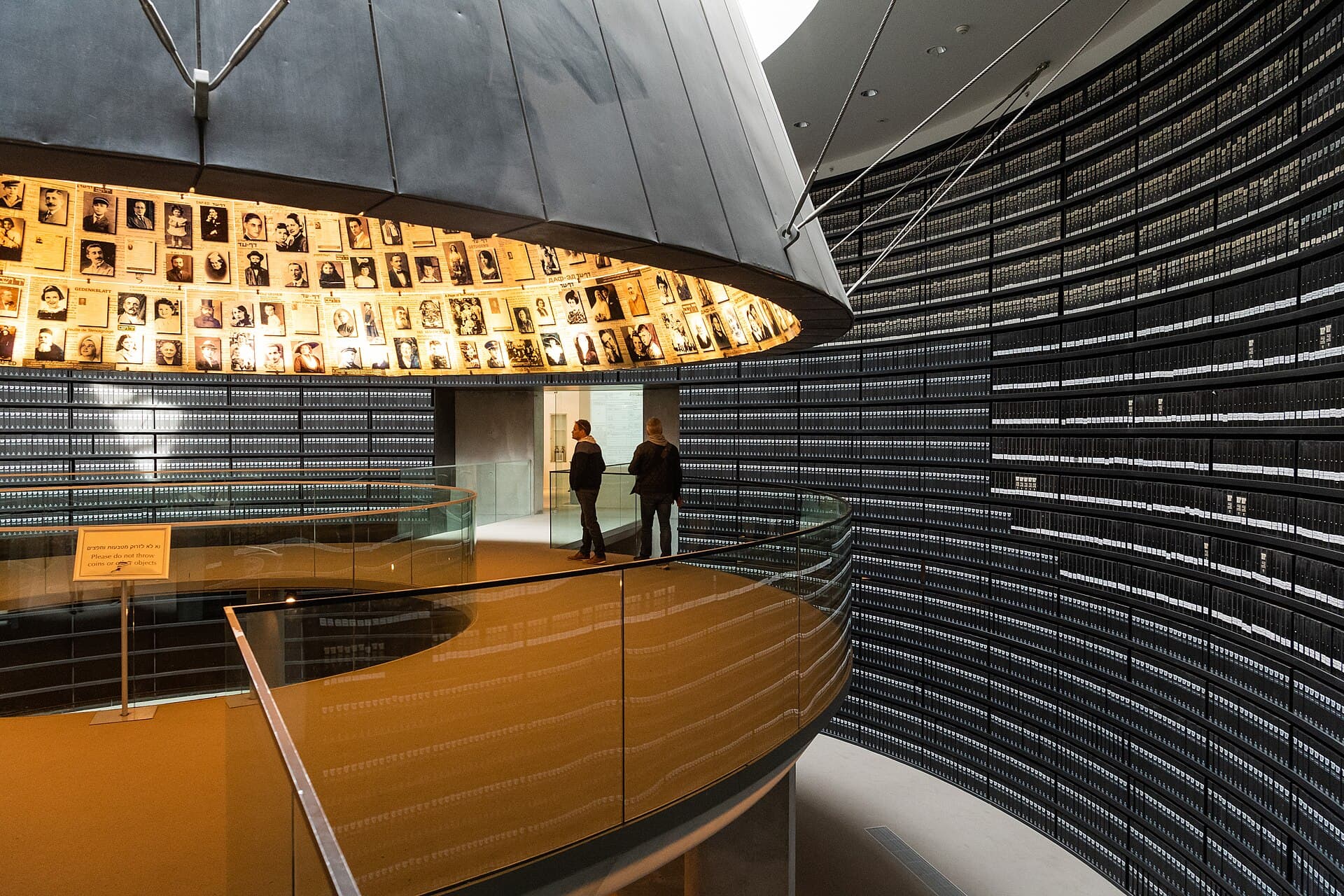
In a circular hall on a hillside in western Jerusalem, the walls are lined with black binders. Each binder holds Pages of Testimony, short forms filled out by survivors and relatives, one page for one person: a name, the names of parents, a place of birth, a place of death where it is known, and sometimes a photograph. Above them, a ten-metre cone rises toward the light, set with six hundred portraits of the murdered. Below, a second cone descends into the bedrock of the mountain. Around the room, some of the shelving stands empty, left that way on purpose. There are names that have not yet been found.
This is the Hall of Names at Yad Vashem, the World Holocaust Remembrance Center, the institution charged by the state of Israel with documenting the Shoah, the murder of six million Jews by Nazi Germany and its collaborators. Yad Vashem is a memorial, a museum, an archive, a research institute and a school, spread across the Mount of Remembrance in Jerusalem. At its centre is a single undertaking that has continued for more than seventy years: to recover the name of every victim, one by one. The impulse is the oldest one in Jewish remembrance, the same that fills synagogues four times a year for Yizkor, the prayer that begins with the word remember.
The name comes from the Book of Isaiah, chapter 56, verse 5: "I will give them, in My house and within My walls, a memorial and a name, better than sons and daughters; I will give them an everlasting name that shall not be cut off." The Hebrew phrase for "a memorial and a name" is yad vashem. The verse speaks of those who will leave no descendants and promises them a remembrance that outlasts the family line, so the institution's whole mission is stated in its own name: for the murdered, who often left no grave, no children and no record, an everlasting name that shall not be cut off.
Yad Vashem was established on 19 August 1953, when the Knesset, Israel's parliament, unanimously passed the Martyrs' and Heroes' Remembrance Law. The law came five years after the founding of the state, when a large share of Israel's population were themselves survivors, and it charged the new authority with commemorating the six million, the destroyed communities, the fighters and rebels, and the non-Jews who risked their lives to rescue Jews. The site chosen was Har Hazikaron, the Mount of Remembrance, on the western edge of Jerusalem, adjacent to Mount Herzl, the national cemetery. Over the following decades the hillside filled with memorials, archives and research buildings, and eventually a museum campus.
The gathering of names began almost at once. In the 1950s Yad Vashem started distributing Pages of Testimony, one-page forms on which a survivor, a relative or a friend could record what was known of a single victim. The pages were filled out at kitchen tables across the world, in whatever language the writer had, and returned to Jerusalem, accumulating decade by decade into the millions. In 2004 the collection became the core of the Central Database of Shoah Victims' Names, which joins the pages with archival lists, deportation records and other documentation, and which now holds around five million of the six million names, freely searchable online. The remaining names are the hardest: whole families and communities were destroyed with no one left to remember them, and researchers continue to work through fragmentary records to recover as many as can still be found.
The Holocaust History Museum, opened in 2005, carries the main narrative. Its approach is chronological and deliberately concrete: the galleries move from Jewish life in pre-war Europe through the rise of the Nazi regime, the ghettos, the mass shootings in the occupied Soviet territories, the death camps, the death marches and the liberation, ending with the survivors' rebuilding of their lives. At every stage the museum works through individuals rather than abstractions. Diaries, letters, photographs, shoes, toys and household objects are shown with the names of the people they belonged to, video testimony from survivors runs throughout the galleries, and the scale of the murder is conveyed by the accumulation of particular lives rather than by statistics alone.
The route through the museum ends at the Hall of Names, the circular repository described above, where the Pages of Testimony line the walls around the cone of photographs. It is the museum's conclusion and its point: after the history has been told, what remains is the obligation to each name.
Elsewhere on the mountain stands the Children's Memorial, dedicated to the roughly one and a half million Jewish children who were murdered. It is an underground space in which a few memorial candles are reflected between mirrors into what appears to be an endless field of lights, while a recorded voice reads the names of murdered children, their ages and their home countries, one after another, on a continuous loop. The memorial was designed by Moshe Safdie and endowed by Abe and Edita Spiegel, whose son Uziel was murdered at Auschwitz at the age of two and a half.
Yad Vashem also administers the Righteous Among the Nations program, established under the 1953 law to recognize non-Jews who risked their lives to save Jews during the Holocaust. Each case is examined by a public commission working to defined criteria, and those recognized are honoured on the Avenue and in the Garden of the Righteous on the campus, where trees were planted for the earliest honourees. More than 28,000 men and women from over fifty countries have been recognized, among them Oskar Schindler and Raoul Wallenberg, alongside thousands whose names are known almost nowhere else.
The Holocaust History Museum was designed by Moshe Safdie, the Israeli-Canadian architect, and opened in March 2005, replacing an earlier museum building from 1973. Its form is a long triangular prism of concrete, about 180 metres from end to end, that cuts straight through the Mount of Remembrance. Most of the structure lies beneath the hill, with only the spine of the prism breaking above ground to admit daylight through a skylight running its full length. Visitors cross from one side of the mountain to the other, zigzagging through galleries that open off the central axis, descending as the history darkens and rising again toward the end.
The building's ending is its most quoted gesture. At the northern end the prism opens outward, and the walls sweep apart into a balcony cantilevered over the valley, with a wide view of the Jerusalem hills. After the enclosure of the galleries and the Hall of Names, the visitor walks out into open air and light, above the living city.
Yad Vashem is Israel's official memorial to the victims of the Holocaust and one of the most visited sites in the country. Visiting heads of state are routinely brought to the mountain, and the annual state ceremony for Holocaust Remembrance Day is held there. Its research institute and its International School for Holocaust Studies train educators and historians from around the world.
Its deeper significance lies in the character of its central project. The Holocaust was an attempt not only to murder a people but to erase them, to leave no graves, no records and no memory. Yad Vashem's answer has been the fullest attempt ever made to meet erasure with names, one by one. A Page of Testimony does not restore a life. It restores the fact of a life: that this person existed, was born somewhere, belonged to someone, and was murdered. Multiplied five million times, and still incomplete, the collection is a work without precedent, and the empty shelves in the Hall of Names state plainly that it is not finished.
The Yad Vashem Archives hold the largest collection of Holocaust documentation in the world, around 230 million pages of material, together with hundreds of thousands of photographs and tens of thousands of recorded survivor testimonies: German administrative records, ghetto and camp documentation, diaries, letters and postwar testimony, gathered from archives and families across dozens of countries. A long-running digitization effort has placed a growing share of it online, and the names database is open to anyone without charge, so that a person anywhere in the world can search for a grandparent, a lost branch of a family, or a town.
The archive serves two purposes at once. It is the evidentiary record on which the history of the Holocaust rests and against which denial breaks. And it is a memorial in the strict sense of the institution's name: a repository in which each recovered person has a place, whether or not anyone survives to remember them. The Pages of Testimony were written by people who understood that they might be the last on earth who knew a particular name. Yad Vashem exists so that the knowledge did not end with them.
Yad Vashem stands on Har Hazikaron in western Jerusalem, adjacent to Mount Herzl, and is reached by the Jerusalem light rail to the Mount Herzl stop or by city bus lines. Admission is free, though online reservation of an entry slot is required. The site is open Sunday to Thursday and on Friday mornings, and closed on Saturdays and Jewish holidays. Children under ten are not admitted to the Holocaust History Museum.
The campus is large, and the Holocaust History Museum alone asks for two to three hours of unhurried attention. Many visitors also walk to the Children's Memorial, the Hall of Remembrance with its eternal flame, and the Avenue of the Righteous. The site is arranged for slowness rather than coverage, and it rewards leaving time at the end to stand on the balcony over the valley before returning to the city.