Heritage · Museum
National Museum of Anthropology: Mexico's Ancient Heritage
In a single wooded park in Mexico City sits the museum that holds the Aztec Sun Stone, the Olmec colossal heads, and the reconstructed tomb of a Maya king. It is Mexico's largest and most visited museum, joining the archaeology of Mesoamerica to the living cultures of the country's Indigenous peoples.Written to last.
By Confinity Heritage Editorial · Updated 2026-07-31 · 7-minute readQuiet tools, kept out of the way.
The National Museum of Anthropology (Museo Nacional de Antropología) occupies a long, low building in the Bosque de Chapultepec, the great wooded park at the centre of Mexico City. It is the largest and most visited museum in the country, drawing around 3.7 million visitors in 2024, and it was built for a single, ambitious purpose: to gather the archaeological and ethnographic record of the peoples who have lived in Mexico, from the earliest settlers of the central valleys to the Indigenous communities of the present. The collection is arranged so that a visitor moves from the deep past of Mesoamerica on the ground floor to the living cultures of Mexico's Indigenous peoples on the floor above.
That double movement, from ancient objects to present-day communities, is the museum's defining idea. It does not treat Indigenous Mexico as a closed chapter to be admired from a distance. The stone carvings, funerary masks, and painted vessels below are presented alongside the languages, textiles, ceremonies, and daily life of the peoples above, many of whom are descendants of the cultures whose work fills the archaeological halls. The result is a place that reads at once as a record of civilisations that shaped the Americas and as an account of cultures that continue to shape Mexico today.
Mexico's national museum has older roots than its Chapultepec home. A national collection was established in the early nineteenth century, and for many decades the country's antiquities were displayed in a building on Calle de Moneda in the historic centre of Mexico City, near the ruins of the Aztec capital of Tenochtitlan. By the mid twentieth century that space could no longer hold or properly show the growing collection.
Under President Adolfo López Mateos, the government commissioned a new, purpose-built museum in Chapultepec Park. Construction was rapid: the building was completed in roughly 19 months and opened in 1964. At the same time the older collections were divided, with the archaeological and ethnographic material moving to the new anthropology museum while historical collections were housed separately, an arrangement that let the new institution concentrate wholly on the Indigenous cultures of Mexico. From the outset it was intended as a national statement, a place where the country would present its pre-Hispanic and Indigenous heritage to its own citizens and to the world.
The museum was designed by the architect Pedro Ramírez Vázquez, working with Rafael Mijares Alcérreca and Jorge Campuzano. The plan is deceptively simple: two floors of exhibition halls, 23 rooms in all, wrapped around a vast rectangular courtyard, so that the galleries open onto open air and light rather than a sequence of enclosed corridors. The building covers a site of nearly 80,000 square metres, and its scale is felt as soon as a visitor passes through the entrance into the courtyard.
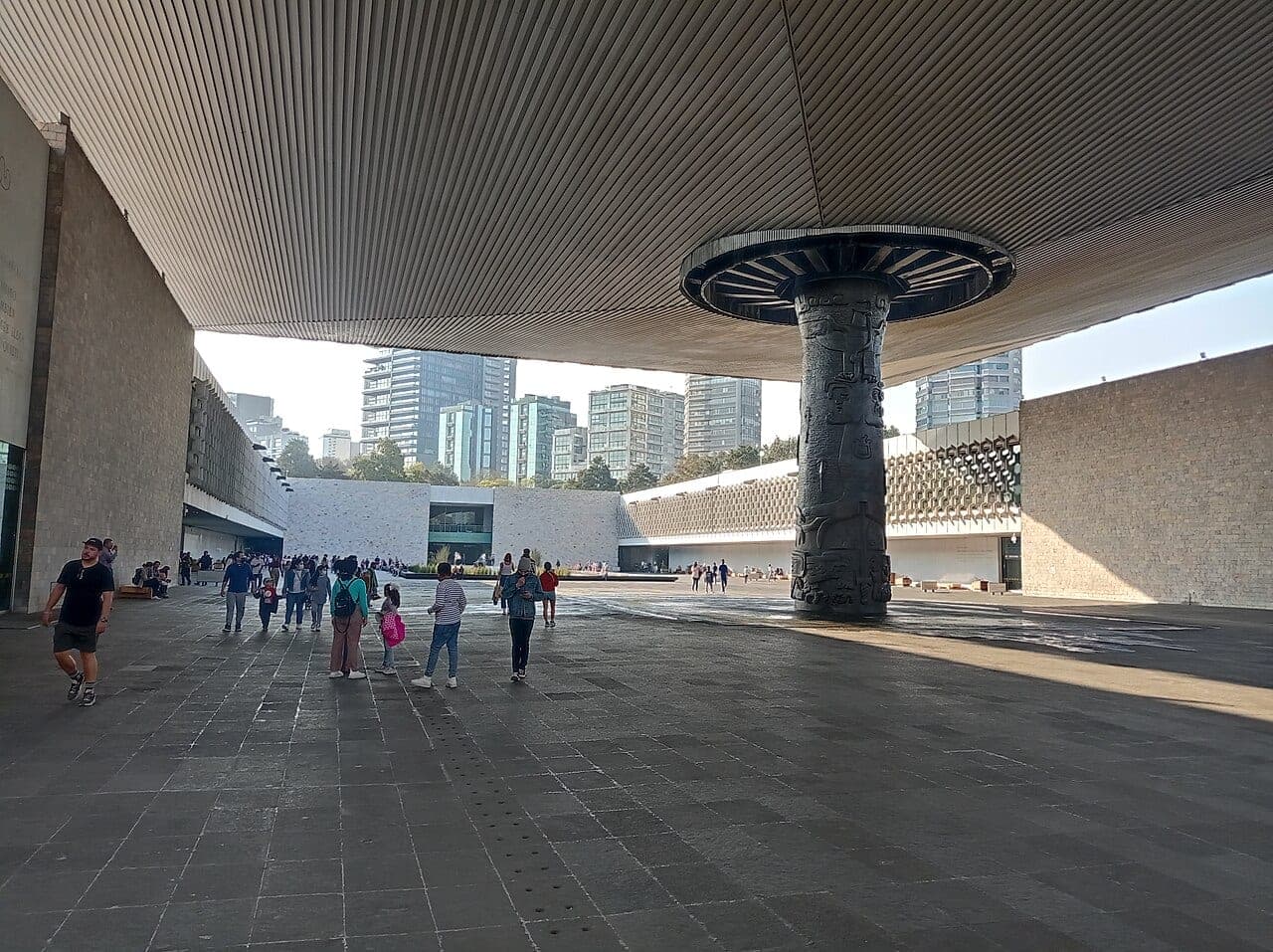
 One column carries the whole canopy, and water falls from its rim in a continuous curtain. Ramirez Vazquez built the courtyard around a single support so nothing would compete with what is under it. Photograph by ProtoplasmaKid, CC BY-SA 4.0, via Wikimedia Commons.
The courtyard is dominated by the feature that has become the museum's emblem: el paraguas, "the umbrella." A single slender column rises from the centre of the open plaza and spreads outward to carry an immense flat concrete canopy that shelters much of the courtyard, one of the most recognisable gestures of mid-century Mexican modernism. The column is clad in bronze and carries hammered reliefs by the brothers José and Tomás Chávez Morado, a composition titled Imagen de México (Image of Mexico) that sets the symbols of Indigenous and European worlds against one another around the four cardinal directions. Water falls from the rim of the canopy as a continuous curtain, so that the structure functions as both shelter and fountain. The effect is deliberate and monumental, a modern architectural frame built to honour an ancient inheritance.
The ground floor is given over to archaeology, organised by region and culture so that a visitor can follow the great civilisations of Mesoamerica in turn: the early Preclassic peoples, Teotihuacan, the Toltec and Mexica (Aztec) worlds of central Mexico, the cultures of Oaxaca and the Gulf Coast, the Maya of the south and southeast, and the peoples of northern and western Mexico.
The most famous single object is the Aztec, or Mexica, Sun Stone, known in Spanish as the Piedra del Sol. This massive carved basalt disc, several metres across, was unearthed on 17 December 1790 during works in the main square of Mexico City, near the cathedral built over the Aztec ceremonial centre. Long described in popular writing as a calendar, it is a dense cosmological carving whose central face is usually read as a solar or earth deity surrounded by signs of the days and the ages of the world. It has become one of the most reproduced images in Mexico and a shorthand for the country's pre-Hispanic past.
The Gulf Coast hall holds the colossal heads of the Olmec, the earliest major civilisation of Mesoamerica. Carved from single blocks of basalt and standing taller than a person, these heads, brought from sites in the modern states of Veracruz and Tabasco, are thought to portray individual rulers, and their scale and realism are among the enduring achievements of ancient American sculpture.
The Maya hall contains one of the museum's most moving displays: a full-scale reproduction of the burial chamber of K'inich Janaab' Pakal, the seventh-century ruler of Palenque. The tomb was discovered deep inside the Temple of the Inscriptions by the archaeologist Alberto Ruz Lhuillier, who reached the sealed chamber in 1952 after years of clearing a hidden interior staircase. The museum reconstructs the descent and the chamber, and displays the king's carved sarcophagus lid together with the jade funerary mask that covered his face, a portrait assembled from fitted stones. Nearby, the Teotihuacan hall recreates elements of that vast ancient city north of the capital, including a reproduction of part of the sculpted facade of the Temple of the Feathered Serpent, so that the monumental architecture can be read alongside the objects recovered from it.
The upper floor turns from archaeology to ethnography. Its halls are devoted to the living cultures of Mexico's Indigenous peoples, arranged by region and theme, and covering languages, dress, textiles, agriculture, religion, festivals, and domestic life. Clothing, tools, and ritual objects are shown in the context of the communities that make and use them, so that the floor reads as a portrait of contemporary Indigenous Mexico rather than a display of relics. This upper level is what gives the museum its dual character: it is at once a museum of ancient objects and a museum of present cultures.
The National Museum of Anthropology is closely bound up with Mexican national identity. In presenting the Sun Stone, the Olmec heads, and the tomb of Pakal within a single grand building, the museum offers a narrative in which the modern nation draws its roots directly from the Indigenous civilisations of Mesoamerica. It is a place of national pride, a fixture of school visits and state occasions, and for many Mexicans the definitive account of where the country comes from. By devoting an entire floor to living Indigenous cultures, it also makes the point that this heritage is not only ancient but continuing.
One object in the museum draws that history into a present-day question. On display is a reproduction of the feathered headdress associated with the Aztec ruler Moctezuma, often called the Penacho. The original, a rare survival of Aztec featherwork made from quetzal and other feathers with gold detailing, is held in Vienna, in the Weltmuseum, having reached Europe in the sixteenth century. Mexico has requested its return, and the object has become a focus of discussion about the restitution of cultural heritage. A joint expert commission examined the question and concluded that the headdress is too fragile to be transported safely, and it remains in Vienna while conversations about cooperation and shared access continue. The museum presents its faithful reproduction so that visitors can see the form and craftsmanship of the piece within the wider story of Aztec art.
The museum sits in the Bosque de Chapultepec, along the Paseo de la Reforma in the Polanco area of Mexico City, and is easily reached by metro, with stations serving the park and the nearby Auditorio. It is generally open Tuesday to Sunday and closed on Mondays; admission is charged through the national institute that runs it, with reduced or free entry offered to certain visitors on set days. Because opening hours, ticket prices, and temporary exhibitions change, it is worth checking the official website before a visit.
The collection is very large, and few visitors see all of it well in a single day. Many choose a small number of halls, often the Mexica room with the Sun Stone, the Maya room with Pakal's tomb, the Gulf Coast room with the Olmec heads, and one or two of the ethnography galleries above. The central courtyard, the umbrella column, and the surrounding park make natural places to rest between halls, and the wider Chapultepec park, with its castle, lake, and other museums, easily fills the rest of a day around a visit.
One column carries the whole canopy, and water falls from its rim in a continuous curtain. Ramirez Vazquez built the courtyard around a single support so nothing would compete with what is under it. Photograph by ProtoplasmaKid, CC BY-SA 4.0, via Wikimedia Commons.
The courtyard is dominated by the feature that has become the museum's emblem: el paraguas, "the umbrella." A single slender column rises from the centre of the open plaza and spreads outward to carry an immense flat concrete canopy that shelters much of the courtyard, one of the most recognisable gestures of mid-century Mexican modernism. The column is clad in bronze and carries hammered reliefs by the brothers José and Tomás Chávez Morado, a composition titled Imagen de México (Image of Mexico) that sets the symbols of Indigenous and European worlds against one another around the four cardinal directions. Water falls from the rim of the canopy as a continuous curtain, so that the structure functions as both shelter and fountain. The effect is deliberate and monumental, a modern architectural frame built to honour an ancient inheritance.
The ground floor is given over to archaeology, organised by region and culture so that a visitor can follow the great civilisations of Mesoamerica in turn: the early Preclassic peoples, Teotihuacan, the Toltec and Mexica (Aztec) worlds of central Mexico, the cultures of Oaxaca and the Gulf Coast, the Maya of the south and southeast, and the peoples of northern and western Mexico.
The most famous single object is the Aztec, or Mexica, Sun Stone, known in Spanish as the Piedra del Sol. This massive carved basalt disc, several metres across, was unearthed on 17 December 1790 during works in the main square of Mexico City, near the cathedral built over the Aztec ceremonial centre. Long described in popular writing as a calendar, it is a dense cosmological carving whose central face is usually read as a solar or earth deity surrounded by signs of the days and the ages of the world. It has become one of the most reproduced images in Mexico and a shorthand for the country's pre-Hispanic past.
The Gulf Coast hall holds the colossal heads of the Olmec, the earliest major civilisation of Mesoamerica. Carved from single blocks of basalt and standing taller than a person, these heads, brought from sites in the modern states of Veracruz and Tabasco, are thought to portray individual rulers, and their scale and realism are among the enduring achievements of ancient American sculpture.
The Maya hall contains one of the museum's most moving displays: a full-scale reproduction of the burial chamber of K'inich Janaab' Pakal, the seventh-century ruler of Palenque. The tomb was discovered deep inside the Temple of the Inscriptions by the archaeologist Alberto Ruz Lhuillier, who reached the sealed chamber in 1952 after years of clearing a hidden interior staircase. The museum reconstructs the descent and the chamber, and displays the king's carved sarcophagus lid together with the jade funerary mask that covered his face, a portrait assembled from fitted stones. Nearby, the Teotihuacan hall recreates elements of that vast ancient city north of the capital, including a reproduction of part of the sculpted facade of the Temple of the Feathered Serpent, so that the monumental architecture can be read alongside the objects recovered from it.
The upper floor turns from archaeology to ethnography. Its halls are devoted to the living cultures of Mexico's Indigenous peoples, arranged by region and theme, and covering languages, dress, textiles, agriculture, religion, festivals, and domestic life. Clothing, tools, and ritual objects are shown in the context of the communities that make and use them, so that the floor reads as a portrait of contemporary Indigenous Mexico rather than a display of relics. This upper level is what gives the museum its dual character: it is at once a museum of ancient objects and a museum of present cultures.
The National Museum of Anthropology is closely bound up with Mexican national identity. In presenting the Sun Stone, the Olmec heads, and the tomb of Pakal within a single grand building, the museum offers a narrative in which the modern nation draws its roots directly from the Indigenous civilisations of Mesoamerica. It is a place of national pride, a fixture of school visits and state occasions, and for many Mexicans the definitive account of where the country comes from. By devoting an entire floor to living Indigenous cultures, it also makes the point that this heritage is not only ancient but continuing.
One object in the museum draws that history into a present-day question. On display is a reproduction of the feathered headdress associated with the Aztec ruler Moctezuma, often called the Penacho. The original, a rare survival of Aztec featherwork made from quetzal and other feathers with gold detailing, is held in Vienna, in the Weltmuseum, having reached Europe in the sixteenth century. Mexico has requested its return, and the object has become a focus of discussion about the restitution of cultural heritage. A joint expert commission examined the question and concluded that the headdress is too fragile to be transported safely, and it remains in Vienna while conversations about cooperation and shared access continue. The museum presents its faithful reproduction so that visitors can see the form and craftsmanship of the piece within the wider story of Aztec art.
The museum sits in the Bosque de Chapultepec, along the Paseo de la Reforma in the Polanco area of Mexico City, and is easily reached by metro, with stations serving the park and the nearby Auditorio. It is generally open Tuesday to Sunday and closed on Mondays; admission is charged through the national institute that runs it, with reduced or free entry offered to certain visitors on set days. Because opening hours, ticket prices, and temporary exhibitions change, it is worth checking the official website before a visit.
The collection is very large, and few visitors see all of it well in a single day. Many choose a small number of halls, often the Mexica room with the Sun Stone, the Maya room with Pakal's tomb, the Gulf Coast room with the Olmec heads, and one or two of the ethnography galleries above. The central courtyard, the umbrella column, and the surrounding park make natural places to rest between halls, and the wider Chapultepec park, with its castle, lake, and other museums, easily fills the rest of a day around a visit.
History and founding
The building
The collection
Cultural significance
Visiting
References and resources
- Museo Nacional de Antropología (INAH, official): visitor information, halls, and the museum's own account of its collection.
- INAH: Museo Nacional de Antropología: the national institute's profile of the building and its history.
- Encyclopaedia Britannica: National Museum of Anthropology: overview of the museum's design, architect, and holdings.
- Wikipedia: National Museum of Anthropology (Mexico): detailed history, architecture, and gallery-by-gallery description with sources.
- Wikipedia: Aztec sun stone: the discovery, meaning, and display of the Piedra del Sol.
- Wikipedia: Moctezuma's headdress: the history of the Penacho, its featherwork, and the restitution discussion.