Heritage · Country
Vietnam Culture and Heritage
From the family altar where each household keeps its dead close to the martyr cemeteries that line the old front, Vietnam treats remembrance as a daily duty rather than an occasion. A guide to a culture shaped by the three teachings, a thousand years of dynasties and resistance, and the death anniversaries that gather every family home.Written to last.
By Confinity Heritage Editorial · Updated 2026-07-31 · 8-minute readQuiet tools, kept out of the way.
In most Vietnamese homes a shelf or small table is set apart for the dead, holding photographs of grandparents and great-grandparents, an incense burner, a dish of fruit, and on the right days a cooked meal. This is the ban tho gia tien, the family ancestor altar, and it is the quiet centre of Vietnamese life. Before a wedding, an examination or a long journey, the family lights incense and speaks to those who came before; on the anniversary of a death the household gathers to cook for the departed by name. Memory here is less an occasion than a daily habit, handed down across generations.
That habit rests on a long and contested past: roughly a thousand years of Chinese rule, an independence won in 938, and the dynasties that built the country's cities and its writing, before French colonial rule and the wars of the twentieth century. Those wars, the First Indochina War against France and the conflict known in Vietnam as the Resistance War Against America (1955–1975), ended in reunification in 1975 and 1976 and remain within living memory on every side.
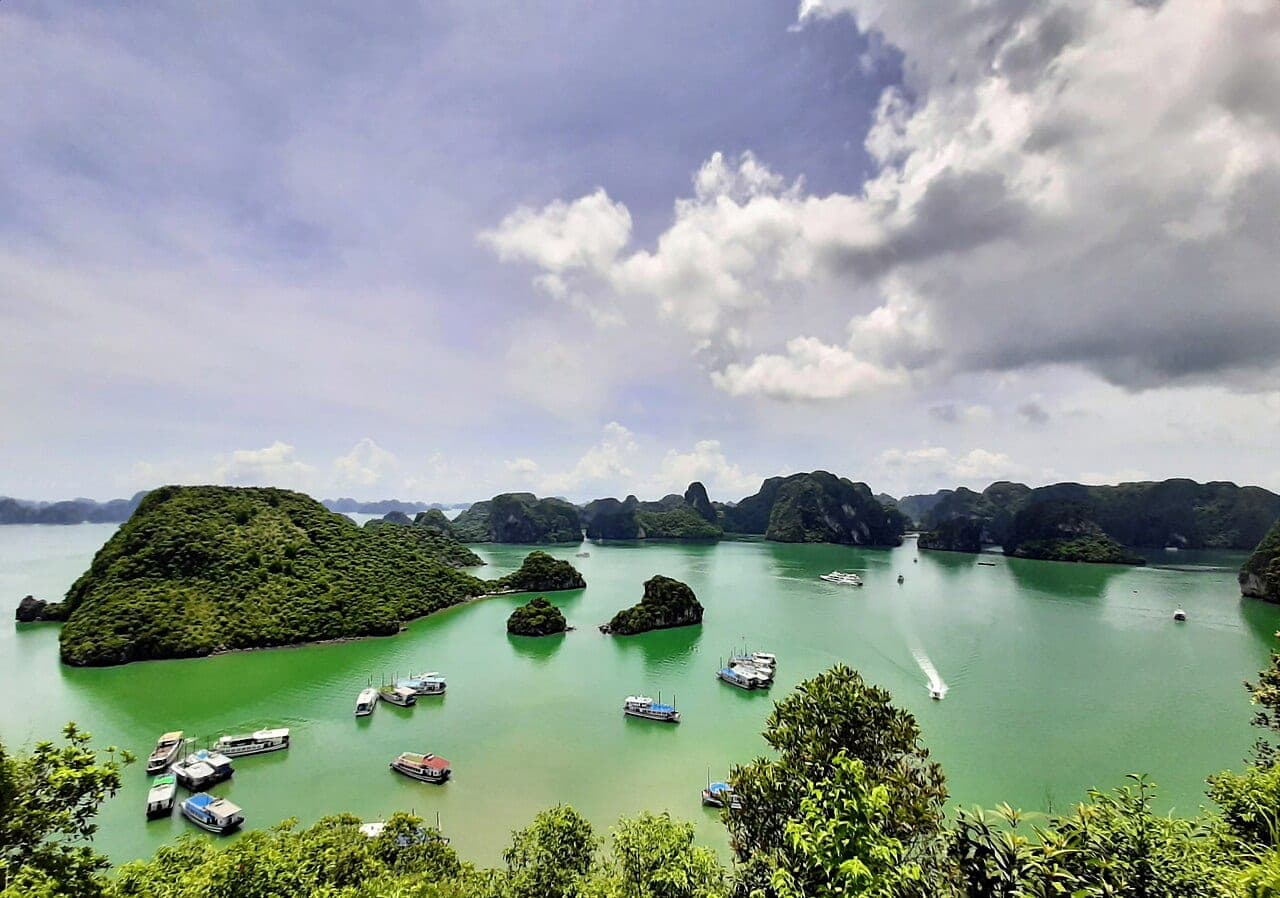
Vietnam occupies the eastern edge of mainland Southeast Asia, a long S-shaped country of about 331,000 square kilometres running some 1,650 kilometres from north to south. It borders China to the north, Laos and Cambodia to the west, and the sea the Vietnamese call the East Sea to the east. Two great river deltas, the Red River in the north and the Mekong in the south, hold most of the population and grow most of the rice, and the limestone towers of Ha Long Bay stand off the northern coast.
The population is close to 100 million. The state recognises 54 ethnic groups, the Kinh, or Viet, majority making up around 85 per cent, alongside Tay, Thai, Khmer, Cham and many upland peoples. Vietnam is a one-party socialist republic; its currency is the dong, Hanoi is the capital, and Ho Chi Minh City in the south is the largest city. No single religion dominates on paper, but ancestor veneration, practised across faiths, is close to universal.
Hanoi. The capital on the Red River dates its founding to 1010, when the Ly king Ly Thai To moved his court there and named it Thang Long, the city of the ascending dragon. It keeps the Temple of Literature, the Confucian academy founded in 1070, the old quarter of guild streets, and the Imperial Citadel of Thang Long, inscribed by UNESCO in 2010.
 Hoi An survived intact because the river silted up and the trade moved elsewhere. Photograph by lumoplank, CC0, via Wikimedia Commons.
Ho Chi Minh City (Saigon). The largest city and commercial engine of the south grew from the Khmer settlement of Prey Nokor into the port of Saigon, capital of French Cochinchina and later of the Republic of Vietnam. Renamed in 1976, it keeps its French-era cathedral, the Independence Palace and the War Remnants Museum, and many residents still call the old centre Saigon.
Hue. The former imperial capital on the Perfume River was the seat of the Nguyen dynasty from 1802 to 1945. Its walled Citadel, royal tombs and temples form the Complex of Hue Monuments, Vietnam's first UNESCO inscription in 1993, and it remains a centre of court music, cuisine and Buddhist observance.
Hoi An. A small port on the central coast, Hoi An was a leading trading town from the fifteenth to the nineteenth centuries, drawing Japanese, Chinese, Dutch and other merchants. Its intact old town, with the Japanese covered bridge, shophouses and assembly halls, was inscribed by UNESCO in 1999.
Da Nang. The central region's largest city and port sits between Hue and Hoi An. A strategic harbour and major landing point during the war, it is now a fast-growing coastal city and the gateway to the Cham Museum and the Marble Mountains.
Organised society in the Red River Delta reaches back to the Bronze Age Dong Son culture and to the semi-legendary Hung kings of Van Lang, still honoured as the nation's founders. From 111 BCE the region fell under successive Chinese dynasties, roughly a thousand years the Vietnamese call Bac thuoc, the northern domination. Resistance ran through it, most famously the revolt of the Trung Sisters in 40 CE, until Ngo Quyen destroyed a Southern Han fleet at the Battle of Bach Dang in 938, securing lasting independence.
Hoi An survived intact because the river silted up and the trade moved elsewhere. Photograph by lumoplank, CC0, via Wikimedia Commons.
Ho Chi Minh City (Saigon). The largest city and commercial engine of the south grew from the Khmer settlement of Prey Nokor into the port of Saigon, capital of French Cochinchina and later of the Republic of Vietnam. Renamed in 1976, it keeps its French-era cathedral, the Independence Palace and the War Remnants Museum, and many residents still call the old centre Saigon.
Hue. The former imperial capital on the Perfume River was the seat of the Nguyen dynasty from 1802 to 1945. Its walled Citadel, royal tombs and temples form the Complex of Hue Monuments, Vietnam's first UNESCO inscription in 1993, and it remains a centre of court music, cuisine and Buddhist observance.
Hoi An. A small port on the central coast, Hoi An was a leading trading town from the fifteenth to the nineteenth centuries, drawing Japanese, Chinese, Dutch and other merchants. Its intact old town, with the Japanese covered bridge, shophouses and assembly halls, was inscribed by UNESCO in 1999.
Da Nang. The central region's largest city and port sits between Hue and Hoi An. A strategic harbour and major landing point during the war, it is now a fast-growing coastal city and the gateway to the Cham Museum and the Marble Mountains.
Organised society in the Red River Delta reaches back to the Bronze Age Dong Son culture and to the semi-legendary Hung kings of Van Lang, still honoured as the nation's founders. From 111 BCE the region fell under successive Chinese dynasties, roughly a thousand years the Vietnamese call Bac thuoc, the northern domination. Resistance ran through it, most famously the revolt of the Trung Sisters in 40 CE, until Ngo Quyen destroyed a Southern Han fleet at the Battle of Bach Dang in 938, securing lasting independence.
 The citadel at Hue, seat of the Nguyen emperors and badly damaged in the fighting of 1968. Photograph by CEphoto, Uwe Aranas, CC BY-SA 3.0, via Wikimedia Commons.
A sequence of Vietnamese dynasties followed. The Ly (1009–1225) fixed the capital at Thang Long and built the state's Confucian and Buddhist institutions; the Tran (1225–1400) turned back three Mongol invasions under the general Tran Hung Dao; and after a brief Ming reoccupation, Le Loi founded the Later Le dynasty in 1428. Rivalry between the Trinh and Nguyen lords and the Tay Son uprising followed, until Nguyen Anh reunified the country as Emperor Gia Long in 1802, ruling from Hue and giving the nation the name Viet Nam.
From the 1860s France took control piece by piece, forming French Indochina. After Japanese occupation in the Second World War, Ho Chi Minh declared independence in Hanoi in September 1945. The First Indochina War (1946–1954) ended with the French defeat at Dien Bien Phu and the Geneva Accords, which divided the country at the 17th parallel pending elections that never took place. The conflict that followed, known internationally as the Vietnam War and in Vietnam as the Resistance War Against America (1955–1975), was fought between the north and the southern republic and their allies, at a cost of some three million Vietnamese lives and tens of thousands of foreign troops. It ended with the fall of Saigon in April 1975 and reunification as the Socialist Republic of Vietnam in 1976. The Doi Moi reforms of 1986 reoriented the economy towards the market, opening the growth that continues today.
Vietnamese belongs to the Vietic branch of the Austroasiatic family, kin to Khmer rather than to Chinese, though centuries of contact filled it with Chinese vocabulary. It is tonal, with six tones in the northern standard, and the 53 minority peoples keep their own languages.
Its written form moved through three stages. For most of the imperial era, formal writing used classical Chinese, chu Han. From around the thirteenth century, scholars adapted Chinese characters to record spoken Vietnamese in a script called chu Nom, which carried a growing body of vernacular poetry. The decisive shift came with a Latin-based alphabet, quoc ngu, developed in the seventeenth century by Portuguese, Italian and French Jesuit missionaries; Alexandre de Rhodes compiled its first major dictionary, printed in 1651. Long confined to the church, quoc ngu was later promoted by the French administration and became the standard written form in the twentieth century. The nation's name reverses the older Nam Viet, joining Viet, the region's peoples, with Nam, meaning south, and was adopted officially in the early nineteenth century.
Vietnamese identity is carried in dress, food and performance as much as in monuments. The ao dai, the long split tunic worn over loose trousers, is the country's most recognisable garment, worn by students, teachers and brides; the conical non la hat is its rural counterpart.
The cuisine is built on rice, fresh herbs and the fermented fish sauce nuoc mam, with strong regional differences from northern pho to the court cooking of Hue and the sweeter food of the Mekong south; the French left the banh mi sandwich and iced coffee. The performing arts run just as deep, from the quan ho love duets of the north to water puppetry, mua roi nuoc, a Red River Delta tradition dating to at least the eleventh century, in which lacquered puppets are worked over a flooded stage.
Vietnamese spiritual life is often described through Tam giao, the three teachings, the interweaving of Confucianism, Buddhism and Taoism that has shaped ethics and ritual for centuries. Many Vietnamese draw on all three at once: Confucian respect for family, Buddhist ideas of merit and rebirth, and Taoist attention to the spirit world. Mahayana Buddhism is the largest organised religion, and the pagoda remains a familiar centre of community life.
Around these traditions runs a deep layer of folk religion, honouring guardian spirits, tutelary deities and the spirits of the land; the worship of mother goddesses, Dao Mau, was recognised by UNESCO in 2016. Christianity, chiefly Roman Catholicism introduced by missionaries from the sixteenth and seventeenth centuries, claims around seven per cent of the population. Two faiths born in the south are distinctively Vietnamese: Cao Dai, founded in Tay Ninh in 1926 as a synthesis of the three teachings with Christianity, and Hoa Hao Buddhism, founded in the Mekong Delta in 1939. Across nearly all of them, the veneration of ancestors is the common thread.
The ancestor altar is the physical heart of Vietnamese remembrance. In homes, shops and workshops a dedicated space holds photographs of the dead, an incense burner, candles, flowers and offerings of fruit and food. The living report the family's news to it and light incense at the turning points of the year and of a life. Keeping the altar, and the names and dates of the dead, is a duty of the family and above all of the eldest son, though in practice the whole household shares it.
The central observance is the death anniversary, the dam gio or ngay gio, marked each year on the lunar date of a person's death. It is often a larger gathering than a birthday: relatives return, a full meal is cooked and offered first to the departed at the altar, then shared by the living, so the dead are treated as present members of the family. Funerals follow careful stages, with a wake, procession and burial, mourning dress worn by close kin, and commemorations commonly on the 49th and 100th days and each year thereafter. Thanh Minh, the spring grave-tending day, and Vu Lan, the Buddhist festival of filial piety and wandering souls, fold the dead further into the year. Above all there is Tet Nguyen Dan, the lunar new year, when ancestors are invited home to share the holiday, the altar laden with special foods and the spirits welcomed at the start and seen off at the close, so the year's most important festival is also an act of remembrance.
The wars of the twentieth century added a national dimension to this family practice. Almost every Vietnamese family lost members, and the state maintains martyr cemeteries, the nghia trang liet si, in towns and villages across the country; the largest, the Truong Son National Martyrs' Cemetery, holds more than ten thousand of the war dead. Monuments honour the Heroic Vietnamese Mothers who lost children in the conflicts, and families still search for and rebury those whose remains were never recovered. In Vietnam the ancestor and the fallen soldier meet at the same altar, and remembrance is understood as both a family bond and a civic one.
The Vietnamese family record sits on a table in the house.
The ancestral altar holds the tablets and photographs of the dead of the household, and the giỗ, the death anniversary, brings the family together to feed them. It is the practical genealogy of Vietnam and it is maintained by everybody rather than by an institution. Written up, it becomes the gia phả, a family book recording the line from a founding ancestor with the graves, the anniversaries and the land attached to it. Many clans keep one, and the từ đường, the ancestral house, is where it lives.
The village kept its own record in the đình, the communal house, along with the register of village members and the land registers, the địa bạ, which the Nguyễn dynasty compiled in the early nineteenth century and which name landholders commune by commune.
French colonial administration built an état civil from the later nineteenth century, and those files are divided between the national archives centres in Hanoi, Ho Chi Minh City and Da Lat and the overseas archives at Aix-en-Provence.
The twentieth century scattered a great deal. Partition in 1954 moved close to a million people south, the war moved millions more, and the departures after 1975 put around two million Vietnamese abroad. For the diaspora the founding document is often a refugee camp registration card from Malaysia, Hong Kong, Indonesia or the Philippines, and the gia phả, if the family kept one, was carried out by hand.
Vietnam's framework rests on the Law on Cultural Heritage of 2001, covering both monuments and intangible traditions and administered through the Ministry of Culture, Sports and Tourism. The country holds nine UNESCO World Heritage sites. Five are cultural: the Complex of Hue Monuments (1993), Hoi An Ancient Town and the My Son Sanctuary (both 1999), the Central Sector of the Imperial Citadel of Thang Long (2010) and the Citadel of the Ho Dynasty (2011). Two are natural: Ha Long Bay (1994, extended in 2023) and Phong Nha-Ke Bang National Park (2003). Trang An (2014) is mixed, and the Yen Tu, Vinh Nghiem, Con Son and Kiep Bac complex was added in 2025 for its ties to Vietnamese Truc Lam Zen Buddhism.
My Son preserves the brick towers of the Cham kingdom of Champa, a Hindu civilisation centred on the worship of Shiva that flourished on the central coast from about the fourth to the thirteenth centuries; its conservation, complicated by wartime damage, has drawn international teams for decades. Vietnam's intangible heritage is equally recognised, with UNESCO listings that include the gong culture of the Central Highlands, quan ho folk song, ca tru music and the mother goddess rituals of Dao Mau. Much preservation happens at village level, in the upkeep of communal houses, pagodas and clan halls.
Digitisation has become an important part of Vietnamese preservation, driven by the fragility of records in a tropical climate and the loss of documents during the wars. The National Archives and the National Library have expanded programmes to scan and catalogue historical materials, and museums publish collections online.
A distinctive effort surrounds the older scripts. The chu Nom writing that carried centuries of Vietnamese literature is legible today to only a small number of specialists, and the Vietnamese Nom Preservation Foundation has worked to digitise Nom texts, build character databases and put classical works within reach of students, so a body of writing at risk of becoming unreadable is carried into searchable form. Community and diaspora projects add family histories, photographs and oral testimony to the record.
Vietnamese culture travels widely today, carried in part by a diaspora of several million, the Viet Kieu, in the United States, France and Australia, who keep temples, festivals and language schools and return for family observances. Vietnamese cinema has drawn international attention since Tran Anh Hung's The Scent of Green Papaya was nominated for an Academy Award in 1994, and Vietnamese food, such as pho and banh mi, has become a global cuisine.
At home, the country balances rapid modernisation against the pull of tradition. New media and music thrive, yet the ancestor altar remains in most homes and Tet still empties the cities as families return to their home villages. This movement between the contemporary and the inherited, rather than any break with the past, defines cultural life now.
A trading town saved intact. Largely bypassed by later development, Hoi An kept its old town almost unchanged and, since its 1999 UNESCO inscription, has become a model of conservation-led revival.
A Cham sanctuary conserved. My Son, damaged during the war, has been stabilised and studied through sustained international cooperation, preserving the finest surviving monuments of the Champa civilisation.
An endangered script carried forward. The digitisation of chu Nom texts has begun to reopen centuries of literature few could still read, turning a script at risk of silence into a resource students can study.
A living calendar of remembrance. Amid rapid growth and migration, the ancestor altar, the annual dam gio and the return home at Tet have endured, keeping the dead present in daily life and passing that practice to a new generation.
The citadel at Hue, seat of the Nguyen emperors and badly damaged in the fighting of 1968. Photograph by CEphoto, Uwe Aranas, CC BY-SA 3.0, via Wikimedia Commons.
A sequence of Vietnamese dynasties followed. The Ly (1009–1225) fixed the capital at Thang Long and built the state's Confucian and Buddhist institutions; the Tran (1225–1400) turned back three Mongol invasions under the general Tran Hung Dao; and after a brief Ming reoccupation, Le Loi founded the Later Le dynasty in 1428. Rivalry between the Trinh and Nguyen lords and the Tay Son uprising followed, until Nguyen Anh reunified the country as Emperor Gia Long in 1802, ruling from Hue and giving the nation the name Viet Nam.
From the 1860s France took control piece by piece, forming French Indochina. After Japanese occupation in the Second World War, Ho Chi Minh declared independence in Hanoi in September 1945. The First Indochina War (1946–1954) ended with the French defeat at Dien Bien Phu and the Geneva Accords, which divided the country at the 17th parallel pending elections that never took place. The conflict that followed, known internationally as the Vietnam War and in Vietnam as the Resistance War Against America (1955–1975), was fought between the north and the southern republic and their allies, at a cost of some three million Vietnamese lives and tens of thousands of foreign troops. It ended with the fall of Saigon in April 1975 and reunification as the Socialist Republic of Vietnam in 1976. The Doi Moi reforms of 1986 reoriented the economy towards the market, opening the growth that continues today.
Vietnamese belongs to the Vietic branch of the Austroasiatic family, kin to Khmer rather than to Chinese, though centuries of contact filled it with Chinese vocabulary. It is tonal, with six tones in the northern standard, and the 53 minority peoples keep their own languages.
Its written form moved through three stages. For most of the imperial era, formal writing used classical Chinese, chu Han. From around the thirteenth century, scholars adapted Chinese characters to record spoken Vietnamese in a script called chu Nom, which carried a growing body of vernacular poetry. The decisive shift came with a Latin-based alphabet, quoc ngu, developed in the seventeenth century by Portuguese, Italian and French Jesuit missionaries; Alexandre de Rhodes compiled its first major dictionary, printed in 1651. Long confined to the church, quoc ngu was later promoted by the French administration and became the standard written form in the twentieth century. The nation's name reverses the older Nam Viet, joining Viet, the region's peoples, with Nam, meaning south, and was adopted officially in the early nineteenth century.
Vietnamese identity is carried in dress, food and performance as much as in monuments. The ao dai, the long split tunic worn over loose trousers, is the country's most recognisable garment, worn by students, teachers and brides; the conical non la hat is its rural counterpart.
The cuisine is built on rice, fresh herbs and the fermented fish sauce nuoc mam, with strong regional differences from northern pho to the court cooking of Hue and the sweeter food of the Mekong south; the French left the banh mi sandwich and iced coffee. The performing arts run just as deep, from the quan ho love duets of the north to water puppetry, mua roi nuoc, a Red River Delta tradition dating to at least the eleventh century, in which lacquered puppets are worked over a flooded stage.
Vietnamese spiritual life is often described through Tam giao, the three teachings, the interweaving of Confucianism, Buddhism and Taoism that has shaped ethics and ritual for centuries. Many Vietnamese draw on all three at once: Confucian respect for family, Buddhist ideas of merit and rebirth, and Taoist attention to the spirit world. Mahayana Buddhism is the largest organised religion, and the pagoda remains a familiar centre of community life.
Around these traditions runs a deep layer of folk religion, honouring guardian spirits, tutelary deities and the spirits of the land; the worship of mother goddesses, Dao Mau, was recognised by UNESCO in 2016. Christianity, chiefly Roman Catholicism introduced by missionaries from the sixteenth and seventeenth centuries, claims around seven per cent of the population. Two faiths born in the south are distinctively Vietnamese: Cao Dai, founded in Tay Ninh in 1926 as a synthesis of the three teachings with Christianity, and Hoa Hao Buddhism, founded in the Mekong Delta in 1939. Across nearly all of them, the veneration of ancestors is the common thread.
The ancestor altar is the physical heart of Vietnamese remembrance. In homes, shops and workshops a dedicated space holds photographs of the dead, an incense burner, candles, flowers and offerings of fruit and food. The living report the family's news to it and light incense at the turning points of the year and of a life. Keeping the altar, and the names and dates of the dead, is a duty of the family and above all of the eldest son, though in practice the whole household shares it.
The central observance is the death anniversary, the dam gio or ngay gio, marked each year on the lunar date of a person's death. It is often a larger gathering than a birthday: relatives return, a full meal is cooked and offered first to the departed at the altar, then shared by the living, so the dead are treated as present members of the family. Funerals follow careful stages, with a wake, procession and burial, mourning dress worn by close kin, and commemorations commonly on the 49th and 100th days and each year thereafter. Thanh Minh, the spring grave-tending day, and Vu Lan, the Buddhist festival of filial piety and wandering souls, fold the dead further into the year. Above all there is Tet Nguyen Dan, the lunar new year, when ancestors are invited home to share the holiday, the altar laden with special foods and the spirits welcomed at the start and seen off at the close, so the year's most important festival is also an act of remembrance.
The wars of the twentieth century added a national dimension to this family practice. Almost every Vietnamese family lost members, and the state maintains martyr cemeteries, the nghia trang liet si, in towns and villages across the country; the largest, the Truong Son National Martyrs' Cemetery, holds more than ten thousand of the war dead. Monuments honour the Heroic Vietnamese Mothers who lost children in the conflicts, and families still search for and rebury those whose remains were never recovered. In Vietnam the ancestor and the fallen soldier meet at the same altar, and remembrance is understood as both a family bond and a civic one.
The Vietnamese family record sits on a table in the house.
The ancestral altar holds the tablets and photographs of the dead of the household, and the giỗ, the death anniversary, brings the family together to feed them. It is the practical genealogy of Vietnam and it is maintained by everybody rather than by an institution. Written up, it becomes the gia phả, a family book recording the line from a founding ancestor with the graves, the anniversaries and the land attached to it. Many clans keep one, and the từ đường, the ancestral house, is where it lives.
The village kept its own record in the đình, the communal house, along with the register of village members and the land registers, the địa bạ, which the Nguyễn dynasty compiled in the early nineteenth century and which name landholders commune by commune.
French colonial administration built an état civil from the later nineteenth century, and those files are divided between the national archives centres in Hanoi, Ho Chi Minh City and Da Lat and the overseas archives at Aix-en-Provence.
The twentieth century scattered a great deal. Partition in 1954 moved close to a million people south, the war moved millions more, and the departures after 1975 put around two million Vietnamese abroad. For the diaspora the founding document is often a refugee camp registration card from Malaysia, Hong Kong, Indonesia or the Philippines, and the gia phả, if the family kept one, was carried out by hand.
Vietnam's framework rests on the Law on Cultural Heritage of 2001, covering both monuments and intangible traditions and administered through the Ministry of Culture, Sports and Tourism. The country holds nine UNESCO World Heritage sites. Five are cultural: the Complex of Hue Monuments (1993), Hoi An Ancient Town and the My Son Sanctuary (both 1999), the Central Sector of the Imperial Citadel of Thang Long (2010) and the Citadel of the Ho Dynasty (2011). Two are natural: Ha Long Bay (1994, extended in 2023) and Phong Nha-Ke Bang National Park (2003). Trang An (2014) is mixed, and the Yen Tu, Vinh Nghiem, Con Son and Kiep Bac complex was added in 2025 for its ties to Vietnamese Truc Lam Zen Buddhism.
My Son preserves the brick towers of the Cham kingdom of Champa, a Hindu civilisation centred on the worship of Shiva that flourished on the central coast from about the fourth to the thirteenth centuries; its conservation, complicated by wartime damage, has drawn international teams for decades. Vietnam's intangible heritage is equally recognised, with UNESCO listings that include the gong culture of the Central Highlands, quan ho folk song, ca tru music and the mother goddess rituals of Dao Mau. Much preservation happens at village level, in the upkeep of communal houses, pagodas and clan halls.
Digitisation has become an important part of Vietnamese preservation, driven by the fragility of records in a tropical climate and the loss of documents during the wars. The National Archives and the National Library have expanded programmes to scan and catalogue historical materials, and museums publish collections online.
A distinctive effort surrounds the older scripts. The chu Nom writing that carried centuries of Vietnamese literature is legible today to only a small number of specialists, and the Vietnamese Nom Preservation Foundation has worked to digitise Nom texts, build character databases and put classical works within reach of students, so a body of writing at risk of becoming unreadable is carried into searchable form. Community and diaspora projects add family histories, photographs and oral testimony to the record.
Vietnamese culture travels widely today, carried in part by a diaspora of several million, the Viet Kieu, in the United States, France and Australia, who keep temples, festivals and language schools and return for family observances. Vietnamese cinema has drawn international attention since Tran Anh Hung's The Scent of Green Papaya was nominated for an Academy Award in 1994, and Vietnamese food, such as pho and banh mi, has become a global cuisine.
At home, the country balances rapid modernisation against the pull of tradition. New media and music thrive, yet the ancestor altar remains in most homes and Tet still empties the cities as families return to their home villages. This movement between the contemporary and the inherited, rather than any break with the past, defines cultural life now.
A trading town saved intact. Largely bypassed by later development, Hoi An kept its old town almost unchanged and, since its 1999 UNESCO inscription, has become a model of conservation-led revival.
A Cham sanctuary conserved. My Son, damaged during the war, has been stabilised and studied through sustained international cooperation, preserving the finest surviving monuments of the Champa civilisation.
An endangered script carried forward. The digitisation of chu Nom texts has begun to reopen centuries of literature few could still read, turning a script at risk of silence into a resource students can study.
A living calendar of remembrance. Amid rapid growth and migration, the ancestor altar, the annual dam gio and the return home at Tet have endured, keeping the dead present in daily life and passing that practice to a new generation.
National Overview
Notable Cities
Historical Foundations
Linguistic and Etymological Roots
Cultural Identity
Religion and Spirituality
Remembrance and Mourning Traditions
Tracing a Family in Vietnam
Heritage Preservation Efforts
Digital Heritage
Contemporary Cultural Influences
Success Stories
References and resources
- UNESCO World Heritage Centre: Viet Nam
- UNESCO World Heritage Centre: Complex of Hue Monuments
- UNESCO World Heritage Centre: Ha Long Bay and the Cat Ba Archipelago
- UNESCO World Heritage Centre: My Son Sanctuary
- UNESCO: Yen Tu, Vinh Nghiem, Con Son, Kiep Bac inscribed on the World Heritage List
- UNESCO Intangible Cultural Heritage: Viet Nam
- Vietnamese Nom Preservation Foundation
- Encyclopaedia Britannica: Vietnam
- Encyclopaedia Britannica: Vietnam War