Heritage · Museum
J. Paul Getty Museum: Art, Architecture & the Getty Center
The J. Paul Getty Museum keeps its collection across two Los Angeles sites: the hilltop Getty Center, designed by Richard Meier and clad in Italian travertine, and the seaside Getty Villa, home to Greek and Roman antiquities. Funded by the oil fortune of J. Paul Getty and open to the public without charge, it holds European paintings, drawings, sculpture, photography, and illuminated manuscripts, including Van Gogh's Irises.Written to last.
By Confinity Heritage Editorial · Updated 2026-07-31 · 7-minute readQuiet tools, kept out of the way.
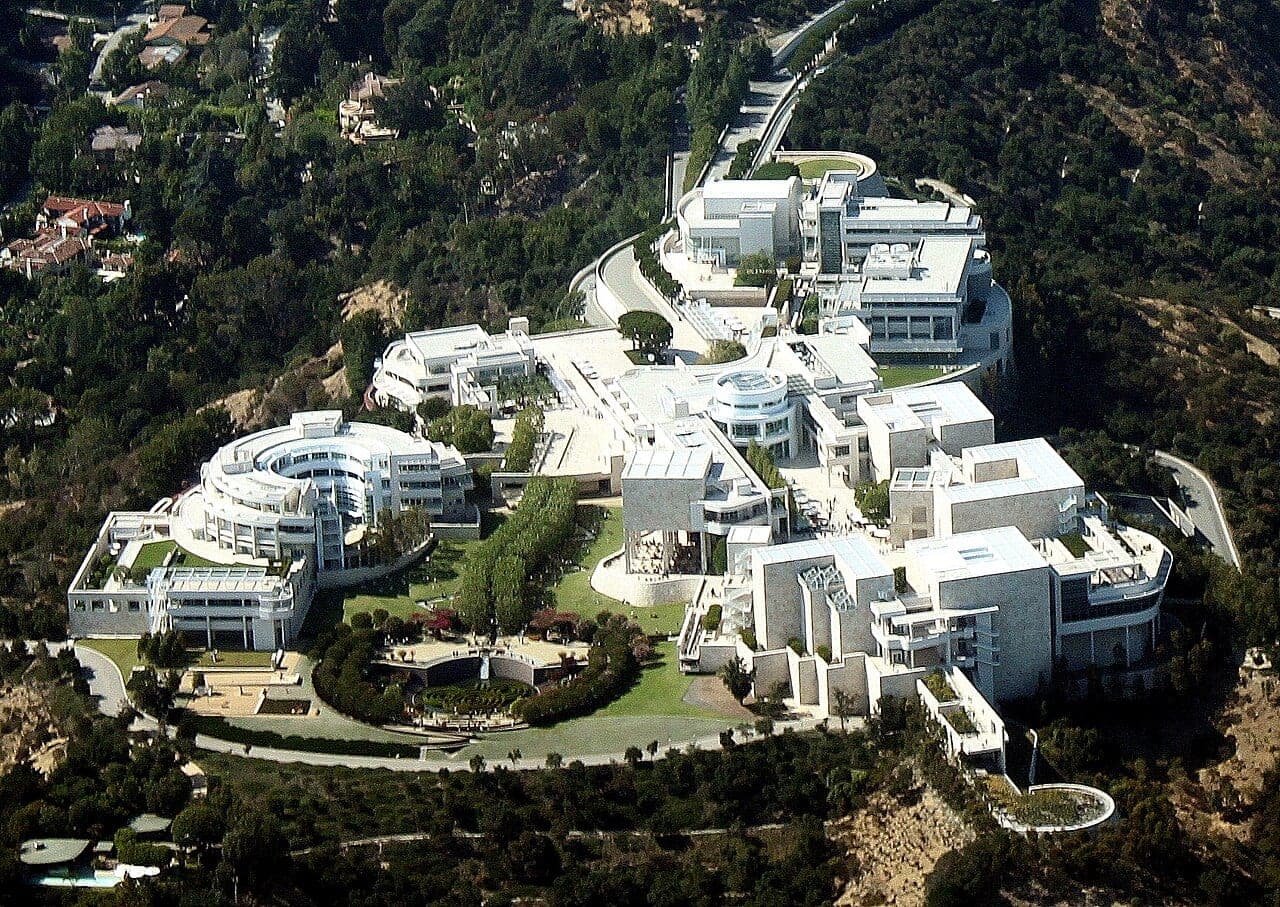
The J. Paul Getty Museum, known to most visitors simply as the Getty, is the art museum of the J. Paul Getty Trust, and it keeps its collection across two very different places in Los Angeles. The larger of the two is the Getty Center, the hilltop campus of white metal and honey-colored stone that the architect Richard Meier raised above the Sepulveda Pass in Brentwood and that opened to the public on December 16, 1997. The second is the Getty Villa, a re-creation of an ancient Roman country house on the coast near Malibu, where the museum gathers the Greek, Roman, and Etruscan antiquities from which the collection first grew. Both sites are free to enter, a choice made possible by an endowment that has made the Getty one of the wealthiest arts institutions in the world.
Behind the museum stands the memory of one man and the fortune he built. J. Paul Getty was an American oil magnate who began buying art in the 1930s and opened a small public museum in his ranch house above the Pacific in the 1950s. When he died in 1976 he left the bulk of his estate, around 700 million dollars in Getty Oil stock, to the trust that bears his name, and that bequest turned a modest private collection into an institution able to build, buy, and give on a scale few museums can match. The Getty today is not only a gallery but a group of institutes for research and conservation, and its recent history includes a public reckoning with how some of its antiquities were acquired. What follows traces the museum from the ranch house to the hilltop, and the collection it now holds in trust.
Jean Paul Getty was born in Minnesota in 1892 and made his fortune in oil, first in Oklahoma and later across the wider industry that carried his name. He started collecting art seriously during the 1930s, drawn to Greek and Roman antiquities, eighteenth-century French furniture, and European paintings, and he displayed his purchases in a wing of his ranch house in the Pacific Palisades district of Los Angeles. In 1953 he established the J. Paul Getty Museum as a trust, and the following year he opened the ranch-house galleries to the public. Admission was free from the beginning, a practice the museum has kept ever since.
The collection soon outgrew the house. To hold it, Getty built a new museum on his Malibu property, a full-scale re-creation of the Villa of the Papyri, a Roman country house at Herculaneum that had been buried by the eruption of Mount Vesuvius in 79 CE. That building opened in 1974. By then Getty was living in England, and he never saw the finished villa in person before his death two years later.
Getty died on June 6, 1976, and his will left the greater part of his estate to the museum. Legal and tax matters delayed the transfer, but when the bequest was settled the trust found itself in control of a fortune valued at more than a billion dollars, which by 1982 made it the wealthiest art institution in the world. The trustees decided to use that wealth to grow beyond the antiquities villa into a broad museum supported by programs in research, conservation, and grant-making. In 1984 they commissioned Richard Meier to design a new campus, and after more than a decade of planning and construction the Getty Center opened in December 1997. The Malibu villa closed for renovation and reopened in 2006 as a museum devoted entirely to antiquities, the role it fills today.
The Getty is best known for its holdings of European art made before the twentieth century, and its single most famous painting is Vincent van Gogh's Irises, completed in 1889 during the artist's stay at the asylum in Saint-Remy. The Getty acquired the picture in 1990, and it now hangs among works by Rembrandt, Titian, Rubens, Poussin, and the French Impressionists Monet and Cezanne. The paintings galleries are arranged by period and lit, where possible, by natural light drawn through the skylights of the pavilions that house them.
Around the paintings sit several other departments of unusual depth. The drawings collection reaches from the Renaissance to the nineteenth century. The department of illuminated manuscripts was created almost at a stroke in 1983, when the Getty bought the Ludwig collection of 144 medieval and Renaissance manuscripts and became one of the few American museums able to show the painted book as an art form in its own right. The sculpture and decorative arts galleries continue the taste Getty himself had shown for eighteenth-century French furniture, tapestries woven for European courts, and paneled period rooms.
Photography is a comparatively young part of the collection but among its strongest. In the mid-1980s the museum acquired several major private holdings at once, giving it a collection that runs from the invention of the medium in the nineteenth century through modern and contemporary work. The antiquities, meanwhile, live apart from all of this at the Getty Villa, where Greek, Roman, and Etruscan sculpture, vases, glass, and jewelry are shown in galleries and gardens designed to evoke the ancient world the objects came from.
The Getty Center is the work of Richard Meier, who spent much of the 1980s and 1990s on the project. The campus covers about 24 acres within a larger hilltop site in the Santa Monica Mountains, and it is clad in roughly 1.2 million square feet of travertine, a fossil-bearing Italian stone quarried near Tivoli and cut so that the rough, cleft faces catch the California light. Meier balanced that warm stone against panels of white-enameled aluminum, giving the buildings the pale, sharp-edged look for which he is known. Visitors leave their cars in a garage at the foot of the hill and ride a cable-drawn tram up to the arrival plaza, so that the museum is reached as a deliberate ascent rather than a walk from a parking lot.
 The cladding is Italian travertine, split rather than sawn so the fossils in it stay visible. About 1.2 million square feet of it was quarried for the site. Photograph by Wgreaves, CC BY-SA 4.0, via Wikimedia Commons.
At the center of the campus lies the Central Garden, a work of landscape art designed by the artist Robert Irwin rather than a conventional garden designer. It covers about 134,000 square feet and was planted so that its color and texture change through the seasons, with a stream running down a walkway to a pool ringed by a maze of azaleas. Irwin described it as a sculpture in the form of a garden that is always changing and never twice the same. The whole Getty Center cost about 1.3 billion dollars to build, a figure that reflects both the difficulty of the hilltop site and the quality of its materials.
The Getty Villa, some miles down the coast, is a different kind of building. Modeled on the buried Roman villa at Herculaneum, it presents its antiquities in the setting of a first-century country house, complete with a long outdoor peristyle garden, formal pools, a herb garden, and an open-air theater used for performances of ancient drama. Together the two sites let the museum show the classical past in a re-created villa and the later history of European art in a modern campus, each in a setting suited to what it holds.
The Getty Museum is one part of a larger body, the J. Paul Getty Trust, which also funds the Getty Research Institute, the Getty Conservation Institute, and the Getty Foundation. The Research Institute keeps one of the great art-history libraries and archives; the Conservation Institute carries out and shares conservation science that reaches far beyond the museum's own walls; and the Foundation gives grants to museums, scholars, and projects worldwide. Free admission, which draws close to 1.8 million visitors a year, is the most public expression of the trust's founding purpose, to make art and its study widely available.
The Getty's recent history also includes a difficult chapter over the origins of some of its antiquities, which the institution has addressed openly. In 2005 an Italian court indicted the museum's former antiquities curator, Marion True, on charges connected to trafficking in looted objects; the case ran for years and ended in 2010 without a verdict after the statute of limitations expired. During the same period the Getty examined the provenance of items in its collection and reached agreements to return a number of them to their countries of origin. In 2007 it agreed to return 40 objects to Italy, among them a large statue of a goddess, often identified with Aphrodite, that had been excavated illegally near the ancient Sicilian town of Morgantina. That statue was sent back to Italy and placed on display at the museum in Aidone, Sicily, in 2011. The Getty also returned objects to Greece during these years. Alongside the returns, the museum revised its acquisition policy in 2006 to require clearer documentation of an object's history before purchase, aligning its practice with international standards on the provenance of antiquities.
The museum operates at two locations, and admission to both is free. The Getty Center sits at 1200 Getty Center Drive in Brentwood, reached from Interstate 405; visitors park in the garage at the base of the hill, for which there is a fee, and ride the tram to the galleries above. The Center is generally open daily except Mondays and a few holidays, with galleries, the Central Garden, several dining options, and shops on the campus. Most visitors do well to allow at least half a day, and the views over Los Angeles and toward the ocean are part of the experience.
The Getty Villa lies on the Pacific Coast Highway near Malibu and shows the antiquities collection in its re-created Roman setting. Admission is free, but the Villa uses timed-entry tickets that should be reserved in advance, and parking again carries a fee. It is typically open daily except Tuesdays. Both sites are wheelchair accessible and offer guided tours, audio guides, and family programs, and either can be visited on its own without seeing the other on the same day.
The cladding is Italian travertine, split rather than sawn so the fossils in it stay visible. About 1.2 million square feet of it was quarried for the site. Photograph by Wgreaves, CC BY-SA 4.0, via Wikimedia Commons.
At the center of the campus lies the Central Garden, a work of landscape art designed by the artist Robert Irwin rather than a conventional garden designer. It covers about 134,000 square feet and was planted so that its color and texture change through the seasons, with a stream running down a walkway to a pool ringed by a maze of azaleas. Irwin described it as a sculpture in the form of a garden that is always changing and never twice the same. The whole Getty Center cost about 1.3 billion dollars to build, a figure that reflects both the difficulty of the hilltop site and the quality of its materials.
The Getty Villa, some miles down the coast, is a different kind of building. Modeled on the buried Roman villa at Herculaneum, it presents its antiquities in the setting of a first-century country house, complete with a long outdoor peristyle garden, formal pools, a herb garden, and an open-air theater used for performances of ancient drama. Together the two sites let the museum show the classical past in a re-created villa and the later history of European art in a modern campus, each in a setting suited to what it holds.
The Getty Museum is one part of a larger body, the J. Paul Getty Trust, which also funds the Getty Research Institute, the Getty Conservation Institute, and the Getty Foundation. The Research Institute keeps one of the great art-history libraries and archives; the Conservation Institute carries out and shares conservation science that reaches far beyond the museum's own walls; and the Foundation gives grants to museums, scholars, and projects worldwide. Free admission, which draws close to 1.8 million visitors a year, is the most public expression of the trust's founding purpose, to make art and its study widely available.
The Getty's recent history also includes a difficult chapter over the origins of some of its antiquities, which the institution has addressed openly. In 2005 an Italian court indicted the museum's former antiquities curator, Marion True, on charges connected to trafficking in looted objects; the case ran for years and ended in 2010 without a verdict after the statute of limitations expired. During the same period the Getty examined the provenance of items in its collection and reached agreements to return a number of them to their countries of origin. In 2007 it agreed to return 40 objects to Italy, among them a large statue of a goddess, often identified with Aphrodite, that had been excavated illegally near the ancient Sicilian town of Morgantina. That statue was sent back to Italy and placed on display at the museum in Aidone, Sicily, in 2011. The Getty also returned objects to Greece during these years. Alongside the returns, the museum revised its acquisition policy in 2006 to require clearer documentation of an object's history before purchase, aligning its practice with international standards on the provenance of antiquities.
The museum operates at two locations, and admission to both is free. The Getty Center sits at 1200 Getty Center Drive in Brentwood, reached from Interstate 405; visitors park in the garage at the base of the hill, for which there is a fee, and ride the tram to the galleries above. The Center is generally open daily except Mondays and a few holidays, with galleries, the Central Garden, several dining options, and shops on the campus. Most visitors do well to allow at least half a day, and the views over Los Angeles and toward the ocean are part of the experience.
The Getty Villa lies on the Pacific Coast Highway near Malibu and shows the antiquities collection in its re-created Roman setting. Admission is free, but the Villa uses timed-entry tickets that should be reserved in advance, and parking again carries a fee. It is typically open daily except Tuesdays. Both sites are wheelchair accessible and offer guided tours, audio guides, and family programs, and either can be visited on its own without seeing the other on the same day.
History and founding
The collection
The building
Cultural significance
Visiting
References and resources
- History of the J. Paul Getty Trust, the institution's official account of its founding and growth
- J. Paul Getty Museum on Wikipedia, with detail on the collection and both sites
- Getty Center on Wikipedia, a history of Richard Meier's campus and Robert Irwin's Central Garden
- Getty Trust at Encyclopaedia Britannica
- Ending a decades-long dispute, the Getty's Aphrodite returns to Italy, NPR on the 2011 repatriation
- Getty History and Timeline, the museum's official chronology