For families who want their stories to last. learn about the founding circle.

Heritage · Legacy

Vincent van Gogh Legacy

Explore Vincent van Gogh's life and art, from his emotive masterpieces like 'The Starry Night' to his journey through poverty and mental health struggles.

Written to last.

By Confinity Heritage Editorial · Updated 2026-07-20 · 6-minute read
Quiet tools, kept out of the way.
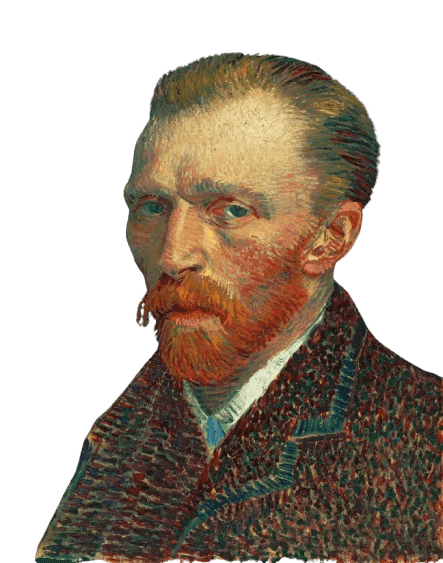
Self-portrait by Vincent van Gogh: the painter with a red beard and a steady gaze, rendered in short, swirling strokes of blue and green.
Vincent van Gogh painted for only about a decade, yet in that short span he produced roughly 2,100 works, including around 860 oil paintings, most of them in his final two years (Wikipedia). He was born in the rural southern Netherlands in 1853, came to art late after failing at several other trades, and died in a French village in 1890 at the age of 37. During his life he sold almost nothing and was widely taken for a failure. Within twenty years of his death he was counted among the most influential painters who had ever lived. Part of the reason we can say so much about him with confidence is that he wrote it down. Around 900 of his letters survive, more than 650 of them addressed to his younger brother Theo, and together they form one of the fullest first-person records any major artist has left (Vincent van Gogh: The Letters). The letters let us follow his reading, his money worries, his colour theory, and his illness in his own careful handwriting, which is why so much of what follows can be stated plainly rather than guessed at. Vincent Willem van Gogh was born on 30 March 1853 in Groot-Zundert, a village in the province of North Brabant near the Belgian border (Britannica). He was the eldest surviving son of Theodorus van Gogh, a minister in the Dutch Reformed Church, and Anna Cornelia Carbentus. The family was respectable and not wealthy, and several of Vincent's uncles worked in the art trade, which shaped the path he first took. At sixteen he joined the art dealers Goupil & Cie, where an uncle had connections, and the job carried him to branches in The Hague, London, and Paris (Van Gogh Museum). He was a poor salesman and grew openly contemptuous of the trade in pictures, and he was dismissed in 1876. A period of intense religious feeling followed. He worked briefly as a teacher and assistant preacher in England, then trained toward the ministry, and in 1878 went to the Borinage, a bleak coal-mining district in southern Belgium, to serve as a lay evangelist. The Borinage marked the turn of his life. He gave away his own comforts to the miners and lived in poverty alongside them, and his employers, unsettled by his extremity, declined to renew his appointment. Out of that failure came a decision: on the advice and with the support of Theo, he resolved to become an artist. He was twenty-seven, an age at which many painters have already been working for a decade (Van Gogh Museum). From then until his death, Theo, by now a professional art dealer in Paris, sent his brother money and paints almost every month and became the audience for his letters. Van Gogh taught himself with grim discipline, copying drawing manuals and studying anatomy and perspective. His early Dutch pictures are dark and earthbound, built from browns and greys, and they fix on peasants, weavers, and labourers. The best known of them, The Potato Eaters of 1885, shows a family of farm workers around a dish of potatoes under a single lamp, their hands and faces deliberately coarse. He wanted, he told Theo, to paint people who had earned their food by honest work. It is a world away in mood from the paintings that made him famous, and it was made only five years before he died. In 1886 van Gogh moved to Paris to live with Theo, and the encounter with the city's new painting changed everything. He saw the work of the Impressionists and the younger Neo-Impressionists at first hand, met artists such as Émile Bernard and Paul Signac, and absorbed the Japanese woodblock prints then circulating in Paris (Wikipedia). Over roughly two years his palette lightened and cleared, his brushwork broke into separate strokes of pure colour, and the dark peasant painter became a colourist. Many of his self-portraits date from this period, made in part because he could not afford models. Paris exhausted him, and in February 1888 he travelled south to Arles in Provence, drawn by the strong light and clear colour of the Mediterranean countryside. This was his most productive stretch. He rented rooms in the building he called the Yellow House and dreamed of gathering a community of artists there, painting the orchards in blossom, the harvest, the postman Joseph Roulin and his family, the night café, and the first of his sunflower still lifes (Britannica). He worked at great speed and wrote to Theo about colour as though it were a language he had only just learned to speak. Paul Gauguin joined him at Arles in October 1888, and for about two months the two men painted together and argued fiercely. On the night of 23 December 1888 the tension broke. After a confrontation with Gauguin, van Gogh cut off part of his own left ear with a razor, wrapped it, and carried it to a woman at a house nearby (History). He was found bleeding the next morning and taken to hospital in Arles. Gauguin left, and the artists' community was over almost before it began. Van Gogh recorded the aftermath without flinching in his Self-Portrait with Bandaged Ear of early 1889. The crisis was the first of several. In May 1889 van Gogh admitted himself, of his own accord, to the asylum of Saint-Paul-de-Mausole at Saint-Rémy-de-Provence, where he stayed for about a year (Van Gogh Museum). Between recurring attacks, during which he could not paint at all, he worked with astonishing intensity, making roughly 150 paintings in that single year. Among them are The Starry Night, painted in June 1889 from the view outside his barred window and reworked from memory, along with the cypresses, the olive groves, and a series of surging, restless landscapes. When Theo's son was born in early 1890 and named Vincent Willem after his uncle, van Gogh painted Almond Blossom, a branch of pale flowers against blue, as a gift for the child. In May 1890 he left the south and settled at Auvers-sur-Oise, a village north of Paris, close enough to see Theo and under the informal care of Dr Paul Gachet, an art-loving physician (Wikipedia). The pace did not slow. In about seventy days at Auvers he produced more than seventy paintings, including the Portrait of Dr Gachet, the village church, and the wide, uneasy Wheatfield with Crows. Van Gogh's illness has never been settled to a single diagnosis, and it is worth being careful about it. During his lifetime the doctors who treated him at Arles and Saint-Rémy suspected a form of epilepsy, and since his death scholars and physicians have proposed many other explanations, among them bipolar disorder, and have found no agreement (Wikipedia). What the letters and medical notes do record clearly is the shape of his suffering: episodes of severe agitation and hallucination that arrived without warning, left him unable to work, and were followed by long lucid stretches in which he wrote calmly about what had happened to him. His work and his condition should not be collapsed into each other. The swirling skies and heightened colour of the late paintings were the product of deliberate technique and study, worked out on canvas and argued through in his correspondence. He painted many of his strongest pictures in his most stable weeks, and during his worst attacks he generally could not paint at all. On 27 July 1890, in a field near Auvers, van Gogh shot himself in the chest. He walked back to his room at the Auberge Ravoux and died there in the early hours of 29 July, with Theo at his side; he was 37 (Wikipedia: Death of Vincent van Gogh). The account of his death as suicide is the one supported by the contemporary evidence and by the Van Gogh Museum, though a later theory that he was shot by others has circulated; historians who have examined it regard it as unsupported. Theo, who had carried his brother's career on his own shoulders for a decade, collapsed in grief and health after the funeral and died on 25 January 1891, barely six months later, at the age of 33 (Wikipedia: Theo van Gogh). The brothers now lie side by side in the cemetery at Auvers. The persistent claim that van Gogh sold only one painting in his lifetime is nearly, but not quite, true. One sale is firmly documented: The Red Vineyard, bought for 400 francs by the Belgian painter and collector Anna Boch after it was shown with the group Les XX in Brussels early in 1890. The Van Gogh Museum notes that he probably sold or traded a handful of other works as well, so the honest version is that he sold very little and earned almost nothing from his art while he lived (Van Gogh Museum). Recognition came only after he could no longer see it. Much of that recognition was built by one determined person. When Theo died, his widow, Johanna van Gogh-Bonger, inherited hundreds of paintings and the entire body of letters. She spent the rest of her life lending the pictures to exhibitions, placing them with collectors and museums, and preparing the correspondence for publication; the first substantial edition of the letters appeared in 1914 (Wikipedia). Her work turned a private tragedy into a public body of work that critics could study and the public could see. The influence spread quickly. The bright colour and open, expressive brushwork of the late paintings fed directly into Fauvism and, above all, into German Expressionism in the first years of the twentieth century, and his example stands behind much of what modern painting did next with colour and feeling (Britannica). The family collection that Johanna preserved passed to her son, Vincent Willem van Gogh, and it forms the core of the Van Gogh Museum in Amsterdam, which opened in 1973 and now holds the largest collection of his work in the world (Van Gogh Museum). His paintings, once nearly unsellable, are today among the most valuable and most reproduced images on earth. Van Gogh's life is easy to sentimentalise and worth telling straight instead. The facts are steadying on their own: a man who found his real work at twenty-seven, taught himself a craft against the grain of his own instability, made more than two thousand things in ten years, and died believing he had failed. The record survives because he wrote it and because his brother's widow refused to let it disappear. What makes his story unusually complete is documentation. Because van Gogh described his intentions, his methods, and his crises in hundreds of letters, we do not have to invent his inner life to feel close to it; we can read it. That is the difference between a reputation and a record. A legacy holds when the specifics are kept, dated, and open to anyone who wants to check them, so that a person is remembered as they actually were rather than as a legend rounded off at the edges. Van Gogh, of all people, left enough of himself behind for that to be possible.
What we preserve here

A life worth keeping is a life worth re-reading. Confinity exists so the lives in your own family are kept with the same care.

More legacies to read

All legacies
Heritage library
Start your own archive