Heritage · Country
Ukraine Culture and Heritage
On the fourth Saturday of each November, Ukrainians set a single candle in the window for the millions starved in the Holodomor, and since 2022 whole city squares have filled with small flags, one for each fallen defender. A guide to the country's heritage and to a nation that has had to become an expert in remembering.Written to last.
By Confinity Heritage Editorial · 2026-07-11 · 8-minute readQuiet tools, kept out of the way.
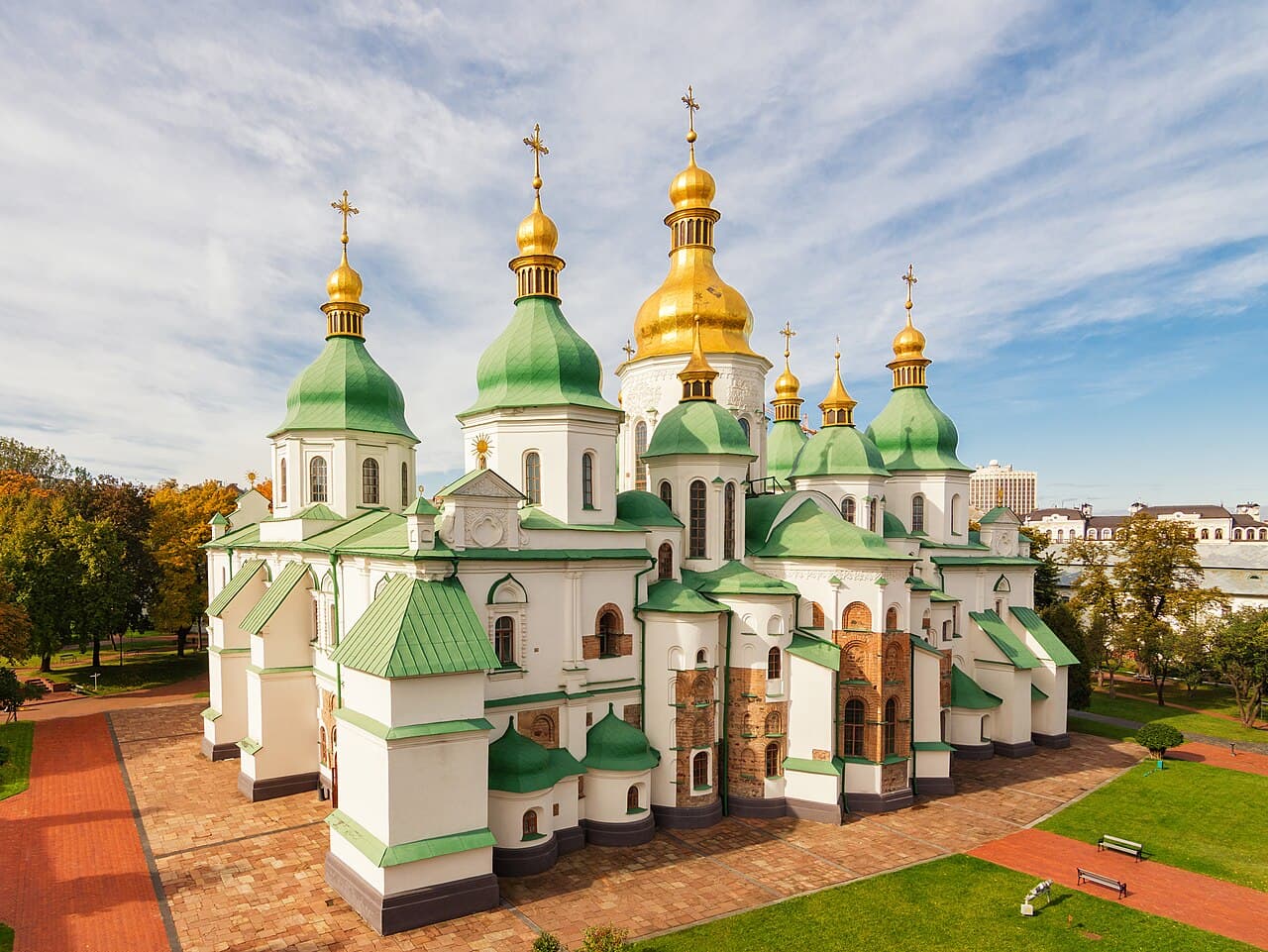
Across the open steppe of southern and eastern Ukraine stand thousands of burial mounds, the kurhans, some raised by Scythian nomads two and a half thousand years ago and some older still, and on the greatest of them once stood carved stone figures, the kamyani baby, weathered sentinels with their hands folded over their bellies. The Cossacks who later crossed the same grasslands used the mounds as landmarks and lookout posts, and Ukrainian archaeologists have pulled from them the worked gold that fills the treasuries of Kyiv. The land itself is a cemetery on a geological scale, a country whose flatness is broken by the graves of the people who crossed it, and that long habit of marking the dead in the landscape has never really stopped.
Ukraine has needed the habit. Within a single lifetime it lost several million people to a famine engineered by Moscow in 1932 and 1933, saw more than a million Jews murdered on its soil during the Holocaust, and since February 2022 has been fighting the largest war in Europe since 1945. Each catastrophe has produced its own grammar of memory: the candle set in the window on Holodomor Memorial Day, the ravine at Babyn Yar, the photographs of the killed pinned along a monastery wall in central Kyiv, and the fields of small blue-and-yellow flags that now stand in Independence Square and in town squares across the country, each flag a name.
.jpg%2F1280px-Cathedral_of_the_Dormition_-_Kiev_Pechersk_Lavra_(8601807770).jpg&w=3840&q=75) The Dormition Cathedral of the Kyiv Pechersk Lavra, rebuilt and reconsecrated in 2000 after the Soviet-era destruction of 1941. CC BY 2.0, via Wikimedia Commons.
Ukraine is the largest country lying entirely within Europe, some 603,000 square kilometres of black-earth plain, rolling steppe and river valley, bordered by seven countries and by the Black Sea and Sea of Azov to the south. The Dnipro, one of the longest rivers in Europe, runs the length of the country from the northern forests to the sea and has always been its central artery; Kyiv rose on its bluffs. Most of Ukraine is lowland famous for its chornozem, the deep black soil that made the country one of the world's great grain exporters, but the land rises to the wooded Carpathians in the west, where Hoverla reaches 2,061 metres, and to the Crimean mountains in the south.
Before 2022 Ukraine had a population of roughly 41 million, excluding Crimea, which Russia annexed in 2014. The full-scale invasion has since displaced millions inside the country and driven several million more abroad, the largest refugee movement in Europe since the Second World War, so that any current figure is provisional. Ukraine is a unitary republic with a directly elected president and a parliament, the Verkhovna Rada, and it has been independent since the collapse of the Soviet Union in 1991, when more than 90 per cent of voters, in every region, chose to leave. Kyiv, a city of some three million, is the capital and the spiritual centre of the East Slavic world; the country's identity, long suppressed and repeatedly declared extinct by its neighbours, has proved to be one of the most durable facts of modern Europe.
Kyiv. More than fifteen hundred years old, the capital was the seat of Kyivan Rus, the medieval federation from which Ukraine, Belarus and Russia all trace descent, and its skyline is still defined by the gilded domes that Rus built. The eleventh-century Saint Sophia Cathedral and the cave monastery of the Kyiv Pechersk Lavra together form Ukraine's first UNESCO World Heritage Site, inscribed in 1990; Independence Square, the Maidan, has twice been the stage of revolution. Kyiv is where the modern Ukrainian nation keeps its records, its relics and, increasingly, its war dead.
Lviv. The great city of the west, founded in the mid-thirteenth century and named for Prince Lev, spent centuries within Poland and the Austro-Hungarian Empire, and its historic centre, a UNESCO site since 1998, is one of the best-preserved ensembles of a Central European trading town anywhere. Its Rynok, the market square, is ringed by forty-four merchant houses in styles from Renaissance to Art Nouveau, and its Lychakiv Cemetery is among the most beautiful in Europe. Far from the front, Lviv has become a refuge and a hospital city, and its citizens sandbagged their monuments and wrapped their stained glass at the start of the war.
The Dormition Cathedral of the Kyiv Pechersk Lavra, rebuilt and reconsecrated in 2000 after the Soviet-era destruction of 1941. CC BY 2.0, via Wikimedia Commons.
Ukraine is the largest country lying entirely within Europe, some 603,000 square kilometres of black-earth plain, rolling steppe and river valley, bordered by seven countries and by the Black Sea and Sea of Azov to the south. The Dnipro, one of the longest rivers in Europe, runs the length of the country from the northern forests to the sea and has always been its central artery; Kyiv rose on its bluffs. Most of Ukraine is lowland famous for its chornozem, the deep black soil that made the country one of the world's great grain exporters, but the land rises to the wooded Carpathians in the west, where Hoverla reaches 2,061 metres, and to the Crimean mountains in the south.
Before 2022 Ukraine had a population of roughly 41 million, excluding Crimea, which Russia annexed in 2014. The full-scale invasion has since displaced millions inside the country and driven several million more abroad, the largest refugee movement in Europe since the Second World War, so that any current figure is provisional. Ukraine is a unitary republic with a directly elected president and a parliament, the Verkhovna Rada, and it has been independent since the collapse of the Soviet Union in 1991, when more than 90 per cent of voters, in every region, chose to leave. Kyiv, a city of some three million, is the capital and the spiritual centre of the East Slavic world; the country's identity, long suppressed and repeatedly declared extinct by its neighbours, has proved to be one of the most durable facts of modern Europe.
Kyiv. More than fifteen hundred years old, the capital was the seat of Kyivan Rus, the medieval federation from which Ukraine, Belarus and Russia all trace descent, and its skyline is still defined by the gilded domes that Rus built. The eleventh-century Saint Sophia Cathedral and the cave monastery of the Kyiv Pechersk Lavra together form Ukraine's first UNESCO World Heritage Site, inscribed in 1990; Independence Square, the Maidan, has twice been the stage of revolution. Kyiv is where the modern Ukrainian nation keeps its records, its relics and, increasingly, its war dead.
Lviv. The great city of the west, founded in the mid-thirteenth century and named for Prince Lev, spent centuries within Poland and the Austro-Hungarian Empire, and its historic centre, a UNESCO site since 1998, is one of the best-preserved ensembles of a Central European trading town anywhere. Its Rynok, the market square, is ringed by forty-four merchant houses in styles from Renaissance to Art Nouveau, and its Lychakiv Cemetery is among the most beautiful in Europe. Far from the front, Lviv has become a refuge and a hospital city, and its citizens sandbagged their monuments and wrapped their stained glass at the start of the war.
.jpg%2F1280px-Rynok_Square_in_Lviv_(8673861595).jpg&w=3840&q=75) The Rynok market square in Lviv, the heart of a UNESCO-listed old town. CC BY 2.0, via Wikimedia Commons.
Kharkiv. Ukraine's second city and its first Soviet capital, a centre of science, engineering and the arts near the Russian border, Kharkiv gave the Ukrainian avant-garde of the 1920s its home before Stalin destroyed it. Repeatedly shelled since 2022, the city has kept its universities and theatres running underground, and its Derzhprom constructivist complex remains a monument to the brief cultural flowering the Soviets called the "Executed Renaissance".
Odesa. The Black Sea port laid out under Catherine II at the end of the eighteenth century grew into a cosmopolitan city of Greeks, Jews, Italians and Ukrainians, famous for its Potemkin Steps, its opera house and its literary wit. Its historic centre was inscribed as a World Heritage Site in 2023, immediately placed on the danger list, after Russian missiles struck the city; the Transfiguration Cathedral was among the buildings hit.
Chernihiv. One of the oldest cities of Rus, north of Kyiv, Chernihiv preserves a cluster of eleventh- and twelfth-century churches among the earliest stone architecture in Eastern Europe, the deep pre-Mongol layer of Ukrainian heritage that the country is now defending.
Ukraine's recorded history begins on the steppe with the Cimmerians and Scythians, whose kurhans and golden animal-style art the Greeks who traded on the Black Sea coast described and coveted. In the ninth century the Varangian and Slavic princes of Kyiv built Kyivan Rus into the dominant power of Eastern Europe, and in 988 Grand Prince Volodymyr accepted Byzantine Christianity and had the people of Kyiv baptised in the Dnipro, binding the region to the Orthodox and Byzantine world. Yaroslav the Wise raised Saint Sophia and issued the first East Slavic law code. The Mongol sack of Kyiv in 1240 ended that golden age, and the lands of modern Ukraine passed for centuries under the rule of Lithuania and then the Polish-Lithuanian Commonwealth.
Out of the frontier steppe rose the Cossacks, free warrior communities whose Zaporozhian Sich became the cradle of a distinct Ukrainian political identity; the great revolt led by Hetman Bohdan Khmelnytsky in 1648 created a Cossack state that was gradually absorbed by Moscow. By the nineteenth century Ukraine was divided between the Russian and Austro-Hungarian empires, and a national revival, led above all by the poet and former serf Taras Shevchenko, insisted that Ukrainians were a people in their own right. A short-lived Ukrainian People's Republic emerged from the chaos of 1917 to 1921 before Soviet power crushed it. What followed under Stalin was catastrophe: the Holodomor of 1932 and 1933, a man-made famine that killed millions and which Ukraine and many other states now recognise as genocide, and then the Second World War, in which the country was fought over twice, its Jews murdered in mass shootings such as Babyn Yar, and millions of its soldiers and civilians killed. Independence came peacefully in 1991, but the twenty-first century brought the Orange Revolution of 2004, the Revolution of Dignity on the Maidan in 2013 and 2014, Russia's seizure of Crimea and war in the Donbas, and, on 24 February 2022, the full-scale invasion that continues.
The Rynok market square in Lviv, the heart of a UNESCO-listed old town. CC BY 2.0, via Wikimedia Commons.
Kharkiv. Ukraine's second city and its first Soviet capital, a centre of science, engineering and the arts near the Russian border, Kharkiv gave the Ukrainian avant-garde of the 1920s its home before Stalin destroyed it. Repeatedly shelled since 2022, the city has kept its universities and theatres running underground, and its Derzhprom constructivist complex remains a monument to the brief cultural flowering the Soviets called the "Executed Renaissance".
Odesa. The Black Sea port laid out under Catherine II at the end of the eighteenth century grew into a cosmopolitan city of Greeks, Jews, Italians and Ukrainians, famous for its Potemkin Steps, its opera house and its literary wit. Its historic centre was inscribed as a World Heritage Site in 2023, immediately placed on the danger list, after Russian missiles struck the city; the Transfiguration Cathedral was among the buildings hit.
Chernihiv. One of the oldest cities of Rus, north of Kyiv, Chernihiv preserves a cluster of eleventh- and twelfth-century churches among the earliest stone architecture in Eastern Europe, the deep pre-Mongol layer of Ukrainian heritage that the country is now defending.
Ukraine's recorded history begins on the steppe with the Cimmerians and Scythians, whose kurhans and golden animal-style art the Greeks who traded on the Black Sea coast described and coveted. In the ninth century the Varangian and Slavic princes of Kyiv built Kyivan Rus into the dominant power of Eastern Europe, and in 988 Grand Prince Volodymyr accepted Byzantine Christianity and had the people of Kyiv baptised in the Dnipro, binding the region to the Orthodox and Byzantine world. Yaroslav the Wise raised Saint Sophia and issued the first East Slavic law code. The Mongol sack of Kyiv in 1240 ended that golden age, and the lands of modern Ukraine passed for centuries under the rule of Lithuania and then the Polish-Lithuanian Commonwealth.
Out of the frontier steppe rose the Cossacks, free warrior communities whose Zaporozhian Sich became the cradle of a distinct Ukrainian political identity; the great revolt led by Hetman Bohdan Khmelnytsky in 1648 created a Cossack state that was gradually absorbed by Moscow. By the nineteenth century Ukraine was divided between the Russian and Austro-Hungarian empires, and a national revival, led above all by the poet and former serf Taras Shevchenko, insisted that Ukrainians were a people in their own right. A short-lived Ukrainian People's Republic emerged from the chaos of 1917 to 1921 before Soviet power crushed it. What followed under Stalin was catastrophe: the Holodomor of 1932 and 1933, a man-made famine that killed millions and which Ukraine and many other states now recognise as genocide, and then the Second World War, in which the country was fought over twice, its Jews murdered in mass shootings such as Babyn Yar, and millions of its soldiers and civilians killed. Independence came peacefully in 1991, but the twenty-first century brought the Orange Revolution of 2004, the Revolution of Dignity on the Maidan in 2013 and 2014, Russia's seizure of Crimea and war in the Donbas, and, on 24 February 2022, the full-scale invasion that continues.
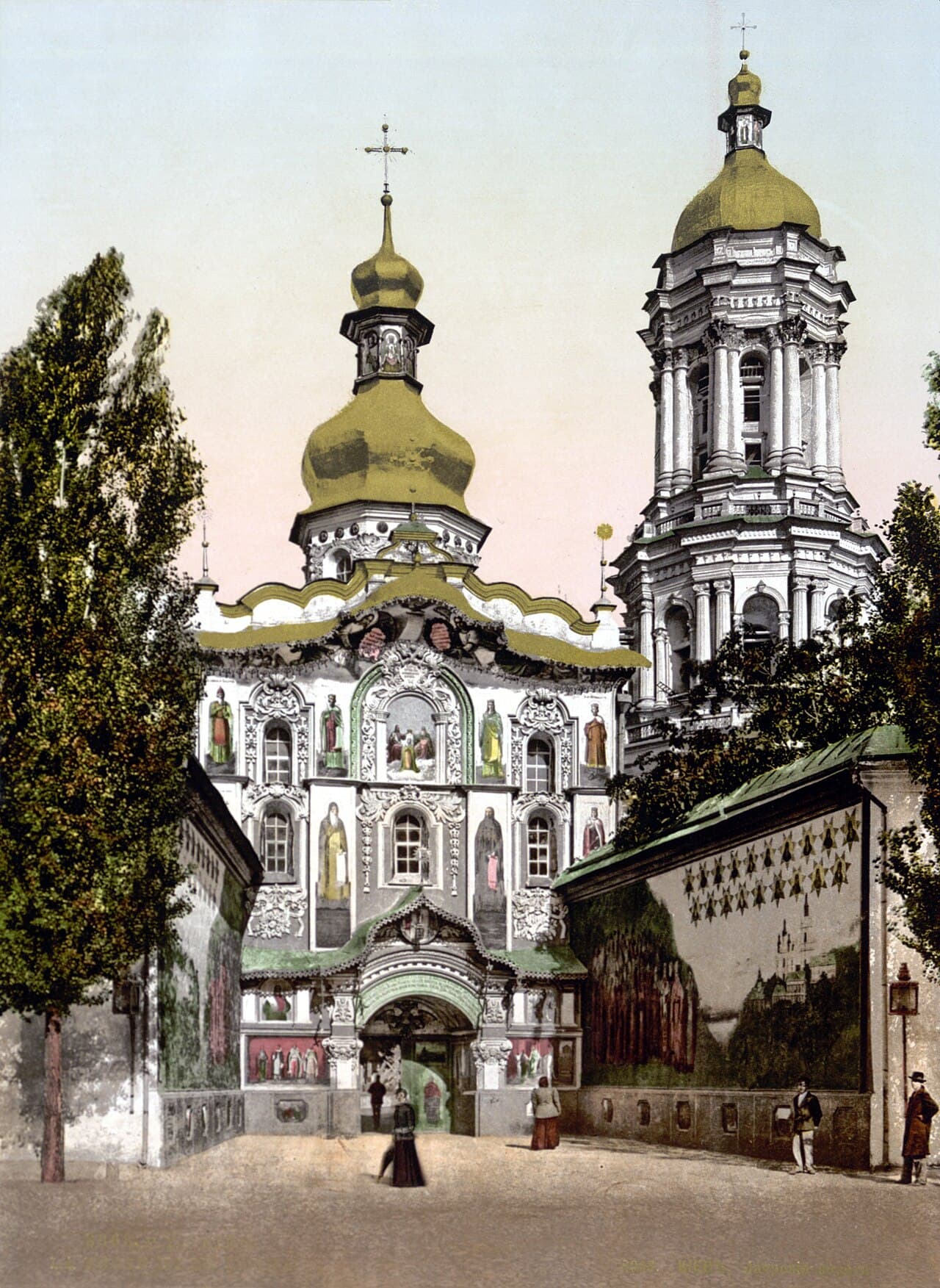 Kyiv in the 1890s, in a Library of Congress photochrom print, its river bluffs crowned by the churches of Rus. Public domain, via Wikimedia Commons.
Ukrainian is an East Slavic language, close kin to Belarusian and, more distantly, Russian, written in a Cyrillic alphabet descended from the script devised for the Slavs in the ninth century. The origin of the country's name is debated: it is usually derived from the Slavic krai, meaning land, region or edge, and older readings that translated it as "borderland" have given way among Ukrainians to the sense of "homeland" or simply "the country". Whatever its root, Ukrainians today insist on the form "in Ukraine" rather than "the Ukraine", the definite article having carried an imperial suggestion of a mere province.
The map of Ukraine records every power that ruled it. Greek colony names survive on the Black Sea coast; Turkic words mark the centuries of steppe nomads and the Crimean Khanate; Polish, Lithuanian and German layers lie thick over the west, where Lviv was long Lwów and Lemberg. The language itself was repeatedly banned or belittled under the Russian Empire and the Soviet Union, subjected to forced Russification, yet it survived in villages, in the countryside and in the fierce loyalty of writers. Since 2022 that history has driven a broad turn away from Russian in everyday life, and a wave of renaming has stripped Soviet and Russian imperial names from streets and towns across the country. Ukrainian also carries a distinctive musical tradition of its own in the heroic songs of the blind minstrels, the kobzars, who wandered the country singing the dumy, historical ballads of Cossack loss, until Stalin's regime had many of them killed.
Ukrainian culture is built around the village and the land even as the country has urbanised, and its most recognisable emblems come from folk craft. The vyshyvanka, the embroidered shirt whose red-and-black patterns vary from region to region, has become a national symbol worn with pride; the third Thursday of May is marked as Vyshyvanka Day, when people fill streets and offices in embroidery. The pysanka, the wax-resist decorated egg, is far older than Christianity in its symbolism and is treated as a small talisman of life. Petrykivka painting, the exuberant floral folk art of the Dnipro region, joined UNESCO's intangible heritage list in 2013. Above all there is food: borscht, the beetroot soup that every family makes differently, became in 2022 the subject of a UNESCO Urgent Safeguarding listing for "the culture of Ukrainian borscht cooking", a rare case of a recipe entering world heritage as a matter of cultural survival.
The country's literary and musical canon is national infrastructure. Taras Shevchenko, whose collection Kobzar appeared in 1840, is revered less as a poet than as the voice of the nation, his monuments standing in almost every town; Lesya Ukrainka and Ivan Franko complete the trinity of nineteenth-century writers. The bandura, a many-stringed lute-harp, remains the emblematic instrument, and folk singing runs from the polyphony of village women to the global success of groups like DakhaBrakha. Football and, increasingly, other sports carry modern identity, but so do the older customs that mark the year, from Malanka masking at the old new year to the Kupala fires of midsummer and the caroling of Christmas, now celebrated by a growing number of Ukrainians on 25 December after a 2023 change to the church calendar that itself was a statement of distance from Moscow.
Ukraine is one of the oldest centres of Eastern Christianity, dating its faith to the baptism of Rus in 988, and its religious life is overwhelmingly Christian and strikingly plural. Orthodoxy has long been divided, and the creation in 2018 and 2019 of a unified Orthodox Church of Ukraine, granted a tomos of independence by the Ecumenical Patriarch of Constantinople, was a landmark of national self-definition, setting the new church against the older body historically tied to the Moscow Patriarchate. In the western regions of Galicia and Transcarpathia the dominant tradition is the Ukrainian Greek Catholic Church, an Eastern-rite church in communion with Rome that was banned outright under the Soviets and re-emerged from the catacombs in 1989. Roman Catholics, Protestants and a large evangelical community complete the Christian picture.
Ukraine is also central to Jewish and Islamic history. The Hasidic movement was born here in the eighteenth century around the Baal Shem Tov at Medzhybizh, and each Rosh Hashanah, in ordinary years, tens of thousands of Hasidic pilgrims travel to the town of Uman to pray at the grave of Rabbi Nachman of Breslov. The Crimean Tatars, a Muslim Turkic people deported en masse by Stalin in 1944 and only able to return after 1989, are indigenous to the peninsula and central to its heritage. Sacred geography still orders the country: the golden-domed monasteries of Kyiv, the wooden tserkvas of the Carpathians built without a single nail and inscribed by UNESCO in 2013, and the pilgrimage sites of the Greek Catholic west. The war has fallen heavily on this inheritance, damaging or destroying churches of every denomination, and in June 2026 a drone strike damaged the Dormition Cathedral of the Lavra itself.
Ukrainian mourning keeps the deep forms of Orthodox and folk practice. A death is announced to the household by covering the mirrors; the body is watched over at a wake, laid out at home or in church with an open coffin, and then buried. Cremation remains uncommon. The family and community gather afterwards for a memorial meal at which kutia, a wheat-and-honey dish, and koliva are shared. Prayers and gatherings are repeated on the ninth and the fortieth day after death, and again at the year's mind, the fortieth day marking the soul's final departure. Ritual embroidered cloths, the rushnyky, accompany a person through life and death, draped over icons and lowered into the grave. In much of Ukraine the most vivid day of remembrance is Provody, also called Grobky, in the week after Easter, when families travel to the cemetery, tidy the graves and eat and drink among them, sharing food with the dead in a spring reunion of the living and the departed.
Onto these village rites the twentieth century layered national days of mourning. Holodomor Memorial Day, on the fourth Saturday of November, is the most solemn: at four in the afternoon Ukrainians light a candle and set it in the window, and the whole country observes a minute of silence for the millions the famine killed, remembered at the National Museum of the Holodomor-Genocide in Kyiv, whose thirty-metre white "Candle of Memory" rises above the Dnipro and whose sculpture of a starving girl clutching a few stalks of wheat has become the emblem of the tragedy. The Holocaust has its own sites, above all the ravine of Babyn Yar in Kyiv, where German forces and collaborators shot 33,771 Jews over two days in September 1941 and tens of thousands more in the months that followed; the Babyn Yar Holocaust Memorial Center now works to mark the place. The Revolution of Dignity added the Heavenly Hundred, the protesters killed on the Maidan in early 2014, commemorated each February along the street where they died.
Kyiv in the 1890s, in a Library of Congress photochrom print, its river bluffs crowned by the churches of Rus. Public domain, via Wikimedia Commons.
Ukrainian is an East Slavic language, close kin to Belarusian and, more distantly, Russian, written in a Cyrillic alphabet descended from the script devised for the Slavs in the ninth century. The origin of the country's name is debated: it is usually derived from the Slavic krai, meaning land, region or edge, and older readings that translated it as "borderland" have given way among Ukrainians to the sense of "homeland" or simply "the country". Whatever its root, Ukrainians today insist on the form "in Ukraine" rather than "the Ukraine", the definite article having carried an imperial suggestion of a mere province.
The map of Ukraine records every power that ruled it. Greek colony names survive on the Black Sea coast; Turkic words mark the centuries of steppe nomads and the Crimean Khanate; Polish, Lithuanian and German layers lie thick over the west, where Lviv was long Lwów and Lemberg. The language itself was repeatedly banned or belittled under the Russian Empire and the Soviet Union, subjected to forced Russification, yet it survived in villages, in the countryside and in the fierce loyalty of writers. Since 2022 that history has driven a broad turn away from Russian in everyday life, and a wave of renaming has stripped Soviet and Russian imperial names from streets and towns across the country. Ukrainian also carries a distinctive musical tradition of its own in the heroic songs of the blind minstrels, the kobzars, who wandered the country singing the dumy, historical ballads of Cossack loss, until Stalin's regime had many of them killed.
Ukrainian culture is built around the village and the land even as the country has urbanised, and its most recognisable emblems come from folk craft. The vyshyvanka, the embroidered shirt whose red-and-black patterns vary from region to region, has become a national symbol worn with pride; the third Thursday of May is marked as Vyshyvanka Day, when people fill streets and offices in embroidery. The pysanka, the wax-resist decorated egg, is far older than Christianity in its symbolism and is treated as a small talisman of life. Petrykivka painting, the exuberant floral folk art of the Dnipro region, joined UNESCO's intangible heritage list in 2013. Above all there is food: borscht, the beetroot soup that every family makes differently, became in 2022 the subject of a UNESCO Urgent Safeguarding listing for "the culture of Ukrainian borscht cooking", a rare case of a recipe entering world heritage as a matter of cultural survival.
The country's literary and musical canon is national infrastructure. Taras Shevchenko, whose collection Kobzar appeared in 1840, is revered less as a poet than as the voice of the nation, his monuments standing in almost every town; Lesya Ukrainka and Ivan Franko complete the trinity of nineteenth-century writers. The bandura, a many-stringed lute-harp, remains the emblematic instrument, and folk singing runs from the polyphony of village women to the global success of groups like DakhaBrakha. Football and, increasingly, other sports carry modern identity, but so do the older customs that mark the year, from Malanka masking at the old new year to the Kupala fires of midsummer and the caroling of Christmas, now celebrated by a growing number of Ukrainians on 25 December after a 2023 change to the church calendar that itself was a statement of distance from Moscow.
Ukraine is one of the oldest centres of Eastern Christianity, dating its faith to the baptism of Rus in 988, and its religious life is overwhelmingly Christian and strikingly plural. Orthodoxy has long been divided, and the creation in 2018 and 2019 of a unified Orthodox Church of Ukraine, granted a tomos of independence by the Ecumenical Patriarch of Constantinople, was a landmark of national self-definition, setting the new church against the older body historically tied to the Moscow Patriarchate. In the western regions of Galicia and Transcarpathia the dominant tradition is the Ukrainian Greek Catholic Church, an Eastern-rite church in communion with Rome that was banned outright under the Soviets and re-emerged from the catacombs in 1989. Roman Catholics, Protestants and a large evangelical community complete the Christian picture.
Ukraine is also central to Jewish and Islamic history. The Hasidic movement was born here in the eighteenth century around the Baal Shem Tov at Medzhybizh, and each Rosh Hashanah, in ordinary years, tens of thousands of Hasidic pilgrims travel to the town of Uman to pray at the grave of Rabbi Nachman of Breslov. The Crimean Tatars, a Muslim Turkic people deported en masse by Stalin in 1944 and only able to return after 1989, are indigenous to the peninsula and central to its heritage. Sacred geography still orders the country: the golden-domed monasteries of Kyiv, the wooden tserkvas of the Carpathians built without a single nail and inscribed by UNESCO in 2013, and the pilgrimage sites of the Greek Catholic west. The war has fallen heavily on this inheritance, damaging or destroying churches of every denomination, and in June 2026 a drone strike damaged the Dormition Cathedral of the Lavra itself.
Ukrainian mourning keeps the deep forms of Orthodox and folk practice. A death is announced to the household by covering the mirrors; the body is watched over at a wake, laid out at home or in church with an open coffin, and then buried. Cremation remains uncommon. The family and community gather afterwards for a memorial meal at which kutia, a wheat-and-honey dish, and koliva are shared. Prayers and gatherings are repeated on the ninth and the fortieth day after death, and again at the year's mind, the fortieth day marking the soul's final departure. Ritual embroidered cloths, the rushnyky, accompany a person through life and death, draped over icons and lowered into the grave. In much of Ukraine the most vivid day of remembrance is Provody, also called Grobky, in the week after Easter, when families travel to the cemetery, tidy the graves and eat and drink among them, sharing food with the dead in a spring reunion of the living and the departed.
Onto these village rites the twentieth century layered national days of mourning. Holodomor Memorial Day, on the fourth Saturday of November, is the most solemn: at four in the afternoon Ukrainians light a candle and set it in the window, and the whole country observes a minute of silence for the millions the famine killed, remembered at the National Museum of the Holodomor-Genocide in Kyiv, whose thirty-metre white "Candle of Memory" rises above the Dnipro and whose sculpture of a starving girl clutching a few stalks of wheat has become the emblem of the tragedy. The Holocaust has its own sites, above all the ravine of Babyn Yar in Kyiv, where German forces and collaborators shot 33,771 Jews over two days in September 1941 and tens of thousands more in the months that followed; the Babyn Yar Holocaust Memorial Center now works to mark the place. The Revolution of Dignity added the Heavenly Hundred, the protesters killed on the Maidan in early 2014, commemorated each February along the street where they died.
.jpg%2F1280px-%2522The_Memory_Candle%2522_monument_to_the_victims_of_Holodomor_-_%25E2%2580%259CThe_Memorial_in_Commemoration_of_Famines%25E2%2580%2599_Victims_in_Ukraine%25E2%2580%259D_museum_(8601805294).jpg&w=3840&q=75) The Candle of Memory at the National Museum of the Holodomor-Genocide, Kyiv, where a candle is lit each November for the famine's victims. CC BY 2.0, via Wikimedia Commons.
Since 2022 remembrance has become a daily national activity. Along the wall of St. Michael's Golden-Domed Monastery in Kyiv, itself a building the Soviets dynamited in 1937 and Ukrainians rebuilt after independence, thousands of photographs of killed soldiers are pinned in a growing memorial to the fallen defenders of Ukraine, and outside the monastery stands an exhibition of destroyed Russian armour. In Independence Square and in the central squares of cities across the country, families and comrades plant small national flags for the dead, so that the flags multiply week by week into vast silent fields, each carrying a handwritten name and dates. Fallen soldiers are brought home for burial with a kneeling honour guard and roads that halt as the coffin passes, and towns are opening dedicated Alleys of Glory in their cemeteries. It is a country improvising, at speed and on a terrible scale, the memorial forms of a war that has not ended.
Ukrainian records were made by other people's empires, and where they are now depends on which one. The centre and east were under Russian rule, so the sources are the Orthodox metrical books from 1722 and the revision lists between 1719 and 1858. Galicia and Bukovina in the west were Habsburg, so the sources are Greek Catholic, Roman Catholic and Jewish registers kept to the Austrian pattern, often in better order and with more detail.
Both bodies of material sit in the regional state archives, and Ukraine had been opening them at speed. A national digitisation programme was well under way before 2022, and much of what had been photographed by then is online.
The war has changed the work in two directions at once. Archives in the east and south have been shelled, occupied, or evacuated in a hurry, and some collections are simply not accountable. At the same time the digitisation has accelerated, and volunteer projects both inside Ukraine and among the diaspora have been scanning and indexing registers specifically because the originals are at risk. It is heritage preservation carried out as emergency salvage.
For families abroad, the older obstacle still applies: place names have changed repeatedly, sometimes three or four times in a century, and a village remembered in a family as Polish or Russian or Austrian may now carry a Ukrainian name that no relative ever used. Establishing where a family came from is usually harder than finding them once you know.
Ukraine's formal heritage system centres on its great national reserves, the Sophia of Kyiv and Kyiv-Pechersk Lavra conservation areas foremost among them, and on the Ministry of Culture, which maintains the state register of monuments. The country has eight UNESCO World Heritage Sites, seven cultural and one natural: the Kyiv ensemble of Saint Sophia and the Lavra; the historic centre of Lviv; the Struve Geodetic Arc survey points; the ancient Greek city of Tauric Chersonese near Sevastopol; the Residence of the Bukovinian and Dalmatian Metropolitans in Chernivtsi; the wooden tserkvas of the Carpathian region, shared with Poland; the primeval beech forests of the Carpathians, a transnational natural site; and the historic centre of Odesa, added in 2023. Three of these, in Kyiv, Lviv and Odesa, are now on the List of World Heritage in Danger.
The war has turned preservation into emergency salvage. UNESCO has verified damage to hundreds of cultural sites since the invasion began, from museums and churches to monuments and libraries, and Ukrainian institutions have responded with a nationwide effort to protect what remains: monuments sandbagged in place, stained glass boarded, movable collections evacuated westward or into shelters, and the great bronze statues of Lviv wrapped against blast. International bodies including the Blue Shield and UNESCO have supplied equipment and training, and the destruction of heritage is being documented as potential evidence of war crimes. The reconstruction planning that has already begun, from the ruined towns of the Kyiv region to the shelled cathedral of Odesa, is drawing on the country's own long experience, unfortunately deep, of rebuilding what has been destroyed.
The most striking response to the war has been digital. In March 2022 a group of cultural-heritage professionals and volunteers launched Saving Ukrainian Cultural Heritage Online, or SUCHO, and within weeks had mobilised more than a thousand volunteers around the world to copy and archive the websites, digital exhibits and online collections of Ukrainian museums, libraries and archives before they could be knocked offline or destroyed. The project has since preserved digital records of thousands of institutions and moved on to shipping physical digitisation equipment into the country, an improvised but historic rescue of a nation's online memory.
Ukraine's own institutions have also gone online. The State Archival Service holds the civil and church registers and Soviet-era records on which family history depends, and digitisation has accelerated as the originals have come under threat; genealogical researchers, many in the vast diaspora, increasingly find Ukrainian records through partners such as FamilySearch. The independent history project Ukraïner has built a large body of documentary film and oral testimony from every region, and museums including the Holodomor museum have put testimony, documents and 3D models online, among them a detailed digital model of the "Bitter Memory of Childhood" sculpture. The war has compressed a generation of digitisation into a few urgent years.
Ukraine's contemporary culture has, since 2022, commanded more of the world's attention than at any time in its history, and much of it turns on memory and identity. Ukrainian music has become a form of statecraft: Jamala won the Eurovision Song Contest in 2016 with "1944", a song about the Stalinist deportation of her own Crimean Tatar people, and the Kalush Orchestra won in May 2022, months into the invasion, with the folk-rap "Stefania". Bands such as Okean Elzy, Go_A and DakhaBrakha carry Ukrainian sound worldwide, and writers including Serhiy Zhadan, Oksana Zabuzhko and Andrey Kurkov are widely translated. The country's decommunisation laws of 2015 and the derussification that followed the invasion have driven a sweeping public reckoning with the Soviet and imperial past, toppling Lenin statues, renaming thousands of streets and reopening long-suppressed questions about which history to keep.
The diaspora is a heritage institution in its own right. Ukrainians have settled in large numbers in Canada, where prairie communities have preserved churches, folk museums and the pysanka tradition for more than a century, as well as in the United States, Brazil, Argentina and across Europe, and the post-2022 refugee wave has added millions more, above all in Poland and Germany. These communities sustain Ukrainian schools, festivals and archives abroad, and in wartime they have become both a lifeline and a second custodian of the culture.
The monastery that came back. St. Michael's Golden-Domed Monastery in Kyiv, whose gilded cathedral had stood since the twelfth century, was dynamited by the Soviet authorities in 1937 as part of the destruction of the city's churches. After independence Ukraine rebuilt it, reconstruction beginning in 1997 and the reconsecrated cathedral opening in 1999, a deliberate act of restoring a memory the state had tried to erase; today its walls carry the photographs of the country's war dead.
A famine written into world memory. The National Museum of the Holodomor-Genocide, opened in 2008 on the seventy-fifth anniversary of the famine, and the steady work of Ukrainian historians and diplomats have moved the Holodomor from a forbidden subject, denied for decades, to an event recognised as genocide by dozens of national parliaments, its victims remembered each November by candlelight around the world.
The volunteers who saved the archive. Saving Ukrainian Cultural Heritage Online, launched within days of the 2022 invasion, showed that a distributed volunteer effort could preserve the digital heritage of an entire country under attack, archiving the online collections of thousands of Ukrainian institutions and setting a template for cultural rescue in future conflicts.
Borscht as heritage. In July 2022 UNESCO inscribed the culture of Ukrainian borscht cooking on its List of Intangible Cultural Heritage in Need of Urgent Safeguarding, an unusually swift recognition that treated a beloved everyday dish as part of a heritage under existential threat, and that Ukrainians received as a small vindication.
The Scythian gold comes home. A collection of ancient Scythian gold and other treasures, on loan from Crimean museums to a museum in Amsterdam when Russia annexed the peninsula in 2014, became the subject of a long legal battle over who owned it. In 2023 the Dutch Supreme Court ruled that the artefacts belonged to the Ukrainian state, and they were returned to Kyiv, a rare victory for the principle that a nation's heritage follows the nation.
The Candle of Memory at the National Museum of the Holodomor-Genocide, Kyiv, where a candle is lit each November for the famine's victims. CC BY 2.0, via Wikimedia Commons.
Since 2022 remembrance has become a daily national activity. Along the wall of St. Michael's Golden-Domed Monastery in Kyiv, itself a building the Soviets dynamited in 1937 and Ukrainians rebuilt after independence, thousands of photographs of killed soldiers are pinned in a growing memorial to the fallen defenders of Ukraine, and outside the monastery stands an exhibition of destroyed Russian armour. In Independence Square and in the central squares of cities across the country, families and comrades plant small national flags for the dead, so that the flags multiply week by week into vast silent fields, each carrying a handwritten name and dates. Fallen soldiers are brought home for burial with a kneeling honour guard and roads that halt as the coffin passes, and towns are opening dedicated Alleys of Glory in their cemeteries. It is a country improvising, at speed and on a terrible scale, the memorial forms of a war that has not ended.
Ukrainian records were made by other people's empires, and where they are now depends on which one. The centre and east were under Russian rule, so the sources are the Orthodox metrical books from 1722 and the revision lists between 1719 and 1858. Galicia and Bukovina in the west were Habsburg, so the sources are Greek Catholic, Roman Catholic and Jewish registers kept to the Austrian pattern, often in better order and with more detail.
Both bodies of material sit in the regional state archives, and Ukraine had been opening them at speed. A national digitisation programme was well under way before 2022, and much of what had been photographed by then is online.
The war has changed the work in two directions at once. Archives in the east and south have been shelled, occupied, or evacuated in a hurry, and some collections are simply not accountable. At the same time the digitisation has accelerated, and volunteer projects both inside Ukraine and among the diaspora have been scanning and indexing registers specifically because the originals are at risk. It is heritage preservation carried out as emergency salvage.
For families abroad, the older obstacle still applies: place names have changed repeatedly, sometimes three or four times in a century, and a village remembered in a family as Polish or Russian or Austrian may now carry a Ukrainian name that no relative ever used. Establishing where a family came from is usually harder than finding them once you know.
Ukraine's formal heritage system centres on its great national reserves, the Sophia of Kyiv and Kyiv-Pechersk Lavra conservation areas foremost among them, and on the Ministry of Culture, which maintains the state register of monuments. The country has eight UNESCO World Heritage Sites, seven cultural and one natural: the Kyiv ensemble of Saint Sophia and the Lavra; the historic centre of Lviv; the Struve Geodetic Arc survey points; the ancient Greek city of Tauric Chersonese near Sevastopol; the Residence of the Bukovinian and Dalmatian Metropolitans in Chernivtsi; the wooden tserkvas of the Carpathian region, shared with Poland; the primeval beech forests of the Carpathians, a transnational natural site; and the historic centre of Odesa, added in 2023. Three of these, in Kyiv, Lviv and Odesa, are now on the List of World Heritage in Danger.
The war has turned preservation into emergency salvage. UNESCO has verified damage to hundreds of cultural sites since the invasion began, from museums and churches to monuments and libraries, and Ukrainian institutions have responded with a nationwide effort to protect what remains: monuments sandbagged in place, stained glass boarded, movable collections evacuated westward or into shelters, and the great bronze statues of Lviv wrapped against blast. International bodies including the Blue Shield and UNESCO have supplied equipment and training, and the destruction of heritage is being documented as potential evidence of war crimes. The reconstruction planning that has already begun, from the ruined towns of the Kyiv region to the shelled cathedral of Odesa, is drawing on the country's own long experience, unfortunately deep, of rebuilding what has been destroyed.
The most striking response to the war has been digital. In March 2022 a group of cultural-heritage professionals and volunteers launched Saving Ukrainian Cultural Heritage Online, or SUCHO, and within weeks had mobilised more than a thousand volunteers around the world to copy and archive the websites, digital exhibits and online collections of Ukrainian museums, libraries and archives before they could be knocked offline or destroyed. The project has since preserved digital records of thousands of institutions and moved on to shipping physical digitisation equipment into the country, an improvised but historic rescue of a nation's online memory.
Ukraine's own institutions have also gone online. The State Archival Service holds the civil and church registers and Soviet-era records on which family history depends, and digitisation has accelerated as the originals have come under threat; genealogical researchers, many in the vast diaspora, increasingly find Ukrainian records through partners such as FamilySearch. The independent history project Ukraïner has built a large body of documentary film and oral testimony from every region, and museums including the Holodomor museum have put testimony, documents and 3D models online, among them a detailed digital model of the "Bitter Memory of Childhood" sculpture. The war has compressed a generation of digitisation into a few urgent years.
Ukraine's contemporary culture has, since 2022, commanded more of the world's attention than at any time in its history, and much of it turns on memory and identity. Ukrainian music has become a form of statecraft: Jamala won the Eurovision Song Contest in 2016 with "1944", a song about the Stalinist deportation of her own Crimean Tatar people, and the Kalush Orchestra won in May 2022, months into the invasion, with the folk-rap "Stefania". Bands such as Okean Elzy, Go_A and DakhaBrakha carry Ukrainian sound worldwide, and writers including Serhiy Zhadan, Oksana Zabuzhko and Andrey Kurkov are widely translated. The country's decommunisation laws of 2015 and the derussification that followed the invasion have driven a sweeping public reckoning with the Soviet and imperial past, toppling Lenin statues, renaming thousands of streets and reopening long-suppressed questions about which history to keep.
The diaspora is a heritage institution in its own right. Ukrainians have settled in large numbers in Canada, where prairie communities have preserved churches, folk museums and the pysanka tradition for more than a century, as well as in the United States, Brazil, Argentina and across Europe, and the post-2022 refugee wave has added millions more, above all in Poland and Germany. These communities sustain Ukrainian schools, festivals and archives abroad, and in wartime they have become both a lifeline and a second custodian of the culture.
The monastery that came back. St. Michael's Golden-Domed Monastery in Kyiv, whose gilded cathedral had stood since the twelfth century, was dynamited by the Soviet authorities in 1937 as part of the destruction of the city's churches. After independence Ukraine rebuilt it, reconstruction beginning in 1997 and the reconsecrated cathedral opening in 1999, a deliberate act of restoring a memory the state had tried to erase; today its walls carry the photographs of the country's war dead.
A famine written into world memory. The National Museum of the Holodomor-Genocide, opened in 2008 on the seventy-fifth anniversary of the famine, and the steady work of Ukrainian historians and diplomats have moved the Holodomor from a forbidden subject, denied for decades, to an event recognised as genocide by dozens of national parliaments, its victims remembered each November by candlelight around the world.
The volunteers who saved the archive. Saving Ukrainian Cultural Heritage Online, launched within days of the 2022 invasion, showed that a distributed volunteer effort could preserve the digital heritage of an entire country under attack, archiving the online collections of thousands of Ukrainian institutions and setting a template for cultural rescue in future conflicts.
Borscht as heritage. In July 2022 UNESCO inscribed the culture of Ukrainian borscht cooking on its List of Intangible Cultural Heritage in Need of Urgent Safeguarding, an unusually swift recognition that treated a beloved everyday dish as part of a heritage under existential threat, and that Ukrainians received as a small vindication.
The Scythian gold comes home. A collection of ancient Scythian gold and other treasures, on loan from Crimean museums to a museum in Amsterdam when Russia annexed the peninsula in 2014, became the subject of a long legal battle over who owned it. In 2023 the Dutch Supreme Court ruled that the artefacts belonged to the Ukrainian state, and they were returned to Kyiv, a rare victory for the principle that a nation's heritage follows the nation.
National Overview
Notable Cities
Historical Foundations
Linguistic and Etymological Roots
Cultural Identity
Religion and Spirituality
Remembrance and Mourning Traditions
Tracing a Family in Ukraine
Heritage Preservation Efforts
Digital Heritage
Contemporary Cultural Influences
Success Stories
References and resources
- UNESCO World Heritage Centre, Ukraine, the state-party page listing Ukraine's eight World Heritage sites and their danger-list status.
- National Museum of the Holodomor-Genocide, Ukraine's national museum and memorial to the victims of the 1932–33 famine.
- Saving Ukrainian Cultural Heritage Online (SUCHO), the volunteer initiative archiving Ukraine's digital cultural heritage since 2022.
- UNESCO, Culture of Ukrainian borscht cooking, the 2022 Urgent Safeguarding inscription.
- Babyn Yar Holocaust Memorial Center, the memorial project at the site of the 1941 massacre in Kyiv.
- State Archival Service of Ukraine, the national archives holding civil, church and Soviet-era records.
- Ukrainian Institute of National Memory, the state body responsible for memory policy, decommunisation and commemoration.
- Encyclopaedia Britannica, Ukraine, geography, history and cultural background.