Heritage · Country
Brazil Culture and Heritage
The largest destination of the transatlantic slave trade and home to more than two hundred Indigenous peoples, Brazil carries its Indigenous, African and Portuguese inheritances in a single body. A guide to the country's heritage and to the quiet, candlelit Finados with which Brazilians keep company with their dead.Written to last.
By Confinity Heritage Editorial · Updated 2026-07-31 · 8-minute readQuiet tools, kept out of the way.
Brazil is often introduced through its sound and colour, but its deeper subject is memory. The country was assembled from three inheritances that did not choose one another: the Indigenous nations who had lived in the land for millennia, the Portuguese who claimed it in 1500, and the millions of Africans carried here in chains across three and a half centuries. Keeping faith with that past means holding all three at once, including the parts that hurt, and Brazilians do so in ways that are less loud than the postcards suggest. On the second of November the cemeteries fill not with parades but with families carrying flowers and lighting candles for their dead.
This is a country where the same family may pray a Catholic rosary, keep a photograph of a grandmother beside a saint's image, and understand that a relative's spirit is watched over by an African deity. It is also a country still learning to name its wounds in public: the wharf where nearly a million enslaved people first set foot on the continent, the peoples whose languages were lost, the museum that burned in a single night. What follows is a guide to Brazil's heritage and to how it remembers, told with the care the subject asks for.
Brazil is the largest country in South America and the fifth largest on earth, covering more than 8.5 million square kilometres and bordering every South American nation except Chile and Ecuador. Within that vast frame lie the Amazon rainforest, the Atlantic Forest of the coast, now reduced to fragments, the wooded Cerrado savanna, the wetlands of the Pantanal and the semi-arid sertão of the north-east, while a long Atlantic coastline gathers most of the population near the sea.
According to the 2022 census Brazil is home to 203.1 million people, the most populous nation in Latin America and the largest Roman Catholic country in the world. It is a federation of 26 states and the Federal District of Brasília, and around 87 per cent of its people now live in cities. The population is among the most mixed anywhere: Brazilians of African and mixed ancestry together form a majority, alongside descendants of Portuguese, Italian, German, Lebanese and Japanese settlers, and roughly 1.7 million Indigenous people of hundreds of distinct nations. Brazil holds 26 UNESCO World Heritage sites, fifteen cultural, seven natural and one mixed.
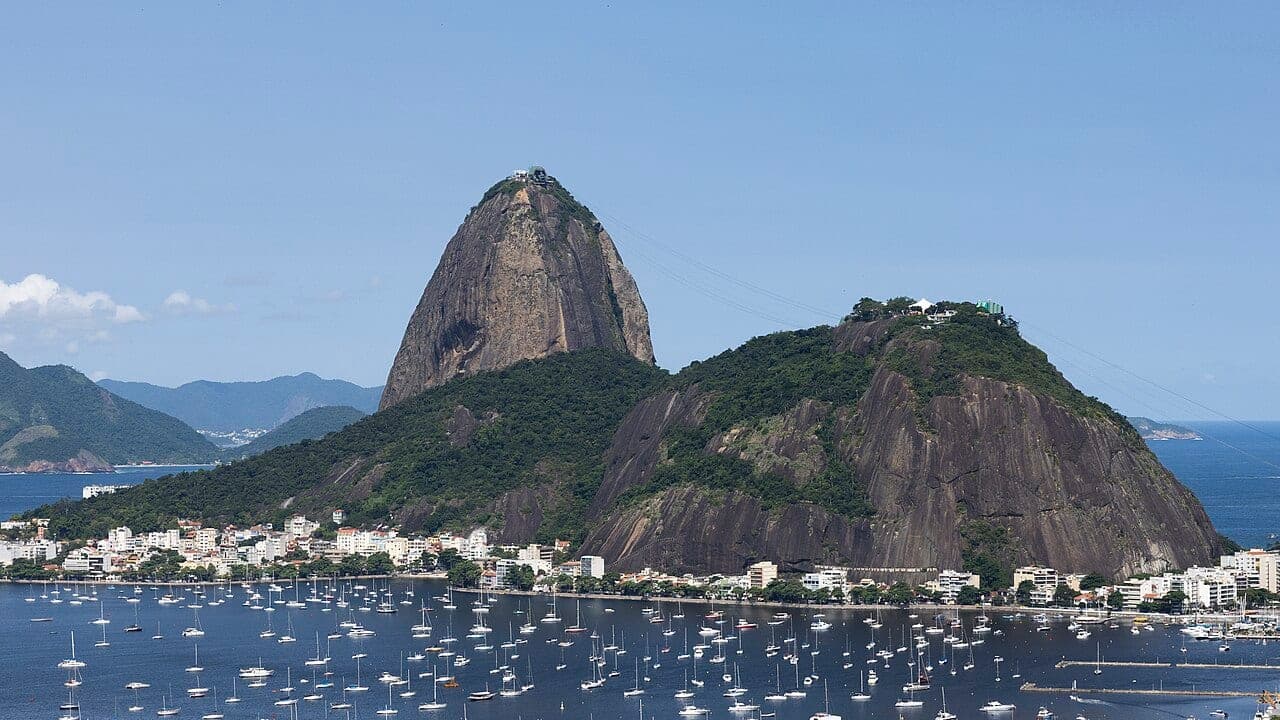
Rio de Janeiro. The former imperial and republican capital sits between granite peaks and the sea, its cultural landscape between mountain and coast inscribed by UNESCO in 2012. Sugarloaf Mountain, Christ the Redeemer and the Sambadrome of Carnival are its emblems, but the old port district also holds Little Africa and the Valongo Wharf, the most important physical trace of the arrival of enslaved Africans in the Americas.
São Paulo. The largest city in the Southern Hemisphere and the financial engine of the country, greater São Paulo holds more than 20 million people. Built by successive waves of migration, it holds the largest Japanese community outside Japan alongside Italian, Lebanese and north-eastern Brazilian populations.
Salvador. The first colonial capital, founded in 1549 in Bahia, Salvador holds the largest population of African descent of any city outside the African continent. Its Pelourinho, the cobbled historic centre named for the whipping post that once stood there, was inscribed by UNESCO in 1985; it is the heartland of Candomblé, capoeira and the samba de roda.
Ouro Preto. The baroque gold-mining town of Minas Gerais, with churches carved by the sculptor Aleijadinho, became Brazil's first World Heritage site in 1980.
Brasília and Olinda. The purpose-built capital, laid out by Lúcio Costa and designed by Oscar Niemeyer and opened in 1960, was inscribed by UNESCO in 1987 as a landmark of modern urbanism. The colonial hill town of Olinda in Pernambuco, listed in 1982, keeps one of the country's most beloved Carnivals.
People had lived in the land for many thousands of years before Europeans arrived; the skull known as Luzia, recovered in Minas Gerais, is among the oldest human remains found in the Americas. When the Portuguese fleet of Pedro Álvares Cabral reached the coast on 22 April 1500, the land the Treaty of Tordesillas had already assigned to Portugal was home to a great many peoples, the Tupi-speaking nations most numerous along the seaboard. Colonisation followed the wealth: first brazilwood, which gave the country its name, then sugar in the north-east, then the gold and diamonds of Minas Gerais.
 Ouro Preto was built on gold, and when the gold ran out the town stopped changing, which is why it survives. Photograph by Yamen, CC BY-SA 4.0, via Wikimedia Commons.
That economy was built on enslaved labour. Brazil was the largest single destination of the transatlantic slave trade, receiving an estimated 4.8 to 5 million enslaved Africans, close to two in every five people carried across the Atlantic. Many resisted: escaped and freeborn people founded quilombos, self-governing communities, of which Palmares under the leader Zumbi was the largest, holding out for most of the seventeenth century. Brazil became the last country in the Western Hemisphere to abolish slavery, when Princess Isabel signed the brief Lei Áurea, the Golden Law, on 13 May 1888.
The political story ran in parallel. Dom Pedro I declared independence from Portugal on 7 September 1822, founding an empire that lasted through the long reign of his son Dom Pedro II until a military coup proclaimed a republic on 15 November 1889. The twentieth century brought industrialisation, populist government under Getúlio Vargas, the move of the capital to Brasília, and a military dictatorship from 1964 to 1985, whose disappeared are mourned still. Democracy was restored with the constitution of 1988.
Brazil is the largest Portuguese-speaking nation on earth, home to far more Lusophones than Portugal itself, and Brazilian Portuguese has grown into a distinct variety with its own accent, vocabulary and spelling conventions. Yet the language absorbed the country it entered. For much of the colonial period a Tupi-based lingua franca, the Língua Geral, was spoken more widely than Portuguese across large parts of the territory, and its descendant Nheengatu survives in the upper Rio Negro.
The Indigenous imprint is everywhere on the map and in daily speech. Countless place names are Tupi in origin, and everyday words for animals, plants and foods entered Portuguese from Indigenous tongues. The linguistic loss, however, has been severe. Of the many hundreds of Indigenous languages thought to have been spoken before 1500, well under two hundred survive, most of them endangered and some down to a handful of elderly speakers. There has been repair as well as loss: in 2002 the Amazonian municipality of São Gabriel da Cachoeira became the first in Brazil to make Indigenous languages, Nheengatu, Tucano and Baniwa, co-official alongside Portuguese, and schools, dictionaries and community media now work to keep them alive.
Brazilian identity was long described through the idea of racial and cultural mixture, mestiçagem, popularised by the sociologist Gilberto Freyre in the 1930s. Later scholars and the Black movement rightly challenged the softer readings of that idea, which could obscure the inequality left by slavery, and the country has moved towards a fuller account in which African and Indigenous inheritances are named as sources rather than dissolved into a single blend.
The cultural forms carry that history plainly. Samba grew from the samba de roda of the Bahian Recôncavo, a dance-and-song circle rooted in the traditions of enslaved Africans that UNESCO proclaimed a Masterpiece of Intangible Heritage in 2005; carried south by migrants, it became the pulse of Rio's Carnival and a national symbol. Capoeira, the art that blends martial movement, music and play, was developed by enslaved and freed Africans and is now inscribed on the UNESCO list in its own right. Football is close to a national language, with five World Cup titles and figures such as Pelé held in reverence, and the shared table, from feijoada to churrasco, is its own everyday inheritance.
Brazil remains the largest Catholic country in the world, though the 2022 census recorded Catholics at 56.7 per cent of the population, down sharply from earlier generations. The emotional centre of that faith is Nossa Senhora Aparecida, the dark-clay image of the Virgin drawn from a river by fishermen in 1717 and now the patron saint of Brazil, honoured at a basilica that draws millions of pilgrims each year. Evangelical and Pentecostal churches have grown quickly, reaching about 26.9 per cent in 2022, and around one in ten Brazilians now report no religion.
Ouro Preto was built on gold, and when the gold ran out the town stopped changing, which is why it survives. Photograph by Yamen, CC BY-SA 4.0, via Wikimedia Commons.
That economy was built on enslaved labour. Brazil was the largest single destination of the transatlantic slave trade, receiving an estimated 4.8 to 5 million enslaved Africans, close to two in every five people carried across the Atlantic. Many resisted: escaped and freeborn people founded quilombos, self-governing communities, of which Palmares under the leader Zumbi was the largest, holding out for most of the seventeenth century. Brazil became the last country in the Western Hemisphere to abolish slavery, when Princess Isabel signed the brief Lei Áurea, the Golden Law, on 13 May 1888.
The political story ran in parallel. Dom Pedro I declared independence from Portugal on 7 September 1822, founding an empire that lasted through the long reign of his son Dom Pedro II until a military coup proclaimed a republic on 15 November 1889. The twentieth century brought industrialisation, populist government under Getúlio Vargas, the move of the capital to Brasília, and a military dictatorship from 1964 to 1985, whose disappeared are mourned still. Democracy was restored with the constitution of 1988.
Brazil is the largest Portuguese-speaking nation on earth, home to far more Lusophones than Portugal itself, and Brazilian Portuguese has grown into a distinct variety with its own accent, vocabulary and spelling conventions. Yet the language absorbed the country it entered. For much of the colonial period a Tupi-based lingua franca, the Língua Geral, was spoken more widely than Portuguese across large parts of the territory, and its descendant Nheengatu survives in the upper Rio Negro.
The Indigenous imprint is everywhere on the map and in daily speech. Countless place names are Tupi in origin, and everyday words for animals, plants and foods entered Portuguese from Indigenous tongues. The linguistic loss, however, has been severe. Of the many hundreds of Indigenous languages thought to have been spoken before 1500, well under two hundred survive, most of them endangered and some down to a handful of elderly speakers. There has been repair as well as loss: in 2002 the Amazonian municipality of São Gabriel da Cachoeira became the first in Brazil to make Indigenous languages, Nheengatu, Tucano and Baniwa, co-official alongside Portuguese, and schools, dictionaries and community media now work to keep them alive.
Brazilian identity was long described through the idea of racial and cultural mixture, mestiçagem, popularised by the sociologist Gilberto Freyre in the 1930s. Later scholars and the Black movement rightly challenged the softer readings of that idea, which could obscure the inequality left by slavery, and the country has moved towards a fuller account in which African and Indigenous inheritances are named as sources rather than dissolved into a single blend.
The cultural forms carry that history plainly. Samba grew from the samba de roda of the Bahian Recôncavo, a dance-and-song circle rooted in the traditions of enslaved Africans that UNESCO proclaimed a Masterpiece of Intangible Heritage in 2005; carried south by migrants, it became the pulse of Rio's Carnival and a national symbol. Capoeira, the art that blends martial movement, music and play, was developed by enslaved and freed Africans and is now inscribed on the UNESCO list in its own right. Football is close to a national language, with five World Cup titles and figures such as Pelé held in reverence, and the shared table, from feijoada to churrasco, is its own everyday inheritance.
Brazil remains the largest Catholic country in the world, though the 2022 census recorded Catholics at 56.7 per cent of the population, down sharply from earlier generations. The emotional centre of that faith is Nossa Senhora Aparecida, the dark-clay image of the Virgin drawn from a river by fishermen in 1717 and now the patron saint of Brazil, honoured at a basilica that draws millions of pilgrims each year. Evangelical and Pentecostal churches have grown quickly, reaching about 26.9 per cent in 2022, and around one in ten Brazilians now report no religion.
 The twelve prophets at Congonhas, carved in soapstone by Aleijadinho as his hands were failing him. Photograph by Adam Jones, CC BY-SA 3.0, via Wikimedia Commons.
Alongside and often within Christianity stand the Afro-Brazilian religions. Candomblé took form in nineteenth-century Bahia, where enslaved people of Yoruba, Fon and Bantu origin preserved the worship of the orixás, the deities of nature and destiny, under the cover of a Catholic colony; each orixá came to be paired with a Catholic saint, a syncretism born of necessity that endures as devotion. Umbanda emerged in the early twentieth century as a distinctly Brazilian faith, drawing together Candomblé, Catholicism, Indigenous spirits and the Kardecist Spiritism popular among the middle class. These traditions have suffered real persecution, historically from the state and today from a current of religious intolerance that has vandalised terreiros, and their houses of worship are increasingly defended as heritage as well as places of faith.
Brazil's principal day of remembrance is Finados, the Dia de Finados, kept on 2 November as All Souls' Day. It is a national holiday and, unlike the festive Day of the Dead of some neighbours, a quiet and contemplative occasion. Families visit the cemetery to clean and tend the grave, lay flowers, light candles and attend Mass; many keep a small home arrangement of photographs and candles for the departed. By nightfall the graveyards glow with candlelight, a quiet act of keeping company with the dead.
Ordinary Catholic mourning has a steady rhythm. The velório, the wake, gathers family and community around the body, and burial usually follows within a day. Seven days after the death the missa de sétimo dia, the seventh-day Mass, gathers everyone again, with further Masses often marking the thirtieth day and the first anniversary. The Afro-Brazilian tradition has its own funerary rite, the axexê of Candomblé, a sequence of songs, drumming and ritual over several days that releases the spirit of the deceased and settles the community after the loss; many Candomblé families weave the axexê together with a Catholic burial and seventh-day Mass, so that the two systems accompany a single death.
Some of Brazil's most important remembrance is collective and hard-won. The Valongo Wharf in Rio, where enslaved Africans came ashore in enormous numbers, is honoured each year with the Washing of the Valongo, and the community holds it as a sacred memorial to those who arrived and those who did not survive the crossing. The memory of resistance is carried by Black Consciousness Day on 20 November, the date of Zumbi of Palmares's death, which became a national public holiday in 2024. Indigenous loss is mourned and asserted in the annual mobilisations of Indigenous peoples in Brasília, and the disappeared of the 1964 to 1985 dictatorship are remembered by their families and by a National Truth Commission that reported in 2014. Where the names themselves were destroyed, Umbanda supplies a category in their place: the Pretos Velhos, the spirits of Africans who were enslaved here and lived to old age, are received as the elder generation a whole population was denied. In each case the work is the same: to say the names, and to refuse to let a death go unrecorded.
Brazilian records start with the parish and they start early. Catholic registers of baptism, marriage and burial run from the sixteenth century in the older towns of the northeast, and because the church registered enslaved people as well as free ones, those books are the principal surviving evidence of individual Afro-Brazilian lives before abolition. Civil registration came only with the Republic in 1889 and became general slowly after that. FamilySearch has digitised a very large share of both and publishes the images free.
Then there is the fire. On 14 December 1890, Rui Barbosa, finance minister of the new republic, signed an order for the destruction of all records of the purchase and sale of enslaved people: the registration books, the customs records, the tax rolls. The burning was carried out on 13 May 1891, the second anniversary of abolition. The stated reason was to erase the stain of slavery from the national record. Historians generally hold that the practical purpose was to make compensation claims by former owners impossible, and the effect was to destroy the paper trail of four million lives.
What that means for a Brazilian family tracing African ancestry is that the state archive is missing precisely where it should be fullest, and the church archive has to carry the weight. Parish books, inventories of estates, and the manumission letters recorded by notaries are the evidence that remains. Quilombola communities pressing land claims today are working against the same absence, and for the same reason.
Brazil built its heritage machinery early. The Institute of National Historical and Artistic Heritage (IPHAN), created in 1937, is the federal body responsible for listing and protecting the country's cultural property, both the built heritage of colonial towns and the living heritage of communities. In 1986 the Casa Branca terreiro in Salvador, the oldest Candomblé house in the country, became the first site of African origin listed by IPHAN, an official acknowledgement that Afro-Brazilian religion belongs to the national heritage.
The UNESCO record traces the same widening view: from the baroque churches of Ouro Preto in 1980 and the modernist plan of Brasília in 1987 to the Valongo Wharf in 2017, inscribed expressly as a place of memory of the slave trade. That widening was interrupted by disaster. On 2 September 2018 fire tore through the National Museum in Rio, Brazil's oldest scientific institution, destroying roughly 80 per cent of a collection of some 20 million items in a single night, the loss traced to failing infrastructure and neglected fire safety. From the rubble, treated like an archaeological dig, crews recovered tens of thousands of pieces, among them the skull of Luzia; the museum has since drawn thousands of donations from around the world, and a reconstruction is under way, with a first stage of the rebuilt institution reopening to the public.
The digital effort has, in part, been driven by loss. After the 2018 fire, museums, universities and members of the public pooled photographs and records to reconstruct virtually what the flames had taken, and the museum has worked with international partners to model destroyed galleries. National digital libraries such as the Brasiliana collection have put rare books, maps and manuscripts online, and institutions have partnered with platforms like Google Arts and Culture to open the Valongo Wharf to visitors who cannot travel there.
Indigenous and Afro-Brazilian heritage is finding a digital home as well. Language documentation projects archive endangered tongues in sound and text, and community organisations maintain online resources on Indigenous peoples, terreiros and quilombo histories, so that what is remembered is not left to a single, fragile copy.
Brazil's writers have carried its inner life to the world, from the nineteenth-century master Machado de Assis, grandson of freed slaves, to Clarice Lispector's interior novels, Jorge Amado's Bahian sagas and the globally read Paulo Coelho. Its music has been an export in its own right: the cool, understated bossa nova of Antônio Carlos Jobim and João Gilberto reshaped popular song worldwide, and the Tropicália movement of Caetano Veloso and Gilberto Gil, forged partly in exile under the dictatorship, opened Brazilian popular music to everything at once.
Brazilian cinema has told the country's harder stories to global audiences, from the road film Central do Brasil and the favela epic City of God to Walter Salles's I'm Still Here, which follows a family's search for a father disappeared by the dictatorship and won Brazil its first Academy Award, for Best International Feature, in 2025, so that the film which carried the country furthest was itself a work of remembrance. Football, Carnival and a large diaspora carry the culture well beyond its borders, while its sources remain firmly at home.
A wharf becomes a place of memory. The rediscovery of the Valongo Wharf during works for the 2016 Olympics turned a buried stone quay into the country's foremost memorial of the slave trade, inscribed by UNESCO in 2017 and honoured each year in the community's Washing of the Valongo.
A museum rebuilds after the fire. After the 2018 catastrophe, the National Museum recovered tens of thousands of objects, including the skull of Luzia, gathered thousands of donations worldwide, and began reopening its rebuilt galleries, turning a night of loss into a long act of recovery.
Resistance enters the national calendar. Black Consciousness Day, marking the death of Zumbi of Palmares, became a national public holiday in 2024, giving the memory of enslaved people's resistance a fixed and shared place in the year.
African faith recognised as heritage. The listing of the Casa Branca terreiro by IPHAN in 1986 was the first time a site of African origin was protected as national heritage, and it opened the way for the recognition of Candomblé and Umbanda houses across the country.
Indigenous languages regain standing. The decision of São Gabriel da Cachoeira in 2002 to make Nheengatu, Tucano and Baniwa co-official, together with a growing movement of documentation and schooling, has begun to reverse centuries of linguistic loss.
The twelve prophets at Congonhas, carved in soapstone by Aleijadinho as his hands were failing him. Photograph by Adam Jones, CC BY-SA 3.0, via Wikimedia Commons.
Alongside and often within Christianity stand the Afro-Brazilian religions. Candomblé took form in nineteenth-century Bahia, where enslaved people of Yoruba, Fon and Bantu origin preserved the worship of the orixás, the deities of nature and destiny, under the cover of a Catholic colony; each orixá came to be paired with a Catholic saint, a syncretism born of necessity that endures as devotion. Umbanda emerged in the early twentieth century as a distinctly Brazilian faith, drawing together Candomblé, Catholicism, Indigenous spirits and the Kardecist Spiritism popular among the middle class. These traditions have suffered real persecution, historically from the state and today from a current of religious intolerance that has vandalised terreiros, and their houses of worship are increasingly defended as heritage as well as places of faith.
Brazil's principal day of remembrance is Finados, the Dia de Finados, kept on 2 November as All Souls' Day. It is a national holiday and, unlike the festive Day of the Dead of some neighbours, a quiet and contemplative occasion. Families visit the cemetery to clean and tend the grave, lay flowers, light candles and attend Mass; many keep a small home arrangement of photographs and candles for the departed. By nightfall the graveyards glow with candlelight, a quiet act of keeping company with the dead.
Ordinary Catholic mourning has a steady rhythm. The velório, the wake, gathers family and community around the body, and burial usually follows within a day. Seven days after the death the missa de sétimo dia, the seventh-day Mass, gathers everyone again, with further Masses often marking the thirtieth day and the first anniversary. The Afro-Brazilian tradition has its own funerary rite, the axexê of Candomblé, a sequence of songs, drumming and ritual over several days that releases the spirit of the deceased and settles the community after the loss; many Candomblé families weave the axexê together with a Catholic burial and seventh-day Mass, so that the two systems accompany a single death.
Some of Brazil's most important remembrance is collective and hard-won. The Valongo Wharf in Rio, where enslaved Africans came ashore in enormous numbers, is honoured each year with the Washing of the Valongo, and the community holds it as a sacred memorial to those who arrived and those who did not survive the crossing. The memory of resistance is carried by Black Consciousness Day on 20 November, the date of Zumbi of Palmares's death, which became a national public holiday in 2024. Indigenous loss is mourned and asserted in the annual mobilisations of Indigenous peoples in Brasília, and the disappeared of the 1964 to 1985 dictatorship are remembered by their families and by a National Truth Commission that reported in 2014. Where the names themselves were destroyed, Umbanda supplies a category in their place: the Pretos Velhos, the spirits of Africans who were enslaved here and lived to old age, are received as the elder generation a whole population was denied. In each case the work is the same: to say the names, and to refuse to let a death go unrecorded.
Brazilian records start with the parish and they start early. Catholic registers of baptism, marriage and burial run from the sixteenth century in the older towns of the northeast, and because the church registered enslaved people as well as free ones, those books are the principal surviving evidence of individual Afro-Brazilian lives before abolition. Civil registration came only with the Republic in 1889 and became general slowly after that. FamilySearch has digitised a very large share of both and publishes the images free.
Then there is the fire. On 14 December 1890, Rui Barbosa, finance minister of the new republic, signed an order for the destruction of all records of the purchase and sale of enslaved people: the registration books, the customs records, the tax rolls. The burning was carried out on 13 May 1891, the second anniversary of abolition. The stated reason was to erase the stain of slavery from the national record. Historians generally hold that the practical purpose was to make compensation claims by former owners impossible, and the effect was to destroy the paper trail of four million lives.
What that means for a Brazilian family tracing African ancestry is that the state archive is missing precisely where it should be fullest, and the church archive has to carry the weight. Parish books, inventories of estates, and the manumission letters recorded by notaries are the evidence that remains. Quilombola communities pressing land claims today are working against the same absence, and for the same reason.
Brazil built its heritage machinery early. The Institute of National Historical and Artistic Heritage (IPHAN), created in 1937, is the federal body responsible for listing and protecting the country's cultural property, both the built heritage of colonial towns and the living heritage of communities. In 1986 the Casa Branca terreiro in Salvador, the oldest Candomblé house in the country, became the first site of African origin listed by IPHAN, an official acknowledgement that Afro-Brazilian religion belongs to the national heritage.
The UNESCO record traces the same widening view: from the baroque churches of Ouro Preto in 1980 and the modernist plan of Brasília in 1987 to the Valongo Wharf in 2017, inscribed expressly as a place of memory of the slave trade. That widening was interrupted by disaster. On 2 September 2018 fire tore through the National Museum in Rio, Brazil's oldest scientific institution, destroying roughly 80 per cent of a collection of some 20 million items in a single night, the loss traced to failing infrastructure and neglected fire safety. From the rubble, treated like an archaeological dig, crews recovered tens of thousands of pieces, among them the skull of Luzia; the museum has since drawn thousands of donations from around the world, and a reconstruction is under way, with a first stage of the rebuilt institution reopening to the public.
The digital effort has, in part, been driven by loss. After the 2018 fire, museums, universities and members of the public pooled photographs and records to reconstruct virtually what the flames had taken, and the museum has worked with international partners to model destroyed galleries. National digital libraries such as the Brasiliana collection have put rare books, maps and manuscripts online, and institutions have partnered with platforms like Google Arts and Culture to open the Valongo Wharf to visitors who cannot travel there.
Indigenous and Afro-Brazilian heritage is finding a digital home as well. Language documentation projects archive endangered tongues in sound and text, and community organisations maintain online resources on Indigenous peoples, terreiros and quilombo histories, so that what is remembered is not left to a single, fragile copy.
Brazil's writers have carried its inner life to the world, from the nineteenth-century master Machado de Assis, grandson of freed slaves, to Clarice Lispector's interior novels, Jorge Amado's Bahian sagas and the globally read Paulo Coelho. Its music has been an export in its own right: the cool, understated bossa nova of Antônio Carlos Jobim and João Gilberto reshaped popular song worldwide, and the Tropicália movement of Caetano Veloso and Gilberto Gil, forged partly in exile under the dictatorship, opened Brazilian popular music to everything at once.
Brazilian cinema has told the country's harder stories to global audiences, from the road film Central do Brasil and the favela epic City of God to Walter Salles's I'm Still Here, which follows a family's search for a father disappeared by the dictatorship and won Brazil its first Academy Award, for Best International Feature, in 2025, so that the film which carried the country furthest was itself a work of remembrance. Football, Carnival and a large diaspora carry the culture well beyond its borders, while its sources remain firmly at home.
A wharf becomes a place of memory. The rediscovery of the Valongo Wharf during works for the 2016 Olympics turned a buried stone quay into the country's foremost memorial of the slave trade, inscribed by UNESCO in 2017 and honoured each year in the community's Washing of the Valongo.
A museum rebuilds after the fire. After the 2018 catastrophe, the National Museum recovered tens of thousands of objects, including the skull of Luzia, gathered thousands of donations worldwide, and began reopening its rebuilt galleries, turning a night of loss into a long act of recovery.
Resistance enters the national calendar. Black Consciousness Day, marking the death of Zumbi of Palmares, became a national public holiday in 2024, giving the memory of enslaved people's resistance a fixed and shared place in the year.
African faith recognised as heritage. The listing of the Casa Branca terreiro by IPHAN in 1986 was the first time a site of African origin was protected as national heritage, and it opened the way for the recognition of Candomblé and Umbanda houses across the country.
Indigenous languages regain standing. The decision of São Gabriel da Cachoeira in 2002 to make Nheengatu, Tucano and Baniwa co-official, together with a growing movement of documentation and schooling, has begun to reverse centuries of linguistic loss.
National Overview
Notable Cities
Historical Foundations
Linguistic and Etymological Roots
Cultural Identity
Religion and Spirituality
Remembrance and Mourning Traditions
Tracing a Family in Brazil
Heritage Preservation Efforts
Digital Heritage
Contemporary Cultural Influences
Success Stories
References and resources
- UNESCO World Heritage Centre, Brazil: the state-party page listing all 26 World Heritage sites.
- UNESCO World Heritage Centre, Valongo Wharf Archaeological Site: the 2017 inscription of the slave-trade memorial.
- UNESCO Intangible Cultural Heritage, Samba de Roda of the Recôncavo of Bahia: the 2005 proclamation.
- IPHAN, the Institute of National Historical and Artistic Heritage: Brazil's federal heritage body, created in 1937.
- IPHAN, Terreiro Casa Branca do Engenho Velho: the first site of African origin listed as national heritage.
- IBGE, 2022 census population results: Brazil reaches 203.1 million.
- IBGE, 2022 census religion results: Catholic decline and evangelical growth.
- Instituto Socioambiental, Indigenous languages of Brazil: the scale of linguistic diversity and loss.
- Smithsonian Magazine on Brazil's National Museum after the fire: the 2018 disaster and recovery.
- Wikipedia, National Day of Zumbi and Black Consciousness: the origin and holiday status of 20 November.
- Encyclopaedia Britannica, Brazil: geography, history and political background.