Heritage · Country
Crimea Culture and Heritage
A peninsula holding a Greek city inscribed by UNESCO, the only surviving palace of the Crimean Khans, and cave towns cut into limestone. This guide follows Crimean heritage and above all the Crimean Tatars, their severely endangered language, and the deportation of 18 May 1944.Written to last.
By Confinity Heritage Editorial · Updated 2026-08-17 · 8-minute readQuiet tools, kept out of the way.
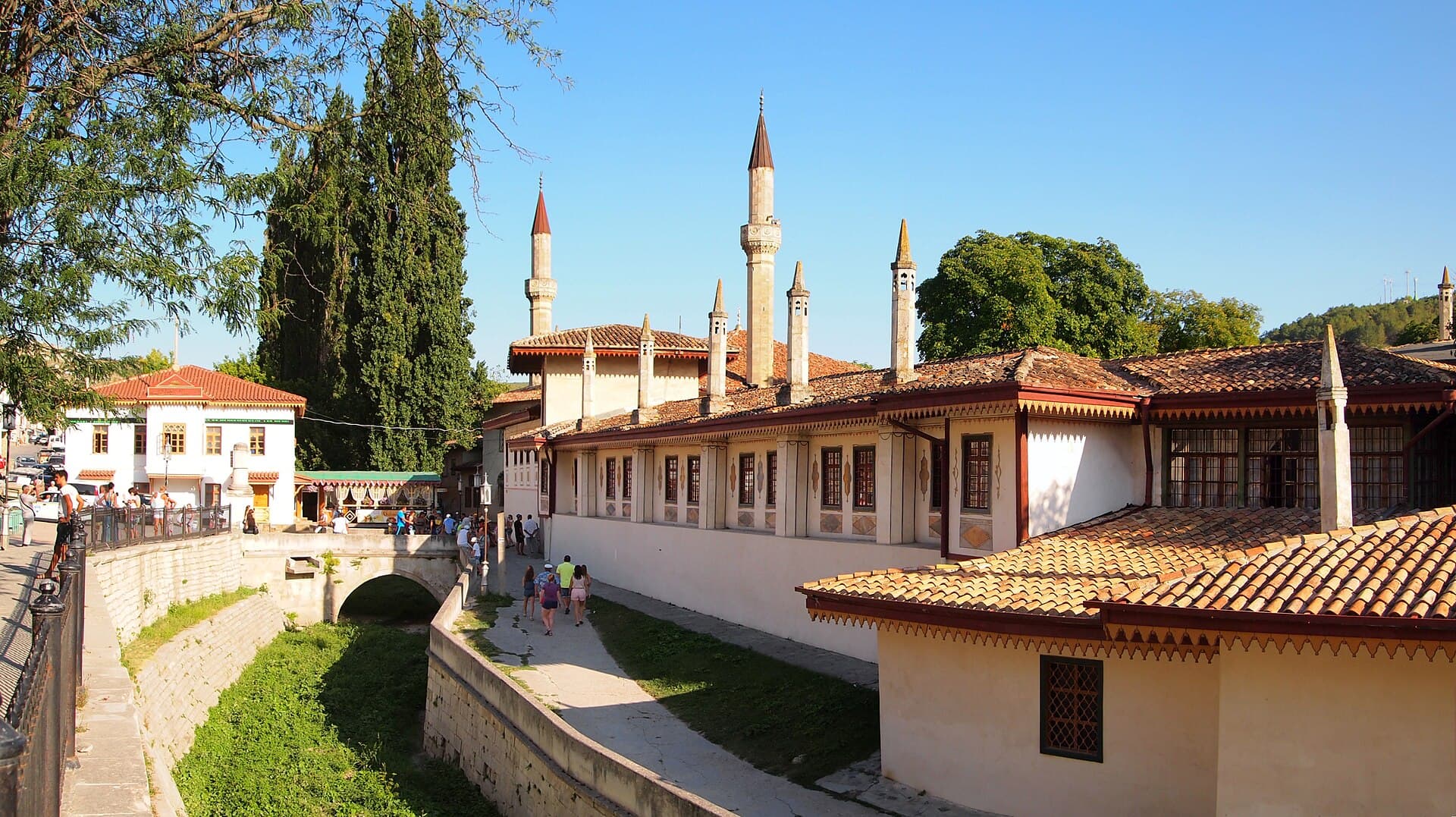
In a small courtyard at Bakhchysarai there is a marble slab from which water falls, drop by drop, from one shallow basin into the next. It was carved in 1764 for Kırım Giray Khan, and the story attached to it is that he had it made after the death of a woman he loved, so the stone would go on weeping when he could not. Pushkin saw it in 1820 and wrote a poem about it, and two roses are laid on it daily still. It sits inside the only palace of the Crimean Khans that survives.
Crimea is a peninsula of about 27,000 square kilometres, joined to the mainland by a strip of land five to seven kilometres wide, and almost every people who ever crossed the Black Sea left something on it. This profile gives most of its length to the Crimean Tatars, the Turkic Muslim people indigenous to the peninsula, whose language UNESCO classifies as severely endangered and whose deportation in 1944 is the fact around which their remembrance is organised.
The peninsula hangs from the northern shore of the Black Sea, tethered at the Perekop isthmus and separated from the Sea of Azov by the Syvash, a maze of shallow salt lagoons that dries to a crust in summer. Most of Crimea is flat steppe, but a limestone range runs along the southern coast for about 150 kilometres, rising to Roman-Kosh at 1,545 metres, and the narrow shelf between those mountains and the sea grows vines, figs and cypress. Around two and a half million people live here, Russians forming the largest group, then Ukrainians, then Crimean Tatars, whose share is usually put between ten and thirteen per cent.
Crimea is internationally recognised as part of Ukraine. Russian forces took control of the peninsula in late February and early March 2014, a referendum was held on 16 March, and Russia declared the territory admitted to the Russian Federation on 18 March; Russia calls this a reunification, and Ukraine and most other states call it an occupation and annexation. On 27 March 2014 the United Nations General Assembly adopted resolution 68/262, which affirmed its commitment to the sovereignty, political independence, unity and territorial integrity of Ukraine within its internationally recognised borders, stated that the referendum had no validity and could not form the basis for any alteration of the status of the Autonomous Republic of Crimea or of the city of Sevastopol, and called on all states and organisations not to recognise any such alteration (UN Digital Library). The Assembly has adopted resolutions on the human rights situation in the peninsula every year since resolution 71/205 of 19 December 2016 (UN Digital Library). Russia rejects those resolutions and holds that the peninsula's population exercised a right of self-determination.
Bakhchysarai. The Khanate's capital from the early sixteenth century sits in a river valley below cliffs. The Khan's Palace, the Hansaray, is the only surviving palatial complex of the dynasty anywhere: courtyards, painted rooms, a harem block, a cemetery of khans and the Great Khan Mosque. Above the town are the Uspensky cave monastery and the abandoned fortress town of Chufut-Kale.
Sevastopol. Founded as a naval base in 1783 on the site of the Tatar village of Aqyar, the city sits beside Chersonesus, a Greek colony of the sixth century BC that later became Byzantine and is where Volodymyr of Kyiv is traditionally said to have been baptised in 988. UNESCO inscribed it in 2013 as the Ancient City of Tauric Chersonese and its Chora, with six plots of surviving Greek field divisions (UNESCO).
Simferopol (Aqmescit). The administrative centre grew from the Tatar town of Aqmescit beside Neapolis Scythica, the Scythian capital, whose painted tombs are still being excavated inside the modern city.
Kerch, Feodosia and Sudak. Kerch was Panticapaeum, capital of the Bosporan Kingdom, and holds the Tsarsky burial vault of the fourth century BC. Feodosia was the Greek Theodosia and then the Genoese Caffa. Sudak keeps the best-preserved Genoese fortress on the peninsula, its wall climbing a ridge above the sea.
Yalta. A resort of nineteenth-century palaces, among them Livadia, where the conference of February 1945 was held.
The Tauri gave the peninsula its classical name, Taurica, and the Cimmerians and Scythians held the steppe behind them. Greek colonists arrived in the sixth century BC and built Chersonesus and Panticapaeum; the Bosporan Kingdom that followed supplied Athens with grain and buried its aristocracy under mounds full of worked gold. Byzantium later held the ports, and in the mountains the Crimean Goths kept a Christian principality centred on Mangup, taken by the Ottomans in 1475.
 Bakhchisaray was the capital of the Crimean Khanate, and the palace is the only substantial surviving example of Crimean Tatar palace architecture anywhere. Photograph by Jean and Nathalie, CC BY 2.0, via Wikimedia Commons.
The Crimean Khanate emerged in the 1440s under the Giray dynasty, descendants of Genghis Khan through the Golden Horde, and from 1475 it was an Ottoman vassal that kept its own court, coinage and law. It lasted until the Russian Empire annexed it in 1783, and that annexation began a long emigration to Ottoman lands, so a people who had been the majority became a minority at home. The Crimean War of 1853 to 1856 put the siege of Sevastopol and the charge of the Light Brigade into European memory.
A Crimean Tatar national assembly, the Qurultay, met in Bakhchysarai in December 1917 and was suppressed as Bolshevik power consolidated. The Crimean Autonomous Soviet Socialist Republic followed in 1921, and with it famine, the seizure of the religious endowments and the execution of much of the intelligentsia. German and Romanian forces held the peninsula from 1941 to 1944, and the Jewish and Krymchak communities were murdered almost entirely, several thousand of them shot at the anti-tank ditch near Bagerovo outside Kerch.
Then came the deportation. On 11 May 1944 the State Defence Committee issued order 5859ss, and between 18 and 20 May the NKVD removed the whole Crimean Tatar population, roughly 191,000 people by the operation's own returns, giving families minutes to gather what they could carry and loading them into freight wagons. Most went to Uzbekistan, others to the Mari republic, Kazakhstan and the Urals, all under a special settlement regime that made leaving the assigned district a criminal offence. Estimates of how many died vary widely and should be read as a range: Soviet archival records account for around 27,000 deaths by the end of 1945, the demographer Dalkhat Ediev arrives at about 34,300, Brian Glyn Williams estimates 40,000 to 44,000, and the survey conducted by the Crimean Tatar national movement in the 1960s concluded that 46 per cent of those deported died in transit or in the first years of exile (Wikipedia). Greeks, Armenians and Bulgarians were deported a few weeks later.
A decree of September 1967 withdrew the charge of treason while withholding the right of return granted to other deported peoples, and the ban was lifted only on 14 November 1989. Around 166,000 people had come back by January 1992, many to villages that no longer bore their old names. Crimea passed to the Ukrainian Soviet republic in 1954.
Crimean Tatar is a Turkic language with an unusual internal structure, because its three dialects sit on opposite sides of a family divide. The northern steppe dialect is Kipchak, close to Nogai; the southern coastal dialect, Yalıboyu, is Oghuz and close to Turkish; and the central mountain dialect, which is the basis of the literary standard, mixes the two. UNESCO's atlas classifies the language as severely endangered, and specialists argue that this understates the position, since transmission to children has largely stopped (Wikipedia). Its script has changed four times in a century: Arabic until 1928, Latin until 1938, Cyrillic thereafter, and a Latin alphabet adopted by the Qurultay in 1997 and confirmed in Ukrainian law in 2021.
The central figure in the language's modern history is Ismail Gasprinsky, who founded the newspaper Terciman at Bakhchysarai in 1883 and ran it until his death in 1914. He wrote it in a deliberately simplified Turkic that readers from Kazan to Bukhara could follow, and his new-method schools became the reference point for reform across the Muslim communities of the Russian Empire (Wikipedia).
Other languages have gone quiet here. Crimean Gothic survived in the mountains into the sixteenth century and is known almost entirely from one source: the Flemish diplomat Ogier Ghiselin de Busbecq collected about eighty words and the lyrics of a song from two men at Constantinople in 1562 (Wikipedia). Karaim and Krymchak, both Turkic and both written in Hebrew letters, are now spoken by a handful of people. The place names hold the layers plainly: Gözleve became Yevpatoria, Kefe became Feodosia, and Aqyar became Sevastopol.
Crimean Tatar culture is easiest to see at a wedding. The dance is the haytarma, its name meaning a return or a turning back, danced with the man's arms held wide and the woman turning her wrists, the tune carried on accordion, frame drum and clarinet. The song most people know is "Ey Güzel Qırım", a lament for the peninsula written in exile, and the same subject reached a very large audience in 2016 when Jamala won the Eurovision Song Contest with "1944", about her own great-grandmother's deportation.
The food is specific and portable: çibörek, a half-moon of fried dough filled with minced lamb; yantıq, the same pastry cooked dry on a griddle; kobete, a layered meat pie; and a great deal of green tea. The crafts that survived exile are filigree silver from Bakhchysarai, copper vessels, and the embroidery whose geometric ornament was reconstructed after 1990 from museum pieces and from the few textiles families had managed to carry with them.
Two festivals mark the year: Hıdırlez in early May, which opens the pasture season with a shared meal and horse games, and Derviza at the end of September, which closes the harvest. The peninsula also carries Greek, Armenian, Bulgarian, German and Jewish inheritances, and a Russian literary layer running from Pushkin through Chekhov at Yalta to Maximilian Voloshin at Koktebel.
Most Crimean Tatars are Sunni Muslims of the Hanafi school, and the peninsula's Islamic architecture is Ottoman in idiom. The Juma-Jami mosque at Yevpatoria, begun in 1552, is attributed to the imperial architect Sinan and is the largest working mosque in Crimea. Sufi orders left tekkes and a scattering of azizler, the tombs of holy men, which people went on visiting through the Soviet decades.
Orthodox Christianity has its own deep claim here. Chersonesus is where Byzantine sources place the baptism of Volodymyr of Kyiv in 988, and monks cut monasteries into the cliffs at Inkerman and above Bakhchysarai, the latter still in use. The Armenian monastery of Surb Khach near Stary Krym dates from 1358. The Crimean Karaites, a Turkic-speaking people who follow a scriptural Judaism without the Talmud, built kenesas at Yevpatoria and Chufut-Kale, while the Krymchaks, who follow rabbinic Judaism and pray according to a rite compiled at Kaffa in the sixteenth century, had their own synagogues. Both now number in the hundreds here.
The centre of Crimean Tatar remembrance is 18 May. On 12 November 2015 the Verkhovna Rada of Ukraine recognised the 1944 deportation as a genocide of the Crimean Tatar people and made 18 May a day of remembrance for its victims; Latvia and Lithuania passed comparable resolutions in 2019, the Canadian House of Commons in 2022, and Estonia, Poland, the Czech Republic and the Netherlands have since done the same. Those recognitions are acts of national legislatures and do not represent a ruling by any international court. The day is kept with a minute's silence at noon, the reading of names, a dua for the dead, and candles set in windows.
Crimean Tatar funerals follow Hanafi practice. The body is washed and wrapped in a plain white shroud, the janaza prayer is said, burial happens within a day where it can, and the grave is dug so the body faces Mecca. Relatives gather for a meal and Quran recitation on the third, seventh and fortieth days and again after a year. What the deportation did was break the connection between the dead and the ground: families who returned after 1989 had parents and grandparents buried in Uzbekistan and Kazakhstan, and the villages they came back to often held no marked Muslim cemetery at all, so the work of the 1990s included finding old burial grounds under orchards and pasture and fencing them again.
The other traditions are equally particular. Orthodox families keep the ninth and fortieth day and visit graves at Radonitsa in the week after Easter, leaving food at the graveside. The Karaim cemetery in the Josaphat valley below Chufut-Kale lies under oaks the community held sacred and called Balta Tiymez, the axe does not touch. The Krymchak dead of December 1941 are commemorated at Simferopol, where nearly three-quarters of the community was killed. Two wars left foreign cemeteries: the Brotherhood cemetery above Sevastopol holds the Russian defenders of the 1854 siege, while the British graves on Cathcart's Hill were built over in the Soviet period and the memorial moved to an obelisk at Dergachi in 2003, which reporting for the Pulitzer Center found neglected and overgrown (Pulitzer Center).
Crimea's records have been moved by every power that has held the peninsula, and the most consequential absence is the Crimean Tatars'.
The Crimean Khanate, which ruled here for three centuries, kept court and land records; a substantial part was destroyed or dispersed after the Russian annexation of 1783, and what survives is split between Simferopol, Saint Petersburg and Istanbul. Muslim metrical books kept by the mullahs, and Orthodox and Karaite registers, cover the nineteenth century.
The rupture is 18 May 1944. The entire Crimean Tatar population, around 190,000 people, was deported to Uzbekistan and the Urals in three days; a very large proportion died within eighteen months. Their property was redistributed, their place names were changed, and their existence was removed from official reference works for decades. Return only became possible from the late 1980s, and returning families had to prove a connection to land whose records had been altered. The NKVD deportation lists are the document that survives, and they are held in Moscow.
Ukrainian administration from 1954 built the modern civil registry. Since the Russian annexation in 2014 the peninsula's records have been reissued under Russian systems, and Ukraine does not recognise documents issued there, so a Crimean birth certificate from the last decade is valid in one country and not the other. Families are documented twice, or not at all.
The central fact about heritage protection in Crimea is that the bodies responsible for it can't get in. UNESCO has said repeatedly that it has no access to the peninsula and cannot carry out direct monitoring, so its reporting rests on secondary sources; its Executive Board has kept an agenda item on the situation in Crimea open since 2015. On 22 July 2026, at its 48th session in Busan, the World Heritage Committee placed Tauric Chersonese on the List of World Heritage in Danger, citing construction and large-scale excavation on and around the property; Russia's delegate rejected the decision as a politicisation of the committee's work (The Art Newspaper).
The restoration carried out at the Khan's Palace from 2017 has drawn sustained criticism. Crimean Tatar specialists and conservators reported that centuries-old oak roof beams were replaced with concrete, that the hand-made spoon tiles were removed and substituted, and that eighteenth-century wall paintings in the Great Khan Mosque were damaged when facades were cleaned with high-pressure water (RFE/RL). In 2018 ICCROM, the intergovernmental body for conservation science, reported violations of restoration principles at the site and the removal from the work of researchers who had cared for it for decades. The palace has been on Ukraine's tentative list since 2003, and the criticism is a matter of record rather than a settled legal finding.
One dispute did end in a court. More than a thousand objects from four Crimean museums, including Scythian gold, were on loan to the Allard Pierson Museum in Amsterdam in 2014, and after nine years of litigation the Supreme Court of the Netherlands ruled on 9 June 2023 that they belonged to the Ukrainian state and had to go to Kyiv rather than back to the museums that lent them (Cultural Property News). In its judgment of 31 January 2024 in Ukraine v. Russian Federation, the International Court of Justice found that Russia had breached the racial discrimination convention over Ukrainian-language education in Crimea, while declining to find a breach in the ban on the Mejlis (ICJ).
Because access is closed to most researchers, the record is being rebuilt at a distance. Ukrainian institutions maintain registers of museum objects and monuments compiled from pre-2014 inventories, which is what made the Amsterdam case provable, and satellite imagery now does much of the work site inspection would otherwise do. Crimean Tatar organisations in Kyiv and the diaspora have digitised newspapers, photographs and family papers, including runs of Gasprinsky's Terciman, while oral history projects record surviving deportees and their children.
The language has moved online out of necessity, with a Crimean Tatar Wikipedia, Latin-script teaching material and keyboard layouts, and the archive of the television channel ATR, refused a licence in Crimea in 2015 and now operating from Kyiv.
Crimean Tatar culture is currently most visible outside Crimea. Kyiv has a Crimean Tatar theatre company, restaurants serving çibörek, concerts around 18 May, and the offices of the Mejlis and the Crimean Tatar Resource Centre. The Crimea Platform, launched in 2021, gives the peninsula's heritage and human rights questions a standing forum.
The diaspora is the other centre of gravity. Türkiye holds by far the largest Crimean Tatar population, descended from the nineteenth-century emigrations, with organised communities in Eskişehir, Konya and Ankara; there are older communities in Romania's Dobruja and Bulgaria, and a substantial population still in Uzbekistan. Between them they sustained the music, print and association life that kept the culture continuous while the homeland was unreachable.
A people returned. More than a quarter of a million Crimean Tatars came back between 1989 and the mid-1990s, rebuilding villages, mosques and cemeteries after forty-five years away.
The Amsterdam collection went to Kyiv. The Supreme Court of the Netherlands ruled in June 2023 that over a thousand objects lent by Crimean museums belonged to the Ukrainian state.
The deportation named. Ukraine's parliament recognised the events of 18 May 1944 as a genocide in 2015, and seven other legislatures have adopted comparable resolutions since.
A script recovered. The Latin alphabet adopted by the Qurultay in 1997 was given legal effect in Ukraine in 2021.
Bakhchisaray was the capital of the Crimean Khanate, and the palace is the only substantial surviving example of Crimean Tatar palace architecture anywhere. Photograph by Jean and Nathalie, CC BY 2.0, via Wikimedia Commons.
The Crimean Khanate emerged in the 1440s under the Giray dynasty, descendants of Genghis Khan through the Golden Horde, and from 1475 it was an Ottoman vassal that kept its own court, coinage and law. It lasted until the Russian Empire annexed it in 1783, and that annexation began a long emigration to Ottoman lands, so a people who had been the majority became a minority at home. The Crimean War of 1853 to 1856 put the siege of Sevastopol and the charge of the Light Brigade into European memory.
A Crimean Tatar national assembly, the Qurultay, met in Bakhchysarai in December 1917 and was suppressed as Bolshevik power consolidated. The Crimean Autonomous Soviet Socialist Republic followed in 1921, and with it famine, the seizure of the religious endowments and the execution of much of the intelligentsia. German and Romanian forces held the peninsula from 1941 to 1944, and the Jewish and Krymchak communities were murdered almost entirely, several thousand of them shot at the anti-tank ditch near Bagerovo outside Kerch.
Then came the deportation. On 11 May 1944 the State Defence Committee issued order 5859ss, and between 18 and 20 May the NKVD removed the whole Crimean Tatar population, roughly 191,000 people by the operation's own returns, giving families minutes to gather what they could carry and loading them into freight wagons. Most went to Uzbekistan, others to the Mari republic, Kazakhstan and the Urals, all under a special settlement regime that made leaving the assigned district a criminal offence. Estimates of how many died vary widely and should be read as a range: Soviet archival records account for around 27,000 deaths by the end of 1945, the demographer Dalkhat Ediev arrives at about 34,300, Brian Glyn Williams estimates 40,000 to 44,000, and the survey conducted by the Crimean Tatar national movement in the 1960s concluded that 46 per cent of those deported died in transit or in the first years of exile (Wikipedia). Greeks, Armenians and Bulgarians were deported a few weeks later.
A decree of September 1967 withdrew the charge of treason while withholding the right of return granted to other deported peoples, and the ban was lifted only on 14 November 1989. Around 166,000 people had come back by January 1992, many to villages that no longer bore their old names. Crimea passed to the Ukrainian Soviet republic in 1954.
Crimean Tatar is a Turkic language with an unusual internal structure, because its three dialects sit on opposite sides of a family divide. The northern steppe dialect is Kipchak, close to Nogai; the southern coastal dialect, Yalıboyu, is Oghuz and close to Turkish; and the central mountain dialect, which is the basis of the literary standard, mixes the two. UNESCO's atlas classifies the language as severely endangered, and specialists argue that this understates the position, since transmission to children has largely stopped (Wikipedia). Its script has changed four times in a century: Arabic until 1928, Latin until 1938, Cyrillic thereafter, and a Latin alphabet adopted by the Qurultay in 1997 and confirmed in Ukrainian law in 2021.
The central figure in the language's modern history is Ismail Gasprinsky, who founded the newspaper Terciman at Bakhchysarai in 1883 and ran it until his death in 1914. He wrote it in a deliberately simplified Turkic that readers from Kazan to Bukhara could follow, and his new-method schools became the reference point for reform across the Muslim communities of the Russian Empire (Wikipedia).
Other languages have gone quiet here. Crimean Gothic survived in the mountains into the sixteenth century and is known almost entirely from one source: the Flemish diplomat Ogier Ghiselin de Busbecq collected about eighty words and the lyrics of a song from two men at Constantinople in 1562 (Wikipedia). Karaim and Krymchak, both Turkic and both written in Hebrew letters, are now spoken by a handful of people. The place names hold the layers plainly: Gözleve became Yevpatoria, Kefe became Feodosia, and Aqyar became Sevastopol.
Crimean Tatar culture is easiest to see at a wedding. The dance is the haytarma, its name meaning a return or a turning back, danced with the man's arms held wide and the woman turning her wrists, the tune carried on accordion, frame drum and clarinet. The song most people know is "Ey Güzel Qırım", a lament for the peninsula written in exile, and the same subject reached a very large audience in 2016 when Jamala won the Eurovision Song Contest with "1944", about her own great-grandmother's deportation.
The food is specific and portable: çibörek, a half-moon of fried dough filled with minced lamb; yantıq, the same pastry cooked dry on a griddle; kobete, a layered meat pie; and a great deal of green tea. The crafts that survived exile are filigree silver from Bakhchysarai, copper vessels, and the embroidery whose geometric ornament was reconstructed after 1990 from museum pieces and from the few textiles families had managed to carry with them.
Two festivals mark the year: Hıdırlez in early May, which opens the pasture season with a shared meal and horse games, and Derviza at the end of September, which closes the harvest. The peninsula also carries Greek, Armenian, Bulgarian, German and Jewish inheritances, and a Russian literary layer running from Pushkin through Chekhov at Yalta to Maximilian Voloshin at Koktebel.
Most Crimean Tatars are Sunni Muslims of the Hanafi school, and the peninsula's Islamic architecture is Ottoman in idiom. The Juma-Jami mosque at Yevpatoria, begun in 1552, is attributed to the imperial architect Sinan and is the largest working mosque in Crimea. Sufi orders left tekkes and a scattering of azizler, the tombs of holy men, which people went on visiting through the Soviet decades.
Orthodox Christianity has its own deep claim here. Chersonesus is where Byzantine sources place the baptism of Volodymyr of Kyiv in 988, and monks cut monasteries into the cliffs at Inkerman and above Bakhchysarai, the latter still in use. The Armenian monastery of Surb Khach near Stary Krym dates from 1358. The Crimean Karaites, a Turkic-speaking people who follow a scriptural Judaism without the Talmud, built kenesas at Yevpatoria and Chufut-Kale, while the Krymchaks, who follow rabbinic Judaism and pray according to a rite compiled at Kaffa in the sixteenth century, had their own synagogues. Both now number in the hundreds here.
The centre of Crimean Tatar remembrance is 18 May. On 12 November 2015 the Verkhovna Rada of Ukraine recognised the 1944 deportation as a genocide of the Crimean Tatar people and made 18 May a day of remembrance for its victims; Latvia and Lithuania passed comparable resolutions in 2019, the Canadian House of Commons in 2022, and Estonia, Poland, the Czech Republic and the Netherlands have since done the same. Those recognitions are acts of national legislatures and do not represent a ruling by any international court. The day is kept with a minute's silence at noon, the reading of names, a dua for the dead, and candles set in windows.
Crimean Tatar funerals follow Hanafi practice. The body is washed and wrapped in a plain white shroud, the janaza prayer is said, burial happens within a day where it can, and the grave is dug so the body faces Mecca. Relatives gather for a meal and Quran recitation on the third, seventh and fortieth days and again after a year. What the deportation did was break the connection between the dead and the ground: families who returned after 1989 had parents and grandparents buried in Uzbekistan and Kazakhstan, and the villages they came back to often held no marked Muslim cemetery at all, so the work of the 1990s included finding old burial grounds under orchards and pasture and fencing them again.
The other traditions are equally particular. Orthodox families keep the ninth and fortieth day and visit graves at Radonitsa in the week after Easter, leaving food at the graveside. The Karaim cemetery in the Josaphat valley below Chufut-Kale lies under oaks the community held sacred and called Balta Tiymez, the axe does not touch. The Krymchak dead of December 1941 are commemorated at Simferopol, where nearly three-quarters of the community was killed. Two wars left foreign cemeteries: the Brotherhood cemetery above Sevastopol holds the Russian defenders of the 1854 siege, while the British graves on Cathcart's Hill were built over in the Soviet period and the memorial moved to an obelisk at Dergachi in 2003, which reporting for the Pulitzer Center found neglected and overgrown (Pulitzer Center).
Crimea's records have been moved by every power that has held the peninsula, and the most consequential absence is the Crimean Tatars'.
The Crimean Khanate, which ruled here for three centuries, kept court and land records; a substantial part was destroyed or dispersed after the Russian annexation of 1783, and what survives is split between Simferopol, Saint Petersburg and Istanbul. Muslim metrical books kept by the mullahs, and Orthodox and Karaite registers, cover the nineteenth century.
The rupture is 18 May 1944. The entire Crimean Tatar population, around 190,000 people, was deported to Uzbekistan and the Urals in three days; a very large proportion died within eighteen months. Their property was redistributed, their place names were changed, and their existence was removed from official reference works for decades. Return only became possible from the late 1980s, and returning families had to prove a connection to land whose records had been altered. The NKVD deportation lists are the document that survives, and they are held in Moscow.
Ukrainian administration from 1954 built the modern civil registry. Since the Russian annexation in 2014 the peninsula's records have been reissued under Russian systems, and Ukraine does not recognise documents issued there, so a Crimean birth certificate from the last decade is valid in one country and not the other. Families are documented twice, or not at all.
The central fact about heritage protection in Crimea is that the bodies responsible for it can't get in. UNESCO has said repeatedly that it has no access to the peninsula and cannot carry out direct monitoring, so its reporting rests on secondary sources; its Executive Board has kept an agenda item on the situation in Crimea open since 2015. On 22 July 2026, at its 48th session in Busan, the World Heritage Committee placed Tauric Chersonese on the List of World Heritage in Danger, citing construction and large-scale excavation on and around the property; Russia's delegate rejected the decision as a politicisation of the committee's work (The Art Newspaper).
The restoration carried out at the Khan's Palace from 2017 has drawn sustained criticism. Crimean Tatar specialists and conservators reported that centuries-old oak roof beams were replaced with concrete, that the hand-made spoon tiles were removed and substituted, and that eighteenth-century wall paintings in the Great Khan Mosque were damaged when facades were cleaned with high-pressure water (RFE/RL). In 2018 ICCROM, the intergovernmental body for conservation science, reported violations of restoration principles at the site and the removal from the work of researchers who had cared for it for decades. The palace has been on Ukraine's tentative list since 2003, and the criticism is a matter of record rather than a settled legal finding.
One dispute did end in a court. More than a thousand objects from four Crimean museums, including Scythian gold, were on loan to the Allard Pierson Museum in Amsterdam in 2014, and after nine years of litigation the Supreme Court of the Netherlands ruled on 9 June 2023 that they belonged to the Ukrainian state and had to go to Kyiv rather than back to the museums that lent them (Cultural Property News). In its judgment of 31 January 2024 in Ukraine v. Russian Federation, the International Court of Justice found that Russia had breached the racial discrimination convention over Ukrainian-language education in Crimea, while declining to find a breach in the ban on the Mejlis (ICJ).
Because access is closed to most researchers, the record is being rebuilt at a distance. Ukrainian institutions maintain registers of museum objects and monuments compiled from pre-2014 inventories, which is what made the Amsterdam case provable, and satellite imagery now does much of the work site inspection would otherwise do. Crimean Tatar organisations in Kyiv and the diaspora have digitised newspapers, photographs and family papers, including runs of Gasprinsky's Terciman, while oral history projects record surviving deportees and their children.
The language has moved online out of necessity, with a Crimean Tatar Wikipedia, Latin-script teaching material and keyboard layouts, and the archive of the television channel ATR, refused a licence in Crimea in 2015 and now operating from Kyiv.
Crimean Tatar culture is currently most visible outside Crimea. Kyiv has a Crimean Tatar theatre company, restaurants serving çibörek, concerts around 18 May, and the offices of the Mejlis and the Crimean Tatar Resource Centre. The Crimea Platform, launched in 2021, gives the peninsula's heritage and human rights questions a standing forum.
The diaspora is the other centre of gravity. Türkiye holds by far the largest Crimean Tatar population, descended from the nineteenth-century emigrations, with organised communities in Eskişehir, Konya and Ankara; there are older communities in Romania's Dobruja and Bulgaria, and a substantial population still in Uzbekistan. Between them they sustained the music, print and association life that kept the culture continuous while the homeland was unreachable.
A people returned. More than a quarter of a million Crimean Tatars came back between 1989 and the mid-1990s, rebuilding villages, mosques and cemeteries after forty-five years away.
The Amsterdam collection went to Kyiv. The Supreme Court of the Netherlands ruled in June 2023 that over a thousand objects lent by Crimean museums belonged to the Ukrainian state.
The deportation named. Ukraine's parliament recognised the events of 18 May 1944 as a genocide in 2015, and seven other legislatures have adopted comparable resolutions since.
A script recovered. The Latin alphabet adopted by the Qurultay in 1997 was given legal effect in Ukraine in 2021.
National Overview
Notable Cities
Historical Foundations
Linguistic and Etymological Roots
Cultural Identity
Religion and Spirituality
Remembrance and Mourning Traditions
Tracing a Family in Crimea
Heritage Preservation Efforts
Digital Heritage
Contemporary Cultural Influences
Success Stories
References and resources
- UN General Assembly resolution 68/262: territorial integrity of Ukraine, 27 March 2014.
- UN General Assembly resolution 71/205: human rights in Crimea and Sevastopol, 19 December 2016.
- UNESCO, Ancient City of Tauric Chersonese and its Chora.
- The Art Newspaper, Tauric Chersonese added to the List of World Heritage in Danger.
- International Court of Justice, Ukraine v. Russian Federation: the judgment of 31 January 2024.
- RFE/RL, Facelift Or Farce? Restoration Of Palace Shocks Crimean Tatars.
- Deportation of the Crimean Tatars, Wikipedia: order 5859ss and the death-toll estimates.
- Crimean Tatar language, Ismail Gasprinsky and Crimean Gothic, Wikipedia.
- Chufut-Kale, Wikipedia and Mangup, Wikipedia.
- Crimean Karaites, Wikipedia and Krymchaks, Wikipedia.
- Cultural Property News, Netherlands court rules Crimean gold must go to Ukraine.
- Pulitzer Center, Graves of Britain's Crimean War dead.
- Encyclopaedia Britannica, Crimea.