Heritage · Country
Argentina Culture and Heritage
Tango and payada, Recoleta's marble city of the dead, the Difunta Correa's roadside water bottles and the white headscarves of the Madres de Plaza de Mayo. A guide to Argentina's heritage, and to a nation that has made remembering its dead a duty of state.Written to last.
By Confinity Heritage Editorial · 2026-07-10 · 8-minute readQuiet tools, kept out of the way.
Argentina remembers out loud. Its most famous creation, the tango, began as the memory-music of homesick immigrants in the port tenements of Buenos Aires; its national poem is the sung complaint of a persecuted gaucho; one of its most visited attractions is a cemetery. In the canyons of Patagonia, hands stencilled on rock as much as thirteen thousand years ago still greet visitors like a signature left for the future, and in the Andean north-west the royal road of the Inca threads through villages that keep feeding their dead each November.
The deepest layer of Argentine memory, though, is the most recent. Out of the terror of the 1976 to 1983 dictatorship, when thousands of people were made to disappear, Argentines built one of the world's most determined cultures of remembrance: mothers who circled a plaza in white headscarves until the missing were named, grandmothers who spent decades finding stolen grandchildren, forensic scientists who taught the world how to give the anonymous dead back their names. In 2023 UNESCO inscribed the ESMA Museum and Site of Memory, a former clandestine torture centre, on the World Heritage List.
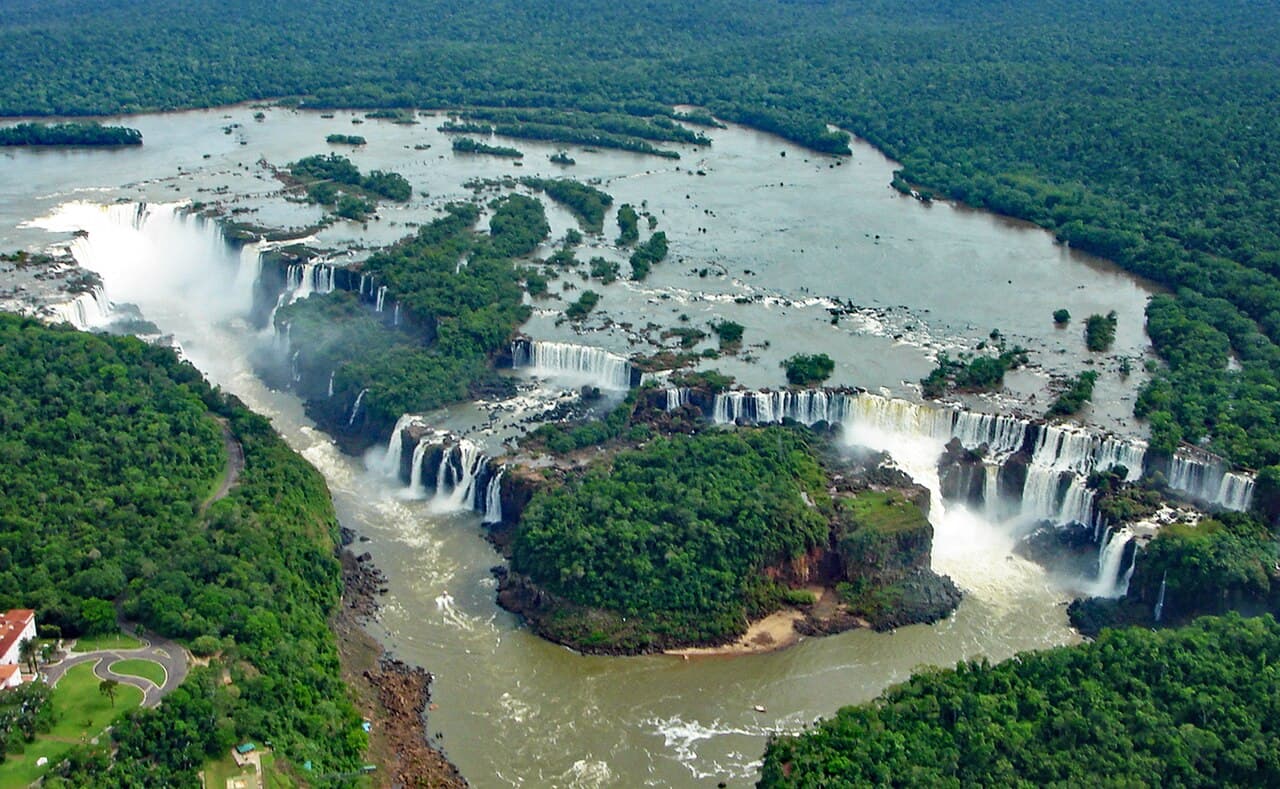
Argentina fills most of South America's southern cone: at roughly 2.8 million square kilometres it is the continent's second-largest country after Brazil and the eighth-largest in the world. Four great landscapes organise it. The Andes wall the west, rising to Aconcagua, at 6,961 metres the highest mountain in the Americas; the humid Pampas spread out from Buenos Aires in the grasslands that made the country's beef and wheat fortunes; the subtropical north holds the Gran Chaco and the Iguazú Falls; and Patagonia runs south through steppe and glacier to Tierra del Fuego.
Some 47 million people live here, more than nine in ten of them in cities, and about a third in greater Buenos Aires alone, a metropolis of around 15 million. Argentina's self-image as a nation of immigrants is grounded in fact: between 1880 and 1930 millions of Europeans, above all Italians and Spaniards, landed at the port of Buenos Aires, and their surnames, foods and speech rhythms shape Argentine identity to this day. More than a million Argentines also identify as indigenous or indigenous-descended, chiefly Mapuche, Kolla, Qom, Wichí, Diaguita and Guaraní peoples, and the 2022 census counted some 300,000 Afro-descendants, heirs of a colonial population that official history long wrote out of the story. Spanish is the national language, the peso the currency, and twelve properties stand on the UNESCO World Heritage List, from a painted cave in Patagonia to a former torture centre in the capital.
Buenos Aires. Founded in 1536, abandoned, and refounded in 1580, the capital grew from a muddy river port into one of the great cities of the world, its avenues and belle-époque palaces built on the export boom of the late nineteenth century. Tango was born in its immigrant quarters and lives on in hundreds of milongas; Café Tortoni has served writers and musicians since 1858; the Teatro Colón ranks among the finest opera houses anywhere; and the painted houses of La Boca's Caminito recall the Genoese dockworkers who settled there. The Plaza de Mayo has been the stage of national life since independence, and the marble labyrinth of Recoleta Cemetery is a city of the dead as celebrated as the city of the living around it.
Córdoba. Argentina's second city, founded in 1573, keeps the country's richest colonial ensemble in the Jesuit Block, a World Heritage Site since 2000, together with its university, founded in 1613 and among the oldest in the Americas. The 1918 University Reform that began here reshaped higher education across Latin America. Each January the nearby town of Cosquín hosts the National Folklore Festival, held since 1961 and the largest gathering of Argentine folk music and dance.
Salta. The most complete colonial city of the north-west, ringed by red-rock valleys and the gateway to the Quebrada de Humahuaca, a World Heritage cultural landscape since 2003. Its Museum of High Altitude Archaeology holds the Llullaillaco children, Inca ritual burials recovered from a 6,700-metre volcano summit, whose display remains the subject of continuing dialogue with indigenous communities. In September the Fiesta del Milagro fills the streets with one of the country's largest religious processions.
Mendoza. Set against the highest Andes at the foot of Aconcagua, Mendoza is the capital of Argentine wine, producing most of the country's output and the Malbec that carried its name abroad. The city drinks through irrigation channels first cut by the indigenous Huarpe people, and each March the Fiesta Nacional de la Vendimia crowns the grape harvest with parades and a spectacle in the hills.
San Antonio de Areco. A small pampas town that serves as the sanctuary of gaucho culture: silversmiths and leather-workers keep the old crafts, the Ricardo Güiraldes Gaucho Museum honours the author of Don Segundo Sombra, and every November the Fiesta de la Tradición fills the streets with horsemen, folk dancers and asado smoke.
The oldest chapter of Argentine heritage is painted on stone. At Cueva de las Manos in Santa Cruz, hunter-gatherer bands stencilled hundreds of hands and painted guanaco hunts on the walls of the Río Pinturas canyon between roughly 13,000 and 9,500 years ago; the site joined the World Heritage List in 1999. In the north-west, Diaguita and other farming societies built terraced villages, and in the fifteenth century the region entered the Inca world, stitched to Cuzco by the Qhapaq Ñan road system that UNESCO inscribed across six countries in 2014. Guaraní peoples farmed the subtropical north-east, where Jesuit missions later rose among them.
 The Quebrada de Humahuaca has been a route through the Andes for ten thousand years, used by hunters, the Inca and the Spanish in turn. Photograph by Bernard Gagnon, CC BY-SA 4.0, via Wikimedia Commons.
Spanish settlement came slowly, from Peru and Chile as much as from the Atlantic, and the region remained a colonial backwater until the Viceroyalty of the Río de la Plata was created in 1776 with Buenos Aires as its capital. The city's militias repelled British invasions in 1806 and 1807, a rehearsal of self-reliance that fed the May Revolution of 25 May 1810 and the declaration of independence at Tucumán on 9 July 1816. José de San Martín then led an army over the Andes to liberate Chile and Peru, becoming the country's foremost national hero. Decades of civil war between centralists and federalists followed until the 1853 constitution and national unification in the 1860s. The military campaigns of the 1870s and 1880s, remembered as the Conquest of the Desert, opened Patagonia to settlement by dispossessing the Mapuche and Tehuelche, a violence whose reassessment is now part of Argentina's public debate.
Then came the boom: railways, refrigerated beef, wheat and mass immigration made Argentina one of the wealthiest countries on earth per person by the eve of the First World War. The twentieth century was harsher. A coup in 1930 opened five decades of political instability; Juan Perón's movement, with Eva Perón at its emotional centre, transformed labour rights and national identity from 1946; and coups and proscriptions culminated in the dictatorship of 1976 to 1983, which waged a campaign of state terrorism against its own population. Human rights organisations speak of as many as 30,000 people detained and disappeared. The failed war over the Malvinas (Falkland Islands) in 1982, which cost 649 Argentine lives, brought the regime down, and democracy returned in December 1983. The CONADEP truth commission's report Nunca Más (1984) and the Trial of the Juntas (1985) set precedents for accounting with state crimes that the world still studies.
Argentina is the only country named in Latin: argentum, silver. Early explorers heard tales of a Sierra del Plata, a mountain of silver somewhere upriver, and the estuary became the Río de la Plata, the river of silver, though the metal never materialised. The name "Argentina" first appeared in a 1602 poem by Martín del Barco Centenera and became official with the 1826 constitution's "República Argentina". Buenos Aires itself is a devotion: the first settlers dedicated their port to Santa María del Buen Ayre, Our Lady of the Fair Winds.
The Spanish spoken here, Rioplatense, is instantly recognisable: the voseo (vos instead of tú), the "sh" sound given to ll and y, and an intonation that linguists trace to the Italian of millions of immigrants. Buenos Aires also bred lunfardo, a slang of the ports and prisons stuffed with Italian loanwords, which became the poetic vocabulary of tango lyrics. Indigenous languages survive alongside: a Quechua variety in Santiago del Estero, Guaraní, co-official in Corrientes province since 2004, Mapudungun in Patagonia, and Wichí, Qom and Moqoit, which the province of Chaco made official in 2010. Others, such as Vilela and Tehuelche, stand at the edge of silence, kept alive by handfuls of speakers and revival programmes. The map remembers older tongues everywhere: Iguazú is Guaraní for "big water".
The gaucho, the horseman of the Pampas, is the country's founding character. José Hernández's Martín Fierro (1872), the great poem of the gauchesque tradition, turned him into a national conscience, and his birthday, 10 November, is celebrated as the Day of Tradition. Around the gaucho cluster living practices: horsemanship and estancia life, the poncho and bombachas, and the payada, a duel of improvised sung verse in which two guitar-carrying payadores answer each other for hours; the Afro-Argentine payador Gabino Ezeiza remains the art's most famous name. Mate, the shared gourd of yerba tea passed from hand to hand in strict order, is the daily ritual of belonging, and the Sunday asado, beef cooked slowly over embers for the extended family, is as close as Argentina comes to a secular sacrament.
Music divides the country generously. Folk traditions, the zamba and chacarera of the north-west and the chamamé of Corrientes with its heart-cry sapukay, fill the peñas, and chamamé joined UNESCO's intangible heritage list in 2020. Tango, born in the 1880s from African, criollo and European elements around the port, is carried by the bandoneón, a German-invented button instrument that became the sound of Buenos Aires melancholy; UNESCO inscribed the tradition, shared with Uruguay, in 2009. The city's buses and shop signs still carry fileteado, the swirling ornamental painting style inscribed by UNESCO in 2015. And football is identity itself: the Boca Juniors and River Plate rivalry, the deification of Diego Maradona and the long reign of Lionel Messi belong to any honest account of Argentine culture, as do the cheek-kiss greeting and dinners that begin at ten at night.
Argentina is historically Catholic, though less uniformly than before: a 2019 CONICET survey found about 63 per cent of Argentines identifying as Catholic and some 15 per cent as evangelical Protestants, with the non-religious growing. The country gave the Church its first pope from the Americas, Francis, the Buenos Aires archbishop elected in 2013, whose death in 2025 was mourned across the political spectrum. The national shrine is the neo-Gothic basilica of Our Lady of Luján, the country's patroness, reached each October by hundreds of thousands of pilgrims who walk some sixty kilometres from Buenos Aires.
Other faiths are woven deep. Argentina hosts the largest Jewish community in Latin America, concentrated in Buenos Aires, where the 1994 bombing of the AMIA community centre killed 85 people; every 18 July a siren sounds and the names of the dead are read aloud, one of the country's fixed rites of memory. The King Fahd Islamic Cultural Centre in Buenos Aires is the largest mosque in Latin America. In the Andean north-west, communities feed Pachamama, the earth mother, each August, opening a hole in the ground for offerings of food, drink and coca before the planting season, a ceremony older than any church in the country. And along every highway, popular devotion runs ahead of official religion, in the red-flagged shrines of Gauchito Gil and the water-bottle mounds of the Difunta Correa, folk saints the Church has declined to canonise but the people have.
Argentine mourning begins with accompaniment. The velorio, the wake, gathers family, neighbours and colleagues around the deceased, traditionally through the night, with coffee, embraces and low talk; burial or cremation follows quickly, usually within a day or two, and the condolence visit, the pésame, is a social duty few will skip. Anniversary masses and rounds of remembrance notices in the newspapers mark the months that follow. What distinguishes Argentina is how public and monumental remembrance then becomes.
The Quebrada de Humahuaca has been a route through the Andes for ten thousand years, used by hunters, the Inca and the Spanish in turn. Photograph by Bernard Gagnon, CC BY-SA 4.0, via Wikimedia Commons.
Spanish settlement came slowly, from Peru and Chile as much as from the Atlantic, and the region remained a colonial backwater until the Viceroyalty of the Río de la Plata was created in 1776 with Buenos Aires as its capital. The city's militias repelled British invasions in 1806 and 1807, a rehearsal of self-reliance that fed the May Revolution of 25 May 1810 and the declaration of independence at Tucumán on 9 July 1816. José de San Martín then led an army over the Andes to liberate Chile and Peru, becoming the country's foremost national hero. Decades of civil war between centralists and federalists followed until the 1853 constitution and national unification in the 1860s. The military campaigns of the 1870s and 1880s, remembered as the Conquest of the Desert, opened Patagonia to settlement by dispossessing the Mapuche and Tehuelche, a violence whose reassessment is now part of Argentina's public debate.
Then came the boom: railways, refrigerated beef, wheat and mass immigration made Argentina one of the wealthiest countries on earth per person by the eve of the First World War. The twentieth century was harsher. A coup in 1930 opened five decades of political instability; Juan Perón's movement, with Eva Perón at its emotional centre, transformed labour rights and national identity from 1946; and coups and proscriptions culminated in the dictatorship of 1976 to 1983, which waged a campaign of state terrorism against its own population. Human rights organisations speak of as many as 30,000 people detained and disappeared. The failed war over the Malvinas (Falkland Islands) in 1982, which cost 649 Argentine lives, brought the regime down, and democracy returned in December 1983. The CONADEP truth commission's report Nunca Más (1984) and the Trial of the Juntas (1985) set precedents for accounting with state crimes that the world still studies.
Argentina is the only country named in Latin: argentum, silver. Early explorers heard tales of a Sierra del Plata, a mountain of silver somewhere upriver, and the estuary became the Río de la Plata, the river of silver, though the metal never materialised. The name "Argentina" first appeared in a 1602 poem by Martín del Barco Centenera and became official with the 1826 constitution's "República Argentina". Buenos Aires itself is a devotion: the first settlers dedicated their port to Santa María del Buen Ayre, Our Lady of the Fair Winds.
The Spanish spoken here, Rioplatense, is instantly recognisable: the voseo (vos instead of tú), the "sh" sound given to ll and y, and an intonation that linguists trace to the Italian of millions of immigrants. Buenos Aires also bred lunfardo, a slang of the ports and prisons stuffed with Italian loanwords, which became the poetic vocabulary of tango lyrics. Indigenous languages survive alongside: a Quechua variety in Santiago del Estero, Guaraní, co-official in Corrientes province since 2004, Mapudungun in Patagonia, and Wichí, Qom and Moqoit, which the province of Chaco made official in 2010. Others, such as Vilela and Tehuelche, stand at the edge of silence, kept alive by handfuls of speakers and revival programmes. The map remembers older tongues everywhere: Iguazú is Guaraní for "big water".
The gaucho, the horseman of the Pampas, is the country's founding character. José Hernández's Martín Fierro (1872), the great poem of the gauchesque tradition, turned him into a national conscience, and his birthday, 10 November, is celebrated as the Day of Tradition. Around the gaucho cluster living practices: horsemanship and estancia life, the poncho and bombachas, and the payada, a duel of improvised sung verse in which two guitar-carrying payadores answer each other for hours; the Afro-Argentine payador Gabino Ezeiza remains the art's most famous name. Mate, the shared gourd of yerba tea passed from hand to hand in strict order, is the daily ritual of belonging, and the Sunday asado, beef cooked slowly over embers for the extended family, is as close as Argentina comes to a secular sacrament.
Music divides the country generously. Folk traditions, the zamba and chacarera of the north-west and the chamamé of Corrientes with its heart-cry sapukay, fill the peñas, and chamamé joined UNESCO's intangible heritage list in 2020. Tango, born in the 1880s from African, criollo and European elements around the port, is carried by the bandoneón, a German-invented button instrument that became the sound of Buenos Aires melancholy; UNESCO inscribed the tradition, shared with Uruguay, in 2009. The city's buses and shop signs still carry fileteado, the swirling ornamental painting style inscribed by UNESCO in 2015. And football is identity itself: the Boca Juniors and River Plate rivalry, the deification of Diego Maradona and the long reign of Lionel Messi belong to any honest account of Argentine culture, as do the cheek-kiss greeting and dinners that begin at ten at night.
Argentina is historically Catholic, though less uniformly than before: a 2019 CONICET survey found about 63 per cent of Argentines identifying as Catholic and some 15 per cent as evangelical Protestants, with the non-religious growing. The country gave the Church its first pope from the Americas, Francis, the Buenos Aires archbishop elected in 2013, whose death in 2025 was mourned across the political spectrum. The national shrine is the neo-Gothic basilica of Our Lady of Luján, the country's patroness, reached each October by hundreds of thousands of pilgrims who walk some sixty kilometres from Buenos Aires.
Other faiths are woven deep. Argentina hosts the largest Jewish community in Latin America, concentrated in Buenos Aires, where the 1994 bombing of the AMIA community centre killed 85 people; every 18 July a siren sounds and the names of the dead are read aloud, one of the country's fixed rites of memory. The King Fahd Islamic Cultural Centre in Buenos Aires is the largest mosque in Latin America. In the Andean north-west, communities feed Pachamama, the earth mother, each August, opening a hole in the ground for offerings of food, drink and coca before the planting season, a ceremony older than any church in the country. And along every highway, popular devotion runs ahead of official religion, in the red-flagged shrines of Gauchito Gil and the water-bottle mounds of the Difunta Correa, folk saints the Church has declined to canonise but the people have.
Argentine mourning begins with accompaniment. The velorio, the wake, gathers family, neighbours and colleagues around the deceased, traditionally through the night, with coffee, embraces and low talk; burial or cremation follows quickly, usually within a day or two, and the condolence visit, the pésame, is a social duty few will skip. Anniversary masses and rounds of remembrance notices in the newspapers mark the months that follow. What distinguishes Argentina is how public and monumental remembrance then becomes.
 Eva Peron's body was taken after her death, hidden abroad for sixteen years and eventually returned. It now lies in the Duarte vault at Recoleta under several metres of reinforced concrete. Photograph by David Berkowitz, CC BY 2.0, via Wikimedia Commons.
The country's cemeteries are national museums. Recoleta, opened in 1822 as the first public cemetery of Buenos Aires, packs more than six thousand vaults, statues and mausoleums into a walled grid of marble streets, holding presidents, poets and Eva Perón, whose body, hidden and moved for years after her death in 1952, was finally laid in the Duarte family vault in 1976. Across town in Chacarita lies the tango singer Carlos Gardel, killed in a 1935 air crash; visitors still slip a lit cigarette between the bronze fingers of his statue, an offering repeated daily for ninety years.
Folk devotion turns some graves into national shrines. At Vallecito in San Juan province, more than half a million people a year visit the sanctuary of the Difunta Correa, a young mother said to have died of thirst in the desert in the 1840s while her baby survived at her breast; travellers leave bottles of water to quench her eternal thirst, and miniature houses and number plates in thanks for favours received. Each 8 January, hundreds of thousands converge on Mercedes in Corrientes for Gauchito Gil, a Robin Hood-style gaucho executed in the 1870s, whose red-flagged roadside shrines now stand on virtually every route in the country. In the Andean north-west, All Saints and All Souls on 1 and 2 November remain a feast of the returning dead: Kolla and other communities in Jujuy and Salta build offering tables with tantawawas, small breads shaped like infants, together with the favourite food and drink of the departed, then carry flowers and prayers to the cemeteries and eat with their dead.
Above all this stands the memory of the disappeared. From April 1977, in the middle of the terror, a group of mothers began walking slow circles around the Plaza de Mayo demanding their children back, their white headscarves embroidered with the missing names; the Madres de Plaza de Mayo turned a private grief into the most recognisable emblem of human rights on the continent, and painted headscarves still mark pavements across Argentina. The Abuelas de Plaza de Mayo took up a second search, for the roughly 500 babies born in captivity or kidnapped with their parents and given to other families; backed since 1987 by a National Genetic Data Bank, they had restored the identities of 140 grandchildren by July 2025. Every 24 March, the anniversary of the 1976 coup, is now the Day of Remembrance for Truth and Justice, a national public holiday marked by mass marches.
The sites of horror have become sites of conscience. The former Navy Mechanics School (ESMA) in Buenos Aires, through which some 5,000 detainees passed, most of them murdered, many thrown alive from aircraft into the Río de la Plata, opened as a museum in 2015 and was inscribed on the World Heritage List in 2023. On the river's edge, the Parque de la Memoria holds a monument of four stelae faced with thirty thousand porphyry blocks, around nine thousand of them engraved with names, ages and, where known, pregnancies; the blank stones wait for identities still to be recovered, and the monument deliberately faces the water into which so many were dropped. The Argentine Forensic Anthropology Team (EAAF), founded in 1984 with the American forensic scientist Clyde Snow, pioneered the science of identifying the exhumed dead and has since worked in dozens of countries; at home, its work extends to the Malvinas, where, with the Red Cross, it has given names to more than a hundred Argentine soldiers buried anonymously in the Darwin cemetery. In Argentina, restoring a name to the dead is understood not as administration but as the completion of mourning, and as a debt the living owe.
Argentina is a country of arrivals, and its records are organised accordingly. Between 1857 and 1940 something over six million people landed here, mostly Italians and Spaniards, and the immigration service recorded each one: name, age, occupation, marital status, ship, port of departure. Those arrival records for 1882 to 1960 are indexed and searchable through CEMLA, the migration studies centre in Buenos Aires, and for a great many Italian and Spanish families the Argentine entry is the document that names the village back home.
Civil registration began province by province in the 1880s, with Buenos Aires from 1886, and the registers are held by each province's Registro Civil rather than nationally. Access to the originals generally requires proof of descent, which makes the church books the practical first step.
Those go back much further. Parish registers begin in the seventeenth century in the older settlements, and FamilySearch has digitised a large part of them, so baptisms and marriages can often be read at home even where the civil record cannot.
The most recent Argentine records are the ones the country least wanted to make. Between 1976 and 1983 the military government disappeared thousands of people and took the infants of the disappeared to be raised by other families. The Abuelas de Plaza de Mayo have used a national genetic data bank, established in 1987, to identify well over a hundred of those children as adults. It is genealogy conducted as a criminal investigation, and it is the reason Argentina built one of the first forensic identification programmes in the world.
Argentina's legal framework for heritage dates to Law 12,665 of 1940, which created the National Commission of Monuments, of Places and of Historical Assets, joined by Law 25,743 of 2003 protecting archaeological and palaeontological heritage. A third pillar is distinctive: Law 26,691 of 2011 declared the former clandestine detention centres of the dictatorship "Sites of Memory", requiring their preservation; more than 700 such sites have been identified and signposted, and dozens now operate as memory spaces with public programmes.
Twelve properties carry World Heritage status, beginning with Los Glaciares National Park in 1981 and including the Jesuit missions of the Guaraní, Cueva de las Manos, the Quebrada de Humahuaca, the Jesuit Block of Córdoba, the Qhapaq Ñan and, most recently, the ESMA museum in 2023. The Qhapaq Ñan inscription, shared with five other Andean countries, is managed with the highland communities who still walk and maintain the old road. On the intangible side, tango (2009), filete porteño (2015) and chamamé (2020) all stand on UNESCO's Representative List. A dense network of institutions carries the daily work, from the National Institute of Anthropology and Latin American Thought to provincial museums such as the Güiraldes gaucho museum in Areco, while festivals like Cosquín and the Fiesta de la Tradición keep transmission alive rather than curated.
The Archivo General de la Nación (AGN), founded in 1821, is one of Latin America's great archives, holding written, photographic and audiovisual records that span five centuries, including more than 800,000 photographs. A rolling digitisation programme, supported by CONICET researchers, is moving manuscripts, images and sound online, and the archive's catalogue can now be searched over the internet. The National Library and provincial archives run parallel digital collections.
Argentina's memory movement built its own digital infrastructure. Memoria Abierta, an alliance of human rights organisations, has recorded and digitised hundreds of oral testimonies of state terrorism and mapped the topography of the clandestine centres; the Parque de la Memoria maintains a public online database of victims that families can consult and correct; and the National Genetic Data Bank keeps the DNA profiles that continue to resolve identity cases decades on. The ESMA museum offers virtual visits, extending an obligation of witness to those who cannot stand in the building itself. Together these projects make Argentina a reference point for how a country can digitise not only its treasures but its wounds.
Argentine letters shaped world literature in the twentieth century through Jorge Luis Borges, whose labyrinths and mirrors made Buenos Aires a universal city, and Julio Cortázar, whose Hopscotch rewired the novel. Ernesto Sábato lent his moral weight to the prologue of Nunca Más. A new generation carries the tradition into darker registers: Mariana Enriquez's gothic stories of memory and violence and Samanta Schweblin's unsettling fictions are read in dozens of languages and shortlisted for the world's major prizes.
Cinema has made Argentine memory a global export. The Official Story (1985), about a child appropriated during the dictatorship, won the country's first Academy Award for best foreign film; The Secret in Their Eyes repeated the feat in 2010; and Argentina, 1985, on the Trial of the Juntas, won the Golden Globe in 2023. In music, Astor Piazzolla carried tango into the concert hall, Mercedes Sosa gave Latin America its conscience-voice, and rock nacional soundtracked the return of democracy. Football remains the great shared emotion: when Maradona died in November 2020 the government declared three days of national mourning, and when Messi lifted the World Cup in 2022 millions filled the streets of Buenos Aires in the largest gathering in Argentine history. Meanwhile the tango that left the port a century ago now sustains milongas on every continent, and dancers return each August for Buenos Aires' tango festival and world championship.
A torture centre becomes World Heritage. In September 2023 UNESCO inscribed the ESMA Museum and Site of Memory on the World Heritage List, recognising the scale and coordination of the crimes it documents. A building where thousands were tortured is now a classroom for the world, preserved by law and run with survivors' testimony at its core.
The 140th grandchild. In July 2025 the Abuelas de Plaza de Mayo announced the identification of the 140th grandchild stolen during the dictatorship, a man born in a clandestine detention centre in 1977. Nearly five decades of patient genetic and documentary work continue to restore identities, with some 300 cases still open.
Names for the fallen of the Malvinas. Working with the International Committee of the Red Cross, the Argentine Forensic Anthropology Team identified more than a hundred soldiers buried as unknowns in the Darwin cemetery, allowing mothers, many in their eighties, to finally stand at a named grave.
Three living traditions on the world list. Tango (2009), filete porteño (2015) and chamamé (2020) all entered UNESCO's Representative List of the Intangible Cultural Heritage of Humanity, recognition that Argentina's most valuable heritage is danced, painted and sung rather than built.
Eva Peron's body was taken after her death, hidden abroad for sixteen years and eventually returned. It now lies in the Duarte vault at Recoleta under several metres of reinforced concrete. Photograph by David Berkowitz, CC BY 2.0, via Wikimedia Commons.
The country's cemeteries are national museums. Recoleta, opened in 1822 as the first public cemetery of Buenos Aires, packs more than six thousand vaults, statues and mausoleums into a walled grid of marble streets, holding presidents, poets and Eva Perón, whose body, hidden and moved for years after her death in 1952, was finally laid in the Duarte family vault in 1976. Across town in Chacarita lies the tango singer Carlos Gardel, killed in a 1935 air crash; visitors still slip a lit cigarette between the bronze fingers of his statue, an offering repeated daily for ninety years.
Folk devotion turns some graves into national shrines. At Vallecito in San Juan province, more than half a million people a year visit the sanctuary of the Difunta Correa, a young mother said to have died of thirst in the desert in the 1840s while her baby survived at her breast; travellers leave bottles of water to quench her eternal thirst, and miniature houses and number plates in thanks for favours received. Each 8 January, hundreds of thousands converge on Mercedes in Corrientes for Gauchito Gil, a Robin Hood-style gaucho executed in the 1870s, whose red-flagged roadside shrines now stand on virtually every route in the country. In the Andean north-west, All Saints and All Souls on 1 and 2 November remain a feast of the returning dead: Kolla and other communities in Jujuy and Salta build offering tables with tantawawas, small breads shaped like infants, together with the favourite food and drink of the departed, then carry flowers and prayers to the cemeteries and eat with their dead.
Above all this stands the memory of the disappeared. From April 1977, in the middle of the terror, a group of mothers began walking slow circles around the Plaza de Mayo demanding their children back, their white headscarves embroidered with the missing names; the Madres de Plaza de Mayo turned a private grief into the most recognisable emblem of human rights on the continent, and painted headscarves still mark pavements across Argentina. The Abuelas de Plaza de Mayo took up a second search, for the roughly 500 babies born in captivity or kidnapped with their parents and given to other families; backed since 1987 by a National Genetic Data Bank, they had restored the identities of 140 grandchildren by July 2025. Every 24 March, the anniversary of the 1976 coup, is now the Day of Remembrance for Truth and Justice, a national public holiday marked by mass marches.
The sites of horror have become sites of conscience. The former Navy Mechanics School (ESMA) in Buenos Aires, through which some 5,000 detainees passed, most of them murdered, many thrown alive from aircraft into the Río de la Plata, opened as a museum in 2015 and was inscribed on the World Heritage List in 2023. On the river's edge, the Parque de la Memoria holds a monument of four stelae faced with thirty thousand porphyry blocks, around nine thousand of them engraved with names, ages and, where known, pregnancies; the blank stones wait for identities still to be recovered, and the monument deliberately faces the water into which so many were dropped. The Argentine Forensic Anthropology Team (EAAF), founded in 1984 with the American forensic scientist Clyde Snow, pioneered the science of identifying the exhumed dead and has since worked in dozens of countries; at home, its work extends to the Malvinas, where, with the Red Cross, it has given names to more than a hundred Argentine soldiers buried anonymously in the Darwin cemetery. In Argentina, restoring a name to the dead is understood not as administration but as the completion of mourning, and as a debt the living owe.
Argentina is a country of arrivals, and its records are organised accordingly. Between 1857 and 1940 something over six million people landed here, mostly Italians and Spaniards, and the immigration service recorded each one: name, age, occupation, marital status, ship, port of departure. Those arrival records for 1882 to 1960 are indexed and searchable through CEMLA, the migration studies centre in Buenos Aires, and for a great many Italian and Spanish families the Argentine entry is the document that names the village back home.
Civil registration began province by province in the 1880s, with Buenos Aires from 1886, and the registers are held by each province's Registro Civil rather than nationally. Access to the originals generally requires proof of descent, which makes the church books the practical first step.
Those go back much further. Parish registers begin in the seventeenth century in the older settlements, and FamilySearch has digitised a large part of them, so baptisms and marriages can often be read at home even where the civil record cannot.
The most recent Argentine records are the ones the country least wanted to make. Between 1976 and 1983 the military government disappeared thousands of people and took the infants of the disappeared to be raised by other families. The Abuelas de Plaza de Mayo have used a national genetic data bank, established in 1987, to identify well over a hundred of those children as adults. It is genealogy conducted as a criminal investigation, and it is the reason Argentina built one of the first forensic identification programmes in the world.
Argentina's legal framework for heritage dates to Law 12,665 of 1940, which created the National Commission of Monuments, of Places and of Historical Assets, joined by Law 25,743 of 2003 protecting archaeological and palaeontological heritage. A third pillar is distinctive: Law 26,691 of 2011 declared the former clandestine detention centres of the dictatorship "Sites of Memory", requiring their preservation; more than 700 such sites have been identified and signposted, and dozens now operate as memory spaces with public programmes.
Twelve properties carry World Heritage status, beginning with Los Glaciares National Park in 1981 and including the Jesuit missions of the Guaraní, Cueva de las Manos, the Quebrada de Humahuaca, the Jesuit Block of Córdoba, the Qhapaq Ñan and, most recently, the ESMA museum in 2023. The Qhapaq Ñan inscription, shared with five other Andean countries, is managed with the highland communities who still walk and maintain the old road. On the intangible side, tango (2009), filete porteño (2015) and chamamé (2020) all stand on UNESCO's Representative List. A dense network of institutions carries the daily work, from the National Institute of Anthropology and Latin American Thought to provincial museums such as the Güiraldes gaucho museum in Areco, while festivals like Cosquín and the Fiesta de la Tradición keep transmission alive rather than curated.
The Archivo General de la Nación (AGN), founded in 1821, is one of Latin America's great archives, holding written, photographic and audiovisual records that span five centuries, including more than 800,000 photographs. A rolling digitisation programme, supported by CONICET researchers, is moving manuscripts, images and sound online, and the archive's catalogue can now be searched over the internet. The National Library and provincial archives run parallel digital collections.
Argentina's memory movement built its own digital infrastructure. Memoria Abierta, an alliance of human rights organisations, has recorded and digitised hundreds of oral testimonies of state terrorism and mapped the topography of the clandestine centres; the Parque de la Memoria maintains a public online database of victims that families can consult and correct; and the National Genetic Data Bank keeps the DNA profiles that continue to resolve identity cases decades on. The ESMA museum offers virtual visits, extending an obligation of witness to those who cannot stand in the building itself. Together these projects make Argentina a reference point for how a country can digitise not only its treasures but its wounds.
Argentine letters shaped world literature in the twentieth century through Jorge Luis Borges, whose labyrinths and mirrors made Buenos Aires a universal city, and Julio Cortázar, whose Hopscotch rewired the novel. Ernesto Sábato lent his moral weight to the prologue of Nunca Más. A new generation carries the tradition into darker registers: Mariana Enriquez's gothic stories of memory and violence and Samanta Schweblin's unsettling fictions are read in dozens of languages and shortlisted for the world's major prizes.
Cinema has made Argentine memory a global export. The Official Story (1985), about a child appropriated during the dictatorship, won the country's first Academy Award for best foreign film; The Secret in Their Eyes repeated the feat in 2010; and Argentina, 1985, on the Trial of the Juntas, won the Golden Globe in 2023. In music, Astor Piazzolla carried tango into the concert hall, Mercedes Sosa gave Latin America its conscience-voice, and rock nacional soundtracked the return of democracy. Football remains the great shared emotion: when Maradona died in November 2020 the government declared three days of national mourning, and when Messi lifted the World Cup in 2022 millions filled the streets of Buenos Aires in the largest gathering in Argentine history. Meanwhile the tango that left the port a century ago now sustains milongas on every continent, and dancers return each August for Buenos Aires' tango festival and world championship.
A torture centre becomes World Heritage. In September 2023 UNESCO inscribed the ESMA Museum and Site of Memory on the World Heritage List, recognising the scale and coordination of the crimes it documents. A building where thousands were tortured is now a classroom for the world, preserved by law and run with survivors' testimony at its core.
The 140th grandchild. In July 2025 the Abuelas de Plaza de Mayo announced the identification of the 140th grandchild stolen during the dictatorship, a man born in a clandestine detention centre in 1977. Nearly five decades of patient genetic and documentary work continue to restore identities, with some 300 cases still open.
Names for the fallen of the Malvinas. Working with the International Committee of the Red Cross, the Argentine Forensic Anthropology Team identified more than a hundred soldiers buried as unknowns in the Darwin cemetery, allowing mothers, many in their eighties, to finally stand at a named grave.
Three living traditions on the world list. Tango (2009), filete porteño (2015) and chamamé (2020) all entered UNESCO's Representative List of the Intangible Cultural Heritage of Humanity, recognition that Argentina's most valuable heritage is danced, painted and sung rather than built.
National Overview
Notable Cities
Historical Foundations
Linguistic and Etymological Roots
Cultural Identity
Religion and Spirituality
Remembrance and Mourning Traditions
Tracing a Family in Argentina
Heritage Preservation Efforts
Digital Heritage
Contemporary Cultural Influences
Success Stories
References and resources
- UNESCO World Heritage Centre, ESMA Museum and Site of Memory, the 2023 inscription of the former clandestine detention centre.
- UNESCO World Heritage Centre, Qhapaq Ñan, Andean Road System, the six-country inscription that includes north-western Argentina.
- UNESCO Intangible Cultural Heritage, Tango, the 2009 joint inscription with Uruguay.
- UNESCO Intangible Cultural Heritage, Chamamé, the 2020 inscription of the Corrientes tradition.
- Parque de la Memoria, Monument to the Victims of State Terrorism, the stelae, the names and the public victims database.
- Buenos Aires Herald, Grandmothers of Plaza de Mayo identify 140th stolen grandchild, the July 2025 identification.
- Equipo Argentino de Antropología Forense (EAAF), the forensic team founded in 1984, now working worldwide.
- Archivo General de la Nación, Argentina's national archive and its digitisation programmes.
- Encyclopaedia Britannica, Argentina, geography, history and political background.