Heritage · Country
Malta Culture and Heritage
Malta holds the oldest free-standing stone temples on earth, an underground necropolis carved for some seven thousand of the dead, and a fortress capital raised in a single generation after the Great Siege of 1565. A guide to the archipelago's heritage across 316 square kilometres, to its Catholic funerary and festa customs, and to the work carrying Maltese memory into the digital age.Written to last.
By Confinity Heritage Editorial · Updated 2026-07-31 · 8-minute readQuiet tools, kept out of the way.
Malta is a place where the oldest human building instinct still shows in the rock. On this small archipelago in the centre of the Mediterranean, people were raising temples of dressed stone before the pyramids of Egypt and before Stonehenge, and beneath the ground at Paola they hollowed a three-level sanctuary that served as a cemetery for roughly seven thousand of their dead. Long before it possessed a written language, Malta had a way of gathering the living around the memory of the departed, and that instinct never left the islands. It runs on through the fortress churches of the Knights of St John, through a calendar of Catholic memorial rites still kept in every parish, and through village feasts that turn a saint's day into a reunion of the whole community, present and past.
The physical inheritance is guarded with unusual care for so small a country. Malta counts three UNESCO World Heritage Sites inside an area of only 316 square kilometres: the megalithic temples, the underground Hypogeum, and the capital of Valletta, built almost in a single generation after the Great Siege of 1565. To that inheritance the twentieth century added a national emblem of endurance, the George Cross awarded to the whole island for its ordeal under bombardment in the Second World War.
Malta lies in the middle of the Mediterranean, roughly halfway between Sicily and the North African coast, a position that has made it a crossroads and a prize for three thousand years. The state consists of three inhabited islands, Malta itself, Gozo (Għawdex) and the tiny Comino (Kemmuna), together with a scatter of uninhabited rocks. The whole covers about 316 square kilometres, which makes Malta the smallest member state of the European Union, and with a population of a little over half a million it is also one of the most densely settled countries on earth. There are no rivers and few trees; the defining material is the pale, honey-coloured Globigerina limestone from which the temples, the cities and the field walls are all cut.
The capital is Valletta, and the largest urban area spreads around the Grand Harbour. Malta is overwhelmingly Roman Catholic, and its two official languages are Maltese and English. The country gained independence in 1964, became a republic in 1974, joined the European Union in 2004 and adopted the euro in 2008.
Valletta. The capital occupies a narrow peninsula between two great harbours and was built by the Knights of St John after 1565, named for the Grand Master who led the defence, Jean Parisot de Valette. Laid out on a grid within massive bastions, it is a planned Baroque city, home to the Grandmaster's Palace and to St John's Co-Cathedral, whose gilded interior holds Caravaggio's vast Beheading of Saint John the Baptist of 1608, the painter's only signed work. Valletta was European Capital of Culture in 2018.
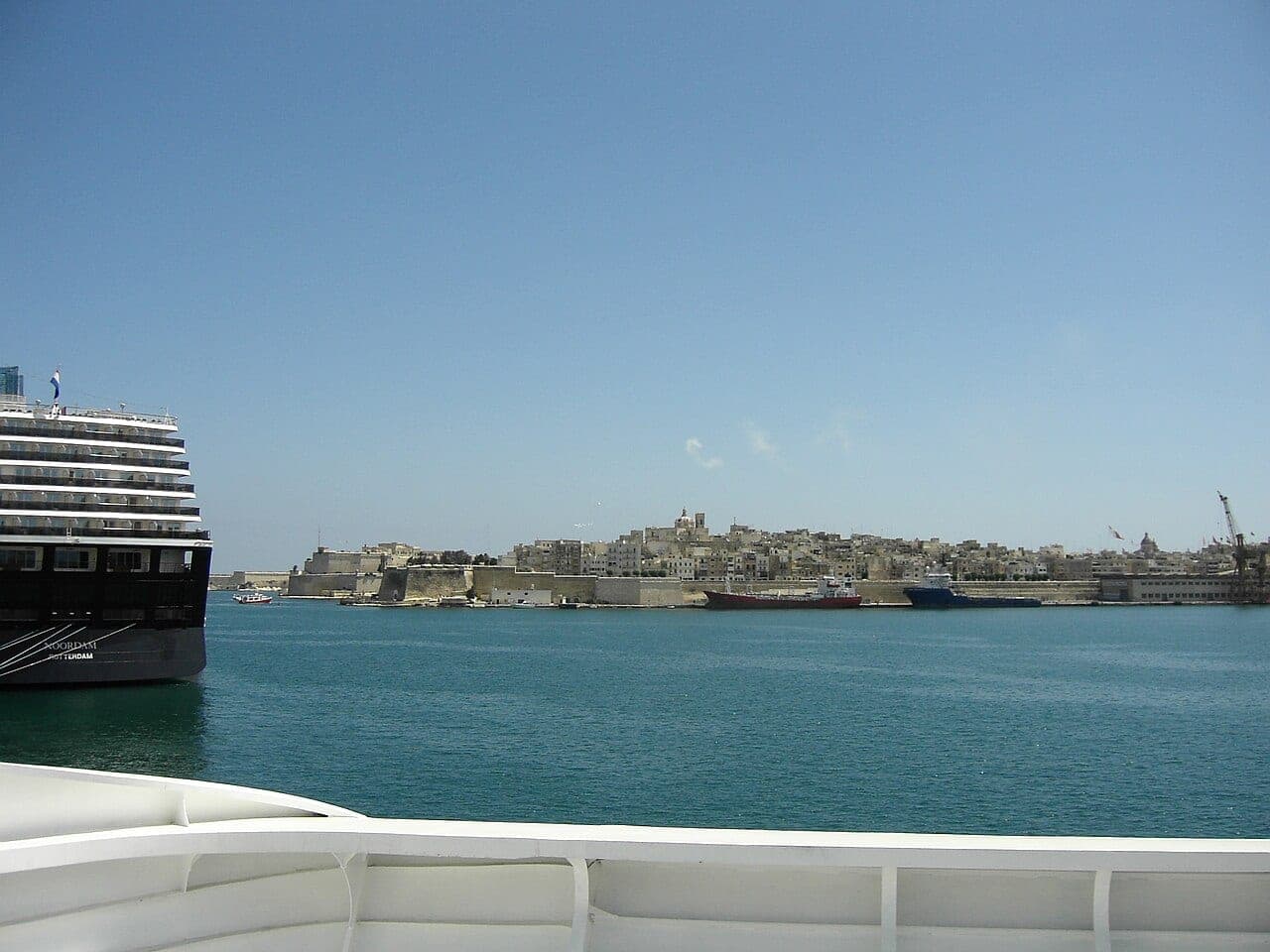
 Valletta was laid out on a grid behind these walls immediately after the siege of 1565, as a city designed from nothing to survive the next one. Photograph by Kavallier09, CC BY-SA 4.0, via Wikimedia Commons.
Mdina. The old capital crowns a hill in the centre of the island and is known as the Silent City. Settled by the Phoenicians and important under Rome as Melite, it took its present name from the Arabic madīnah, meaning town, and keeps the winding, shaded lanes of the Arab period behind its walls. The Normans arrived in 1091, and the medieval nobility filled Mdina with palaces and the cathedral said to mark the house of the governor Publius.
Victoria, Gozo. The capital of the sister island of Gozo, still widely called Rabat, is crowned by the Cittadella, a fortified citadel whose bastions look out across the whole island. Nearby at Xagħra stand the Ġgantija temples, among the oldest of all.
The Three Cities. Across the Grand Harbour from Valletta lie Birgu (Vittoriosa), Senglea (Isla) and Cospicua (Bormla), the first home of the Knights from 1530 and the ground where the Great Siege was won and lost. Fort St Angelo at the tip of Birgu was the heart of the defence in 1565 and again a target in the bombing of the 1940s.
Maltese history opens with one of the great puzzles of prehistory. From around 3600 BC the islanders began building free-standing temples of colossal stone, at Ġgantija on Gozo, at Ħaġar Qim and Mnajdra on the southern cliffs, and at Tarxien, Skorba and Ta' Ħaġrat. These are among the earliest free-standing stone structures anywhere, older than the pyramids, and the temple culture endured for a thousand years before it faded around 2500 BC. In the same period the community carved the Ħal Saflieni Hypogeum, an underground complex on three levels that held the remains of an estimated seven thousand people.
Valletta was laid out on a grid behind these walls immediately after the siege of 1565, as a city designed from nothing to survive the next one. Photograph by Kavallier09, CC BY-SA 4.0, via Wikimedia Commons.
Mdina. The old capital crowns a hill in the centre of the island and is known as the Silent City. Settled by the Phoenicians and important under Rome as Melite, it took its present name from the Arabic madīnah, meaning town, and keeps the winding, shaded lanes of the Arab period behind its walls. The Normans arrived in 1091, and the medieval nobility filled Mdina with palaces and the cathedral said to mark the house of the governor Publius.
Victoria, Gozo. The capital of the sister island of Gozo, still widely called Rabat, is crowned by the Cittadella, a fortified citadel whose bastions look out across the whole island. Nearby at Xagħra stand the Ġgantija temples, among the oldest of all.
The Three Cities. Across the Grand Harbour from Valletta lie Birgu (Vittoriosa), Senglea (Isla) and Cospicua (Bormla), the first home of the Knights from 1530 and the ground where the Great Siege was won and lost. Fort St Angelo at the tip of Birgu was the heart of the defence in 1565 and again a target in the bombing of the 1940s.
Maltese history opens with one of the great puzzles of prehistory. From around 3600 BC the islanders began building free-standing temples of colossal stone, at Ġgantija on Gozo, at Ħaġar Qim and Mnajdra on the southern cliffs, and at Tarxien, Skorba and Ta' Ħaġrat. These are among the earliest free-standing stone structures anywhere, older than the pyramids, and the temple culture endured for a thousand years before it faded around 2500 BC. In the same period the community carved the Ħal Saflieni Hypogeum, an underground complex on three levels that held the remains of an estimated seven thousand people.
 The Maltese temples are older than the pyramids and older than Stonehenge, and the people who raised them left no writing and no clear successor culture. Photograph by Diego Delso, CC BY-SA 4.0, via Wikimedia Commons.
After a Bronze Age of fortified villages, Malta entered recorded history with the Phoenicians, who settled from about the eighth century BC and gave the islands their name. Their Carthaginian heirs held Malta until Rome took it during the Punic Wars, and under Roman rule the city of Melite prospered. Christian tradition dates from this era: the Acts of the Apostles records that Saint Paul was shipwrecked on the island around AD 60, healed the father of the governor Publius, and left behind a community that made Publius the first bishop, beginning a Christian presence the Maltese count as unbroken.
Byzantine rule gave way in 870 to Arab conquest, and it was the Arab centuries that reshaped the islands most lastingly, above all in the language and in place names such as Mdina and Għawdex. The Normans under Count Roger took Malta in 1091, tying it to Sicily and to Latin Christianity, and centuries of Sicilian, Aragonese and Castilian rule followed. In 1530 the Emperor Charles V granted the islands to the Knights of St John, expelled from Rhodes, for the token yearly rent of a single falcon. In 1565 an Ottoman army laid siege to the young Order; against long odds the Knights and the Maltese held out through the summer, and the Great Siege became one of the most celebrated defences in European history. To guard against any return, the victorious Grand Master began a new fortress capital, Valletta, whose first stone was laid in 1566.
The Knights ruled until 1798, when Napoleon seized Malta on his way to Egypt. The Maltese soon rose against the French, and with British help forced their surrender in 1800; British sovereignty was confirmed by the Treaty of Paris in 1814. Malta's harbours made it a pillar of British naval power, and that value brought catastrophe in the Second World War, when the island endured one of the most intense aerial bombardments of the conflict. In 1942 King George VI awarded the whole island the George Cross, the only such collective honour ever given, and the medal has appeared on the national flag ever since. Malta became independent in 1964, a republic in 1974, and saw the last British forces depart in 1979.
Malta's most singular inheritance may be its language. Maltese (Malti) descends from Siculo-Arabic, the Arabic once spoken across Sicily and Malta, and it is the only Semitic language written in the Latin alphabet, as well as the only Semitic and Afroasiatic tongue with official status in the European Union. Its grammar and everyday core remain Semitic, while centuries of contact have layered in a vast vocabulary of Sicilian, Italian and, more recently, English words. The alphabet was standardised in 1924 and runs to thirty letters, among them the distinctive ċ, ġ, ħ and ż and the digraph għ. English shares official status with Maltese, a legacy of British rule, and most Maltese move easily between the two.
The name of the country is itself contested. It comes through the Latin Melita from the Greek Melitē, which some derive from méli, honey, perhaps for the island's endemic bees, and others trace to a Phoenician or Punic root meaning refuge or safe harbour. Either reading suits a place that has been both a producer of honey and a shelter for ships. Gozo carries its own older name, Għawdex, of Semitic form.
At the centre of Maltese cultural life is the village festa, the annual feast that each parish holds for its patron saint between spring and early autumn. Over a week the church is draped in damask and lit with candelabra, the streets are hung with banners, brass band clubs march, and the sky fills with the fireworks for which Malta is renowned; on the final day the saint's statue is carried through the streets on the shoulders of the parishioners. The tradition was inscribed on UNESCO's Representative List of the Intangible Cultural Heritage of Humanity in 2023.
The islands hold other emblems just as recognisable. The luzzu, the small fishing boat painted in bright bands of colour, carries on its prow a pair of eyes, often called the Eye of Osiris or Horus, meant to guard the fisherman at sea; whole harbours of them fill Marsaxlokk. Maltese craftspeople are known for delicate silver and gold filigree, and the eight-pointed Maltese cross of the Knights remains a national symbol. The table is distinctive too: the flaky ricotta or pea pastizzi, the slow-cooked rabbit stew stuffat tal-fenek that counts as the national dish and gathers friends for the meal called a fenkata, the flat ftira bread, and sweets such as imqaret and kannoli.
Malta is one of the most observantly Catholic countries in Europe. Around nine in ten Maltese identify as Roman Catholic, the constitution names Catholicism the religion of the state, and more than three hundred churches serve a population of half a million. Islanders trace the tradition without a break to the shipwreck of Saint Paul and the ministry of Publius, which gives their Catholicism an unusually deep sense of continuity.
The parish is the basic unit of belonging, and its calendar orders communal life. Holy Week is observed with particular seriousness: on Good Friday, towns mount solemn processions in which life-size statues of the Passion are carried through the streets to the beat of funeral marches. The Marian devotion is strong, focused above all on the national shrine of Ta' Pinu on Gozo, and the festa cycle that runs from April to October keeps the saints present through the year.
Maltese mourning follows the Roman Catholic pattern, kept with care. A death is marked by a Requiem Mass and burial, usually within a couple of days, with cremation historically rare; the rosary is recited for the repose of the soul, families wear dark clothing, and further Masses are offered at the month's mind and on each anniversary. Graves are family property, tended and visited, and older custom kept the household of the bereaved from cooking for a time. Within living memory villages also called on the newwieħa, women hired to weep and lament aloud behind the coffin, a role that has since faded but that linked Maltese grief to an old Mediterranean art of public mourning.
The dead are remembered together each November. On All Souls' Day, the second of the month, known in Maltese as Jum l-Erwieħ or L-Għid tal-Erwieħ, families visit the cemeteries, church bells toll for the souls in purgatory, and Masses are said for the departed; the day carries its own foods, above all the almond biscuits called Għadam tal-Mejtin, the bones of the dead. Older generations recall the poor going door to door with the appeal xi ħaġa għall-erwieħ, something for the souls, so that charity to the living became a prayer for the dead.
Public remembrance in Malta gathers around the sieges. Victory Day, Il-Vitorja, on the eighth of September, coincides with the feast of Our Lady of Victories and marks the end of three ordeals at once: the Great Siege of 1565, the blockade that ended French rule in 1800, and the wartime siege that broke in 1943. It is kept with Mass, band marches and the traditional regatta of rowing boats in the Grand Harbour, so that the memory of survival is renewed each year as a communal act. The George Cross on the flag carries the same memory in daily use, and the festa itself, honouring the parish and the generations who built its church, is at heart an act of collective remembrance.
Malta's best genealogical source is a room full of notarial registers, and the earliest of them was written in 1465.
The Notarial Archives in Valletta hold around twenty thousand volumes of contracts, wills, dowries and property transfers running from the fifteenth century to the present. Because a Maltese notarial deed names the parties, their fathers, their heirs, their residences and often dates of death and marriage, the collection functions as a continuous genealogical record of a small population across five and a half centuries. It also nearly did not survive: volumes were stored for decades in conditions that let damp, pests and neglect do their work, and the rescue and conservation of them has been a long public campaign, latterly with substantial European funding.
Parish registers begin in the sixteenth century, after the Council of Trent, and Malta's are unusually complete because the islands are small, Catholic and were never conquered after 1565. Civil registration dates from 1863 and is held by the Public Registry.
The Order of St John's own archive, held at the National Library, documents the knights and the administration of the islands from 1530 to 1798.
Two absences: the deportations and the emigration. Maltese emigration in the twentieth century was heavy, to Australia, Britain, Canada and the United States, and for many families the recent generations are documented in Melbourne rather than in Mosta. The wartime evacuation of Malta's towns during the siege moved most of the population inland and generated its own registers.
Malta's monuments are managed chiefly by Heritage Malta, the national agency for museums and sites, working alongside the planning authority and the Superintendence of Cultural Heritage. The country's three UNESCO World Heritage Sites are the City of Valletta and the Ħal Saflieni Hypogeum, both inscribed in 1980, and the Megalithic Temples of Malta, inscribed as Ġgantija in 1980 and extended in 1992 to take in the other five temple sites.
Because prehistoric stone and paint are fragile, several sites are held under strict protection. The Hypogeum admits only small numbers of visitors each day under controlled temperature and humidity to preserve its red-ochre wall paintings, and since 2009 the cliffside temples of Ħaġar Qim and Mnajdra have sheltered under protective canopies against rain and sun. Beyond the flagship sites, Malta's intangible heritage is recognised as well: the festa joined the Maltese folk-song tradition of għana and the ftira bread already on the UNESCO lists.
Malta has moved to record its heritage in digital form so that it can be studied and shared without wear on the originals. Heritage Malta has supported detailed three-dimensional scanning of the temples and of the Hypogeum, whose closed chambers can now be explored virtually, and has partnered with Google Arts and Culture to bring the underground site to a global audience. The National Archives of Malta and the Malta Libraries have digitised registers, photographs and the Melitensia collections that document the islands' past, reaching researchers and the large Maltese diaspora who trace their families through them.
Maltese culture today lives both on the islands and across a wide diaspora in Australia, Canada, the United States and Britain, where clubs, parishes and festa committees keep the language and customs in regular use. At home the small size of the country has not limited its reach: Valletta's turn as European Capital of Culture in 2018 drew international attention, the harbours and forts serve regularly as film locations, and a new generation of Maltese writers, musicians and artists works in a language that digital media help keep current among the young.
The festa wins global recognition. The inscription of the Maltese village festa on UNESCO's Representative List in 2023 confirmed a living tradition, sustained year-round by volunteer band clubs and parish committees, as heritage of value to all humanity.
The Hypogeum protected and reopened. After a conservation programme installed environmental controls to stabilise its climate, the Ħal Saflieni Hypogeum reopened to carefully limited numbers of visitors in 2017, allowing the only prehistoric painted interior in the Maltese islands to survive continued public access.
A capital renewed. Valletta marked its European Capital of Culture year in 2018 with a wave of restoration across its bastions and streets, anchored by Renzo Piano's new City Gate and parliament.
A small language secured. Maltese became an official language of the European Union on accession in 2004, giving one of the world's smallest Semitic tongues a permanent place in the institutions of the continent.
The Maltese temples are older than the pyramids and older than Stonehenge, and the people who raised them left no writing and no clear successor culture. Photograph by Diego Delso, CC BY-SA 4.0, via Wikimedia Commons.
After a Bronze Age of fortified villages, Malta entered recorded history with the Phoenicians, who settled from about the eighth century BC and gave the islands their name. Their Carthaginian heirs held Malta until Rome took it during the Punic Wars, and under Roman rule the city of Melite prospered. Christian tradition dates from this era: the Acts of the Apostles records that Saint Paul was shipwrecked on the island around AD 60, healed the father of the governor Publius, and left behind a community that made Publius the first bishop, beginning a Christian presence the Maltese count as unbroken.
Byzantine rule gave way in 870 to Arab conquest, and it was the Arab centuries that reshaped the islands most lastingly, above all in the language and in place names such as Mdina and Għawdex. The Normans under Count Roger took Malta in 1091, tying it to Sicily and to Latin Christianity, and centuries of Sicilian, Aragonese and Castilian rule followed. In 1530 the Emperor Charles V granted the islands to the Knights of St John, expelled from Rhodes, for the token yearly rent of a single falcon. In 1565 an Ottoman army laid siege to the young Order; against long odds the Knights and the Maltese held out through the summer, and the Great Siege became one of the most celebrated defences in European history. To guard against any return, the victorious Grand Master began a new fortress capital, Valletta, whose first stone was laid in 1566.
The Knights ruled until 1798, when Napoleon seized Malta on his way to Egypt. The Maltese soon rose against the French, and with British help forced their surrender in 1800; British sovereignty was confirmed by the Treaty of Paris in 1814. Malta's harbours made it a pillar of British naval power, and that value brought catastrophe in the Second World War, when the island endured one of the most intense aerial bombardments of the conflict. In 1942 King George VI awarded the whole island the George Cross, the only such collective honour ever given, and the medal has appeared on the national flag ever since. Malta became independent in 1964, a republic in 1974, and saw the last British forces depart in 1979.
Malta's most singular inheritance may be its language. Maltese (Malti) descends from Siculo-Arabic, the Arabic once spoken across Sicily and Malta, and it is the only Semitic language written in the Latin alphabet, as well as the only Semitic and Afroasiatic tongue with official status in the European Union. Its grammar and everyday core remain Semitic, while centuries of contact have layered in a vast vocabulary of Sicilian, Italian and, more recently, English words. The alphabet was standardised in 1924 and runs to thirty letters, among them the distinctive ċ, ġ, ħ and ż and the digraph għ. English shares official status with Maltese, a legacy of British rule, and most Maltese move easily between the two.
The name of the country is itself contested. It comes through the Latin Melita from the Greek Melitē, which some derive from méli, honey, perhaps for the island's endemic bees, and others trace to a Phoenician or Punic root meaning refuge or safe harbour. Either reading suits a place that has been both a producer of honey and a shelter for ships. Gozo carries its own older name, Għawdex, of Semitic form.
At the centre of Maltese cultural life is the village festa, the annual feast that each parish holds for its patron saint between spring and early autumn. Over a week the church is draped in damask and lit with candelabra, the streets are hung with banners, brass band clubs march, and the sky fills with the fireworks for which Malta is renowned; on the final day the saint's statue is carried through the streets on the shoulders of the parishioners. The tradition was inscribed on UNESCO's Representative List of the Intangible Cultural Heritage of Humanity in 2023.
The islands hold other emblems just as recognisable. The luzzu, the small fishing boat painted in bright bands of colour, carries on its prow a pair of eyes, often called the Eye of Osiris or Horus, meant to guard the fisherman at sea; whole harbours of them fill Marsaxlokk. Maltese craftspeople are known for delicate silver and gold filigree, and the eight-pointed Maltese cross of the Knights remains a national symbol. The table is distinctive too: the flaky ricotta or pea pastizzi, the slow-cooked rabbit stew stuffat tal-fenek that counts as the national dish and gathers friends for the meal called a fenkata, the flat ftira bread, and sweets such as imqaret and kannoli.
Malta is one of the most observantly Catholic countries in Europe. Around nine in ten Maltese identify as Roman Catholic, the constitution names Catholicism the religion of the state, and more than three hundred churches serve a population of half a million. Islanders trace the tradition without a break to the shipwreck of Saint Paul and the ministry of Publius, which gives their Catholicism an unusually deep sense of continuity.
The parish is the basic unit of belonging, and its calendar orders communal life. Holy Week is observed with particular seriousness: on Good Friday, towns mount solemn processions in which life-size statues of the Passion are carried through the streets to the beat of funeral marches. The Marian devotion is strong, focused above all on the national shrine of Ta' Pinu on Gozo, and the festa cycle that runs from April to October keeps the saints present through the year.
Maltese mourning follows the Roman Catholic pattern, kept with care. A death is marked by a Requiem Mass and burial, usually within a couple of days, with cremation historically rare; the rosary is recited for the repose of the soul, families wear dark clothing, and further Masses are offered at the month's mind and on each anniversary. Graves are family property, tended and visited, and older custom kept the household of the bereaved from cooking for a time. Within living memory villages also called on the newwieħa, women hired to weep and lament aloud behind the coffin, a role that has since faded but that linked Maltese grief to an old Mediterranean art of public mourning.
The dead are remembered together each November. On All Souls' Day, the second of the month, known in Maltese as Jum l-Erwieħ or L-Għid tal-Erwieħ, families visit the cemeteries, church bells toll for the souls in purgatory, and Masses are said for the departed; the day carries its own foods, above all the almond biscuits called Għadam tal-Mejtin, the bones of the dead. Older generations recall the poor going door to door with the appeal xi ħaġa għall-erwieħ, something for the souls, so that charity to the living became a prayer for the dead.
Public remembrance in Malta gathers around the sieges. Victory Day, Il-Vitorja, on the eighth of September, coincides with the feast of Our Lady of Victories and marks the end of three ordeals at once: the Great Siege of 1565, the blockade that ended French rule in 1800, and the wartime siege that broke in 1943. It is kept with Mass, band marches and the traditional regatta of rowing boats in the Grand Harbour, so that the memory of survival is renewed each year as a communal act. The George Cross on the flag carries the same memory in daily use, and the festa itself, honouring the parish and the generations who built its church, is at heart an act of collective remembrance.
Malta's best genealogical source is a room full of notarial registers, and the earliest of them was written in 1465.
The Notarial Archives in Valletta hold around twenty thousand volumes of contracts, wills, dowries and property transfers running from the fifteenth century to the present. Because a Maltese notarial deed names the parties, their fathers, their heirs, their residences and often dates of death and marriage, the collection functions as a continuous genealogical record of a small population across five and a half centuries. It also nearly did not survive: volumes were stored for decades in conditions that let damp, pests and neglect do their work, and the rescue and conservation of them has been a long public campaign, latterly with substantial European funding.
Parish registers begin in the sixteenth century, after the Council of Trent, and Malta's are unusually complete because the islands are small, Catholic and were never conquered after 1565. Civil registration dates from 1863 and is held by the Public Registry.
The Order of St John's own archive, held at the National Library, documents the knights and the administration of the islands from 1530 to 1798.
Two absences: the deportations and the emigration. Maltese emigration in the twentieth century was heavy, to Australia, Britain, Canada and the United States, and for many families the recent generations are documented in Melbourne rather than in Mosta. The wartime evacuation of Malta's towns during the siege moved most of the population inland and generated its own registers.
Malta's monuments are managed chiefly by Heritage Malta, the national agency for museums and sites, working alongside the planning authority and the Superintendence of Cultural Heritage. The country's three UNESCO World Heritage Sites are the City of Valletta and the Ħal Saflieni Hypogeum, both inscribed in 1980, and the Megalithic Temples of Malta, inscribed as Ġgantija in 1980 and extended in 1992 to take in the other five temple sites.
Because prehistoric stone and paint are fragile, several sites are held under strict protection. The Hypogeum admits only small numbers of visitors each day under controlled temperature and humidity to preserve its red-ochre wall paintings, and since 2009 the cliffside temples of Ħaġar Qim and Mnajdra have sheltered under protective canopies against rain and sun. Beyond the flagship sites, Malta's intangible heritage is recognised as well: the festa joined the Maltese folk-song tradition of għana and the ftira bread already on the UNESCO lists.
Malta has moved to record its heritage in digital form so that it can be studied and shared without wear on the originals. Heritage Malta has supported detailed three-dimensional scanning of the temples and of the Hypogeum, whose closed chambers can now be explored virtually, and has partnered with Google Arts and Culture to bring the underground site to a global audience. The National Archives of Malta and the Malta Libraries have digitised registers, photographs and the Melitensia collections that document the islands' past, reaching researchers and the large Maltese diaspora who trace their families through them.
Maltese culture today lives both on the islands and across a wide diaspora in Australia, Canada, the United States and Britain, where clubs, parishes and festa committees keep the language and customs in regular use. At home the small size of the country has not limited its reach: Valletta's turn as European Capital of Culture in 2018 drew international attention, the harbours and forts serve regularly as film locations, and a new generation of Maltese writers, musicians and artists works in a language that digital media help keep current among the young.
The festa wins global recognition. The inscription of the Maltese village festa on UNESCO's Representative List in 2023 confirmed a living tradition, sustained year-round by volunteer band clubs and parish committees, as heritage of value to all humanity.
The Hypogeum protected and reopened. After a conservation programme installed environmental controls to stabilise its climate, the Ħal Saflieni Hypogeum reopened to carefully limited numbers of visitors in 2017, allowing the only prehistoric painted interior in the Maltese islands to survive continued public access.
A capital renewed. Valletta marked its European Capital of Culture year in 2018 with a wave of restoration across its bastions and streets, anchored by Renzo Piano's new City Gate and parliament.
A small language secured. Maltese became an official language of the European Union on accession in 2004, giving one of the world's smallest Semitic tongues a permanent place in the institutions of the continent.
National Overview
Notable Cities
Historical Foundations
Linguistic and Etymological Roots
Cultural Identity
Religion and Spirituality
Remembrance and Mourning Traditions
Tracing a Family in Malta
Heritage Preservation Efforts
Digital Heritage
Contemporary Cultural Influences
Success Stories
References and resources
- UNESCO World Heritage Centre, Malta. Malta's three World Heritage Sites.
- UNESCO, Megalithic Temples of Malta. Inscription and description of the temple sites.
- UNESCO, Ħal Saflieni Hypogeum. The underground necropolis and its significance.
- UNESCO Intangible Cultural Heritage, Maltese village festa. The 2023 inscription.
- Encyclopaedia Britannica, Malta. Geography, history and national background.
- Encyclopaedia Britannica, Valletta. The founding of the capital.
- Wikipedia, Maltese language. The Semitic language in Latin script.
- Wikipedia, Award of the George Cross to Malta. The 1942 honour and the flag.
- Heritage Malta. The national heritage agency.