Heritage · Country
Australia Culture and Heritage
One continent holds the oldest continuous living cultures on earth and one of the youngest settler nations, and their memories do not always agree. A guide to the Dreaming, Uluru, ANZAC Day, and the long work of saying sorry.Written to last.
By Confinity Heritage Editorial · Updated 2026-07-31 · 8-minute readQuiet tools, kept out of the way.
Australia holds two measures of time on a single continent, and they do not sit easily together. One is counted in tens of thousands of years: the Aboriginal and Torres Strait Islander peoples have lived here for at least 65,000 years, which makes theirs the oldest continuous living cultures on earth, a presence written into the land through the Dreaming, through ceremony, and through songlines that map the country in memory (AIATSIS). The other is counted in centuries, beginning with British settlement in 1788 and a nation that federated only in 1901. To remember Australia honestly is to hold both at once, the deep human occupation of the land and the recent history of dispossession, survival, and, slowly, apology.
This guide treats Australia as a place of memory rather than a checklist of sights. It follows the ceremony of the First Peoples and the sacred desert monolith of Uluru, whose Anangu owners closed the climb in 2019 out of respect for their law. It walks the harbour of Sydney and the arcades of Melbourne, and it gathers at the war memorials where the country falls silent at dawn each 25 April. It also keeps faith with the harder chapters: the frontier, the Stolen Generations named in the 1997 Bringing Them Home report, National Sorry Day, and the national Apology of 2008. Running through all of it is one question, how a young settler state and the world's most enduring cultures learn to remember together.
Australia is the only country that is also a continent, and at roughly 7.7 million square kilometres it is the sixth largest nation on earth, ringed by the Indian and Pacific Oceans (Britannica). Most of the interior is arid or semi-arid, the red heart of the outback, so that life clusters on a thin green coastal rim. The population passed 25.4 million at the 2021 census and has since climbed toward 27 million, one of the most urbanised and most migrant-shaped populations anywhere, with nearly half of residents born overseas or having a parent who was (Australian Bureau of Statistics).
At the 2021 census, 812,728 people, about 3.2 per cent of the population, identified as Aboriginal and Torres Strait Islander, a count that has grown by more than a quarter in five years (ABS). Australia is a federal parliamentary democracy and a constitutional monarchy, formed of six states and two mainland territories, with Canberra as its purpose-built capital, chosen as a compromise between Sydney and Melbourne. English is the national language in practice, spoken alongside more than three hundred languages at home, a country of many origins layered over an ancient foundation.
Sydney. The oldest colonial city, founded in 1788 on the country of the Gadigal people, wraps around one of the world's great harbours. The Opera House and the Harbour Bridge are national icons, and its museums, from the Australian Museum to the Art Gallery of New South Wales, hold both settler and First Nations collections.
Melbourne. The cultural and sporting capital, built on Kulin nation land, is a city of laneways, Victorian arcades, the Melbourne Cricket Ground, and the National Gallery of Victoria, the oldest public art gallery in the country. It hosts the Australian Open.
Canberra. The planned capital in the Australian Capital Territory holds the institutions of national memory: the Australian War Memorial, the National Museum of Australia, the National Gallery, the National Library, and the Australian Institute of Aboriginal and Torres Strait Islander Studies.
Brisbane, Perth, and Adelaide. The subtropical Queensland capital, the isolated western city on Whadjuk Noongar country, and the planned City of Churches on Kaurna land each anchor vast regions and hold distinct migrant and Aboriginal communities.
Darwin and Alice Springs. Darwin is the gateway to Kakadu and Arnhem Land, while Alice Springs, known to its Arrernte owners as Mparntwe, is the desert hub closest to Uluru and a heart of the Central Australian art movement.
The human story of Australia begins deep in the last ice age. Archaeological evidence from sites such as Madjedbebe in Arnhem Land points to occupation at least 65,000 years ago, and the burials at Lake Mungo in the Willandra Lakes, dated to roughly 40,000 years, are among the oldest known cremation and ceremonial burials on earth (Australian Human Rights Commission). Across that immense span, First Peoples developed hundreds of distinct nations, sophisticated fire management of the land, and, at Budj Bim in what is now Victoria, one of the world's oldest engineered aquaculture systems. In the far north, the Torres Strait Islanders, a Melanesian seafaring people, built their own maritime cultures between the mainland and New Guinea.
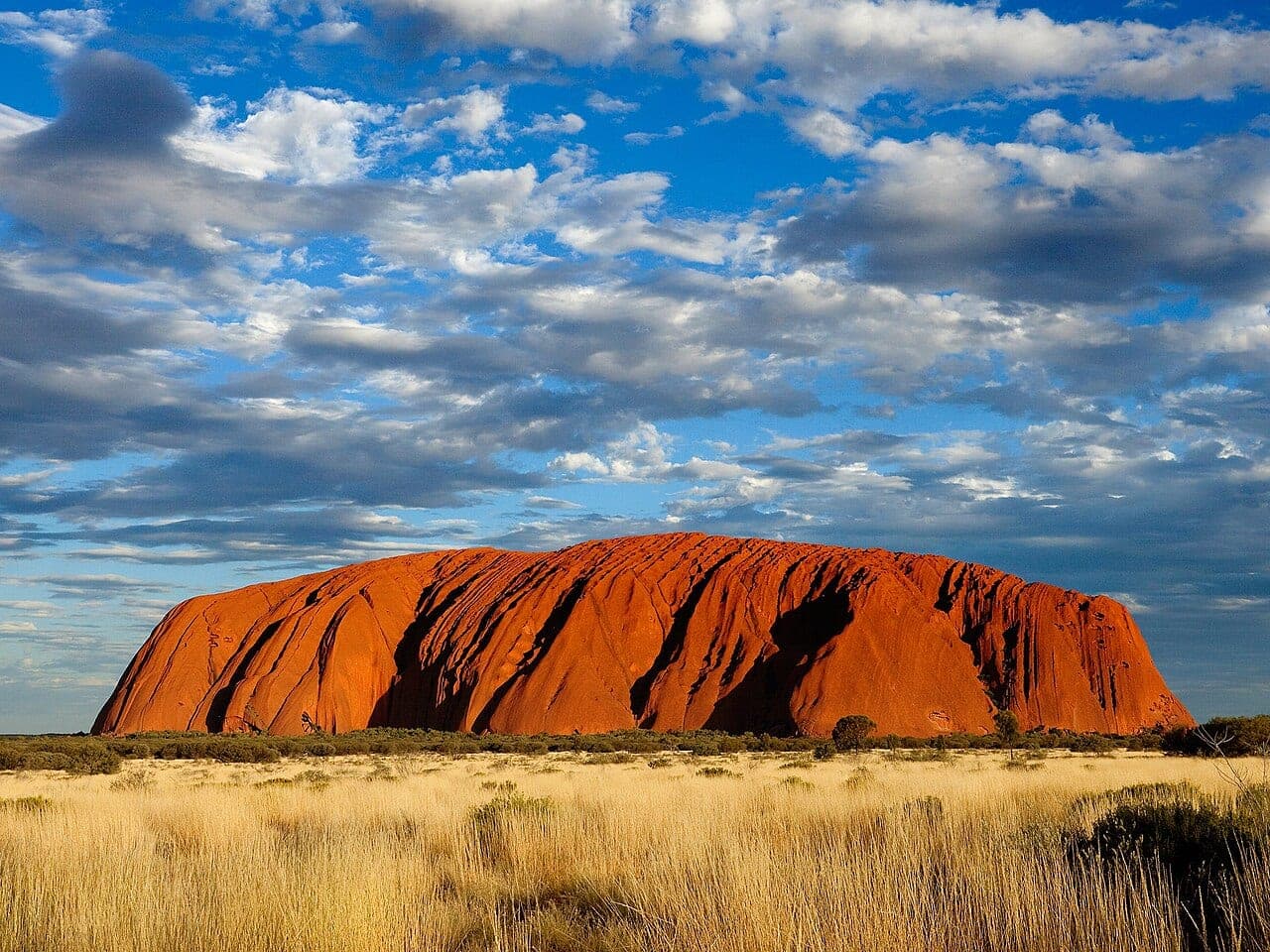
 Uluru, returned to Anangu ownership in 1985 and closed to climbers in 2019 at their request. Photograph by Dietmar Rabich, CC BY-SA 4.0, via Wikimedia Commons.
European contact turned invasion. James Cook charted the east coast in 1770, and on 26 January 1788 the First Fleet under Governor Arthur Phillip landed at Sydney Cove to found a penal colony, a date now marked as Australia Day and mourned by many as Invasion Day or Survival Day. The land was claimed under the legal fiction of terra nullius, land belonging to no one, ignoring the peoples already present (National Museum of Australia). Frontier violence, dispossession, and introduced disease devastated Aboriginal populations through the nineteenth century, even as gold rushes from the 1850s drew new migrants. On 1 January 1901 the six British colonies of New South Wales, Victoria, Queensland, South Australia, Western Australia, and Tasmania federated into the Commonwealth of Australia (Parliamentary Education Office). The new nation's early decades were shaped by the restrictive White Australia policy. Only in 1992 did the High Court, in the Mabo case brought by Eddie Koiki Mabo and fellow Torres Strait Islanders, overturn terra nullius and recognise native title, leading to the Native Title Act 1993.
Australian English grew from the convict and free-settler speech of Britain and Ireland, flattened and blended in a new country into a recognisable accent with its own idiom, the clipped vowels and habit of shortening words that gives the world "arvo," "barbie," and "servo." Yet the everyday vocabulary is threaded with Aboriginal words absorbed from first encounters: "kangaroo" from the Guugu Yimithirr of far north Queensland, "boomerang" and "dingo" from the Dharug of the Sydney region, along with "koala," "wombat," "billabong," "cooee," and "yakka." The map itself is largely a First Nations text, from Canberra and Parramatta to Woolloomooloo and Wagga Wagga.
Before 1788, more than 250 distinct languages and some 800 dialects were spoken across the continent (AIATSIS). Colonisation, missions, and the removal of children broke the chain of transmission with brutal speed. The third National Indigenous Languages Survey found that only about 123 Indigenous languages are still spoken today, of which just 12 are being learned by children as a first language, while 109 are endangered. Against that loss, communities are reviving at least 31 languages through dictionaries, schooling, and recordings, and dual naming has restored Aboriginal names to the map, so that Ayers Rock is again Uluru, the Olgas are Kata Tjuta, the Grampians are also Gariwerd, and Alice Springs is also Mparntwe.
At the centre of Aboriginal life is the Dreaming, an English rendering of concepts such as the Anangu word Tjukurpa, which describes the creative acts of ancestral beings who shaped the land, laid down the law, and set the patterns of kinship and Country. The Dreaming is not a myth of the distant past but a living framework that binds people to specific tracts of land and water, to ceremony, and to obligation. Songlines cross the continent as sung routes of navigation and memory, and rock art at Kakadu and the petroglyphs of Murujuga on the Burrup Peninsula record tens of thousands of years of that knowledge (Tourism Australia).
Uluru, returned to Anangu ownership in 1985 and closed to climbers in 2019 at their request. Photograph by Dietmar Rabich, CC BY-SA 4.0, via Wikimedia Commons.
European contact turned invasion. James Cook charted the east coast in 1770, and on 26 January 1788 the First Fleet under Governor Arthur Phillip landed at Sydney Cove to found a penal colony, a date now marked as Australia Day and mourned by many as Invasion Day or Survival Day. The land was claimed under the legal fiction of terra nullius, land belonging to no one, ignoring the peoples already present (National Museum of Australia). Frontier violence, dispossession, and introduced disease devastated Aboriginal populations through the nineteenth century, even as gold rushes from the 1850s drew new migrants. On 1 January 1901 the six British colonies of New South Wales, Victoria, Queensland, South Australia, Western Australia, and Tasmania federated into the Commonwealth of Australia (Parliamentary Education Office). The new nation's early decades were shaped by the restrictive White Australia policy. Only in 1992 did the High Court, in the Mabo case brought by Eddie Koiki Mabo and fellow Torres Strait Islanders, overturn terra nullius and recognise native title, leading to the Native Title Act 1993.
Australian English grew from the convict and free-settler speech of Britain and Ireland, flattened and blended in a new country into a recognisable accent with its own idiom, the clipped vowels and habit of shortening words that gives the world "arvo," "barbie," and "servo." Yet the everyday vocabulary is threaded with Aboriginal words absorbed from first encounters: "kangaroo" from the Guugu Yimithirr of far north Queensland, "boomerang" and "dingo" from the Dharug of the Sydney region, along with "koala," "wombat," "billabong," "cooee," and "yakka." The map itself is largely a First Nations text, from Canberra and Parramatta to Woolloomooloo and Wagga Wagga.
Before 1788, more than 250 distinct languages and some 800 dialects were spoken across the continent (AIATSIS). Colonisation, missions, and the removal of children broke the chain of transmission with brutal speed. The third National Indigenous Languages Survey found that only about 123 Indigenous languages are still spoken today, of which just 12 are being learned by children as a first language, while 109 are endangered. Against that loss, communities are reviving at least 31 languages through dictionaries, schooling, and recordings, and dual naming has restored Aboriginal names to the map, so that Ayers Rock is again Uluru, the Olgas are Kata Tjuta, the Grampians are also Gariwerd, and Alice Springs is also Mparntwe.
At the centre of Aboriginal life is the Dreaming, an English rendering of concepts such as the Anangu word Tjukurpa, which describes the creative acts of ancestral beings who shaped the land, laid down the law, and set the patterns of kinship and Country. The Dreaming is not a myth of the distant past but a living framework that binds people to specific tracts of land and water, to ceremony, and to obligation. Songlines cross the continent as sung routes of navigation and memory, and rock art at Kakadu and the petroglyphs of Murujuga on the Burrup Peninsula record tens of thousands of years of that knowledge (Tourism Australia).
 The rock galleries at Ubirr were painted and repainted over thousands of years, which makes them a record kept by maintenance rather than by preservation. Photograph by Sardaka, CC BY-SA 4.0, via Wikimedia Commons.
Aboriginal visual art has become one of the country's most powerful cultural exports, from bark paintings and x-ray art of the north to the desert dot-painting movement that began at Papunya in 1971. Music carries the yidaki, the didgeridoo, and clapsticks; ceremony gathers communities in corroboree. Torres Strait Islander culture adds its own dance, drumming, and seafaring traditions. Layered over this ancient foundation is a settler identity built on the bush legend and its ideals of mateship, egalitarianism, and the "fair go," expressed in a devotion to sport and a life lived outdoors. Successive waves of migration, European, then Asian, Middle Eastern, and African, have made contemporary Australia one of the most diverse societies on earth.
For the First Peoples, spirituality is inseparable from the Dreaming and from Country. Sacred sites, ancestral beings, and custodial responsibility for land and water form a religious system in which the living are caretakers of a creation that continues. Places such as Uluru are not scenery but scripture, holding stories and law that belong to their traditional owners.
Christianity arrived with the First Fleet in 1788 and became the majority faith of settler Australia, shaping schools, hospitals, and public life. It remains the largest religion, though its hold is loosening: at the 2021 census about 44 per cent of Australians identified as Christian, while those reporting no religion rose to roughly 39 per cent, and Islam, Buddhism, and Hinduism grow with migration (ABS). The result is a secular, multifaith country in which cathedrals share cities with mosques, temples, and gurdwaras, and in which the oldest spiritual traditions on the continent are increasingly honoured in public ceremony.
No civic ritual matters more to settler Australia than ANZAC Day. Each 25 April the nation marks the landing of the Australian and New Zealand Army Corps at Gallipoli in 1915, a campaign that failed and left more than 8,000 Australians dead, yet gave the young nation a founding story of endurance and sacrifice (Australian War Memorial). Australians gather before first light at dawn services timed to the hour of the landing, listen to the Last Post and a minute's silence, and recite the words "Lest we forget." Remembrance Day on 11 November keeps a second national silence for the war dead.
Aboriginal communities carry their own profound traditions of mourning, often referred to in English as Sorry Business, a period of communal grief and ceremony that can extend well beyond a funeral and that draws in wide networks of kin. A smoking ceremony, in which native plants are burned to produce a cleansing smoke, is widely used afterwards to treat the home and possessions of the person who has died. These practices vary greatly between nations and are governed by the community's own law, so they are described here only in general terms and with respect. Out of that respect, this guide follows a widely observed cultural protocol: some Aboriginal and Torres Strait Islander communities ask that the names and images of people who have recently died be used with care or avoided for a time, and readers may encounter such warnings on films, exhibitions, and archives.
The heaviest memory the nation carries is the Stolen Generations, the tens of thousands of Aboriginal and Torres Strait Islander children forcibly removed from their families under assimilation policies across much of the twentieth century. The 1997 Bringing Them Home report documented the scale and lasting harm of those removals and recommended a national apology and reparations (Australian Human Rights Commission). From 1998 the country began marking National Sorry Day on 26 May, the anniversary of the report's tabling. On 13 February 2008, Prime Minister Kevin Rudd delivered the formal Apology to Australia's Indigenous peoples in parliament, the word "sorry" repeated to the survivors as the first business of the sitting year, a moment watched by crowds across the country (National Museum of Australia).
Australia's records begin with a paradox: the convicts are the best-documented poor people of the nineteenth century anywhere in the world. Between 1788 and 1868 around 162,000 people were transported, and the system that shipped them recorded their trial, sentence, ship, age, trade, literacy, height, complexion and tattoos, then kept recording them through tickets of leave, pardons and marriages. A convict ancestor is usually easier to trace than a free settler, and the shame that once attached to one has been comprehensively replaced by interest.
Civil registration is a state matter and began separately in each colony, mostly in the 1850s, so research starts by working out which colony a family was in. The colonial certificates are unusually informative: a Victorian death certificate names the parents of the deceased, including the mother's maiden name, and where and how long they had lived in the colony.
The National Archives of Australia hold the immigration, naturalisation and service records, and a great deal is digitised and free.
For Aboriginal and Torres Strait Islander families the record is a different thing, because so much of it was made by the authorities that removed children from their families. The files of the Protection Boards, the mission registers and the welfare records are the evidence of that removal and often the only route back to a name. The Bringing Them Home report of 1997 led to link-up services in every state, and access to those files is now a right rather than a favour, though the reading of them is hard.
Australia holds twenty-one inscriptions on the UNESCO World Heritage List, spanning natural, cultural, and mixed values (UNESCO). The Great Barrier Reef, Kakadu National Park, and the Willandra Lakes Region were among the first, listed in 1981 at a committee session held in Sydney. Uluru-Kata Tjuta National Park is a mixed site, recognised for its desert landscape in 1987 and for its living Anangu culture in 1994. The Sydney Opera House was added in 2007, in 2019 the Budj Bim Cultural Landscape became the first place inscribed solely for its Aboriginal cultural values, honouring an ancient eel-farming system of the Gunditjmara people, and in 2025 the Murujuga rock art of the Burrup Peninsula joined the list.
The most significant act of heritage respect in recent memory was made not by adding a site but by closing one. In 1985 Uluru-Kata Tjuta was handed back to its Anangu traditional owners, and for decades signs at the base carried the owners' request that visitors stay off the rock. On 26 October 2019, the 34th anniversary of that Handback, the climb was closed permanently, because ascending the rock had never been permitted under Tjukurpa, Anangu law and culture (Parks Australia). Alongside such landscapes, institutions including AIATSIS lead the repatriation of ancestral remains and secret-sacred objects held in museums abroad, returning them to the care of descendant communities.
Australia has invested heavily in making its memory searchable. Trove, run by the National Library of Australia, aggregates hundreds of millions of digitised newspapers, photographs, maps, and records from libraries, museums, and archives across the country into a single free resource (National Library of Australia). The National Film and Sound Archive and state libraries add moving image and sound to that store.
For First Nations heritage, the digital question is also a question of control. AIATSIS holds the world's largest collection of Aboriginal and Torres Strait Islander cultural material, and its Australian Indigenous Languages Collection is inscribed on the UNESCO Memory of the World register. Digitisation here follows Indigenous cultural protocols, so that access to sensitive recordings, images, and knowledge is governed by the communities they come from. Language projects such as the Gambay map and First Languages Australia put revival material online for the communities doing the work, treating cultural data as something held in trust rather than simply published.
Aboriginal creativity now sits near the centre of the national story. In music, Yothu Yindi's "Treaty" carried Yolngu language and land rights to the charts in 1991, Archie Roach's "Took the Children Away" gave the Stolen Generations a voice, and Geoffrey Gurrumul Yunupingu sang in Yolngu Matha to audiences around the world. In literature, the poet Oodgeroo Noonuccal opened a path later widened by prize-winners such as Kim Scott, Alexis Wright, and Tara June Winch, whose novel The Yield turns on a lost language. In sport, Cathy Freeman's 400-metre gold at the Sydney 2000 Olympics, run with the Aboriginal and Australian flags together, became a national symbol of reconciliation.
Public culture has shifted with it. Welcome to Country and Acknowledgement of Country, once rare, now open sporting fixtures, parliaments, and school assemblies, and the Aboriginal flag flies beside the national one. That progress is real but unfinished, and honesty requires noting its limits: in October 2023 a national referendum to create an Aboriginal and Torres Strait Islander Voice to parliament was defeated, a result that showed how contested the path to constitutional recognition remains. Memory and reconciliation in Australia are still being argued out.
The rock came home, and the climb closed. The 1985 Handback of Uluru-Kata Tjuta to its Anangu owners, followed by the permanent closure of the climb in 2019, showed a nation choosing respect for living law over tourism, on the traditional owners' own terms.
Terra nullius fell. Eddie Koiki Mabo's decade-long case ended in the 1992 High Court decision that recognised native title and dismantled the legal fiction that the land had belonged to no one, reshaping Australian law.
Languages are being spoken again. From the revival of Kaurna in Adelaide to renewed teaching of Wiradjuri and Gamilaraay, communities are bringing languages back from silence through dictionaries, schools, and digital archives, part of a movement reviving at least 31 tongues.
A culture recognised in the land itself. The 2019 listing of Budj Bim honoured a Gunditjmara aquaculture system thousands of years old, the first Australian place inscribed for its Aboriginal cultural values alone.
A nation said sorry. The 2008 Apology to the Stolen Generations, and the annual observance of National Sorry Day since 1998, turned the findings of the Bringing Them Home report into public acts of remembrance.
The rock galleries at Ubirr were painted and repainted over thousands of years, which makes them a record kept by maintenance rather than by preservation. Photograph by Sardaka, CC BY-SA 4.0, via Wikimedia Commons.
Aboriginal visual art has become one of the country's most powerful cultural exports, from bark paintings and x-ray art of the north to the desert dot-painting movement that began at Papunya in 1971. Music carries the yidaki, the didgeridoo, and clapsticks; ceremony gathers communities in corroboree. Torres Strait Islander culture adds its own dance, drumming, and seafaring traditions. Layered over this ancient foundation is a settler identity built on the bush legend and its ideals of mateship, egalitarianism, and the "fair go," expressed in a devotion to sport and a life lived outdoors. Successive waves of migration, European, then Asian, Middle Eastern, and African, have made contemporary Australia one of the most diverse societies on earth.
For the First Peoples, spirituality is inseparable from the Dreaming and from Country. Sacred sites, ancestral beings, and custodial responsibility for land and water form a religious system in which the living are caretakers of a creation that continues. Places such as Uluru are not scenery but scripture, holding stories and law that belong to their traditional owners.
Christianity arrived with the First Fleet in 1788 and became the majority faith of settler Australia, shaping schools, hospitals, and public life. It remains the largest religion, though its hold is loosening: at the 2021 census about 44 per cent of Australians identified as Christian, while those reporting no religion rose to roughly 39 per cent, and Islam, Buddhism, and Hinduism grow with migration (ABS). The result is a secular, multifaith country in which cathedrals share cities with mosques, temples, and gurdwaras, and in which the oldest spiritual traditions on the continent are increasingly honoured in public ceremony.
No civic ritual matters more to settler Australia than ANZAC Day. Each 25 April the nation marks the landing of the Australian and New Zealand Army Corps at Gallipoli in 1915, a campaign that failed and left more than 8,000 Australians dead, yet gave the young nation a founding story of endurance and sacrifice (Australian War Memorial). Australians gather before first light at dawn services timed to the hour of the landing, listen to the Last Post and a minute's silence, and recite the words "Lest we forget." Remembrance Day on 11 November keeps a second national silence for the war dead.
Aboriginal communities carry their own profound traditions of mourning, often referred to in English as Sorry Business, a period of communal grief and ceremony that can extend well beyond a funeral and that draws in wide networks of kin. A smoking ceremony, in which native plants are burned to produce a cleansing smoke, is widely used afterwards to treat the home and possessions of the person who has died. These practices vary greatly between nations and are governed by the community's own law, so they are described here only in general terms and with respect. Out of that respect, this guide follows a widely observed cultural protocol: some Aboriginal and Torres Strait Islander communities ask that the names and images of people who have recently died be used with care or avoided for a time, and readers may encounter such warnings on films, exhibitions, and archives.
The heaviest memory the nation carries is the Stolen Generations, the tens of thousands of Aboriginal and Torres Strait Islander children forcibly removed from their families under assimilation policies across much of the twentieth century. The 1997 Bringing Them Home report documented the scale and lasting harm of those removals and recommended a national apology and reparations (Australian Human Rights Commission). From 1998 the country began marking National Sorry Day on 26 May, the anniversary of the report's tabling. On 13 February 2008, Prime Minister Kevin Rudd delivered the formal Apology to Australia's Indigenous peoples in parliament, the word "sorry" repeated to the survivors as the first business of the sitting year, a moment watched by crowds across the country (National Museum of Australia).
Australia's records begin with a paradox: the convicts are the best-documented poor people of the nineteenth century anywhere in the world. Between 1788 and 1868 around 162,000 people were transported, and the system that shipped them recorded their trial, sentence, ship, age, trade, literacy, height, complexion and tattoos, then kept recording them through tickets of leave, pardons and marriages. A convict ancestor is usually easier to trace than a free settler, and the shame that once attached to one has been comprehensively replaced by interest.
Civil registration is a state matter and began separately in each colony, mostly in the 1850s, so research starts by working out which colony a family was in. The colonial certificates are unusually informative: a Victorian death certificate names the parents of the deceased, including the mother's maiden name, and where and how long they had lived in the colony.
The National Archives of Australia hold the immigration, naturalisation and service records, and a great deal is digitised and free.
For Aboriginal and Torres Strait Islander families the record is a different thing, because so much of it was made by the authorities that removed children from their families. The files of the Protection Boards, the mission registers and the welfare records are the evidence of that removal and often the only route back to a name. The Bringing Them Home report of 1997 led to link-up services in every state, and access to those files is now a right rather than a favour, though the reading of them is hard.
Australia holds twenty-one inscriptions on the UNESCO World Heritage List, spanning natural, cultural, and mixed values (UNESCO). The Great Barrier Reef, Kakadu National Park, and the Willandra Lakes Region were among the first, listed in 1981 at a committee session held in Sydney. Uluru-Kata Tjuta National Park is a mixed site, recognised for its desert landscape in 1987 and for its living Anangu culture in 1994. The Sydney Opera House was added in 2007, in 2019 the Budj Bim Cultural Landscape became the first place inscribed solely for its Aboriginal cultural values, honouring an ancient eel-farming system of the Gunditjmara people, and in 2025 the Murujuga rock art of the Burrup Peninsula joined the list.
The most significant act of heritage respect in recent memory was made not by adding a site but by closing one. In 1985 Uluru-Kata Tjuta was handed back to its Anangu traditional owners, and for decades signs at the base carried the owners' request that visitors stay off the rock. On 26 October 2019, the 34th anniversary of that Handback, the climb was closed permanently, because ascending the rock had never been permitted under Tjukurpa, Anangu law and culture (Parks Australia). Alongside such landscapes, institutions including AIATSIS lead the repatriation of ancestral remains and secret-sacred objects held in museums abroad, returning them to the care of descendant communities.
Australia has invested heavily in making its memory searchable. Trove, run by the National Library of Australia, aggregates hundreds of millions of digitised newspapers, photographs, maps, and records from libraries, museums, and archives across the country into a single free resource (National Library of Australia). The National Film and Sound Archive and state libraries add moving image and sound to that store.
For First Nations heritage, the digital question is also a question of control. AIATSIS holds the world's largest collection of Aboriginal and Torres Strait Islander cultural material, and its Australian Indigenous Languages Collection is inscribed on the UNESCO Memory of the World register. Digitisation here follows Indigenous cultural protocols, so that access to sensitive recordings, images, and knowledge is governed by the communities they come from. Language projects such as the Gambay map and First Languages Australia put revival material online for the communities doing the work, treating cultural data as something held in trust rather than simply published.
Aboriginal creativity now sits near the centre of the national story. In music, Yothu Yindi's "Treaty" carried Yolngu language and land rights to the charts in 1991, Archie Roach's "Took the Children Away" gave the Stolen Generations a voice, and Geoffrey Gurrumul Yunupingu sang in Yolngu Matha to audiences around the world. In literature, the poet Oodgeroo Noonuccal opened a path later widened by prize-winners such as Kim Scott, Alexis Wright, and Tara June Winch, whose novel The Yield turns on a lost language. In sport, Cathy Freeman's 400-metre gold at the Sydney 2000 Olympics, run with the Aboriginal and Australian flags together, became a national symbol of reconciliation.
Public culture has shifted with it. Welcome to Country and Acknowledgement of Country, once rare, now open sporting fixtures, parliaments, and school assemblies, and the Aboriginal flag flies beside the national one. That progress is real but unfinished, and honesty requires noting its limits: in October 2023 a national referendum to create an Aboriginal and Torres Strait Islander Voice to parliament was defeated, a result that showed how contested the path to constitutional recognition remains. Memory and reconciliation in Australia are still being argued out.
The rock came home, and the climb closed. The 1985 Handback of Uluru-Kata Tjuta to its Anangu owners, followed by the permanent closure of the climb in 2019, showed a nation choosing respect for living law over tourism, on the traditional owners' own terms.
Terra nullius fell. Eddie Koiki Mabo's decade-long case ended in the 1992 High Court decision that recognised native title and dismantled the legal fiction that the land had belonged to no one, reshaping Australian law.
Languages are being spoken again. From the revival of Kaurna in Adelaide to renewed teaching of Wiradjuri and Gamilaraay, communities are bringing languages back from silence through dictionaries, schools, and digital archives, part of a movement reviving at least 31 tongues.
A culture recognised in the land itself. The 2019 listing of Budj Bim honoured a Gunditjmara aquaculture system thousands of years old, the first Australian place inscribed for its Aboriginal cultural values alone.
A nation said sorry. The 2008 Apology to the Stolen Generations, and the annual observance of National Sorry Day since 1998, turned the findings of the Bringing Them Home report into public acts of remembrance.
National Overview
Notable Cities
Historical Foundations
Linguistic and Etymological Roots
Cultural Identity
Religion and Spirituality
Remembrance and Mourning Traditions
Tracing a Family in Australia
Heritage Preservation Efforts
Digital Heritage
Contemporary Cultural Influences
Success Stories
References and resources
- AIATSIS: the Australian Institute of Aboriginal and Torres Strait Islander Studies, on languages, the Stolen Generations, and cultural collections.
- Australian Human Rights Commission: Bringing Them Home: the 1997 report on the removal of Aboriginal and Torres Strait Islander children.
- National Museum of Australia: National Apology: the 2008 Apology and the Mabo decision in the Defining Moments series.
- Parks Australia: Uluru climb closure: the 2019 closure and its cultural basis in Tjukurpa.
- UNESCO World Heritage Centre: Australia: the country's twenty World Heritage inscriptions.
- Australian War Memorial: ANZAC Day traditions: Gallipoli, the dawn service, and the Last Post.
- Australian Bureau of Statistics: 2021 Census: population, ancestry, language, and religion data.
- Trove, National Library of Australia: the national digital aggregator of newspapers, records, and images.
- Encyclopaedia Britannica: Australia: geography, history, and society.