Heritage · Country
Uruguay Culture and Heritage
On a limestone peninsula in the Río de la Plata, a smugglers' town changed hands between Portugal and Spain a dozen times before it became a place people travel to in order to remember. Uruguay is a small, deliberately secular republic that keeps its past in cobbled quarters, in the drums of candombe, and in the slow ritual of a shared mate gourd.Written to last.
By Confinity Heritage Editorial · Updated 2026-07-31 · 8-minute readQuiet tools, kept out of the way.
Uruguay is a country of grass and water, wedged between two giants and small enough that its cattle far outnumber its people. It keeps its memory in modest, durable things: the uneven cobbles of a colonial contraband port, the iron and brick of a meat factory that once fed distant armies, a gourd of bitter tea passed hand to hand on the seafront promenade, and the low thunder of drums that spill out of three Montevideo neighbourhoods every Sunday. For a nation that spent its first century as a buffer fought over by Buenos Aires and Rio de Janeiro, remembering who it is has never been a small matter.
It is also, by long habit, a secular place, perhaps the most secular in Latin America. Early in the twentieth century Uruguay removed crosses from its hospitals, renamed Christmas as the Day of the Family and Holy Week as Tourism Week, and made a quiet, flower-bearing visit to the cemetery the ordinary shape of grief.
At roughly 176,000 square kilometres, Uruguay is the second-smallest country in South America, a land of rolling grasslands known as cuchillas, threaded by the Uruguay River on the west and opening south and east onto the broad Río de la Plata and the Atlantic. There are no mountains to speak of; the country is defined instead by openness, the estancia country of the pampa where the gaucho became a national figure and beef remains central to the economy and the table.
The population is small and heavily concentrated. About 3.4 million people live here, and the 2023 census counted roughly 1.29 million of them in Montevideo alone, close to 37 per cent of the country in one coastal city (World Population Review). Uruguay is among the most urbanised and literate nations in the Americas, with a stable democracy and a large middle class. Two properties carry UNESCO World Heritage status, the Historic Quarter of Colonia del Sacramento and the Fray Bentos Industrial Landscape, while candombe drumming and the tango it shares with Argentina both sit on UNESCO's list of intangible cultural heritage.
Montevideo. The capital gathers most of the country's institutions, its port and its cultural memory. Its oldest district, the Ciudad Vieja, grew from the Spanish fortress town of San Felipe y Santiago, begun by Bruno Mauricio de Zabala in 1724 and recognised as a city in 1730 to counter Portuguese ambitions on the estuary (New World Encyclopedia). The old town holds the Teatro Solís, the Mercado del Puerto with its wood-fired grills, Plaza Independencia with the mausoleum of the national hero Artigas beneath it, and the waterfront Rambla where the city walks and drinks mate. In the southern neighbourhoods of Sur, Palermo and Cordón, the Afro-Uruguayan drum tradition still lives on the street.
 Colonia changed hands between Portugal and Spain repeatedly, and the two street patterns are still legible in the same few blocks. Photograph by Diego Delso, CC BY-SA 3.0, via Wikimedia Commons.
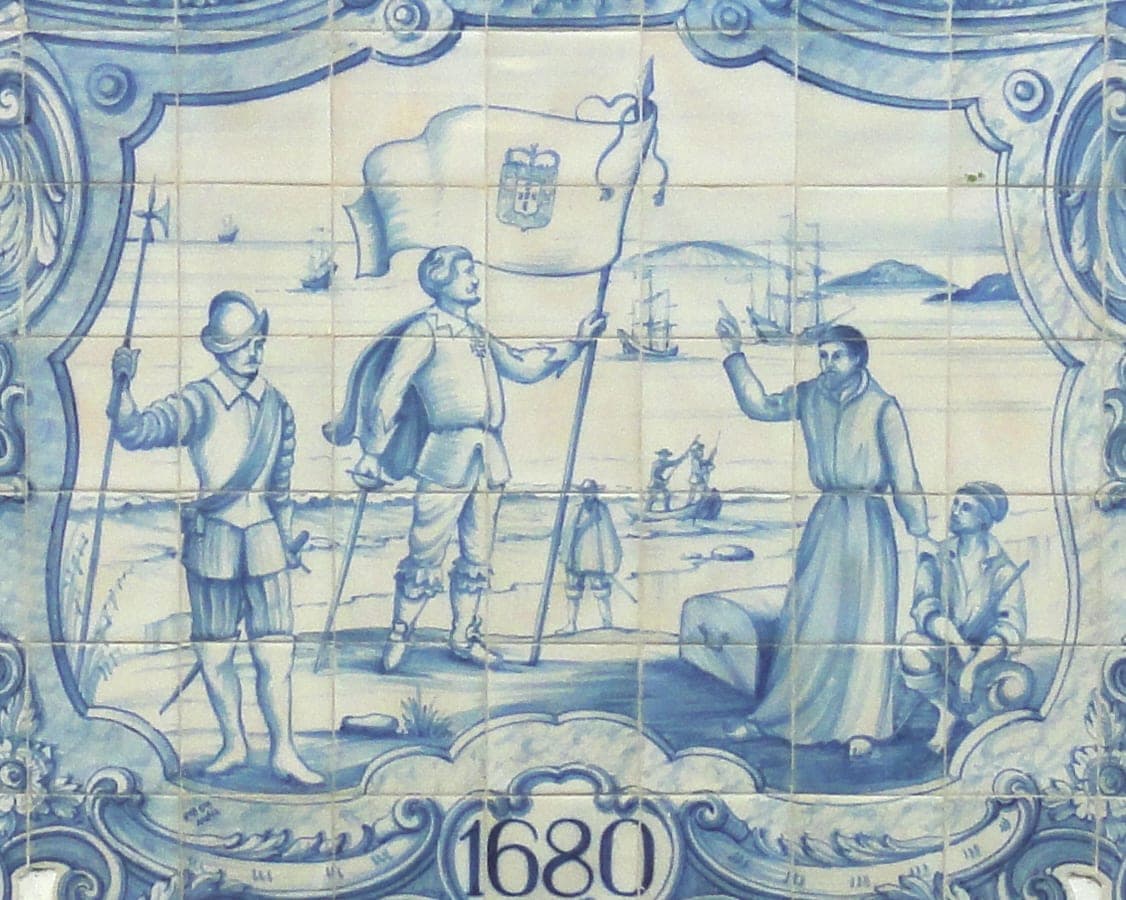
Colonia del Sacramento. Founded by the Portuguese in 1680 on a small peninsula facing Buenos Aires, Colonia was built for smuggling and strategy, a foothold from which to resist Spain and slip goods around its monopoly (UNESCO). It changed hands between the two crowns repeatedly over the following century. Its Barrio Histórico, inscribed by UNESCO in 1995, preserves that contested inheritance in a single small grid: the irregular Portuguese street plan, the Calle de los Suspiros, seventeenth-century ruins, a lighthouse, and small museums including the Portuguese Museum.
Punta del Este. On the Atlantic near Maldonado, Punta del Este is the country's best-known resort, a peninsula of beaches and summer houses that fills each January with regional visitors. Its signature image is modern rather than colonial: the giant concrete fingers of La Mano, half-buried in the sand, near the sculptor Carlos Páez Vilaró's white cliffside studio at Casapueblo.
Salto. Uruguay's second city sits on the Uruguay River in the north-west, where the binational Salto Grande hydroelectric dam links the country with Argentina. Salto is citrus country and, above all, thermal-spring country: the Termas del Daymán and neighbouring resorts draw visitors year-round to hot mineral waters, a wellness economy distinct from the coast's.
Before Europeans arrived, the grasslands and river margins were the country of the Charrúa, mobile hunter-gatherers who dominated at contact, alongside smaller Chaná and Guaraní populations (Massacre of Salsipuedes, Wikipedia). The Charrúa resisted assimilation, and their story ends in tragedy: in 1831, under President Fructuoso Rivera, the young republic lured Charrúa leaders to a supposed meeting at Salsipuedes and killed most of the men in a deliberate campaign of extermination. Only a handful survived, and the memory of that violence has become a live question in modern Uruguay.
European settlement grew out of imperial rivalry rather than mineral wealth. The Portuguese planted Colonia del Sacramento in 1680; the Spanish answered with Montevideo in the 1720s; and the whole territory, the Banda Oriental or eastern shore, became a buffer contested between Buenos Aires and the expanding Portuguese, later Brazilian, empire. The independence hero José Gervasio Artigas led a federalist movement here in the 1810s, but Portuguese-Brazilian forces overran the province between 1816 and 1820, sending Artigas into a long exile in Paraguay (Cisplatine War, Wikipedia).
Independence came from a second effort. In 1825 a band remembered as the Thirty-Three Orientals, backed by Buenos Aires, rose against Brazilian rule, triggering the Cisplatine War. British mediation ended the fighting: the Preliminary Peace Convention of 27 August 1828 created an independent buffer state between the two powers, and the first national constitution followed in 1830 (Preliminary Peace Convention, Wikipedia).
The country's modern reinvention is its most distinctive chapter. In the early twentieth century, under the two-time president José Batlle y Ordóñez, Uruguay built one of the earliest welfare states in the Americas and separated church from state with unusual thoroughness: religious teaching left public schools in 1909, divorce and an eight-hour day were enacted, women voted from 1927, and the constitution of 1917 formally divided church and state (Encyclopedia.com). These reforms earned the nickname "the Switzerland of America" and set a secular, egalitarian tone that still marks national life. Football belongs to the same era of confidence: Uruguay hosted and won the first FIFA World Cup in 1930, beating Argentina 4-2 at the Estadio Centenario in Montevideo, a stadium built for the tournament and named for the centenary of the 1830 constitution (Olympics.com).
Uruguay is Spanish-speaking, and the variety heard here is Rioplatense, the River Plate dialect shared with Buenos Aires across the estuary. Its most recognisable features are the voseo, the use of vos rather than tú with its own verb forms, and the soft "sh" sound given to ll and y, an intonation many linguists connect to the Italian immigration that reshaped both shores (Rioplatense Spanish, Wikipedia).
The name of the country comes from the river, and the river's name comes from Guaraní. It is popularly rendered as "the river of the painted birds", a phrase that has become a piece of national poetry, though scholars are more cautious and point to earlier readings such as "river of the urú", a partridge-like bird, or "river of the snails" (José Pedro Rona, ANS). Uruguayans still call themselves orientales, easterners, from the land's old name as the eastern bank of the Uruguay River, and use the word with pride.
The founding character of the interior is the gaucho, the horseman of the open estancia, whose skills, leatherwork and silver-mounted gear became a shorthand for national character much as they did across the river in Argentina, and whose world of cattle and country music is still honoured in festivals across the ranching north.
The most universal daily ritual is mate. Uruguayans drink more of the bitter yerba infusion per head than any nation, passing a shared gourd and metal straw around a circle in a fixed, unhurried order. Food gathers people in the same spirit: the asado, beef and offal grilled slowly over embers, is the weekend centre of family life, joined by the chivito steak sandwich and by dulce de leche in almost everything sweet.
Music carries the country's mixed inheritance. Tango grew up on both banks of the Plata and is claimed with feeling in Montevideo as well as Buenos Aires. Candombe is Uruguay's own: a drumming and dance tradition created by the descendants of enslaved Africans, built on three interlocking drums, the chico, repique and piano, and carried through the streets in processions called llamadas (UNESCO Intangible Cultural Heritage). During Carnival, said to be among the longest in the world, it joins murga, a satirical choral theatre, turning the summer city over to performance for weeks.
Uruguay is nominally Catholic but, in practice, the most secular society in Latin America, with one of the region's highest shares of people who report no religion at all. That secular character was built by policy. The Batlle-era reforms separated church from state, ended religious teaching in public schools, and rewrote the calendar in civic terms, so that in Uruguay the 25th of December is officially the Day of the Family, the Epiphany is Children's Day, the Feast of the Immaculate Conception is Beach Day, and Holy Week is Tourism Week (Guru'Guay). Catholic devotion continues in churches and processions, but shares public space with a large non-believing majority and a growing Protestant minority.
Alongside these run the spiritual traditions of the African diaspora, kept alive within the families who also carry candombe. Afro-Uruguayan communities and Afro-Brazilian religions such as Umbanda have a visible presence, most strikingly each 2 February, when devotees gather on the beaches of Montevideo at dusk to float flowers and small boats out onto the water as offerings to Iemanjá, the sea goddess.
Uruguayan mourning tends toward the plain and the communal. A death is marked by a velorio, a wake at which family, neighbours and colleagues gather to accompany the bereaved; burial or cremation usually follows quickly, and press notices mark the anniversaries. The tone is more civic and familial than liturgical.
The national day of the dead is the 2nd of November, the Día de los Difuntos. It is not the festive, marigold-lit celebration of Mexico but a quieter observance: families clean and tend graves and lay fresh flowers, often chrysanthemums, with candles (Counting the Days). The Cementerio Central in Montevideo, opened in the 1830s, is a walkable national record in stone, holding writers, presidents and generals, and its National Pantheon honours the figures the state has chosen to remember permanently.
For Afro-Uruguayans, remembrance and music are inseparable. Candombe is itself an act of memory, transmitted within families of African descent and understood as both celebration and an expression of endurance through slavery and its aftermath; when the drums come out in Sur and Palermo, they trace a lineage as much as they make a party. The memory of the Charrúa has become a national reckoning as well. In 2002, after a law passed for the purpose, the remains of the chief Vaimaca Perú, taken to Paris in 1833, were returned from France and interred with honours in the National Pantheon, a belated act of repair for the killings at Salsipuedes (Ancient Origins).
Uruguayan records are compact, well kept and, for one period, deliberately incomplete.
Catholic parish registers begin in the eighteenth century and civil registration in 1879, held by the Dirección General del Registro de Estado Civil. The Archivo General de la Nación in Montevideo holds the colonial and national series, and because the population is small and heavily concentrated in one city, Uruguayan research is usually a matter of finding a parish rather than searching a country.
Immigration is the main story. Between the 1830s and the 1930s Uruguay took in very large numbers of Spaniards, Italians, French Basques and later Jews from central and eastern Europe, in proportion to its size among the highest immigration rates anywhere. The passenger lists, the naturalisation files and the mutual aid society records of those communities are held in Montevideo and in the countries they left.
Afro-Uruguayan families descend largely from enslaved people brought through Montevideo, which was a slaving port for the whole River Plate, and the baptismal registers, which recorded enslaved children separately, are the principal source. Candombe, the drumming tradition of the barrios, carries the community's own memory.
The dictatorship between 1973 and 1985 disappeared close to two hundred people and imprisoned a very large number, and it also took children. The recovery of those children as adults, and the search for the remains of the disappeared on military land, has been running for decades and is still producing identifications.
Uruguay's two World Heritage Sites bracket its history at opposite ends. The Historic Quarter of Colonia del Sacramento, inscribed in 1995, preserves the fused Portuguese, Spanish and post-colonial fabric of a seventeenth-century contraband port (UNESCO). At the other end stands the Fray Bentos Industrial Landscape, inscribed in 2015, a meat-processing complex on the Uruguay River that grew from an 1859 factory: the Liebig Extract of Meat Company shipped meat extract and corned beef to Europe from 1865, and the later Anglo plant exported frozen meat from 1924, together feeding the armies of two world wars from a site nicknamed "the kitchen of the world" (UNESCO). Colonia represents the colonial founding; Fray Bentos, the export economy that made the modern country.
On the intangible side, candombe and its social space were inscribed on UNESCO's Representative List in 2009, alongside the tango Uruguay shares with Argentina (MercoPress). At home, the National Commission for Cultural Heritage oversees protection, and each year the Día del Patrimonio opens hundreds of historic buildings to the public across a single weekend, making preservation a shared national outing rather than a specialist concern.
For a small country, Uruguay maintains a dense set of memory institutions, and much of their work is moving online. The National Library and the General Archive of the Nation hold the documentary record of the republic, the National History Museum keeps the objects of independence, and the public broadcaster SODRE preserves an audiovisual archive of tango and candombe that anchors those living traditions to a documented past.
Digitisation has advanced through the universities and cultural agencies: the University of the Republic runs open digital libraries of historic periodicals and manuscripts, and cultural bodies have built online catalogues around Colonia, Fray Bentos and the candombe neighbourhoods. Because so much of the country's heritage is intangible, the archives that capture the drums and the voices are as central to preservation here as any stone.
Uruguay's cultural weight has always outrun its size, above all in letters. Eduardo Galeano, whose Open Veins of Latin America and Soccer in Sun and Shadow were read across the continent, and Mario Benedetti, one of the most beloved writers in Spanish, both came from Montevideo, as did the poet Juana de Ibarbourou and the short-story master Horacio Quiroga. In music, Jorge Drexler became the first Uruguayan to win an Academy Award, taking the 2005 Oscar for best original song, while Rubén Rada and Jaime Roos carried candombe rhythms into popular song.
The country has also drawn attention as a social pioneer. Under President José Mujica, a former guerrilla known for his austere life, Uruguay legalised abortion in 2012 and, in 2013, both same-sex marriage and a regulated legal cannabis market, extending a reforming tradition that reached back to the secular state a century earlier (France 24). And football remains a shared feeling out of all proportion to the country's size: the 1950 victory over Brazil in the Maracanã, the Maracanazo, is remembered as one of the greatest upsets the game has known, and the light-blue shirt still carries the weight of 1930 and 1950 into every tournament (FIFA).
A contraband port saved as a shared inheritance. Colonia del Sacramento could have been lost to redevelopment like so many small waterfronts. Instead its Barrio Histórico was protected and, in 1995, inscribed by UNESCO, and the intertwined Portuguese and Spanish city is now one of the most visited historic places on the Río de la Plata.
An industrial ruin recognised as heritage. The Fray Bentos meat plant fell silent as the industry changed, but rather than being demolished it was preserved, declared a national monument, and in 2015 inscribed as a World Heritage Site, honouring the workers and the trade that ran through its docks (UNESCO).
Drums kept in the family and on the list. Candombe survived slavery, marginalisation and the redevelopment of the old Afro-Uruguayan tenements, and in 2009 its practice and social space were recognised by UNESCO; the llamadas still fill the streets of Sur and Palermo each week (UNESCO).
A chief brought home. In 2002, after nearly 170 years, the remains of the Charrúa leader Vaimaca Perú were returned from a Paris museum and buried in Uruguay's National Pantheon, an act that opened the way for a wider recognition of Charrúa descent and identity today.
Colonia changed hands between Portugal and Spain repeatedly, and the two street patterns are still legible in the same few blocks. Photograph by Diego Delso, CC BY-SA 3.0, via Wikimedia Commons.
Colonia del Sacramento. Founded by the Portuguese in 1680 on a small peninsula facing Buenos Aires, Colonia was built for smuggling and strategy, a foothold from which to resist Spain and slip goods around its monopoly (UNESCO). It changed hands between the two crowns repeatedly over the following century. Its Barrio Histórico, inscribed by UNESCO in 1995, preserves that contested inheritance in a single small grid: the irregular Portuguese street plan, the Calle de los Suspiros, seventeenth-century ruins, a lighthouse, and small museums including the Portuguese Museum.
Punta del Este. On the Atlantic near Maldonado, Punta del Este is the country's best-known resort, a peninsula of beaches and summer houses that fills each January with regional visitors. Its signature image is modern rather than colonial: the giant concrete fingers of La Mano, half-buried in the sand, near the sculptor Carlos Páez Vilaró's white cliffside studio at Casapueblo.
Salto. Uruguay's second city sits on the Uruguay River in the north-west, where the binational Salto Grande hydroelectric dam links the country with Argentina. Salto is citrus country and, above all, thermal-spring country: the Termas del Daymán and neighbouring resorts draw visitors year-round to hot mineral waters, a wellness economy distinct from the coast's.
Before Europeans arrived, the grasslands and river margins were the country of the Charrúa, mobile hunter-gatherers who dominated at contact, alongside smaller Chaná and Guaraní populations (Massacre of Salsipuedes, Wikipedia). The Charrúa resisted assimilation, and their story ends in tragedy: in 1831, under President Fructuoso Rivera, the young republic lured Charrúa leaders to a supposed meeting at Salsipuedes and killed most of the men in a deliberate campaign of extermination. Only a handful survived, and the memory of that violence has become a live question in modern Uruguay.
European settlement grew out of imperial rivalry rather than mineral wealth. The Portuguese planted Colonia del Sacramento in 1680; the Spanish answered with Montevideo in the 1720s; and the whole territory, the Banda Oriental or eastern shore, became a buffer contested between Buenos Aires and the expanding Portuguese, later Brazilian, empire. The independence hero José Gervasio Artigas led a federalist movement here in the 1810s, but Portuguese-Brazilian forces overran the province between 1816 and 1820, sending Artigas into a long exile in Paraguay (Cisplatine War, Wikipedia).
Independence came from a second effort. In 1825 a band remembered as the Thirty-Three Orientals, backed by Buenos Aires, rose against Brazilian rule, triggering the Cisplatine War. British mediation ended the fighting: the Preliminary Peace Convention of 27 August 1828 created an independent buffer state between the two powers, and the first national constitution followed in 1830 (Preliminary Peace Convention, Wikipedia).
The country's modern reinvention is its most distinctive chapter. In the early twentieth century, under the two-time president José Batlle y Ordóñez, Uruguay built one of the earliest welfare states in the Americas and separated church from state with unusual thoroughness: religious teaching left public schools in 1909, divorce and an eight-hour day were enacted, women voted from 1927, and the constitution of 1917 formally divided church and state (Encyclopedia.com). These reforms earned the nickname "the Switzerland of America" and set a secular, egalitarian tone that still marks national life. Football belongs to the same era of confidence: Uruguay hosted and won the first FIFA World Cup in 1930, beating Argentina 4-2 at the Estadio Centenario in Montevideo, a stadium built for the tournament and named for the centenary of the 1830 constitution (Olympics.com).
Uruguay is Spanish-speaking, and the variety heard here is Rioplatense, the River Plate dialect shared with Buenos Aires across the estuary. Its most recognisable features are the voseo, the use of vos rather than tú with its own verb forms, and the soft "sh" sound given to ll and y, an intonation many linguists connect to the Italian immigration that reshaped both shores (Rioplatense Spanish, Wikipedia).
The name of the country comes from the river, and the river's name comes from Guaraní. It is popularly rendered as "the river of the painted birds", a phrase that has become a piece of national poetry, though scholars are more cautious and point to earlier readings such as "river of the urú", a partridge-like bird, or "river of the snails" (José Pedro Rona, ANS). Uruguayans still call themselves orientales, easterners, from the land's old name as the eastern bank of the Uruguay River, and use the word with pride.
The founding character of the interior is the gaucho, the horseman of the open estancia, whose skills, leatherwork and silver-mounted gear became a shorthand for national character much as they did across the river in Argentina, and whose world of cattle and country music is still honoured in festivals across the ranching north.
The most universal daily ritual is mate. Uruguayans drink more of the bitter yerba infusion per head than any nation, passing a shared gourd and metal straw around a circle in a fixed, unhurried order. Food gathers people in the same spirit: the asado, beef and offal grilled slowly over embers, is the weekend centre of family life, joined by the chivito steak sandwich and by dulce de leche in almost everything sweet.
Music carries the country's mixed inheritance. Tango grew up on both banks of the Plata and is claimed with feeling in Montevideo as well as Buenos Aires. Candombe is Uruguay's own: a drumming and dance tradition created by the descendants of enslaved Africans, built on three interlocking drums, the chico, repique and piano, and carried through the streets in processions called llamadas (UNESCO Intangible Cultural Heritage). During Carnival, said to be among the longest in the world, it joins murga, a satirical choral theatre, turning the summer city over to performance for weeks.
Uruguay is nominally Catholic but, in practice, the most secular society in Latin America, with one of the region's highest shares of people who report no religion at all. That secular character was built by policy. The Batlle-era reforms separated church from state, ended religious teaching in public schools, and rewrote the calendar in civic terms, so that in Uruguay the 25th of December is officially the Day of the Family, the Epiphany is Children's Day, the Feast of the Immaculate Conception is Beach Day, and Holy Week is Tourism Week (Guru'Guay). Catholic devotion continues in churches and processions, but shares public space with a large non-believing majority and a growing Protestant minority.
Alongside these run the spiritual traditions of the African diaspora, kept alive within the families who also carry candombe. Afro-Uruguayan communities and Afro-Brazilian religions such as Umbanda have a visible presence, most strikingly each 2 February, when devotees gather on the beaches of Montevideo at dusk to float flowers and small boats out onto the water as offerings to Iemanjá, the sea goddess.
Uruguayan mourning tends toward the plain and the communal. A death is marked by a velorio, a wake at which family, neighbours and colleagues gather to accompany the bereaved; burial or cremation usually follows quickly, and press notices mark the anniversaries. The tone is more civic and familial than liturgical.
The national day of the dead is the 2nd of November, the Día de los Difuntos. It is not the festive, marigold-lit celebration of Mexico but a quieter observance: families clean and tend graves and lay fresh flowers, often chrysanthemums, with candles (Counting the Days). The Cementerio Central in Montevideo, opened in the 1830s, is a walkable national record in stone, holding writers, presidents and generals, and its National Pantheon honours the figures the state has chosen to remember permanently.
For Afro-Uruguayans, remembrance and music are inseparable. Candombe is itself an act of memory, transmitted within families of African descent and understood as both celebration and an expression of endurance through slavery and its aftermath; when the drums come out in Sur and Palermo, they trace a lineage as much as they make a party. The memory of the Charrúa has become a national reckoning as well. In 2002, after a law passed for the purpose, the remains of the chief Vaimaca Perú, taken to Paris in 1833, were returned from France and interred with honours in the National Pantheon, a belated act of repair for the killings at Salsipuedes (Ancient Origins).
Uruguayan records are compact, well kept and, for one period, deliberately incomplete.
Catholic parish registers begin in the eighteenth century and civil registration in 1879, held by the Dirección General del Registro de Estado Civil. The Archivo General de la Nación in Montevideo holds the colonial and national series, and because the population is small and heavily concentrated in one city, Uruguayan research is usually a matter of finding a parish rather than searching a country.
Immigration is the main story. Between the 1830s and the 1930s Uruguay took in very large numbers of Spaniards, Italians, French Basques and later Jews from central and eastern Europe, in proportion to its size among the highest immigration rates anywhere. The passenger lists, the naturalisation files and the mutual aid society records of those communities are held in Montevideo and in the countries they left.
Afro-Uruguayan families descend largely from enslaved people brought through Montevideo, which was a slaving port for the whole River Plate, and the baptismal registers, which recorded enslaved children separately, are the principal source. Candombe, the drumming tradition of the barrios, carries the community's own memory.
The dictatorship between 1973 and 1985 disappeared close to two hundred people and imprisoned a very large number, and it also took children. The recovery of those children as adults, and the search for the remains of the disappeared on military land, has been running for decades and is still producing identifications.
Uruguay's two World Heritage Sites bracket its history at opposite ends. The Historic Quarter of Colonia del Sacramento, inscribed in 1995, preserves the fused Portuguese, Spanish and post-colonial fabric of a seventeenth-century contraband port (UNESCO). At the other end stands the Fray Bentos Industrial Landscape, inscribed in 2015, a meat-processing complex on the Uruguay River that grew from an 1859 factory: the Liebig Extract of Meat Company shipped meat extract and corned beef to Europe from 1865, and the later Anglo plant exported frozen meat from 1924, together feeding the armies of two world wars from a site nicknamed "the kitchen of the world" (UNESCO). Colonia represents the colonial founding; Fray Bentos, the export economy that made the modern country.
On the intangible side, candombe and its social space were inscribed on UNESCO's Representative List in 2009, alongside the tango Uruguay shares with Argentina (MercoPress). At home, the National Commission for Cultural Heritage oversees protection, and each year the Día del Patrimonio opens hundreds of historic buildings to the public across a single weekend, making preservation a shared national outing rather than a specialist concern.
For a small country, Uruguay maintains a dense set of memory institutions, and much of their work is moving online. The National Library and the General Archive of the Nation hold the documentary record of the republic, the National History Museum keeps the objects of independence, and the public broadcaster SODRE preserves an audiovisual archive of tango and candombe that anchors those living traditions to a documented past.
Digitisation has advanced through the universities and cultural agencies: the University of the Republic runs open digital libraries of historic periodicals and manuscripts, and cultural bodies have built online catalogues around Colonia, Fray Bentos and the candombe neighbourhoods. Because so much of the country's heritage is intangible, the archives that capture the drums and the voices are as central to preservation here as any stone.
Uruguay's cultural weight has always outrun its size, above all in letters. Eduardo Galeano, whose Open Veins of Latin America and Soccer in Sun and Shadow were read across the continent, and Mario Benedetti, one of the most beloved writers in Spanish, both came from Montevideo, as did the poet Juana de Ibarbourou and the short-story master Horacio Quiroga. In music, Jorge Drexler became the first Uruguayan to win an Academy Award, taking the 2005 Oscar for best original song, while Rubén Rada and Jaime Roos carried candombe rhythms into popular song.
The country has also drawn attention as a social pioneer. Under President José Mujica, a former guerrilla known for his austere life, Uruguay legalised abortion in 2012 and, in 2013, both same-sex marriage and a regulated legal cannabis market, extending a reforming tradition that reached back to the secular state a century earlier (France 24). And football remains a shared feeling out of all proportion to the country's size: the 1950 victory over Brazil in the Maracanã, the Maracanazo, is remembered as one of the greatest upsets the game has known, and the light-blue shirt still carries the weight of 1930 and 1950 into every tournament (FIFA).
A contraband port saved as a shared inheritance. Colonia del Sacramento could have been lost to redevelopment like so many small waterfronts. Instead its Barrio Histórico was protected and, in 1995, inscribed by UNESCO, and the intertwined Portuguese and Spanish city is now one of the most visited historic places on the Río de la Plata.
An industrial ruin recognised as heritage. The Fray Bentos meat plant fell silent as the industry changed, but rather than being demolished it was preserved, declared a national monument, and in 2015 inscribed as a World Heritage Site, honouring the workers and the trade that ran through its docks (UNESCO).
Drums kept in the family and on the list. Candombe survived slavery, marginalisation and the redevelopment of the old Afro-Uruguayan tenements, and in 2009 its practice and social space were recognised by UNESCO; the llamadas still fill the streets of Sur and Palermo each week (UNESCO).
A chief brought home. In 2002, after nearly 170 years, the remains of the Charrúa leader Vaimaca Perú were returned from a Paris museum and buried in Uruguay's National Pantheon, an act that opened the way for a wider recognition of Charrúa descent and identity today.
National Overview
Notable Cities
Historical Foundations
Linguistic and Etymological Roots
Cultural Identity
Religion and Spirituality
Remembrance and Mourning Traditions
Tracing a Family in Uruguay
Heritage Preservation Efforts
Digital Heritage
Contemporary Cultural Influences
Success Stories
References and resources
- UNESCO World Heritage Centre: Historic Quarter of the City of Colonia del Sacramento. The 1995 inscription of the Portuguese-founded contraband port.
- UNESCO World Heritage Centre: Fray Bentos Industrial Landscape. The 2015 inscription of the meat-processing complex.
- UNESCO Intangible Cultural Heritage: Candombe and its socio-cultural space. The 2009 inscription of Afro-Uruguayan drumming.
- MercoPress: Tango and candombe declared intangible cultural expressions by UNESCO. The joint 2009 recognition.
- Olympics.com: First FIFA World Cup, how Uruguay 1930 set the tone. The inaugural World Cup and the Estadio Centenario.
- Encyclopedia.com: The Catholic Church in Uruguay. The Batlle reforms and the separation of church and state.
- Massacre of Salsipuedes, Wikipedia. The Charrúa, the 1831 campaign and its aftermath.
- Guru'Guay: Why Uruguayans celebrate Tourism Week, not Easter. The secular renaming of the national calendar.
- Encyclopaedia Britannica: Uruguay. Geography, history and political background.