Heritage · Country
Belgium Culture and Heritage
Every evening at eight o'clock the traffic stops under the Menin Gate at Ypres and buglers of the local fire brigade sound the Last Post for the missing of the First World War, as they have almost without a break since 1928. A guide to a small, divided country that turned its battlefields into the most faithfully kept memory in Europe.Written to last.
By Confinity Heritage Editorial · 2026-07-11 · 8-minute readQuiet tools, kept out of the way.
Every evening at eight o'clock, in the small Flemish town of Ypres, the police halt the traffic through a great stone archway and buglers from the volunteer fire brigade step into the road and sound the Last Post. The Menin Gate they stand beneath is not a triumphal arch but a memorial: carved into its walls are the names of 54,395 soldiers of the British Empire who died in the surrounding fields and have no known grave. The ceremony has taken place almost every night since 1928, interrupted only by the years of German occupation in the Second World War, and on the evening Ypres was liberated in 1944 the buglers played again even as fighting continued nearby. Few acts of remembrance anywhere are so unbroken, or so local: it is not the state that keeps this vigil but a town that decided its dead, and other people's dead, would be sounded to rest each night.
That a country this small should hold the most carefully tended war memory in Europe is one of the paradoxes of Belgium. It is a nation barely two centuries old, wedged between larger neighbours, split down the middle by language, and so often fought over that it was long called the cockpit of Europe. Yet Belgium has made remembrance a kind of vocation, on the battlefields of Flanders, in the transit camp from which its Jews were deported, and in the belfries and béguinages that record an older civic and religious life.
 La Grand-Place in Brussels, in a photochrome print of about 1895. Public domain, via Wikimedia Commons.
Belgium is a small, densely populated country in north-western Europe, some 30,500 square kilometres in area, bordered by the Netherlands, Germany, Luxembourg and France and opening onto the North Sea along a short, flat coast of dunes and resort towns. The land rises gently from the polders and plains of Flanders in the north, through the central plateau around Brussels, to the forested hills of the Ardennes in the south-east, where the country's highest ground and its wildest scenery lie. It is one of the most urbanised and industrialised parts of Europe, a plain crossed by rivers, canals, railways and motorways, and home to the port of Antwerp, one of the largest in the world.
With about 11.7 million people, Belgium is also one of the most institutionally complicated states in Europe, the result of its central fact: it is divided by language. It is a federal constitutional monarchy under King Philippe, but power is shared among three regions, Flanders in the Dutch-speaking north, Wallonia in the French-speaking south, and the officially bilingual Brussels-Capital Region, and three language communities, Flemish, French and a small German-speaking community in the east. This layered arrangement, built up through successive state reforms since the 1970s, gives Belgium multiple parliaments and governments and a politics defined by the balance between its communities. Brussels, the capital, is not only the seat of the Belgian federation but the headquarters of the European Union and NATO, a city where the country's internal divisions sit alongside its role as a centre of European power.
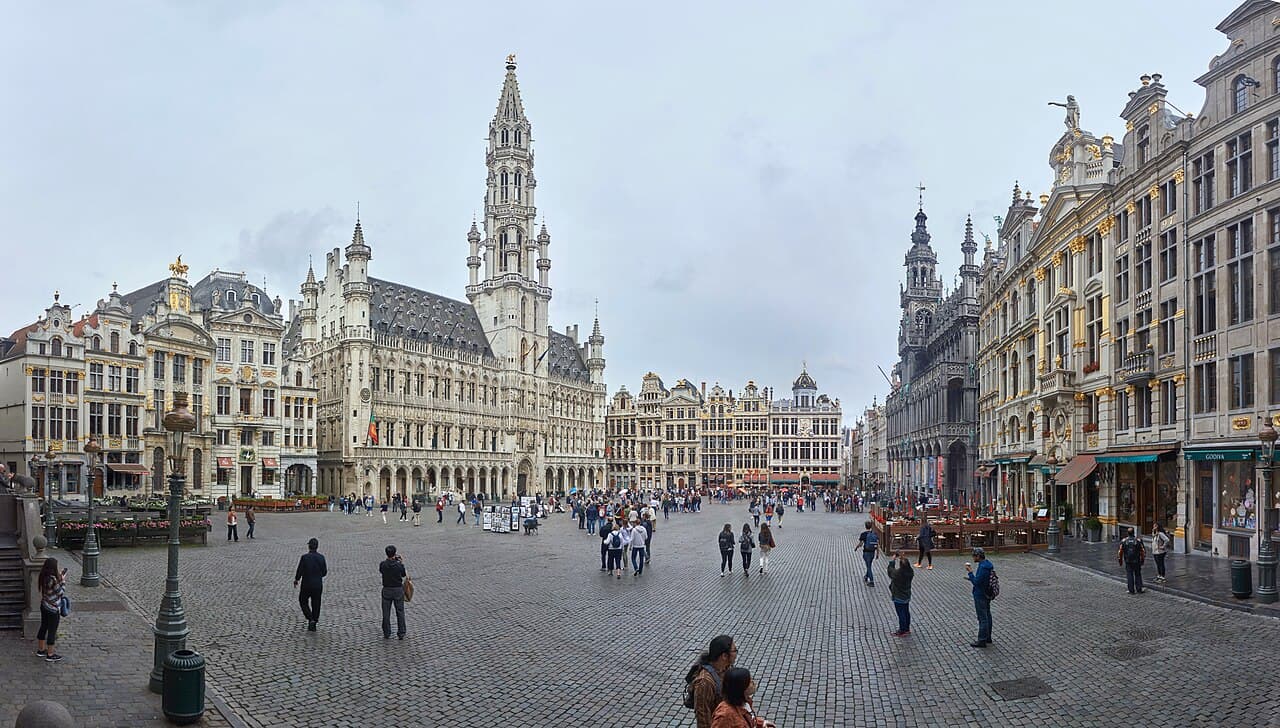
Brussels. The capital grew from a tenth-century settlement on the Senne into the ceremonial heart of the Burgundian and Habsburg Low Countries and, after 1830, of independent Belgium. Its Grand-Place, the market square framed by the Gothic town hall and the guildhalls of the old trades, is one of the finest in Europe and a UNESCO World Heritage Site; every two years the square is carpeted with hundreds of thousands of cut begonias. Around it lie the Art Nouveau townhouses of Victor Horta, the royal museums, and the institutions of the European Union, making Brussels at once a Flemish, a French-speaking and a European city.
La Grand-Place in Brussels, in a photochrome print of about 1895. Public domain, via Wikimedia Commons.
Belgium is a small, densely populated country in north-western Europe, some 30,500 square kilometres in area, bordered by the Netherlands, Germany, Luxembourg and France and opening onto the North Sea along a short, flat coast of dunes and resort towns. The land rises gently from the polders and plains of Flanders in the north, through the central plateau around Brussels, to the forested hills of the Ardennes in the south-east, where the country's highest ground and its wildest scenery lie. It is one of the most urbanised and industrialised parts of Europe, a plain crossed by rivers, canals, railways and motorways, and home to the port of Antwerp, one of the largest in the world.
With about 11.7 million people, Belgium is also one of the most institutionally complicated states in Europe, the result of its central fact: it is divided by language. It is a federal constitutional monarchy under King Philippe, but power is shared among three regions, Flanders in the Dutch-speaking north, Wallonia in the French-speaking south, and the officially bilingual Brussels-Capital Region, and three language communities, Flemish, French and a small German-speaking community in the east. This layered arrangement, built up through successive state reforms since the 1970s, gives Belgium multiple parliaments and governments and a politics defined by the balance between its communities. Brussels, the capital, is not only the seat of the Belgian federation but the headquarters of the European Union and NATO, a city where the country's internal divisions sit alongside its role as a centre of European power.
Brussels. The capital grew from a tenth-century settlement on the Senne into the ceremonial heart of the Burgundian and Habsburg Low Countries and, after 1830, of independent Belgium. Its Grand-Place, the market square framed by the Gothic town hall and the guildhalls of the old trades, is one of the finest in Europe and a UNESCO World Heritage Site; every two years the square is carpeted with hundreds of thousands of cut begonias. Around it lie the Art Nouveau townhouses of Victor Horta, the royal museums, and the institutions of the European Union, making Brussels at once a Flemish, a French-speaking and a European city.
 The market square and belfry of Bruges. CC BY 2.0, via Wikimedia Commons.
Bruges. The great medieval cloth-trading city of Flanders, Bruges grew rich on the wool and finance of the fourteenth and fifteenth centuries and then, when its link to the sea silted up, fell into a long sleep that preserved it. That accidental stillness left one of the best-kept medieval townscapes in Europe, its brick gables, canals and belfry inscribed as a World Heritage Site, and its Basilica of the Holy Blood the focus of an annual procession over seven centuries old.
Ghent. A rival to Bruges and once one of the largest cities north of the Alps, Ghent keeps its medieval merchant houses along the Graslei quay, the castle of the counts of Flanders, and, in St Bavo's Cathedral, the Adoration of the Mystic Lamb, the vast fifteenth-century altarpiece by the brothers Van Eyck that is among the most important and most stolen paintings in the world. A university town with an industrial past, Ghent wears its heritage more plainly than Bruges, a living city rather than a preserved one.
Antwerp. The port on the Scheldt was the commercial capital of sixteenth-century Europe, home to the painter Peter Paul Rubens, whose house and altarpieces still define the city, and to a diamond trade and a Jewish quarter that have shaped it for centuries. Its cathedral, printing museum and river frontage record successive ages of wealth, and its harbour, endlessly rebuilt, remains one of the engines of the European economy.
The market square and belfry of Bruges. CC BY 2.0, via Wikimedia Commons.
Bruges. The great medieval cloth-trading city of Flanders, Bruges grew rich on the wool and finance of the fourteenth and fifteenth centuries and then, when its link to the sea silted up, fell into a long sleep that preserved it. That accidental stillness left one of the best-kept medieval townscapes in Europe, its brick gables, canals and belfry inscribed as a World Heritage Site, and its Basilica of the Holy Blood the focus of an annual procession over seven centuries old.
Ghent. A rival to Bruges and once one of the largest cities north of the Alps, Ghent keeps its medieval merchant houses along the Graslei quay, the castle of the counts of Flanders, and, in St Bavo's Cathedral, the Adoration of the Mystic Lamb, the vast fifteenth-century altarpiece by the brothers Van Eyck that is among the most important and most stolen paintings in the world. A university town with an industrial past, Ghent wears its heritage more plainly than Bruges, a living city rather than a preserved one.
Antwerp. The port on the Scheldt was the commercial capital of sixteenth-century Europe, home to the painter Peter Paul Rubens, whose house and altarpieces still define the city, and to a diamond trade and a Jewish quarter that have shaped it for centuries. Its cathedral, printing museum and river frontage record successive ages of wealth, and its harbour, endlessly rebuilt, remains one of the engines of the European economy.
.jpg%2F1280px-Antwerp%252C_Belgium%252C_from_the_left_bank_of_the_Scheldt_(ca._1890-1900).jpg&w=3840&q=75) Antwerp seen across the Scheldt, in a photochrome print of about 1890–1900. Public domain, via Wikimedia Commons.
Ypres. Rebuilt almost from nothing after the First World War flattened it, Ypres is now a place of pilgrimage. Its reconstructed Cloth Hall houses the In Flanders Fields Museum, the Menin Gate carries the names of the missing, and the surrounding countryside is dense with Commonwealth, German and other cemeteries, so that a town of a few tens of thousands is one of the great memorial landscapes of the twentieth century.
The land that is now Belgium takes even its name from antiquity: the Belgae were the tribes of the region whom Julius Caesar, conquering Gaul in the first century BC, called the bravest of all its peoples, and the Roman province of Gallia Belgica preserved the name for centuries. In the Middle Ages the territory was not a country but a patchwork of prosperous fiefs, the County of Flanders, the Duchy of Brabant, the Prince-Bishopric of Liège and others, whose cloth towns grew into some of the wealthiest and most self-governing cities in Europe, jealous of their charters and quick to revolt, as they did against the French king before the Battle of the Golden Spurs in 1302. Gathered under the dukes of Burgundy in the fifteenth century, the Low Countries became a centre of art and commerce, the age of the Flemish Primitives and of Bruges at its height.
The following centuries made the region a battlefield for greater powers. Passing by inheritance to the Habsburgs, the southern Low Countries stayed Catholic and Spanish when the northern provinces broke away as the Dutch Republic; they were fought over in war after war, ruled from Spain and then from Austria, annexed by France under the Revolution, and handed after Napoleon's fall to a new Kingdom of the Netherlands. The Belgians, Catholic and increasingly resentful of Dutch Protestant rule, rose in revolution in 1830 and won independence, choosing Leopold of Saxe-Coburg as their first king in 1831 and adopting a liberal constitution; the powers guaranteed the new state's neutrality. That neutrality was violated in August 1914 when Germany invaded on its way to France, and Belgium became the western front's most fought-over ground, its towns shelled to rubble and its fields, especially around Ypres, turned into a landscape of trenches and mass death. Occupied again in the Second World War, and the scene of the Battle of the Bulge in the Ardennes in the winter of 1944–45, Belgium emerged to help found the European institutions now seated in Brussels, even as its own internal politics turned increasingly on the divide between Flanders and Wallonia.
Belgium's name descends, through the Roman Gallia Belgica, from the Belgae of Caesar's account, and the modern state revived the ancient word when it declared independence in 1830. The country sits astride one of Europe's oldest and most consequential linguistic frontiers: the line, running roughly east to west just south of Brussels, where Germanic and Romance speech have met since the early Middle Ages. North of it lies Flanders, where the language is Dutch, historically called Flemish in its local forms; south lies Wallonia, where French is spoken, alongside the older Walloon and Picard dialects now much diminished; and in a small area annexed from Germany after 1919, near Eupen, there is a German-speaking community with its own official status.
This division is the central fact of Belgian public life, and language has been fought over for a century and more. When Belgium was founded, French was the language of government, law, the army and the educated classes, and Dutch-speaking Flanders, though the majority, was effectively second-class; the Flemish Movement grew through the nineteenth and twentieth centuries to win equal status for Dutch, until the two languages were made formally equal and a fixed linguistic border was drawn in the 1960s. The result is a country with two dominant written languages of equal weight, bilingual road signs and institutions in Brussels, and communities that increasingly run their own schools and cultural life. The map records the layering: Romance and Germanic place names meet along the language line, French -court and -mont villages give way to Flemish -gem, -hout and -berg, and Brussels itself carries doubled names, Grand-Place and Grote Markt, that spell out the divide in stone.
For a country so often described as divided, Belgium has a strong and shared everyday culture, much of it built around food, drink and a fondness for the absurd. Its beer is a serious heritage: a tradition of Trappist and abbey brewing, lambics fermented with wild yeasts, and hundreds of distinctive styles that UNESCO recognised as intangible cultural heritage in 2016. Chips fried twice and served with mayonnaise, mussels, waffles and a chocolate industry of international renown are national institutions, and the Belgians tend to regard French claims on any of them with amused irritation. The country invented the modern comic strip as an art form, giving the world Hergé's Tintin, Peyo's Smurfs and a whole school of graphic storytelling honoured in a national comics museum in Brussels.
The visual arts run deep. The Flemish Primitives, Jan van Eyck and Hans Memling, changed European painting in the fifteenth century; Pieter Bruegel the Elder painted its peasants and its winters; Rubens made Antwerp a capital of the Baroque; and in the twentieth century the surrealist René Magritte, with his bowler hats and pipes, gave Belgium a second great visual language, now gathered in a dedicated Magritte museum. Folk custom survives in vivid processions and carnivals that are among the most theatrical in Europe: the Gilles of Binche, in wax masks and ostrich-feather hats, throwing oranges on Shrove Tuesday; the giant figures paraded at Ath and elsewhere; and the Procession of the Holy Blood in Bruges. Several of these carnival and giant traditions are inscribed on UNESCO's intangible heritage lists, marks of a local ritual life that the linguistic quarrels have never displaced.
Belgium has been overwhelmingly Roman Catholic for most of its history, and Catholicism was central to the very creation of the state: it was Catholic resistance to Protestant Dutch rule that helped drive the revolution of 1830, and for more than a century the Church shaped education, politics and daily life across both language communities. The landscape is marked by it, from the great cathedrals of Tournai, Antwerp, Mechelen and Brussels to the béguinages, the walled communities of lay religious women that grew up in the medieval Low Countries and survive nowhere better than in Flanders, where thirteen of them are collectively inscribed as a World Heritage Site. Mechelen remains the seat of the Belgian primate, and Catholic feast days still frame the folk calendar of processions and pardons.
That religious identity has thinned dramatically. Belgium is now one of the more secular societies in Europe: while a majority still identify culturally as Catholic and use the Church for baptisms, funerals and holidays, regular attendance has collapsed, and the country was among the first to legalise euthanasia and same-sex marriage, over Church objection. At the same time immigration, especially from Morocco and Turkey, has made Islam a significant presence, particularly in Brussels and the industrial cities, and the Belgian state, which formally recognises and part-funds several religions and organised secularism alike, now supports Catholic, Protestant, Jewish, Anglican, Orthodox, Islamic and non-confessional bodies together. The sacred geography that draws the most feeling now is arguably not devotional at all but memorial, the cemeteries and monuments of the wars, visited in far greater numbers than the churches.
Belgian mourning at the family level follows the Catholic pattern that shaped the whole country, even as fewer people practise the faith: a funeral Mass or a secular ceremony, burial or, increasingly, cremation, and a printed memorial card, the doodsprentje or image mortuaire, bearing the dead person's photograph, dates and a prayer or verse, kept by mourners and collected for generations, so that Belgian and Flemish families often hold drawers of these small cards recording their dead. The great collective day of remembrance is All Saints', Toussaint or Allerheiligen, on 1 November, when families across the country visit the cemeteries, clean and tend the graves and lay flowers, above all the chrysanthemums that are so tied to the day that the flower is rarely given for any other purpose; on that day the graveyards of Belgium fill with people and colour.
Above this ordinary cycle stands the extraordinary memory of the First World War, which Belgium has kept more faithfully than almost any nation kept its own. The Ypres Salient, where hundreds of thousands died in the mud of battles like Passchendaele, became after 1918 a permanent memorial landscape. The Commonwealth War Graves Commission maintains scores of cemeteries there, among them Tyne Cot, the largest Commonwealth war cemetery in the world, with nearly twelve thousand graves and, on its wall, the names of thousands more missing. The Menin Gate at Ypres carries 54,395 names of the missing, and beneath it the Last Post has been sounded by local buglers nearly every evening since 1928. The In Flanders Fields Museum, in the rebuilt Cloth Hall, takes its name from the poem John McCrae wrote nearby in 1915, the poem that made the red poppy the flower of remembrance across the British world.
Antwerp seen across the Scheldt, in a photochrome print of about 1890–1900. Public domain, via Wikimedia Commons.
Ypres. Rebuilt almost from nothing after the First World War flattened it, Ypres is now a place of pilgrimage. Its reconstructed Cloth Hall houses the In Flanders Fields Museum, the Menin Gate carries the names of the missing, and the surrounding countryside is dense with Commonwealth, German and other cemeteries, so that a town of a few tens of thousands is one of the great memorial landscapes of the twentieth century.
The land that is now Belgium takes even its name from antiquity: the Belgae were the tribes of the region whom Julius Caesar, conquering Gaul in the first century BC, called the bravest of all its peoples, and the Roman province of Gallia Belgica preserved the name for centuries. In the Middle Ages the territory was not a country but a patchwork of prosperous fiefs, the County of Flanders, the Duchy of Brabant, the Prince-Bishopric of Liège and others, whose cloth towns grew into some of the wealthiest and most self-governing cities in Europe, jealous of their charters and quick to revolt, as they did against the French king before the Battle of the Golden Spurs in 1302. Gathered under the dukes of Burgundy in the fifteenth century, the Low Countries became a centre of art and commerce, the age of the Flemish Primitives and of Bruges at its height.
The following centuries made the region a battlefield for greater powers. Passing by inheritance to the Habsburgs, the southern Low Countries stayed Catholic and Spanish when the northern provinces broke away as the Dutch Republic; they were fought over in war after war, ruled from Spain and then from Austria, annexed by France under the Revolution, and handed after Napoleon's fall to a new Kingdom of the Netherlands. The Belgians, Catholic and increasingly resentful of Dutch Protestant rule, rose in revolution in 1830 and won independence, choosing Leopold of Saxe-Coburg as their first king in 1831 and adopting a liberal constitution; the powers guaranteed the new state's neutrality. That neutrality was violated in August 1914 when Germany invaded on its way to France, and Belgium became the western front's most fought-over ground, its towns shelled to rubble and its fields, especially around Ypres, turned into a landscape of trenches and mass death. Occupied again in the Second World War, and the scene of the Battle of the Bulge in the Ardennes in the winter of 1944–45, Belgium emerged to help found the European institutions now seated in Brussels, even as its own internal politics turned increasingly on the divide between Flanders and Wallonia.
Belgium's name descends, through the Roman Gallia Belgica, from the Belgae of Caesar's account, and the modern state revived the ancient word when it declared independence in 1830. The country sits astride one of Europe's oldest and most consequential linguistic frontiers: the line, running roughly east to west just south of Brussels, where Germanic and Romance speech have met since the early Middle Ages. North of it lies Flanders, where the language is Dutch, historically called Flemish in its local forms; south lies Wallonia, where French is spoken, alongside the older Walloon and Picard dialects now much diminished; and in a small area annexed from Germany after 1919, near Eupen, there is a German-speaking community with its own official status.
This division is the central fact of Belgian public life, and language has been fought over for a century and more. When Belgium was founded, French was the language of government, law, the army and the educated classes, and Dutch-speaking Flanders, though the majority, was effectively second-class; the Flemish Movement grew through the nineteenth and twentieth centuries to win equal status for Dutch, until the two languages were made formally equal and a fixed linguistic border was drawn in the 1960s. The result is a country with two dominant written languages of equal weight, bilingual road signs and institutions in Brussels, and communities that increasingly run their own schools and cultural life. The map records the layering: Romance and Germanic place names meet along the language line, French -court and -mont villages give way to Flemish -gem, -hout and -berg, and Brussels itself carries doubled names, Grand-Place and Grote Markt, that spell out the divide in stone.
For a country so often described as divided, Belgium has a strong and shared everyday culture, much of it built around food, drink and a fondness for the absurd. Its beer is a serious heritage: a tradition of Trappist and abbey brewing, lambics fermented with wild yeasts, and hundreds of distinctive styles that UNESCO recognised as intangible cultural heritage in 2016. Chips fried twice and served with mayonnaise, mussels, waffles and a chocolate industry of international renown are national institutions, and the Belgians tend to regard French claims on any of them with amused irritation. The country invented the modern comic strip as an art form, giving the world Hergé's Tintin, Peyo's Smurfs and a whole school of graphic storytelling honoured in a national comics museum in Brussels.
The visual arts run deep. The Flemish Primitives, Jan van Eyck and Hans Memling, changed European painting in the fifteenth century; Pieter Bruegel the Elder painted its peasants and its winters; Rubens made Antwerp a capital of the Baroque; and in the twentieth century the surrealist René Magritte, with his bowler hats and pipes, gave Belgium a second great visual language, now gathered in a dedicated Magritte museum. Folk custom survives in vivid processions and carnivals that are among the most theatrical in Europe: the Gilles of Binche, in wax masks and ostrich-feather hats, throwing oranges on Shrove Tuesday; the giant figures paraded at Ath and elsewhere; and the Procession of the Holy Blood in Bruges. Several of these carnival and giant traditions are inscribed on UNESCO's intangible heritage lists, marks of a local ritual life that the linguistic quarrels have never displaced.
Belgium has been overwhelmingly Roman Catholic for most of its history, and Catholicism was central to the very creation of the state: it was Catholic resistance to Protestant Dutch rule that helped drive the revolution of 1830, and for more than a century the Church shaped education, politics and daily life across both language communities. The landscape is marked by it, from the great cathedrals of Tournai, Antwerp, Mechelen and Brussels to the béguinages, the walled communities of lay religious women that grew up in the medieval Low Countries and survive nowhere better than in Flanders, where thirteen of them are collectively inscribed as a World Heritage Site. Mechelen remains the seat of the Belgian primate, and Catholic feast days still frame the folk calendar of processions and pardons.
That religious identity has thinned dramatically. Belgium is now one of the more secular societies in Europe: while a majority still identify culturally as Catholic and use the Church for baptisms, funerals and holidays, regular attendance has collapsed, and the country was among the first to legalise euthanasia and same-sex marriage, over Church objection. At the same time immigration, especially from Morocco and Turkey, has made Islam a significant presence, particularly in Brussels and the industrial cities, and the Belgian state, which formally recognises and part-funds several religions and organised secularism alike, now supports Catholic, Protestant, Jewish, Anglican, Orthodox, Islamic and non-confessional bodies together. The sacred geography that draws the most feeling now is arguably not devotional at all but memorial, the cemeteries and monuments of the wars, visited in far greater numbers than the churches.
Belgian mourning at the family level follows the Catholic pattern that shaped the whole country, even as fewer people practise the faith: a funeral Mass or a secular ceremony, burial or, increasingly, cremation, and a printed memorial card, the doodsprentje or image mortuaire, bearing the dead person's photograph, dates and a prayer or verse, kept by mourners and collected for generations, so that Belgian and Flemish families often hold drawers of these small cards recording their dead. The great collective day of remembrance is All Saints', Toussaint or Allerheiligen, on 1 November, when families across the country visit the cemeteries, clean and tend the graves and lay flowers, above all the chrysanthemums that are so tied to the day that the flower is rarely given for any other purpose; on that day the graveyards of Belgium fill with people and colour.
Above this ordinary cycle stands the extraordinary memory of the First World War, which Belgium has kept more faithfully than almost any nation kept its own. The Ypres Salient, where hundreds of thousands died in the mud of battles like Passchendaele, became after 1918 a permanent memorial landscape. The Commonwealth War Graves Commission maintains scores of cemeteries there, among them Tyne Cot, the largest Commonwealth war cemetery in the world, with nearly twelve thousand graves and, on its wall, the names of thousands more missing. The Menin Gate at Ypres carries 54,395 names of the missing, and beneath it the Last Post has been sounded by local buglers nearly every evening since 1928. The In Flanders Fields Museum, in the rebuilt Cloth Hall, takes its name from the poem John McCrae wrote nearby in 1915, the poem that made the red poppy the flower of remembrance across the British world.
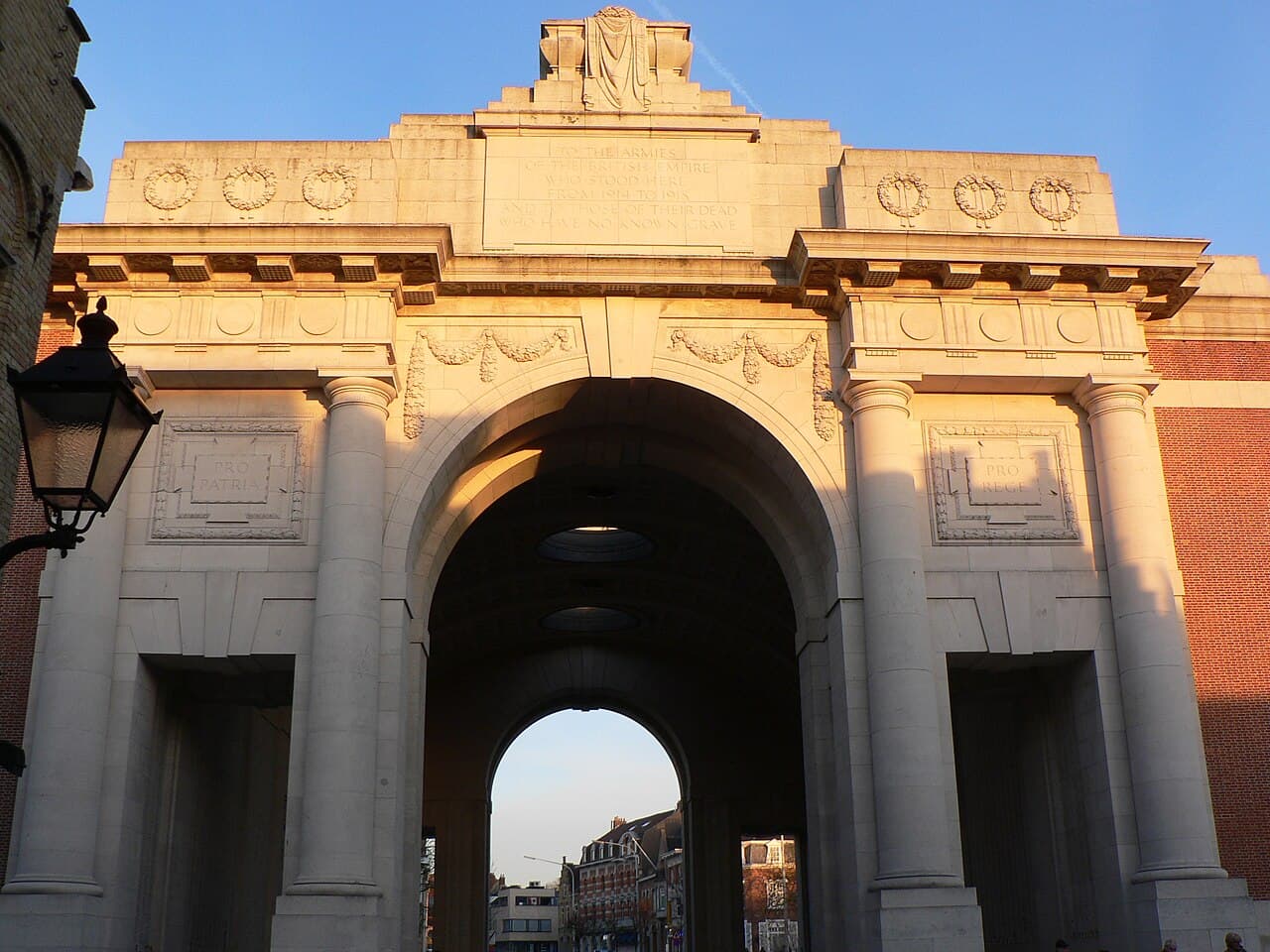 The Menin Gate at Ypres, where the Last Post has sounded almost every evening since 1928. Public domain, via Wikimedia Commons.
Belgium's remembrance is not only of foreign armies. The Flemish Movement built its own war memorial at Diksmuide, the towering IJzertoren, or Yser Tower, over the graves of Flemish soldiers, inscribed with the pacifist and nationalist slogan "No More War" in four languages and the Flemish "AVV-VVK"; it remains a charged site where Flemish identity and the memory of the war meet. The Second World War left its own scars and its own memorials: Fort Breendonk, a prison camp where the SS tortured and killed resistance members and Jews, is preserved as a national memorial almost exactly as it was left; and Kazerne Dossin in Mechelen, the barracks that served as the transit camp from which more than 25,000 Jews and Roma were deported to Auschwitz, most never to return, opened in 2012 as a memorial and museum of the Holocaust and human rights. In the Ardennes, Bastogne remembers the American dead of the Battle of the Bulge. Together these sites make Belgium, for its size, one of the most concentrated landscapes of twentieth-century memory anywhere.
Belgian records are among the easiest in Europe to use, because the state archives put them online and did not charge for it.
Civil registration began in 1796 under French annexation and has run continuously since, so every Belgian birth, marriage and death for two and a quarter centuries has a state record on a standard form. Before that the parish registers carry it, and many run from the sixteenth century. The State Archives publish digitised images of both, along with the population registers, free through their search portal.
The population registers are the Belgian speciality and they are worth understanding. From 1846 every municipality kept a running register of households, updated as people were born, married, moved in and moved out, recording each move with a date and a destination. It means a Belgian family can be followed from address to address across a lifetime, and it makes internal migration, which is otherwise invisible, entirely traceable.
The language line runs through the archive as it runs through the country: records in Flanders are in Dutch, in Wallonia in French, in Brussels in both, and in the eastern cantons in German, with a French-language layer over everything from the Napoleonic period.
For the two wars, the Belgian record is unusually full: the archives of the occupation administrations, the deportation files, and the registers of the Dossin barracks at Mechelen, from which Jews and Roma were deported to Auschwitz.
Because Belgium is a federation, heritage protection is largely a matter for its regions, and Flanders, Wallonia and Brussels each run their own listing and conservation systems, with agencies such as the Flemish Onroerend Erfgoed maintaining registers of protected monuments, landscapes and archaeological sites. This regional structure, far from weakening preservation, has produced strong and well-funded conservation, and Belgium is exceptionally rich in inscribed heritage for its area. Its UNESCO World Heritage list ranges across the country's whole history: the Grand-Place of Brussels; the Flemish béguinages; the historic centre of Bruges; the belfries of Belgium and France, the tall municipal towers that symbolised the medieval cities' hard-won civic freedom; the town houses of the Art Nouveau architect Victor Horta; the Neolithic flint mines at Spiennes; the great cathedral of Tournai; the Plantin-Moretus printing house in Antwerp; and the major mining sites of Wallonia, monuments to the industrial revolution that Belgium led on the Continent.
The most recent addition is the most telling. In 2023 UNESCO inscribed the funerary and memorial sites of the First World War along the Western Front, a transnational listing shared with France, bringing scores of Belgian cemeteries and memorials, the Menin Gate and Tyne Cot among them, formally under the protection of world heritage, and recognising that a landscape of graves can be a monument in its own right. Alongside these, national memorial institutions such as Fort Breendonk and Kazerne Dossin are protected and interpreted with unusual care, and the museums of Ypres, Passchendaele and Bastogne form a network dedicated to keeping the meaning of the wars alive for visitors who arrive by the million.
Belgium's documentary memory is being opened up online through its archives and libraries, again along partly federal lines. The State Archives of Belgium, which hold the country's civil registers, parish records, notarial deeds and much else, run a large digitisation programme whose search portal makes centuries of baptism, marriage and death records freely consultable, the foundation of Belgian family history and a resource of real value to the many descendants of Belgian emigrants abroad. The Royal Library of Belgium, the KBR in Brussels, has digitised manuscripts, early printed books and the incomparable holdings of the old Burgundian library, and platforms aggregating Belgian museum and archive collections feed into the wider European digital library.
War memory has its own dedicated digital architecture, fitting for a country so defined by it. CegeSoma, the Belgian state centre for the study of war and society, digitises records, photographs and testimony of both world wars and the occupations; Kazerne Dossin has built a database that seeks to name and picture every one of the more than 25,000 people deported from the Mechelen barracks, turning a list of the murdered back into individuals; and the In Flanders Fields Museum maintains a names list and research databases for the dead and missing of the Ypres Salient, so that a visitor can trace a single soldier from a battlefield to a record. These projects share a purpose with the evening bugle call at the Menin Gate: to make sure the enormous, anonymising numbers of the wars stay attached to names.
Modern Belgian culture travels far, often without the world quite noticing it is Belgian. Its fashion designers, the "Antwerp Six" and their successors, remade European fashion from a port city; its electronic and dance music helped shape the sound of the 1990s; and its film-makers, above all the brothers Jean-Pierre and Luc Dardenne, twice winners of the top prize at Cannes, have made a spare social realism that is among the most respected in world cinema. The comic-strip tradition remains a living industry and export, and Belgian chocolate, beer and chips continue to define the country abroad more powerfully than any political image.
The living debates are those of the divided federation and the diverse city. The long argument between Flanders and Wallonia over how much of the state should be devolved, or whether it should hold together at all, runs through every election, and shapes even how heritage and memory are organised. Brussels, meanwhile, is one of the most internationally diverse cities in Europe, home to large Moroccan, Turkish, Congolese and European communities and to the institutions of the EU, and its culture increasingly reflects that mix rather than the old Flemish-Walloon binary. Belgium also continues to reckon with the darkest part of its past, the brutal colonial regime in Congo under Leopold II and the later Belgian Congo, a reckoning sharpened in recent years by the reassessment of monuments, the return of looted objects, and a parliamentary examination of the colonial record.
The Last Post, unbroken. Since 1928 the buglers of the Ypres fire brigade have sounded the Last Post under the Menin Gate almost every evening, a ceremony maintained by a local association through war and occupation; it is now one of the longest-running acts of daily remembrance in the world, drawing crowds to a small Flemish town every night of the year.
Naming the deported at Kazerne Dossin. The memorial and museum opened at Mechelen in 2012 on the site of the transit barracks has worked to identify, photograph and record each of the more than 25,000 Jews and Roma deported from there to Auschwitz, restoring individual names and faces to a mass crime and building one of Europe's most rigorous Holocaust documentation projects.
Bruges preserved by accident and by choice. The silting of its harbour left Bruges a sleeping medieval city, and modern Belgium chose to protect rather than redevelop it, so that its historic centre was inscribed as a World Heritage Site in 2000, a rare survival of a complete medieval townscape now visited by millions.
A battlefield made World Heritage. In 2023 UNESCO inscribed the First World War cemeteries and memorials of the Western Front, including the Belgian sites around Ypres, recognising for the first time that a landscape created purely to bury and commemorate the dead could stand among the monuments of world heritage.
The Mystic Lamb restored. The Van Eyck brothers' Adoration of the Mystic Lamb in Ghent, repeatedly stolen, split up and damaged over six centuries, has undergone a painstaking multi-year conservation completed in stages in recent years, returning the fifteenth century's greatest painting to something close to its original brilliance and to public view in St Bavo's Cathedral.
The Menin Gate at Ypres, where the Last Post has sounded almost every evening since 1928. Public domain, via Wikimedia Commons.
Belgium's remembrance is not only of foreign armies. The Flemish Movement built its own war memorial at Diksmuide, the towering IJzertoren, or Yser Tower, over the graves of Flemish soldiers, inscribed with the pacifist and nationalist slogan "No More War" in four languages and the Flemish "AVV-VVK"; it remains a charged site where Flemish identity and the memory of the war meet. The Second World War left its own scars and its own memorials: Fort Breendonk, a prison camp where the SS tortured and killed resistance members and Jews, is preserved as a national memorial almost exactly as it was left; and Kazerne Dossin in Mechelen, the barracks that served as the transit camp from which more than 25,000 Jews and Roma were deported to Auschwitz, most never to return, opened in 2012 as a memorial and museum of the Holocaust and human rights. In the Ardennes, Bastogne remembers the American dead of the Battle of the Bulge. Together these sites make Belgium, for its size, one of the most concentrated landscapes of twentieth-century memory anywhere.
Belgian records are among the easiest in Europe to use, because the state archives put them online and did not charge for it.
Civil registration began in 1796 under French annexation and has run continuously since, so every Belgian birth, marriage and death for two and a quarter centuries has a state record on a standard form. Before that the parish registers carry it, and many run from the sixteenth century. The State Archives publish digitised images of both, along with the population registers, free through their search portal.
The population registers are the Belgian speciality and they are worth understanding. From 1846 every municipality kept a running register of households, updated as people were born, married, moved in and moved out, recording each move with a date and a destination. It means a Belgian family can be followed from address to address across a lifetime, and it makes internal migration, which is otherwise invisible, entirely traceable.
The language line runs through the archive as it runs through the country: records in Flanders are in Dutch, in Wallonia in French, in Brussels in both, and in the eastern cantons in German, with a French-language layer over everything from the Napoleonic period.
For the two wars, the Belgian record is unusually full: the archives of the occupation administrations, the deportation files, and the registers of the Dossin barracks at Mechelen, from which Jews and Roma were deported to Auschwitz.
Because Belgium is a federation, heritage protection is largely a matter for its regions, and Flanders, Wallonia and Brussels each run their own listing and conservation systems, with agencies such as the Flemish Onroerend Erfgoed maintaining registers of protected monuments, landscapes and archaeological sites. This regional structure, far from weakening preservation, has produced strong and well-funded conservation, and Belgium is exceptionally rich in inscribed heritage for its area. Its UNESCO World Heritage list ranges across the country's whole history: the Grand-Place of Brussels; the Flemish béguinages; the historic centre of Bruges; the belfries of Belgium and France, the tall municipal towers that symbolised the medieval cities' hard-won civic freedom; the town houses of the Art Nouveau architect Victor Horta; the Neolithic flint mines at Spiennes; the great cathedral of Tournai; the Plantin-Moretus printing house in Antwerp; and the major mining sites of Wallonia, monuments to the industrial revolution that Belgium led on the Continent.
The most recent addition is the most telling. In 2023 UNESCO inscribed the funerary and memorial sites of the First World War along the Western Front, a transnational listing shared with France, bringing scores of Belgian cemeteries and memorials, the Menin Gate and Tyne Cot among them, formally under the protection of world heritage, and recognising that a landscape of graves can be a monument in its own right. Alongside these, national memorial institutions such as Fort Breendonk and Kazerne Dossin are protected and interpreted with unusual care, and the museums of Ypres, Passchendaele and Bastogne form a network dedicated to keeping the meaning of the wars alive for visitors who arrive by the million.
Belgium's documentary memory is being opened up online through its archives and libraries, again along partly federal lines. The State Archives of Belgium, which hold the country's civil registers, parish records, notarial deeds and much else, run a large digitisation programme whose search portal makes centuries of baptism, marriage and death records freely consultable, the foundation of Belgian family history and a resource of real value to the many descendants of Belgian emigrants abroad. The Royal Library of Belgium, the KBR in Brussels, has digitised manuscripts, early printed books and the incomparable holdings of the old Burgundian library, and platforms aggregating Belgian museum and archive collections feed into the wider European digital library.
War memory has its own dedicated digital architecture, fitting for a country so defined by it. CegeSoma, the Belgian state centre for the study of war and society, digitises records, photographs and testimony of both world wars and the occupations; Kazerne Dossin has built a database that seeks to name and picture every one of the more than 25,000 people deported from the Mechelen barracks, turning a list of the murdered back into individuals; and the In Flanders Fields Museum maintains a names list and research databases for the dead and missing of the Ypres Salient, so that a visitor can trace a single soldier from a battlefield to a record. These projects share a purpose with the evening bugle call at the Menin Gate: to make sure the enormous, anonymising numbers of the wars stay attached to names.
Modern Belgian culture travels far, often without the world quite noticing it is Belgian. Its fashion designers, the "Antwerp Six" and their successors, remade European fashion from a port city; its electronic and dance music helped shape the sound of the 1990s; and its film-makers, above all the brothers Jean-Pierre and Luc Dardenne, twice winners of the top prize at Cannes, have made a spare social realism that is among the most respected in world cinema. The comic-strip tradition remains a living industry and export, and Belgian chocolate, beer and chips continue to define the country abroad more powerfully than any political image.
The living debates are those of the divided federation and the diverse city. The long argument between Flanders and Wallonia over how much of the state should be devolved, or whether it should hold together at all, runs through every election, and shapes even how heritage and memory are organised. Brussels, meanwhile, is one of the most internationally diverse cities in Europe, home to large Moroccan, Turkish, Congolese and European communities and to the institutions of the EU, and its culture increasingly reflects that mix rather than the old Flemish-Walloon binary. Belgium also continues to reckon with the darkest part of its past, the brutal colonial regime in Congo under Leopold II and the later Belgian Congo, a reckoning sharpened in recent years by the reassessment of monuments, the return of looted objects, and a parliamentary examination of the colonial record.
The Last Post, unbroken. Since 1928 the buglers of the Ypres fire brigade have sounded the Last Post under the Menin Gate almost every evening, a ceremony maintained by a local association through war and occupation; it is now one of the longest-running acts of daily remembrance in the world, drawing crowds to a small Flemish town every night of the year.
Naming the deported at Kazerne Dossin. The memorial and museum opened at Mechelen in 2012 on the site of the transit barracks has worked to identify, photograph and record each of the more than 25,000 Jews and Roma deported from there to Auschwitz, restoring individual names and faces to a mass crime and building one of Europe's most rigorous Holocaust documentation projects.
Bruges preserved by accident and by choice. The silting of its harbour left Bruges a sleeping medieval city, and modern Belgium chose to protect rather than redevelop it, so that its historic centre was inscribed as a World Heritage Site in 2000, a rare survival of a complete medieval townscape now visited by millions.
A battlefield made World Heritage. In 2023 UNESCO inscribed the First World War cemeteries and memorials of the Western Front, including the Belgian sites around Ypres, recognising for the first time that a landscape created purely to bury and commemorate the dead could stand among the monuments of world heritage.
The Mystic Lamb restored. The Van Eyck brothers' Adoration of the Mystic Lamb in Ghent, repeatedly stolen, split up and damaged over six centuries, has undergone a painstaking multi-year conservation completed in stages in recent years, returning the fifteenth century's greatest painting to something close to its original brilliance and to public view in St Bavo's Cathedral.
National Overview
Notable Cities
Historical Foundations
Linguistic and Etymological Roots
Cultural Identity
Religion and Spirituality
Remembrance and Mourning Traditions
Tracing a Family in Belgium
Heritage Preservation Efforts
Digital Heritage
Contemporary Cultural Influences
Success Stories
References and resources
- UNESCO World Heritage Centre, Belgium, the state-party page covering the Grand-Place, the béguinages, Bruges, the belfries and Belgium's other inscribed sites.
- State Archives of Belgium, the national archives and their digitised civil and parish registers for family history.
- KBR, Royal Library of Belgium, the national library, its digitised manuscripts and the Burgundian collections.
- In Flanders Fields Museum, Ypres, the museum of the Ypres Salient and its names list of the war dead.
- Kazerne Dossin, the Holocaust memorial and museum at the Mechelen deportation barracks.
- Fort Breendonk National Memorial, the preserved SS prison camp and memorial.
- Commonwealth War Graves Commission, Belgium, the cemeteries of the Ypres Salient, including Tyne Cot and the Menin Gate.
- CegeSoma, Study Centre for War and Society, the Belgian centre documenting the world wars and occupations.
- Encyclopaedia Britannica, Belgium, geography, history and political background.