Heritage · Country
Tunisia Culture and Heritage
Tunisia gathers the memory of the Mediterranean into one small country: the harbours of Phoenician Carthage, a Roman amphitheatre that rivals the Colosseum, and Kairouan, among the holiest cities of Islam. Its Amazigh foundations, Arab and Islamic centuries, and the ancient Jewish community of Djerba survive in living cities and in the ways Tunisians remember their dead.Written to last.
By Confinity Heritage Editorial · Updated 2026-07-31 · 8-minute readQuiet tools, kept out of the way.
Tunisia occupies a hinge of the Mediterranean, a compact country where the sea, the mountains and the Sahara meet within a few hundred kilometres. On this ground the Phoenicians built Carthage, Rome raised one of the largest amphitheatres of the ancient world at El Jem, and Arab armies founded Kairouan, which became one of the holiest cities of Islam. Layer upon layer of settlement has left Tunisia with a density of monuments that few countries of its size can match.
That inheritance is not only carved in stone. It survives in the medinas of Tunis and Sousse, in the Roman mosaics of the Bardo, in the Malouf music carried across the sea from Andalusia, and in the customs by which Tunisians mark birth, marriage and death. It is an inheritance shaped by the Amazigh peoples who were here first, by Arab and Islamic civilisation, and by one of the oldest continuous Jewish communities in the world on the island of Djerba.
Tunisia is the northernmost country of Africa and the smallest of the Maghreb states, covering about 163,600 square kilometres between Algeria to the west and Libya to the south-east (Britannica). The north is green and hilly, crossed by the eastern end of the Atlas ranges and watered by the Medjerda, the country's only permanent river; the centre is a plain of olive groves sloping to the coastal Sahel, and the south dries into steppe, the salt pan of the Chott el Djerid, and the Sahara.
Roughly twelve million people live in Tunisia, most of them along the coast and in the greater Tunis region (Britannica). Arabic is the official language and Sunni Islam the faith of the large majority, while French remains widely used in administration and education, and Amazigh (Berber) speech survives in southern villages. The currency is the Tunisian dinar, and the population is overwhelmingly of mixed Arab and Amazigh descent, an inheritance visible in place names, food and family custom.
Tunis. The capital grew up beside the ruins of Carthage and became a great city under the Hafsid dynasty from the thirteenth century. Its walled medina, listed by UNESCO in 1979, holds more than seven hundred monuments, among them the ninth-century Zitouna Mosque, covered souks, palaces and Ottoman-era mausoleums (UNESCO). In its western suburb of Le Bardo, a nineteenth-century palace houses the Bardo National Museum and its unmatched collection of Roman mosaics (Bardo National Museum).
Carthage. Now a coastal suburb of Tunis, Carthage was once the capital of a Mediterranean empire and later a leading city of Roman Africa. Its excavated remains, from the Punic tophet and Byrsa hill to Roman baths, cisterns and villas, form an archaeological park inscribed by UNESCO in 1979 (UNESCO).
Kairouan. Founded in 670 as the first Arab-Muslim city of the Maghreb, Kairouan is regarded by many as the fourth holiest city of Islam, after Mecca, Medina and Jerusalem (Britannica). Its Great Mosque, the Aghlabid water basins and the old medina were inscribed together in 1988 (UNESCO).
Sousse. A port on the Gulf of Hammamet, Sousse preserves one of the finest early Islamic medinas in the Maghreb, with its ninth-century Ribat, or fortified monastery, its Great Mosque and its kasbah. The medina was listed by UNESCO in 1988 (UNESCO).
Sfax. Tunisia's second city and its economic engine, Sfax was founded in the ninth century under the Aghlabids and keeps one of the best-preserved walled medinas in North Africa. It is also the country's olive-oil capital, drawing on some of the largest olive estates in the world (Discover Tunisia).
The oldest layer of Tunisian identity is Amazigh. The ancestors of today's Berber peoples farmed and herded across the region for thousands of years before any city rose on the coast, and the kingdoms of Numidia, ruled by figures such as Massinissa in the second century BC, showed the strength of that indigenous world. Amazigh language and custom run beneath every later culture that settled here.
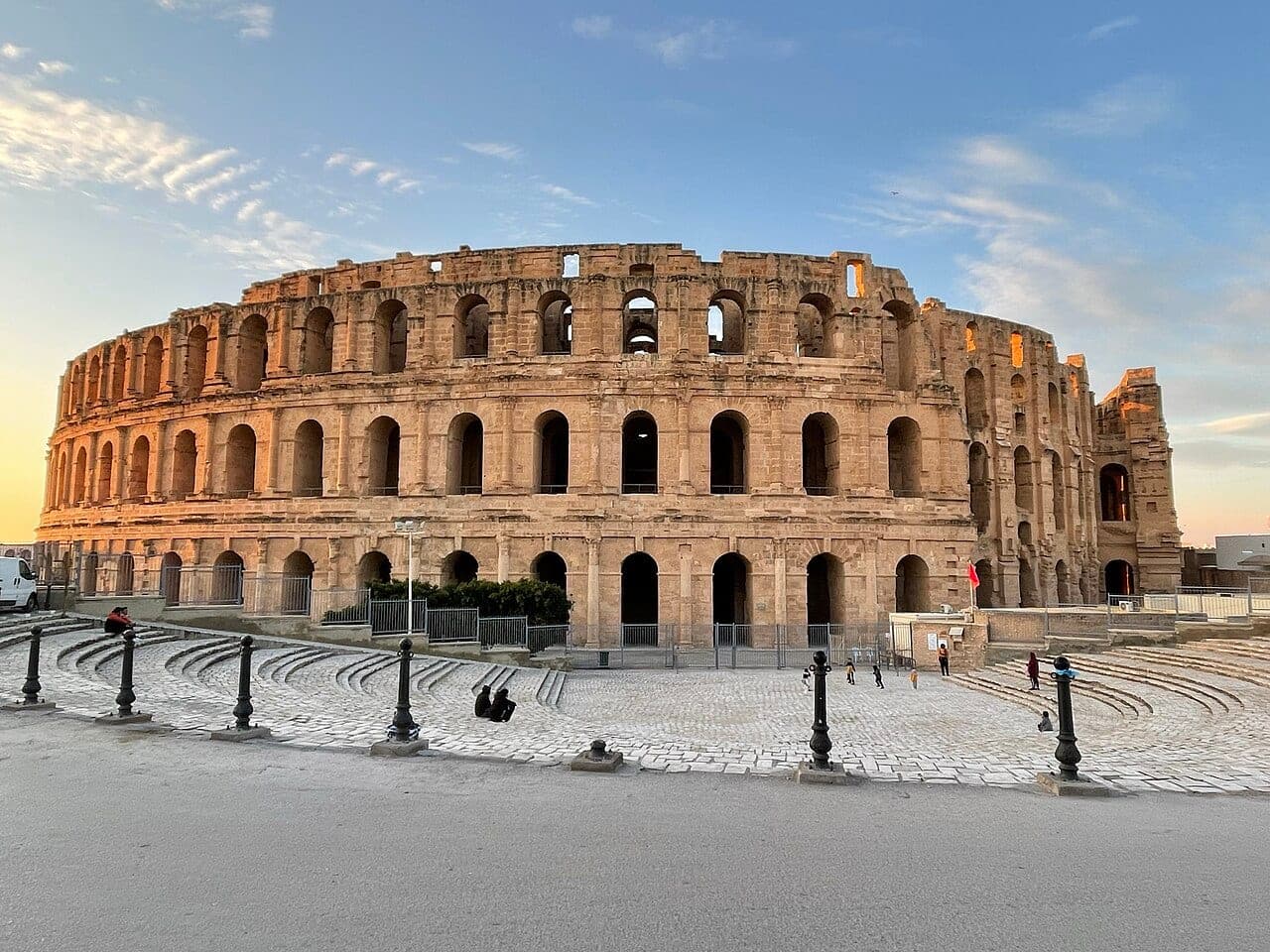
 El Djem held perhaps thirty-five thousand people in a town that no longer needs a building that size, which is why it survives. Photograph by Agnieszka Wolska, CC BY-SA 3.0, via Wikimedia Commons.
Phoenician traders from the Levant founded Carthage on the bay of Tunis around 814 BC, in the tradition that names the queen Dido as its founder (Britannica). Carthage grew into the head of a commercial empire spanning the western Mediterranean, and its rivalry with Rome produced the three Punic Wars (264–146 BC). The second brought the general Hannibal across the Alps to threaten Rome itself; the third ended in 146 BC when Roman armies destroyed the city (Britannica).
Rome rebuilt Carthage a century later, and the province of Africa Proconsularis became one of the granaries of the empire. Prosperity paid for monumental building, above all the amphitheatre at El Jem, raised around AD 238 with seating for tens of thousands, and the well-planned town of Dougga with its temples, theatre and capitol (UNESCO).
Arab armies carried Islam into the region in the seventh century, and in 670 the general Uqba ibn Nafi founded Kairouan as a garrison and capital, building the first version of its Great Mosque (Great Mosque of Kairouan). Under the Aghlabid dynasty (800–909), governing for the Abbasid caliphs, Kairouan became a centre of learning and law; the Aghlabids rebuilt the Great Mosque in stone, dug the great circular reservoirs that still stand outside the city, and raised the coastal ribats of Sousse and Monastir.
Later dynasties, the Fatimids, Zirids, Almohads and the long-lived Hafsids, ruled from Mahdia and then Tunis. From the sixteenth century Tunisia passed under Ottoman authority, governed in practice by local beys, and the Husainid dynasty held the beylik from 1705. Mounting debt gave France the pretext to impose a protectorate in 1881 under the Treaty of Bardo (Britannica). A nationalist movement grew in response, and the Neo-Destour party led by Habib Bourguiba won full independence on 20 March 1956, with a republic declared the following year under Bourguiba as first president (Tunisian independence). Decades later, protests that began in December 2010 in Sidi Bouzid spread nationwide, and in January 2011 President Zine El Abidine Ben Ali left office after twenty-three years in power, in the events known as the Jasmine Revolution (Britannica).
The everyday language of the country is Tunisian Arabic, a Maghrebi dialect known as Derja, which carries an Amazigh substrate together with loanwords from Ottoman Turkish, Italian and French. Standard Arabic is the official written language of the state, mosque and press. Tamazight, in southern and Djerban varieties, is still spoken in a handful of villages, and interest in it has grown among younger Tunisians. French, the language of the protectorate, remains a common second language in education, science and commerce, so that many Tunisians move easily between Arabic and French in daily life.
The name of the country comes from its capital, Tunis. Most scholars trace Tunis to a Berber root of the form t-n-s, carrying senses such as to encamp, to rest or to spend the night, though some connect it to Tanit, the great goddess of Carthage (Grokipedia: Tunis). The English form Tunisia reaches the language through French Tunisie, built on the Arabic Tunis with a territorial ending. In a wider echo, the Roman province of Africa, named after the Afri people who lived near Carthage, eventually lent its name to the whole continent (Washington Report).
If any single art form speaks for Tunisia it is mosaic. The floors and wall panels lifted from Roman villas across the country, gods and seasons, hunts and harvests, portraits of poets, fill the halls of the Bardo, whose collection is the largest of Roman mosaics anywhere (Bardo National Museum). The craft did not die with Rome. Kairouan is famous for hand-knotted carpets, the coastal towns for ceramics and tiles, Nabeul for pottery, and the medinas for chased copper, leatherwork and jewellery in patterns that run back through Islamic, Roman and Punic taste.
The classical music of the cities is Malouf, the Arab-Andalusian suite tradition brought to North Africa by Muslims and Jews expelled from Spain, organised around the nuba, a long cycle of sung and instrumental movements (Tunisian malouf). Alongside it live the rural mezoued, played on bagpipe and drum, the trance music of Sufi brotherhoods, and the Stambeli of Tunisians of sub-Saharan descent. Tunisian cooking is Mediterranean and North African at once: couscous in countless regional forms, the fiery chilli paste harissa on almost every table, brik, a thin pastry folded around egg and fried, grilled fish along the coast, and pastries heavy with almonds, dates and honey. Strong mint tea, poured over pine nuts or almonds, is the sign of welcome in any home.
Sunni Islam of the Maliki school shapes public and private life for the great majority of Tunisians, and the country's mosques include some of the oldest in the Islamic world. The Great Mosque of Kairouan, rebuilt by the Aghlabids in the ninth century, served as the architectural model for later mosques across the Maghreb, its forest of ancient columns and massive square minaret setting a pattern copied for centuries (Great Mosque of Kairouan). The Zitouna Mosque in Tunis was long a leading centre of Islamic scholarship.
El Djem held perhaps thirty-five thousand people in a town that no longer needs a building that size, which is why it survives. Photograph by Agnieszka Wolska, CC BY-SA 3.0, via Wikimedia Commons.
Phoenician traders from the Levant founded Carthage on the bay of Tunis around 814 BC, in the tradition that names the queen Dido as its founder (Britannica). Carthage grew into the head of a commercial empire spanning the western Mediterranean, and its rivalry with Rome produced the three Punic Wars (264–146 BC). The second brought the general Hannibal across the Alps to threaten Rome itself; the third ended in 146 BC when Roman armies destroyed the city (Britannica).
Rome rebuilt Carthage a century later, and the province of Africa Proconsularis became one of the granaries of the empire. Prosperity paid for monumental building, above all the amphitheatre at El Jem, raised around AD 238 with seating for tens of thousands, and the well-planned town of Dougga with its temples, theatre and capitol (UNESCO).
Arab armies carried Islam into the region in the seventh century, and in 670 the general Uqba ibn Nafi founded Kairouan as a garrison and capital, building the first version of its Great Mosque (Great Mosque of Kairouan). Under the Aghlabid dynasty (800–909), governing for the Abbasid caliphs, Kairouan became a centre of learning and law; the Aghlabids rebuilt the Great Mosque in stone, dug the great circular reservoirs that still stand outside the city, and raised the coastal ribats of Sousse and Monastir.
Later dynasties, the Fatimids, Zirids, Almohads and the long-lived Hafsids, ruled from Mahdia and then Tunis. From the sixteenth century Tunisia passed under Ottoman authority, governed in practice by local beys, and the Husainid dynasty held the beylik from 1705. Mounting debt gave France the pretext to impose a protectorate in 1881 under the Treaty of Bardo (Britannica). A nationalist movement grew in response, and the Neo-Destour party led by Habib Bourguiba won full independence on 20 March 1956, with a republic declared the following year under Bourguiba as first president (Tunisian independence). Decades later, protests that began in December 2010 in Sidi Bouzid spread nationwide, and in January 2011 President Zine El Abidine Ben Ali left office after twenty-three years in power, in the events known as the Jasmine Revolution (Britannica).
The everyday language of the country is Tunisian Arabic, a Maghrebi dialect known as Derja, which carries an Amazigh substrate together with loanwords from Ottoman Turkish, Italian and French. Standard Arabic is the official written language of the state, mosque and press. Tamazight, in southern and Djerban varieties, is still spoken in a handful of villages, and interest in it has grown among younger Tunisians. French, the language of the protectorate, remains a common second language in education, science and commerce, so that many Tunisians move easily between Arabic and French in daily life.
The name of the country comes from its capital, Tunis. Most scholars trace Tunis to a Berber root of the form t-n-s, carrying senses such as to encamp, to rest or to spend the night, though some connect it to Tanit, the great goddess of Carthage (Grokipedia: Tunis). The English form Tunisia reaches the language through French Tunisie, built on the Arabic Tunis with a territorial ending. In a wider echo, the Roman province of Africa, named after the Afri people who lived near Carthage, eventually lent its name to the whole continent (Washington Report).
If any single art form speaks for Tunisia it is mosaic. The floors and wall panels lifted from Roman villas across the country, gods and seasons, hunts and harvests, portraits of poets, fill the halls of the Bardo, whose collection is the largest of Roman mosaics anywhere (Bardo National Museum). The craft did not die with Rome. Kairouan is famous for hand-knotted carpets, the coastal towns for ceramics and tiles, Nabeul for pottery, and the medinas for chased copper, leatherwork and jewellery in patterns that run back through Islamic, Roman and Punic taste.
The classical music of the cities is Malouf, the Arab-Andalusian suite tradition brought to North Africa by Muslims and Jews expelled from Spain, organised around the nuba, a long cycle of sung and instrumental movements (Tunisian malouf). Alongside it live the rural mezoued, played on bagpipe and drum, the trance music of Sufi brotherhoods, and the Stambeli of Tunisians of sub-Saharan descent. Tunisian cooking is Mediterranean and North African at once: couscous in countless regional forms, the fiery chilli paste harissa on almost every table, brik, a thin pastry folded around egg and fried, grilled fish along the coast, and pastries heavy with almonds, dates and honey. Strong mint tea, poured over pine nuts or almonds, is the sign of welcome in any home.
Sunni Islam of the Maliki school shapes public and private life for the great majority of Tunisians, and the country's mosques include some of the oldest in the Islamic world. The Great Mosque of Kairouan, rebuilt by the Aghlabids in the ninth century, served as the architectural model for later mosques across the Maghreb, its forest of ancient columns and massive square minaret setting a pattern copied for centuries (Great Mosque of Kairouan). The Zitouna Mosque in Tunis was long a leading centre of Islamic scholarship.
 The Great Mosque of Kairouan, whose square minaret became the model for mosque towers across North Africa and Spain. Photograph by weetoon66, CC BY-SA 2.0, via Wikimedia Commons.
Tunisia is also home to one of the oldest Jewish communities in the world, centred on the island of Djerba. The El Ghriba synagogue there, whose foundation tradition reaches back to priests who fled Jerusalem after the destruction of the First Temple in 586 BC, is regarded as the oldest synagogue in Africa (El Ghriba synagogue). Each spring, on Lag BaOmer, Jewish pilgrims travel to Djerba from Israel, France and across the diaspora for the Ghriba pilgrimage, a festival of prayer, music and candle-lighting that is one of the most distinctive Jewish observances anywhere. Sufi devotion has long coloured Tunisian Islam too, in the veneration of saints, the zawiya lodges of brotherhoods such as the Qadiriyya and Aissawa, and the shrine of the fourteenth-century scholar Abu Said al-Baji at the clifftop village of Sidi Bou Saïd.
Tunisian mourning follows the pattern of Islamic practice, quick, plain and shared by the whole community. The body is washed by relatives or trusted attendants of the same sex, wrapped in a simple white shroud, and buried, usually within a day, after the funeral prayer at the mosque or graveside, laid on the right side facing Mecca beneath a modest grave. Neighbours and kin gather at once, and for three days the family receives visitors offering condolence, women and men in separate rooms, while households nearby cook and send food so that the bereaved need not. Qur'anic recitation runs through the days of the aza, with the refrain that all belong to God and to Him they return, and a widow observes the waiting period of four months and ten days. Many later mark the fortieth day and the anniversary with a further gathering, a Qur'an reading and charity in the name of the dead, and visits to tidy graves are common on the mornings of the two Eids.
In the Amazigh south, older layers survive within the Islamic frame, from particular laments to the memory of ancestral burial grounds tended by whole families. On Djerba, the Jewish community keeps its own rites: burial without delay in the island's cemeteries, the seven-day shiva at home, the recitation of Kaddish, and the annual remembrance of the dead, so that on one small island two ancient traditions of grief have long been practised side by side. Across all these communities the conviction is the same, that to name the dead, tend their graves and gather in their memory is a duty owed by the living.
Tunisian records are unusually good for North Africa, and the reason is that the state here was administratively precocious.
The Beylical administration produced land, tax and appointment registers before the French arrived, and Tunisia adopted a constitution in 1861, the first in the Arab world. The Archives Nationales de Tunisie hold the Ottoman and Beylical series along with the protectorate and republican files, and they are better catalogued than most in the region.
Sharia court registers and the deeds of habous endowments are the substance of family history, naming marriages, inheritances and the descendants entitled to administer an endowment. The état civil was introduced under the protectorate from 1908 and extended to the whole population, so Tunisia has a longer run of universal civil registration than most of its neighbours.
The Jewish record is a large part of Tunisian history and mostly lives elsewhere now. The community on Djerba is one of the oldest continuous Jewish communities in the world, tracing itself to antiquity, and it still exists, but the large mainland community left after 1948 and 1967, chiefly for France and Israel, taking its registers and rabbinical records with it.
Amazigh families in the south and on Djerba keep descent through the tribe and the fraction, and the ksour, the fortified granaries of the Dahar, were held collectively by lineages with each family's chamber recorded.
The 2011 revolution opened the archives of the interior ministry to a truth commission, whose files are now a family matter for thousands of households.
Tunisia carries a heavy concentration of protected heritage. Its inscribed UNESCO World Heritage sites include the Archaeological Site of Carthage and the Medina of Tunis, both listed in 1979; the Amphitheatre of El Jem, also 1979; Ichkeul National Park, a lake and wetland vital to migrating birds, in 1980; the Punic Town of Kerkuane and its Necropolis, the only Phoenicio-Punic city to survive with its street plan intact, in 1985; Kairouan and the Medina of Sousse, both 1988; and Dougga, described by UNESCO as the best-preserved small Roman town in North Africa, in 1997 (UNESCO Tunisia). In July 2026 the village of Sidi Bou Saïd was added to the list, bringing the national total to ten properties (UNESCO Tunisia).
The care of these places rests chiefly with the Institut National du Patrimoine and the Agence de Mise en Valeur du Patrimoine, which manage excavation, conservation and presentation, often with international partners. Kerkuane, abandoned during the First Punic War around 250 BC and never built over, gives archaeologists an almost unique window on Punic domestic life (UNESCO). Ichkeul, threatened for years by upstream dams that cut the fresh water reaching its lake, has been the subject of long remediation to protect its role on the flyway of hundreds of thousands of waterbirds (UNESCO).
Because Tunisia's monuments are so numerous and so exposed to weather, tourism and time, digital documentation has become an important tool of preservation. Photogrammetry and 3D scanning have been used to record standing structures at Carthage, Dougga and El Jem, and the Bardo's mosaics have been catalogued and photographed for study and for online access. International survey programmes that map endangered archaeology across North Africa from satellite imagery include Tunisian sites in their open databases, helping conservators track erosion, looting and encroachment from a distance.
Tunisian institutions and universities have digitised manuscripts, colonial-era photographs and excavation archives, while volunteer groups and heritage pages document medina houses, Jewish and Ottoman monuments and disappearing crafts, crowd-sourcing a record no single museum could assemble alone. Virtual tours of Carthage, El Jem and the Bardo now let Tunisians abroad and visitors worldwide walk sites they may never reach in person.
Tunisia's cultural reach is larger than its size. Its cinema has long punched above its weight, from Nacer Khemir to the award-winning Moufida Tlatli and the Carthage Film Festival, the oldest in Africa and the Arab world. The desert around Tozeur and Matmata has famously served as film locations that carried images of southern Tunisia to global audiences, and in literature both French and Arabic flourish, with writers, musicians and artists working between Tunis, Paris and the wider Mediterranean.
Since 2011 an energetic arts and civil-society scene has expanded in the space that opened up, with street art, independent music, festivals and heritage initiatives run by a young generation that treats the country's mosaics, calligraphy and medina architecture as living material. Malouf and mezoued reach new listeners through recordings and fusion projects, while the Ghriba pilgrimage and the Kairouan and Sousse festivals continue to bind heritage to public celebration. The diaspora in France, Italy and North America sustains publishing, research and remembrance across borders.
Kerkuane preserved whole. Abandoned during the First Punic War and never rebuilt, the Punic town survives as the only known example of a Phoenicio-Punic city, an archaeological record of a civilisation otherwise known mainly through the writings of its enemies (UNESCO).
The Bardo reopens. After the 2015 attack, Tunisia repaired and reopened the Bardo National Museum, keeping the largest collection of Roman mosaics in the world in public view and reaffirming the country's commitment to its ancient heritage (Bardo National Museum).
Djerba's living pilgrimage. The annual Ghriba pilgrimage continues to gather Jewish visitors from around the world to one of the oldest synagogues on earth, sustaining a two-thousand-year presence and a rare example of long coexistence (El Ghriba synagogue).
A tenth World Heritage listing. The inscription of Sidi Bou Saïd in 2026 recognised the blue-and-white clifftop village and made Tunisia one of the most heavily listed countries in Africa and the Arab world (UNESCO Tunisia).
The Great Mosque of Kairouan, whose square minaret became the model for mosque towers across North Africa and Spain. Photograph by weetoon66, CC BY-SA 2.0, via Wikimedia Commons.
Tunisia is also home to one of the oldest Jewish communities in the world, centred on the island of Djerba. The El Ghriba synagogue there, whose foundation tradition reaches back to priests who fled Jerusalem after the destruction of the First Temple in 586 BC, is regarded as the oldest synagogue in Africa (El Ghriba synagogue). Each spring, on Lag BaOmer, Jewish pilgrims travel to Djerba from Israel, France and across the diaspora for the Ghriba pilgrimage, a festival of prayer, music and candle-lighting that is one of the most distinctive Jewish observances anywhere. Sufi devotion has long coloured Tunisian Islam too, in the veneration of saints, the zawiya lodges of brotherhoods such as the Qadiriyya and Aissawa, and the shrine of the fourteenth-century scholar Abu Said al-Baji at the clifftop village of Sidi Bou Saïd.
Tunisian mourning follows the pattern of Islamic practice, quick, plain and shared by the whole community. The body is washed by relatives or trusted attendants of the same sex, wrapped in a simple white shroud, and buried, usually within a day, after the funeral prayer at the mosque or graveside, laid on the right side facing Mecca beneath a modest grave. Neighbours and kin gather at once, and for three days the family receives visitors offering condolence, women and men in separate rooms, while households nearby cook and send food so that the bereaved need not. Qur'anic recitation runs through the days of the aza, with the refrain that all belong to God and to Him they return, and a widow observes the waiting period of four months and ten days. Many later mark the fortieth day and the anniversary with a further gathering, a Qur'an reading and charity in the name of the dead, and visits to tidy graves are common on the mornings of the two Eids.
In the Amazigh south, older layers survive within the Islamic frame, from particular laments to the memory of ancestral burial grounds tended by whole families. On Djerba, the Jewish community keeps its own rites: burial without delay in the island's cemeteries, the seven-day shiva at home, the recitation of Kaddish, and the annual remembrance of the dead, so that on one small island two ancient traditions of grief have long been practised side by side. Across all these communities the conviction is the same, that to name the dead, tend their graves and gather in their memory is a duty owed by the living.
Tunisian records are unusually good for North Africa, and the reason is that the state here was administratively precocious.
The Beylical administration produced land, tax and appointment registers before the French arrived, and Tunisia adopted a constitution in 1861, the first in the Arab world. The Archives Nationales de Tunisie hold the Ottoman and Beylical series along with the protectorate and republican files, and they are better catalogued than most in the region.
Sharia court registers and the deeds of habous endowments are the substance of family history, naming marriages, inheritances and the descendants entitled to administer an endowment. The état civil was introduced under the protectorate from 1908 and extended to the whole population, so Tunisia has a longer run of universal civil registration than most of its neighbours.
The Jewish record is a large part of Tunisian history and mostly lives elsewhere now. The community on Djerba is one of the oldest continuous Jewish communities in the world, tracing itself to antiquity, and it still exists, but the large mainland community left after 1948 and 1967, chiefly for France and Israel, taking its registers and rabbinical records with it.
Amazigh families in the south and on Djerba keep descent through the tribe and the fraction, and the ksour, the fortified granaries of the Dahar, were held collectively by lineages with each family's chamber recorded.
The 2011 revolution opened the archives of the interior ministry to a truth commission, whose files are now a family matter for thousands of households.
Tunisia carries a heavy concentration of protected heritage. Its inscribed UNESCO World Heritage sites include the Archaeological Site of Carthage and the Medina of Tunis, both listed in 1979; the Amphitheatre of El Jem, also 1979; Ichkeul National Park, a lake and wetland vital to migrating birds, in 1980; the Punic Town of Kerkuane and its Necropolis, the only Phoenicio-Punic city to survive with its street plan intact, in 1985; Kairouan and the Medina of Sousse, both 1988; and Dougga, described by UNESCO as the best-preserved small Roman town in North Africa, in 1997 (UNESCO Tunisia). In July 2026 the village of Sidi Bou Saïd was added to the list, bringing the national total to ten properties (UNESCO Tunisia).
The care of these places rests chiefly with the Institut National du Patrimoine and the Agence de Mise en Valeur du Patrimoine, which manage excavation, conservation and presentation, often with international partners. Kerkuane, abandoned during the First Punic War around 250 BC and never built over, gives archaeologists an almost unique window on Punic domestic life (UNESCO). Ichkeul, threatened for years by upstream dams that cut the fresh water reaching its lake, has been the subject of long remediation to protect its role on the flyway of hundreds of thousands of waterbirds (UNESCO).
Because Tunisia's monuments are so numerous and so exposed to weather, tourism and time, digital documentation has become an important tool of preservation. Photogrammetry and 3D scanning have been used to record standing structures at Carthage, Dougga and El Jem, and the Bardo's mosaics have been catalogued and photographed for study and for online access. International survey programmes that map endangered archaeology across North Africa from satellite imagery include Tunisian sites in their open databases, helping conservators track erosion, looting and encroachment from a distance.
Tunisian institutions and universities have digitised manuscripts, colonial-era photographs and excavation archives, while volunteer groups and heritage pages document medina houses, Jewish and Ottoman monuments and disappearing crafts, crowd-sourcing a record no single museum could assemble alone. Virtual tours of Carthage, El Jem and the Bardo now let Tunisians abroad and visitors worldwide walk sites they may never reach in person.
Tunisia's cultural reach is larger than its size. Its cinema has long punched above its weight, from Nacer Khemir to the award-winning Moufida Tlatli and the Carthage Film Festival, the oldest in Africa and the Arab world. The desert around Tozeur and Matmata has famously served as film locations that carried images of southern Tunisia to global audiences, and in literature both French and Arabic flourish, with writers, musicians and artists working between Tunis, Paris and the wider Mediterranean.
Since 2011 an energetic arts and civil-society scene has expanded in the space that opened up, with street art, independent music, festivals and heritage initiatives run by a young generation that treats the country's mosaics, calligraphy and medina architecture as living material. Malouf and mezoued reach new listeners through recordings and fusion projects, while the Ghriba pilgrimage and the Kairouan and Sousse festivals continue to bind heritage to public celebration. The diaspora in France, Italy and North America sustains publishing, research and remembrance across borders.
Kerkuane preserved whole. Abandoned during the First Punic War and never rebuilt, the Punic town survives as the only known example of a Phoenicio-Punic city, an archaeological record of a civilisation otherwise known mainly through the writings of its enemies (UNESCO).
The Bardo reopens. After the 2015 attack, Tunisia repaired and reopened the Bardo National Museum, keeping the largest collection of Roman mosaics in the world in public view and reaffirming the country's commitment to its ancient heritage (Bardo National Museum).
Djerba's living pilgrimage. The annual Ghriba pilgrimage continues to gather Jewish visitors from around the world to one of the oldest synagogues on earth, sustaining a two-thousand-year presence and a rare example of long coexistence (El Ghriba synagogue).
A tenth World Heritage listing. The inscription of Sidi Bou Saïd in 2026 recognised the blue-and-white clifftop village and made Tunisia one of the most heavily listed countries in Africa and the Arab world (UNESCO Tunisia).
National Overview
Notable Cities
Historical Foundations
Linguistic and Etymological Roots
Cultural Identity
Religion and Spirituality
Remembrance and Mourning Traditions
Tracing a Family in Tunisia
Heritage Preservation Efforts
Digital Heritage
Contemporary Cultural Influences
Success Stories
References and resources
- Encyclopaedia Britannica: Tunisia
- Encyclopaedia Britannica: Carthage
- Encyclopaedia Britannica: Kairouan
- Encyclopaedia Britannica: Jasmine Revolution
- UNESCO World Heritage Centre: Tunisia state party page
- UNESCO World Heritage Centre: Amphitheatre of El Jem
- UNESCO World Heritage Centre: Archaeological Site of Carthage
- UNESCO World Heritage Centre: Medina of Tunis
- UNESCO World Heritage Centre: Kairouan
- UNESCO World Heritage Centre: Medina of Sousse
- UNESCO World Heritage Centre: Punic Town of Kerkuane and its Necropolis
- UNESCO World Heritage Centre: Ichkeul National Park
- Wikipedia: Great Mosque of Kairouan
- Wikipedia: El Ghriba synagogue
- Wikipedia: Tunisian malouf
- Wikipedia: Bardo National Museum (Tunis)
- Wikipedia: Tunisian independence