Heritage · Country
Seychelles Culture and Heritage
Scattered across the western Indian Ocean, the granite peaks and coral atolls of Seychelles shelter the coco de mer palm of the Vallée de Mai and the tortoise multitudes of Aldabra. This is the homeland of the Seychellois Creole people, whose language, moutya drumming and remembrance customs grew from islands that no one called home until the eighteenth century.Written to last.
By Confinity Heritage Editorial · Updated 2026-07-31 · 8-minute readQuiet tools, kept out of the way.
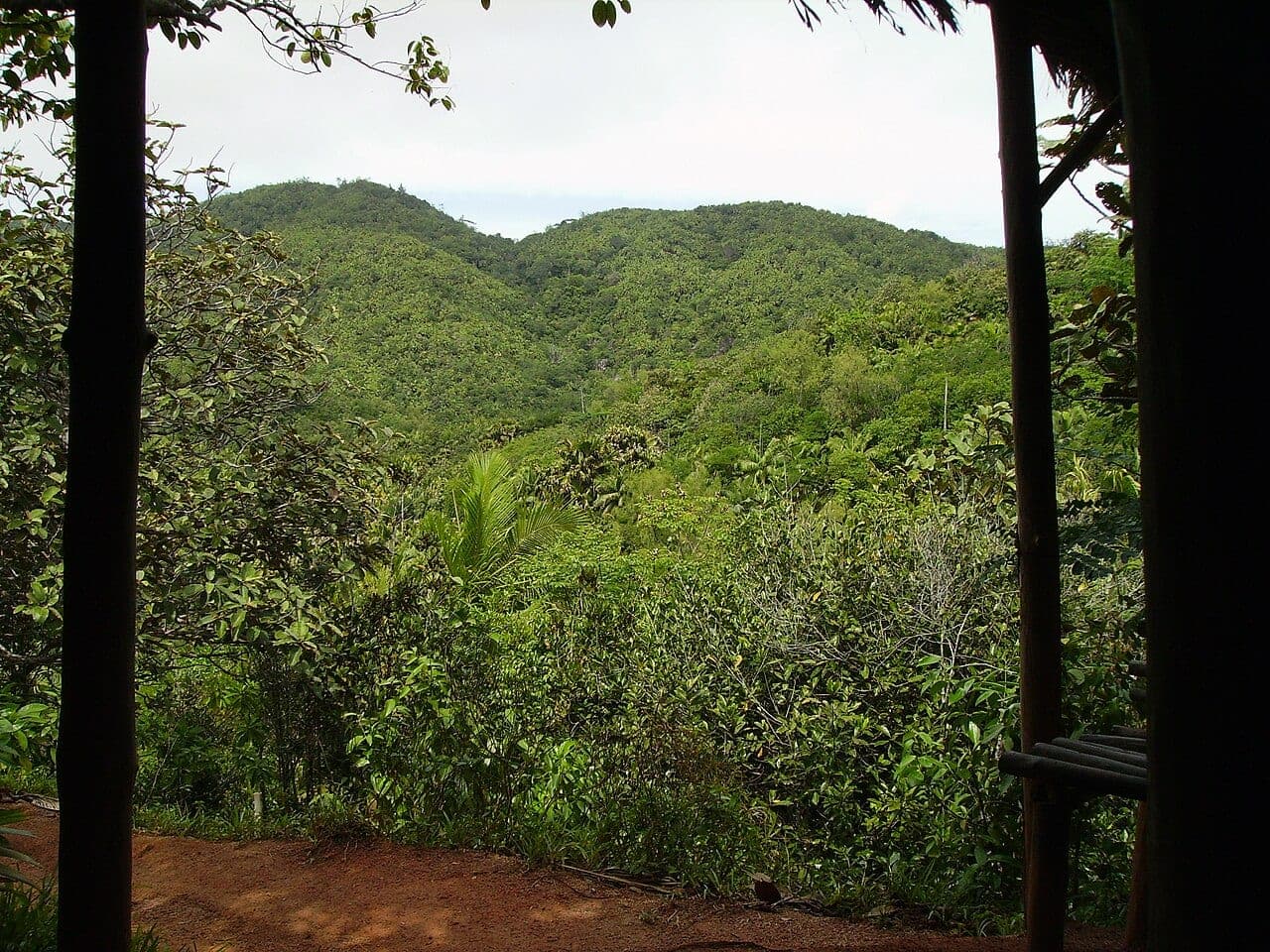
The Republic of Seychelles is a scattering of about 115 islands spread over a wide reach of the western Indian Ocean, northeast of Madagascar and a little south of the equator. Its inner islands are unusual among ocean archipelagos in being made of granite, the weathered remnants of the ancient supercontinent of Gondwana, while its outer islands are low coral atolls and reefs, among them one of the largest raised coral atolls anywhere on Earth. Uniquely for a land of this size, the islands had no indigenous human population. When the first settlers arrived in the eighteenth century they came to an empty shore, and everything Seychellois that followed was carried there, planted there or born there.
This heritage archive gathers what the islands remember: the palm forests and tortoise sanctuaries that carry global protection, the sober record of a society founded on enslaved labour, and the Creole culture, language and mourning customs that the descendants of the enslaved built and still keep. It is written for families tracing Seychellois roots and for readers who want the fuller story behind the beaches, and it treats the harder parts of that story with the plainness they deserve.
Seychelles is the smallest sovereign state in Africa by population, home to roughly 100,000 people, most of them living on the main island of Mahé. The archipelago divides into two natural families. The granitic inner islands, clustered around Mahé, Praslin and La Digue, rise steeply from the sea in grey peaks softened by forest; the coral outer islands, including the Amirantes, the Farquhar group and remote Aldabra, sit low and flat, ringed by lagoon and reef (Britannica).
Two of these places hold UNESCO World Heritage status. The Vallée de Mai on Praslin, inscribed in 1983, is a surviving fragment of the palm forest that once covered the granitic islands, and the only home in the wild of the coco de mer, the palm that produces the largest and heaviest seed in the plant kingdom. Aldabra Atoll, inscribed in 1982, is one of the world's largest raised coral atolls and shelters some 150,000 Aldabra giant tortoises, the largest population of giant tortoises on the planet (Seychelles Islands Foundation). These two sites, one green and one made of stone and shell, anchor the national sense of what the islands hold in trust.
Victoria, on the northeast coast of Mahé, is the capital and the only town of any size in the country. It is often counted among the smallest national capitals in the world, a compact grid of colonial and Creole buildings, a covered market, and the small silver Clock Tower known locally as Lorloz, a 1903 replica of a clock on Vauxhall Bridge Road in London that has become the informal emblem of the town. Almost the whole apparatus of the state, its ministries, its cathedral, its museums and its harbour, sits within a short walk of the tower.
Beyond Mahé, the settlements of Praslin and La Digue carry the weight of the outer-island character. Praslin, the second-largest island, holds the Vallée de Mai in its centre and the pale sweep of Anse Lazio on its coast; its villages of Baie Sainte Anne and Grand Anse are the gateways to the palm reserve. La Digue, smaller and slower, is known for the granite boulders of Anse Source d'Argent, for the plantation grounds of L'Union Estate, and for a pace of life in which the ox cart and the bicycle long outnumbered the car. Together these three islands hold the great majority of the Seychellois people and the living centre of Creole daily life.
The islands were known to Arab and Austronesian navigators, and Portuguese sailors charted parts of the archipelago in the early sixteenth century, giving the Amirantes their name after Vasco da Gama's title of admiral. For two centuries the granitic islands remained a landmark and an occasional refuge for pirates rather than a home. The French expedition of Lazare Picault reached them in 1742 and returned in 1743, and in 1756 France formally claimed the archipelago, laying a stone of possession (Britannica: History).
The first permanent settlement followed in 1770 on the island of Sainte Anne, when a small party of French planters arrived from Mauritius with enslaved Africans (Slavery in Seychelles). This is the foundation of Seychellois society, and it should be named plainly: the plantation economy of cinnamon, spice and later coconut oil was built on the forced labour of people taken chiefly from Mozambique and Madagascar, alongside a smaller number from India. There was no earlier population to displace, and so from its very beginning the settled society of Seychelles was a society of masters and the enslaved.
Britain captured the islands in 1794, and the French administrator Jean-Baptiste Quéau de Quinssy negotiated repeated capitulations that spared the colony the worst of the war. The Treaty of Paris ceded Seychelles to Britain in 1814. Slavery was abolished in the British colony in 1835, though the freed people were held for a further apprenticeship period; census figures recorded about 6,521 enslaved people in the islands at abolition, the majority of Mozambican origin (Slavery in Seychelles). In the decades that followed, the Royal Navy landed more than 2,800 liberated Africans in Seychelles, people freed from slaving ships intercepted in the western Indian Ocean, many of whom were then indentured to the same plantations (Crown Colony of the Seychelles). A mission school for the children of these liberated Africans was opened at Venn's Town, above the west coast of Mahé, in 1876.
Administered for most of the nineteenth century as a dependency of Mauritius, Seychelles became a separate British Crown Colony in 1903. Self-government came in 1975 and full independence within the Commonwealth on 29 June 1976, with James Mancham as the first president. A coup in 1977 brought France-Albert René to power and a period of one-party socialist rule; multiparty politics returned in 1993, and the modern republic has since alternated power peacefully between elected governments.
Seychelles has three official languages: Seychellois Creole, English and French. Seychellois Creole, known as Kreol Seselwa, is a French-based creole that grew from the speech of the enslaved population and diverged over time under the influence of the Bantu languages of East Africa. It is the mother tongue of well over ninety per cent of the population, and in 1978 it became one of the first creole languages anywhere to be given official status, with a standard orthography later developed and maintained by the national creole institute, Lenstiti Kreol (Seychellois Creole).
The name of the country itself records the colonial founding. When France claimed the archipelago in 1756, the islands were named in honour of Jean Moreau de Séchelles, the finance minister of Louis XV. The main island of Mahé, in turn, carries the name of Bertrand-François Mahé de La Bourdonnais, the French governor of Mauritius who authorised Picault's voyages. The everyday map of Seychelles is thus written in a mixture of French colonial memory and Creole speech, so that a French place name is often spoken and sung in the Creole of the people who live beneath it.
The core of Seychellois culture is Creole, forged from African, French, and later Indian, Chinese and British threads into something distinct to the islands. Its clearest voice is music and dance. Sega is the lively, hip-swaying song and dance shared across the creole islands of the Indian Ocean, performed at celebrations and family gatherings. Moutya is older and graver: a slow, hypnotic form driven by a single large goatskin drum warmed over a fire, sung in Creole and danced at night. It was carried to the islands by enslaved Africans and performed away from the plantation house, and its songs were a way of voicing hardship and quiet resistance. In 2021 moutya became the first Seychellois tradition inscribed on the UNESCO Representative List of the Intangible Cultural Heritage of Humanity (UNESCO: Moutya).
 The Vallee de Mai grows the coco de mer, whose nut is the largest seed of any plant, and which General Gordon decided was the forbidden fruit and this valley the garden of Eden. Photograph by Radoslaw Botev, CC BY-SA 4.0, via Wikimedia Commons.
Alongside these African-rooted forms sits the kanmtole, a set of European-derived country dances performed to violin, accordion, banjo and drum, a reminder of the plantation ballroom reworked for the village hall. The same blending shows in Creole architecture, in the timber plantation houses with their wide shaded verandas, steep hipped roofs and lattice screens built for the tropical heat, and in Creole cuisine, where grilled fish, octopus curry, breadfruit and rice are bound together with coconut milk, chilli and imported spice. Food, house and dance all tell the same story of many origins settling into one island manner.
Seychelles is overwhelmingly Christian, and Roman Catholicism is the faith of roughly three-quarters of the population, a legacy of the French founding that the British administration never displaced. An Anglican minority and other Christian churches account for much of the remainder, alongside small Hindu and Muslim communities descended largely from later Indian and other arrivals. The parish church and its calendar of feast days, first communions and saints' days remain central to community life across the islands.
Running quietly beneath formal religion is a body of Creole folk belief known as gris-gris, a set of practices concerning spirits, protective charms and healing that came with the enslaved and mingled with folk Catholicism. The traditional practitioner, the bononm or bonnfanm dibwa, was consulted for cures, for luck and for protection against harm. Officially discouraged and now much diminished, these beliefs still colour the popular imagination, and the line between a saint's blessing and a folk charm has often been thinner in daily practice than in doctrine.
Seychellois mourning follows the Roman Catholic pattern, adapted to island life. When a death occurs, the family holds a wake, the lavey, at which relatives and neighbours gather in the home over several evenings to pray the rosary, share coffee and food, and sit with the bereaved through the night. A Requiem Mass and burial follow, and the dead are remembered again at the month's mind and on anniversaries. Graves are commonly tended and whitewashed, and on All Saints' and All Souls' Days at the start of November families visit the cemeteries to clean the tombs, lay flowers and light candles, so that the whole community keeps its dead on the same days.
The Creole wake carries older textures within this Catholic frame, including hymn singing, storytelling and the shared vigil that turns grief into a communal act rather than a private one. Overarching all of it is the memory of slavery, which the nation has increasingly chosen to hold openly rather than bury. The freed people of 1835 marked their emancipation with peaceable gatherings, and modern Seychelles has raised monuments to its origins, among them the Bicentennial Monument in Victoria, whose three stylised wings represent the African, Asian and European roots of the Seychellois people. Recent national inquiries into the history of slavery have made the remembrance of the enslaved a matter of public record as well as private grief.
Nobody lived on the Seychelles before the French arrived in 1770, so every Seychellois family has an arrival date, and the records often give it.
French settlers came from Mauritius and Réunion with enslaved people from Madagascar and East Africa, and the earliest registers are French Catholic. Britain took the islands in 1810 and administered them from Mauritius until 1903, which is why so much of the older material is in Port Louis and Kew as well as at the National Archives in Victoria.
Slavery was abolished in 1835, and the registers of the enslaved compiled in the 1820s, together with the compensation records, name individuals.
Then the liberated Africans. From the 1860s the Royal Navy landed people taken from intercepted Arab slave dhows in the Indian Ocean, and around two and a half thousand were settled in the Seychelles, many as children, and placed on estates or in mission schools. The Liberated African registers name them with age and ship, and a large share of the modern population descends from that group.
Seychellois Creole, Kreol Seselwa, is the language almost everyone speaks and one of three official ones.
The islands were also a place of exile: Prempeh I of Asante was held here from 1900, and Archbishop Makarios of Cyprus in 1956, along with sultans and chiefs from across the British empire, whose files document the practice of removing inconvenient rulers to the middle of an ocean.
Two institutions carry the main weight of Seychellois heritage. The natural World Heritage Sites, the Vallée de Mai and Aldabra Atoll, are managed by the Seychelles Islands Foundation, a public trust established in 1979 that funds the protection of Aldabra in part through the controlled sale of coco de mer nuts and through research partnerships (Seychelles Islands Foundation). The built and cultural heritage of the granitic islands falls to the Seychelles Heritage Foundation, which cares for sites such as the mission ruins of Venn's Town at Mission Lodge and the plantation house museum at Domaine de Val des Prés (Seychelles Heritage Foundation).
The record of the nation's past is held above all at the National Museum of History in Victoria, which moved in 2017 into the former Supreme Court building on Independence Avenue and gathers the archaeological, colonial and Creole story of the islands under one roof, alongside a separate Natural History Museum. Policy for all of this sits with the Seychelles National Institute of Culture, Heritage and the Arts, the state body responsible for protecting and promoting Seychellois cultural heritage, from historic sites and museums to the intangible traditions of language, music and craft (National Institute of Culture, Heritage and the Arts).
For a small and scattered nation, digital tools have become a practical way of keeping heritage within reach of both residents and the diaspora. The Seychelles Islands Foundation publishes research data, monitoring records and imagery from Aldabra and the Vallée de Mai online, opening two of the world's most remote protected places to people who will never stand in them. UNESCO's intangible heritage inventory carries the documentation and recorded performances of moutya, preserving the drum patterns and Creole verses for future practitioners.
The Creole language itself has been served by digital dictionaries and orthography resources maintained through Lenstiti Kreol, and national inquiries into the history of slavery have been published online, turning archival evidence into a public resource. Museum digitisation, recorded oral histories of sega and moutya performers, and the online catalogues of the heritage foundations all extend the reach of a heritage that once lived only on the islands. It is the same instinct that leads a family to gather its photographs, letters and recorded voices into a lasting archive, so that memory survives distance and time.
The clearest expression of living Seychellois culture is the Festival Kreol, the annual Creole festival held in Victoria and across Mahé, usually in the last week of October. Over the course of a week the festival fills the islands with moutya and sega, kanmtole bands, Creole food, craft, poetry and street performance, and it links Seychelles to the wider creolophone world of the Indian Ocean, the Caribbean and beyond. It has become both a celebration and an act of preservation, keeping the older forms in public view for a younger generation.
Contemporary Seychellois identity is shaped as well by a musical and literary culture that sings and writes in Creole, by a diaspora settled in Britain, Australia and elsewhere that carries the language abroad, and by an economy in which tourism has made the islands' heritage part of how the nation presents itself to the world. The challenge that runs through all of this is to let the culture remain a lived thing for Seychellois people rather than only a performance for visitors.
The clearest success is Aldabra. Its extreme remoteness spared it the settlement, clearance and hunting that reshaped almost every other Indian Ocean island, and the stewardship of the Seychelles Islands Foundation has kept it as close to untouched as any large ecosystem now can be. Its population of about 150,000 Aldabra giant tortoises is the largest on Earth, several times greater than the tortoises of the Galápagos, and the atoll also protects nesting green turtles and the Aldabra rail, the last flightless bird surviving in the Indian Ocean (Seychelles Islands Foundation).
The wider conservation record is strong for a nation of such limited means. Giant tortoises raised from Aldabra stock have been reintroduced to other islands; the coco de mer is protected in law and its nuts strictly controlled; and clean-up expeditions have removed many tonnes of ocean-borne plastic from Aldabra's shores. Seychelles has also committed large areas of its ocean to marine protection through innovative financing. For a country whose written history began only in the eighteenth century, and began in the injury of slavery, the careful keeping of its islands and the open remembrance of its founding are achievements worth naming together.
The Vallee de Mai grows the coco de mer, whose nut is the largest seed of any plant, and which General Gordon decided was the forbidden fruit and this valley the garden of Eden. Photograph by Radoslaw Botev, CC BY-SA 4.0, via Wikimedia Commons.
Alongside these African-rooted forms sits the kanmtole, a set of European-derived country dances performed to violin, accordion, banjo and drum, a reminder of the plantation ballroom reworked for the village hall. The same blending shows in Creole architecture, in the timber plantation houses with their wide shaded verandas, steep hipped roofs and lattice screens built for the tropical heat, and in Creole cuisine, where grilled fish, octopus curry, breadfruit and rice are bound together with coconut milk, chilli and imported spice. Food, house and dance all tell the same story of many origins settling into one island manner.
Seychelles is overwhelmingly Christian, and Roman Catholicism is the faith of roughly three-quarters of the population, a legacy of the French founding that the British administration never displaced. An Anglican minority and other Christian churches account for much of the remainder, alongside small Hindu and Muslim communities descended largely from later Indian and other arrivals. The parish church and its calendar of feast days, first communions and saints' days remain central to community life across the islands.
Running quietly beneath formal religion is a body of Creole folk belief known as gris-gris, a set of practices concerning spirits, protective charms and healing that came with the enslaved and mingled with folk Catholicism. The traditional practitioner, the bononm or bonnfanm dibwa, was consulted for cures, for luck and for protection against harm. Officially discouraged and now much diminished, these beliefs still colour the popular imagination, and the line between a saint's blessing and a folk charm has often been thinner in daily practice than in doctrine.
Seychellois mourning follows the Roman Catholic pattern, adapted to island life. When a death occurs, the family holds a wake, the lavey, at which relatives and neighbours gather in the home over several evenings to pray the rosary, share coffee and food, and sit with the bereaved through the night. A Requiem Mass and burial follow, and the dead are remembered again at the month's mind and on anniversaries. Graves are commonly tended and whitewashed, and on All Saints' and All Souls' Days at the start of November families visit the cemeteries to clean the tombs, lay flowers and light candles, so that the whole community keeps its dead on the same days.
The Creole wake carries older textures within this Catholic frame, including hymn singing, storytelling and the shared vigil that turns grief into a communal act rather than a private one. Overarching all of it is the memory of slavery, which the nation has increasingly chosen to hold openly rather than bury. The freed people of 1835 marked their emancipation with peaceable gatherings, and modern Seychelles has raised monuments to its origins, among them the Bicentennial Monument in Victoria, whose three stylised wings represent the African, Asian and European roots of the Seychellois people. Recent national inquiries into the history of slavery have made the remembrance of the enslaved a matter of public record as well as private grief.
Nobody lived on the Seychelles before the French arrived in 1770, so every Seychellois family has an arrival date, and the records often give it.
French settlers came from Mauritius and Réunion with enslaved people from Madagascar and East Africa, and the earliest registers are French Catholic. Britain took the islands in 1810 and administered them from Mauritius until 1903, which is why so much of the older material is in Port Louis and Kew as well as at the National Archives in Victoria.
Slavery was abolished in 1835, and the registers of the enslaved compiled in the 1820s, together with the compensation records, name individuals.
Then the liberated Africans. From the 1860s the Royal Navy landed people taken from intercepted Arab slave dhows in the Indian Ocean, and around two and a half thousand were settled in the Seychelles, many as children, and placed on estates or in mission schools. The Liberated African registers name them with age and ship, and a large share of the modern population descends from that group.
Seychellois Creole, Kreol Seselwa, is the language almost everyone speaks and one of three official ones.
The islands were also a place of exile: Prempeh I of Asante was held here from 1900, and Archbishop Makarios of Cyprus in 1956, along with sultans and chiefs from across the British empire, whose files document the practice of removing inconvenient rulers to the middle of an ocean.
Two institutions carry the main weight of Seychellois heritage. The natural World Heritage Sites, the Vallée de Mai and Aldabra Atoll, are managed by the Seychelles Islands Foundation, a public trust established in 1979 that funds the protection of Aldabra in part through the controlled sale of coco de mer nuts and through research partnerships (Seychelles Islands Foundation). The built and cultural heritage of the granitic islands falls to the Seychelles Heritage Foundation, which cares for sites such as the mission ruins of Venn's Town at Mission Lodge and the plantation house museum at Domaine de Val des Prés (Seychelles Heritage Foundation).
The record of the nation's past is held above all at the National Museum of History in Victoria, which moved in 2017 into the former Supreme Court building on Independence Avenue and gathers the archaeological, colonial and Creole story of the islands under one roof, alongside a separate Natural History Museum. Policy for all of this sits with the Seychelles National Institute of Culture, Heritage and the Arts, the state body responsible for protecting and promoting Seychellois cultural heritage, from historic sites and museums to the intangible traditions of language, music and craft (National Institute of Culture, Heritage and the Arts).
For a small and scattered nation, digital tools have become a practical way of keeping heritage within reach of both residents and the diaspora. The Seychelles Islands Foundation publishes research data, monitoring records and imagery from Aldabra and the Vallée de Mai online, opening two of the world's most remote protected places to people who will never stand in them. UNESCO's intangible heritage inventory carries the documentation and recorded performances of moutya, preserving the drum patterns and Creole verses for future practitioners.
The Creole language itself has been served by digital dictionaries and orthography resources maintained through Lenstiti Kreol, and national inquiries into the history of slavery have been published online, turning archival evidence into a public resource. Museum digitisation, recorded oral histories of sega and moutya performers, and the online catalogues of the heritage foundations all extend the reach of a heritage that once lived only on the islands. It is the same instinct that leads a family to gather its photographs, letters and recorded voices into a lasting archive, so that memory survives distance and time.
The clearest expression of living Seychellois culture is the Festival Kreol, the annual Creole festival held in Victoria and across Mahé, usually in the last week of October. Over the course of a week the festival fills the islands with moutya and sega, kanmtole bands, Creole food, craft, poetry and street performance, and it links Seychelles to the wider creolophone world of the Indian Ocean, the Caribbean and beyond. It has become both a celebration and an act of preservation, keeping the older forms in public view for a younger generation.
Contemporary Seychellois identity is shaped as well by a musical and literary culture that sings and writes in Creole, by a diaspora settled in Britain, Australia and elsewhere that carries the language abroad, and by an economy in which tourism has made the islands' heritage part of how the nation presents itself to the world. The challenge that runs through all of this is to let the culture remain a lived thing for Seychellois people rather than only a performance for visitors.
The clearest success is Aldabra. Its extreme remoteness spared it the settlement, clearance and hunting that reshaped almost every other Indian Ocean island, and the stewardship of the Seychelles Islands Foundation has kept it as close to untouched as any large ecosystem now can be. Its population of about 150,000 Aldabra giant tortoises is the largest on Earth, several times greater than the tortoises of the Galápagos, and the atoll also protects nesting green turtles and the Aldabra rail, the last flightless bird surviving in the Indian Ocean (Seychelles Islands Foundation).
The wider conservation record is strong for a nation of such limited means. Giant tortoises raised from Aldabra stock have been reintroduced to other islands; the coco de mer is protected in law and its nuts strictly controlled; and clean-up expeditions have removed many tonnes of ocean-borne plastic from Aldabra's shores. Seychelles has also committed large areas of its ocean to marine protection through innovative financing. For a country whose written history began only in the eighteenth century, and began in the injury of slavery, the careful keeping of its islands and the open remembrance of its founding are achievements worth naming together.
National Overview
Notable Cities
Historical Foundations
Linguistic and Etymological Roots
Cultural Identity
Religion and Spirituality
Remembrance and Mourning Traditions
Tracing a Family in Seychelles
Heritage Preservation Efforts
Digital Heritage
Contemporary Cultural Influences
Success Stories
References and resources
- Britannica: Seychelles and Britannica: History of Seychelles
- UNESCO World Heritage Centre: Vallée de Mai Nature Reserve
- UNESCO World Heritage Centre: Aldabra Atoll
- UNESCO Intangible Cultural Heritage: Moutya
- Seychelles Islands Foundation
- Seychelles Heritage Foundation
- Seychelles National Institute of Culture, Heritage and the Arts
- Wikipedia: Slavery in Seychelles
- Wikipedia: Crown Colony of the Seychelles
- Wikipedia: Seychellois Creole