Heritage · Country
Maldives Culture and Heritage
A double chain of coral atolls strung across the equator, where seafarers, cowrie traders and coral-stone masons built a Muslim civilisation on the lowest land on earth. From the carved coral and lacquer of the Malé Friday Mosque to the Buddhist stupas beneath the palms, the Maldives keep a memory the rising ocean now presses upon.Written to last.
By Confinity Heritage Editorial · Updated 2026-07-31 · 8-minute readQuiet tools, kept out of the way.
The Maldives lie strung across the equator as a double chain of coral atolls, the smallest and lowest nation in Asia and among the most dispersed on earth. Its islands, numbering close to 1,200, sit atop the drowned rim of an undersea mountain range, gathered into a ribbon of atolls that runs some 870 kilometres from north to south yet rises, on average, only about 1.5 metres above the waves. For at least two thousand years these specks of reef and sand have been a waypoint on the great sea road of the Indian Ocean, where the monsoon carried Arab, Persian, Indian, Sinhala, Malay and East African vessels past a country that traded in cowrie shells, coir rope and dried fish. Out of that traffic the Maldivians made a language, a script and a faith entirely their own.
The record of that making survives in coral. Maldivian masons quarried the living reef and cut it into the blocks of their mosques, their tombs and their palaces, and the finest of these buildings, the Malé Friday Mosque, carries carved coral panels and lacquered woodwork with few exact parallels anywhere. Beneath the palms lie older mounds still, the ruined stupas of a Buddhist civilisation that flourished for more than a millennium before the islands turned to Islam in 1153. This profile traces how the Maldives remember, from the coral headstones of their old cemeteries to the digital surveys recording a heritage a rising ocean has placed under strain.
The Republic of Maldives is built from roughly 1,190 coral islands grouped into a series of natural atolls, scattered over some 90,000 square kilometres of ocean of which only about 298 square kilometres is dry land, according to Encyclopaedia Britannica. For administration the country divides these into twenty-one atolls, and the word "atoll" itself comes from the Dhivehi atolu. No point of natural ground reaches much above two and a half metres, and more than four-fifths of the land sits less than a metre above sea level, which makes the Maldives the lowest-lying country on the planet and the one most exposed to a rising ocean.
Around half a million Maldivians live here, more than a third of them in the capital, Malé, one of the most densely settled cities anywhere. Sunni Islam is the state religion and the common thread of national life. The modern economy rests on two pillars: the tuna fishery that has fed the islands for centuries, and the resort tourism that since the 1970s has turned uninhabited reefs into famous holiday islands.
Malé. The capital, long called the King's Island, occupies a single small island packed with people, mosques and markets. It holds the seat of government, the fish market on the northern shore, and the principal national monuments: the coral-stone Malé Friday Mosque with its round minaret and the National Museum in the old Sultan's Park. Malé has been the political centre of the archipelago since the sultanate, its towers rising straight from the reef in a nation running out of room.
Addu City. At the far south of the country, across the equator, Addu (Seenu) Atoll forms the second urban centre, a string of linked islands around a wide lagoon. Its heritage is partly military: the British operated an air base on Gan through two world wars and the Cold War, and the atoll briefly declared its own breakaway republic in the late 1950s, remembered still in the south's distinctive dialect.
Fuvahmulah. A single large island forming its own atoll, Fuvahmulah is famous for freshwater lakes and for the Havitta, a great mound that marks the ruin of a pre-Islamic Buddhist stupa, one of the clearest survivals of the islands' first religion.
The historic atolls. Much of the deepest heritage lies away from the cities. Utheemu in the far north (Haa Alif Atoll) preserves the timber palace, Utheemu Ganduvaru, of the sixteenth-century hero Muhammad Thakurufaanu. Baa Atoll's island of Thulhaadhoo is the home of Maldivian lacquerwork, while old coral-stone mosques and mounded stupa sites survive on islands across Laamu, Alifu and Gaafu atolls.
The first settlers most likely reached the Maldives from the Indian subcontinent and Sri Lanka more than two thousand years ago, bringing an Indo-Aryan language and, in time, Buddhism. From perhaps the third century BCE, Buddhism became the islands' faith and shaped their culture for around 1,400 years, leaving monasteries such as the one excavated at Kaashidhoo, dated to between roughly 205 and 560 CE, and the ruined stupas the Maldivians call havitta or hawitta, of which several hundred once dotted the archipelago and were first documented systematically by the British archaeologist H. C. P. Bell in the 1920s.
The islands owed their prosperity to the sea. Maldivian cowrie shells, gathered on the reef flats, circulated as currency across Asia and West Africa, and Maldivian coir, the rope twisted from coconut husk, rigged ships throughout the Indian Ocean; both, with dried fish, were traded for rice, cloth and metal the atolls could not produce. In 1153 the last Buddhist king, remembered as Dhovemi, accepted Islam and took the title Sultan Muhammad al-Adil, an event that tradition credits to a visiting scholar, Abu al-Barakat, and that is recorded on twelfth-century copper-plate charters, the loamaafaanu, now held in the National Museum.
From that conversion grew a sultanate that endured, under a succession of dynasties, for close to eight centuries. Portuguese forces seized Malé in 1558, but their occupation was ended after some fifteen years by Thakurufaanu, whose rebellion is still marked as National Day. Dutch influence reached the islands from Ceylon in the seventeenth century, and in 1887 the British made the Maldives a protected state while leaving the sultanate in place. The country regained full independence on 26 July 1965, and after a referendum abolished the monarchy it became a republic on 11 November 1968 under President Ibrahim Nasir.
The national language is Dhivehi, an Indo-Aryan tongue descended, like Sinhala, from the Prakrits of ancient South Asia, and enriched over centuries with Arabic, Persian, Urdu and Portuguese words carried in on the trade winds. Southern atolls such as Addu and Fuvahmulah keep dialects distinct enough that northern Maldivians may struggle to follow them.
Dhivehi has been written in several scripts. The older alphabets, known as Eveyla Akuru and Dhives Akuru, ran from left to right and derived from South Indian writing. They were displaced, from around the eighteenth century, by the present script, Thaana, which is unusual among writing systems: it runs from right to left like Arabic, and its letters derive in part from Arabic and local numerals, letting scribes mix Dhivehi and sacred Arabic on one line. The name of the country most likely joins the Sanskrit mala, garland or necklace, to dvipa, island, describing the way the atolls string across the sea; medieval Arab travellers knew the islands as Dhibat al-Mahal, from which the European form "Maldives" descends.
Maldivian material culture is, above all, a culture of coral and coconut. Masons cut blocks from the reef-building coral of the genus Porites, soft when freshly quarried and hard once dry, and fitted them without mortar into mosques and tombs carved with foliate and Arabic-inscribed panels and fitted with lacquered, gilded timber. The related craft of lacquerwork, liye laajehun, in which turned wooden boxes are coated in coloured lacquer and incised with fine patterns, remains a speciality of Thulhaadhoo in Baa Atoll, as craft surveys record. Women across the atolls weave reed mats, the finest being the thundu kunaa, worked on a low loom from local reeds dyed in soft browns, yellows and black.
The signature sound of the islands is boduberu, meaning "big drum", a music of hide drums, chant and hand-clapping that builds to a fast, trance-like climax and is generally traced to East African seafarers who reached the archipelago centuries ago. The everyday cuisine turns on fish and coconut: garudhiya, a clear tuna broth eaten with rice, lime and chilli; mas huni, shredded smoked tuna tossed with grated coconut and onion and scooped up in roshi flatbread at breakfast; and savoury short-eats, hedhikaa, served with sweet tea.
Islam has been the faith of the Maldives since 1153 and is woven through law, calendar and daily routine. Maldivians are Sunni Muslims of the Shafi'i school, the tradition common along the shores of the western Indian Ocean, and the Constitution makes Islam the religion of the state. Mosques stand on every inhabited island, and Ramadan and the two Eids are the great communal seasons of the year.
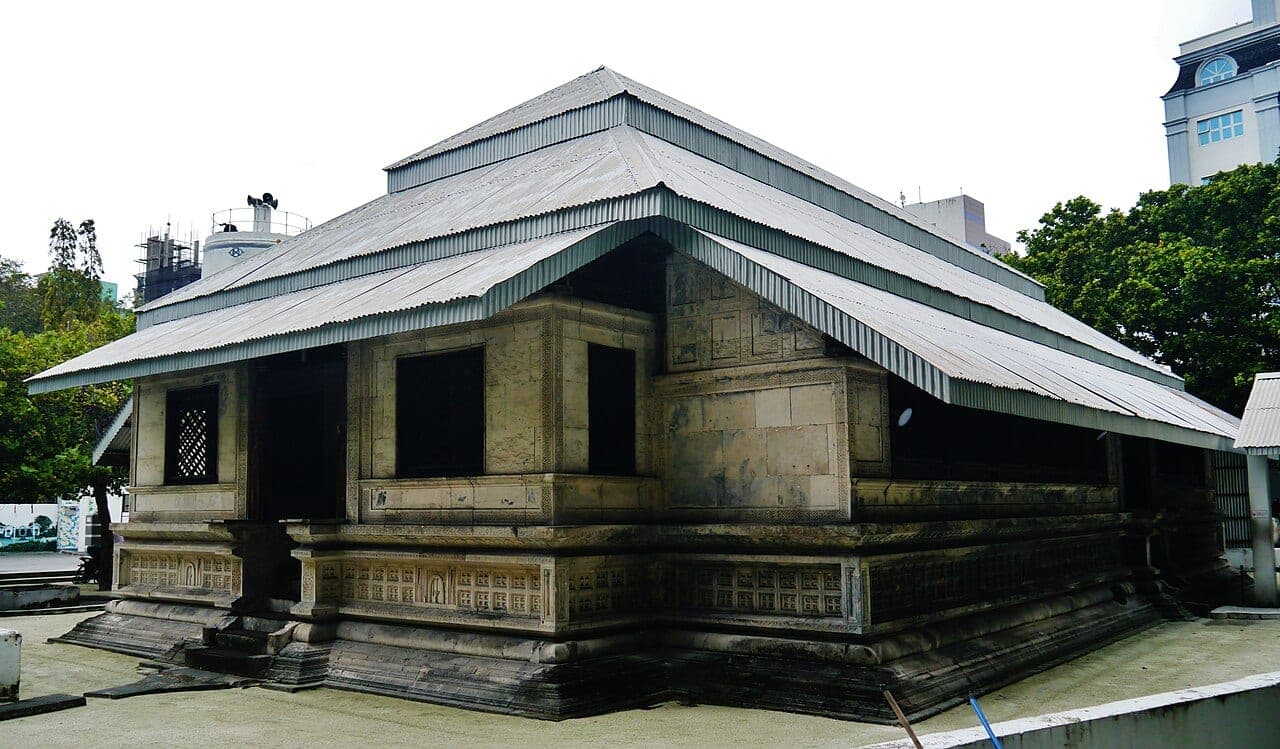
 Hukuru Miskiy was built in 1658 out of cut coral stone, carved after it was set in place, with lacquered woodwork and Quranic inscriptions cut into the blocks themselves. Photograph by Jolle, CC BY-SA 3.0, via Wikimedia Commons.
Before Islam, the same islands were Buddhist for well over a thousand years, and that earlier faith is not forgotten so much as buried in the landscape. The havitta mounds, copper-plate charters and coral images recovered by archaeologists attest a Maldivian Buddhism with its own monasteries and iconography, and a still older Hindu layer beneath it. Beneath both ran a folk stratum of sea and spirit lore, the tales of the dhevi blamed for illness or misfortune, which survives now mainly in story rather than practice.
Maldivian mourning follows Islamic practice, carried out quickly and by the whole community. When a person dies, the body is washed and wrapped in a plain white shroud, the funeral prayer, janazah, is offered at the mosque, and burial follows the same day or the next. The dead are laid directly in the earth without a coffin, on the right side with the face turned toward Mecca, in the island cemetery close to the mosque. The bereaved family receives condoling visitors who bring food, prayers and Qur'anic recitation are offered in the days that follow, and a widow observes the customary period of iddah.
What makes the old Maldivian cemetery distinctive is its coral. Beside the historic mosques stand fields of carved coral-stone headstones, some centuries old, incised with Arabic inscriptions and dates and, on the finest, with delicate ornament. By long convention the shape of the stone records the sex of the person beneath it: rounded tops mark the graves of women, pointed tops those of men. Around the Malé Friday Mosque, ornate mausoleums, the ziyaaraiy, cover the tombs of sultans, scholars and national heroes, so the burial ground doubles as a record of the country's leadership. These carved stones are among the most fragile of Maldivian monuments, worn by salt air and, increasingly, threatened by flooding.
Maldivian records are Islamic and the oldest of them are cut into copper.
The lomafanu are copper-plate grants, the earliest dating from the twelfth century, recording royal endowments to mosques and the names attached to them. They are the oldest written documents in the country and they sit at the boundary between the Buddhist period and the conversion to Islam, traditionally dated to 1153.
After that the record is Islamic and dynastic: the Tarikh, the chronicle of the sultans, mosque foundation records, and the qadi court registers of marriage, divorce and inheritance, which for an atoll population with high remarriage rates are unusually busy documents. The National Archives and the National Centre for Linguistic and Historical Research in Malé hold them, along with material in Thaana, the Maldivian script, which is written right to left and was devised in the sixteenth century.
The island is the unit. A Maldivian belongs to an island, and until the recent concentration of population in Malé most families stayed on one for generations, so island registers and the mosque are where a family is found.
Two modern events. The 2004 tsunami killed relatively few Maldivians but destroyed records and forced the evacuation of several islands entirely. And the population has moved: more than a third of Maldivians now live in Malé, one of the most densely populated places on earth, and the island connection that the older records depend on is weakening.
The keystone of the national campaign is the coral-stone mosque. Six of these buildings, led by the Malé Friday Mosque, or Hukuru Miskiy, have stood on UNESCO's Tentative List for World Heritage since 2008, proposed as unique examples of a sea-culture architecture in cut coral. The Friday Mosque itself was rebuilt in its present form in 1658 under Sultan Ibrahim Iskandar I (reigned 1648–1687), and its round minaret, the Munnaaru, was added in the 1670s, said to echo the minarets the sultan had seen on pilgrimage to Mecca, as the national tourism body documents.
The country's chief repository is the National Museum in Malé, housed since 2010 in a purpose-built building beside the old sultans' palace. Its collections run from royal thrones and lacquerwork to the loamaafaanu copper plates and pre-Islamic coral sculpture. That pre-Islamic collection suffered grievously during the political turmoil of February 2012, when intruders smashed many of the ancient Buddhist coral and limestone images, destroying much of the material documenting the islands' first religion, a loss described as largely beyond repair. Above every other threat, though, is the sea itself. With most land less than a metre above the waterline, coastal erosion and storm flooding endanger mosques, cemeteries and whole settlements, and adaptation projects such as the raised reclaimed island of Hulhumalé, built about two metres above sea level, aim to safeguard both the population and the heritage they keep.
Because so much Maldivian heritage is both dispersed across remote atolls and physically at risk, documentation has become a form of preservation in its own right. The Maldives Heritage Survey, carried out with international academic partners, has recorded the country's historic mosques, cemeteries and coral monuments in photographs, drawings and 3D scans, building an open online archive of sites that may not survive the century, while a companion Coral Stone Mosques project studies the tentative-list buildings.
Beyond fieldwork, museum and library collections are being brought online: the Maritime Asia Heritage Survey has digitised objects and manuscripts including material from the National Museum, and the loamaafaanu charters are increasingly accessible in reproduction. For a nation whose ground is uncertain, these records hold the country's memory somewhere the tide cannot reach.
Modern Maldivian identity is shaped by the meeting of a tightly Islamic society with a globalised tourist economy and a young, connected population. Migration is central: people move from the outer atolls to overcrowded Malé and reclaimed Hulhumalé for work and schooling, and many study and settle abroad, so island heritage is increasingly sustained at a distance. Dhivehi-language broadcasting, film and social media carry island culture to a diaspora that stays in daily touch with home.
The defining contemporary theme, though, is the climate. The Maldives has become one of the world's most prominent voices on rising seas, and in 2009 the government staged an underwater cabinet meeting, ministers in scuba gear signing a document on the sea floor, to dramatise the danger before a UN summit. That advocacy has itself become part of the national story, framing the survival of Maldivian heritage as a question the whole world now shares.
A country mapped before it floods. The Maldives Heritage Survey and allied projects have recorded hundreds of historic mosques, cemeteries and coral monuments in photography, drawings and 3D scans, a durable record of a heritage physical conservation alone cannot guarantee.
Six mosques toward World Heritage. The coral-stone mosques, led by Hukuru Miskiy, have advanced on UNESCO's Tentative List since 2008, drawing attention to a building tradition found nowhere else and to the coral carving that made it.
A hero's house preserved. Utheemu Ganduvaru, the timber palace of Muhammad Thakurufaanu, survives as a working heritage site and place of pilgrimage, keeping the sixteenth-century liberation alive on the island where it began.
Heritage as climate diplomacy. By turning the threat to their islands into a global cause, most memorably with the 2009 underwater cabinet meeting, Maldivians have made the survival of their low-lying homeland part of the world's conversation about the sea.
Hukuru Miskiy was built in 1658 out of cut coral stone, carved after it was set in place, with lacquered woodwork and Quranic inscriptions cut into the blocks themselves. Photograph by Jolle, CC BY-SA 3.0, via Wikimedia Commons.
Before Islam, the same islands were Buddhist for well over a thousand years, and that earlier faith is not forgotten so much as buried in the landscape. The havitta mounds, copper-plate charters and coral images recovered by archaeologists attest a Maldivian Buddhism with its own monasteries and iconography, and a still older Hindu layer beneath it. Beneath both ran a folk stratum of sea and spirit lore, the tales of the dhevi blamed for illness or misfortune, which survives now mainly in story rather than practice.
Maldivian mourning follows Islamic practice, carried out quickly and by the whole community. When a person dies, the body is washed and wrapped in a plain white shroud, the funeral prayer, janazah, is offered at the mosque, and burial follows the same day or the next. The dead are laid directly in the earth without a coffin, on the right side with the face turned toward Mecca, in the island cemetery close to the mosque. The bereaved family receives condoling visitors who bring food, prayers and Qur'anic recitation are offered in the days that follow, and a widow observes the customary period of iddah.
What makes the old Maldivian cemetery distinctive is its coral. Beside the historic mosques stand fields of carved coral-stone headstones, some centuries old, incised with Arabic inscriptions and dates and, on the finest, with delicate ornament. By long convention the shape of the stone records the sex of the person beneath it: rounded tops mark the graves of women, pointed tops those of men. Around the Malé Friday Mosque, ornate mausoleums, the ziyaaraiy, cover the tombs of sultans, scholars and national heroes, so the burial ground doubles as a record of the country's leadership. These carved stones are among the most fragile of Maldivian monuments, worn by salt air and, increasingly, threatened by flooding.
Maldivian records are Islamic and the oldest of them are cut into copper.
The lomafanu are copper-plate grants, the earliest dating from the twelfth century, recording royal endowments to mosques and the names attached to them. They are the oldest written documents in the country and they sit at the boundary between the Buddhist period and the conversion to Islam, traditionally dated to 1153.
After that the record is Islamic and dynastic: the Tarikh, the chronicle of the sultans, mosque foundation records, and the qadi court registers of marriage, divorce and inheritance, which for an atoll population with high remarriage rates are unusually busy documents. The National Archives and the National Centre for Linguistic and Historical Research in Malé hold them, along with material in Thaana, the Maldivian script, which is written right to left and was devised in the sixteenth century.
The island is the unit. A Maldivian belongs to an island, and until the recent concentration of population in Malé most families stayed on one for generations, so island registers and the mosque are where a family is found.
Two modern events. The 2004 tsunami killed relatively few Maldivians but destroyed records and forced the evacuation of several islands entirely. And the population has moved: more than a third of Maldivians now live in Malé, one of the most densely populated places on earth, and the island connection that the older records depend on is weakening.
The keystone of the national campaign is the coral-stone mosque. Six of these buildings, led by the Malé Friday Mosque, or Hukuru Miskiy, have stood on UNESCO's Tentative List for World Heritage since 2008, proposed as unique examples of a sea-culture architecture in cut coral. The Friday Mosque itself was rebuilt in its present form in 1658 under Sultan Ibrahim Iskandar I (reigned 1648–1687), and its round minaret, the Munnaaru, was added in the 1670s, said to echo the minarets the sultan had seen on pilgrimage to Mecca, as the national tourism body documents.
The country's chief repository is the National Museum in Malé, housed since 2010 in a purpose-built building beside the old sultans' palace. Its collections run from royal thrones and lacquerwork to the loamaafaanu copper plates and pre-Islamic coral sculpture. That pre-Islamic collection suffered grievously during the political turmoil of February 2012, when intruders smashed many of the ancient Buddhist coral and limestone images, destroying much of the material documenting the islands' first religion, a loss described as largely beyond repair. Above every other threat, though, is the sea itself. With most land less than a metre above the waterline, coastal erosion and storm flooding endanger mosques, cemeteries and whole settlements, and adaptation projects such as the raised reclaimed island of Hulhumalé, built about two metres above sea level, aim to safeguard both the population and the heritage they keep.
Because so much Maldivian heritage is both dispersed across remote atolls and physically at risk, documentation has become a form of preservation in its own right. The Maldives Heritage Survey, carried out with international academic partners, has recorded the country's historic mosques, cemeteries and coral monuments in photographs, drawings and 3D scans, building an open online archive of sites that may not survive the century, while a companion Coral Stone Mosques project studies the tentative-list buildings.
Beyond fieldwork, museum and library collections are being brought online: the Maritime Asia Heritage Survey has digitised objects and manuscripts including material from the National Museum, and the loamaafaanu charters are increasingly accessible in reproduction. For a nation whose ground is uncertain, these records hold the country's memory somewhere the tide cannot reach.
Modern Maldivian identity is shaped by the meeting of a tightly Islamic society with a globalised tourist economy and a young, connected population. Migration is central: people move from the outer atolls to overcrowded Malé and reclaimed Hulhumalé for work and schooling, and many study and settle abroad, so island heritage is increasingly sustained at a distance. Dhivehi-language broadcasting, film and social media carry island culture to a diaspora that stays in daily touch with home.
The defining contemporary theme, though, is the climate. The Maldives has become one of the world's most prominent voices on rising seas, and in 2009 the government staged an underwater cabinet meeting, ministers in scuba gear signing a document on the sea floor, to dramatise the danger before a UN summit. That advocacy has itself become part of the national story, framing the survival of Maldivian heritage as a question the whole world now shares.
A country mapped before it floods. The Maldives Heritage Survey and allied projects have recorded hundreds of historic mosques, cemeteries and coral monuments in photography, drawings and 3D scans, a durable record of a heritage physical conservation alone cannot guarantee.
Six mosques toward World Heritage. The coral-stone mosques, led by Hukuru Miskiy, have advanced on UNESCO's Tentative List since 2008, drawing attention to a building tradition found nowhere else and to the coral carving that made it.
A hero's house preserved. Utheemu Ganduvaru, the timber palace of Muhammad Thakurufaanu, survives as a working heritage site and place of pilgrimage, keeping the sixteenth-century liberation alive on the island where it began.
Heritage as climate diplomacy. By turning the threat to their islands into a global cause, most memorably with the 2009 underwater cabinet meeting, Maldivians have made the survival of their low-lying homeland part of the world's conversation about the sea.
National Overview
Notable Cities
Historical Foundations
Linguistic and Etymological Roots
Cultural Identity
Religion and Spirituality
Remembrance and Mourning Traditions
Tracing a Family in Maldives
Heritage Preservation Efforts
Digital Heritage
Contemporary Cultural Influences
Success Stories
References and resources
- UNESCO World Heritage Centre: The Coral Stone Mosques of Maldives (Tentative List). The 2008 nomination for Hukuru Miskiy and five other mosques.
- Encyclopaedia Britannica: Maldives. Geography, atolls, history and society.
- Visit Maldives: Hukuru Miskiy and Munnaaru. The Malé Friday Mosque and its minaret.
- Maldives Heritage Survey. Field survey and digital archive of mosques and cemeteries.
- Coral Stone Mosques of the Maldives. Documentation of the coral-stone mosque tradition.
- Maritime Asia Heritage Survey: Maldives National Museum. Digitised objects from the national collection.
- National Museum (Maldives), Wikipedia. Collections and the 2012 damage to pre-Islamic artefacts.
- Havitta, Wikipedia. The pre-Islamic Buddhist stupa mounds.
- Boduberu, Wikipedia. The drumming tradition and its origins.