Heritage · Country
Reunion Culture and Heritage
Nobody lived on this island before Europeans landed on it, so every Réunionnais alive descends from someone who arrived, by choice or in chains. This is a guide to Réunion's heritage, from the maroon cirques and the Tamil firewalk to the ancestor ceremonies that still carry Malagasy names.Written to last.
By Confinity Heritage Editorial · Updated 2026-08-17 · 8-minute readQuiet tools, kept out of the way.
Réunion is one of the few inhabited places on earth whose population can be dated to the year. When settlers of the French East India Company came ashore in 1665 there was nobody to meet them: no indigenous people, no earlier village, no language already fastened to the mountains. Every Réunionnais alive is descended from someone who crossed open water to get here, and a great many of those crossings were made in the hold of a ship, under compulsion, from Madagascar and the East African coast.
That fact organises everything the island remembers. With no pre-colonial heritage to recover and no first people to appeal to, the founding story is what the enslaved did once they arrived: the flight inland, the camps in the collapsed heart of an extinct volcano, and the hunting parties sent after them. The cirques of Mafate, Salazie and Cilaos are named in Malagasy, several ridges and peaks carry the names of maroon leaders, and the emancipation of 20 December 1848 is still the largest public day in the calendar.
Réunion is a volcanic island of about 2,511 square kilometres in the western Indian Ocean, roughly 700 kilometres east of Madagascar, with a population approaching 900,000. Two volcanoes made it. The extinct Piton des Neiges rises to 3,070 metres, and the collapse of its flanks left the three great amphitheatres, the cirques of Mafate, Salazie and Cilaos, each ringed by near-vertical cliffs the islanders call remparts. The active Piton de la Fournaise, 2,631 metres, erupts in most years. Politically the island is France: an overseas department under the law of 19 March 1946, an overseas region as well, and the only one of the older overseas departments that has kept a separate departmental council and regional council rather than merging them into a single assembly. It's an outermost region of the European Union and uses the euro. French is the official language, Réunion Creole the language of the yard and the family, and the population is of African, Malagasy, Indian, European, Chinese and Comorian descent in combinations islanders describe with the word métissage.
Saint-Denis. The capital, about 150,000 people, sits behind the Barachois, a seafront of old cannon and casuarina trees where the town takes the evening air. Its streets hold Creole townhouses with fretted zinc lambrequins and deep verandas called varangues, the Jardin de l'État, and the mosque Noor-e-Islam, inaugurated on 28 November 1905 by Gujarati merchant families and generally counted the first purpose-built mosque in France, twenty-one years ahead of the Grande Mosquée de Paris.
Saint-Paul and Saint-André. Saint-Paul, on the west coast, was the first settlement, and the Grotte des Premiers Français marks the shelter the earliest arrivals used; its seafront cemetery holds the grave of the poet Leconte de Lisle, born here in 1818. Saint-André, in the east, is the centre of Tamil Réunion, where the largest temples stand and the firewalks draw the biggest crowds.
Cilaos, Hell-Bourg and the cirques. Cilaos, reached by a road of some four hundred bends, is a spa town of about 5,000, and Hell-Bourg in Salazie keeps the finest Creole houses on the island. Mafate has no roads at all, and its ten îlets, among them La Nouvelle, Marla, Aurère and Roche Plate, are reached only on foot or by helicopter.
Arab navigators knew the island and Portuguese ships sighted it early in the sixteenth century, calling it Santa Apolónia, but nobody stayed. France claimed it in 1642, and a dozen mutineers exiled there from the French post in Madagascar in 1646 lived three years, were collected in good health, and reported the place habitable. Settlement followed in 1665, when Étienne Regnault landed with about twenty people for the Compagnie des Indes orientales, and the island was named Île Bourbon.
Coffee changed it. The company introduced Arabica around 1715, including the mutation known as Bourbon pointu, and coffee, then cloves and finally sugar, required a labour force the colony did not have. Enslaved people were brought from Madagascar above all, then from Mozambique, the Swahili coast and India, and by the mid-eighteenth century they were the large majority of the population; royal letters patent of December 1723 applied a version of the Code Noir to the Mascarenes, setting out the enslaved as property in law. The name La Réunion dates from 23 March 1793 and commemorates the joining of the fédérés of Marseille with the National Guard in Paris; the island was Île Bonaparte from 1806 to 1810, British-held until 1815, and Réunion again for good from 1848.
The interior holds the other half of that story. From the 1690s enslaved people escaped into the mountains, and by the eighteenth century there were maroon camps along the upper rivers and inside the three cirques, growing crops on ledges and moving along passes the colony could not find. The response was organised hunting. Detachments known as chasseurs de noirs went into the highlands under paid leaders, of whom François Mussard was by some distance the most effective, and the colonial records count 199 maroons located between 1725 and 1749, of whom 185 were killed (Wikipédia). Mussard reported killing a man recorded as Maffack in 1751, and complained the following year that there were so many passes known only to the maroons that he could not reach them.
Their names stayed on the map. Mafate is usually derived from the Malagasy mahafaty, roughly "that which kills", and is also read as the name of the chief Mussard hunted, the two readings braided together by nineteenth-century writers (Wikipédia). Cilaos is commonly traced to tsy ilaozana, "the place one does not abandon", though some historians give it as the name of a man who took refuge there (Wikipédia). Peaks called Cimendef and Dimitile carry maroon names, and Salazie holds the story of Anchaing and Héva, remembered as legend rather than as documented history.
Abolition came by decree from Paris. The text of 27 April 1848 was carried out by the commissioner Sarda Garriga, who arrived in October, spent weeks preparing planters and the enslaved for the change, and proclaimed emancipation on 20 December 1848, freeing roughly 62,000 people. Indenture began at once, bringing tens of thousands of workers from southern India and later from Mozambique, the Comoros and China. Departmentalisation followed in 1946.
French is the official language of the state, the courts and the classroom. Réunion Creole is the mother tongue of most of the population, a French-lexifier creole whose grammar was shaped by Malagasy and East African speakers and whose vocabulary picked up Tamil, Gujarati and Chinese words as later arrivals settled. The relationship between the two is diglossic: French carries formal authority and Creole carries family, humour and argument, a division enforced for generations by schools that punished children for speaking Creole in the yard. Since the 1970s that hierarchy has been contested by writers and teachers, competing orthographies have been proposed, and Creole is now taught and examined as a school subject, though it has no co-official status (Wikipédia).
The island's vocabulary of self-description is itself a record of arrival. Kaf names Réunionnais of African and Malagasy descent, Malbar those descended from Indian indentured workers, Zarabe the Gujarati Muslim families, Sinwa the Chinese, Yab the poor white smallholders of the heights, and gramoun means an elder. The highland toponyms are almost all Malagasy, unusual for a French department and a direct consequence of who was living up there when the names were written down.
Maloya is the centre of it. Made by enslaved Malagasy and African workers on the sugar estates, it's built from a lead voice and an answering chorus over the roulèr, a barrel drum the player sits astride, the kayamb, a flat rattle of cane stems filled with seeds, and smaller percussion including the piker and the mouth bow called bobre. It began inside ancestor ceremonies and became a music of complaint about slavery and its aftermath. After 1946 the authorities treated maloya as subversive for its association with the Réunionnais communist movement and the campaign for autonomy, and for roughly three decades it was kept off the radio and out of official halls, surviving in yards and at private services until Firmin Viry's recordings in the mid-1970s brought it back into public hearing. Granmoun Lélé and Danyèl Waro carried it further, and UNESCO inscribed maloya on the Representative List of the Intangible Cultural Heritage of Humanity in 2009 (UNESCO). Séga, lighter and faster, is the music of dances and celebrations.
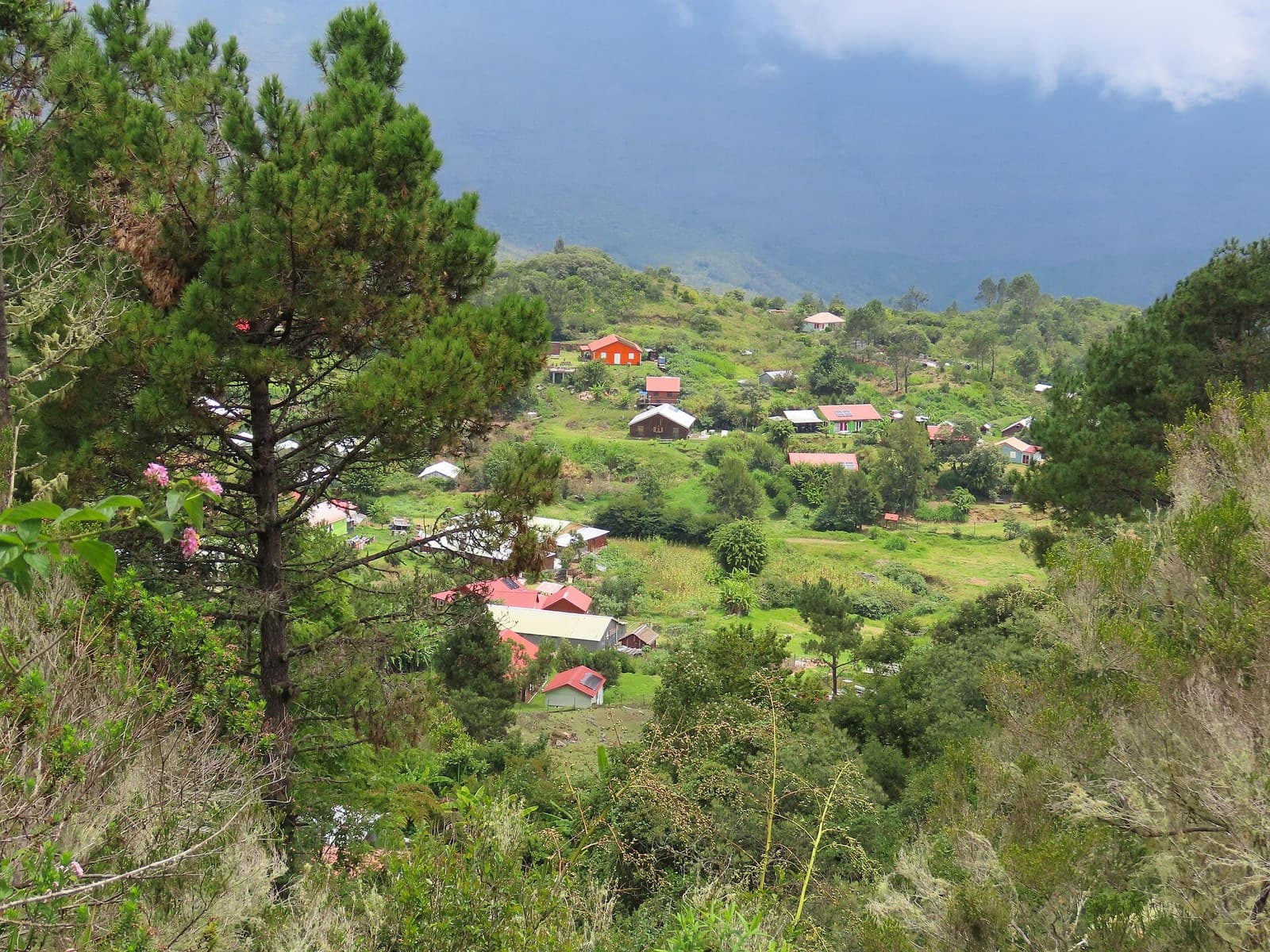
 Mafate was settled by people escaping slavery, it has no road to this day, and everything reaching the villages inside it comes on foot or by helicopter. Photograph by Mamphi, CC BY-SA 3.0, via Wikimedia Commons.
The built culture is the Creole house: a timber box under a hipped roof, raised on blocks, fronted by a varangue and edged with cut zinc lambrequins, set behind a barrière and a guétali, the corner pavilion from which the household watched the street without being seen. The kitchen records every arrival, from cari and rougail built on turmeric, ginger and combava to Chinese achards and samoussas from the Gujarati shops.
Roman Catholicism has been the majority religion since settlement and shapes the parish calendar of every commune. Alongside it sit three inheritances brought by later arrivals and now thoroughly Réunionnais. Tamil religion arrived with indenture after 1848 and is practised openly at temples all over the island. The most visible ceremony is the marche sur le feu, the firewalk held for the goddess Draupadi, known here as Pandialé, whom the Tamil telling of the Mahabharata has passing through fire to prove herself; penitents keep eighteen days of fasting, abstinence and vigil before crossing the bed of embers, mostly between December and January. The cavadee, at Tai Poussam in January, honours Murugan: after ten days of fasting the devotees have cheeks, tongue and skin pierced with fine silver needles and carry the decorated wooden arch, the kavadi, in procession to the temple.
Islam came with Gujarati traders from Surat in the later nineteenth century, and their descendants, the Zarabe, built the Saint-Denis mosque that opened in 1905. Chinese families brought temples to Guan Di and the ancestors. Cutting across all of it is the cult of Saint-Expédit, whose small red-painted shrines stand at roadsides and cliff edges all over the island, receiving petitions for urgent help and, by long report, requests for harm as well; the Church has never been comfortable with it, which has not slowed it down.
A death is followed by the veillée, the wake, with the house kept open through the nights before burial, coffee and rum served, prayers said and stories told so the family is never alone with the body. Burial is usually Catholic, in family plots that relatives repaint and tile, and 1 November is the day the cemeteries fill.
The deeper practice is older than the parish. The servis kabaré, also called servis malgas or simply kabar, is a ceremony held in honour of named ancestors, and it descends from Malagasy rites of thanksgiving, the kabary tsikafara of the Betsimisaraka, carried over on the slave ships and kept alive on the estates (HAL). It's normally held in fulfilment of a vow, at night, in a yard or under a tent, and an animal, usually a goat or fowl, is offered and cooked. A table is laid with what the dead person liked in life, rum, coffee, cakes, cigarettes, and an officiant calls the ancestors one by one, speaks to them directly, thanks them and asks for protection. Maloya is played to open and hold that conversation, and possession by an ancestor may follow. Families who hold a servis kabaré rarely advertise it, and it has coexisted for two centuries with Catholic funerals attended by the same people, which is why UNESCO's file on maloya names the decline of ancestor veneration as a risk to the music itself. Tamil households keep a parallel meal for the ancestors, known here as sanblani.
Public remembrance turns on one date. The twentieth of December, Fèt Kaf, marks Sarda Garriga's proclamation of emancipation and is a public holiday across the department, with kabars, maloya concerts, readings of the decree and ceremonies at the sites of the plantation economy. It's the day the island talks about slavery out loud, and the day most families cook and gather, which is why it, rather than 14 July, is the fixed point of the Réunionnais year.
Réunion was uninhabited when people first landed on it, so every Réunionnais family arrived, and the records say from where.
French settlement began in the 1660s, and the colony was built on enslaved labour from Madagascar, Mozambique and India. Parish registers run from the seventeenth century for the free population; the enslaved appear in plantation inventories, baptism records and the registers of the slave trade.
Abolition came on 20 December 1848, and as in the Antilles the registres d'individualité record every freed person with the surname assigned to them. Officials here worked through name lists including invented and classical names, and the register connects the new name to the old entry. The departmental archives at Saint-Denis have digitised those registers along with the civil registers and parish books, free.
Indenture followed immediately: engagés from India, chiefly Tamil Nadu, and from Africa, China and the Comoros, with contracts and arrival registers surviving.
The maroon record is in the interior. People who escaped slavery took to the cirques, the collapsed volcanic amphitheatres of Mafate, Cilaos and Salazie, and the place names there are the names of maroon leaders. That is a genealogy written on the map.
The hardest modern file is the Réunionnais children of Creuse: between 1963 and 1982 more than two thousand children were taken from Réunion and placed with families in rural mainland France, and the French state acknowledged responsibility in 2014.
UNESCO inscribed the Pitons, cirques and remparts of Reunion Island on the World Heritage List in 2010 as a natural site, covering roughly forty per cent of the island's surface and matching the core zone of the Parc national de La Réunion, created in 2007 (UNESCO). It protects the volcanic landforms and the endemic species of the highlands, and it protects the maroon country as a by-product, since the cirques and their remparts are the ground the escaped enslaved used.
Two sites carry the human history. The Musée historique de Villèle, at Saint-Gilles-les-Hauts, occupies the former Panon-Desbassayns estate, a sugar and coffee property that in 1845 ran to nearly 500 hectares and was worked by 295 enslaved people, replaced after 1848 by more than two hundred indentured labourers. Opened by the department in the 1970s as a house museum, it was listed as a historic monument in December 2019 and reworked as a museum of the plantation and of slavery, with the master's house, the chapel, the enslaved people's hospital and the indentured workers' quarters read together (Fondation pour la mémoire de l'esclavage). The lazarets of the Grande Chaloupe, built between 1860 and 1865 on the coast west of Saint-Denis, are where indentured workers arriving by sea were held in quarantine before being sent to the estates, in buildings that also served as a children's prison, a disciplinary workshop and a leper asylum; the site was listed in 1998 and partly restored by volunteers between 2004 and 2011 (Wikipédia).
The volcano has its own interpretation centre, the Maison du Volcan at Bourg-Murat, and the sugar industry is kept at Stella Matutina, in a former factory at Saint-Leu.
The records that let a Réunionnais family cross 1848 are online and free. The departmental archives have digitised the emancipation registers of 1832 and the special registers of 1848, the volumes in which the newly freed were entered by name so that they could be counted as citizens for the elections of 1849, and these sit alongside the parish and civil registers (Fondation pour la mémoire de l'esclavage). In May 2023 UNESCO added the registers identifying enslaved persons in the former French colonies, 1666 to 1880, to the Memory of the World Register, in a nomination presented jointly by France and Haiti; the Réunion volumes are part of that record. The portal Société de plantation, histoire et mémoires de l'esclavage à La Réunion publishes dossiers and teaching material alongside them, and the Anchoukaj project indexes the 1848 registers for Réunion and the French Caribbean (Anchoukaj).
Réunion exports its music. Danyèl Waro, Christine Salem, Lindigo and a younger generation working in maloya elektronik play festivals across Europe and Africa, and the island has become a meeting point for Malagasy, Mauritian and Comorian musicians.
Two things run through domestic argument. The first is the cost of living. Unemployment has run at close to a fifth of the workforce for years, several times the mainland rate, and prices for imported food and fuel are markedly higher than in France. In November 2018 the gilets jaunes movement took a sharper form here than almost anywhere: from 17 November roadblocks closed the ring road and most of the island's commerce, schools shut, and the prefecture imposed a night curfew in fourteen communes from 20 to 24 November.
The second is the enfants de la Creuse. Between 1963 and 1982, under a policy of population transfer promoted by the deputy Michel Debré, Réunionnais children were moved to rural departments of mainland France, above all the Creuse, which was losing people and needed pupils and farm labour. Many were wards of the state; others were taken from living parents who were poor, or who were told the arrangement was temporary or educational. Later research has identified roughly 1,630 children, and figures near 2,000 are commonly cited for the programme as a whole. Some were adopted, many were placed in institutions or on farms, and a large number never came back. On 18 February 2014 the National Assembly adopted a resolution recognising the moral responsibility of the state toward them, a commission of historians and social scientists reported in 2018, and survivors' associations continue to press for a formal apology, a memorial and reparation (Wikipedia).
A suppressed music on the world register. Maloya, kept off the radio for decades as politically suspect, was inscribed by UNESCO in 2009 and is now taught at the island's conservatoire.
The maroon country protected. The 2010 World Heritage inscription gave legal protection to roughly two-fifths of the island, including the three cirques where escaped enslaved people made their camps.
The registers of the freed made searchable. The departmental archives digitised the 1832 and 1848 registers and put them online free, and in 2023 the French colonial slavery registers entered UNESCO's Memory of the World.
A cirque still lived in. Mafate has no road, and its ten îlets remain inhabited, with school, clinic and post carried in on foot and by helicopter.
Mafate was settled by people escaping slavery, it has no road to this day, and everything reaching the villages inside it comes on foot or by helicopter. Photograph by Mamphi, CC BY-SA 3.0, via Wikimedia Commons.
The built culture is the Creole house: a timber box under a hipped roof, raised on blocks, fronted by a varangue and edged with cut zinc lambrequins, set behind a barrière and a guétali, the corner pavilion from which the household watched the street without being seen. The kitchen records every arrival, from cari and rougail built on turmeric, ginger and combava to Chinese achards and samoussas from the Gujarati shops.
Roman Catholicism has been the majority religion since settlement and shapes the parish calendar of every commune. Alongside it sit three inheritances brought by later arrivals and now thoroughly Réunionnais. Tamil religion arrived with indenture after 1848 and is practised openly at temples all over the island. The most visible ceremony is the marche sur le feu, the firewalk held for the goddess Draupadi, known here as Pandialé, whom the Tamil telling of the Mahabharata has passing through fire to prove herself; penitents keep eighteen days of fasting, abstinence and vigil before crossing the bed of embers, mostly between December and January. The cavadee, at Tai Poussam in January, honours Murugan: after ten days of fasting the devotees have cheeks, tongue and skin pierced with fine silver needles and carry the decorated wooden arch, the kavadi, in procession to the temple.
Islam came with Gujarati traders from Surat in the later nineteenth century, and their descendants, the Zarabe, built the Saint-Denis mosque that opened in 1905. Chinese families brought temples to Guan Di and the ancestors. Cutting across all of it is the cult of Saint-Expédit, whose small red-painted shrines stand at roadsides and cliff edges all over the island, receiving petitions for urgent help and, by long report, requests for harm as well; the Church has never been comfortable with it, which has not slowed it down.
A death is followed by the veillée, the wake, with the house kept open through the nights before burial, coffee and rum served, prayers said and stories told so the family is never alone with the body. Burial is usually Catholic, in family plots that relatives repaint and tile, and 1 November is the day the cemeteries fill.
The deeper practice is older than the parish. The servis kabaré, also called servis malgas or simply kabar, is a ceremony held in honour of named ancestors, and it descends from Malagasy rites of thanksgiving, the kabary tsikafara of the Betsimisaraka, carried over on the slave ships and kept alive on the estates (HAL). It's normally held in fulfilment of a vow, at night, in a yard or under a tent, and an animal, usually a goat or fowl, is offered and cooked. A table is laid with what the dead person liked in life, rum, coffee, cakes, cigarettes, and an officiant calls the ancestors one by one, speaks to them directly, thanks them and asks for protection. Maloya is played to open and hold that conversation, and possession by an ancestor may follow. Families who hold a servis kabaré rarely advertise it, and it has coexisted for two centuries with Catholic funerals attended by the same people, which is why UNESCO's file on maloya names the decline of ancestor veneration as a risk to the music itself. Tamil households keep a parallel meal for the ancestors, known here as sanblani.
Public remembrance turns on one date. The twentieth of December, Fèt Kaf, marks Sarda Garriga's proclamation of emancipation and is a public holiday across the department, with kabars, maloya concerts, readings of the decree and ceremonies at the sites of the plantation economy. It's the day the island talks about slavery out loud, and the day most families cook and gather, which is why it, rather than 14 July, is the fixed point of the Réunionnais year.
Réunion was uninhabited when people first landed on it, so every Réunionnais family arrived, and the records say from where.
French settlement began in the 1660s, and the colony was built on enslaved labour from Madagascar, Mozambique and India. Parish registers run from the seventeenth century for the free population; the enslaved appear in plantation inventories, baptism records and the registers of the slave trade.
Abolition came on 20 December 1848, and as in the Antilles the registres d'individualité record every freed person with the surname assigned to them. Officials here worked through name lists including invented and classical names, and the register connects the new name to the old entry. The departmental archives at Saint-Denis have digitised those registers along with the civil registers and parish books, free.
Indenture followed immediately: engagés from India, chiefly Tamil Nadu, and from Africa, China and the Comoros, with contracts and arrival registers surviving.
The maroon record is in the interior. People who escaped slavery took to the cirques, the collapsed volcanic amphitheatres of Mafate, Cilaos and Salazie, and the place names there are the names of maroon leaders. That is a genealogy written on the map.
The hardest modern file is the Réunionnais children of Creuse: between 1963 and 1982 more than two thousand children were taken from Réunion and placed with families in rural mainland France, and the French state acknowledged responsibility in 2014.
UNESCO inscribed the Pitons, cirques and remparts of Reunion Island on the World Heritage List in 2010 as a natural site, covering roughly forty per cent of the island's surface and matching the core zone of the Parc national de La Réunion, created in 2007 (UNESCO). It protects the volcanic landforms and the endemic species of the highlands, and it protects the maroon country as a by-product, since the cirques and their remparts are the ground the escaped enslaved used.
Two sites carry the human history. The Musée historique de Villèle, at Saint-Gilles-les-Hauts, occupies the former Panon-Desbassayns estate, a sugar and coffee property that in 1845 ran to nearly 500 hectares and was worked by 295 enslaved people, replaced after 1848 by more than two hundred indentured labourers. Opened by the department in the 1970s as a house museum, it was listed as a historic monument in December 2019 and reworked as a museum of the plantation and of slavery, with the master's house, the chapel, the enslaved people's hospital and the indentured workers' quarters read together (Fondation pour la mémoire de l'esclavage). The lazarets of the Grande Chaloupe, built between 1860 and 1865 on the coast west of Saint-Denis, are where indentured workers arriving by sea were held in quarantine before being sent to the estates, in buildings that also served as a children's prison, a disciplinary workshop and a leper asylum; the site was listed in 1998 and partly restored by volunteers between 2004 and 2011 (Wikipédia).
The volcano has its own interpretation centre, the Maison du Volcan at Bourg-Murat, and the sugar industry is kept at Stella Matutina, in a former factory at Saint-Leu.
The records that let a Réunionnais family cross 1848 are online and free. The departmental archives have digitised the emancipation registers of 1832 and the special registers of 1848, the volumes in which the newly freed were entered by name so that they could be counted as citizens for the elections of 1849, and these sit alongside the parish and civil registers (Fondation pour la mémoire de l'esclavage). In May 2023 UNESCO added the registers identifying enslaved persons in the former French colonies, 1666 to 1880, to the Memory of the World Register, in a nomination presented jointly by France and Haiti; the Réunion volumes are part of that record. The portal Société de plantation, histoire et mémoires de l'esclavage à La Réunion publishes dossiers and teaching material alongside them, and the Anchoukaj project indexes the 1848 registers for Réunion and the French Caribbean (Anchoukaj).
Réunion exports its music. Danyèl Waro, Christine Salem, Lindigo and a younger generation working in maloya elektronik play festivals across Europe and Africa, and the island has become a meeting point for Malagasy, Mauritian and Comorian musicians.
Two things run through domestic argument. The first is the cost of living. Unemployment has run at close to a fifth of the workforce for years, several times the mainland rate, and prices for imported food and fuel are markedly higher than in France. In November 2018 the gilets jaunes movement took a sharper form here than almost anywhere: from 17 November roadblocks closed the ring road and most of the island's commerce, schools shut, and the prefecture imposed a night curfew in fourteen communes from 20 to 24 November.
The second is the enfants de la Creuse. Between 1963 and 1982, under a policy of population transfer promoted by the deputy Michel Debré, Réunionnais children were moved to rural departments of mainland France, above all the Creuse, which was losing people and needed pupils and farm labour. Many were wards of the state; others were taken from living parents who were poor, or who were told the arrangement was temporary or educational. Later research has identified roughly 1,630 children, and figures near 2,000 are commonly cited for the programme as a whole. Some were adopted, many were placed in institutions or on farms, and a large number never came back. On 18 February 2014 the National Assembly adopted a resolution recognising the moral responsibility of the state toward them, a commission of historians and social scientists reported in 2018, and survivors' associations continue to press for a formal apology, a memorial and reparation (Wikipedia).
A suppressed music on the world register. Maloya, kept off the radio for decades as politically suspect, was inscribed by UNESCO in 2009 and is now taught at the island's conservatoire.
The maroon country protected. The 2010 World Heritage inscription gave legal protection to roughly two-fifths of the island, including the three cirques where escaped enslaved people made their camps.
The registers of the freed made searchable. The departmental archives digitised the 1832 and 1848 registers and put them online free, and in 2023 the French colonial slavery registers entered UNESCO's Memory of the World.
A cirque still lived in. Mafate has no road, and its ten îlets remain inhabited, with school, clinic and post carried in on foot and by helicopter.
National Overview
Notable Cities
Historical Foundations
Linguistic and Etymological Roots
Cultural Identity
Religion and Spirituality
Remembrance and Mourning Traditions
Tracing a Family in Reunion
Heritage Preservation Efforts
Digital Heritage
Contemporary Cultural Influences
Success Stories
References and resources
- UNESCO, Pitons, cirques and remparts of Reunion Island: the 2010 natural World Heritage inscription.
- UNESCO, Maloya: the 2009 intangible heritage listing.
- Marronnage à La Réunion, Wikipédia: the maroon camps and the chasseurs de noirs.
- Cirque de Mafate, Wikipédia: etymology and the îlets.
- Cilaos, Wikipédia: the competing etymologies and the maroon history.
- Créole réunionnais, Wikipédia: the language and its standing in schools.
- Lazarets de la Grande Chaloupe, Wikipédia: the quarantine station for the indentured.
- Fondation pour la mémoire de l'esclavage, Musée historique de Villèle: the plantation and slavery museum.
- Les noms de la liberté, 1664-1848: the naming of the freed.
- Anchoukaj: searchable index of the 1848 registers.
- Le servis kabaré de Gramoun Baba, HAL: an ethnographic account of the ancestor ceremony.
- Children of Creuse, Wikipedia: the transfers and the 2014 resolution.