Heritage · Country
Madagascar Culture and Heritage
Madagascar remembers across an ocean and across the grave: an Austronesian and East African people whose language reaches back to Borneo, whose ancestors, the razana, stay kin to the living. From the sacred Royal Hill of Ambohimanga to the famadihana, the tender turning of the bones, this is a land where remembrance is a duty owed to the dead.Written to last.
By Confinity Heritage Editorial · Updated 2026-07-31 · 8-minute readQuiet tools, kept out of the way.
Madagascar is the fourth-largest island on Earth, a continent in miniature that broke from Africa tens of millions of years ago and then evolved almost alone. Its people arrived by an equally improbable route: the first settlers came not from the African coast to the west but from Island Southeast Asia, seafarers whose descendants still speak a language whose closest living relative is Ma'anyan, of the Barito valley of southern Borneo, some eight thousand kilometres away. East African arrivals, Arab and Swahili traders and later Europeans added their strands, producing a nation at once African and Asian and wholly its own: eighteen recognised peoples sharing one language, Malagasy, and one conviction, that the dead do not depart but become the razana, the ancestors, who remain the most present members of every family.
Memory here is a duty owed to the ancestors and paid in stone, silk and ceremony. The tomb is often built more carefully than the house of the living; the highland peoples periodically open those tombs to lift, rewrap and celebrate their dead in the famadihana, the turning of the bones; and the Royal Hill of Ambohimanga, where the sovereigns who unified the island lie buried, remains a place of pilgrimage rather than a ruin. This profile traces how the Malagasy remember, and how a country of exceptional living heritage and exceptional biological wealth works to keep both intact.
The Republic of Madagascar lies in the western Indian Ocean, divided from East Africa by the Mozambique Channel, and is home to roughly thirty million people. Its geography sorts into worlds: the cool central highlands of terraced rice around the capital, Antananarivo; the humid eastern escarpment falling to a coast of ports and rainforest; and the drier western savannah and spiny southern thickets beyond. The Malagasy commonly distinguish the highland peoples, among them the Merina and Betsileo, from the coastal groups called the côtiers, though all eighteen recognised peoples speak dialects of one Malagasy language.
Two things set the island apart. The first is its biology: drifting in isolation for so long, Madagascar evolved a flora and fauna found nowhere else, and close to ninety per cent of its wildlife is endemic, including more than a hundred kinds of lemur and six of the world's baobab species, the trees the Malagasy call renala, "mother of the forest". The second is the ancestors. Across every region and faith the razana are held to remain part of the family, and daily life is shaped by fady, the taboos, particular to lineage and place, that mark what the ancestors permit. Rice, vary, anchors nearly every meal, and the humpbacked zebu is at once wealth, sacrifice and the measure of a family's standing.
Antananarivo. The capital, shortened to Tana, was founded in the early seventeenth century by King Andrianjaka on a ridge above the rice plains; its name means "city of the thousand", for the garrison said to have held it. It climbs in tiers of lanes and staircases to the Rova, the royal compound crowned by the Manjakamiadana palace. One of the twelve sacred hills of Imerina, it remains the administrative, intellectual and spiritual centre of the country.
Toamasina. Historically Tamatave, Toamasina is Madagascar's principal port, where the highland railway, completed in 1913, meets the Indian Ocean. King Radama I took the town in 1817 during the Merina expansion, and under the French it became the main gateway for trade.
Fianarantsoa. The chief city of the southern highlands and historic capital of the Betsileo, Fianarantsoa was founded in 1830 by Queen Ranavalona I as a southern counterpart to Antananarivo; its name means "the place where good is learned". A hill town of old churches, it anchors the country's small wine country and the forest railway down to the coast at Manakara.
Antsirabe. High in the volcanic highlands, Antsirabe was established in 1872 by Norwegian Lutheran missionaries drawn to its thermal springs; its name means "the place of much salt". It is a town of spa-era architecture, crater lakes and countless pousse-pousse, the pedalled rickshaws that are its signature.
Madagascar was among the last large landmasses on Earth to be settled. The founding population crossed the Indian Ocean from Island Southeast Asia, most likely in the first millennium of the common era, bringing outrigger canoes, rice, the banana and a Malayo-Polynesian language. Genetic and linguistic research traces them above all to southern Borneo, while a roughly equal share of Malagasy ancestry is East African, the two peoples mingling over the following centuries. Bantu-speaking arrivals brought zebu and much vocabulary; Arab and Swahili traders left the Antemoro of the southeast a tradition of Arabic-script manuscripts.
By the time Portuguese sailors sighted the island in 1500, distinct kingdoms had formed: the Sakalava in the west, the Betsimisaraka on the east coast, and the Merina of Imerina on the central plateau. The decisive turn came late in the eighteenth century, when King Andrianampoinimerina, reigning from about 1787 to 1810, reunified the chiefdoms of Imerina from his sacred capital at Ambohimanga while ruling from Antananarivo. His ambition passed to his son as a single sentence: the sea, he said, was to be the boundary of his rice field. That son, Radama I (1810 to 1828), carried Merina arms across most of the island and welcomed British diplomacy and the London Missionary Society, whose missionaries gave Malagasy the Latin alphabet and its first schools.
Later sovereigns, above all Ranavalona I, resisted European encroachment, but the pressure proved relentless. France declared a protectorate in 1894, took Antananarivo by force in 1895, annexed the island in 1896 and, in 1897, abolished the monarchy and exiled the last queen, Ranavalona III. A nationalist uprising in 1947 was crushed with great loss of life. Independence came peacefully on 26 June 1960, with Philibert Tsiranana as first president, a date kept each year as the national day.
Malagasy is an Austronesian language, the westernmost outpost of a family reaching to Hawaii and Easter Island. It belongs to the Barito group of the Malayo-Polynesian branch, and its closest relative is Ma'anyan, spoken along the Barito river of southern Borneo, a thread carrying the memory of the founding voyage across the whole ocean. Onto this frame Malagasy has layered Bantu vocabulary from East Africa, Arabic and Swahili terms from the trading coasts, and later French and English. One language is spoken across the island in regional dialects; the highland Merina variety became the written standard, and Malagasy shares official status with French.
Among the Antemoro, Malagasy was written for centuries in an Arabic-derived script, sorabe, "the great writings", used for genealogies and sacred lore, and these are among the oldest documents made on the island. The name Madagascar is not local at all: Malagasy speakers call their island Madagasikara. The European form appears to descend from the garbled notes of Marco Polo, who never came near it and seems to have confused reports with the Somali port of Mogadishu; the mangled name was fixed on the great maps of the sixteenth century and has clung ever since.
The signature performance of the highlands is the hira gasy, a day-long spectacle in which costumed troupes join kabary oratory, song, music and dance to deliver moral teaching before a village. Oratory is itself a prized art, and the proverbs called ohabolana are woven through the speeches that grace weddings, funerals and reburials. The valiha, a tube zither cut from a single length of bamboo, is regarded as the national instrument; alongside it the marovany box zither and the small kabosy guitar accompany the driving salegy dance music of the coasts.
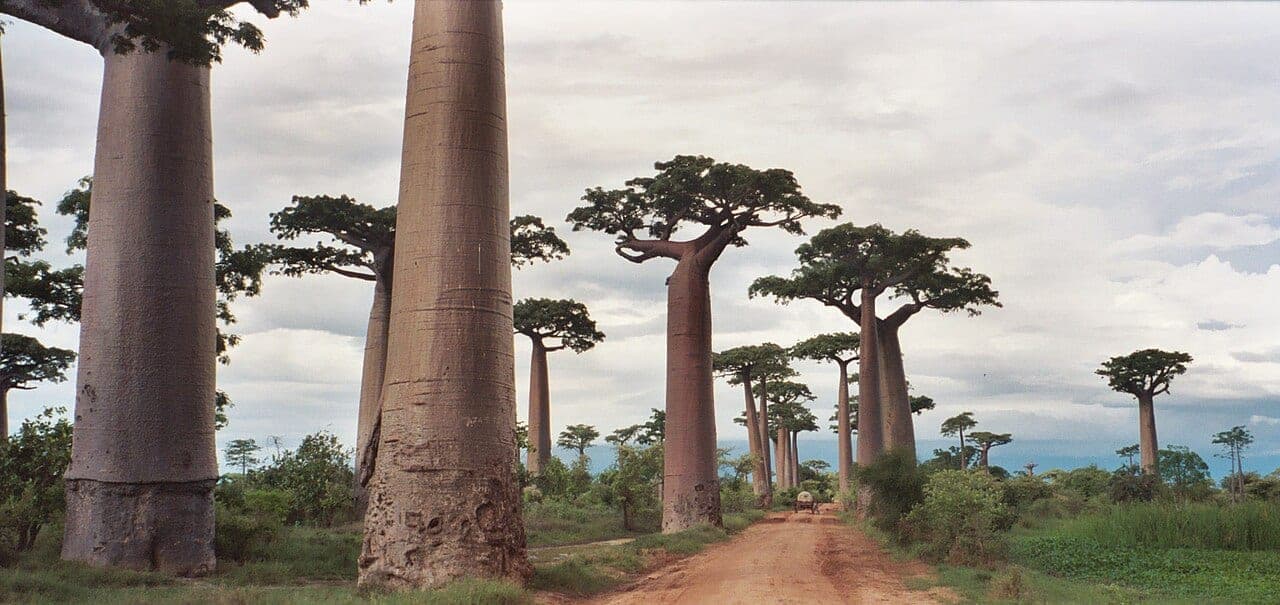
 The baobabs on the Morondava road are survivors of a forest that was cleared around them, left standing because they are useful and because they are regarded as ancestral. Photograph by Cactus0625, CC BY-SA 4.0, via Wikimedia Commons.
Cloth is central to identity. The lamba, a length of fabric wrapped about the body, is worn across the island, and Merina silk weaving produced the intricate geometric lamba akotofahana admired far abroad. The most important cloth of all is the lamba mena, the fine, often reddish silk shroud in which the dead are wrapped. At the table, rice is dressed with a laoka, or accompaniment: the national dish romazava, a stew of zebu beef and leafy greens, and ravitoto, pounded cassava leaves with pork, are eaten everywhere, while the slaughter of a zebu marks every occasion of consequence.
Roughly half of Madagascar's people are Christian, Catholic and Protestant alike, with a smaller Muslim community and many who hold to ancestral belief; in practice the boundary is porous, and Christianity is widely lived alongside the older faith rather than in place of it. The creator is known as Zanahary or Andriamanitra, "the fragrant lord", but it is the razana, the ancestors, who touch daily life. They intercede between the living and the divine, bless or withhold blessing, and remain members of the family whose approval is sought before any weighty decision.
This worldview is enforced through fady, taboos that vary by descent group, region and even individual: a fady may forbid a food, a day for certain work, or a place, and its force comes from the ancestors who laid it down. Diviners called ombiasy read the future and diagnose misfortune through sikidy, a seed-and-position divination of clear East African and Arab lineage. Land itself belongs less to the living than to the ancestors buried in it, and the living are its custodians, a conviction shaping everything from farming to the building of tombs.
In Malagasy thought the tomb is the true and permanent home, and the house of the living only a temporary lodging; families invest their care and resources accordingly, raising family tombs of stone that can be grander and more durable than any dwelling. To be buried in ancestral ground, among one's own razana, is among the deepest of needs here, and bodies are carried long distances so that a person may lie where they belong.
The baobabs on the Morondava road are survivors of a forest that was cleared around them, left standing because they are useful and because they are regarded as ancestral. Photograph by Cactus0625, CC BY-SA 4.0, via Wikimedia Commons.
Cloth is central to identity. The lamba, a length of fabric wrapped about the body, is worn across the island, and Merina silk weaving produced the intricate geometric lamba akotofahana admired far abroad. The most important cloth of all is the lamba mena, the fine, often reddish silk shroud in which the dead are wrapped. At the table, rice is dressed with a laoka, or accompaniment: the national dish romazava, a stew of zebu beef and leafy greens, and ravitoto, pounded cassava leaves with pork, are eaten everywhere, while the slaughter of a zebu marks every occasion of consequence.
Roughly half of Madagascar's people are Christian, Catholic and Protestant alike, with a smaller Muslim community and many who hold to ancestral belief; in practice the boundary is porous, and Christianity is widely lived alongside the older faith rather than in place of it. The creator is known as Zanahary or Andriamanitra, "the fragrant lord", but it is the razana, the ancestors, who touch daily life. They intercede between the living and the divine, bless or withhold blessing, and remain members of the family whose approval is sought before any weighty decision.
This worldview is enforced through fady, taboos that vary by descent group, region and even individual: a fady may forbid a food, a day for certain work, or a place, and its force comes from the ancestors who laid it down. Diviners called ombiasy read the future and diagnose misfortune through sikidy, a seed-and-position divination of clear East African and Arab lineage. Land itself belongs less to the living than to the ancestors buried in it, and the living are its custodians, a conviction shaping everything from farming to the building of tombs.
In Malagasy thought the tomb is the true and permanent home, and the house of the living only a temporary lodging; families invest their care and resources accordingly, raising family tombs of stone that can be grander and more durable than any dwelling. To be buried in ancestral ground, among one's own razana, is among the deepest of needs here, and bodies are carried long distances so that a person may lie where they belong.
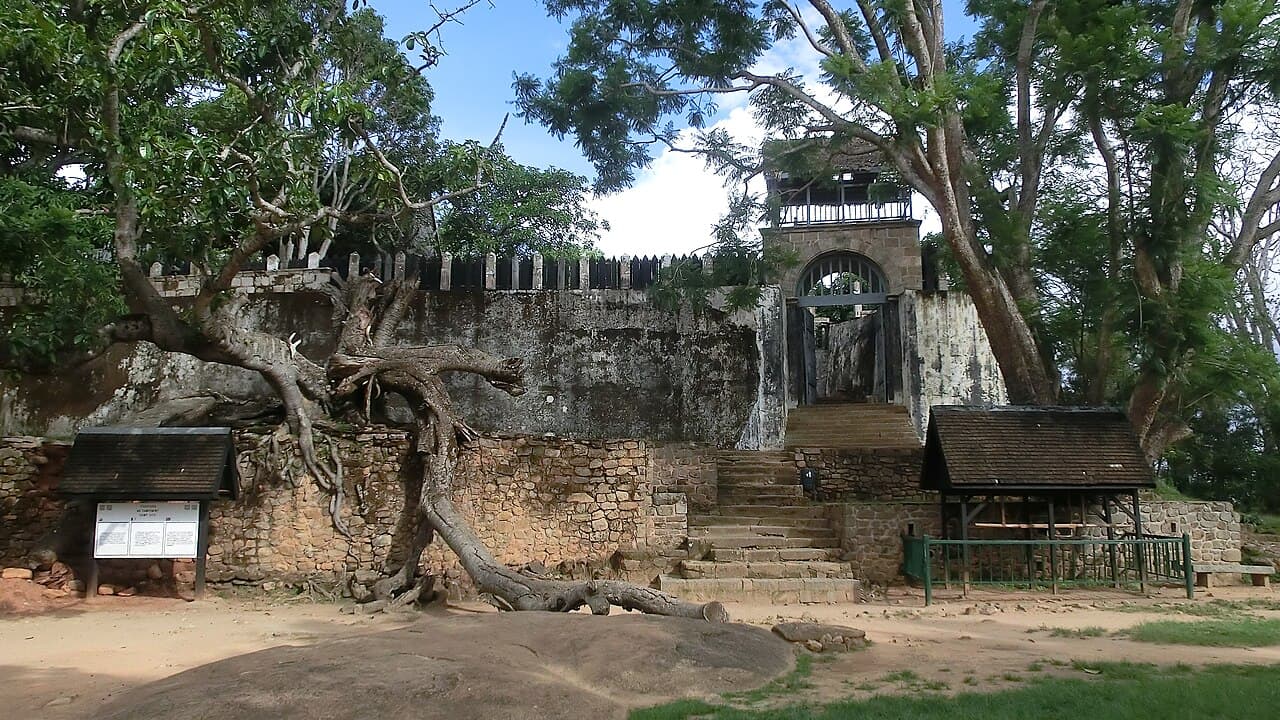 Ambohimanga is the burial place of Merina royalty and remains a place of pilgrimage and sacrifice, which is why parts of it are closed to visitors. Photograph by Jose Antonio, public domain, via Wikimedia Commons.
Among the Merina and Betsileo of the highlands this bond finds its most distinctive expression in the famadihana, the turning of the bones, one of the most tender remembrance customs anywhere in the world. Every several years, when a family can meet the cost and when the ancestors are felt to call for it, the tomb is opened and the wrapped remains of the dead are lifted gently into the daylight. Relatives rewrap each ancestor in a fresh lamba mena, renew the name so it will not be forgotten, and hold the dead close, speaking to them, sharing the family's news and asking their blessing. There is music and dance, and the ancestors are carried aloft and borne once around the tomb before being laid to rest again. The ceremony is understood not as mourning but as reunion and an act of love, a reaffirmation that the dead remain kin, honoured guests at a family gathering rather than absent figures. Underlying it is the belief that a person joins the ancestral world fully only over time, so that the living hold a long and intimate duty of care toward those who have died.
Not all Malagasy hold famadihana. In the arid south, the Mahafaly and Antandroy raise monumental tombs adorned with painted scenes and with aloalo, the carved wooden posts that record the life of the dead, and mark death with the sacrifice of many zebu whose horns then crown the graves. Where Christian practice has grown, some families have modified or set aside the reburial, and the tradition is changing with the times and its expense. Across these variations the constant holds: the dead are not left behind, and remembrance is a lasting obligation the living owe, with reverence, to their ancestors.
The Malagasy record is kept in the tomb, and that is not a figure of speech.
A family belongs to a tomb, and the tomb holds the ancestors who define who the family is and where its land is. Famadihana, the turning of the bones, brings the dead out every few years to be rewrapped in fresh silk and carried among the living, and the occasion is when the genealogy is recited and the connections between branches are re-established in front of everybody. For most Malagasy families this is the primary record and the state's paperwork is secondary.
The written record starts with the Merina kingdom, which built an administration in the nineteenth century, adopted the Latin alphabet through the London Missionary Society, and generated royal archives, land records and mission registers. Those are held in Antananarivo, together with the French colonial series from 1896 to 1960; much of the French administrative record is also at Aix-en-Provence.
Civil registration exists and is incomplete outside the towns, so for a great many families the twentieth century is documented better by the church than by the state. Protestant and Catholic mission registers are the practical vital records for much of the highlands and the coast.
The names themselves carry the history: Malagasy personal names are often long descriptive compounds rather than inherited surnames, so families are traced by ancestry and place rather than by a name passed down.
Madagascar carries three UNESCO World Heritage sites, and its sole cultural inscription is the Royal Hill of Ambohimanga, added in 2001 as a place of memory and national identity. The fortified hill, one of the twelve sacred hills of Imerina, holds the palace, sacred pools and royal tombs of the sovereigns who built the Merina kingdom, and remains, four centuries on, a living sanctuary to which Malagasy still come to honour the ancestors. In the capital, the Rova of Antananarivo was gutted by fire in November 1995, a national grief; after a long restoration it was reopened on the twenty-fifth anniversary, in November 2020, and objects saved from the flames are kept at the nearby Andafiavaratra Palace museum.
The island's other two inscriptions are natural. The Tsingy de Bemaraha Strict Nature Reserve, inscribed in 1990, guards a labyrinth of razor-edged limestone pinnacles, the tsingy, sheltering lemurs and endemic plants. The Rainforests of the Atsinanana, six national parks along the eastern escarpment and inscribed in 2007, protect vital habitat for lemurs and other threatened species; they were placed on the List of World Heritage in Danger in 2010 amid illegal rosewood logging and lemur poaching. Beyond the list, the Avenue of the Baobabs near Morondava became a protected natural monument in 2015, while conservation everywhere contends with deforestation and rural poverty.
For a country of thin institutional resources, digital tools have become an important means of safeguarding heritage that is often oral, dispersed or at risk. The restoration of the Rova of Antananarivo was accompanied by extensive documentation, and the collections of the Andafiavaratra museum are gradually being catalogued so that the fragments saved from the 1995 fire can be studied and shared, while UNESCO's online dossiers keep a permanent record of the World Heritage sites and their threats.
The island's biology has driven the most ambitious work: online botanical and biodiversity databases compiled by Malagasy and international researchers record its endemic species and their conservation status, in effect a digital ark for a natural inheritance under pressure. Malagasy-language material grows through Wikimedia and language projects, and the diaspora records and circulates music, oratory and family history that might otherwise fade, extending the ancestral instinct to remember into a form distance cannot easily erase.
Malagasy culture reaches the world above all through music. The valiha virtuosos Justin Vali and Rajery, the guitarist D'Gary, the band Tarika and the "king of salegy" Eusèbe Jaojoby have carried the island's sound onto international stages, and a substantial community abroad, concentrated in France, sustains these links. In letters, the country reveres the poet Jean-Joseph Rabearivelo as a founding modern voice, while writers such as Michèle Rakotoson and Naivo, whose "Beyond the Rice Fields" became the first Malagasy novel translated into English, have brought its history and memory to new readers.
The island's nature is itself a cultural force: its lemurs, baobabs and landscapes draw growing numbers of visitors whose interest, handled with care, can help fund the heritage they come to see.
A palace risen from the ashes. The restored Rova of Antananarivo reopened in November 2020, exactly twenty-five years after the fire that destroyed it, returning to the nation the seat of its former sovereigns and the objects saved from the flames.
A sacred hill kept living. The Royal Hill of Ambohimanga endures not as a museum piece but as a place of pilgrimage, its 2001 UNESCO inscription recognising a sanctity Malagasy have maintained for four hundred years.
The island's sound abroad. Malagasy musicians, from the valiha players Justin Vali and Rajery to the salegy singer Jaojoby, have won an international audience for a tradition rooted in bamboo zithers and highland song.
A digital ark for a singular nature. Biodiversity databases built by Malagasy and international scientists now document the island's endemic species in detail, a durable record that aids the protection of its lemurs and baobabs.
Ambohimanga is the burial place of Merina royalty and remains a place of pilgrimage and sacrifice, which is why parts of it are closed to visitors. Photograph by Jose Antonio, public domain, via Wikimedia Commons.
Among the Merina and Betsileo of the highlands this bond finds its most distinctive expression in the famadihana, the turning of the bones, one of the most tender remembrance customs anywhere in the world. Every several years, when a family can meet the cost and when the ancestors are felt to call for it, the tomb is opened and the wrapped remains of the dead are lifted gently into the daylight. Relatives rewrap each ancestor in a fresh lamba mena, renew the name so it will not be forgotten, and hold the dead close, speaking to them, sharing the family's news and asking their blessing. There is music and dance, and the ancestors are carried aloft and borne once around the tomb before being laid to rest again. The ceremony is understood not as mourning but as reunion and an act of love, a reaffirmation that the dead remain kin, honoured guests at a family gathering rather than absent figures. Underlying it is the belief that a person joins the ancestral world fully only over time, so that the living hold a long and intimate duty of care toward those who have died.
Not all Malagasy hold famadihana. In the arid south, the Mahafaly and Antandroy raise monumental tombs adorned with painted scenes and with aloalo, the carved wooden posts that record the life of the dead, and mark death with the sacrifice of many zebu whose horns then crown the graves. Where Christian practice has grown, some families have modified or set aside the reburial, and the tradition is changing with the times and its expense. Across these variations the constant holds: the dead are not left behind, and remembrance is a lasting obligation the living owe, with reverence, to their ancestors.
The Malagasy record is kept in the tomb, and that is not a figure of speech.
A family belongs to a tomb, and the tomb holds the ancestors who define who the family is and where its land is. Famadihana, the turning of the bones, brings the dead out every few years to be rewrapped in fresh silk and carried among the living, and the occasion is when the genealogy is recited and the connections between branches are re-established in front of everybody. For most Malagasy families this is the primary record and the state's paperwork is secondary.
The written record starts with the Merina kingdom, which built an administration in the nineteenth century, adopted the Latin alphabet through the London Missionary Society, and generated royal archives, land records and mission registers. Those are held in Antananarivo, together with the French colonial series from 1896 to 1960; much of the French administrative record is also at Aix-en-Provence.
Civil registration exists and is incomplete outside the towns, so for a great many families the twentieth century is documented better by the church than by the state. Protestant and Catholic mission registers are the practical vital records for much of the highlands and the coast.
The names themselves carry the history: Malagasy personal names are often long descriptive compounds rather than inherited surnames, so families are traced by ancestry and place rather than by a name passed down.
Madagascar carries three UNESCO World Heritage sites, and its sole cultural inscription is the Royal Hill of Ambohimanga, added in 2001 as a place of memory and national identity. The fortified hill, one of the twelve sacred hills of Imerina, holds the palace, sacred pools and royal tombs of the sovereigns who built the Merina kingdom, and remains, four centuries on, a living sanctuary to which Malagasy still come to honour the ancestors. In the capital, the Rova of Antananarivo was gutted by fire in November 1995, a national grief; after a long restoration it was reopened on the twenty-fifth anniversary, in November 2020, and objects saved from the flames are kept at the nearby Andafiavaratra Palace museum.
The island's other two inscriptions are natural. The Tsingy de Bemaraha Strict Nature Reserve, inscribed in 1990, guards a labyrinth of razor-edged limestone pinnacles, the tsingy, sheltering lemurs and endemic plants. The Rainforests of the Atsinanana, six national parks along the eastern escarpment and inscribed in 2007, protect vital habitat for lemurs and other threatened species; they were placed on the List of World Heritage in Danger in 2010 amid illegal rosewood logging and lemur poaching. Beyond the list, the Avenue of the Baobabs near Morondava became a protected natural monument in 2015, while conservation everywhere contends with deforestation and rural poverty.
For a country of thin institutional resources, digital tools have become an important means of safeguarding heritage that is often oral, dispersed or at risk. The restoration of the Rova of Antananarivo was accompanied by extensive documentation, and the collections of the Andafiavaratra museum are gradually being catalogued so that the fragments saved from the 1995 fire can be studied and shared, while UNESCO's online dossiers keep a permanent record of the World Heritage sites and their threats.
The island's biology has driven the most ambitious work: online botanical and biodiversity databases compiled by Malagasy and international researchers record its endemic species and their conservation status, in effect a digital ark for a natural inheritance under pressure. Malagasy-language material grows through Wikimedia and language projects, and the diaspora records and circulates music, oratory and family history that might otherwise fade, extending the ancestral instinct to remember into a form distance cannot easily erase.
Malagasy culture reaches the world above all through music. The valiha virtuosos Justin Vali and Rajery, the guitarist D'Gary, the band Tarika and the "king of salegy" Eusèbe Jaojoby have carried the island's sound onto international stages, and a substantial community abroad, concentrated in France, sustains these links. In letters, the country reveres the poet Jean-Joseph Rabearivelo as a founding modern voice, while writers such as Michèle Rakotoson and Naivo, whose "Beyond the Rice Fields" became the first Malagasy novel translated into English, have brought its history and memory to new readers.
The island's nature is itself a cultural force: its lemurs, baobabs and landscapes draw growing numbers of visitors whose interest, handled with care, can help fund the heritage they come to see.
A palace risen from the ashes. The restored Rova of Antananarivo reopened in November 2020, exactly twenty-five years after the fire that destroyed it, returning to the nation the seat of its former sovereigns and the objects saved from the flames.
A sacred hill kept living. The Royal Hill of Ambohimanga endures not as a museum piece but as a place of pilgrimage, its 2001 UNESCO inscription recognising a sanctity Malagasy have maintained for four hundred years.
The island's sound abroad. Malagasy musicians, from the valiha players Justin Vali and Rajery to the salegy singer Jaojoby, have won an international audience for a tradition rooted in bamboo zithers and highland song.
A digital ark for a singular nature. Biodiversity databases built by Malagasy and international scientists now document the island's endemic species in detail, a durable record that aids the protection of its lemurs and baobabs.
National Overview
Notable Cities
Historical Foundations
Linguistic and Etymological Roots
Cultural Identity
Religion and Spirituality
Remembrance and Mourning Traditions
Tracing a Family in Madagascar
Heritage Preservation Efforts
Digital Heritage
Contemporary Cultural Influences
Success Stories
References and resources
- UNESCO World Heritage Centre: Royal Hill of Ambohimanga. The country's only cultural World Heritage site, inscribed in 2001 as a place of memory and identity.
- UNESCO World Heritage Centre: Tsingy de Bemaraha Strict Nature Reserve. The limestone pinnacle reserve of the west, inscribed in 1990.
- UNESCO World Heritage Centre: Rainforests of the Atsinanana. The six eastern national parks inscribed in 2007 and later listed as in danger.
- Encyclopaedia Britannica: Madagascar. Geography, peoples, history and the island's endemic biology.
- Nature, Scientific Reports: Contrasting Linguistic and Genetic Origins of the Asian Source Populations of Malagasy. The Austronesian and East African origins of the Malagasy.
- The Conversation: How the Banjar people of Borneo became ancestors of the Malagasy. The peopling of the island from southern Borneo and East Africa.
- Bradt Guides: Madagascar's famadihana, the turning of the bones. A respectful account of the highland reburial ceremony.
- Wikipedia: Famadihana. The ritual, its meaning and the belief in the razana ancestors.
- Wikipedia: Rova of Antananarivo. The royal compound, the 1995 fire and the 2020 restoration.
- Wikipedia: Avenue of the Baobabs. The grove of Grandidier's baobabs, the renala, near Morondava.