Heritage · Country
Mozambique Culture and Heritage
A whole nation carries the name of a single trader on a small coral island in the Indian Ocean. This is a guide to Mozambique's Swahili and Portuguese inheritances, its carving and music, and the way its peoples keep faith with the dead.Written to last.
By Confinity Heritage Editorial · Updated 2026-07-31 · 8-minute readQuiet tools, kept out of the way.
Few countries wear the name of one person, and fewer still the name of a man remembered only in fragments. Mozambique takes its name from a small coral island off its northern coast, and the island took its name from Mussa Bin Bique, a Muslim trader and ruler, likely of Omani origin, who governed it as a Swahili trading post before European ships arrived. Portuguese sailors under Vasco da Gama, who reached the island in 1498, adapted his name into Mocambique and applied it first to the island, then to the captaincy, and at last to the whole territory (Wikipedia). A nation of more than thirty million people still answers, in effect, to the name of a single sultan.
That is a fitting beginning for a country whose heritage is above all a record of long memory: the Swahili towns of the Indian Ocean coast, four centuries of Portuguese rule seated on that same island, the Makonde carvers of the northern plateau, the Chopi orchestras of the south, and traditions of mourning in which the dead do not leave the family but move to a nearer, watchful place.
Mozambique occupies 801,590 square kilometres along the south-east African coast, a long, narrow country curving for roughly 2,700 kilometres beside the Indian Ocean (Wikipedia). It borders Tanzania to the north, Malawi, Zambia and Zimbabwe to the west, and Eswatini and South Africa to the south, while the Mozambique Channel separates it from Madagascar. The great Zambezi River cuts the country almost in two, dividing a densely populated north from a south drawn towards the capital. The population passed 34 million in 2024, spread across ten provinces and the capital city.
The republic is young, independent from Portugal only since 25 June 1975 and multiparty since 1990. Its people belong to many Bantu-speaking groups, among them the Makhuwa, Tsonga, Sena, Lomwe, Chopi, Ndau and Yao, with Swahili communities on the far northern coast. Portuguese remains the single official language and the common tongue of the towns, but for most Mozambicans it is a second language, learned over a first that carries the family's oldest words.
Maputo. The capital, called Lourenco Marques through the colonial period and renamed in 1976, grew around a Portuguese fortress completed in 1787 and became the capital of Portuguese East Africa in 1907, superseding the northern island that had held that role for centuries (Britannica). It is the country's largest city and principal port, its old core keeping a striking colonial-era architecture, and with neighbouring Matola it forms the largest urban area in the country.
Beira. Founded in 1887 at the mouth of the Pungwe River, Beira is the central coast's chief port and the gateway for landlocked Zimbabwe, Zambia and Malawi, whose trade moves along the Beira Corridor of road, rail and pipeline. Low-lying and exposed, the city bore the worst of Cyclone Idai in 2019, one of the deadliest storms recorded in the region.
Nampula. The largest city of the north and a commercial and transport hub for the Makhuwa heartland, Nampula sits inland behind the coast, connected by rail to the port of Nacala and to the historic island that lies within its province. It anchors a region holding the country's deepest reserves of pre-colonial and Islamic heritage.
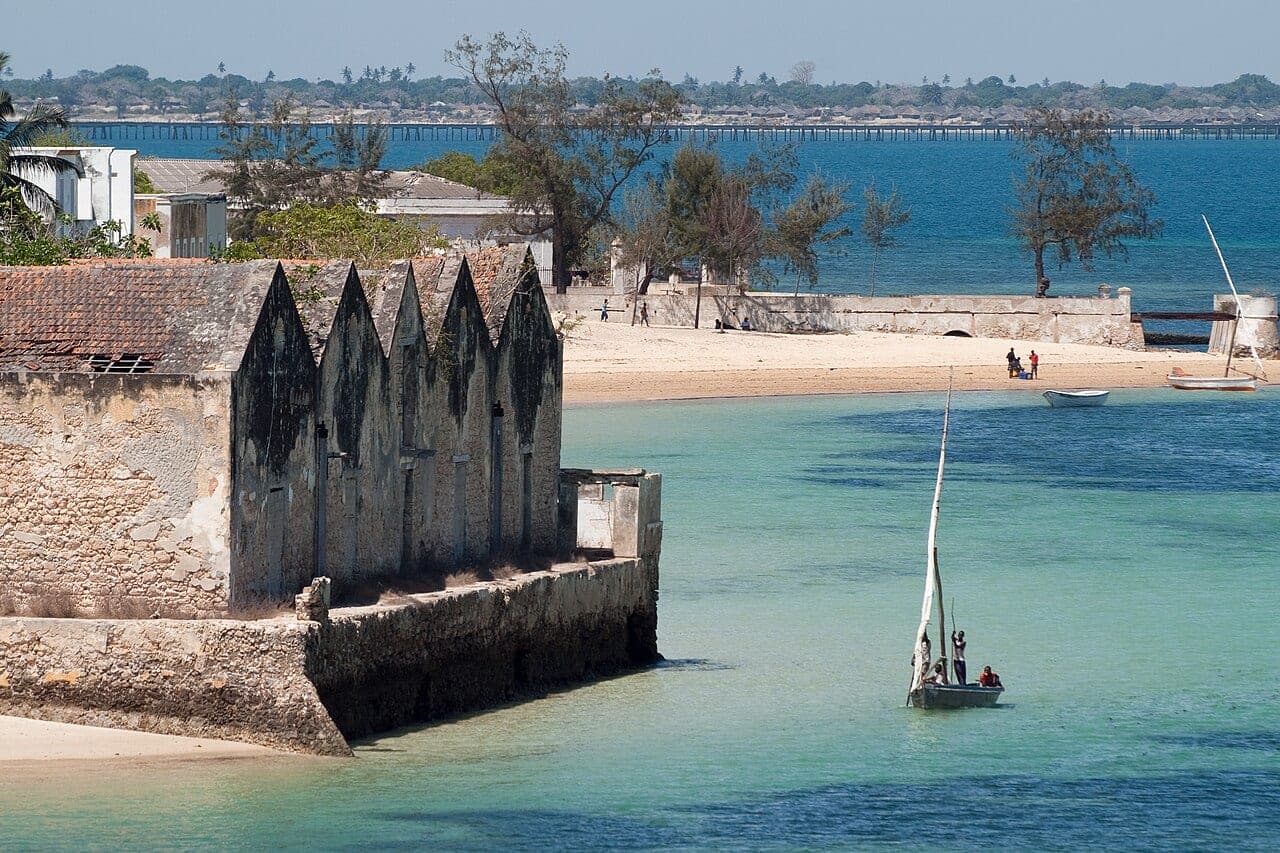
Island of Mozambique. Barely three kilometres long and a few hundred metres wide, Ilha de Mocambique was the Swahili and then the Portuguese capital of the whole territory until the seat of government moved south in 1898. It preserves one of the most complete surviving ensembles of coral-stone architecture on the Swahili coast, blending Bantu, Swahili, Arab, Indian and European forms, and its Fort of Sao Sebastiao and the small sixteenth-century Chapel of Nossa Senhora do Baluarte are among the oldest European buildings in the southern hemisphere (UNESCO). The northern half is the reef-stone Stone Town; the southern half is the Macuti Town, named for the palm-thatch roofs of the fishing families who make it home.
Bantu-speaking farmers and ironworkers settled the region in the first millennium AD, and from about the tenth century a chain of coastal towns joined the Indian Ocean trading world. Sofala, on the central coast, became the key outlet through which gold and ivory from the interior kingdoms, Great Zimbabwe and later the Mutapa state, reached Swahili merchants and, through them, the markets of Arabia, Persia, India and China (Wikipedia). By the twelfth century the sultanate of Kilwa controlled Sofala's gold, and Islam and the Swahili language spread down the shore, leaving mosques, coral-stone houses and a merchant culture long predating any European claim.
 The Island of Mozambique was a Swahili trading settlement before it was a Portuguese capital, and the stone town and the reed town have always been two different places on the same island. Photograph by Cornelius Kibelka, CC BY-SA 2.0, via Wikimedia Commons.
The Portuguese arrived with da Gama in 1498 and within a generation had taken the Island of Mozambique, fortifying it as a naval base on the sea route to India. For close to four centuries the island served as the capital of Portuguese East Africa, a station in a trade that carried gold, ivory and, with growing cruelty, enslaved people. Effective control over the interior came late and was often brutal, the colonial economy leaning on forced labour, and it is remembered soberly rather than romantically. Resistance took organised form when the Mozambique Liberation Front, Frelimo, was founded in exile in 1962 under Eduardo Mondlane and began an armed struggle in 1964. Mondlane was assassinated in 1969, and Samora Machel led the movement to independence on 25 June 1975 (Britannica).
Independence was followed almost at once by a long war. From 1977 to 1992 a conflict between the Frelimo government and the Renamo insurgency, driven and supplied in large part from outside the country, devastated the countryside, and an estimated one million people died. President Machel was killed in a plane crash near the South African border in October 1986, a loss the country still marks. The Rome General Peace Accords of October 1992 ended the fighting, multiparty elections followed in 1994, and Mozambique has since worked to keep and deepen a hard-won peace.
Portuguese is the sole official language, the medium of government, schooling and the national press, yet Ethnologue counts more than forty living languages within the country's borders, nearly all of them Bantu (Wikipedia). Emakhuwa, spoken across the northern provinces, is the most widely used mother tongue; Xitsonga dominates the far south around Maputo; Cisena runs along the Zambezi valley; and Lomwe, Ndau, Chopi, Yao and, on the northernmost coast, Swahili fill the map between them. Several of these languages are now used in early primary education, giving long-unwritten tongues a firmer written life.
The country's own name is its clearest piece of linguistic archaeology. When da Gama's sailors reached the island, they rendered the name of its ruler, Mussa Bin Bique, as Mocambique, likely simplifying a Swahili and Arabic form they found hard to pronounce. The name of one man became the name of an island, a captaincy and finally a republic, so that a Muslim trader of the late fifteenth century is commemorated, unknowingly, every time the nation is spoken of.
Two artistic traditions carry Mozambique's name furthest. In the north, on the Mueda plateau of Cabo Delgado, the Makonde are renowned for sculpture in dark, dense woods, above all African blackwood, the mpingo or pau-preto. Their carving grew from the mapiko masks worn in male initiation, in which a masked dancer takes the part of an ancestral spirit, and developed in the twentieth century into a celebrated figurative art of interlocked human forms and dreamlike shetani spirits (Wikipedia). In the south, among the Chopi of Inhambane, the timbila is a wooden xylophone tuned and voiced with gourd resonators sealed in beeswax; orchestras of these instruments, from a handful to dozens, play long, layered compositions in which each of the player's hands keeps a separate rhythm, an art UNESCO recognises as intangible heritage of humanity (UNESCO ICH).
Everyday culture is just as expressive. Marrabenta, the guitar-driven urban dance music born in the neighbourhoods of Maputo in the 1930s and 1940s, took its name from the local word for "to break," a nod to the cheap instruments played hard until they gave out (Wikipedia). The capulana, a printed cotton wrap, serves at once as skirt, shawl, baby carrier, gift, marker of status and, at the last, a shroud, so that a woman's cloths become a portable archive of her life. And at the table matapa, young cassava leaves pounded with ground peanuts and coconut, is the dish most often named national, served beside prawns and chicken grilled with the piri-piri chilli that Mozambican cooks made famous.
Mozambique is religiously plural, and its faiths overlap more than they divide. Recent surveys put Christians at roughly two-thirds of the population, Muslims at close to a fifth, and a smaller share professing no religion or traditional belief (Wikipedia). Christianity arrived with the Portuguese and is today both Roman Catholic and, increasingly, Evangelical, Pentecostal and Zionist. Islam is older and coastal: it came with the Swahili trading towns centuries before the Portuguese, and it remains strongest in the north, where Sufi brotherhoods and long-established mosques anchor community life.
Beneath and within both lies an older layer of belief that most Mozambicans never wholly set aside. Traditional religion holds that ancestral spirits remain present and powerful, able to bless or trouble the living, and it is common for Christian or Muslim families to observe ancestral rites alongside their formal faith. Ancestors are addressed at births, marriages and moments of crisis; diviners and healers mediate when misfortune suggests a spiritual cause; and the boundary between the seen and unseen world is treated less as a wall than as a doorway kept ajar.
A death in Mozambique is the affair of a whole community. Across many of the country's peoples, relatives and friends shave their hair and dress in dark clothing, festivity is suspended, and the household gathers for days of vigil, with a period of intense mourning in the first days after burial (My Send Off). Among the Makhuwa of the north, death is regarded not as natural but as an intrusion to be explained, and grief is matched by a search for its cause. Widows in particular pass through prescribed rites, sitting apart, marked with ash or dust, and later undergoing a cleansing that lifts the "darkness" death leaves on the house.
The purpose of these rites is not only to grieve but to relocate the dead. In the traditional understanding the deceased does not vanish; properly mourned and honoured, the person joins the ancestors and continues to watch over the family, accompanying them home from the grave to take up a guardian's role. Christian and Islamic practice have woven themselves into this pattern rather than replacing it. Christian families hold a wake and a funeral service, then bury their dead and return for memorial gatherings; Muslim families on the coast wash and shroud the body for swift burial and observe the appointed periods of mourning, including the widow's. In many households both faiths still keep the older courtesies owed to the ancestors, so that prayer book, Quran and inherited custom all have their place at the graveside.
Mozambican records are Portuguese in form and were tested to destruction by thirty years of continuous war.
Catholic parish registers survive from the colonial period in the coastal towns, and Islamic records on the northern coast are older still: the Swahili settlements of the Ilha de Moçambique and the Querimba islands kept Arabic documents and sharia court records, and their families connect to Oman, the Comoros and Zanzibar. Portuguese administrative papers are divided between Maputo and the Arquivo Histórico Ultramarino in Lisbon, and the prazo estates of the Zambezi valley left their own peculiar record of Afro-Portuguese landholding families.
The colonial labour system generated documentation of its own. Mozambican men were recruited in enormous numbers to work the South African gold mines under formal agreements running from the nineteenth century, and their contracts, medical files and death records are held in Johannesburg.
Independence in 1975 was followed almost immediately by a civil war that lasted until 1992, displaced around five million people, and destroyed schools, clinics and administrative offices as a matter of strategy. Provincial registries were lost. Civil registration since has had to be rebuilt from almost nothing, and campaigns to register adults retrospectively continue.
The Historical Archive of Mozambique in Maputo has done substantial work preserving what survived, and the oral history collections gathered since independence carry the twentieth century for families whose paperwork does not.
Mozambique's single UNESCO World Heritage site is the Island of Mozambique, inscribed in 1991 for the architectural unity of a town built continuously in the same coral stone, with the same techniques and decoration, since the sixteenth century (UNESCO). Preservation there is delicate: the island is both a monument and a living community, its stone town needing conservation and its thatched Macuti town needing homes and services, and international partners have worked with the national conservation office to repair buildings, manage tourism and keep the two halves in balance.
The country's other headline inscription is intangible. The Chopi timbila tradition was proclaimed a Masterpiece of the Oral and Intangible Heritage of Humanity in 2005 and inscribed on UNESCO's Representative List in 2008, with safeguarding plans, supported at points by Japanese and United Nations funding, aimed at training young players and passing on the crafts of building and tuning the instruments (UNESCO ICH). Master musicians now teach a new generation and, notably, admit girls to orchestras once reserved for men, an adaptation that has helped keep the tradition alive against the pull of modern popular music.
Digital preservation in Mozambique is young and unevenly resourced, but it is growing. The photographic and documentary record of the Island of Mozambique and of the colonial and independence periods is being catalogued and, in part, digitised by national archives and university and museum partners, and the country features in the international documentation of the Indian Ocean slave routes.
The languages, too, are entering the digital record. Researchers have built parallel text collections and machine-translation resources for Emakhuwa and Portuguese, and translated media and scripture in several Bantu languages are increasingly available online. For a heritage that lives in performance and speech more than in stone, recording that oral inheritance may prove the most valuable digital work of all.
Mozambique's modern culture reaches well beyond its borders. In literature the novelist Mia Couto, whose Portuguese is reshaped by the rhythms and coinages of Mozambican speech, has won the Camoes and Neustadt International prizes; the poet Jose Craveirinha was the first African writer to receive the Camoes Prize, and Paulina Chiziane, the country's first published woman novelist, took the same honour in 2021. In the visual arts the painter Malangatana Ngwenya turned the country's suffering into dense, teeming canvases now held in major collections, while Makonde sculptors carried their blackwood figures onto the international art market.
Music remains the country's most exported voice, from the marrabenta revival and the newer pandza style that fuses it with electronic beats to the timbila orchestras of Inhambane. Communities in Portugal, South Africa and beyond carry these forms with them, along with the capulana, the piri-piri kitchen and the funeral customs that keep the diaspora tied to home ground.
An island saved from oblivion. When the capital moved south in 1898, the Island of Mozambique emptied of officials and commerce, and the loss of importance, paradoxically, spared its architecture from redevelopment. Its 1991 UNESCO listing turned that survival into a mandate, and conservation partnerships have since stabilised its forts, churches, mosques and merchant houses while supporting the fishing families who keep it a place people live.
A xylophone tradition passed on. The Chopi timbila might have faded with its ageing masters. Instead its UNESCO recognition helped fund a deliberate handing-down: senior musicians training young players, teaching the felling and tuning of the sneezewood slats, and opening the orchestras to girls, so that a complex art still sounds in Inhambane.
A peace that has held. The war that followed independence cost around a million lives, yet the settlement reached in Rome in 1992 ended it, and the country has since chosen, through repeated negotiation, to keep the peace. In a region where such accords often fail, Mozambique's remains a reference point for reconciliation after civil war.
A literature that remembers in its own voice. Writers such as Mia Couto and Paulina Chiziane have carried Mozambican memory into world literature not by abandoning Portuguese but by bending it around Mozambican ways of speaking and grieving, so that the country's languages and its dead find a place on the international page.
The Island of Mozambique was a Swahili trading settlement before it was a Portuguese capital, and the stone town and the reed town have always been two different places on the same island. Photograph by Cornelius Kibelka, CC BY-SA 2.0, via Wikimedia Commons.
The Portuguese arrived with da Gama in 1498 and within a generation had taken the Island of Mozambique, fortifying it as a naval base on the sea route to India. For close to four centuries the island served as the capital of Portuguese East Africa, a station in a trade that carried gold, ivory and, with growing cruelty, enslaved people. Effective control over the interior came late and was often brutal, the colonial economy leaning on forced labour, and it is remembered soberly rather than romantically. Resistance took organised form when the Mozambique Liberation Front, Frelimo, was founded in exile in 1962 under Eduardo Mondlane and began an armed struggle in 1964. Mondlane was assassinated in 1969, and Samora Machel led the movement to independence on 25 June 1975 (Britannica).
Independence was followed almost at once by a long war. From 1977 to 1992 a conflict between the Frelimo government and the Renamo insurgency, driven and supplied in large part from outside the country, devastated the countryside, and an estimated one million people died. President Machel was killed in a plane crash near the South African border in October 1986, a loss the country still marks. The Rome General Peace Accords of October 1992 ended the fighting, multiparty elections followed in 1994, and Mozambique has since worked to keep and deepen a hard-won peace.
Portuguese is the sole official language, the medium of government, schooling and the national press, yet Ethnologue counts more than forty living languages within the country's borders, nearly all of them Bantu (Wikipedia). Emakhuwa, spoken across the northern provinces, is the most widely used mother tongue; Xitsonga dominates the far south around Maputo; Cisena runs along the Zambezi valley; and Lomwe, Ndau, Chopi, Yao and, on the northernmost coast, Swahili fill the map between them. Several of these languages are now used in early primary education, giving long-unwritten tongues a firmer written life.
The country's own name is its clearest piece of linguistic archaeology. When da Gama's sailors reached the island, they rendered the name of its ruler, Mussa Bin Bique, as Mocambique, likely simplifying a Swahili and Arabic form they found hard to pronounce. The name of one man became the name of an island, a captaincy and finally a republic, so that a Muslim trader of the late fifteenth century is commemorated, unknowingly, every time the nation is spoken of.
Two artistic traditions carry Mozambique's name furthest. In the north, on the Mueda plateau of Cabo Delgado, the Makonde are renowned for sculpture in dark, dense woods, above all African blackwood, the mpingo or pau-preto. Their carving grew from the mapiko masks worn in male initiation, in which a masked dancer takes the part of an ancestral spirit, and developed in the twentieth century into a celebrated figurative art of interlocked human forms and dreamlike shetani spirits (Wikipedia). In the south, among the Chopi of Inhambane, the timbila is a wooden xylophone tuned and voiced with gourd resonators sealed in beeswax; orchestras of these instruments, from a handful to dozens, play long, layered compositions in which each of the player's hands keeps a separate rhythm, an art UNESCO recognises as intangible heritage of humanity (UNESCO ICH).
Everyday culture is just as expressive. Marrabenta, the guitar-driven urban dance music born in the neighbourhoods of Maputo in the 1930s and 1940s, took its name from the local word for "to break," a nod to the cheap instruments played hard until they gave out (Wikipedia). The capulana, a printed cotton wrap, serves at once as skirt, shawl, baby carrier, gift, marker of status and, at the last, a shroud, so that a woman's cloths become a portable archive of her life. And at the table matapa, young cassava leaves pounded with ground peanuts and coconut, is the dish most often named national, served beside prawns and chicken grilled with the piri-piri chilli that Mozambican cooks made famous.
Mozambique is religiously plural, and its faiths overlap more than they divide. Recent surveys put Christians at roughly two-thirds of the population, Muslims at close to a fifth, and a smaller share professing no religion or traditional belief (Wikipedia). Christianity arrived with the Portuguese and is today both Roman Catholic and, increasingly, Evangelical, Pentecostal and Zionist. Islam is older and coastal: it came with the Swahili trading towns centuries before the Portuguese, and it remains strongest in the north, where Sufi brotherhoods and long-established mosques anchor community life.
Beneath and within both lies an older layer of belief that most Mozambicans never wholly set aside. Traditional religion holds that ancestral spirits remain present and powerful, able to bless or trouble the living, and it is common for Christian or Muslim families to observe ancestral rites alongside their formal faith. Ancestors are addressed at births, marriages and moments of crisis; diviners and healers mediate when misfortune suggests a spiritual cause; and the boundary between the seen and unseen world is treated less as a wall than as a doorway kept ajar.
A death in Mozambique is the affair of a whole community. Across many of the country's peoples, relatives and friends shave their hair and dress in dark clothing, festivity is suspended, and the household gathers for days of vigil, with a period of intense mourning in the first days after burial (My Send Off). Among the Makhuwa of the north, death is regarded not as natural but as an intrusion to be explained, and grief is matched by a search for its cause. Widows in particular pass through prescribed rites, sitting apart, marked with ash or dust, and later undergoing a cleansing that lifts the "darkness" death leaves on the house.
The purpose of these rites is not only to grieve but to relocate the dead. In the traditional understanding the deceased does not vanish; properly mourned and honoured, the person joins the ancestors and continues to watch over the family, accompanying them home from the grave to take up a guardian's role. Christian and Islamic practice have woven themselves into this pattern rather than replacing it. Christian families hold a wake and a funeral service, then bury their dead and return for memorial gatherings; Muslim families on the coast wash and shroud the body for swift burial and observe the appointed periods of mourning, including the widow's. In many households both faiths still keep the older courtesies owed to the ancestors, so that prayer book, Quran and inherited custom all have their place at the graveside.
Mozambican records are Portuguese in form and were tested to destruction by thirty years of continuous war.
Catholic parish registers survive from the colonial period in the coastal towns, and Islamic records on the northern coast are older still: the Swahili settlements of the Ilha de Moçambique and the Querimba islands kept Arabic documents and sharia court records, and their families connect to Oman, the Comoros and Zanzibar. Portuguese administrative papers are divided between Maputo and the Arquivo Histórico Ultramarino in Lisbon, and the prazo estates of the Zambezi valley left their own peculiar record of Afro-Portuguese landholding families.
The colonial labour system generated documentation of its own. Mozambican men were recruited in enormous numbers to work the South African gold mines under formal agreements running from the nineteenth century, and their contracts, medical files and death records are held in Johannesburg.
Independence in 1975 was followed almost immediately by a civil war that lasted until 1992, displaced around five million people, and destroyed schools, clinics and administrative offices as a matter of strategy. Provincial registries were lost. Civil registration since has had to be rebuilt from almost nothing, and campaigns to register adults retrospectively continue.
The Historical Archive of Mozambique in Maputo has done substantial work preserving what survived, and the oral history collections gathered since independence carry the twentieth century for families whose paperwork does not.
Mozambique's single UNESCO World Heritage site is the Island of Mozambique, inscribed in 1991 for the architectural unity of a town built continuously in the same coral stone, with the same techniques and decoration, since the sixteenth century (UNESCO). Preservation there is delicate: the island is both a monument and a living community, its stone town needing conservation and its thatched Macuti town needing homes and services, and international partners have worked with the national conservation office to repair buildings, manage tourism and keep the two halves in balance.
The country's other headline inscription is intangible. The Chopi timbila tradition was proclaimed a Masterpiece of the Oral and Intangible Heritage of Humanity in 2005 and inscribed on UNESCO's Representative List in 2008, with safeguarding plans, supported at points by Japanese and United Nations funding, aimed at training young players and passing on the crafts of building and tuning the instruments (UNESCO ICH). Master musicians now teach a new generation and, notably, admit girls to orchestras once reserved for men, an adaptation that has helped keep the tradition alive against the pull of modern popular music.
Digital preservation in Mozambique is young and unevenly resourced, but it is growing. The photographic and documentary record of the Island of Mozambique and of the colonial and independence periods is being catalogued and, in part, digitised by national archives and university and museum partners, and the country features in the international documentation of the Indian Ocean slave routes.
The languages, too, are entering the digital record. Researchers have built parallel text collections and machine-translation resources for Emakhuwa and Portuguese, and translated media and scripture in several Bantu languages are increasingly available online. For a heritage that lives in performance and speech more than in stone, recording that oral inheritance may prove the most valuable digital work of all.
Mozambique's modern culture reaches well beyond its borders. In literature the novelist Mia Couto, whose Portuguese is reshaped by the rhythms and coinages of Mozambican speech, has won the Camoes and Neustadt International prizes; the poet Jose Craveirinha was the first African writer to receive the Camoes Prize, and Paulina Chiziane, the country's first published woman novelist, took the same honour in 2021. In the visual arts the painter Malangatana Ngwenya turned the country's suffering into dense, teeming canvases now held in major collections, while Makonde sculptors carried their blackwood figures onto the international art market.
Music remains the country's most exported voice, from the marrabenta revival and the newer pandza style that fuses it with electronic beats to the timbila orchestras of Inhambane. Communities in Portugal, South Africa and beyond carry these forms with them, along with the capulana, the piri-piri kitchen and the funeral customs that keep the diaspora tied to home ground.
An island saved from oblivion. When the capital moved south in 1898, the Island of Mozambique emptied of officials and commerce, and the loss of importance, paradoxically, spared its architecture from redevelopment. Its 1991 UNESCO listing turned that survival into a mandate, and conservation partnerships have since stabilised its forts, churches, mosques and merchant houses while supporting the fishing families who keep it a place people live.
A xylophone tradition passed on. The Chopi timbila might have faded with its ageing masters. Instead its UNESCO recognition helped fund a deliberate handing-down: senior musicians training young players, teaching the felling and tuning of the sneezewood slats, and opening the orchestras to girls, so that a complex art still sounds in Inhambane.
A peace that has held. The war that followed independence cost around a million lives, yet the settlement reached in Rome in 1992 ended it, and the country has since chosen, through repeated negotiation, to keep the peace. In a region where such accords often fail, Mozambique's remains a reference point for reconciliation after civil war.
A literature that remembers in its own voice. Writers such as Mia Couto and Paulina Chiziane have carried Mozambican memory into world literature not by abandoning Portuguese but by bending it around Mozambican ways of speaking and grieving, so that the country's languages and its dead find a place on the international page.
National Overview
Notable Cities
Historical Foundations
Linguistic and Etymological Roots
Cultural Identity
Religion and Spirituality
Remembrance and Mourning Traditions
Tracing a Family in Mozambique
Heritage Preservation Efforts
Digital Heritage
Contemporary Cultural Influences
Success Stories
References and resources
- UNESCO World Heritage Centre, Island of Mozambique: the 1991 inscription and its conservation history.
- UNESCO Intangible Cultural Heritage, Chopi Timbila: the timbila tradition and its safeguarding plan.
- Encyclopaedia Britannica, Mozambique: geography, colonial history and independence.
- Wikipedia, Mozambique: national statistics, borders and the civil war.
- Wikipedia, Mussa Bin Bique: the ruler who gave the island and the country their name.
- Wikipedia, Sofala: the medieval gold and ivory port of the Swahili coast.
- Wikipedia, Languages of Mozambique: Portuguese and the Bantu language families.
- Wikipedia, Makonde art: mapiko masks and blackwood sculpture.
- Wikipedia, Marrabenta: the urban dance music of Maputo.
- Wikipedia, Religion in Mozambique: Christianity, Islam and traditional belief.
- My Send Off, Mozambique Traditions of Mourning: community mourning and cleansing customs.