Heritage · Country
São Tomé and Príncipe Culture and Heritage
São Tomé and Príncipe keeps its memory in performance: the Tchiloli drama, now UNESCO-listed, the roças plantations and a creole culture born of the Atlantic's first plantation society. A guide to how the islands remember.Written to last.
By Confinity Heritage Editorial · 2026-07-10 · 8-minute readQuiet tools, kept out of the way.
In a forest clearing on São Tomé, an all-male troupe in frock coats, veils and mirrored sunglasses performs a sixteenth-century Portuguese verse drama about a murdered youth and a mother who demands justice from Charlemagne himself. The Tchiloli has been performed this way for centuries, handed from father to son, and in December 2025 it became the country's first entry on UNESCO's list of the Intangible Cultural Heritage of Humanity. It is the perfect emblem of São Tomé and Príncipe: a European text made utterly African, a colonial inheritance turned into an instrument of memory and, many scholars argue, a coded trial of colonial power staged in plain sight.
These two small islands in the Gulf of Guinea were uninhabited when Portuguese navigators sighted them in the 1470s. Everything here, the forro creole language, the roças plantation houses, the Angolar fishing communities, the dances and the saints' festivals, was created by people brought together across the Atlantic world, very many of them by force. That history makes São Tomé and Príncipe one of the most instructive heritage landscapes anywhere: the birthplace of the tropical plantation economy, and a society that has spent five centuries transforming that inheritance into a culture of its own. This profile traces how the islands remember, from the wake and the seventh-day mass to the national mourning of the Batepá massacre.
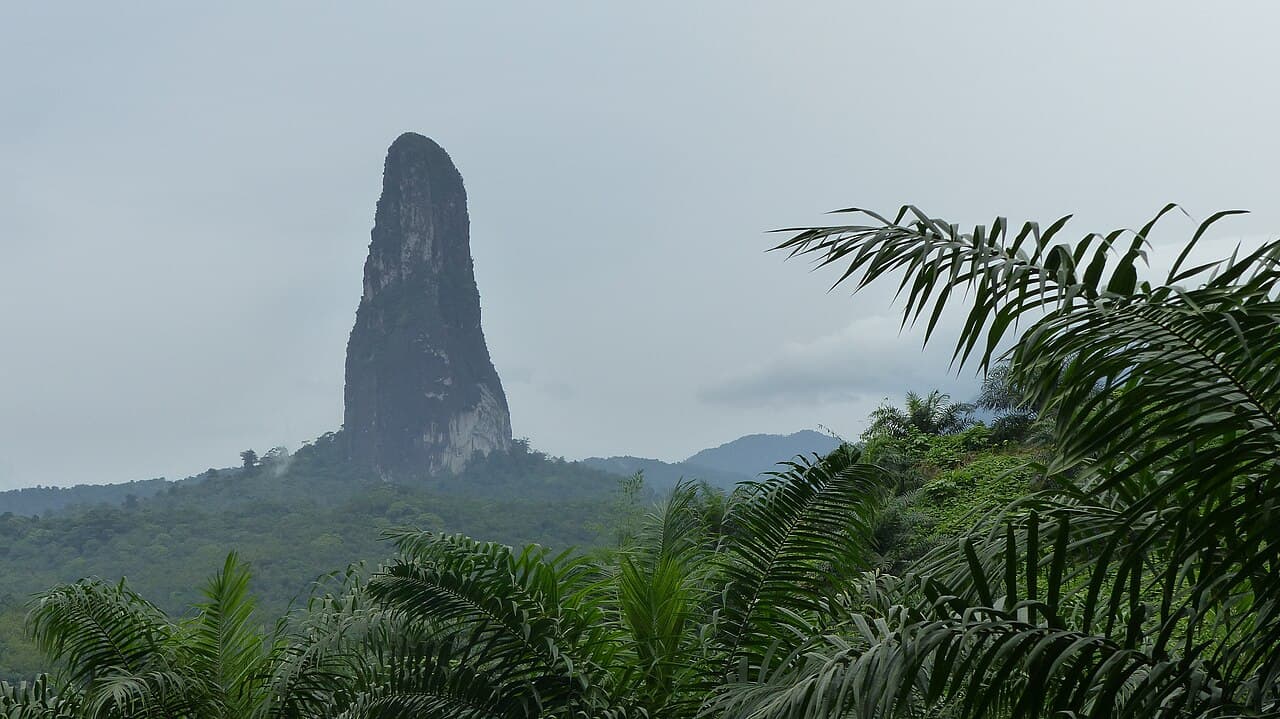
São Tomé and Príncipe is Africa's second-smallest state: two main volcanic islands and a scatter of islets totalling about a thousand square kilometres, set in the Gulf of Guinea some 250 kilometres off the coast of Gabon. The equator itself crosses the Ilhéu das Rolas at São Tomé island's southern tip. Both islands rise steeply from the sea along the Cameroon volcanic line, their interiors a spectacular tangle of rainforest, crater plugs and mist forest; the Pico Cão Grande, a needle of volcanic rock rising over 300 metres above the southern forests of São Tomé, has become the country's most photographed natural monument. That forest is of global importance, rich in endemic birds, plants and other species, and since 2024 the entire national territory has been recognised within UNESCO biosphere reserves, a world first.
Around 230,000 people live in the country, the great majority on São Tomé island, with only a few thousand on Príncipe, which has enjoyed regional autonomy since 1995. The population descends from the many streams of the islands' plantation history: the forros, the historic creole community; the angolares of the south-eastern coast; the descendants of contract labourers from Cape Verde, Angola and Mozambique; and smaller European and mixed communities. Cocoa, the crop that once made these islands famous, remains a signature export alongside coffee, pepper and a growing eco-tourism economy. The national currency is the dobra, and the unofficial national philosophy is léve-léve, "easy-easy", a gentle insistence that life is to be lived at the islands' own pace.
São Tomé. The capital, founded in the 1490s on a sheltered bay of the north-east coast, is one of the oldest European-founded towns in the tropics, and its centre keeps the low, arcaded profile of a Portuguese colonial port: pastel façades, the sixteenth-century cathedral, and shaded plazas around the old market. At the harbour mouth stands Fort São Sebastião, built in 1575, which now houses the National Museum's collection of religious art, colonial-era furnishings and testimony of the plantation age. The former customs house on the waterfront has been reborn as CACAU, a contemporary arts centre whose name abbreviates "House of Arts, Creation, Environment and Utopias", the hub of the capital's lively cultural scene.
Santo António. The capital of Príncipe, often described as one of the smallest capital towns in the world, drowses along a river mouth beneath forested peaks. Its great moment comes each August, when the town performs the Auto de Floripes, a day-long open-air drama of Moors and Christians that pours through the streets during the festivities of São Lourenço, the whole community serving as cast and audience.
Trindade. The historic heartland town of the forro community in the hills above the capital, surrounded by old cocoa country and by the villages, including Batepá, whose name is written into the national memory of 1953.
São João dos Angolares. The main settlement of the Angolar people on São Tomé's south-east coast, descendants of Africans who escaped enslavement and built a free society in the island's rugged south. The town keeps its own language and fishing traditions, and the restored Roça São João has become a renowned centre for gastronomy and the arts.
Portuguese navigators, traditionally João de Santarém and Pêro Escovar, reached uninhabited São Tomé around the feast of St Thomas in December 1471 and Príncipe soon after. Effective settlement began in 1493 under Álvaro Caminha, and among the first colonists was a group whose story still startles: some two thousand Jewish children, taken from families expelled from Spain, forcibly baptised and shipped to the island. With settlers came sugar cane and enslaved Africans from the nearby mainland, and by the mid-sixteenth century São Tomé had become the first true plantation economy of the tropics, the template, historians note, for the system later exported to Brazil and the Caribbean.
 The rocas were plantation compounds with their own hospitals, chapels and railways, worked after abolition by contract labourers whose contracts were not easy to leave. People still live in the buildings. Photograph by Alyssa K. Barry, CC BY-SA 4.0, via Wikimedia Commons.
Resistance is equally old. Enslaved people escaped into the southern forests from the earliest decades, forming the free Angolar communities, and in July 1595 an enslaved man named Amador led a mass revolt that overran much of the island; his followers proclaimed him king before the rising was crushed and Amador captured in January 1596 and executed. Rei Amador is today a national hero, commemorated each 4 January.
As sugar declined, the islands became an entrepôt of the Atlantic slave trade, then found a second plantation age in the nineteenth century: coffee arrived in 1787 and cocoa around 1820, the first cocoa grown in Africa, planted on Príncipe. The great estates known as roças spread across both islands, and by the first decade of the twentieth century this tiny colony was among the world's largest cocoa producers. The roças ran on serviçais, contract labourers recruited from Angola, Mozambique and Cape Verde under conditions that journalist Henry Nevinson exposed in 1906 as slavery in all but name, prompting British chocolate makers led by Cadbury to boycott São Toméan cocoa from 1909. Colonial violence culminated in February 1953, when the governor unleashed a wave of arrests, torture and killings against the forro population that became known as the Batepá massacre; hundreds died, and the trauma ignited the independence movement. The Movement for the Liberation of São Tomé and Príncipe led the country to independence on 12 July 1975, and after fifteen years of single-party rule the islands moved peacefully to multiparty democracy in 1990-91, among the earliest such transitions in Africa.
The islands bear saints' and princes' names from the age of navigation: São Tomé for St Thomas, whose feast fell near the day of its sighting, and Príncipe, "the Prince's island", renamed in 1502 in honour of the heir to the Portuguese throne, to whom its sugar revenues were assigned. Portuguese is the official language and is spoken by nearly the whole population, a higher share than in any other African state.
The islands' deeper linguistic heritage lies in their creoles, which rank among the oldest in the Atlantic world. From the meeting of Portuguese with West African and Bantu languages in the sixteenth century grew a Gulf of Guinea proto-creole whose daughters live on the islands today: Forro (Sãotomense), the language of the historic creole population and the vehicle of proverbs, song and storytelling; Angolar, the distinctive speech of the south-eastern fishing communities, thick with Kimbundu vocabulary carried from Angola; and Lung'Ie, "the language of the island", the creole of Príncipe. Cape Verdean creole is also widely spoken among descendants of contract labourers. Lung'Ie is critically endangered, with only a small number of fluent speakers remaining, and it has become the focus of revitalisation efforts, including radio broadcasting, new orthographic and teaching materials and school initiatives on Príncipe, work that continues against steep odds. As everywhere, each language carries an archive: to lose Lung'Ie would be to lose the islands' oldest continuous voice of Príncipe itself.
Santomean culture is creole culture: neither African tradition transplanted whole nor Portuguese culture copied, but a five-century synthesis with its own genius. Its most celebrated expression is performance. The Tchiloli, formally "The Tragedy of the Marquis of Mantua and the Emperor Charlemagne", is built on a sixteenth-century Portuguese text attributed to the Madeiran playwright Baltasar Dias: Charlemagne's son murders the nephew of the Marquis of Mantua, and the bereaved family pursues justice against the emperor's own blood. Performed in the open air by hereditary all-male troupes called tragédias, with drums, bamboo flutes, dancing, masks and costumes that mix medieval courts with top hats and office suits, the play has been continuously reworked into a Santomean meditation on power, justice and the dead. On Príncipe, the Auto de Floripes serves a similar role each August, its battles of Moors and Christians absorbing the whole of Santo António.
The Danço-Congo, regarded as the most strongly African of the islands' dramatic dances, deploys a captain, devils and drummers in a whirling allegory often read as the story of enslavement and deliverance. Social dances such as the stately ússua and the socopé, and the drum-driven puíta, animate festivals and family celebrations, while a calendar of patron-saint festivals structures the year in every town. The islands' cuisine tells the same creole story: calulu, a slow herb-and-smoked-fish stew, is the national dish, cooked with breadfruit, banana and palm oil, and the roça kitchens have lately become laboratories of a proud new Santomean gastronomy.
São Tomé and Príncipe is a predominantly Catholic country, heir to one of the oldest dioceses in sub-Saharan Africa, erected at São Tomé in 1534, and the Catholic calendar of baptisms, first communions, saints' feasts and masses for the dead frames social life. Evangelical and Adventist congregations have grown in recent decades, and small Muslim and other communities complete the picture.
As across the creole Atlantic, Catholicism on the islands lives in dialogue with African spiritual inheritances rather than in place of them. Ethnographers describe among the forros a firm conviction that the spirits of the dead are never wholly separated from the living, and healing and divination practices, including the spirit-possession ceremonies known as djambi, address misfortune by engaging that unseen world. The great performance traditions carry a devotional charge as well: Tchiloli troupes fulfil their roles as inherited obligations, performed for the community and, many say, for the dead who performed them before; the Auto de Floripes belongs to a saint's festival; and the Danço-Congo has long accompanied religious celebration. Rather than a boundary between religions, the islands offer a spectrum along which most families move without contradiction, from Sunday mass to the herbalist and the ancestors.
Death in São Tomé and Príncipe summons the community. The wake, the velório, is among the most important rituals in Santomean life: family, neighbours and friends sit with the dead through the night, praying, singing and remembering, the intensity of attendance a measure of the esteem in which the deceased was held. Ethnographic accounts record that among the forros virtually all adults are expected to take part in the ceremonies of song and dance that accompany a death, and older rites documented on the islands included offerings and animal sacrifice to accompany the departed. The funeral follows quickly in the tropical climate, normally with a mass and a procession to the cemetery.
Catholic time then organises mourning: a mass is celebrated on the seventh day after death, and further masses follow at the month and the year, gathering the family again and again around the memory of their dead. Close relatives traditionally keep nojo, the mourning period marked by black dress and withdrawal from festivity, in the Portuguese manner. On All Souls' Day in early November, families visit the cemeteries to clean and decorate graves with flowers and candles, an act of tenderness repeated across the Lusophone world. Beneath these observances runs the conviction that the dead remain close: they are consulted, appeased and honoured, and neglect of their memory is believed to invite misfortune, which gives the calendar of masses and grave visits a weight far beyond formality.
The islands also mourn collectively. The Batepá massacre of February 1953 is the deepest wound in national memory, and 3 February is a public holiday, the Day of the Martyrs of Liberty, marked by ceremonies honouring the hundreds who died; the anniversary functions as the country's day of national mourning and of gratitude to those whose deaths began the road to independence. Rei Amador, executed in 1596, is remembered each 4 January as the first liberator, his image carried on the national currency. And in a quieter register, the Tchiloli itself can be read as the nation's permanent theatre of mourning: at its centre lie a dead young man, a mother's grief and a family's refusal to let power bury the truth, re-enacted generation after generation by troupes who inherit their roles like heirlooms. Few societies have built so public a stage for the claims of the dead upon the living.
The islands were uninhabited when the Portuguese reached them around 1470, so every São Toméan family arrived, and the paperwork of arrival is the paperwork of the family.
Catholic parish registers are the oldest source and reach back several centuries in the older parishes, recording a population that included Portuguese settlers, Jewish children deported here in the 1490s, and enslaved Africans brought to work the sugar and later the cocoa.
The distinctive Sãotoméan record is the roça. The plantations ran as private estates with their own hospitals, chapels, shops and railways, and they kept registers of the contract labourers who worked them, most brought from Angola, Cape Verde and Mozambique after the formal end of slavery under arrangements that were difficult to leave. Those estate books, where they survive, are the family record for a large part of the population, and the buildings are still lived in.
Colonial administrative records are largely in Lisbon at the Arquivo Histórico Ultramarino, with the national archive in São Tomé holding what remained after independence in 1975.
The hardest date is 1953. The Batepá massacre, in which colonial authorities and settlers killed a large number of forros, the descendants of freed islanders, was not properly documented at the time and the number of dead is still argued about. Establishing who died is an active piece of national history rather than a settled one.
The keystone of institutional preservation is the National Museum in Fort São Sebastião, which since 1975 has gathered religious sculpture, plantation-era objects and historical testimony inside the islands' oldest surviving building. The state has moved in recent years to inventory and champion its intangible heritage: Tchiloli entered the National Inventory of Intangible Cultural Heritage in 2024, after new studies were launched in 2023 to rebuild documentation that had been lost, and the successful UNESCO nomination followed in December 2025, a file first attempted a decade earlier.
The roças pose the islands' greatest preservation challenge. Hundreds of plantation complexes, hospitals, great houses, workers' quarters and railways, constitute an unparalleled ensemble of agro-industrial heritage, but most have decayed since nationalisation in the 1970s, inhabited by the descendants of the workers who built them. The state has placed the roças of Monte Café, Água-Izé and Sundy on its World Heritage tentative list, and restoration has begun where heritage meets livelihood: Roça Sundy and other estates on Príncipe have been rehabilitated as heritage hotels and community enterprises linked to the island's biosphere reserve, while Roça São João hosts arts residencies and a celebrated kitchen. Príncipe's designation as a UNESCO Biosphere Reserve in 2012, extended in 2024 by the São Tomé Island reserve to make the whole country a biosphere reserve, embeds cultural heritage in a broader compact between communities and their forests and seas.
For a small country, São Tomé and Príncipe has a substantial digital memory, much of it built in partnership with the wider Lusophone world. The country's historical archive features among the collections digitised on Casa Comum, the online platform of Portugal's Mário Soares Foundation, which makes documents from the Arquivo Histórico de São Tomé e Príncipe freely consultable, and digitised newspaper collections covering the islands from the nineteenth and early twentieth centuries are available through Lusophone legal and press databases. These records, alongside the plantation registers and colonial papers held in Lisbon, are the documentary counterpart of the roças themselves, and their digitisation has opened the islands' history to a diaspora that could never consult the originals.
Architectural and scholarly documentation has surged around the roças, including systematic photographic and measured surveys published by Portuguese and Santomean researchers, which now serve as both a conservation baseline and a virtual memorial to buildings that may not survive. The Tchiloli nomination process generated fresh audiovisual documentation of the troupes after earlier records were lost, a reminder, echoed in Confinity's own mission, that memory must be recopied by every generation or it fades. Community media complete the picture: radio in creole languages, and diaspora networks that circulate photographs, funeral announcements and festival videos between the islands, Lisbon and beyond, keep the national conversation of remembrance running across an ocean.
The islands' small population has produced a remarkable literary lineage. Francisco José Tenreiro helped pioneer African-themed poetry in Portuguese; Alda Espírito Santo, poet and independence leader, wrote the words of the national anthem and stands among the great women of Lusophone letters; and Conceição Lima has carried Santomean poetry to international audiences, her collections returning again and again to the house, the dead and the islands' buried history. In music, the veteran band Africa Negra, born in the 1970s, has found a devoted global audience through recent reissues and tours, its guitar-driven puxa style now the recognised sound of the islands.
Contemporary art circulates through CACAU and the country's arts biennial, which have made the capital an unexpected node of Gulf of Guinea creativity, while chocolate has come home as heritage: bean-to-bar makers on Príncipe and premium cocoa cooperatives have rebuilt the islands' name among connoisseurs, this time on fair terms. The diaspora, concentrated in Portugal, Angola and Gabon, sustains associations, festival troupes and remittances, and the annual returns for saints' festivals and family masses knit the two Santomean worlds together. Increasingly, the country presents itself to visitors through its heritage, the Tchiloli, the roças, the biosphere forests, betting that memory, honestly told, is its most renewable resource.
Tchiloli joins humanity's heritage list. In December 2025 UNESCO inscribed the Tchiloli on the Representative List of the Intangible Cultural Heritage of Humanity, the country's first inscription, crowning a campaign begun in 2015 and rebuilt after the original documentation was lost. Recognition arrived with the tradition still vigorously alive, performed by hereditary troupes for their own communities.
A whole country becomes a biosphere reserve. Príncipe's UNESCO Biosphere Reserve of 2012 proved that a small island could bind conservation, community and heritage tourism together; the designation of the São Tomé Island reserve in 2024 extended that model to the entire national territory, making São Tomé and Príncipe the first country wholly encompassed by biosphere reserves.
The roças turn from ruin to resource. From Roça Sundy on Príncipe, where Eddington's 1919 eclipse observations first confirmed Einstein's general relativity, to Roça São João's kitchen and residencies, restored plantations are becoming schools, hotels, farms and museums, with three estates now on the World Heritage tentative list, heritage of a painful past put to work for the people who inherited it.
An archive crosses the ocean. The digitisation of the islands' historical records through Casa Comum and allied projects has given Santomeans at home and abroad free access to their documentary past, from colonial-era papers to the press of the plantation age, memory returned, this time, without conditions.
The rocas were plantation compounds with their own hospitals, chapels and railways, worked after abolition by contract labourers whose contracts were not easy to leave. People still live in the buildings. Photograph by Alyssa K. Barry, CC BY-SA 4.0, via Wikimedia Commons.
Resistance is equally old. Enslaved people escaped into the southern forests from the earliest decades, forming the free Angolar communities, and in July 1595 an enslaved man named Amador led a mass revolt that overran much of the island; his followers proclaimed him king before the rising was crushed and Amador captured in January 1596 and executed. Rei Amador is today a national hero, commemorated each 4 January.
As sugar declined, the islands became an entrepôt of the Atlantic slave trade, then found a second plantation age in the nineteenth century: coffee arrived in 1787 and cocoa around 1820, the first cocoa grown in Africa, planted on Príncipe. The great estates known as roças spread across both islands, and by the first decade of the twentieth century this tiny colony was among the world's largest cocoa producers. The roças ran on serviçais, contract labourers recruited from Angola, Mozambique and Cape Verde under conditions that journalist Henry Nevinson exposed in 1906 as slavery in all but name, prompting British chocolate makers led by Cadbury to boycott São Toméan cocoa from 1909. Colonial violence culminated in February 1953, when the governor unleashed a wave of arrests, torture and killings against the forro population that became known as the Batepá massacre; hundreds died, and the trauma ignited the independence movement. The Movement for the Liberation of São Tomé and Príncipe led the country to independence on 12 July 1975, and after fifteen years of single-party rule the islands moved peacefully to multiparty democracy in 1990-91, among the earliest such transitions in Africa.
The islands bear saints' and princes' names from the age of navigation: São Tomé for St Thomas, whose feast fell near the day of its sighting, and Príncipe, "the Prince's island", renamed in 1502 in honour of the heir to the Portuguese throne, to whom its sugar revenues were assigned. Portuguese is the official language and is spoken by nearly the whole population, a higher share than in any other African state.
The islands' deeper linguistic heritage lies in their creoles, which rank among the oldest in the Atlantic world. From the meeting of Portuguese with West African and Bantu languages in the sixteenth century grew a Gulf of Guinea proto-creole whose daughters live on the islands today: Forro (Sãotomense), the language of the historic creole population and the vehicle of proverbs, song and storytelling; Angolar, the distinctive speech of the south-eastern fishing communities, thick with Kimbundu vocabulary carried from Angola; and Lung'Ie, "the language of the island", the creole of Príncipe. Cape Verdean creole is also widely spoken among descendants of contract labourers. Lung'Ie is critically endangered, with only a small number of fluent speakers remaining, and it has become the focus of revitalisation efforts, including radio broadcasting, new orthographic and teaching materials and school initiatives on Príncipe, work that continues against steep odds. As everywhere, each language carries an archive: to lose Lung'Ie would be to lose the islands' oldest continuous voice of Príncipe itself.
Santomean culture is creole culture: neither African tradition transplanted whole nor Portuguese culture copied, but a five-century synthesis with its own genius. Its most celebrated expression is performance. The Tchiloli, formally "The Tragedy of the Marquis of Mantua and the Emperor Charlemagne", is built on a sixteenth-century Portuguese text attributed to the Madeiran playwright Baltasar Dias: Charlemagne's son murders the nephew of the Marquis of Mantua, and the bereaved family pursues justice against the emperor's own blood. Performed in the open air by hereditary all-male troupes called tragédias, with drums, bamboo flutes, dancing, masks and costumes that mix medieval courts with top hats and office suits, the play has been continuously reworked into a Santomean meditation on power, justice and the dead. On Príncipe, the Auto de Floripes serves a similar role each August, its battles of Moors and Christians absorbing the whole of Santo António.
The Danço-Congo, regarded as the most strongly African of the islands' dramatic dances, deploys a captain, devils and drummers in a whirling allegory often read as the story of enslavement and deliverance. Social dances such as the stately ússua and the socopé, and the drum-driven puíta, animate festivals and family celebrations, while a calendar of patron-saint festivals structures the year in every town. The islands' cuisine tells the same creole story: calulu, a slow herb-and-smoked-fish stew, is the national dish, cooked with breadfruit, banana and palm oil, and the roça kitchens have lately become laboratories of a proud new Santomean gastronomy.
São Tomé and Príncipe is a predominantly Catholic country, heir to one of the oldest dioceses in sub-Saharan Africa, erected at São Tomé in 1534, and the Catholic calendar of baptisms, first communions, saints' feasts and masses for the dead frames social life. Evangelical and Adventist congregations have grown in recent decades, and small Muslim and other communities complete the picture.
As across the creole Atlantic, Catholicism on the islands lives in dialogue with African spiritual inheritances rather than in place of them. Ethnographers describe among the forros a firm conviction that the spirits of the dead are never wholly separated from the living, and healing and divination practices, including the spirit-possession ceremonies known as djambi, address misfortune by engaging that unseen world. The great performance traditions carry a devotional charge as well: Tchiloli troupes fulfil their roles as inherited obligations, performed for the community and, many say, for the dead who performed them before; the Auto de Floripes belongs to a saint's festival; and the Danço-Congo has long accompanied religious celebration. Rather than a boundary between religions, the islands offer a spectrum along which most families move without contradiction, from Sunday mass to the herbalist and the ancestors.
Death in São Tomé and Príncipe summons the community. The wake, the velório, is among the most important rituals in Santomean life: family, neighbours and friends sit with the dead through the night, praying, singing and remembering, the intensity of attendance a measure of the esteem in which the deceased was held. Ethnographic accounts record that among the forros virtually all adults are expected to take part in the ceremonies of song and dance that accompany a death, and older rites documented on the islands included offerings and animal sacrifice to accompany the departed. The funeral follows quickly in the tropical climate, normally with a mass and a procession to the cemetery.
Catholic time then organises mourning: a mass is celebrated on the seventh day after death, and further masses follow at the month and the year, gathering the family again and again around the memory of their dead. Close relatives traditionally keep nojo, the mourning period marked by black dress and withdrawal from festivity, in the Portuguese manner. On All Souls' Day in early November, families visit the cemeteries to clean and decorate graves with flowers and candles, an act of tenderness repeated across the Lusophone world. Beneath these observances runs the conviction that the dead remain close: they are consulted, appeased and honoured, and neglect of their memory is believed to invite misfortune, which gives the calendar of masses and grave visits a weight far beyond formality.
The islands also mourn collectively. The Batepá massacre of February 1953 is the deepest wound in national memory, and 3 February is a public holiday, the Day of the Martyrs of Liberty, marked by ceremonies honouring the hundreds who died; the anniversary functions as the country's day of national mourning and of gratitude to those whose deaths began the road to independence. Rei Amador, executed in 1596, is remembered each 4 January as the first liberator, his image carried on the national currency. And in a quieter register, the Tchiloli itself can be read as the nation's permanent theatre of mourning: at its centre lie a dead young man, a mother's grief and a family's refusal to let power bury the truth, re-enacted generation after generation by troupes who inherit their roles like heirlooms. Few societies have built so public a stage for the claims of the dead upon the living.
The islands were uninhabited when the Portuguese reached them around 1470, so every São Toméan family arrived, and the paperwork of arrival is the paperwork of the family.
Catholic parish registers are the oldest source and reach back several centuries in the older parishes, recording a population that included Portuguese settlers, Jewish children deported here in the 1490s, and enslaved Africans brought to work the sugar and later the cocoa.
The distinctive Sãotoméan record is the roça. The plantations ran as private estates with their own hospitals, chapels, shops and railways, and they kept registers of the contract labourers who worked them, most brought from Angola, Cape Verde and Mozambique after the formal end of slavery under arrangements that were difficult to leave. Those estate books, where they survive, are the family record for a large part of the population, and the buildings are still lived in.
Colonial administrative records are largely in Lisbon at the Arquivo Histórico Ultramarino, with the national archive in São Tomé holding what remained after independence in 1975.
The hardest date is 1953. The Batepá massacre, in which colonial authorities and settlers killed a large number of forros, the descendants of freed islanders, was not properly documented at the time and the number of dead is still argued about. Establishing who died is an active piece of national history rather than a settled one.
The keystone of institutional preservation is the National Museum in Fort São Sebastião, which since 1975 has gathered religious sculpture, plantation-era objects and historical testimony inside the islands' oldest surviving building. The state has moved in recent years to inventory and champion its intangible heritage: Tchiloli entered the National Inventory of Intangible Cultural Heritage in 2024, after new studies were launched in 2023 to rebuild documentation that had been lost, and the successful UNESCO nomination followed in December 2025, a file first attempted a decade earlier.
The roças pose the islands' greatest preservation challenge. Hundreds of plantation complexes, hospitals, great houses, workers' quarters and railways, constitute an unparalleled ensemble of agro-industrial heritage, but most have decayed since nationalisation in the 1970s, inhabited by the descendants of the workers who built them. The state has placed the roças of Monte Café, Água-Izé and Sundy on its World Heritage tentative list, and restoration has begun where heritage meets livelihood: Roça Sundy and other estates on Príncipe have been rehabilitated as heritage hotels and community enterprises linked to the island's biosphere reserve, while Roça São João hosts arts residencies and a celebrated kitchen. Príncipe's designation as a UNESCO Biosphere Reserve in 2012, extended in 2024 by the São Tomé Island reserve to make the whole country a biosphere reserve, embeds cultural heritage in a broader compact between communities and their forests and seas.
For a small country, São Tomé and Príncipe has a substantial digital memory, much of it built in partnership with the wider Lusophone world. The country's historical archive features among the collections digitised on Casa Comum, the online platform of Portugal's Mário Soares Foundation, which makes documents from the Arquivo Histórico de São Tomé e Príncipe freely consultable, and digitised newspaper collections covering the islands from the nineteenth and early twentieth centuries are available through Lusophone legal and press databases. These records, alongside the plantation registers and colonial papers held in Lisbon, are the documentary counterpart of the roças themselves, and their digitisation has opened the islands' history to a diaspora that could never consult the originals.
Architectural and scholarly documentation has surged around the roças, including systematic photographic and measured surveys published by Portuguese and Santomean researchers, which now serve as both a conservation baseline and a virtual memorial to buildings that may not survive. The Tchiloli nomination process generated fresh audiovisual documentation of the troupes after earlier records were lost, a reminder, echoed in Confinity's own mission, that memory must be recopied by every generation or it fades. Community media complete the picture: radio in creole languages, and diaspora networks that circulate photographs, funeral announcements and festival videos between the islands, Lisbon and beyond, keep the national conversation of remembrance running across an ocean.
The islands' small population has produced a remarkable literary lineage. Francisco José Tenreiro helped pioneer African-themed poetry in Portuguese; Alda Espírito Santo, poet and independence leader, wrote the words of the national anthem and stands among the great women of Lusophone letters; and Conceição Lima has carried Santomean poetry to international audiences, her collections returning again and again to the house, the dead and the islands' buried history. In music, the veteran band Africa Negra, born in the 1970s, has found a devoted global audience through recent reissues and tours, its guitar-driven puxa style now the recognised sound of the islands.
Contemporary art circulates through CACAU and the country's arts biennial, which have made the capital an unexpected node of Gulf of Guinea creativity, while chocolate has come home as heritage: bean-to-bar makers on Príncipe and premium cocoa cooperatives have rebuilt the islands' name among connoisseurs, this time on fair terms. The diaspora, concentrated in Portugal, Angola and Gabon, sustains associations, festival troupes and remittances, and the annual returns for saints' festivals and family masses knit the two Santomean worlds together. Increasingly, the country presents itself to visitors through its heritage, the Tchiloli, the roças, the biosphere forests, betting that memory, honestly told, is its most renewable resource.
Tchiloli joins humanity's heritage list. In December 2025 UNESCO inscribed the Tchiloli on the Representative List of the Intangible Cultural Heritage of Humanity, the country's first inscription, crowning a campaign begun in 2015 and rebuilt after the original documentation was lost. Recognition arrived with the tradition still vigorously alive, performed by hereditary troupes for their own communities.
A whole country becomes a biosphere reserve. Príncipe's UNESCO Biosphere Reserve of 2012 proved that a small island could bind conservation, community and heritage tourism together; the designation of the São Tomé Island reserve in 2024 extended that model to the entire national territory, making São Tomé and Príncipe the first country wholly encompassed by biosphere reserves.
The roças turn from ruin to resource. From Roça Sundy on Príncipe, where Eddington's 1919 eclipse observations first confirmed Einstein's general relativity, to Roça São João's kitchen and residencies, restored plantations are becoming schools, hotels, farms and museums, with three estates now on the World Heritage tentative list, heritage of a painful past put to work for the people who inherited it.
An archive crosses the ocean. The digitisation of the islands' historical records through Casa Comum and allied projects has given Santomeans at home and abroad free access to their documentary past, from colonial-era papers to the press of the plantation age, memory returned, this time, without conditions.
National Overview
Notable Cities
Historical Foundations
Linguistic and Etymological Roots
Cultural Identity
Religion and Spirituality
Remembrance and Mourning Traditions
Tracing a Family in São Tomé and Príncipe
Heritage Preservation Efforts
Digital Heritage
Contemporary Cultural Influences
Success Stories
References and resources
- UNESCO Intangible Cultural Heritage: São Tomé and Príncipe state page
- Club of Mozambique: São Tomé's Tchiloli inscribed on UNESCO Intangible Cultural Heritage list (December 2025)
- UNESCO World Heritage Centre tentative list: The roças of Monte Café, Água-Izé and Sundy
- UNESCO Man and the Biosphere Programme: Island of Príncipe
- UNESCO Man and the Biosphere Programme: Ilha de São Tomé
- Wikipedia: Batepá massacre
- Wikipedia: Rei Amador
- Wikipedia: Eddington experiment (Príncipe, 1919)
- Everyculture: Culture of São Tomé e Príncipe
- Ethnologue: Principense (Lung'Ie)