Heritage · Country
Portugal Culture and Heritage
Over the door of a chapel in Évora, five thousand monks' bones spell out a greeting to the living: we who are here await you. A guide to Portugal's heritage, its seafaring past and layered faiths, and the particular tenderness with which the Portuguese hold on to what is gone.Written to last.
By Confinity Heritage Editorial · 2026-07-11 · 8-minute readQuiet tools, kept out of the way.
Above the entrance to a small chapel beside the church of St Francis in Évora runs a line that stops most visitors where they stand: "Nós ossos que aqui estamos pelos vossos esperamos", we bones that are here await yours. Inside, the walls and pillars of the Capela dos Ossos are faced entirely with human bones and skulls, the remains of perhaps five thousand people, arranged in careful patterns by Franciscan monks who wanted the living to think about death while they still had time. It is not a morbid oddity so much as a very Portuguese statement, made in stone and bone, that the dead are not elsewhere but here, waiting, and that remembering them is the ordinary business of the living.
That sensibility has a name the Portuguese consider untranslatable: saudade, a longing for something or someone absent, shot through with tenderness rather than despair. It runs through the country's most famous music, the fado, sung in the lamplit taverns of Lisbon and Coimbra and now protected as world heritage; through its poetry, from the sixteenth-century poem of a small nation's improbable voyages to the melancholy of Fernando Pessoa; and through the black-clad widows of its villages, who once mourned for the rest of their lives.
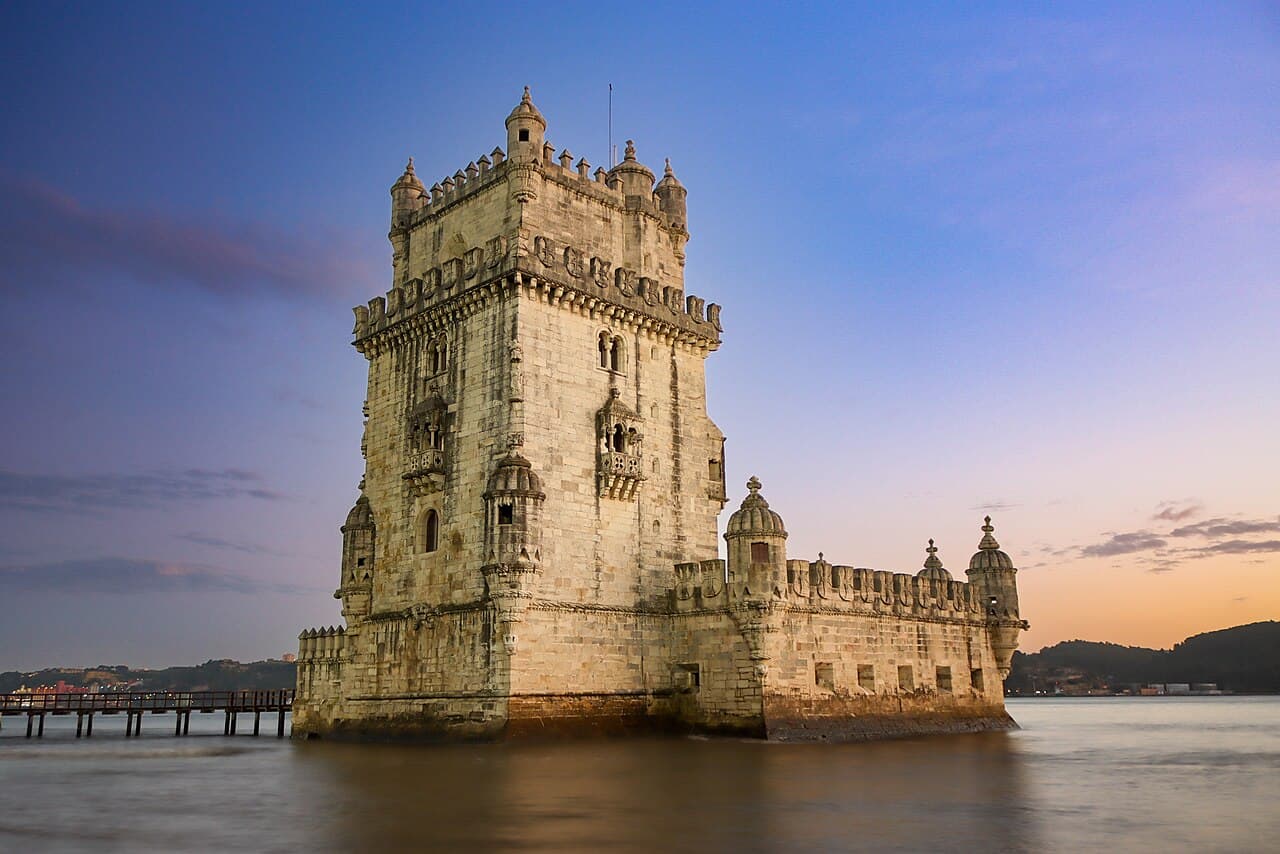
 The Belém Tower on the Tagus, built between 1514 and 1520 and a UNESCO World Heritage Site. CC BY 2.0, via Wikimedia Commons.
Portugal occupies the western strip of the Iberian Peninsula, about 92,000 square kilometres bordered only by Spain on land and by the Atlantic along its whole western and southern edge. Its mainland runs from the green, rainy Minho in the north through the terraced valleys of the Douro and the rolling cork-oak plains of the Alentejo to the beaches of the Algarve, with the Serra da Estrela rising to nearly two thousand metres in the interior. Two archipelagos far out in the Atlantic, the Azores and Madeira, are autonomous regions of the republic and add volcanic peaks, laurel forest and a maritime reach that has always shaped the country's outlook.
About ten million people live in Portugal, roughly a quarter of them around Lisbon, the capital, with Porto anchoring a second metropolitan region in the north. It is a semi-presidential republic, a member of the European Union since 1986 and of the euro, and one of the oldest nation-states in Europe: its land borders have barely moved since the thirteenth century. For a small country it has an outsized global footprint, the legacy of an empire that once reached Brazil, Africa, India, Macau and Timor, and Portuguese is now among the most widely spoken languages on earth. Emigration has been a constant, so that the story of modern Portugal is partly the story of the millions who left and the ties they kept to the villages they came from.
Lisbon. Built on seven hills above the Tagus estuary, the capital is a palimpsest of Moorish castle, medieval Alfama and the geometric Baixa rebuilt after the 1755 earthquake. Its yellow trams grind up lanes too steep for buses, its miradouros look out over a red-tiled city, and its Belém district keeps the monastery and tower from which the age of discovery set sail. Lisbon is the birthplace of fado, the home of the National Pantheon, and a city whose patron saint, Anthony, is celebrated each June with sardines, paper garlands and mass weddings.
Porto. The hard-working city that gave the country and port wine their names sits where the Douro meets the sea, its steep Ribeira quarter tumbling down to the river opposite the wine lodges of Vila Nova de Gaia. Its historic centre is a World Heritage Site; its landmarks include the tiled façade of the São Bento railway station, the ornate Lello bookshop and the Clérigos tower, and its people mark the feast of St John each 24 June with an all-night street party of bonfires and, oddly, plastic hammers.
The Belém Tower on the Tagus, built between 1514 and 1520 and a UNESCO World Heritage Site. CC BY 2.0, via Wikimedia Commons.
Portugal occupies the western strip of the Iberian Peninsula, about 92,000 square kilometres bordered only by Spain on land and by the Atlantic along its whole western and southern edge. Its mainland runs from the green, rainy Minho in the north through the terraced valleys of the Douro and the rolling cork-oak plains of the Alentejo to the beaches of the Algarve, with the Serra da Estrela rising to nearly two thousand metres in the interior. Two archipelagos far out in the Atlantic, the Azores and Madeira, are autonomous regions of the republic and add volcanic peaks, laurel forest and a maritime reach that has always shaped the country's outlook.
About ten million people live in Portugal, roughly a quarter of them around Lisbon, the capital, with Porto anchoring a second metropolitan region in the north. It is a semi-presidential republic, a member of the European Union since 1986 and of the euro, and one of the oldest nation-states in Europe: its land borders have barely moved since the thirteenth century. For a small country it has an outsized global footprint, the legacy of an empire that once reached Brazil, Africa, India, Macau and Timor, and Portuguese is now among the most widely spoken languages on earth. Emigration has been a constant, so that the story of modern Portugal is partly the story of the millions who left and the ties they kept to the villages they came from.
Lisbon. Built on seven hills above the Tagus estuary, the capital is a palimpsest of Moorish castle, medieval Alfama and the geometric Baixa rebuilt after the 1755 earthquake. Its yellow trams grind up lanes too steep for buses, its miradouros look out over a red-tiled city, and its Belém district keeps the monastery and tower from which the age of discovery set sail. Lisbon is the birthplace of fado, the home of the National Pantheon, and a city whose patron saint, Anthony, is celebrated each June with sardines, paper garlands and mass weddings.
Porto. The hard-working city that gave the country and port wine their names sits where the Douro meets the sea, its steep Ribeira quarter tumbling down to the river opposite the wine lodges of Vila Nova de Gaia. Its historic centre is a World Heritage Site; its landmarks include the tiled façade of the São Bento railway station, the ornate Lello bookshop and the Clérigos tower, and its people mark the feast of St John each 24 June with an all-night street party of bonfires and, oddly, plastic hammers.
.jpg%2F1280px-Porto_view_from_Vila_Nova_de_Gaia_(27078365799).jpg&w=3840&q=75) The Ribeira district of Porto on the Douro, a UNESCO World Heritage Site, seen from Vila Nova de Gaia. CC BY 2.0, via Wikimedia Commons.
Coimbra. For centuries the seat of Portugal's only university, founded in 1290 and among the oldest in continuous operation in the world, Coimbra keeps a hillside old town crowned by the Baroque Joanina Library and the ceremonial black capes of its students. It has its own gentler, male-sung form of fado, and its university buildings joined the World Heritage list in 2013.
Évora. The chief city of the Alentejo preserves nearly two thousand years within its walls: a Roman temple still standing in the centre, a cathedral, a Jesuit university and the Chapel of Bones. Its whitewashed historic centre is a World Heritage Site, and the surrounding plain is dotted with prehistoric standing stones older than Stonehenge.
Guimarães. In the north, Guimarães calls itself the birthplace of the nation, and a tiled wall in the old town declares "Aqui nasceu Portugal", Portugal was born here, from the medieval county and castle where the first king rose. Its exceptionally preserved centre was inscribed by UNESCO, and in 2012 it served as a European Capital of Culture.
Portugal's territory was Roman Lusitania, then held by the Suebi and Visigoths, and from 711 largely by the Moors, whose long presence in the south left castles, irrigation and a wealth of place names. The Christian reconquest pushed down from the north, and in 1139 Afonso Henriques, count of the small territory around the Douro, declared himself king; by 1249, with the taking of the Algarve, Portugal reached the borders it still keeps, fixed by treaty with Castile in 1297 and among the oldest stable frontiers in Europe. Secure and Atlantic-facing, the little kingdom turned to the sea.
The fifteenth and sixteenth centuries made Portugal, for a moment, a world power. Sponsored by princes such as Henry, later called the Navigator, and driven by a mix of crusade, commerce and curiosity, Portuguese captains crept down the African coast, rounded the Cape of Good Hope with Bartolomeu Dias in 1488, reached India with Vasco da Gama in 1498, and made landfall in Brazil with Pedro Álvares Cabral in 1500. The wealth of the spice trade paid for the exuberant Manueline architecture of Belém, and the poem of the voyages was written into the national soul by Luís de Camões in "Os Lusíadas" of 1572. Then came reverses: a king lost on crusade in Morocco, sixty years of Spanish rule from 1580 until the Restoration of independence under the House of Braganza in 1640, and, on All Saints' Day 1755, a catastrophe that shook the whole enterprise to its foundations.
The Ribeira district of Porto on the Douro, a UNESCO World Heritage Site, seen from Vila Nova de Gaia. CC BY 2.0, via Wikimedia Commons.
Coimbra. For centuries the seat of Portugal's only university, founded in 1290 and among the oldest in continuous operation in the world, Coimbra keeps a hillside old town crowned by the Baroque Joanina Library and the ceremonial black capes of its students. It has its own gentler, male-sung form of fado, and its university buildings joined the World Heritage list in 2013.
Évora. The chief city of the Alentejo preserves nearly two thousand years within its walls: a Roman temple still standing in the centre, a cathedral, a Jesuit university and the Chapel of Bones. Its whitewashed historic centre is a World Heritage Site, and the surrounding plain is dotted with prehistoric standing stones older than Stonehenge.
Guimarães. In the north, Guimarães calls itself the birthplace of the nation, and a tiled wall in the old town declares "Aqui nasceu Portugal", Portugal was born here, from the medieval county and castle where the first king rose. Its exceptionally preserved centre was inscribed by UNESCO, and in 2012 it served as a European Capital of Culture.
Portugal's territory was Roman Lusitania, then held by the Suebi and Visigoths, and from 711 largely by the Moors, whose long presence in the south left castles, irrigation and a wealth of place names. The Christian reconquest pushed down from the north, and in 1139 Afonso Henriques, count of the small territory around the Douro, declared himself king; by 1249, with the taking of the Algarve, Portugal reached the borders it still keeps, fixed by treaty with Castile in 1297 and among the oldest stable frontiers in Europe. Secure and Atlantic-facing, the little kingdom turned to the sea.
The fifteenth and sixteenth centuries made Portugal, for a moment, a world power. Sponsored by princes such as Henry, later called the Navigator, and driven by a mix of crusade, commerce and curiosity, Portuguese captains crept down the African coast, rounded the Cape of Good Hope with Bartolomeu Dias in 1488, reached India with Vasco da Gama in 1498, and made landfall in Brazil with Pedro Álvares Cabral in 1500. The wealth of the spice trade paid for the exuberant Manueline architecture of Belém, and the poem of the voyages was written into the national soul by Luís de Camões in "Os Lusíadas" of 1572. Then came reverses: a king lost on crusade in Morocco, sixty years of Spanish rule from 1580 until the Restoration of independence under the House of Braganza in 1640, and, on All Saints' Day 1755, a catastrophe that shook the whole enterprise to its foundations.
 A contemporary copper engraving of the 1755 Lisbon earthquake, tsunami and fires. Public domain, via Wikimedia Commons.
The great earthquake of 1 November 1755, followed by a tsunami and days of fire, destroyed much of Lisbon and killed tens of thousands, many of them crushed in churches packed for the feast of All Saints. The disaster shook European thought as well, feeding Voltaire's attack on easy optimism and the wider debate of the Enlightenment, and it produced in the Marquis of Pombal a ruthless modern reformer who rebuilt the city centre on a rational grid, using timber "cage" frames designed to survive future shocks. The following centuries brought Napoleonic invasion and the flight of the court to Brazil, the loss of Brazil itself in 1822, the fall of the monarchy in 1910, the long authoritarian Estado Novo of António de Oliveira Salazar, a draining colonial war in Africa, and finally the near-bloodless Carnation Revolution of 25 April 1974, which restored democracy, ended the empire and set Portugal on its European course.
Portuguese grew out of the Latin brought by Rome, developed in the north-west as Galician-Portuguese, and spread south with the reconquest until it became the language of the whole kingdom. It is now spoken by well over two hundred and fifty million people, the great majority of them in Brazil, and across Angola, Mozambique and the other former colonies, making it one of the world's major languages and the binding thread of the Lusophone community. The country's name is itself a fossil of its origins: Portugal derives from Portus Cale, the Roman and early medieval port at the mouth of the Douro, the twin settlements that became Porto and Gaia and lent their name first to a county and then to a nation.
The map preserves the country's layered past. Arabic names left by the Moors cluster in the centre and south: the Algarve is al-Gharb, "the west" of Al-Andalus; Lisbon's oldest quarter, the Alfama, takes its name from the Arabic for springs or baths; and the shrine town of Fátima carries, by tradition, the name of a Moorish girl. Roman and pre-Roman roots underlie the north, and in one remote corner of Trás-os-Montes, around Miranda do Douro, people still speak Mirandese, a language of the Asturleonese family that Portugal recognised as co-official in 1999, giving a few thousand speakers of a threatened tongue the legal standing their ancestors never had.
Portuguese daily life is bound up with a handful of things it does with unusual devotion. It covers its buildings, inside and out, with azulejos, the painted ceramic tiles that turn train stations, churches and ordinary house fronts into picture galleries. It builds much of its cuisine around bacalhau, salt cod brought back from the North Atlantic and said to have a thousand and one preparations, and finishes with the pastel de nata, the custard tart perfected by monks in Belém. It is the world's largest producer of cork, stripped by hand from the oaks of the Alentejo, and the maker of port and Madeira, fortified wines that carry Portuguese place names around the globe.
Above all it has fado, the urban song of longing that emerged in the taverns of nineteenth-century Lisbon and found its greatest voice in Amália Rodrigues, whose recordings made the music a national emblem and who was mourned as a head of state when she died in 1999. Football is the other great popular passion, a country of ten million that has produced Eusébio and Cristiano Ronaldo and won the European Championship in 2016. The literary inheritance is deep for so small a nation: Camões, whose death is marked on Portugal's national day, the poet-of-many-selves Fernando Pessoa, and José Saramago, who won the Nobel Prize in Literature in 1998. Folk custom survives strongly in the north and interior, from the pagan-tinged winter masquerades of Trás-os-Montes to the popular saints' festivals that fill Lisbon and Porto with grilled sardines and music each June.
Portugal has been Roman Catholic since the reconquest, and although regular churchgoing has fallen sharply, about four in five people still identify with the Church, and its calendar of saints, processions and pilgrimages remains woven into the year. The country's faith is intensely local, organised around patron saints, village chapels and the elaborate Holy Week processions of towns like Braga, the ecclesiastical capital, where the great stairway of Bom Jesus do Monte climbs the hillside in stages of penitence and was added to the World Heritage list in 2019.
The most powerful modern site of devotion is Fátima. In 1917 three shepherd children reported repeated visions of the Virgin Mary in a field called the Cova da Iria, and the shrine that grew there now draws millions of pilgrims a year, many walking for days across the country to arrive for the anniversaries of 13 May and 13 October; two of the children, Francisco and Jacinta Marto, were declared saints on the centenary in 2017. Portugal's religious heritage also carries a darker, older story. The Jews expelled or forcibly converted under King Manuel in 1496 and 1497, and massacred in Lisbon in 1506, left synagogues such as the one preserved at Tomar and a hidden community at Belmonte, where families secretly kept Jewish practice for five centuries. The republic has more recently offered citizenship to their Sephardic descendants and restored parts of this buried inheritance to public view.
Portuguese mourning is Catholic in form and personal in intensity. A death traditionally brought a velório, a wake at which the body was watched through the night, and then a funeral Mass and burial, often in an above-ground family vault in one of the walled cemeteries that sit at the edge of every town. In the villages, and above all in the fishing communities such as Nazaré, women who lost husbands wore black for the rest of their lives, the luto or mourning that could last decades and marked a widow to the whole community; the custom has faded but is still visible among the old. On the first of November, the Dia de Todos os Santos, and the days around it, families clean and dress the graves with chrysanthemums and candles, so that the cemeteries fill with light and flowers in an annual reunion with the dead.
Grief in Portugal has also found a musical and civic language. Fado, with its saudade for absent loves, drowned sailors and a vanished past, is in part a music of loss, and its performance in memory of the dead is common; the state has honoured its great singers by moving them to the Panteão Nacional, the national pantheon in the domed church of Santa Engrácia in Lisbon, where Amália Rodrigues was reinterred in 2001 alongside presidents, writers and, since 2015, the footballer Eusébio. The monastery at Belém serves a similar role for the age of discovery, holding the tombs of Vasco da Gama and of Camões, brought together in the nineteenth century as a national shrine to the seafaring past.
The country's largest collective memory is of catastrophe and of empire. The 1755 earthquake, striking during All Saints' Mass, entered the national imagination as a wound and a warning, and its anniversary still overlaps with the day of the dead. The thirteen years of colonial war in Africa, which ended with the revolution of 1974, cost thousands of Portuguese and far more African lives and returned some half a million retornados, settlers who came "home" to a country many had never lived in; monuments to the overseas combatants now stand in Lisbon and other cities, and the reckoning with the empire's slaving past has become one of the sharpest public debates in the country. Remembrance in Portugal, as so often, is both an act of love for the individual dead and an argument about what the nation was.
Portuguese parish registers are old, well kept and, unusually, free. Baptisms, marriages and burials survive from the sixteenth century in many parishes, and the district archives have digitised a great deal and publish the images without charge, so a family from the Minho or the Algarve can often be followed for three hundred years from a laptop.
Civil registration was introduced for non-Catholics in 1832 and made compulsory for everyone from 1911, after the Republic, and the two systems overlap for a long time. Before 1911 the church record is the record.
Portugal's particular gift to genealogy is the notarial archive. Portuguese notaries recorded dowries, wills, land transfers, emigration permissions and passport applications in enormous quantity, and those books frequently name relationships that the parish register does not. The passport records are especially useful, because they list the destination, and Portuguese emigration went in every direction at once: to Brazil above all, then to the United States and Canada, to Venezuela, to France, to Germany and to the African colonies.
The colonial dimension complicates and enriches it. Records for Goa, Macau, Angola, Mozambique, Cape Verde and São Tomé were kept to the metropolitan pattern, and much of that material sits in Lisbon at the Arquivo Histórico Ultramarino. For families in the former colonies, and for the retornados who arrived in Portugal after 1975, the papers of a life lived elsewhere are often filed in the capital of the country they left.
Portugal manages its heritage through the Directorate-General for Cultural Heritage, the DGPC, which oversees national monuments, museums and archaeology, and through a dense network of municipal and regional bodies. The country's written memory is kept above all in the Torre do Tombo, the national archive in Lisbon whose records reach back to the Middle Ages and which is one of the oldest continuously functioning archives in the world, and in the National Library. Restoration campaigns after the 1755 earthquake, and again in the twentieth century, saved much of the country's medieval and Manueline fabric, though not always with modern scruples about authenticity.
Portugal holds seventeen UNESCO World Heritage Sites, sixteen cultural and one natural, a remarkable number for its size. They span the whole story of the country: the monastery and tower of Belém and the abbeys of Batalha and Alcobaça; the Convent of Christ at Tomar, once a Templar stronghold; the historic centres of Évora, Porto, Guimarães and the border fortress town of Elvas; the cultural landscape of Sintra with its romantic palaces; the terraced vineyards of the Alto Douro and the volcanic vineyard walls of Pico in the Azores; the Palaeolithic rock art of the Côa Valley; the University of Coimbra; and, added in 2019, the royal palace and hunting park of Mafra and the sanctuary of Bom Jesus do Monte in Braga. The one natural site, the ancient laurel forest of Madeira, preserves a woodland that once covered much of southern Europe.
A contemporary copper engraving of the 1755 Lisbon earthquake, tsunami and fires. Public domain, via Wikimedia Commons.
The great earthquake of 1 November 1755, followed by a tsunami and days of fire, destroyed much of Lisbon and killed tens of thousands, many of them crushed in churches packed for the feast of All Saints. The disaster shook European thought as well, feeding Voltaire's attack on easy optimism and the wider debate of the Enlightenment, and it produced in the Marquis of Pombal a ruthless modern reformer who rebuilt the city centre on a rational grid, using timber "cage" frames designed to survive future shocks. The following centuries brought Napoleonic invasion and the flight of the court to Brazil, the loss of Brazil itself in 1822, the fall of the monarchy in 1910, the long authoritarian Estado Novo of António de Oliveira Salazar, a draining colonial war in Africa, and finally the near-bloodless Carnation Revolution of 25 April 1974, which restored democracy, ended the empire and set Portugal on its European course.
Portuguese grew out of the Latin brought by Rome, developed in the north-west as Galician-Portuguese, and spread south with the reconquest until it became the language of the whole kingdom. It is now spoken by well over two hundred and fifty million people, the great majority of them in Brazil, and across Angola, Mozambique and the other former colonies, making it one of the world's major languages and the binding thread of the Lusophone community. The country's name is itself a fossil of its origins: Portugal derives from Portus Cale, the Roman and early medieval port at the mouth of the Douro, the twin settlements that became Porto and Gaia and lent their name first to a county and then to a nation.
The map preserves the country's layered past. Arabic names left by the Moors cluster in the centre and south: the Algarve is al-Gharb, "the west" of Al-Andalus; Lisbon's oldest quarter, the Alfama, takes its name from the Arabic for springs or baths; and the shrine town of Fátima carries, by tradition, the name of a Moorish girl. Roman and pre-Roman roots underlie the north, and in one remote corner of Trás-os-Montes, around Miranda do Douro, people still speak Mirandese, a language of the Asturleonese family that Portugal recognised as co-official in 1999, giving a few thousand speakers of a threatened tongue the legal standing their ancestors never had.
Portuguese daily life is bound up with a handful of things it does with unusual devotion. It covers its buildings, inside and out, with azulejos, the painted ceramic tiles that turn train stations, churches and ordinary house fronts into picture galleries. It builds much of its cuisine around bacalhau, salt cod brought back from the North Atlantic and said to have a thousand and one preparations, and finishes with the pastel de nata, the custard tart perfected by monks in Belém. It is the world's largest producer of cork, stripped by hand from the oaks of the Alentejo, and the maker of port and Madeira, fortified wines that carry Portuguese place names around the globe.
Above all it has fado, the urban song of longing that emerged in the taverns of nineteenth-century Lisbon and found its greatest voice in Amália Rodrigues, whose recordings made the music a national emblem and who was mourned as a head of state when she died in 1999. Football is the other great popular passion, a country of ten million that has produced Eusébio and Cristiano Ronaldo and won the European Championship in 2016. The literary inheritance is deep for so small a nation: Camões, whose death is marked on Portugal's national day, the poet-of-many-selves Fernando Pessoa, and José Saramago, who won the Nobel Prize in Literature in 1998. Folk custom survives strongly in the north and interior, from the pagan-tinged winter masquerades of Trás-os-Montes to the popular saints' festivals that fill Lisbon and Porto with grilled sardines and music each June.
Portugal has been Roman Catholic since the reconquest, and although regular churchgoing has fallen sharply, about four in five people still identify with the Church, and its calendar of saints, processions and pilgrimages remains woven into the year. The country's faith is intensely local, organised around patron saints, village chapels and the elaborate Holy Week processions of towns like Braga, the ecclesiastical capital, where the great stairway of Bom Jesus do Monte climbs the hillside in stages of penitence and was added to the World Heritage list in 2019.
The most powerful modern site of devotion is Fátima. In 1917 three shepherd children reported repeated visions of the Virgin Mary in a field called the Cova da Iria, and the shrine that grew there now draws millions of pilgrims a year, many walking for days across the country to arrive for the anniversaries of 13 May and 13 October; two of the children, Francisco and Jacinta Marto, were declared saints on the centenary in 2017. Portugal's religious heritage also carries a darker, older story. The Jews expelled or forcibly converted under King Manuel in 1496 and 1497, and massacred in Lisbon in 1506, left synagogues such as the one preserved at Tomar and a hidden community at Belmonte, where families secretly kept Jewish practice for five centuries. The republic has more recently offered citizenship to their Sephardic descendants and restored parts of this buried inheritance to public view.
Portuguese mourning is Catholic in form and personal in intensity. A death traditionally brought a velório, a wake at which the body was watched through the night, and then a funeral Mass and burial, often in an above-ground family vault in one of the walled cemeteries that sit at the edge of every town. In the villages, and above all in the fishing communities such as Nazaré, women who lost husbands wore black for the rest of their lives, the luto or mourning that could last decades and marked a widow to the whole community; the custom has faded but is still visible among the old. On the first of November, the Dia de Todos os Santos, and the days around it, families clean and dress the graves with chrysanthemums and candles, so that the cemeteries fill with light and flowers in an annual reunion with the dead.
Grief in Portugal has also found a musical and civic language. Fado, with its saudade for absent loves, drowned sailors and a vanished past, is in part a music of loss, and its performance in memory of the dead is common; the state has honoured its great singers by moving them to the Panteão Nacional, the national pantheon in the domed church of Santa Engrácia in Lisbon, where Amália Rodrigues was reinterred in 2001 alongside presidents, writers and, since 2015, the footballer Eusébio. The monastery at Belém serves a similar role for the age of discovery, holding the tombs of Vasco da Gama and of Camões, brought together in the nineteenth century as a national shrine to the seafaring past.
The country's largest collective memory is of catastrophe and of empire. The 1755 earthquake, striking during All Saints' Mass, entered the national imagination as a wound and a warning, and its anniversary still overlaps with the day of the dead. The thirteen years of colonial war in Africa, which ended with the revolution of 1974, cost thousands of Portuguese and far more African lives and returned some half a million retornados, settlers who came "home" to a country many had never lived in; monuments to the overseas combatants now stand in Lisbon and other cities, and the reckoning with the empire's slaving past has become one of the sharpest public debates in the country. Remembrance in Portugal, as so often, is both an act of love for the individual dead and an argument about what the nation was.
Portuguese parish registers are old, well kept and, unusually, free. Baptisms, marriages and burials survive from the sixteenth century in many parishes, and the district archives have digitised a great deal and publish the images without charge, so a family from the Minho or the Algarve can often be followed for three hundred years from a laptop.
Civil registration was introduced for non-Catholics in 1832 and made compulsory for everyone from 1911, after the Republic, and the two systems overlap for a long time. Before 1911 the church record is the record.
Portugal's particular gift to genealogy is the notarial archive. Portuguese notaries recorded dowries, wills, land transfers, emigration permissions and passport applications in enormous quantity, and those books frequently name relationships that the parish register does not. The passport records are especially useful, because they list the destination, and Portuguese emigration went in every direction at once: to Brazil above all, then to the United States and Canada, to Venezuela, to France, to Germany and to the African colonies.
The colonial dimension complicates and enriches it. Records for Goa, Macau, Angola, Mozambique, Cape Verde and São Tomé were kept to the metropolitan pattern, and much of that material sits in Lisbon at the Arquivo Histórico Ultramarino. For families in the former colonies, and for the retornados who arrived in Portugal after 1975, the papers of a life lived elsewhere are often filed in the capital of the country they left.
Portugal manages its heritage through the Directorate-General for Cultural Heritage, the DGPC, which oversees national monuments, museums and archaeology, and through a dense network of municipal and regional bodies. The country's written memory is kept above all in the Torre do Tombo, the national archive in Lisbon whose records reach back to the Middle Ages and which is one of the oldest continuously functioning archives in the world, and in the National Library. Restoration campaigns after the 1755 earthquake, and again in the twentieth century, saved much of the country's medieval and Manueline fabric, though not always with modern scruples about authenticity.
Portugal holds seventeen UNESCO World Heritage Sites, sixteen cultural and one natural, a remarkable number for its size. They span the whole story of the country: the monastery and tower of Belém and the abbeys of Batalha and Alcobaça; the Convent of Christ at Tomar, once a Templar stronghold; the historic centres of Évora, Porto, Guimarães and the border fortress town of Elvas; the cultural landscape of Sintra with its romantic palaces; the terraced vineyards of the Alto Douro and the volcanic vineyard walls of Pico in the Azores; the Palaeolithic rock art of the Côa Valley; the University of Coimbra; and, added in 2019, the royal palace and hunting park of Mafra and the sanctuary of Bom Jesus do Monte in Braga. The one natural site, the ancient laurel forest of Madeira, preserves a woodland that once covered much of southern Europe.
_Lissabon%252C_Bel%25C3%25A9m%252C_Mosteiro_dos_Jer%25C3%25B3nimos.jpg%2F1280px-2002-10-26_11-15_(Andalusien_%2526_Lissabon_268)_Lissabon%252C_Bel%25C3%25A9m%252C_Mosteiro_dos_Jer%25C3%25B3nimos.jpg&w=3840&q=75) The Jerónimos Monastery in Belém, masterpiece of the Manueline style and burial place of Vasco da Gama and Camões. CC BY 2.0, via Wikimedia Commons.
Portugal's memory institutions have built substantial digital collections. The National Library runs the Biblioteca Nacional Digital, offering free access to digitised books, manuscripts, maps and periodicals, including the printed treasures of the age of discovery. The Torre do Tombo has put much of its catalogue and many of its documents online through the DigitArq system, allowing researchers anywhere to consult royal charters, Inquisition records and notarial archives that once required a visit to Lisbon. Regional and municipal archives across the country have followed, digitising the parish and civil registers on which family history depends.
For genealogy, the collaboration between Portuguese archives and international platforms such as FamilySearch has made the country's baptism, marriage and death registers, kept by parishes from the sixteenth century and by the state from the late nineteenth, searchable from abroad, a resource of particular value to the vast diaspora tracing roots in specific villages. The Côa Valley rock art, too fragile and remote to visit freely, has been documented and interpreted digitally so that its Palaeolithic engravings can be studied without harm, and museums from the Gulbenkian to the national collections have opened image databases that put Portuguese art and artefacts within reach of a global audience.
Portugal's cultural reach today rests heavily on its diaspora and its language. Some five million people of Portuguese origin live abroad, in France, Luxembourg, the United States, Brazil, Venezuela, South Africa and beyond, sustaining Portuguese clubs, festivals and folklore groups far from home, and the Lusophone world of more than two hundred and fifty million speakers gives a small country a large cultural presence. Fado has enjoyed a confident revival led by singers such as Mariza, Ana Moura and Carminho, who take the old music to concert halls worldwide, and Portuguese cinema, from the astonishingly long career of Manoel de Oliveira to the work of Pedro Costa and Miguel Gomes, is admired at the major festivals.
Lisbon and Porto have become magnets for tourism, technology and new residents, hosting events such as the Web Summit and drawing so many visitors that the pressures of short-term rentals and rising rents on historic quarters have become a national argument. The most searching debates concern memory and identity: how to teach and commemorate the empire and the Atlantic slave trade, how to remember the colonial war, and how a country long defined by emigration should respond now that it receives immigrants of its own. These questions, argued in a society that treasures its past, are shaping what Portuguese heritage will mean in the coming generation.
The rock art that stopped a dam. In the early 1990s the building of a dam on the Côa river in the remote north-east threatened to drown thousands of Palaeolithic engravings only just being recognised. A public campaign, backed by archaeologists and schoolchildren, forced the government to halt the dam in 1995 and create an archaeological park; in 1998 the Côa Valley engravings were inscribed as a World Heritage Site, a rare case of open-air prehistoric art saved by popular pressure against a major infrastructure project.
Fado, from the tavern to the world. In 2011 UNESCO added fado to its Representative List of the Intangible Cultural Heritage of Humanity, recognising a music once dismissed as low and disreputable as a defining Portuguese art. The Museu do Fado in Lisbon, opened in 1998, and a wave of young performers have since carried the song to a global audience while keeping it rooted in the neighbourhoods of the Alfama and Mouraria where it was born.
The hidden Jews of Belmonte. In the mountain town of Belmonte, families descended from Jews forced to convert in the 1490s secretly kept Jewish practice for five hundred years, hiding it even from their neighbours. Revealed to the wider world in the early twentieth century and gradually returning to open observance, the community built the Bet Eliahu synagogue in 1996 and now anchors a small revival of Jewish heritage in Portugal, recovering a memory the state had once tried to erase.
Bringing Amália home. When the fado singer Amália Rodrigues died in 1999 the country declared three days of national mourning, and in 2001 her remains were moved to the National Pantheon in Lisbon, the first woman honoured there in her own right. The gesture set a pattern of national remembrance for cultural and sporting figures, from writers to the footballer Eusébio, turning the old church of Santa Engrácia into a genuinely popular shrine.
A city rebuilt to survive. After the 1755 earthquake the Marquis of Pombal rebuilt central Lisbon on a strict grid using the "gaiola pombalina", a timber cage frame engineered to flex in a quake, one of the earliest systematic attempts at earthquake-resistant urban design. The Baixa Pombalina still stands, both a living neighbourhood and a monument to how a traumatised nation chose to rebuild rationally rather than merely restore what it had lost.
The Jerónimos Monastery in Belém, masterpiece of the Manueline style and burial place of Vasco da Gama and Camões. CC BY 2.0, via Wikimedia Commons.
Portugal's memory institutions have built substantial digital collections. The National Library runs the Biblioteca Nacional Digital, offering free access to digitised books, manuscripts, maps and periodicals, including the printed treasures of the age of discovery. The Torre do Tombo has put much of its catalogue and many of its documents online through the DigitArq system, allowing researchers anywhere to consult royal charters, Inquisition records and notarial archives that once required a visit to Lisbon. Regional and municipal archives across the country have followed, digitising the parish and civil registers on which family history depends.
For genealogy, the collaboration between Portuguese archives and international platforms such as FamilySearch has made the country's baptism, marriage and death registers, kept by parishes from the sixteenth century and by the state from the late nineteenth, searchable from abroad, a resource of particular value to the vast diaspora tracing roots in specific villages. The Côa Valley rock art, too fragile and remote to visit freely, has been documented and interpreted digitally so that its Palaeolithic engravings can be studied without harm, and museums from the Gulbenkian to the national collections have opened image databases that put Portuguese art and artefacts within reach of a global audience.
Portugal's cultural reach today rests heavily on its diaspora and its language. Some five million people of Portuguese origin live abroad, in France, Luxembourg, the United States, Brazil, Venezuela, South Africa and beyond, sustaining Portuguese clubs, festivals and folklore groups far from home, and the Lusophone world of more than two hundred and fifty million speakers gives a small country a large cultural presence. Fado has enjoyed a confident revival led by singers such as Mariza, Ana Moura and Carminho, who take the old music to concert halls worldwide, and Portuguese cinema, from the astonishingly long career of Manoel de Oliveira to the work of Pedro Costa and Miguel Gomes, is admired at the major festivals.
Lisbon and Porto have become magnets for tourism, technology and new residents, hosting events such as the Web Summit and drawing so many visitors that the pressures of short-term rentals and rising rents on historic quarters have become a national argument. The most searching debates concern memory and identity: how to teach and commemorate the empire and the Atlantic slave trade, how to remember the colonial war, and how a country long defined by emigration should respond now that it receives immigrants of its own. These questions, argued in a society that treasures its past, are shaping what Portuguese heritage will mean in the coming generation.
The rock art that stopped a dam. In the early 1990s the building of a dam on the Côa river in the remote north-east threatened to drown thousands of Palaeolithic engravings only just being recognised. A public campaign, backed by archaeologists and schoolchildren, forced the government to halt the dam in 1995 and create an archaeological park; in 1998 the Côa Valley engravings were inscribed as a World Heritage Site, a rare case of open-air prehistoric art saved by popular pressure against a major infrastructure project.
Fado, from the tavern to the world. In 2011 UNESCO added fado to its Representative List of the Intangible Cultural Heritage of Humanity, recognising a music once dismissed as low and disreputable as a defining Portuguese art. The Museu do Fado in Lisbon, opened in 1998, and a wave of young performers have since carried the song to a global audience while keeping it rooted in the neighbourhoods of the Alfama and Mouraria where it was born.
The hidden Jews of Belmonte. In the mountain town of Belmonte, families descended from Jews forced to convert in the 1490s secretly kept Jewish practice for five hundred years, hiding it even from their neighbours. Revealed to the wider world in the early twentieth century and gradually returning to open observance, the community built the Bet Eliahu synagogue in 1996 and now anchors a small revival of Jewish heritage in Portugal, recovering a memory the state had once tried to erase.
Bringing Amália home. When the fado singer Amália Rodrigues died in 1999 the country declared three days of national mourning, and in 2001 her remains were moved to the National Pantheon in Lisbon, the first woman honoured there in her own right. The gesture set a pattern of national remembrance for cultural and sporting figures, from writers to the footballer Eusébio, turning the old church of Santa Engrácia into a genuinely popular shrine.
A city rebuilt to survive. After the 1755 earthquake the Marquis of Pombal rebuilt central Lisbon on a strict grid using the "gaiola pombalina", a timber cage frame engineered to flex in a quake, one of the earliest systematic attempts at earthquake-resistant urban design. The Baixa Pombalina still stands, both a living neighbourhood and a monument to how a traumatised nation chose to rebuild rationally rather than merely restore what it had lost.
National Overview
Notable Cities
Historical Foundations
Linguistic and Etymological Roots
Cultural Identity
Religion and Spirituality
Remembrance and Mourning Traditions
Tracing a Family in Portugal
Heritage Preservation Efforts
Digital Heritage
Contemporary Cultural Influences
Success Stories
References and resources
- UNESCO World Heritage Centre, Portugal, the state-party page covering Belém, Évora, the Côa Valley, the Alto Douro and Portugal's other inscribed sites.
- Direção-Geral do Património Cultural (DGPC), the national directorate for monuments, museums and archaeology.
- Arquivo Nacional Torre do Tombo, one of the world's oldest active archives, with catalogues and digitised records online.
- Biblioteca Nacional de Portugal, Biblioteca Nacional Digital, the national library and its free digital collections.
- Museu do Fado, the Lisbon museum of fado, the UNESCO-listed song of saudade.
- Santuário de Fátima, the Marian shrine that draws millions of pilgrims to the Cova da Iria.
- Fundação Côa Parque, Côa Valley rock art, the archaeological park protecting the Palaeolithic engravings saved from a dam.
- UNESCO Intangible Cultural Heritage, Fado, the 2011 inscription of fado as heritage of humanity.
- Encyclopaedia Britannica, Portugal, geography, history and society.