Heritage · Country
Azores Culture and Heritage
Nine islands strung across 600 km of open Atlantic, empty of people until Portuguese boats arrived in the 1430s, so every Azorean descends from someone who came. This is a guide to the archipelago's heritage, from the Holy Spirit brotherhoods and the lava-walled vineyards of Pico to the pilgrims who walk São Miguel for a week in Lent.Written to last.
By Confinity Heritage Editorial · Updated 2026-08-17 · 8-minute readQuiet tools, kept out of the way.
Nobody was born in the Azores until somebody sailed there. The nine islands lie roughly halfway between Lisbon and Newfoundland, and when Portuguese ships found them in the 1420s the land held birds, laurel woods and nobody at all. Everything Azorean since is the work of arrival: settlers from the Algarve and the Minho, a colony of Flemings on Faial and Pico, enslaved and free Africans, Jewish converts, and then a long counter-current of departure that carried more Azoreans to America than the islands themselves have ever held.
What holds all that together is a crown. In almost every parish there's a small painted building, often no bigger than a garage, called an império, and inside it sits a silver crown of the Holy Spirit. Once a year a family takes the crown home, feeds the parish at its own expense, and has a child crowned emperor for the day. The brotherhoods that run this went quiet on the Portuguese mainland centuries ago and never stopped here, and when Azoreans left for Fall River and Toronto they built impérios there too.
The Azores are an autonomous region of Portugal made up of nine inhabited volcanic islands and a scatter of islets, with a land area of about 2,351 square kilometres and 236,440 people at the 2021 census (Wikipedia). They fall into three groups: the eastern pair of São Miguel and Santa Maria, the central cluster of Terceira, Graciosa, São Jorge, Pico and Faial, and the western outposts of Flores and Corvo, which sit on the North American plate. From Santa Maria to Corvo is more than 600 kilometres of open water, so an Azorean crossing his own region travels further than a Portuguese driving from Porto to the Algarve.
The islands sit near the triple junction where the North American, Eurasian and African plates meet, which explains both the fertility of the soil and the periodic disasters. Ponta do Pico rises to 2,351 metres and is the highest mountain in Portugal, a figure that happens to match the archipelago's area in square kilometres. Autonomy dates from the constitutional settlement of 1976, and the region divides its institutions deliberately between islands: government in Ponta Delgada, the legislative assembly in Horta, the judiciary in Angra do Heroísmo. Two Azorean places carry World Heritage listing, and the whole archipelago is a UNESCO Global Geopark.
Ponta Delgada. The largest town, on the south coast of São Miguel, grew rich on oranges shipped to England and keeps the three-arched Portas da Cidade on its waterfront. It holds the Carlos Machado Museum, founded in 1876 and the oldest in the islands, now spread across the former Santo André convent and the old Jesuit college church, with natural history, island ethnography and devotional art. Every spring the town fills for the procession of the Senhor Santo Cristo dos Milagres, the largest religious gathering in the islands.
 Angra was the compulsory stop for fleets crossing between Europe and the Americas, and it was rebuilt to its old plan after the earthquake of 1980. Photograph by Diego Delso, CC BY-SA 4.0, via Wikimedia Commons.
Angra do Heroísmo. Terceira's capital was the obligatory call for ships working the Atlantic between Europe, Brazil and the Indies, and its street grid, harbour forts and merchant houses were inscribed by UNESCO in 1983 (UNESCO). The fortresses of São Sebastião and São João Baptista guard the bay. Almost all of what a visitor sees was put back together after the earthquake of 1 January 1980 flattened a large part of the island.
Horta. The port on Faial faces Pico across a narrow channel and was for decades the mid-Atlantic node of the submarine telegraph, with British, German and American cable companies working out of the town. Yachts crossing the ocean still paint their names on the harbour wall, a folk archive several thousand paintings deep, and the Scrimshaw Museum above Peter Café Sport keeps the carved whale teeth of the men who worked the boats. Across the channel, Madalena and Lajes do Pico hold the whaling museums and stand at the edge of the walled vineyards.
Portuguese ships sighted the islands in the 1420s, and settlement began in earnest around 1432 under Gonçalo Velho Cabral, first on Santa Maria and then on São Miguel from 1436 (History of the Azores). Settlers came mainly from the Algarve, the Alentejo and the Minho, with smaller numbers of Madeirans, Jewish converts and enslaved Africans, and from the 1460s a Flemish colony under Josse van Huerter took root on Faial and later on Pico. So many arrived that sources of the period called the archipelago the Flemish Islands, and by about 1490 roughly 2,000 Flemings were living across five of the nine.
The early economy ran on wheat and on woad, the blue dye plant sold to the cloth towns of Flanders, and then on wine from Pico's lava fields. Angra's real value was as a stopping point: the harbour where the fleets from Brazil and the Indies watered and waited for escorts, which made the island wealthy, made it a target, and put Terceira at the centre of a Spanish invasion in 1583 after the islanders held out longer than any other part of Portugal against Philip II. When the liberal wars split the country, Terceira backed the constitutional side and won in 1837 the title its capital still carries.
Two shocks in the twentieth century shaped the modern islands more than any policy. The Capelinhos volcano erupted off the western tip of Faial from 27 September 1957 to 24 October 1958, burying farmland under ash, destroying some 300 houses in Capelo and Praia do Norte and driving about 2,000 people out (Capelinhos). The United States Congress responded with the Azorean Refugee Act of 1958, pushed by the senators John Pastore of Rhode Island and John F. Kennedy of Massachusetts, which opened visas outside the quota and began a wave of emigration that ran for a generation (Portugal.com). Then, on New Year's Day 1980, an earthquake of magnitude 6.9 struck Terceira, killing more than seventy people and wrecking most of Angra's historic centre (1980 Azores Islands earthquake).
The archipelago takes its name from the goshawk, açor in Portuguese, after birds the first Portuguese crews saw wheeling over the cliffs. Those birds were almost certainly the local buzzard, which islanders still call the queimado or the milhafre, so the whole region is named for a misidentification that nobody has ever bothered to correct. Island names are equally plain: Pico for the mountain, Faial for the faia shrub that covered it, Terceira because it was the third found, Flores for its flowers, and Corvo, the smallest and most westerly, for the crow.
Azorean Portuguese is a set of dialects rather than one, and islanders identify each other by ear within a sentence. The most marked is Micaelense, spoken on São Miguel, where the vowel written u is pronounced with the lips rounded and the tongue well forward, giving a sound closer to the French u than to anything on the mainland. Mainland speakers often find Micaelense the hardest variety of their own language to follow, and Azoreans abroad have sometimes been teased for it by other Portuguese emigrants. Flemish settlement left its own residue in the surname stock: Utra and Dutra, both worn down from van Huerter, along with Brum, Bulcão, Goulart and Silveira, are Azorean family names with roots in the Low Countries, and they travelled on to New England and Ontario with everyone else.
In 1932 the Terceira-born writer Vitorino Nemésio coined the word açorianidade for the particular condition of being an islander here: hemmed by water, conscious of distance, living on ground that moves. It stuck, and it names something real. The islands have produced writers out of all proportion to their size, among them the poet Antero de Quental and Natália Correia, both of São Miguel, and the theme they keep returning to is the sea as both the road out and the wall.
Everyday culture is local to a degree that surprises visitors. Terceira runs the tourada à corda, in which a bull on a long rope is let loose in a village street while men in the crowd play it and get out of the way; São Jorge is known for a hard cow's cheese aged in mountain cellars; the Furnas valley on São Miguel cooks a cozido by burying the pot in volcanic ground for six hours. There's a string instrument found nowhere else, the viola da terra, played for the chamarrita at village dances. Roadsides in summer are blue with hydrangeas planted as field boundaries, and Pico's wine, made from Verdelho and Arinto dos Açores grown between lava walls, is back in serious production after a century of neglect.
The Azores are overwhelmingly Catholic, and the calendar in most parishes is still built around the church. Ponta Delgada's great festival is the Senhor Santo Cristo dos Milagres on the fifth Sunday of Lent, when a sixteenth-century image of Christ, in a purple robe heavy with jewels given by the faithful over four centuries, is carried through streets carpeted in flower petals before crowds swollen by returning emigrants.
The deepest layer of Azorean religion isn't run by priests at all. The Festas do Divino Espírito Santo belong to lay brotherhoods, the irmandades, and their logic goes back to Queen Isabel of Aragon in the thirteenth century, who promoted a cult of the Holy Spirit in which the poor were crowned and fed as a sign of the levelling age to come. On the mainland the practice faded; in the Azores it became the organising ritual of parish life. Each parish keeps its crown, sceptre and banner in an império, a small chapel painted in reds, blues and whites, and in the seven weeks between Easter and Pentecost the crown moves from house to house.
The family holding the crown, the mordomos, takes on a real financial burden. They have to feed everyone who comes, which means slaughtering a bullock, baking massa sovada and cooking the sopas do Espírito Santo, a broth of beef, bread, mint and cabbage handed out free to the whole parish, with the poorest served first and portions carried to anyone too ill to walk. A child is crowned as emperor and led in procession behind the crown on its silver tray. The pageantry isn't the point. The obligation is fixed, it rotates through the parish, and everybody eats, which is why families who couldn't afford it have gone into debt for it and why the whole apparatus was carried across the Atlantic.
The most striking act of remembrance in the islands happens every Lent on São Miguel. Groups of men, the ranchos de romeiros, set out on foot and walk the whole island in seven days, roughly 300 kilometres, stopping to pray at every church and hermitage on the way, of which there are something like a hundred (LusoLife). They wear a shawl and carry a staff and a rosary, walk in double file behind a mestre who chants while the rest answer, and sleep wherever a household will take them in, usually among strangers. The custom is traced to the earthquake that destroyed Vila Franca do Campo in 1522, when survivors walked in penance and in mourning, and a good deal of what the romeiros pray is for the dead of the parishes they pass. Nothing about it is comfortable, which is the point.
Alongside that public penance runs a quieter practice. At crossroads and on the walls above steep bends stand alminhas, small niches holding an image of souls in purgatory, at which passers-by say a prayer or leave a coin or a flower for someone whose grave they may never see. In a place where men drowned at sea, fell from cliffs cutting fodder, or died in New Bedford, the alminha does work a headstone can't, since it remembers a person in the landscape where they lived rather than where their body ended up.
Funeral custom follows the wider Portuguese pattern: the wake at home or in the parish chapel, burial in the parish cemetery, the seventh-day mass and the year's mind, black worn by widows for a long time and by some for life. Emigration split all of this in two. A death in Fall River is often marked twice, with a funeral in America and a mass in the parish the family left, announced from the pulpit to people who knew the dead person's parents. Whaling added a grief of its own, because a boat lost in an open-sea chase left no body to bring home, so the name went onto a chapel wall instead.
Azorean records are Catholic, complete and the best-organised emigration archive in the Atlantic.
Parish registers begin in the sixteenth century, within a century of settlement, and the regional archives at Angra do Heroísmo, Ponta Delgada and Horta hold them along with the notarial and administrative series. A great deal is digitised and free, and because the islands are small and the parishes discrete, an Azorean family can usually be followed for four hundred years without ambiguity.
Emigration is the defining fact. Far more people of Azorean descent live abroad than in the islands, chiefly in Massachusetts, Rhode Island, California, Bermuda, Brazil and Canada. The nineteenth-century route was whaling: American ships called at Faial and Pico for crew, and Azorean men signed on and stayed, which is why New Bedford and Nantucket crew lists are an Azorean genealogical source. The twentieth-century route was the Capelinhos eruption of 1957 and 1958 on Faial, which destroyed farmland and prompted the Azorean Refugee Act in the United States, moving thousands of families to New England.
The passport records held in the regional archives document departures with destination and family, and they connect directly to the arrival records on the other side.
The Holy Ghost festas, brought to New England and California by those emigrants, are the living version of the same connection, and the brotherhoods that run them keep their own membership books.
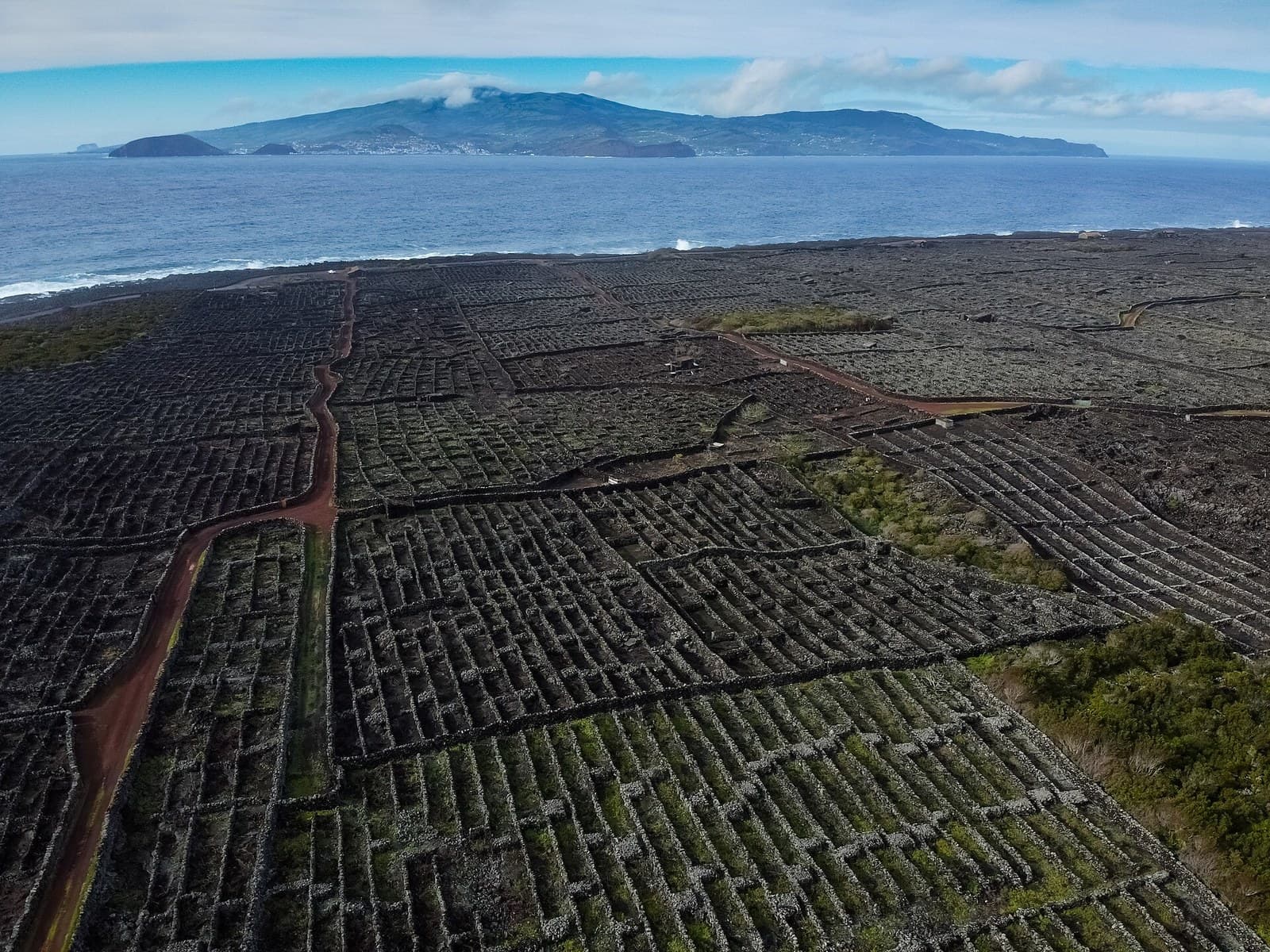
Angra do Heroísmo was inscribed in 1983, at a moment when the town lay half in rubble from the 1980 earthquake, and the listing became part of the argument for rebuilding the old centre rather than clearing it. The Landscape of the Pico Island Vineyard Culture followed in 2004: 987 hectares of small rectangular plots called currais, each walled in black basalt to shelter the vines from wind and salt spray, together with the wine cellars, ports and churches that grew up around them (UNESCO). Much of that ground had been abandoned after phylloxera and emigration, and bringing it back has meant rebuilding dry-stone walls by hand.
The whaling heritage has been kept with unusual honesty. Azoreans hunted sperm whales from open boats until the last hunts in 1984, with a final whale taken off Pico in 1987, and when the industry ended the buildings were kept (Azores Getaways). The Museu dos Baleeiros at Lajes do Pico occupies three boathouses on the harbour front, and the old rendering factory at São Roque is a museum with its boilers left in place. The shore lookouts, the vigias, still stand on the headlands where a watchman with a telescope once called the boats out by firing a rocket. On Faial the Capelinhos lighthouse, buried to its upper windows in ash, has been left as the eruption left it, with an interpretation centre dug in beneath the ash field so nothing new breaks the skyline.
For a diaspora this large, the archives matter more than the monuments. The three regional libraries and archives at Ponta Delgada, Angra do Heroísmo and Horta hold the parish registers of every island, and the baptisms, marriages and burials from 1541 to 1911 have been digitised and put online, so a family in Rhode Island whose great-grandparents left Faial in 1958 can read the priest's handwriting for themselves (archive genealogy service, research guide). Passport files and emigration papers sit alongside them, and those let a researcher watch a village empty year by year.
The regional museums network publishes catalogues online, and the whaling museums have digitised photographs, logbooks and film of hunts nobody will ever see again. Diaspora organisations add a further layer: parish groups and Casa dos Açores associations in Massachusetts, California and Ontario post the year's império rota, the names of the mordomos and photographs of each crowning, so the ritual calendar of a village on São Jorge and its copy in San Jose are both matters of public record.
More than a million people of Azorean descent live in North America, several times the population of the islands, concentrated in southeastern Massachusetts and Rhode Island, in California's Central Valley and Bay Area, and in Ontario (Portuguese Americans, Portuguese Canadians). The Holy Ghost feasts of Fall River, New Bedford and Toronto are among the largest Portuguese festivals held anywhere, and Azorean-American writers such as Katherine Vaz and Frank X. Gaspar have made the crossing itself into literature.
At home, the economy that once turned on whale oil now turns on watching the same animals, and a few of the men who steered the chase boats lived to work both jobs. Air liberalisation in 2015 opened the islands to low-cost carriers and multiplied visitor numbers, which brought money and a familiar set of worries about a small place under attention.
A ritual that survived the crossing. The Holy Spirit brotherhoods faded on the mainland but held here, and emigrants rebuilt impérios in New England, California and Ontario, so the crown, the sopas and the crowned child now circulate on both sides of the Atlantic.
The lava vineyards came back. After phylloxera and depopulation left Pico's walled currais to the brambles, the fields were cleared and the dry-stone walls rebuilt, and in 2004 the landscape was inscribed on the World Heritage List.
Whaling became memory. The factories, boathouses and lookouts were turned into museums instead of being pulled down, and the harbours that launched the hunt now run the whale watching.
A rebuilt town kept its shape. Angra do Heroísmo was reconstructed on its original street plan and inscribed by UNESCO in 1983, while the rubble was still being cleared.
Every parish register is online. Baptisms, marriages and burials from 1541 to 1911 have been digitised from the three regional archives, letting descendants abroad trace a line back to the settlement generations.
Angra was the compulsory stop for fleets crossing between Europe and the Americas, and it was rebuilt to its old plan after the earthquake of 1980. Photograph by Diego Delso, CC BY-SA 4.0, via Wikimedia Commons.
Angra do Heroísmo. Terceira's capital was the obligatory call for ships working the Atlantic between Europe, Brazil and the Indies, and its street grid, harbour forts and merchant houses were inscribed by UNESCO in 1983 (UNESCO). The fortresses of São Sebastião and São João Baptista guard the bay. Almost all of what a visitor sees was put back together after the earthquake of 1 January 1980 flattened a large part of the island.
Horta. The port on Faial faces Pico across a narrow channel and was for decades the mid-Atlantic node of the submarine telegraph, with British, German and American cable companies working out of the town. Yachts crossing the ocean still paint their names on the harbour wall, a folk archive several thousand paintings deep, and the Scrimshaw Museum above Peter Café Sport keeps the carved whale teeth of the men who worked the boats. Across the channel, Madalena and Lajes do Pico hold the whaling museums and stand at the edge of the walled vineyards.
Portuguese ships sighted the islands in the 1420s, and settlement began in earnest around 1432 under Gonçalo Velho Cabral, first on Santa Maria and then on São Miguel from 1436 (History of the Azores). Settlers came mainly from the Algarve, the Alentejo and the Minho, with smaller numbers of Madeirans, Jewish converts and enslaved Africans, and from the 1460s a Flemish colony under Josse van Huerter took root on Faial and later on Pico. So many arrived that sources of the period called the archipelago the Flemish Islands, and by about 1490 roughly 2,000 Flemings were living across five of the nine.
The early economy ran on wheat and on woad, the blue dye plant sold to the cloth towns of Flanders, and then on wine from Pico's lava fields. Angra's real value was as a stopping point: the harbour where the fleets from Brazil and the Indies watered and waited for escorts, which made the island wealthy, made it a target, and put Terceira at the centre of a Spanish invasion in 1583 after the islanders held out longer than any other part of Portugal against Philip II. When the liberal wars split the country, Terceira backed the constitutional side and won in 1837 the title its capital still carries.
Two shocks in the twentieth century shaped the modern islands more than any policy. The Capelinhos volcano erupted off the western tip of Faial from 27 September 1957 to 24 October 1958, burying farmland under ash, destroying some 300 houses in Capelo and Praia do Norte and driving about 2,000 people out (Capelinhos). The United States Congress responded with the Azorean Refugee Act of 1958, pushed by the senators John Pastore of Rhode Island and John F. Kennedy of Massachusetts, which opened visas outside the quota and began a wave of emigration that ran for a generation (Portugal.com). Then, on New Year's Day 1980, an earthquake of magnitude 6.9 struck Terceira, killing more than seventy people and wrecking most of Angra's historic centre (1980 Azores Islands earthquake).
The archipelago takes its name from the goshawk, açor in Portuguese, after birds the first Portuguese crews saw wheeling over the cliffs. Those birds were almost certainly the local buzzard, which islanders still call the queimado or the milhafre, so the whole region is named for a misidentification that nobody has ever bothered to correct. Island names are equally plain: Pico for the mountain, Faial for the faia shrub that covered it, Terceira because it was the third found, Flores for its flowers, and Corvo, the smallest and most westerly, for the crow.
Azorean Portuguese is a set of dialects rather than one, and islanders identify each other by ear within a sentence. The most marked is Micaelense, spoken on São Miguel, where the vowel written u is pronounced with the lips rounded and the tongue well forward, giving a sound closer to the French u than to anything on the mainland. Mainland speakers often find Micaelense the hardest variety of their own language to follow, and Azoreans abroad have sometimes been teased for it by other Portuguese emigrants. Flemish settlement left its own residue in the surname stock: Utra and Dutra, both worn down from van Huerter, along with Brum, Bulcão, Goulart and Silveira, are Azorean family names with roots in the Low Countries, and they travelled on to New England and Ontario with everyone else.
In 1932 the Terceira-born writer Vitorino Nemésio coined the word açorianidade for the particular condition of being an islander here: hemmed by water, conscious of distance, living on ground that moves. It stuck, and it names something real. The islands have produced writers out of all proportion to their size, among them the poet Antero de Quental and Natália Correia, both of São Miguel, and the theme they keep returning to is the sea as both the road out and the wall.
Everyday culture is local to a degree that surprises visitors. Terceira runs the tourada à corda, in which a bull on a long rope is let loose in a village street while men in the crowd play it and get out of the way; São Jorge is known for a hard cow's cheese aged in mountain cellars; the Furnas valley on São Miguel cooks a cozido by burying the pot in volcanic ground for six hours. There's a string instrument found nowhere else, the viola da terra, played for the chamarrita at village dances. Roadsides in summer are blue with hydrangeas planted as field boundaries, and Pico's wine, made from Verdelho and Arinto dos Açores grown between lava walls, is back in serious production after a century of neglect.
The Azores are overwhelmingly Catholic, and the calendar in most parishes is still built around the church. Ponta Delgada's great festival is the Senhor Santo Cristo dos Milagres on the fifth Sunday of Lent, when a sixteenth-century image of Christ, in a purple robe heavy with jewels given by the faithful over four centuries, is carried through streets carpeted in flower petals before crowds swollen by returning emigrants.
The deepest layer of Azorean religion isn't run by priests at all. The Festas do Divino Espírito Santo belong to lay brotherhoods, the irmandades, and their logic goes back to Queen Isabel of Aragon in the thirteenth century, who promoted a cult of the Holy Spirit in which the poor were crowned and fed as a sign of the levelling age to come. On the mainland the practice faded; in the Azores it became the organising ritual of parish life. Each parish keeps its crown, sceptre and banner in an império, a small chapel painted in reds, blues and whites, and in the seven weeks between Easter and Pentecost the crown moves from house to house.
The family holding the crown, the mordomos, takes on a real financial burden. They have to feed everyone who comes, which means slaughtering a bullock, baking massa sovada and cooking the sopas do Espírito Santo, a broth of beef, bread, mint and cabbage handed out free to the whole parish, with the poorest served first and portions carried to anyone too ill to walk. A child is crowned as emperor and led in procession behind the crown on its silver tray. The pageantry isn't the point. The obligation is fixed, it rotates through the parish, and everybody eats, which is why families who couldn't afford it have gone into debt for it and why the whole apparatus was carried across the Atlantic.
The most striking act of remembrance in the islands happens every Lent on São Miguel. Groups of men, the ranchos de romeiros, set out on foot and walk the whole island in seven days, roughly 300 kilometres, stopping to pray at every church and hermitage on the way, of which there are something like a hundred (LusoLife). They wear a shawl and carry a staff and a rosary, walk in double file behind a mestre who chants while the rest answer, and sleep wherever a household will take them in, usually among strangers. The custom is traced to the earthquake that destroyed Vila Franca do Campo in 1522, when survivors walked in penance and in mourning, and a good deal of what the romeiros pray is for the dead of the parishes they pass. Nothing about it is comfortable, which is the point.
Alongside that public penance runs a quieter practice. At crossroads and on the walls above steep bends stand alminhas, small niches holding an image of souls in purgatory, at which passers-by say a prayer or leave a coin or a flower for someone whose grave they may never see. In a place where men drowned at sea, fell from cliffs cutting fodder, or died in New Bedford, the alminha does work a headstone can't, since it remembers a person in the landscape where they lived rather than where their body ended up.
Funeral custom follows the wider Portuguese pattern: the wake at home or in the parish chapel, burial in the parish cemetery, the seventh-day mass and the year's mind, black worn by widows for a long time and by some for life. Emigration split all of this in two. A death in Fall River is often marked twice, with a funeral in America and a mass in the parish the family left, announced from the pulpit to people who knew the dead person's parents. Whaling added a grief of its own, because a boat lost in an open-sea chase left no body to bring home, so the name went onto a chapel wall instead.
Azorean records are Catholic, complete and the best-organised emigration archive in the Atlantic.
Parish registers begin in the sixteenth century, within a century of settlement, and the regional archives at Angra do Heroísmo, Ponta Delgada and Horta hold them along with the notarial and administrative series. A great deal is digitised and free, and because the islands are small and the parishes discrete, an Azorean family can usually be followed for four hundred years without ambiguity.
Emigration is the defining fact. Far more people of Azorean descent live abroad than in the islands, chiefly in Massachusetts, Rhode Island, California, Bermuda, Brazil and Canada. The nineteenth-century route was whaling: American ships called at Faial and Pico for crew, and Azorean men signed on and stayed, which is why New Bedford and Nantucket crew lists are an Azorean genealogical source. The twentieth-century route was the Capelinhos eruption of 1957 and 1958 on Faial, which destroyed farmland and prompted the Azorean Refugee Act in the United States, moving thousands of families to New England.
The passport records held in the regional archives document departures with destination and family, and they connect directly to the arrival records on the other side.
The Holy Ghost festas, brought to New England and California by those emigrants, are the living version of the same connection, and the brotherhoods that run them keep their own membership books.
Angra do Heroísmo was inscribed in 1983, at a moment when the town lay half in rubble from the 1980 earthquake, and the listing became part of the argument for rebuilding the old centre rather than clearing it. The Landscape of the Pico Island Vineyard Culture followed in 2004: 987 hectares of small rectangular plots called currais, each walled in black basalt to shelter the vines from wind and salt spray, together with the wine cellars, ports and churches that grew up around them (UNESCO). Much of that ground had been abandoned after phylloxera and emigration, and bringing it back has meant rebuilding dry-stone walls by hand.
The whaling heritage has been kept with unusual honesty. Azoreans hunted sperm whales from open boats until the last hunts in 1984, with a final whale taken off Pico in 1987, and when the industry ended the buildings were kept (Azores Getaways). The Museu dos Baleeiros at Lajes do Pico occupies three boathouses on the harbour front, and the old rendering factory at São Roque is a museum with its boilers left in place. The shore lookouts, the vigias, still stand on the headlands where a watchman with a telescope once called the boats out by firing a rocket. On Faial the Capelinhos lighthouse, buried to its upper windows in ash, has been left as the eruption left it, with an interpretation centre dug in beneath the ash field so nothing new breaks the skyline.
For a diaspora this large, the archives matter more than the monuments. The three regional libraries and archives at Ponta Delgada, Angra do Heroísmo and Horta hold the parish registers of every island, and the baptisms, marriages and burials from 1541 to 1911 have been digitised and put online, so a family in Rhode Island whose great-grandparents left Faial in 1958 can read the priest's handwriting for themselves (archive genealogy service, research guide). Passport files and emigration papers sit alongside them, and those let a researcher watch a village empty year by year.
The regional museums network publishes catalogues online, and the whaling museums have digitised photographs, logbooks and film of hunts nobody will ever see again. Diaspora organisations add a further layer: parish groups and Casa dos Açores associations in Massachusetts, California and Ontario post the year's império rota, the names of the mordomos and photographs of each crowning, so the ritual calendar of a village on São Jorge and its copy in San Jose are both matters of public record.
More than a million people of Azorean descent live in North America, several times the population of the islands, concentrated in southeastern Massachusetts and Rhode Island, in California's Central Valley and Bay Area, and in Ontario (Portuguese Americans, Portuguese Canadians). The Holy Ghost feasts of Fall River, New Bedford and Toronto are among the largest Portuguese festivals held anywhere, and Azorean-American writers such as Katherine Vaz and Frank X. Gaspar have made the crossing itself into literature.
At home, the economy that once turned on whale oil now turns on watching the same animals, and a few of the men who steered the chase boats lived to work both jobs. Air liberalisation in 2015 opened the islands to low-cost carriers and multiplied visitor numbers, which brought money and a familiar set of worries about a small place under attention.
A ritual that survived the crossing. The Holy Spirit brotherhoods faded on the mainland but held here, and emigrants rebuilt impérios in New England, California and Ontario, so the crown, the sopas and the crowned child now circulate on both sides of the Atlantic.
The lava vineyards came back. After phylloxera and depopulation left Pico's walled currais to the brambles, the fields were cleared and the dry-stone walls rebuilt, and in 2004 the landscape was inscribed on the World Heritage List.
Whaling became memory. The factories, boathouses and lookouts were turned into museums instead of being pulled down, and the harbours that launched the hunt now run the whale watching.
A rebuilt town kept its shape. Angra do Heroísmo was reconstructed on its original street plan and inscribed by UNESCO in 1983, while the rubble was still being cleared.
Every parish register is online. Baptisms, marriages and burials from 1541 to 1911 have been digitised from the three regional archives, letting descendants abroad trace a line back to the settlement generations.
National Overview
Notable Cities
Historical Foundations
Linguistic and Etymological Roots
Cultural Identity
Religion and Spirituality
Remembrance and Mourning Traditions
Tracing a Family in Azores
Heritage Preservation Efforts
Digital Heritage
Contemporary Cultural Influences
Success Stories
References and resources
- UNESCO, Angra do Heroismo: the port of call and its forts, inscribed 1983.
- UNESCO, Landscape of the Pico Island Vineyard Culture: 987 hectares of lava-walled currais, inscribed 2004.
- Azores, Wikipedia: geography and census population.
- History of the Azores, Wikipedia: settlement and the Flemish colony.
- Cult of the Holy Spirit, Wikipedia: brotherhoods, crown, coronation, Queen Isabel.
- Império do Divino Espírito Santo, Visit Azores: the painted chapels.
- Capelinhos, Wikipedia: the 1957 to 1958 eruption.
- The Azorean Refugee Act, Portugal.com: the 1958 legislation.
- 1980 Azores earthquake, Wikipedia: the quake that levelled Angra.
- Whale hunting to whale watching, Azores Getaways: the end of open-boat whaling.
- Carlos Machado Museum, Azores museums network: the 1876 foundation.
- Genealogical research, Azores regional archives: the parish and civil registers.
- Azores and Madeira records, PortugueseRoots: digitised registers, 1541 to 1911.
- The romeiros, LusoLife: the Lenten pilgrims of São Miguel.
- Encyclopaedia Britannica, Azores: geography and history.