Heritage · Country
Madeira Culture and Heritage
An Atlantic island that rains on one side and burns on the other, solved by more than 2,000 km of hand-cut water channels dug largely by enslaved and convict labour. This is a guide to Madeira's heritage, from the levadas and the laurel forest to the wine, the embroidery and the flood of February 2010.Written to last.
By Confinity Heritage Editorial · Updated 2026-08-17 · 8-minute readQuiet tools, kept out of the way.
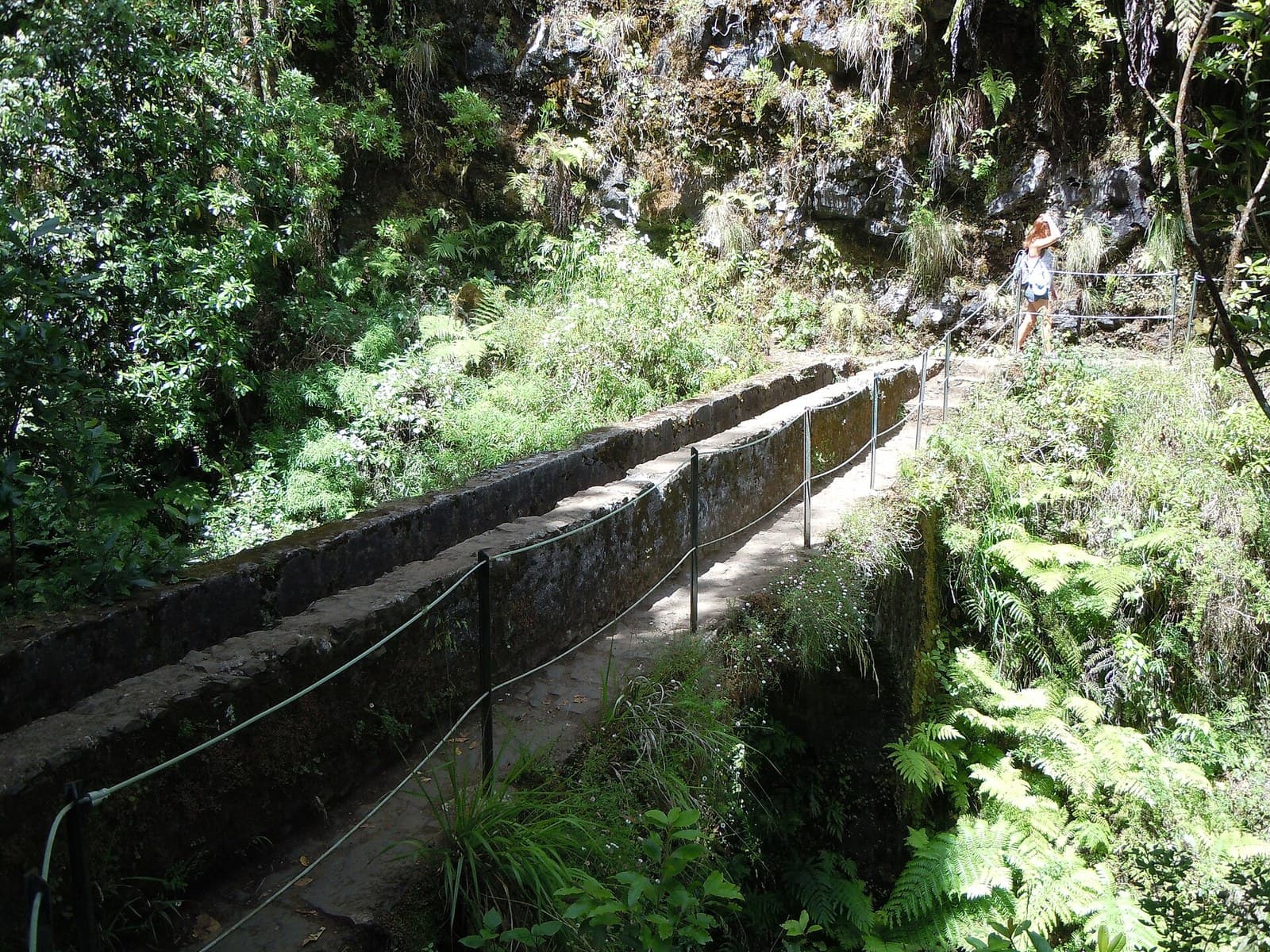
Madeira has a water problem and a famous answer to it. Cloud piles up against the northern mountains and drops rain there almost daily, while the southern slopes where people actually wanted to live and farm stay dry for months. So the island was cut open. More than 2,000 kilometres of narrow stone channels, the levadas, were carved along contour lines and driven through the rock in tunnels, moving water from the wet side to the dry side by gravity alone, at grades so fine that a channel can run for kilometres and fall only a metre (Levada).
That network is the island's great inherited object, and it should be said plainly who built it. The earliest levadas were dug by enslaved people, Guanches taken from the Canary Islands and Africans brought through the Atlantic trade, alongside convicts shipped out from mainland Portugal, and later by hired men lowered on ropes over cliffs to cut ledges into basalt. The sugar wealth those channels irrigated rested on the same labour. What follows is a guide to Madeira's landscapes, museums and archives, and to the ways Madeirans remember their dead, including the more than forty people killed by the water in a single morning in 2010.
Madeira is an autonomous region of Portugal about 800 kilometres southwest of Lisbon and rather closer to the Moroccan coast, made up of the main island of Madeira at 740.7 square kilometres, Porto Santo at 42.5, and the uninhabited Desertas and Selvagens groups, with a total population of 250,769 at the 2021 census (Wikipedia). The main island is the eroded top of a volcano: a spine of peaks rising to 1,862 metres at Pico Ruivo, cliffs that fall straight into deep water, and almost no flat ground, so the farmland is cut into terraces called poios and the settlements string along the coast.
Roughly a fifth of the island is covered by laurisilva, a laurel forest of a kind that once ran across southern Europe and now survives in quantity only here and on a few neighbouring archipelagos. It carries World Heritage listing, and the region's protected areas cover a large share of the land. Autonomy came with the constitutional settlement of 1976, and the regional government, assembly and courts all sit in Funchal, which holds close to half the population of the archipelago.
Funchal. The capital fills an amphitheatre of terraced slopes above a wide bay, and its old cathedral, the Sé, was finished around 1514 under Manuel I, with a ceiling of Madeiran cedar inlaid in geometric patterns of ivory that's among the finest Manueline interiors anywhere (Britannica). Below it lies the Zona Velha, the old quarter of narrow streets where an art project has turned scores of battered doors into painted panels, and the Mercado dos Lavradores, the 1940 market building by Edmundo Tavares, where flower sellers in regional dress work the ground floor and fishmongers split black scabbardfish downstairs. Above the town, Monte holds the church of Nossa Senhora do Monte, the pilgrimage site that also contains the tomb of Charles I, last emperor of Austria, who died in exile on the island in 1922.
 Funchal grew on sugar worked by enslaved labour before the industry moved to Brazil, and the wine trade that replaced it is why Madeira has cellars holding bottles from the eighteenth century. Photograph by PESP, CC BY-SA 4.0, via Wikimedia Commons.
Câmara de Lobos. A working fishing town west of Funchal, its harbour packed with painted boats and its slopes carrying some of the oldest terraced vineyards on the island. Winston Churchill painted the bay in 1950, and the spot he set his easel is still marked.
Machico. The first landfall of the Portuguese and the seat of the island's second captaincy, Machico keeps a fifteenth-century parish church and the chapel of the Senhor dos Milagres, whose October festival is the largest religious gathering in the east of the island.
Santana and Vila Baleira. Santana on the north coast preserves the palheiros, small A-framed houses with steep thatched roofs painted in red, white and blue; Vila Baleira, the only town on Porto Santo, keeps the house where Christopher Columbus is said to have lived while married to the daughter of the island's first captain.
Portuguese captains under Henry the Navigator reached Porto Santo in 1418 and Madeira the following year, and settlement began around 1420 under João Gonçalves Zarco, Tristão Vaz Teixeira and Bartolomeu Perestrelo, who divided the islands into captaincies (Madeira). Nobody lived there before them. The settlers burned the forest to clear ground, a fire that later chroniclers claimed burned for years, and the ash made the first crops spectacular.
Sugar followed, brought from Sicily and the Mediterranean and planted on the irrigated southern terraces, and within two generations Madeira was one of the largest sugar producers in the western world: by 1480 Antwerp had some seventy ships working the Madeira sugar trade. That economy needed both water and hands, and it took both by force. Enslaved Guanches from the Canaries, enslaved Africans and Portuguese convicts cut the levadas, worked the mills and cut the cane, and the sugar fortunes of fifteenth and sixteenth century Funchal, the churches they endowed and the merchant houses they built, were paid for out of that labour. When Brazilian and Caribbean plantations undercut the island in the seventeenth century, sugar collapsed and vines took its place.
Wine made Madeira's second fortune and its international name. English merchants settled in Funchal in numbers after the Anglo-Portuguese commercial treaties, founding houses whose names still hang over the lodges, and the island's position on the westbound Atlantic route made it the last provisioning stop before America. Britain occupied the island twice, in 1801 and 1807, to keep it out of French hands. Emigration began in earnest in the nineteenth century and never really stopped, and in 1976 the archipelago became an autonomous region with its own government and assembly.
The island's name is simply the Portuguese word for wood, madeira, given for the forest that covered it when the first ships arrived. Porto Santo, the holy port, was named by crews who sheltered there from a storm. Funchal takes its name from funcho, fennel, which grew thickly on the slopes above the bay; Câmara de Lobos means the chamber of the wolves, after the monk seals that hauled out in its cove and have since become one of the rarest mammals in Europe; Machico is traditionally derived from Machim, the shipwrecked Englishman of a legend the settlers found convenient.
Madeiran Portuguese is instantly recognisable to other Portuguese speakers, mainly for what it does to vowels. Stressed vowels are drawn out and shifted, so that a word like pai comes out closer to poi, and the language has a lexicon of its own: semilha for potato where the mainland says batata, and a stock of terms from the wine and embroidery trades that came in from English. Emigration added further layers. Families returning from Venezuela brought Spanish turns of phrase and vocabulary into everyday Funchal speech, to the point that the mixture has its own half-joking name, and the Madeiran communities in Jersey, Johannesburg and Caracas each speak a Portuguese marked by where they went.
The levadas are the thing Madeirans point to first, and they remain a working irrigation system rather than a heritage exhibit. Water rights are ancient, minutely divided and still administered: a smallholder may be entitled to a channel's flow for a set number of minutes on a set day, and the levadeiro who walks the line to clear leaves and open sluices is a real job. Because every channel needs a maintenance path beside it, the network doubles as several hundred kilometres of walking route through country that would otherwise be unreachable.
Two crafts built a great deal of household income. Madeira embroidery grew from a domestic tradition into an export industry after Elizabeth Phelps, the Funchal-born daughter of an English wine shipper, organised a local exhibition in 1850 and got island work into the Portuguese section of the Great Exhibition in London the following year, where it was a hit (Bella Phelps). At its height the trade employed tens of thousands of women working at home, taking in cut cloth and marked patterns and returning finished pieces through agents, and it remains one of the few industries in which the island's rural women earned money in their own right (Visit Madeira). The village of Camacha did the same with willow, weaving furniture and baskets that were shipped across Europe.
Everyday food is distinct from mainland cooking. Beef is cut into cubes, threaded onto a bay laurel skewer and grilled as espetada; bread is baked as bolo do caco on a hot stone and served split and dripping with garlic butter; the drink is poncha, sugarcane spirit beaten with honey and lemon juice using a grooved wooden stick. The island also gave the world a musical instrument by accident: Madeiran emigrants who sailed for Hawaii in 1879 carried the small four-string machete with them, and the cabinetmakers among them began building it there under a new name, the ukulele.
Madeira is strongly Catholic, and its patron is Nossa Senhora do Monte, whose church stands at the top of a long flight of steps above Funchal. On 15 August pilgrims climb the last stretch on their knees, and the church holds both the small fifteenth-century statue of the Virgin and the tomb of the exiled Austrian emperor. In Machico the Senhor dos Milagres is honoured on 8 and 9 October, in memory of a flood that swept the crucifix out to sea and of its recovery afterwards, and the night procession draws people back from across the island.
The Christmas season, known simply as the Festa, runs longer here than almost anywhere in Portugal. It opens on 8 December when Funchal switches on its lights, which turn the whole amphitheatre of the bay into a lit slope for a month. Between 16 and 24 December come the missas do parto, the masses of the birth, held at dawn in parish churches with drums, brass and the local ukulele-sized instruments, after which the congregation spills into the street for bolo do caco, poncha and singing at six in the morning. Houses build a lapinha, a tiered nativity with wheat sprouted in dishes weeks in advance, the fireworks over the bay on New Year's Eve are among the largest displays anywhere, and the season closes on 15 January with Santo Amaro, when neighbours go from house to house eating the last of the Christmas food and taking down the decorations.
Madeiran mourning follows the Portuguese pattern of the wake, the funeral mass, the seventh-day mass and the anniversary, with burial in family vaults, the jazigos, that hold several generations under one name. The great collective day is 1 and 2 November, All Saints and All Souls, when families clean the vaults, replace the flowers and stand together at the grave; in a place where the young have emigrated for two centuries, those dates are also when the returning children of the household are most likely to be present. At roadsides and above the steep bends of mountain roads stand alminhas, niches with an image of souls in purgatory where passers-by leave a coin or a flower for the dead, including for people whose graves are in Caracas or Johannesburg.
The island's sharpest modern grief has a date. On 20 February 2010 an intense cold front dropped 108 millimetres of rain on Funchal in five hours, more than the whole of February usually receives, and the water came off the mountains carrying rock and soil down the ribeiras that run through the middle of the city (2010 Madeira floods and mudslides). Mud and boulders swept through streets in Funchal, Ribeira Brava and São Vicente, and the count reached 45 dead with six never found, some 250 injured and around 600 people homeless, at a reconstruction cost near 1.4 billion euros. Anniversary masses are still said, the rebuilt riverbeds through the city are visibly engineered now, and a decade later a handful of families were still without permanent homes. In August 2016 fire came the other way, burning down onto Funchal from the hills and killing three people in their houses.
Madeira's records are Portuguese, old and unusually well digitised, and its emigration reached further than most.
Parish registers begin in the sixteenth century, the islands having been settled from the 1420s, and the regional archive at Funchal has published a large part of them online free along with the civil registers, the notarial books and passport records.
Sugar built the first Madeiran economy and it was worked by enslaved Africans and Guanches taken from the Canaries, which is a part of the island's history that the records document and the tourism does not mention. Wine built the second, and the British merchant houses that traded it, the Blandys and Leacocks among them, left business archives that record a working population.
Emigration went in several directions at once. Madeirans went to Brazil and Venezuela in large numbers, to South Africa, and to Hawai'i as contract labourers for the sugar plantations from 1878. The most distinctive movement is the Presbyterian one: several thousand Madeirans converted under the preaching of Robert Reid Kalley in the 1840s, were persecuted, and left for Trinidad and then Illinois, founding a Portuguese-speaking Protestant community in Jacksonville that kept its own records.
The other Madeiran export was labour to British Guiana, where Madeirans arrived as indentured workers from 1835 and became a distinct community.
The levadas, the irrigation channels cut across the island by hand, were built largely by that same labour.
The Laurisilva of Madeira was inscribed on the World Heritage List in 1999 as the largest surviving area of laurel forest on earth, believed to be about ninety per cent primary and holding endemic plants and animals including the Madeiran wood pigeon. It's managed by the regional forestry and nature institute, which also maintains the levada walking network as a set of waymarked routes, so protection of the forest and public access to it run through the same office (IFCN).
Wine and embroidery are protected by certification rather than by fencing. The old Madeira Wine Institute and the embroidery and handicrafts institute, IBTAM, were merged in 2006 into a single body, IVBAM, which now certifies both: a piece of genuine Madeira embroidery carries a numbered hologram seal, and the wine's designation, its ageing categories and its vintage declarations are policed by the same institute. The result is that a buyer can tell a hand-worked island piece from a machine import, which is the whole point in a trade that was nearly killed by cheap copies.
Funchal's museums cover the layers of the island's economy directly. The Museu A Cidade do Açúcar sits on the excavated site of a fifteenth-century merchant house and tells the sugar story, including the enslaved labour behind it. Quinta das Cruzes occupies the estate associated with Zarco and holds furniture, silver and Manueline stonework. The Casa-Museu Frederico de Freitas preserves a lawyer's collector house with its tiles, prints and watercolours as he left it, and the Museu Etnográfico at Ribeira Brava keeps the tools of levada maintenance, wine pressing, weaving and fishing.
The Arquivo e Biblioteca da Madeira holds the archipelago's parish registers, notarial deeds, passport applications and administrative records, and has digitised a large part of them for consultation online. For descendants of Madeiran emigrants, that catalogue is the practical route back: baptism entries from Câmara de Lobos, the passport files that record when a man left for Demerara or Durban, and the notarial papers that show what a family owned before it sold up (research guide).
Alongside the archive, the regional culture directorate publishes collection records for the Funchal museums, the wine houses maintain public registers of vintage stock going back well into the nineteenth century, and the levada network is now mapped in detail as GPS trail data, so a route cut by forced labour in the sixteenth century can be downloaded to a phone. The picture is uneven, with the archive well ahead of the museums, but the documentary spine of the island's memory is largely searchable from anywhere.
Madeirans left in very large numbers, and the destinations were their own: Demerara and the Caribbean in the nineteenth century, then Brazil, then South Africa, Venezuela and the Channel Islands in the twentieth, with Madeiran-descended communities now numbered in the hundreds of thousands in South Africa and around 200,000 in Venezuela (Madeira). Jersey's hotel and farming economy has run on Madeiran labour since the 1970s, and Portuguese is widely spoken there. The flow reversed when Venezuela's economy failed: returning families, the venezolanos, brought money, Spanish, arepas and a different idea of city life back into Funchal, and their bakeries and cafés changed the sound of the streets.
At home, the island trades on wine, walking and the poet-and-footballer end of celebrity. Madeira wine has recovered its reputation among serious drinkers, partly because bottles from the nineteenth century remain drinkable and are still poured (Britannica). The levada routes have made the island one of the better-known walking destinations in Europe. The poet Herberto Helder was born in Funchal, and Cristiano Ronaldo grew up there, which is why the airport now carries his name.
A working aqueduct became a walking country. The levadas still deliver irrigation water and hydroelectric flow, and their maintenance paths have been waymarked into a trail network that carries the island's tourism without new roads being cut.
The laurel forest survived. Madeira's laurisilva, the largest remaining stand of a forest type that once covered southern Europe, was protected and inscribed by UNESCO in 1999 with most of it still primary growth.
Embroidery kept its name. After a century of cheap imitation, island embroidery is certified piece by piece with a numbered hologram, which preserved both the price and the home-working tradition behind it.
Wine that outlives its makers. Madeira's heated ageing produces a wine effectively immune to oxidation, and bottles laid down two centuries ago are still opened, tasted and sold.
The archive went online. Parish registers, notarial deeds and emigration papers digitised by the Arquivo e Biblioteca da Madeira let descendants in Caracas, Jersey and Johannesburg find the households their families left.
Funchal grew on sugar worked by enslaved labour before the industry moved to Brazil, and the wine trade that replaced it is why Madeira has cellars holding bottles from the eighteenth century. Photograph by PESP, CC BY-SA 4.0, via Wikimedia Commons.
Câmara de Lobos. A working fishing town west of Funchal, its harbour packed with painted boats and its slopes carrying some of the oldest terraced vineyards on the island. Winston Churchill painted the bay in 1950, and the spot he set his easel is still marked.
Machico. The first landfall of the Portuguese and the seat of the island's second captaincy, Machico keeps a fifteenth-century parish church and the chapel of the Senhor dos Milagres, whose October festival is the largest religious gathering in the east of the island.
Santana and Vila Baleira. Santana on the north coast preserves the palheiros, small A-framed houses with steep thatched roofs painted in red, white and blue; Vila Baleira, the only town on Porto Santo, keeps the house where Christopher Columbus is said to have lived while married to the daughter of the island's first captain.
Portuguese captains under Henry the Navigator reached Porto Santo in 1418 and Madeira the following year, and settlement began around 1420 under João Gonçalves Zarco, Tristão Vaz Teixeira and Bartolomeu Perestrelo, who divided the islands into captaincies (Madeira). Nobody lived there before them. The settlers burned the forest to clear ground, a fire that later chroniclers claimed burned for years, and the ash made the first crops spectacular.
Sugar followed, brought from Sicily and the Mediterranean and planted on the irrigated southern terraces, and within two generations Madeira was one of the largest sugar producers in the western world: by 1480 Antwerp had some seventy ships working the Madeira sugar trade. That economy needed both water and hands, and it took both by force. Enslaved Guanches from the Canaries, enslaved Africans and Portuguese convicts cut the levadas, worked the mills and cut the cane, and the sugar fortunes of fifteenth and sixteenth century Funchal, the churches they endowed and the merchant houses they built, were paid for out of that labour. When Brazilian and Caribbean plantations undercut the island in the seventeenth century, sugar collapsed and vines took its place.
Wine made Madeira's second fortune and its international name. English merchants settled in Funchal in numbers after the Anglo-Portuguese commercial treaties, founding houses whose names still hang over the lodges, and the island's position on the westbound Atlantic route made it the last provisioning stop before America. Britain occupied the island twice, in 1801 and 1807, to keep it out of French hands. Emigration began in earnest in the nineteenth century and never really stopped, and in 1976 the archipelago became an autonomous region with its own government and assembly.
The island's name is simply the Portuguese word for wood, madeira, given for the forest that covered it when the first ships arrived. Porto Santo, the holy port, was named by crews who sheltered there from a storm. Funchal takes its name from funcho, fennel, which grew thickly on the slopes above the bay; Câmara de Lobos means the chamber of the wolves, after the monk seals that hauled out in its cove and have since become one of the rarest mammals in Europe; Machico is traditionally derived from Machim, the shipwrecked Englishman of a legend the settlers found convenient.
Madeiran Portuguese is instantly recognisable to other Portuguese speakers, mainly for what it does to vowels. Stressed vowels are drawn out and shifted, so that a word like pai comes out closer to poi, and the language has a lexicon of its own: semilha for potato where the mainland says batata, and a stock of terms from the wine and embroidery trades that came in from English. Emigration added further layers. Families returning from Venezuela brought Spanish turns of phrase and vocabulary into everyday Funchal speech, to the point that the mixture has its own half-joking name, and the Madeiran communities in Jersey, Johannesburg and Caracas each speak a Portuguese marked by where they went.
The levadas are the thing Madeirans point to first, and they remain a working irrigation system rather than a heritage exhibit. Water rights are ancient, minutely divided and still administered: a smallholder may be entitled to a channel's flow for a set number of minutes on a set day, and the levadeiro who walks the line to clear leaves and open sluices is a real job. Because every channel needs a maintenance path beside it, the network doubles as several hundred kilometres of walking route through country that would otherwise be unreachable.
Two crafts built a great deal of household income. Madeira embroidery grew from a domestic tradition into an export industry after Elizabeth Phelps, the Funchal-born daughter of an English wine shipper, organised a local exhibition in 1850 and got island work into the Portuguese section of the Great Exhibition in London the following year, where it was a hit (Bella Phelps). At its height the trade employed tens of thousands of women working at home, taking in cut cloth and marked patterns and returning finished pieces through agents, and it remains one of the few industries in which the island's rural women earned money in their own right (Visit Madeira). The village of Camacha did the same with willow, weaving furniture and baskets that were shipped across Europe.
Everyday food is distinct from mainland cooking. Beef is cut into cubes, threaded onto a bay laurel skewer and grilled as espetada; bread is baked as bolo do caco on a hot stone and served split and dripping with garlic butter; the drink is poncha, sugarcane spirit beaten with honey and lemon juice using a grooved wooden stick. The island also gave the world a musical instrument by accident: Madeiran emigrants who sailed for Hawaii in 1879 carried the small four-string machete with them, and the cabinetmakers among them began building it there under a new name, the ukulele.
Madeira is strongly Catholic, and its patron is Nossa Senhora do Monte, whose church stands at the top of a long flight of steps above Funchal. On 15 August pilgrims climb the last stretch on their knees, and the church holds both the small fifteenth-century statue of the Virgin and the tomb of the exiled Austrian emperor. In Machico the Senhor dos Milagres is honoured on 8 and 9 October, in memory of a flood that swept the crucifix out to sea and of its recovery afterwards, and the night procession draws people back from across the island.
The Christmas season, known simply as the Festa, runs longer here than almost anywhere in Portugal. It opens on 8 December when Funchal switches on its lights, which turn the whole amphitheatre of the bay into a lit slope for a month. Between 16 and 24 December come the missas do parto, the masses of the birth, held at dawn in parish churches with drums, brass and the local ukulele-sized instruments, after which the congregation spills into the street for bolo do caco, poncha and singing at six in the morning. Houses build a lapinha, a tiered nativity with wheat sprouted in dishes weeks in advance, the fireworks over the bay on New Year's Eve are among the largest displays anywhere, and the season closes on 15 January with Santo Amaro, when neighbours go from house to house eating the last of the Christmas food and taking down the decorations.
Madeiran mourning follows the Portuguese pattern of the wake, the funeral mass, the seventh-day mass and the anniversary, with burial in family vaults, the jazigos, that hold several generations under one name. The great collective day is 1 and 2 November, All Saints and All Souls, when families clean the vaults, replace the flowers and stand together at the grave; in a place where the young have emigrated for two centuries, those dates are also when the returning children of the household are most likely to be present. At roadsides and above the steep bends of mountain roads stand alminhas, niches with an image of souls in purgatory where passers-by leave a coin or a flower for the dead, including for people whose graves are in Caracas or Johannesburg.
The island's sharpest modern grief has a date. On 20 February 2010 an intense cold front dropped 108 millimetres of rain on Funchal in five hours, more than the whole of February usually receives, and the water came off the mountains carrying rock and soil down the ribeiras that run through the middle of the city (2010 Madeira floods and mudslides). Mud and boulders swept through streets in Funchal, Ribeira Brava and São Vicente, and the count reached 45 dead with six never found, some 250 injured and around 600 people homeless, at a reconstruction cost near 1.4 billion euros. Anniversary masses are still said, the rebuilt riverbeds through the city are visibly engineered now, and a decade later a handful of families were still without permanent homes. In August 2016 fire came the other way, burning down onto Funchal from the hills and killing three people in their houses.
Madeira's records are Portuguese, old and unusually well digitised, and its emigration reached further than most.
Parish registers begin in the sixteenth century, the islands having been settled from the 1420s, and the regional archive at Funchal has published a large part of them online free along with the civil registers, the notarial books and passport records.
Sugar built the first Madeiran economy and it was worked by enslaved Africans and Guanches taken from the Canaries, which is a part of the island's history that the records document and the tourism does not mention. Wine built the second, and the British merchant houses that traded it, the Blandys and Leacocks among them, left business archives that record a working population.
Emigration went in several directions at once. Madeirans went to Brazil and Venezuela in large numbers, to South Africa, and to Hawai'i as contract labourers for the sugar plantations from 1878. The most distinctive movement is the Presbyterian one: several thousand Madeirans converted under the preaching of Robert Reid Kalley in the 1840s, were persecuted, and left for Trinidad and then Illinois, founding a Portuguese-speaking Protestant community in Jacksonville that kept its own records.
The other Madeiran export was labour to British Guiana, where Madeirans arrived as indentured workers from 1835 and became a distinct community.
The levadas, the irrigation channels cut across the island by hand, were built largely by that same labour.
The Laurisilva of Madeira was inscribed on the World Heritage List in 1999 as the largest surviving area of laurel forest on earth, believed to be about ninety per cent primary and holding endemic plants and animals including the Madeiran wood pigeon. It's managed by the regional forestry and nature institute, which also maintains the levada walking network as a set of waymarked routes, so protection of the forest and public access to it run through the same office (IFCN).
Wine and embroidery are protected by certification rather than by fencing. The old Madeira Wine Institute and the embroidery and handicrafts institute, IBTAM, were merged in 2006 into a single body, IVBAM, which now certifies both: a piece of genuine Madeira embroidery carries a numbered hologram seal, and the wine's designation, its ageing categories and its vintage declarations are policed by the same institute. The result is that a buyer can tell a hand-worked island piece from a machine import, which is the whole point in a trade that was nearly killed by cheap copies.
Funchal's museums cover the layers of the island's economy directly. The Museu A Cidade do Açúcar sits on the excavated site of a fifteenth-century merchant house and tells the sugar story, including the enslaved labour behind it. Quinta das Cruzes occupies the estate associated with Zarco and holds furniture, silver and Manueline stonework. The Casa-Museu Frederico de Freitas preserves a lawyer's collector house with its tiles, prints and watercolours as he left it, and the Museu Etnográfico at Ribeira Brava keeps the tools of levada maintenance, wine pressing, weaving and fishing.
The Arquivo e Biblioteca da Madeira holds the archipelago's parish registers, notarial deeds, passport applications and administrative records, and has digitised a large part of them for consultation online. For descendants of Madeiran emigrants, that catalogue is the practical route back: baptism entries from Câmara de Lobos, the passport files that record when a man left for Demerara or Durban, and the notarial papers that show what a family owned before it sold up (research guide).
Alongside the archive, the regional culture directorate publishes collection records for the Funchal museums, the wine houses maintain public registers of vintage stock going back well into the nineteenth century, and the levada network is now mapped in detail as GPS trail data, so a route cut by forced labour in the sixteenth century can be downloaded to a phone. The picture is uneven, with the archive well ahead of the museums, but the documentary spine of the island's memory is largely searchable from anywhere.
Madeirans left in very large numbers, and the destinations were their own: Demerara and the Caribbean in the nineteenth century, then Brazil, then South Africa, Venezuela and the Channel Islands in the twentieth, with Madeiran-descended communities now numbered in the hundreds of thousands in South Africa and around 200,000 in Venezuela (Madeira). Jersey's hotel and farming economy has run on Madeiran labour since the 1970s, and Portuguese is widely spoken there. The flow reversed when Venezuela's economy failed: returning families, the venezolanos, brought money, Spanish, arepas and a different idea of city life back into Funchal, and their bakeries and cafés changed the sound of the streets.
At home, the island trades on wine, walking and the poet-and-footballer end of celebrity. Madeira wine has recovered its reputation among serious drinkers, partly because bottles from the nineteenth century remain drinkable and are still poured (Britannica). The levada routes have made the island one of the better-known walking destinations in Europe. The poet Herberto Helder was born in Funchal, and Cristiano Ronaldo grew up there, which is why the airport now carries his name.
A working aqueduct became a walking country. The levadas still deliver irrigation water and hydroelectric flow, and their maintenance paths have been waymarked into a trail network that carries the island's tourism without new roads being cut.
The laurel forest survived. Madeira's laurisilva, the largest remaining stand of a forest type that once covered southern Europe, was protected and inscribed by UNESCO in 1999 with most of it still primary growth.
Embroidery kept its name. After a century of cheap imitation, island embroidery is certified piece by piece with a numbered hologram, which preserved both the price and the home-working tradition behind it.
Wine that outlives its makers. Madeira's heated ageing produces a wine effectively immune to oxidation, and bottles laid down two centuries ago are still opened, tasted and sold.
The archive went online. Parish registers, notarial deeds and emigration papers digitised by the Arquivo e Biblioteca da Madeira let descendants in Caracas, Jersey and Johannesburg find the households their families left.
National Overview
Notable Cities
Historical Foundations
Linguistic and Etymological Roots
Cultural Identity
Religion and Spirituality
Remembrance and Mourning Traditions
Tracing a Family in Madeira
Heritage Preservation Efforts
Digital Heritage
Contemporary Cultural Influences
Success Stories
References and resources
- UNESCO, Laurisilva of Madeira: the relict laurel forest, inscribed 1999.
- Madeira, Wikipedia: geography, settlement, sugar, wine and emigration figures.
- Levada (Madeira), Wikipedia: the 2,170 km network, the tunnels and who dug them.
- Madeira wine, Wikipedia: estufagem, canteiro, the noble grapes and the American trade.
- Encyclopaedia Britannica, Madeira wine: the style, its heating and its longevity.
- Encyclopaedia Britannica, Funchal: the capital, the Sé and the harbour.
- Encyclopaedia Britannica, Madeira Islands: geography, economy and history.
- Bella Phelps, Wikipedia: the 1850 Funchal exhibition and the Great Exhibition of 1851.
- Madeira embroidery, Visit Madeira: the craft's history and its certification seal.
- 2010 Madeira floods and mudslides, Wikipedia: the rainfall, the death toll and the reconstruction.
- IFCN, Madeira forestry and nature institute: the laurisilva and the levada trail network.
- Arquivo e Biblioteca da Madeira: parish, notarial and emigration records.
- Museu A Cidade do Açúcar: the sugar economy and the excavated merchant house.
- Quinta das Cruzes: decorative arts on the estate associated with Zarco.
- Casa-Museu Frederico de Freitas: the collector's house kept as he left it.
- Azores and Madeira records, PortugueseRoots: a guide to the digitised registers.