Heritage · University
University of Coimbra: Programs, Campus & Admissions Info
University of Coimbra is a leading institution offering top academic programs, research, and student life. Explore courses, campus details, and admissions info.Written to last.
By Confinity Heritage Editorial · Updated 2026-07-20 · 8-minute readQuiet tools, kept out of the way.
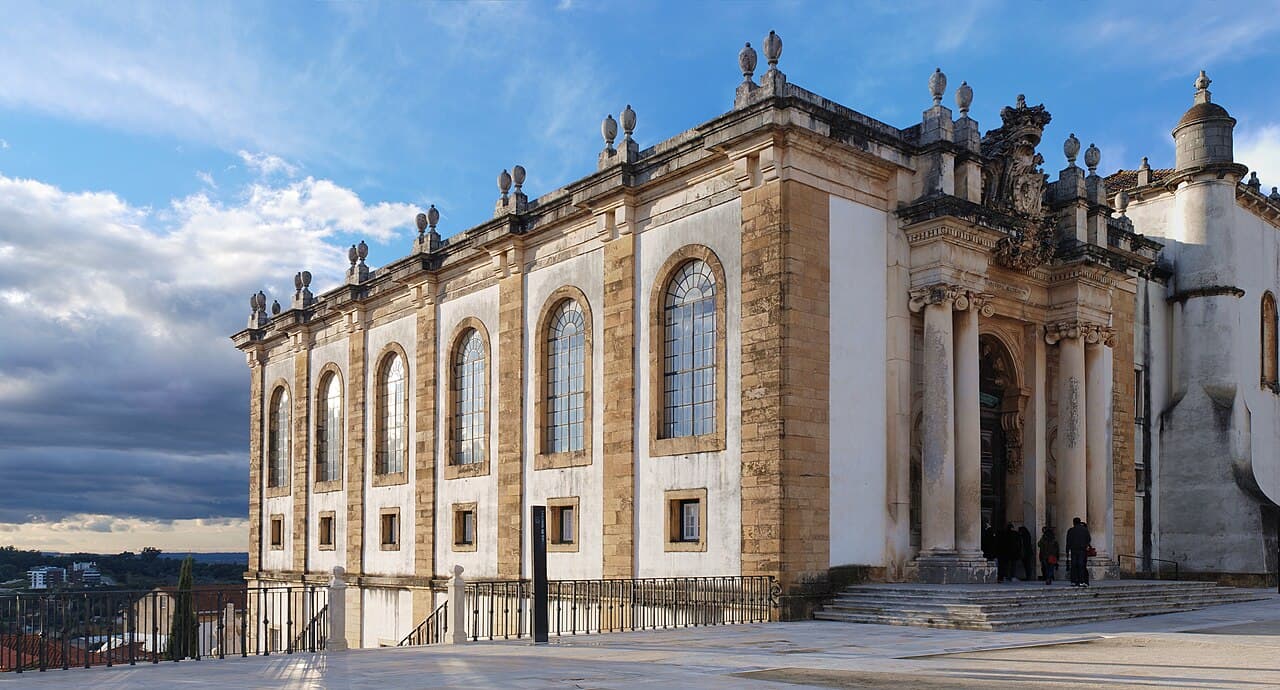
On a hill above the Mondego river in central Portugal stands one of the oldest universities still teaching. The University of Coimbra was founded in 1290, and for most of the centuries since it was the only university in the Portuguese-speaking world. Its buildings are not a preserved ruin or a museum campus. Students still walk to lectures through a medieval gate, sit examinations in a former royal throne room, and sing in black capes on the cathedral steps at night. In 2013 UNESCO added the university and its two historic quarters, the Alta and Sofia, to the World Heritage List.
Coimbra matters because it is continuous. A great deal of what a country knows about itself, its law, its language, its sciences, its record of who studied what and when, has passed through this one place. The university trained generations of Portuguese lawyers, doctors, poets, and administrators, and it carried the Portuguese language and its scholarship across four continents through the reach of the former empire. To understand Portugal's intellectual history, you begin here.
The university began as an Estudo Geral, or general study, established by King Dinis with a royal charter dated 1 March 1290. Later that year, on 9 August, Pope Nicholas IV confirmed it with a papal bull, giving the new institution the standing of a recognised European university with the power to grant degrees. That combination of royal and papal sanction placed Coimbra among the first wave of medieval universities, alongside Bologna, Paris, Oxford, and Salamanca, and it has operated more or less continuously ever since.
For its first two and a half centuries the university had no fixed home. It was founded in Lisbon, then moved to Coimbra, then back to Lisbon, shifting several times as monarchs, plague, and town relations dictated. The decisive change came in 1537, during the reign of King João III, when the university was transferred permanently to Coimbra and installed in the former Royal Palace, the Paço da Alcáçova, on the highest ground of the city. The hilltop palace became the heart of the institution, and the university has stayed there for nearly five hundred years.
The sixteenth century was a period of ambition. João III invited leading humanist scholars to teach, founded colleges to house students and religious orders, and had a whole street of them, the Rua da Sofia, laid out below the hill as a planned academic quarter. This was the age when Pedro Nunes taught navigation and when Coimbra's reputation drew foreign students such as Clavius. The colleges of the Sofia and the buildings of the upper town together came to define the two halves of the university city that UNESCO would recognise centuries later.
The next great turning point was the reform of 1772, driven by the Marquis of Pombal, the powerful minister who rebuilt Lisbon after the 1755 earthquake. Pombal modernised a curriculum that had grown narrow and scholastic. He created faculties dedicated to mathematics and to natural philosophy, founded a chemistry laboratory, an astronomical observatory, an anatomical theatre, and a physics cabinet, and laid out the university's botanical garden. These reforms turned Coimbra into a centre for the experimental sciences and shaped the campus that visitors see today. The university now teaches across eight faculties covering law, medicine, humanities, sciences and technology, pharmacy, economics, psychology and education, and sport, and it is a founding member of the Coimbra Group, a network of long-established European research universities formed in 1985.
The World Heritage property is divided into two areas. The Alta, meaning the upper town, occupies the hilltop and contains the oldest university buildings clustered around the old Royal Palace. The Sofia refers to the colleges built along the Rua da Sofia lower in the city during the sixteenth century, a planned street of religious colleges that represented an early attempt to organise university life around a single axis. Together they show, in the words of the candidacy, an architectural set that illustrates significant periods of Portuguese art and, more than that, a living centre for the production and transmission of knowledge over seven centuries.
 A colony of bats lives in the Joanina and is left alone: they eat the insects that would otherwise eat the books. The tables are covered in leather every night. Photograph by GFreihalter, CC BY-SA 3.0, via Wikimedia Commons.
At the top of the hill, a stone gateway called the Porta Férrea opens onto the Paço das Escolas, the courtyard of the old palace. Around it stand the ceremonial rooms the university still uses. The Sala dos Capelos, the former throne room, hosts the most solemn academic acts, including doctoral defences and the awarding of honorary degrees, beneath a painted ceiling and portraits of Portuguese kings. A colonnaded gallery known as the Via Latina fronts the building. Nearby, the Chapel of São Miguel holds a spectacular Baroque organ, and the University Tower, whose bell the students nickname the cabra, or goat, has marked the rhythm of academic life since the eighteenth century.
The building most people come to see is the Joanina Library, or Biblioteca Joanina. Commissioned by King João V and built between 1717 and 1728, it is one of the most richly decorated Baroque libraries in Europe. Three high rooms open one into the next through gilded arches, their two-storey shelves made of exotic woods brought from Brazil and lacquered in the chinoiserie style then in fashion. Ceiling paintings by Lisbon artists give the illusion of greater height, and a portrait of the founding king by the Italian painter Domenico Duprà presides over the far wall. The library holds tens of thousands of volumes printed between the sixteenth and eighteenth centuries, covering medicine, law, theology, philosophy, history, and science.
The Joanina is also famous for its bats. A small colony of insect-eating bats has lived in the library for generations, and at night they emerge to feed on the moths and other insects that would otherwise eat the paper and bindings. To protect the antique tables from droppings, staff drape them each evening in sheets of leather, and clean the floors each morning. It is one of only two libraries in the world known to rely on bats for pest control, the other being the royal library at the nearby Mafra Palace. The library's metre-thick walls and heavy teak door help keep temperature and humidity stable enough to preserve the collection without modern climate machinery. Beneath the library lies the Prisão Acadêmica, a medieval prison once used to hold students and staff who fell under the university's own jurisdiction, and now the only surviving university jail of its kind.
Coimbra's long monopoly on higher learning in Portugal means that a striking share of the country's historical figures passed through its halls. The mathematician Pedro Nunes, the leading cosmographer of sixteenth-century Portugal, taught here and devised instruments and methods for navigation during the age of Portuguese exploration. National poet Luís de Camões, author of the national poem Os Lusíadas, is traditionally counted among those educated in the university's orbit, and the classical learning of his verse reflects the humanist teaching of the period.
Coimbra also drew scholars from beyond Portugal. The German Jesuit Christopher Clavius, later the leading astronomer of the papal commission that designed the Gregorian calendar of 1582, studied humanities and philosophy at Coimbra between 1556 and 1560. He watched a total solar eclipse over the city in August 1560, an event he said turned him toward mathematics and astronomy for the rest of his life.
The university's best-known scientist is António Egas Moniz, who studied and later taught at Coimbra and won the 1949 Nobel Prize in Physiology or Medicine for developing cerebral angiography, a technique for imaging the blood vessels of the brain. His prize remains the only Nobel awarded to a Portuguese scientist. Coimbra also educated much of Portugal's political class, for better and worse. António de Oliveira Salazar, who studied and lectured in law and economics here before ruling Portugal as authoritarian prime minister from 1932 to 1968, is among the most consequential, and most contested, of its alumni. Against that record stands Aristides de Sousa Mendes, the Coimbra-trained diplomat who defied Salazar's government in 1940 to issue thousands of visas to refugees fleeing the Nazis, and was punished for it. The range from Nunes the navigator's instrument-maker to a Nobel laureate to a dictator and the man who defied him gives some sense of how much of Portuguese public life ran through this single university.
Few universities keep their student customs as visibly as Coimbra. The most striking is the traje académico, a black uniform of suit or skirt worn under a long black cape, or capa e batina. The dress descends from academic gowns worn here for centuries, and students still put it on for ceremonies, serenades, and festivals. Ribbons and accessories carry meaning: the colour of a student's ribbon marks their faculty, yellow for medicine, red for law, dark blue for humanities, and so on.
Those ribbons give their name to the Queima das Fitas, the Burning of the Ribbons, one of the largest student festivals in Europe. Held over a week beginning on the first weekend of May, it marks the end of the academic year for graduating students, who ceremonially burn the narrow ribbons of their earlier years and receive broad new ones. The week runs on parades, concerts, and a great deal of celebration, and it opens with a fado serenade sung at night on the steps of the old cathedral, the Sé Velha, before a crowd of caped students. In the autumn a companion festival, the Latada or Festa das Latas, welcomes new arrivals with its own rituals of initiation, part of the wider tradition of praxe by which older students induct the younger.
Coimbra has its own kind of fado, distinct from the better-known song of Lisbon. Fado de Coimbra is traditionally sung by men, students and former students of the university, accompanied by the pear-shaped Portuguese guitar and a classical guitar. Its songs turn on student life, the city, longing, and love, and they are performed at night, often as serenades. Amália Rodrigues, the great voice of Portuguese fado, made the song simply titled "Coimbra" famous around the world. Older still are the repúblicas, cooperative houses where groups of students live together and govern their own affairs, a form of communal student lodging with roots reaching back into the university's medieval history.
UNESCO inscribed Coimbra under three of its criteria, and the reasoning explains why the place is treated as more than a handsome old campus. Under the first, the university stands for an exchange of human values across seven centuries, as a centre from which knowledge, and the institutions of learning themselves, spread through the Portuguese-speaking world on four continents. Under the second, the built ensemble illustrates the purposes and evolution of a European university and successive periods of Portuguese architecture. Under the third, the university is tied to a living tradition of teaching and to the formation of the Portuguese language and its literature.
That last point is easy to underrate. For centuries Coimbra was where the Portuguese language was studied, codified, and taught at the highest level, and where much of the literature and legal thought of a global empire was written and disseminated. The university did not simply exist in Portuguese history; for long stretches it largely was Portuguese intellectual history. Its combination of continuous teaching, an intact historic campus, and a role in shaping a world language is what raised it above the many beautiful universities that lack one or another of those things.
An institution this old is, among other things, an archive. Coimbra holds manuscripts, incunabula, scientific instruments, botanical specimens, and centuries of its own records, the enrolments, examinations, and doctoral acts that trace who learned what across seven hundred years. The Joanina Library is only the most famous of these holdings. The university's botanical garden, laid out in 1772, preserves living collections and a herbarium; its science museum keeps the physics and natural-history apparatus assembled after the Pombaline reforms; and its libraries protect works from the sixteenth, seventeenth, and eighteenth centuries. Digitisation programmes such as Alma Mater now put thousands of pre-modern books, manuscripts, and photographs within reach of researchers who will never travel to Coimbra.
What Coimbra keeps in trust is not only rare objects but the thread that runs between them and the people who made and used them. A doctoral register, a navigator's treatise, a student's fado, a ribbon burned at the end of a degree: each is a small record of a life spent in learning, held together by an institution that has outlasted every person named in it. Preserving heritage at this scale is finally about keeping those threads legible, so that a name in a ledger or a book on a gilded shelf can still be connected to the story it belongs to. That is the same instinct, at the scale of a nation and its oldest school, that leads a family to keep its own records, letters, and photographs from being scattered and forgotten.
The historic core is open to visitors, though the Joanina Library sells timed tickets and limits how many people enter at once, so it is worth booking ahead. A general ticket to the Paço das Escolas covers the ceremonial rooms, the Chapel of São Miguel, the tower, and the library, and the courtyard itself gives one of the finest views over the red roofs of Coimbra and the Mondego below. The botanical garden is free to walk through and quiet even in high season.
Coimbra remains a working university of more than 25,000 students, roughly a fifth of them from outside Portugal, spread across three main campus areas of which the historic Alta is only the first. Term time is when the city feels most itself, with capes on the streets and serenades in the evenings, and the Queima das Fitas in early May draws visitors from across the country. The best way to understand the place is to arrive when it is full of the students it was built for, rather than as an empty monument, because at Coimbra the tradition and the teaching are still the same thing.
A colony of bats lives in the Joanina and is left alone: they eat the insects that would otherwise eat the books. The tables are covered in leather every night. Photograph by GFreihalter, CC BY-SA 3.0, via Wikimedia Commons.
At the top of the hill, a stone gateway called the Porta Férrea opens onto the Paço das Escolas, the courtyard of the old palace. Around it stand the ceremonial rooms the university still uses. The Sala dos Capelos, the former throne room, hosts the most solemn academic acts, including doctoral defences and the awarding of honorary degrees, beneath a painted ceiling and portraits of Portuguese kings. A colonnaded gallery known as the Via Latina fronts the building. Nearby, the Chapel of São Miguel holds a spectacular Baroque organ, and the University Tower, whose bell the students nickname the cabra, or goat, has marked the rhythm of academic life since the eighteenth century.
The building most people come to see is the Joanina Library, or Biblioteca Joanina. Commissioned by King João V and built between 1717 and 1728, it is one of the most richly decorated Baroque libraries in Europe. Three high rooms open one into the next through gilded arches, their two-storey shelves made of exotic woods brought from Brazil and lacquered in the chinoiserie style then in fashion. Ceiling paintings by Lisbon artists give the illusion of greater height, and a portrait of the founding king by the Italian painter Domenico Duprà presides over the far wall. The library holds tens of thousands of volumes printed between the sixteenth and eighteenth centuries, covering medicine, law, theology, philosophy, history, and science.
The Joanina is also famous for its bats. A small colony of insect-eating bats has lived in the library for generations, and at night they emerge to feed on the moths and other insects that would otherwise eat the paper and bindings. To protect the antique tables from droppings, staff drape them each evening in sheets of leather, and clean the floors each morning. It is one of only two libraries in the world known to rely on bats for pest control, the other being the royal library at the nearby Mafra Palace. The library's metre-thick walls and heavy teak door help keep temperature and humidity stable enough to preserve the collection without modern climate machinery. Beneath the library lies the Prisão Acadêmica, a medieval prison once used to hold students and staff who fell under the university's own jurisdiction, and now the only surviving university jail of its kind.
Coimbra's long monopoly on higher learning in Portugal means that a striking share of the country's historical figures passed through its halls. The mathematician Pedro Nunes, the leading cosmographer of sixteenth-century Portugal, taught here and devised instruments and methods for navigation during the age of Portuguese exploration. National poet Luís de Camões, author of the national poem Os Lusíadas, is traditionally counted among those educated in the university's orbit, and the classical learning of his verse reflects the humanist teaching of the period.
Coimbra also drew scholars from beyond Portugal. The German Jesuit Christopher Clavius, later the leading astronomer of the papal commission that designed the Gregorian calendar of 1582, studied humanities and philosophy at Coimbra between 1556 and 1560. He watched a total solar eclipse over the city in August 1560, an event he said turned him toward mathematics and astronomy for the rest of his life.
The university's best-known scientist is António Egas Moniz, who studied and later taught at Coimbra and won the 1949 Nobel Prize in Physiology or Medicine for developing cerebral angiography, a technique for imaging the blood vessels of the brain. His prize remains the only Nobel awarded to a Portuguese scientist. Coimbra also educated much of Portugal's political class, for better and worse. António de Oliveira Salazar, who studied and lectured in law and economics here before ruling Portugal as authoritarian prime minister from 1932 to 1968, is among the most consequential, and most contested, of its alumni. Against that record stands Aristides de Sousa Mendes, the Coimbra-trained diplomat who defied Salazar's government in 1940 to issue thousands of visas to refugees fleeing the Nazis, and was punished for it. The range from Nunes the navigator's instrument-maker to a Nobel laureate to a dictator and the man who defied him gives some sense of how much of Portuguese public life ran through this single university.
Few universities keep their student customs as visibly as Coimbra. The most striking is the traje académico, a black uniform of suit or skirt worn under a long black cape, or capa e batina. The dress descends from academic gowns worn here for centuries, and students still put it on for ceremonies, serenades, and festivals. Ribbons and accessories carry meaning: the colour of a student's ribbon marks their faculty, yellow for medicine, red for law, dark blue for humanities, and so on.
Those ribbons give their name to the Queima das Fitas, the Burning of the Ribbons, one of the largest student festivals in Europe. Held over a week beginning on the first weekend of May, it marks the end of the academic year for graduating students, who ceremonially burn the narrow ribbons of their earlier years and receive broad new ones. The week runs on parades, concerts, and a great deal of celebration, and it opens with a fado serenade sung at night on the steps of the old cathedral, the Sé Velha, before a crowd of caped students. In the autumn a companion festival, the Latada or Festa das Latas, welcomes new arrivals with its own rituals of initiation, part of the wider tradition of praxe by which older students induct the younger.
Coimbra has its own kind of fado, distinct from the better-known song of Lisbon. Fado de Coimbra is traditionally sung by men, students and former students of the university, accompanied by the pear-shaped Portuguese guitar and a classical guitar. Its songs turn on student life, the city, longing, and love, and they are performed at night, often as serenades. Amália Rodrigues, the great voice of Portuguese fado, made the song simply titled "Coimbra" famous around the world. Older still are the repúblicas, cooperative houses where groups of students live together and govern their own affairs, a form of communal student lodging with roots reaching back into the university's medieval history.
UNESCO inscribed Coimbra under three of its criteria, and the reasoning explains why the place is treated as more than a handsome old campus. Under the first, the university stands for an exchange of human values across seven centuries, as a centre from which knowledge, and the institutions of learning themselves, spread through the Portuguese-speaking world on four continents. Under the second, the built ensemble illustrates the purposes and evolution of a European university and successive periods of Portuguese architecture. Under the third, the university is tied to a living tradition of teaching and to the formation of the Portuguese language and its literature.
That last point is easy to underrate. For centuries Coimbra was where the Portuguese language was studied, codified, and taught at the highest level, and where much of the literature and legal thought of a global empire was written and disseminated. The university did not simply exist in Portuguese history; for long stretches it largely was Portuguese intellectual history. Its combination of continuous teaching, an intact historic campus, and a role in shaping a world language is what raised it above the many beautiful universities that lack one or another of those things.
An institution this old is, among other things, an archive. Coimbra holds manuscripts, incunabula, scientific instruments, botanical specimens, and centuries of its own records, the enrolments, examinations, and doctoral acts that trace who learned what across seven hundred years. The Joanina Library is only the most famous of these holdings. The university's botanical garden, laid out in 1772, preserves living collections and a herbarium; its science museum keeps the physics and natural-history apparatus assembled after the Pombaline reforms; and its libraries protect works from the sixteenth, seventeenth, and eighteenth centuries. Digitisation programmes such as Alma Mater now put thousands of pre-modern books, manuscripts, and photographs within reach of researchers who will never travel to Coimbra.
What Coimbra keeps in trust is not only rare objects but the thread that runs between them and the people who made and used them. A doctoral register, a navigator's treatise, a student's fado, a ribbon burned at the end of a degree: each is a small record of a life spent in learning, held together by an institution that has outlasted every person named in it. Preserving heritage at this scale is finally about keeping those threads legible, so that a name in a ledger or a book on a gilded shelf can still be connected to the story it belongs to. That is the same instinct, at the scale of a nation and its oldest school, that leads a family to keep its own records, letters, and photographs from being scattered and forgotten.
The historic core is open to visitors, though the Joanina Library sells timed tickets and limits how many people enter at once, so it is worth booking ahead. A general ticket to the Paço das Escolas covers the ceremonial rooms, the Chapel of São Miguel, the tower, and the library, and the courtyard itself gives one of the finest views over the red roofs of Coimbra and the Mondego below. The botanical garden is free to walk through and quiet even in high season.
Coimbra remains a working university of more than 25,000 students, roughly a fifth of them from outside Portugal, spread across three main campus areas of which the historic Alta is only the first. Term time is when the city feels most itself, with capes on the streets and serenades in the evenings, and the Queima das Fitas in early May draws visitors from across the country. The best way to understand the place is to arrive when it is full of the students it was built for, rather than as an empty monument, because at Coimbra the tradition and the teaching are still the same thing.
History and founding
The Alta and the Joanina Library
Notable scholars and alumni
Traditions
Cultural significance
What it preserves
Visiting and today
References and resources
- University of Coimbra, Wikipedia
- University of Coimbra, Alta and Sofia, UNESCO World Heritage Centre
- Outstanding Universal Value and criteria, UC World Heritage candidacy
- Joanina Library, Wikipedia
- University of Coimbra, official site
- Queima das Fitas, Wikipedia
- Fado de Coimbra, Center of Portugal
- King Dinis of Portugal, Wikipedia
- Marquis of Pombal, Wikipedia