Heritage · Country
Luxembourg Culture and Heritage
A little castle on a rock above the Alzette in 963 grew into the Gibraltar of the North, a fortress that gave the Holy Roman Empire emperors and Europe one of its founding states. This is a guide to the Grand Duchy's heritage and to how a trilingual Catholic nation remembers its dead, its dynasties and the armies buried in its soil.Written to last.
By Confinity Heritage Editorial · Updated 2026-07-31 · 8-minute readQuiet tools, kept out of the way.
Few small countries carry so much history in so little ground. In the year 963 a minor Ardennes nobleman named Siegfried acquired a rocky outcrop above the River Alzette and raised on it a fort the old deed calls Lucilinburhuc, the "little castle" (Luxembourg government). From that rock grew a town, a county, a duchy, and one of the most contested strongholds in Europe, fortified in turn by Burgundians, Spaniards, Frenchmen, Austrians and Prussians until it was called the Gibraltar of the North. The old quarters and fortifications, with their seventeen kilometres of casemates cut into the cliff, were inscribed on the UNESCO World Heritage List in 1994 (UNESCO).
Luxembourg is also a country defined by remembrance. Its most famous ritual is a hopping procession through the streets of Echternach, danced each spring in honour of a missionary who died in 739 and now recognised on UNESCO's list of intangible heritage. Its soil holds the graves of two armies who fought the Battle of the Bulge, including that of the American general George S. Patton. And it keeps this memory in three languages at once, Luxembourgish, French and German, the daily inheritance of a nation that sits where the Latin and Germanic worlds meet.
The Grand Duchy of Luxembourg is a landlocked country of about 2,586 square kilometres wedged between Belgium, France and Germany, which makes it one of the smallest sovereign states in Europe and the world's only remaining grand duchy (CIA World Factbook). The land divides in two: the wooded, hilly Oesling in the north, a spur of the Ardennes cut by the Our and Sûre rivers, and the gentler, more populous Gutland, the "good land", in the south, whose southern edge holds the red iron-ore basin known as the Minett that once fed a great steel industry.
The population passed 670,000 in 2024, and no European state depends more visibly on newcomers: nearly half of residents hold a foreign nationality, and each working day tens of thousands of cross-border commuters, the frontaliers, arrive from France, Belgium and Germany (CIA World Factbook). The capital, Luxembourg City, is both the seat of the grand ducal monarchy and one of the working capitals of the European Union. A founding member of the communities that became the EU, Luxembourg governs itself as a constitutional monarchy under the House of Nassau-Weilburg, with a single elected Chamber of Deputies and a national day on 23 June.
Luxembourg City. The capital is built around Siegfried's rock and the deep gorges of the Alzette and Pétrusse, which turned the whole plateau into a natural fortress. Its old town and the Bock promontory, honeycombed with casemates, form the UNESCO-listed core, while across the valleys the Kirchberg plateau carries the glass towers of the European quarter. Between them stand the Grand Ducal Palace, the Cathedral of Notre-Dame and the national museums, so that a single walk crosses a thousand years.
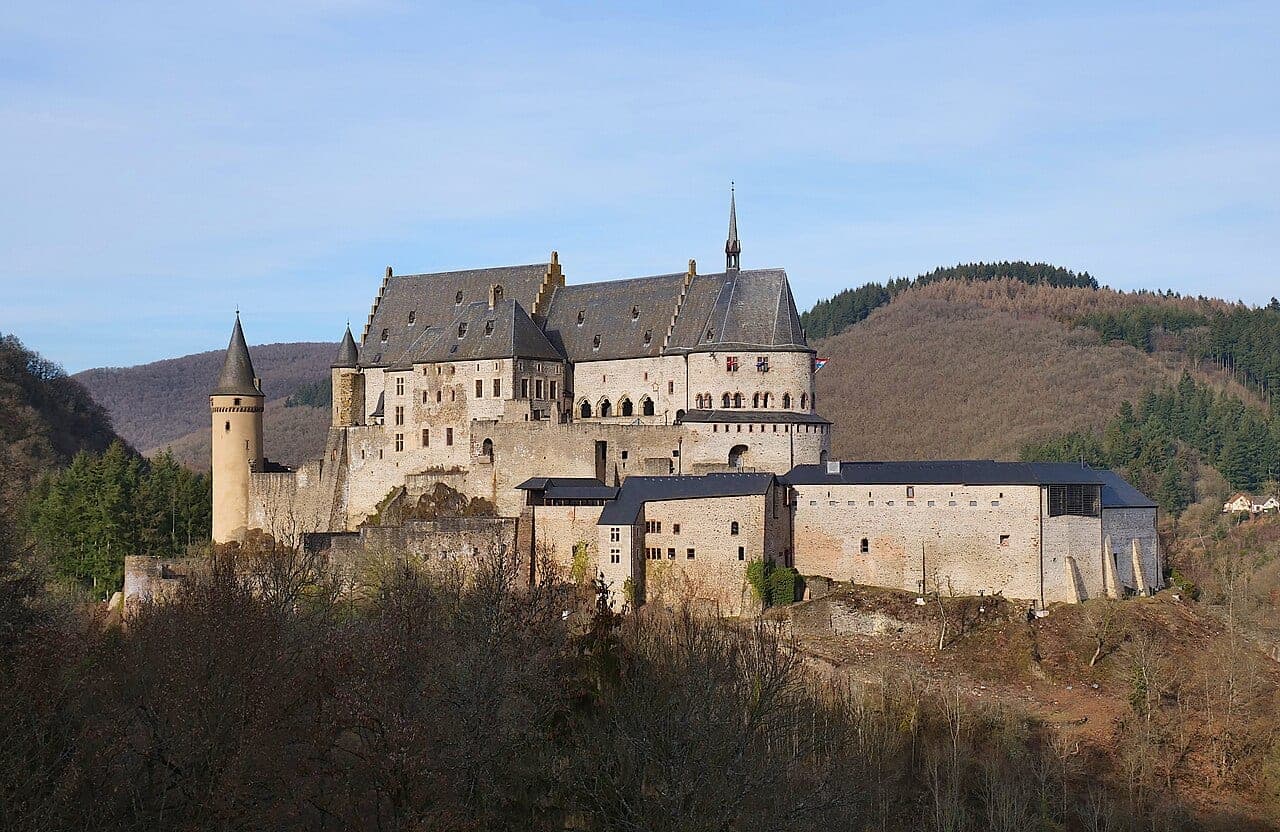
Vianden. In the northern Oesling, above the River Our, the small town of Vianden is crowned by one of the finest hilltop castles in Europe, built between the eleventh and fourteenth centuries on Roman and Carolingian foundations as the seat of the powerful Counts of Vianden (VisitArdenne). The line died out, the castle passed to the House of Nassau and fell to ruin in the nineteenth century, when Victor Hugo, who stayed in the town during his exile, mourned its decay. Taken fully into state ownership in 1977 and painstakingly rebuilt, it now looks much as it did in its medieval prime.
Echternach. The oldest town in the country, Echternach grew around the abbey founded near the year 698 by the Anglo-Saxon missionary Willibrord, who is buried in its basilica. It preserves a Romanesque abbey quarter and a Roman villa nearby, but it is best known for the dancing procession held there each Whit Tuesday.
Esch-sur-Alzette. The second city sits in the Minett, the red-earth iron country along the French border, and its identity was forged in the blast furnaces of the steel age. When the furnaces cooled, the great industrial site of Belval was reborn as a campus of the University of Luxembourg, and in 2022 Esch led the region as a European Capital of Culture.
The story begins with the deed of 963, when Count Siegfried exchanged land in the Ardennes for the Bock rock, with the consent of Emperor Otto I, and built the little castle that gave both town and country their name (Luxembourg government). His descendants raised the county into a dynasty of European weight. In 1308 Count Henry VII was elected King of the Romans and crowned Holy Roman Emperor in 1312, the first of four rulers the house would give the empire (Britannica). His son John, count of Luxembourg and king of Bohemia, blind in his last years, died fighting at the Battle of Crécy in 1346 and remains a national hero. John's son Charles IV reigned as emperor from 1355, issued the Golden Bull and made Prague a capital of learning; the line continued through Wenceslaus and ended with Emperor Sigismund, who died in 1437.
 Seventeen kilometres of tunnels were cut under Luxembourg City, and they sheltered tens of thousands of people during the Second World War. Photograph by Nikolay Maksimovich, CC BY 3.0, via Wikimedia Commons.
For the next four centuries the fortress mattered more than the dynasty. The Burgundians seized it in 1443, and thereafter it passed from one great power to another, held by Habsburg Spain, taken by Louis XIV of France whose engineer Vauban strengthened its walls, restored to the Habsburgs, then garrisoned by revolutionary and Napoleonic France. Spanish, French and Austrian engineers layered the defences into the Gibraltar of the North, with the casemates begun by the Spanish in 1644 and extended under Austrian rule (UNESCO). The Congress of Vienna made Luxembourg a grand duchy in 1815, joined in personal union to the Dutch crown and garrisoned by Prussia as a fortress of the German Confederation. The Treaty of London of 1867 ended that arrangement: the powers guaranteed Luxembourg's neutrality, the Prussian garrison withdrew, and the great fortress was dismantled (Luxembourg government).
The twentieth century tested that hard-won independence twice. German armies occupied the country in both world wars, and in 1940 the occupier annexed it outright and tried to erase its language and identity, provoking a general strike in 1942 that was brutally suppressed. Liberation came in 1944, followed at once by the German counter-offensive in the Ardennes, the Battle of the Bulge, fought partly on Luxembourg soil through the winter of 1944–45. From the ruins Luxembourg turned decisively outward, abandoning neutrality to help found NATO and, in 1951, the European Coal and Steel Community, then the wider communities that became the European Union (Luxembourg government).
The country's name is its oldest document. Lucilinburhuc, recorded in the deed of 963, joins Old High German elements meaning "little" and "castle" or "fortified place", and the modern forms Luxembourg, Lëtzebuerg and Luxemburg all descend from it.
Luxembourg is the only EU member state with a trilingual language regime across its whole territory (Languages of Luxembourg, Wikipedia). Luxembourgish, Lëtzebuergesch, is a Moselle Franconian variety of West Central German that the country standardised into a written language of its own; the law of 24 February 1984 named it the national language, French the language of legislation, and German a further administrative and judicial language. In practice the three divide the day: people speak Luxembourgish at home and in the street, read the press and hear the church largely in German, and conduct law and much official business in French. Surveys around 2018 found nearly all residents able to use French, most able to use German, and a large majority speaking Luxembourgish. The state has worked to strengthen the smallest of the three: a law of 20 July 2018 launched a strategy for the promotion of Luxembourgish and created a Commissioner for the language, and a constitutional revision in 2023 gave the national language formal recognition (Luxembourg government).
Luxembourgish identity grew out of the fortress and the frontier. Centuries of foreign garrisons and shifting borders left a people used to living between cultures, and the national motto, "Mir wëlle bleiwe wat mir sinn", "We want to remain what we are", reads as the quiet defiance of a small nation.
The cultural calendar keeps the past close. The Schueberfouer, a great funfair held in the capital each late summer, traces its origin to a market chartered by John the Blind in 1340. National Day on 23 June fills the streets with torchlight and fireworks. At the table, cross-border tastes meet local ones: the smoked collar of pork with broad beans known as Judd mat Gaardebounen counts as the national dish, and the terraced slopes of the Luxembourg Moselle produce Riesling, Pinot and the sparkling Crémant. Even the workforce is a cultural fact, with commuters from three neighbouring countries making daily life a shared border culture.
Luxembourg has been overwhelmingly Roman Catholic for most of its history, and Catholicism shaped its landscape of memory long before it shaped its politics. The Cathedral of Notre-Dame in the capital holds the tombs of the grand ducal family and the shrine of the country's patroness, Our Lady Comforter of the Afflicted. Each spring the Octave, a two-week pilgrimage in her honour, draws the faithful from across the country and closes with a great procession through the capital.
The most singular expression of Luxembourg's faith is the dancing procession of Echternach, held on Whit Tuesday in honour of Saint Willibrord. Documented since around the year 1100 and inscribed on UNESCO's Representative List of the Intangible Cultural Heritage of Humanity in 2010, it draws thousands of dancers who move through the town in a stepping, hopping rhythm to a single repeated tune, filing at last past the saint's tomb in the basilica (UNESCO). Formal practice has declined and the population has grown more diverse, yet the ritual architecture of Luxembourgish life, its pilgrimages, feast days and funerals, remains deeply marked by the Catholic inheritance.
Catholic custom still frames how Luxembourgers mark a death. A funeral Mass and burial or cremation are followed by the traditions of the Church's calendar of the dead, above all Allerhellgen, All Saints' Day on 1 November, and the following commemoration of All Souls. On these days families visit the cemeteries to clean and dress the graves, laying chrysanthemums and lighting candles among the headstones, so that the burial grounds glow at dusk with small flames tended in the cold.
The Echternach procession is itself an act of remembrance, a community moving in step to honour a saint whose bones lie beneath the church, a ritual handed down for centuries as a living inheritance rather than a museum piece. But Luxembourg's most sombre sites of memory belong to the Second World War. On a hillside at Hamm, near the capital, the Luxembourg American Cemetery holds more than five thousand American war dead, many killed in the Battle of the Bulge and the advance to the Rhine; between its two flagpoles lies the grave of General George S. Patton, whose Third Army had made the city its headquarters and who was buried among his soldiers on Christmas Eve of 1945 (American Battle Monuments Commission). A short distance away, at Sandweiler, a German war cemetery gathers close to eleven thousand German soldiers who fell mainly in the same Ardennes winter of 1944–45 (Sandweiler, Wikipedia). The two grounds, kept in quiet proximity, hold the memory of a battle that scarred the country and of a reconciliation that followed it.
Luxembourg's records are French in form, exceptionally well preserved, and free.
Civil registration began in 1796 under French annexation and has run without a break since, so every birth, marriage and death for over two centuries has a state record on a standard form. Parish registers go back to the sixteenth century in places. The Archives nationales de Luxembourg publish digitised images of both, and there is no charge, which combined with the country's size makes this one of the simplest places in Europe to build a complete family tree.
The complication is the border, or rather how often families crossed it. The historic territory of Luxembourg was much larger than the Grand Duchy, and the partitions of 1659, 1815 and 1839 left Luxembourgish families in what is now Belgium, France and Germany. Records for those places are in Arlon, Metz and Koblenz.
Emigration is the other half. Luxembourg lost a substantial share of its population in the nineteenth century, mostly to the American Midwest, and the parish and passport records that document departures are complemented by settlement records in Wisconsin, Illinois, Iowa and Minnesota.
The war record is precise and painful. Luxembourg was annexed by Germany in 1942 and its young men conscripted into the Wehrmacht; around ten thousand were forced into uniform and thousands died, and the files of the conscription, the resistance and the deportation of the Jewish community are held at the national archives and at the Musée national de la Résistance in Esch.
Luxembourg protects a heritage that ranges from a fortress to a folk ritual. The old city and its fortifications were inscribed on the UNESCO World Heritage List in December 1994, recognising both the surviving ramparts and the casemates cut through the rock, of which a large network can still be visited (UNESCO). National bodies for architectural and archaeological heritage maintain the monuments, from the restored castle of Vianden to the abbey quarter of Echternach and the industrial landscape of the Minett.
Intangible heritage has been taken up with the same seriousness. The hopping procession of Echternach joined UNESCO's Representative List of the Intangible Cultural Heritage of Humanity in 2010 (UNESCO). A national inventory records further living practices, and the promotion of the Luxembourgish language, through the 2018 strategy and the language commissioner, is treated as heritage policy of the most intimate kind.
For a small country, Luxembourg has built substantial digital access to its past. The National Library's platform eluxemburgensia has digitised centuries of the country's newspapers and periodicals in all three languages, opening a searchable record of daily life, obituaries and public memory to anyone online (National Library of Luxembourg). The National Archives, national museums and photographic archive have also moved collections online.
Its most celebrated collection is a work of memory in its own right. "The Family of Man", the landmark photographic exhibition assembled by the Luxembourg-born photographer Edward Steichen and shown around the world after 1955, is permanently installed at Clervaux Castle in the north, and was added to UNESCO's Memory of the World Register in 2003 as a document of the postwar hope for human solidarity (UNESCO Memory of the World).
Modern Luxembourg turns its smallness and its many languages into cultural reach. The capital's Kirchberg plateau holds the Museum of Modern Art Grand-Duc Jean, known as MUDAM and designed by I. M. Pei, and the concert hall of the Philharmonie, while the former steel town of Esch drew international attention as a European Capital of Culture in 2022, with the reclaimed furnaces of Belval as its emblem. A national film fund has made the country a hub for European co-productions, and its writers work in three languages.
The country's outward turn is also institutional. Luxembourg City has been a seat of European justice since 1952 and, from the Kirchberg plateau, hosts the Court of Justice of the European Union, the European Court of Auditors, the European Investment Bank and part of the machinery of the Union (Luxembourg government). The statesman Robert Schuman, whose 1950 declaration launched European integration, was born in the Clausen district of the capital.
A fortress becomes World Heritage. The strongpoint that great powers fought over for centuries, and then dismantled after 1867, was preserved rather than lost to development, and its old quarters and casemates were inscribed by UNESCO in 1994, turning the Gibraltar of the North into a shared civic inheritance.
A ritual kept alive. The dancing procession of Echternach, handed down since the Middle Ages, gained UNESCO recognition in 2010, protecting a living practice that thousands still perform each spring rather than a relic behind glass.
A castle rebuilt. Vianden, ruined in the nineteenth century and mourned by Victor Hugo, was taken into state ownership in 1977 and reconstructed from historical evidence until it regained its medieval form.
Industry reborn as learning. At Belval in the Minett, the blast furnaces that once defined Esch were preserved and set at the heart of a new University of Luxembourg campus, keeping the steel age visible in the country's youngest institution.
A humane archive. "The Family of Man", Edward Steichen's postwar exhibition of human life across the world, found a permanent home at Clervaux and a place on UNESCO's Memory of the World Register in 2003.
Seventeen kilometres of tunnels were cut under Luxembourg City, and they sheltered tens of thousands of people during the Second World War. Photograph by Nikolay Maksimovich, CC BY 3.0, via Wikimedia Commons.
For the next four centuries the fortress mattered more than the dynasty. The Burgundians seized it in 1443, and thereafter it passed from one great power to another, held by Habsburg Spain, taken by Louis XIV of France whose engineer Vauban strengthened its walls, restored to the Habsburgs, then garrisoned by revolutionary and Napoleonic France. Spanish, French and Austrian engineers layered the defences into the Gibraltar of the North, with the casemates begun by the Spanish in 1644 and extended under Austrian rule (UNESCO). The Congress of Vienna made Luxembourg a grand duchy in 1815, joined in personal union to the Dutch crown and garrisoned by Prussia as a fortress of the German Confederation. The Treaty of London of 1867 ended that arrangement: the powers guaranteed Luxembourg's neutrality, the Prussian garrison withdrew, and the great fortress was dismantled (Luxembourg government).
The twentieth century tested that hard-won independence twice. German armies occupied the country in both world wars, and in 1940 the occupier annexed it outright and tried to erase its language and identity, provoking a general strike in 1942 that was brutally suppressed. Liberation came in 1944, followed at once by the German counter-offensive in the Ardennes, the Battle of the Bulge, fought partly on Luxembourg soil through the winter of 1944–45. From the ruins Luxembourg turned decisively outward, abandoning neutrality to help found NATO and, in 1951, the European Coal and Steel Community, then the wider communities that became the European Union (Luxembourg government).
The country's name is its oldest document. Lucilinburhuc, recorded in the deed of 963, joins Old High German elements meaning "little" and "castle" or "fortified place", and the modern forms Luxembourg, Lëtzebuerg and Luxemburg all descend from it.
Luxembourg is the only EU member state with a trilingual language regime across its whole territory (Languages of Luxembourg, Wikipedia). Luxembourgish, Lëtzebuergesch, is a Moselle Franconian variety of West Central German that the country standardised into a written language of its own; the law of 24 February 1984 named it the national language, French the language of legislation, and German a further administrative and judicial language. In practice the three divide the day: people speak Luxembourgish at home and in the street, read the press and hear the church largely in German, and conduct law and much official business in French. Surveys around 2018 found nearly all residents able to use French, most able to use German, and a large majority speaking Luxembourgish. The state has worked to strengthen the smallest of the three: a law of 20 July 2018 launched a strategy for the promotion of Luxembourgish and created a Commissioner for the language, and a constitutional revision in 2023 gave the national language formal recognition (Luxembourg government).
Luxembourgish identity grew out of the fortress and the frontier. Centuries of foreign garrisons and shifting borders left a people used to living between cultures, and the national motto, "Mir wëlle bleiwe wat mir sinn", "We want to remain what we are", reads as the quiet defiance of a small nation.
The cultural calendar keeps the past close. The Schueberfouer, a great funfair held in the capital each late summer, traces its origin to a market chartered by John the Blind in 1340. National Day on 23 June fills the streets with torchlight and fireworks. At the table, cross-border tastes meet local ones: the smoked collar of pork with broad beans known as Judd mat Gaardebounen counts as the national dish, and the terraced slopes of the Luxembourg Moselle produce Riesling, Pinot and the sparkling Crémant. Even the workforce is a cultural fact, with commuters from three neighbouring countries making daily life a shared border culture.
Luxembourg has been overwhelmingly Roman Catholic for most of its history, and Catholicism shaped its landscape of memory long before it shaped its politics. The Cathedral of Notre-Dame in the capital holds the tombs of the grand ducal family and the shrine of the country's patroness, Our Lady Comforter of the Afflicted. Each spring the Octave, a two-week pilgrimage in her honour, draws the faithful from across the country and closes with a great procession through the capital.
The most singular expression of Luxembourg's faith is the dancing procession of Echternach, held on Whit Tuesday in honour of Saint Willibrord. Documented since around the year 1100 and inscribed on UNESCO's Representative List of the Intangible Cultural Heritage of Humanity in 2010, it draws thousands of dancers who move through the town in a stepping, hopping rhythm to a single repeated tune, filing at last past the saint's tomb in the basilica (UNESCO). Formal practice has declined and the population has grown more diverse, yet the ritual architecture of Luxembourgish life, its pilgrimages, feast days and funerals, remains deeply marked by the Catholic inheritance.
Catholic custom still frames how Luxembourgers mark a death. A funeral Mass and burial or cremation are followed by the traditions of the Church's calendar of the dead, above all Allerhellgen, All Saints' Day on 1 November, and the following commemoration of All Souls. On these days families visit the cemeteries to clean and dress the graves, laying chrysanthemums and lighting candles among the headstones, so that the burial grounds glow at dusk with small flames tended in the cold.
The Echternach procession is itself an act of remembrance, a community moving in step to honour a saint whose bones lie beneath the church, a ritual handed down for centuries as a living inheritance rather than a museum piece. But Luxembourg's most sombre sites of memory belong to the Second World War. On a hillside at Hamm, near the capital, the Luxembourg American Cemetery holds more than five thousand American war dead, many killed in the Battle of the Bulge and the advance to the Rhine; between its two flagpoles lies the grave of General George S. Patton, whose Third Army had made the city its headquarters and who was buried among his soldiers on Christmas Eve of 1945 (American Battle Monuments Commission). A short distance away, at Sandweiler, a German war cemetery gathers close to eleven thousand German soldiers who fell mainly in the same Ardennes winter of 1944–45 (Sandweiler, Wikipedia). The two grounds, kept in quiet proximity, hold the memory of a battle that scarred the country and of a reconciliation that followed it.
Luxembourg's records are French in form, exceptionally well preserved, and free.
Civil registration began in 1796 under French annexation and has run without a break since, so every birth, marriage and death for over two centuries has a state record on a standard form. Parish registers go back to the sixteenth century in places. The Archives nationales de Luxembourg publish digitised images of both, and there is no charge, which combined with the country's size makes this one of the simplest places in Europe to build a complete family tree.
The complication is the border, or rather how often families crossed it. The historic territory of Luxembourg was much larger than the Grand Duchy, and the partitions of 1659, 1815 and 1839 left Luxembourgish families in what is now Belgium, France and Germany. Records for those places are in Arlon, Metz and Koblenz.
Emigration is the other half. Luxembourg lost a substantial share of its population in the nineteenth century, mostly to the American Midwest, and the parish and passport records that document departures are complemented by settlement records in Wisconsin, Illinois, Iowa and Minnesota.
The war record is precise and painful. Luxembourg was annexed by Germany in 1942 and its young men conscripted into the Wehrmacht; around ten thousand were forced into uniform and thousands died, and the files of the conscription, the resistance and the deportation of the Jewish community are held at the national archives and at the Musée national de la Résistance in Esch.
Luxembourg protects a heritage that ranges from a fortress to a folk ritual. The old city and its fortifications were inscribed on the UNESCO World Heritage List in December 1994, recognising both the surviving ramparts and the casemates cut through the rock, of which a large network can still be visited (UNESCO). National bodies for architectural and archaeological heritage maintain the monuments, from the restored castle of Vianden to the abbey quarter of Echternach and the industrial landscape of the Minett.
Intangible heritage has been taken up with the same seriousness. The hopping procession of Echternach joined UNESCO's Representative List of the Intangible Cultural Heritage of Humanity in 2010 (UNESCO). A national inventory records further living practices, and the promotion of the Luxembourgish language, through the 2018 strategy and the language commissioner, is treated as heritage policy of the most intimate kind.
For a small country, Luxembourg has built substantial digital access to its past. The National Library's platform eluxemburgensia has digitised centuries of the country's newspapers and periodicals in all three languages, opening a searchable record of daily life, obituaries and public memory to anyone online (National Library of Luxembourg). The National Archives, national museums and photographic archive have also moved collections online.
Its most celebrated collection is a work of memory in its own right. "The Family of Man", the landmark photographic exhibition assembled by the Luxembourg-born photographer Edward Steichen and shown around the world after 1955, is permanently installed at Clervaux Castle in the north, and was added to UNESCO's Memory of the World Register in 2003 as a document of the postwar hope for human solidarity (UNESCO Memory of the World).
Modern Luxembourg turns its smallness and its many languages into cultural reach. The capital's Kirchberg plateau holds the Museum of Modern Art Grand-Duc Jean, known as MUDAM and designed by I. M. Pei, and the concert hall of the Philharmonie, while the former steel town of Esch drew international attention as a European Capital of Culture in 2022, with the reclaimed furnaces of Belval as its emblem. A national film fund has made the country a hub for European co-productions, and its writers work in three languages.
The country's outward turn is also institutional. Luxembourg City has been a seat of European justice since 1952 and, from the Kirchberg plateau, hosts the Court of Justice of the European Union, the European Court of Auditors, the European Investment Bank and part of the machinery of the Union (Luxembourg government). The statesman Robert Schuman, whose 1950 declaration launched European integration, was born in the Clausen district of the capital.
A fortress becomes World Heritage. The strongpoint that great powers fought over for centuries, and then dismantled after 1867, was preserved rather than lost to development, and its old quarters and casemates were inscribed by UNESCO in 1994, turning the Gibraltar of the North into a shared civic inheritance.
A ritual kept alive. The dancing procession of Echternach, handed down since the Middle Ages, gained UNESCO recognition in 2010, protecting a living practice that thousands still perform each spring rather than a relic behind glass.
A castle rebuilt. Vianden, ruined in the nineteenth century and mourned by Victor Hugo, was taken into state ownership in 1977 and reconstructed from historical evidence until it regained its medieval form.
Industry reborn as learning. At Belval in the Minett, the blast furnaces that once defined Esch were preserved and set at the heart of a new University of Luxembourg campus, keeping the steel age visible in the country's youngest institution.
A humane archive. "The Family of Man", Edward Steichen's postwar exhibition of human life across the world, found a permanent home at Clervaux and a place on UNESCO's Memory of the World Register in 2003.
National Overview
Notable Cities
Historical Foundations
Linguistic and Etymological Roots
Cultural Identity
Religion and Spirituality
Remembrance and Mourning Traditions
Tracing a Family in Luxembourg
Heritage Preservation Efforts
Digital Heritage
Contemporary Cultural Influences
Success Stories
References and resources
- UNESCO World Heritage Centre, City of Luxembourg: its Old Quarters and Fortifications: the 1994 inscription covering the ramparts and casemates.
- UNESCO Intangible Cultural Heritage, Hopping procession of Echternach: the 2010 listing and description of the ritual.
- Luxembourg government, Luxembourg's origins: Count Siegfried, the Bock and the deed of 963.
- Encyclopaedia Britannica, House of Luxembourg: the dynasty and its Holy Roman Emperors.
- Luxembourg government, Top 5 agreements that shaped Luxembourg's history: the 1867 Treaty of London and guaranteed neutrality.
- Luxembourg government, European Union and international organisations: founding membership of the European communities.
- Luxembourg government, home of European institutions: the EU institutions seated in Luxembourg City.
- Luxembourg government, strategy for the promotion of the Luxembourgish language: the 2018 law and language commissioner.
- Languages of Luxembourg, Wikipedia: the trilingual regime and the status of Luxembourgish.
- American Battle Monuments Commission, Luxembourg American Cemetery: the Hamm cemetery and the grave of General Patton.
- Sandweiler German war cemetery, Wikipedia: the German dead of the Battle of the Bulge.
- CIA World Factbook, Luxembourg: geography, population and national statistics.