Heritage · Country
Kurdistan Culture and Heritage
A citadel mound in Erbil that people may have lived on for eight thousand years, a Zagros cave where Neanderthals buried their dead, and a language written in three alphabets across four states. This guide follows Kurdish heritage and the memorials Kurds and Yazidis have built for their murdered.Written to last.
By Confinity Heritage Editorial · Updated 2026-08-17 · 8-minute readQuiet tools, kept out of the way.
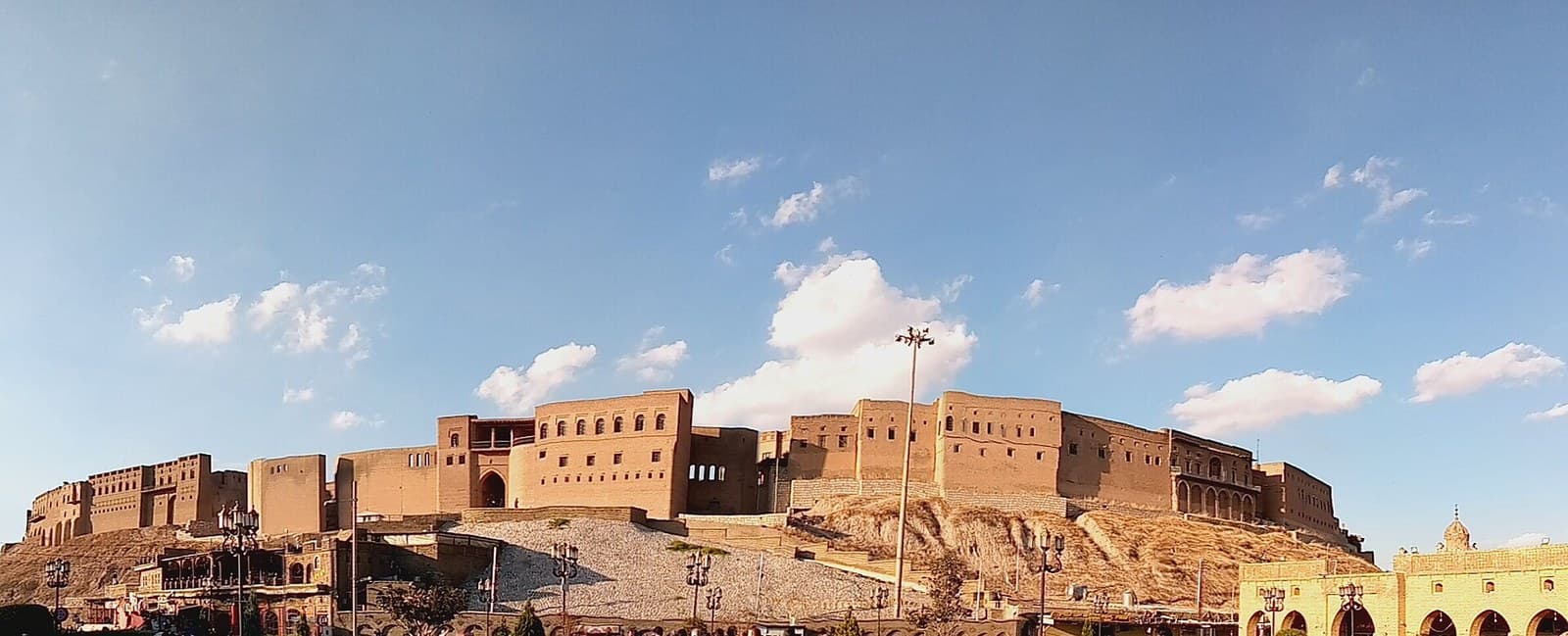
In 2007 the last 840 families living on the citadel of Erbil were moved off so the mound could be restored, and one family was asked to stay. The reason was record-keeping of an unusual kind: if the citadel emptied for even a night, a settlement people may have occupied without a break for eight thousand years would have a gap in it.
Kurdistan names a cultural and linguistic region rather than a state, and this profile says so before it says anything else. What it covers is the heritage: a language group written in three scripts, a spring new year kept on hillsides with fire, an endangered bardic art, and the burial customs of Muslims, Yazidis, Kaka'i and Christians who have lived beside each other here for a very long time. It also covers three episodes of mass killing within living memory.
Kurdistan means at least three things, and this page states which one it uses. In everyday speech it names the cultural and linguistic region where Kurds form a majority or a large minority, a mountainous belt across the Zagros and eastern Taurus taking in south-eastern Türkiye, northern Iraq, north-western Iran and northern Syria. It's also the formal name of a federal region inside Iraq, and of an Iranian province, Kordestan. This profile uses the first sense and names the Kurdistan Region of Iraq when the constituted entity is meant. Estimates run from 25 to 35 million, which makes Kurds one of the largest peoples on earth without a state of their own.
The Kurdistan Region of Iraq is the only Kurdish autonomous entity recognised in a national constitution. Iraq's 2005 constitution recognises it as a federal region with a parliament in Erbil, a president, a regional government and regional guard forces, the Peshmerga, and Kurdish is one of Iraq's two official languages. It covers Erbil, Sulaymaniyah, Duhok and, since 2014, Halabja governorates, with a population put at five to six million (Wikipedia). Kurdish-majority areas in Türkiye and Iran have no comparable status, and the autonomous administration in north-east Syria is a separate matter with a contested standing of its own.
No Kurdish state exists, and views on whether one should differ among Kurds as well as among the states concerned. On 25 September 2017 the regional government held an independence referendum; turnout was reported at 72 per cent and about 93 per cent voted yes. Baghdad rejected the vote as unconstitutional, suspended international flights to the region four days later, and in mid-October retook Kirkuk and other disputed areas. Türkiye and Iran opposed the referendum, the United States and the United Nations objected to its timing, and on 6 November Iraq's Federal Supreme Court ruled that no province could secede; the regional government said it would abide by the ruling (Wikipedia).
Hewlêr (Erbil). The regional capital is built around a citadel on a tell rising 25 to 32 metres above the plain, its ring of house facades forming an unbroken wall. Known in antiquity as Arbela, it held a famous temple of Ishtar, and Alexander's battle against Darius in 331 BC is named for it.
Slemani (Sulaymaniyah). Founded in 1784 by the Baban princes, Slemani became the centre of Sorani literature and printing, home to the poets Nalî, Goran and Sherko Bekas, and its museum, opened in 1961, is the second largest in Iraq after Baghdad.
Amêdî, Akrê and Halabja. Amêdî stands on a flat-topped rock reached by a single road; Akrê is known for its Newroz procession, when thousands of torches move up the hillside after dark; Halabja has meant one thing since March 1988.
Diyarbakır (Amed). The largest Kurdish-majority city in Türkiye, behind black basalt walls inscribed by UNESCO in 2015.
Xenophon's Anabasis describes a mountain people called the Karduchoi harrying a Greek army through these valleys around 400 BC, and later writers connect them to the Kurds with more enthusiasm than evidence. Iranian-speaking peoples held the Zagros through the Median and Parthian periods, the region was Islamised from the seventh century, and by the tenth several Kurdish dynasties ruled substantial land.
The frame that shaped the modern question was set in 1514, when the Ottoman victory at Chaldiran fixed a border between Ottoman and Safavid domains straight through Kurdish territory. Hereditary emirates, Baban, Soran, Botan, Bahdinan and Ardalan, then governed with wide autonomy until Istanbul abolished them in the mid-nineteenth century.
The Treaty of Sèvres of 1920 provided in articles 62 to 64 for Kurdish autonomy and a possible route to independence; the Treaty of Lausanne of 1923, which replaced it, made no mention of the Kurds. Two short-lived republics followed, Ararat and Mahabad, the latter lasting eleven months in 1946.
In Iraq the pattern was agreement followed by collapse. An autonomy accord of March 1970 broke down by 1974; in 1983 around 8,000 men and boys of the Barzani clan were taken from resettlement camps and never returned; the Anfal campaign of 1988 destroyed the rural society of the north; and the rising after the 1991 Gulf War sent over a million people toward the Turkish and Iranian borders within weeks, prompting the northern no-fly zone under which de facto self-rule began.
Kurdish isn't one language but a group of related ones in the north-western branch of Iranian, and speakers of the extremes can't simply understand each other. Kurmanji, or Northern Kurdish, has the most speakers, usually estimated at 15 to 20 million across Türkiye, Syria, Duhok and parts of Iran. Sorani, or Central Kurdish, has perhaps 6 to 7 million speakers in Iraq and western Iran and is the second literary standard. Zaza and Gorani are close relatives whose classification linguists dispute, since most specialists place Zaza-Gorani beside Kurdish rather than inside it while their speakers mostly identify as Kurds (Wikipedia).
The scripts follow the borders. Kurmanji in Türkiye and Syria uses the Hawar alphabet, a Latin system devised by Celadet Alî Bedirxan and published from 1932 in the Damascus journal that gave it its name; Sorani uses a modified Perso-Arabic script; Soviet Kurdish used Cyrillic. A Kurmanji speaker in Diyarbakır often can't read a Sorani book printed two hundred kilometres away.
Prohibition has a documented timeline. In Türkiye the use of Kurdish was illegal after the 1980 coup, formalised by Law No. 2932 of October 1983 and repealed in 1991; broadcasting stayed unlawful until 2002, and the state channel TRT 6 began in January 2009 (Human Rights Watch). In Syria, Kurdish publishing was forbidden for decades, and a special census in Hasakah province in 1962 stripped citizenship from a large number of Kurds, whose descendants stayed stateless until 2011. In Iran, Kurdish may be published but isn't the medium of state schooling. The name itself appears as an administrative term under the Seljuks in the twelfth century, and Erbil's Kurdish name Hewlêr descends through Arabic Arbil from the Assyrian Arbailu.
Newroz falls on 21 March and carries more weight here than a new year usually does. The story told with it is that Kawa, a blacksmith, killed the tyrant Zahhak and lit a fire on the mountain to tell everyone they were free, which is why the day is kept with bonfires on hillsides, jumping the flames, and long lines of dancers below. In Türkiye the celebration was restricted for years and became a mass political gathering as a result; UNESCO inscribed Nowruz in 2009 and enlarged the file in 2016 to twelve states (UNESCO).
The dance is the govend, a line or open circle in which everyone holds hands or little fingers and follows a leader, the sergovend, who carries a handkerchief and sets the figure while zurna and davul carry the tune outdoors.
The dengbêj tradition is the region's great oral art and the one most at risk. A dengbêj sings unaccompanied, in long narrative songs called kilam that carry history, feud, love and lament, and the great names are remembered as individuals: Evdalê Zeynikê in the nineteenth century, and in the twentieth Şakiro and Karapetê Xaço, an Armenian survivor of 1915 who sang his whole repertoire in Kurdish. Decades of restriction, then radio and television, thinned the practice badly, and a Mala Dengbêjan, where singers gather and are recorded, opened in Diyarbakır in 2007 (Wikipedia). Ehmedê Xanî finished Mem û Zîn in 1692, a verse romance that is also an argument about why the Kurds have no ruler of their own.
Most Kurds are Sunni Muslims of the Shafi'i school, which distinguishes them from their Hanafi Turkish and Arab neighbours, and Sufi brotherhoods have shaped religious authority for centuries; the Qadiri order centred on the Barzinji family of Sulaymaniyah and the Naqshbandi on the Barzani family of the north, so that in both cases a religious lineage became a political one.
 Lalish is the holiest place in the Yazidi religion, and every Yazidi is expected to make the pilgrimage once. After 2014 it also became a refuge for people displaced from Sinjar. Photograph by Levi Clancy, CC0, via Wikimedia Commons.
The Yazidis are a Kurdish-speaking people with their own religion, and Lalish, a valley of conical fluted spires in Nineveh governorate, is its centre and the site of the tomb of Sheikh Adi ibn Musafir, who died there around 1162. Yazidis venerate Tawusî Melek, the Peacock Angel, and their society is organised in hereditary castes of sheikhs, pirs and murids who marry within their own group (Wikipedia). Outsiders have persistently misdescribed the faith, and that misdescription has been used to justify violence against it.
The Kaka'i, known in Iran as Yarsan, follow a tradition founded by Sultan Sahak around the fourteenth century, keep their scripture in Gorani verse and treat the long-necked tembûr as a sacred instrument. Assyrian, Chaldean and Syriac Christians have parishes in Ankawa and across the Nineveh Plains and pray in dialects of Aramaic, and the shrine of the prophet Nahum at Alqosh was rescued from collapse between 2018 and 2021.
Muslim practice sets the frame for most Kurdish funerals. The body is washed, wrapped in an unsewn white shroud, prayed over with the janaza and buried the same day where possible, facing Mecca, and the family receives condolences for three days, men and women separately, with Quran recitation and endless small glasses of tea. Women's laments, sung rather than spoken, carry the dead person's name and deeds.
Yazidi practice differs in ways that matter to Yazidis. Burial is quick and in the ground, the head turned toward Lalish, and small hardened balls of clay called berat, made at the sacred spring there, are placed with the body. Every Yazidi is expected to have a brother or sister of the hereafter, from the sheikh or pir castes, who stands beside them in death.
Halabja, 16 March 1988. Iraqi aircraft attacked the town with chemical weapons in the closing phase of the Iran-Iraq war. Between 3,200 and 5,000 people were killed at once and 7,000 to 10,000 injured, most of them civilians, in what is generally described as the largest chemical attack on a civilian area in history (Wikipedia). The Halabja Martyrs Monument opened above the town in 2003, was burned during protests in 2006 and repaired; the mass graves lie in the cemetery beside it, and the wall inside carries the names.
The Anfal campaign, February to September 1988. Eight successive operations swept the rural north, demolishing villages, moving survivors to collective towns and sending tens of thousands of people, most of them men and boys, to be shot in the southern deserts. Human Rights Watch published Genocide in Iraq: The Anfal Campaign Against the Kurds in 1993, working from captured Iraqi state documents, and concluded that the dead could not conceivably number less than 50,000 and might well be twice that; Kurdish authorities put the figure at 182,000 (Human Rights Watch). In June 2007 the Iraqi High Tribunal convicted Ali Hassan al-Majid and two other former officials of genocide over Anfal, and on 1 March 2010 the same court recognised the Halabja attack as an act of genocide against the Kurds (Wikipedia). Mass graves in the southern deserts have been exhumed since 2003 and remains flown north in numbered coffins, and the reburials, carried through streets lined with people holding photographs, are a recurring public rite.
Sulaymaniyah keeps that memory in the building where it was administered. Amna Suraka, the Red Security headquarters of 1985, opened as a museum after 2003 with its cells and shell-holed facade left as they were, and its Hall of Mirrors is lined with roughly 182,000 fragments of mirror, one for each person the Kurdish authorities count as killed in Anfal, under 4,500 bulbs for the destroyed villages (Wikipedia).
The Yazidi genocide, from 3 August 2014. Islamic State forces attacked the Sinjar district, killed men and older boys, abducted women and girls into sexual slavery and took children to raise as fighters. The UN has cited around 5,000 killed, while a survey published in 2017 estimated 2,100 to 4,400 killed and 4,200 to 10,800 abducted (Wikipedia). The Independent International Commission of Inquiry on the Syrian Arab Republic concluded in June 2016 that Islamic State was committing genocide against the Yazidis, and UNITAD, the UN investigative team created by Security Council resolution 2379 of September 2017, reported on 10 May 2021 that it had established clear and convincing evidence that the attacks on the Yazidis of Sinjar constituted genocide (UN News). Several legislatures have adopted recognitions, among them the US House of Representatives and the UK House of Commons in 2016 and Iraq's parliament in March 2021, which are acts of parliaments rather than rulings of a court. One court has ruled: on 30 November 2021 the Higher Regional Court in Frankfurt sentenced an Iraqi former Islamic State member to life imprisonment for genocide, the first such conviction anywhere for crimes against Yazidis (Amnesty International).
The graves are the remembrance now: around eighty have been identified near Sinjar, exhumations began at Kocho in March 2019, and on 6 February 2021 the remains of 104 people from that village were carried home and buried there.
The Kurds have no state, so their records were made by four of them, and the most consequential archive was captured.
Ottoman, then Turkish, Iranian, Iraqi and Syrian administrations each registered Kurds under their own systems and in their own languages, and Kurdish is written in three scripts across those borders. A Kurdish family divided by the frontiers drawn after 1918 may appear in Turkish Latin, Arabic and Persian records within one generation.
Kurdish genealogy itself runs through tribe and lineage, the eşiret, and through the religious families of the Naqshbandi and Qadiri orders, whose descent lines produced the Barzani and Talabani houses.
The Anfal documents are the archive. Iraqi government files on the campaign of 1988, in which chemical weapons were used and tens of thousands of Kurds were killed or disappeared, were captured in quantity during the 1991 uprising and later after 2003. They are bureaucratic in form, naming villages destroyed and people detained, and they were used in the Iraqi High Tribunal proceedings. Mass grave exhumations in southern Iraq have identified people from northern villages.
The Yazidi record is the most recent. After 2014 thousands of Yazidi women and children were enslaved by ISIS, and the identification of the murdered from mass graves around Sinjar, and the tracing of the missing, has been done partly by the community's own bureau and partly by international forensic teams.
UNESCO inscribed the Erbil Citadel on 21 June 2014 under criterion (iv), for its oval fortified plan and its layered domestic architecture. The High Commission for Erbil Citadel Revitalization, set up by the regional government in 2007 with UNESCO support, has stabilised the perimeter houses and restored the hammam and the Grand Mosque, and it's the body that carried out the clearance and kept one household in place (UNESCO). The clearance remains contested, because it protected fragile fabric and it also ended a living quarter.
Shanidar Cave in the Bradost mountains is the region's other site of international importance. Ralph Solecki excavated there between 1951 and 1960 and found the remains of ten Neanderthals, among them Shanidar 1, a man who survived a crushed face and a withered arm for years, which is generally read as evidence that others cared for him. Pollen clumps around Shanidar 4 were interpreted in 1968 as a burial strewn with flowers, a reading challenged since, with burrowing jirds and nesting bees offered as likelier agents. Work resumed in 2014 under the Kurdistan Directorate of Antiquities with a Cambridge-led team, and the skeleton named Shanidar Z, announced in 2020 and its skull reconstructed in 2024, put Neanderthal mortuary behaviour back on excavated ground (Wikipedia).
The Sulaymaniyah Museum has taken an unusual line on looted antiquities, buying tablets in order to keep them in Iraq and publish them; in 2011 it acquired fragments that proved to be a substantially complete Tablet V of the Epic of Gilgamesh, published in 2014 with about twenty lines nobody had read in three thousand years (Wikipedia). Loss continues elsewhere: Hasankeyf on the Tigris went under the Ilısu reservoir from 2020 (Wikipedia).
The Kurdish Institute of Paris, founded in 1983, holds the largest Kurdish library outside the region and has put much of its catalogue and its periodicals online, which for decades was the only way a reader in Türkiye could reach Kurmanji books (Institut kurde de Paris). Documentation of the 2014 atrocities has been digital from the start, combining testimony, satellite imagery, drone survey of grave sites and forensic records, and the evidence packages built that way are what made the Frankfurt prosecution possible. Recording projects for dengbêj repertoire, most of it never written down, are the least visible and the most urgent.
The largest Kurdish community outside the region is in Germany, where estimates run past a million, with others in France, Sweden, the Netherlands and the United States, and a very large internal diaspora in Istanbul and Izmir. Kurdish-language publishing in Sweden kept Kurmanji prose alive through the 1980s and 1990s, largely through Mehmed Uzun.
Kurdish cinema reached international audiences through Yılmaz Güney, whose Yol shared the Palme d'Or in 1982 while he was a fugitive from a Turkish prison, and Şivan Perwer, Ciwan Haco and Aynur Doğan carried Kurdish song abroad.
A citadel inscribed and never emptied. UNESCO listed the Erbil Citadel in 2014, and the restoration kept one family on the mound so habitation stayed unbroken.
Twenty lost lines of Gilgamesh. The Sulaymaniyah Museum bought a looted tablet in 2011 rather than let it leave Iraq, and a new stretch of the epic was published in 2014.
A genocide named in a courtroom. The Frankfurt judgment of 30 November 2021 was the first conviction anywhere for genocide against Yazidis.
Kocho brought home. The remains of 104 people murdered in August 2014 were identified and buried in their own village on 6 February 2021.
Lalish is the holiest place in the Yazidi religion, and every Yazidi is expected to make the pilgrimage once. After 2014 it also became a refuge for people displaced from Sinjar. Photograph by Levi Clancy, CC0, via Wikimedia Commons.
The Yazidis are a Kurdish-speaking people with their own religion, and Lalish, a valley of conical fluted spires in Nineveh governorate, is its centre and the site of the tomb of Sheikh Adi ibn Musafir, who died there around 1162. Yazidis venerate Tawusî Melek, the Peacock Angel, and their society is organised in hereditary castes of sheikhs, pirs and murids who marry within their own group (Wikipedia). Outsiders have persistently misdescribed the faith, and that misdescription has been used to justify violence against it.
The Kaka'i, known in Iran as Yarsan, follow a tradition founded by Sultan Sahak around the fourteenth century, keep their scripture in Gorani verse and treat the long-necked tembûr as a sacred instrument. Assyrian, Chaldean and Syriac Christians have parishes in Ankawa and across the Nineveh Plains and pray in dialects of Aramaic, and the shrine of the prophet Nahum at Alqosh was rescued from collapse between 2018 and 2021.
Muslim practice sets the frame for most Kurdish funerals. The body is washed, wrapped in an unsewn white shroud, prayed over with the janaza and buried the same day where possible, facing Mecca, and the family receives condolences for three days, men and women separately, with Quran recitation and endless small glasses of tea. Women's laments, sung rather than spoken, carry the dead person's name and deeds.
Yazidi practice differs in ways that matter to Yazidis. Burial is quick and in the ground, the head turned toward Lalish, and small hardened balls of clay called berat, made at the sacred spring there, are placed with the body. Every Yazidi is expected to have a brother or sister of the hereafter, from the sheikh or pir castes, who stands beside them in death.
Halabja, 16 March 1988. Iraqi aircraft attacked the town with chemical weapons in the closing phase of the Iran-Iraq war. Between 3,200 and 5,000 people were killed at once and 7,000 to 10,000 injured, most of them civilians, in what is generally described as the largest chemical attack on a civilian area in history (Wikipedia). The Halabja Martyrs Monument opened above the town in 2003, was burned during protests in 2006 and repaired; the mass graves lie in the cemetery beside it, and the wall inside carries the names.
The Anfal campaign, February to September 1988. Eight successive operations swept the rural north, demolishing villages, moving survivors to collective towns and sending tens of thousands of people, most of them men and boys, to be shot in the southern deserts. Human Rights Watch published Genocide in Iraq: The Anfal Campaign Against the Kurds in 1993, working from captured Iraqi state documents, and concluded that the dead could not conceivably number less than 50,000 and might well be twice that; Kurdish authorities put the figure at 182,000 (Human Rights Watch). In June 2007 the Iraqi High Tribunal convicted Ali Hassan al-Majid and two other former officials of genocide over Anfal, and on 1 March 2010 the same court recognised the Halabja attack as an act of genocide against the Kurds (Wikipedia). Mass graves in the southern deserts have been exhumed since 2003 and remains flown north in numbered coffins, and the reburials, carried through streets lined with people holding photographs, are a recurring public rite.
Sulaymaniyah keeps that memory in the building where it was administered. Amna Suraka, the Red Security headquarters of 1985, opened as a museum after 2003 with its cells and shell-holed facade left as they were, and its Hall of Mirrors is lined with roughly 182,000 fragments of mirror, one for each person the Kurdish authorities count as killed in Anfal, under 4,500 bulbs for the destroyed villages (Wikipedia).
The Yazidi genocide, from 3 August 2014. Islamic State forces attacked the Sinjar district, killed men and older boys, abducted women and girls into sexual slavery and took children to raise as fighters. The UN has cited around 5,000 killed, while a survey published in 2017 estimated 2,100 to 4,400 killed and 4,200 to 10,800 abducted (Wikipedia). The Independent International Commission of Inquiry on the Syrian Arab Republic concluded in June 2016 that Islamic State was committing genocide against the Yazidis, and UNITAD, the UN investigative team created by Security Council resolution 2379 of September 2017, reported on 10 May 2021 that it had established clear and convincing evidence that the attacks on the Yazidis of Sinjar constituted genocide (UN News). Several legislatures have adopted recognitions, among them the US House of Representatives and the UK House of Commons in 2016 and Iraq's parliament in March 2021, which are acts of parliaments rather than rulings of a court. One court has ruled: on 30 November 2021 the Higher Regional Court in Frankfurt sentenced an Iraqi former Islamic State member to life imprisonment for genocide, the first such conviction anywhere for crimes against Yazidis (Amnesty International).
The graves are the remembrance now: around eighty have been identified near Sinjar, exhumations began at Kocho in March 2019, and on 6 February 2021 the remains of 104 people from that village were carried home and buried there.
The Kurds have no state, so their records were made by four of them, and the most consequential archive was captured.
Ottoman, then Turkish, Iranian, Iraqi and Syrian administrations each registered Kurds under their own systems and in their own languages, and Kurdish is written in three scripts across those borders. A Kurdish family divided by the frontiers drawn after 1918 may appear in Turkish Latin, Arabic and Persian records within one generation.
Kurdish genealogy itself runs through tribe and lineage, the eşiret, and through the religious families of the Naqshbandi and Qadiri orders, whose descent lines produced the Barzani and Talabani houses.
The Anfal documents are the archive. Iraqi government files on the campaign of 1988, in which chemical weapons were used and tens of thousands of Kurds were killed or disappeared, were captured in quantity during the 1991 uprising and later after 2003. They are bureaucratic in form, naming villages destroyed and people detained, and they were used in the Iraqi High Tribunal proceedings. Mass grave exhumations in southern Iraq have identified people from northern villages.
The Yazidi record is the most recent. After 2014 thousands of Yazidi women and children were enslaved by ISIS, and the identification of the murdered from mass graves around Sinjar, and the tracing of the missing, has been done partly by the community's own bureau and partly by international forensic teams.
UNESCO inscribed the Erbil Citadel on 21 June 2014 under criterion (iv), for its oval fortified plan and its layered domestic architecture. The High Commission for Erbil Citadel Revitalization, set up by the regional government in 2007 with UNESCO support, has stabilised the perimeter houses and restored the hammam and the Grand Mosque, and it's the body that carried out the clearance and kept one household in place (UNESCO). The clearance remains contested, because it protected fragile fabric and it also ended a living quarter.
Shanidar Cave in the Bradost mountains is the region's other site of international importance. Ralph Solecki excavated there between 1951 and 1960 and found the remains of ten Neanderthals, among them Shanidar 1, a man who survived a crushed face and a withered arm for years, which is generally read as evidence that others cared for him. Pollen clumps around Shanidar 4 were interpreted in 1968 as a burial strewn with flowers, a reading challenged since, with burrowing jirds and nesting bees offered as likelier agents. Work resumed in 2014 under the Kurdistan Directorate of Antiquities with a Cambridge-led team, and the skeleton named Shanidar Z, announced in 2020 and its skull reconstructed in 2024, put Neanderthal mortuary behaviour back on excavated ground (Wikipedia).
The Sulaymaniyah Museum has taken an unusual line on looted antiquities, buying tablets in order to keep them in Iraq and publish them; in 2011 it acquired fragments that proved to be a substantially complete Tablet V of the Epic of Gilgamesh, published in 2014 with about twenty lines nobody had read in three thousand years (Wikipedia). Loss continues elsewhere: Hasankeyf on the Tigris went under the Ilısu reservoir from 2020 (Wikipedia).
The Kurdish Institute of Paris, founded in 1983, holds the largest Kurdish library outside the region and has put much of its catalogue and its periodicals online, which for decades was the only way a reader in Türkiye could reach Kurmanji books (Institut kurde de Paris). Documentation of the 2014 atrocities has been digital from the start, combining testimony, satellite imagery, drone survey of grave sites and forensic records, and the evidence packages built that way are what made the Frankfurt prosecution possible. Recording projects for dengbêj repertoire, most of it never written down, are the least visible and the most urgent.
The largest Kurdish community outside the region is in Germany, where estimates run past a million, with others in France, Sweden, the Netherlands and the United States, and a very large internal diaspora in Istanbul and Izmir. Kurdish-language publishing in Sweden kept Kurmanji prose alive through the 1980s and 1990s, largely through Mehmed Uzun.
Kurdish cinema reached international audiences through Yılmaz Güney, whose Yol shared the Palme d'Or in 1982 while he was a fugitive from a Turkish prison, and Şivan Perwer, Ciwan Haco and Aynur Doğan carried Kurdish song abroad.
A citadel inscribed and never emptied. UNESCO listed the Erbil Citadel in 2014, and the restoration kept one family on the mound so habitation stayed unbroken.
Twenty lost lines of Gilgamesh. The Sulaymaniyah Museum bought a looted tablet in 2011 rather than let it leave Iraq, and a new stretch of the epic was published in 2014.
A genocide named in a courtroom. The Frankfurt judgment of 30 November 2021 was the first conviction anywhere for genocide against Yazidis.
Kocho brought home. The remains of 104 people murdered in August 2014 were identified and buried in their own village on 6 February 2021.
National Overview
Notable Cities
Historical Foundations
Linguistic and Etymological Roots
Cultural Identity
Religion and Spirituality
Remembrance and Mourning Traditions
Tracing a Family in Kurdistan
Heritage Preservation Efforts
Digital Heritage
Contemporary Cultural Influences
Success Stories
References and resources
- UNESCO: Erbil Citadel, inscribed 21 June 2014 under criterion (iv), and Nowruz, 2009 and 2016.
- Human Rights Watch: Genocide in Iraq: The Anfal Campaign Against the Kurds and restrictions on the Kurdish language in Turkey.
- UN News, ISIL crimes against Yazidis constitute genocide: UNITAD's briefing of 10 May 2021.
- Amnesty International, the world's first judgment on genocide against the Yazidis.
- Wikipedia: Anfal campaign, Halabja massacre, Halabja Martyrs Monument, Amna Suraka, Yazidi genocide, Sinjar massacre, Yazidis, Lalish.
- Wikipedia: Kurdistan Region, 2017 independence referendum, Kurdish languages, Dengbêj, Mem û Zîn, Shanidar Cave, Erbil Citadel, Sulaymaniyah Museum, Hasankeyf.
- Institut kurde de Paris; Nobel Peace Prize 2018, Nadia Murad; Encyclopaedia Britannica, Kurdistan.