Heritage · Country
Iran Culture and Heritage
For three thousand years Persia has trusted its memory to verse, to fire and to gardens laid out as a map of paradise. A guide to Iran's heritage, from Persepolis and the poets of Shiraz to the Zoroastrian towers of Yazd and the mourning of Muharram.Written to last.
By Confinity Heritage Editorial · Updated 2026-07-31 · 8-minute readQuiet tools, kept out of the way.
Persians have long entrusted their memory to poetry. For centuries families have marked grief, love and hope by opening the collected verses of Hafez at random and reading whatever couplet falls open, a household oracle known as fal-e Hafez, and on the winter-solstice night of Yalda they still gather to read Hafez and Ferdowsi aloud until the longest darkness of the year gives way to light. Iran, the country the Greeks called Persia, is among the oldest continuous civilisations on earth, and much of what it remembers has been carried not in stone alone but in the cadence of a line learned by heart.
That memory also lives in ruins, shrines and gardens laid out to imagine paradise. Iran holds roughly thirty properties on the UNESCO World Heritage List, from the Achaemenid capital at Persepolis to the desert city of Yazd, and its calendar joins two of the world's deepest remembrance traditions: the Zoroastrian inheritance of fire and the spring feast of Nowruz, and the Shia mourning of Muharram.
Iran occupies a high plateau in western Asia, bordered by the Caspian Sea to the north and by the Persian Gulf and the Gulf of Oman to the south, with land frontiers reaching from Iraq and Turkey in the west to Afghanistan and Pakistan in the east. The Zagros mountains run the length of the west and the Alborz rise along the Caspian shore, crowned by the dormant volcano of Mount Damavand at 5,610 metres, while two of the driest deserts on earth fill the interior. The country covers about 1.6 million square kilometres.
The population is around 89 million. Persian speakers form the largest group, alongside sizeable Azerbaijani, Kurdish, Lur, Arab, Baloch and Turkmen communities, so that Iran is a cultural sphere more than a single ethnicity. According to Britannica, the great majority of Iranians are Shia Muslims of the Twelver branch, with Sunni minorities among the Kurds, Baloch and Turkmen and recognised communities of Christians, Jews and Zoroastrians. Tehran, the capital, holds close to nine million people, and a large diaspora lives abroad, with major communities in the United States, Canada, Germany and the Gulf, including the Iranian quarter of Los Angeles nicknamed Tehrangeles.
Tehran. The Qajars made this town their capital in 1786, and it is now the country's political heart. The Golestan Palace, a UNESCO site since 2013, preserves the mirrored halls of a nineteenth-century court, and the National Museum of Iran gathers finds from every era of the plateau.
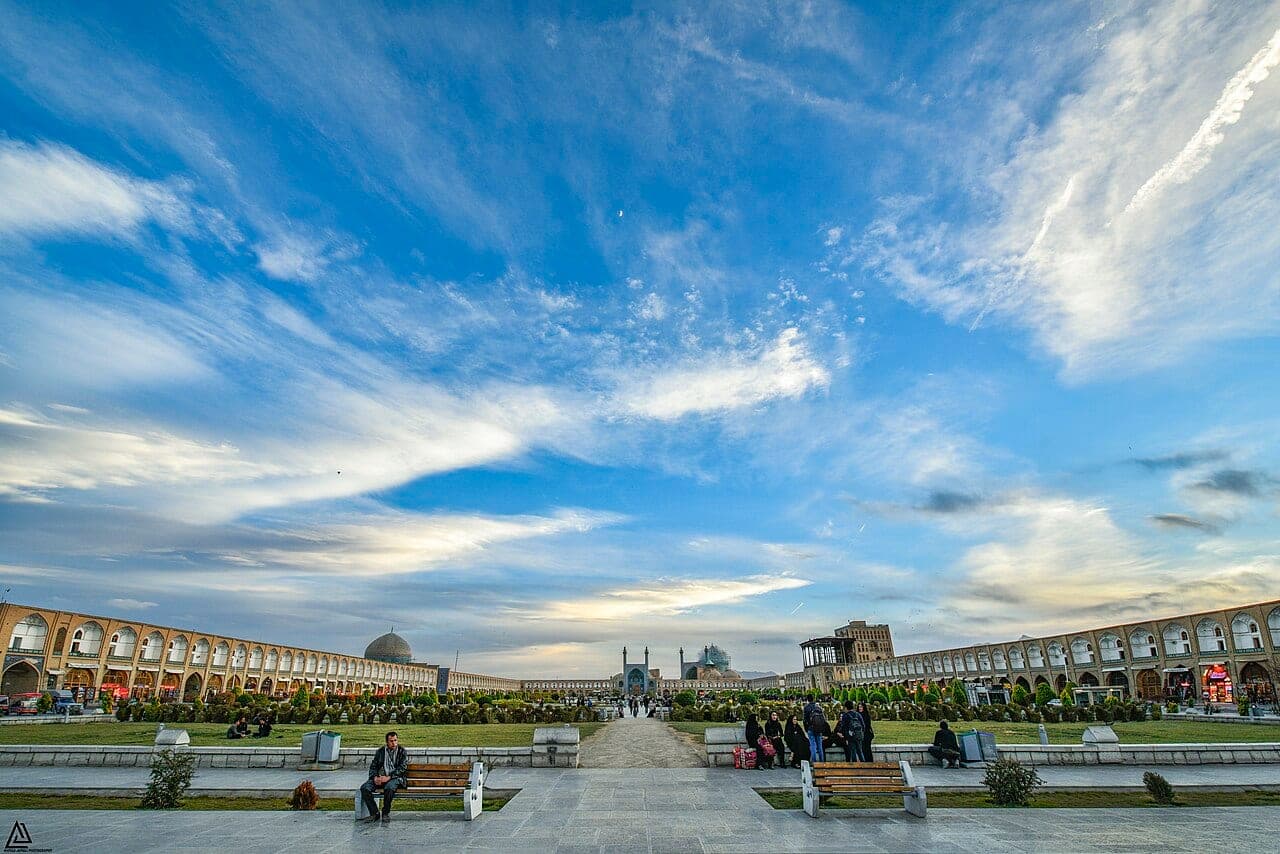
Isfahan. When Shah Abbas I moved the Safavid capital here around 1598, he laid out a celebrated ensemble of Islamic architecture. Around the vast Naqsh-e Jahan Square, a World Heritage site since 1979, stand the Imam Mosque, the Sheikh Lotfollah Mosque, the Ali Qapu palace and the arched bridges of the Zayandeh River. An old saying holds that Isfahan is half the world.
Shiraz. The city of gardens and poets shelters the tombs of Hafez and Saadi, where visitors still read verse over the graves. Its Eram Garden belongs to the Persian Garden inscription, the Nasir al-Mulk Mosque throws coloured light across its floor at dawn, and the city briefly served as Iran's capital under the Zand dynasty.
Persepolis. Near Shiraz lies Persepolis, in Persian Takht-e Jamshid, the ceremonial capital begun by Darius the Great around 518 BC. Its Apadana staircase carries reliefs of delegations bringing gifts from across the empire, and the site was burned in 330 BC during the campaign of Alexander of Macedon. It was among Iran's first World Heritage inscriptions in 1979, and nearby Pasargadae holds the stone tomb of Cyrus the Great.
Yazd. A desert city of mud brick, Yazd is cooled by badgirs, the tall windcatchers that channel breezes indoors, and watered by underground qanats. Long a centre of Zoroastrian life, it keeps an ever-burning fire temple and, on the hills above, the Towers of Silence. In 2017 it became the first entire Iranian city inscribed on the World Heritage List.
Mashhad. Iran's second-largest city grew around the shrine of Imam Reza, the eighth Imam of Twelver Shia Islam, who died there in 818. The holiest city in the country, it draws millions of pilgrims a year. Nearby lie Nishapur, home of Omar Khayyam, and Tus, where Ferdowsi is buried.
Settled life on the plateau reaches back to the Bronze Age kingdom of Elam in the south-west, whose ziggurat at Tchogha Zanbil, built around 1250 BC, is among the best-preserved anywhere. In the early first millennium BC the Medes unified much of the plateau, and in 550 BC Cyrus the Great overthrew them to found the Achaemenid Empire, which under Cyrus and Darius grew into the largest state the world had yet seen, from the Aegean to the Indus. The Cyrus Cylinder, inscribed after the capture of Babylon in 539 BC and now in the British Museum, is often called an early statement on the treatment of conquered peoples, and at Bisotun Darius left a trilingual inscription that later unlocked the reading of cuneiform.
 The Apadana staircase at Persepolis shows delegations from across the empire bringing tribute, each carved in its own dress. Photograph by Adam Jones, CC BY-SA 2.0, via Wikimedia Commons.
The empire fell to Alexander of Macedon between 334 and 330 BC, and after his Seleucid successors the Parthians reclaimed the plateau, ruling from 247 BC to AD 224. The Sassanids, founded by Ardashir I in 224, restored a centralised Persian state and made Zoroastrianism its official religion, before falling to the Arab Muslim armies after the battle of Nahavand in 642.
Islam gradually became the majority faith, yet Persian language and culture survived and shaped the wider Islamic world. In 1501 Shah Ismail founded the Safavid dynasty and established Twelver Shia Islam as the state religion, an identity Iran retains, and under Shah Abbas I the capital at Isfahan reached its height. The Qajars ruled from 1796 to 1925 and made Tehran the capital; the Constitutional Revolution of 1906 established Iran's first parliament. The Pahlavi dynasty governed from 1925 to 1979, when a revolution ended the monarchy and established the Islamic Republic.
Persian, called Farsi by its speakers, belongs to the Iranian branch of the Indo-European family, a distant cousin of English, Greek and Sanskrit. Its written record runs in three stages: Old Persian, cut in cuneiform at Bisotun and Persepolis; Middle Persian, or Pahlavi, the language of the Sassanid court and the Zoroastrian scriptures; and New Persian, which emerged after the coming of Islam and is written in a modified Arabic script. Around AD 1000 the poet Ferdowsi completed the Shahnameh, the Book of Kings, some fifty thousand couplets gathering the myths and history of Iran; by writing in Persian he helped secure the language, and Britannica treats the work as the national epic.
From Ferdowsi flows the region's greatest lyric tradition. Omar Khayyam (1048 to 1131), known abroad for the Rubaiyat, was also a mathematician and astronomer; Nezami gave Persian its romances; Attar and Rumi (1207 to 1273) turned verse toward the mystical; and Saadi (about 1210 to 1291) and Hafez (about 1325 to 1390), both of Shiraz, brought the ghazal to a polish still quoted daily. The name Iran derives from an Old Iranian word for the land of the Aryans, a self-description of the Iranian peoples, while Persia comes through Greek from Pars, the south-western province and Achaemenid homeland known today as Fars; in 1935 the government asked other states to use the endonym Iran. Persian has close sisters in Dari of Afghanistan and Tajik of Tajikistan.
Poetry sits at the centre of Persian identity, joined by arts of equal age. The Persian carpet, knotted in wool and silk with patterns of garden and medallion, is among the most prized textiles anywhere, and the weaving skills of Fars and Kashan were inscribed by UNESCO in 2010. The art of the Persian miniature, the painting that illustrated manuscripts of the poets, was recognised in 2020, and the chahar bagh, the fourfold garden divided by water channels as an image of paradise, is honoured in the Persian Garden inscription of 2011.
The Persian table is its own inheritance. Meals are built around rice cooked so that a golden crust, the tahdig, forms at the base of the pot, served with slow stews such as ghormeh sabzi, thick with herbs, and the walnut-and-pomegranate fesenjan. Saffron, dried limes and pistachios give the cuisine its character, and chelow kabab, grilled meat with saffron rice, is treated as the national dish. Hospitality is governed by taarof, an etiquette of offer and polite refusal, and tea from the samovar punctuates every gathering.
Since the Safavid era, Twelver Shia Islam has been the faith of most Iranians and the official religion of the state. Its devotion centres on the Prophet Muhammad's family and on the Twelve Imams, and its sacred geography is national: the shrine of Imam Reza at Mashhad and the shrine of his sister Fatima Masumeh at Qom, the country's principal seminary city, draw pilgrims from across the Shia world. Sufism, the mystical current given voice by Rumi, runs alongside the mainstream and shapes much of the poetry Iranians hold dear.
The Apadana staircase at Persepolis shows delegations from across the empire bringing tribute, each carved in its own dress. Photograph by Adam Jones, CC BY-SA 2.0, via Wikimedia Commons.
The empire fell to Alexander of Macedon between 334 and 330 BC, and after his Seleucid successors the Parthians reclaimed the plateau, ruling from 247 BC to AD 224. The Sassanids, founded by Ardashir I in 224, restored a centralised Persian state and made Zoroastrianism its official religion, before falling to the Arab Muslim armies after the battle of Nahavand in 642.
Islam gradually became the majority faith, yet Persian language and culture survived and shaped the wider Islamic world. In 1501 Shah Ismail founded the Safavid dynasty and established Twelver Shia Islam as the state religion, an identity Iran retains, and under Shah Abbas I the capital at Isfahan reached its height. The Qajars ruled from 1796 to 1925 and made Tehran the capital; the Constitutional Revolution of 1906 established Iran's first parliament. The Pahlavi dynasty governed from 1925 to 1979, when a revolution ended the monarchy and established the Islamic Republic.
Persian, called Farsi by its speakers, belongs to the Iranian branch of the Indo-European family, a distant cousin of English, Greek and Sanskrit. Its written record runs in three stages: Old Persian, cut in cuneiform at Bisotun and Persepolis; Middle Persian, or Pahlavi, the language of the Sassanid court and the Zoroastrian scriptures; and New Persian, which emerged after the coming of Islam and is written in a modified Arabic script. Around AD 1000 the poet Ferdowsi completed the Shahnameh, the Book of Kings, some fifty thousand couplets gathering the myths and history of Iran; by writing in Persian he helped secure the language, and Britannica treats the work as the national epic.
From Ferdowsi flows the region's greatest lyric tradition. Omar Khayyam (1048 to 1131), known abroad for the Rubaiyat, was also a mathematician and astronomer; Nezami gave Persian its romances; Attar and Rumi (1207 to 1273) turned verse toward the mystical; and Saadi (about 1210 to 1291) and Hafez (about 1325 to 1390), both of Shiraz, brought the ghazal to a polish still quoted daily. The name Iran derives from an Old Iranian word for the land of the Aryans, a self-description of the Iranian peoples, while Persia comes through Greek from Pars, the south-western province and Achaemenid homeland known today as Fars; in 1935 the government asked other states to use the endonym Iran. Persian has close sisters in Dari of Afghanistan and Tajik of Tajikistan.
Poetry sits at the centre of Persian identity, joined by arts of equal age. The Persian carpet, knotted in wool and silk with patterns of garden and medallion, is among the most prized textiles anywhere, and the weaving skills of Fars and Kashan were inscribed by UNESCO in 2010. The art of the Persian miniature, the painting that illustrated manuscripts of the poets, was recognised in 2020, and the chahar bagh, the fourfold garden divided by water channels as an image of paradise, is honoured in the Persian Garden inscription of 2011.
The Persian table is its own inheritance. Meals are built around rice cooked so that a golden crust, the tahdig, forms at the base of the pot, served with slow stews such as ghormeh sabzi, thick with herbs, and the walnut-and-pomegranate fesenjan. Saffron, dried limes and pistachios give the cuisine its character, and chelow kabab, grilled meat with saffron rice, is treated as the national dish. Hospitality is governed by taarof, an etiquette of offer and polite refusal, and tea from the samovar punctuates every gathering.
Since the Safavid era, Twelver Shia Islam has been the faith of most Iranians and the official religion of the state. Its devotion centres on the Prophet Muhammad's family and on the Twelve Imams, and its sacred geography is national: the shrine of Imam Reza at Mashhad and the shrine of his sister Fatima Masumeh at Qom, the country's principal seminary city, draw pilgrims from across the Shia world. Sufism, the mystical current given voice by Rumi, runs alongside the mainstream and shapes much of the poetry Iranians hold dear.
 Naqsh-e Jahan in Isfahan, laid out around 1600 with a mosque on one side, a palace on another and the bazaar on a third. Photograph by Majid eslamdoust, CC BY-SA 4.0, via Wikimedia Commons.
Beneath this lies an older inheritance. Zoroastrianism, founded by the prophet Zarathustra in remote antiquity and centred on the worship of Ahura Mazda through the tended flame, was the faith of the Achaemenids and Sassanids, and its vision of a struggle between light and darkness left a lasting mark on regional thought. A small Zoroastrian community survives, chiefly around Yazd and Kerman, keeping the fire and the festivals. The constitution recognises Zoroastrians, Christians of the Armenian and Assyrian churches, and Jews, whose presence in Iran is among the oldest continuous Jewish communities anywhere; each holds reserved seats in the national parliament.
The most public act of remembrance in Iran belongs to the month of Muharram. On its ninth and tenth days, Tasua and Ashura, Shia Iranians mourn the death of Imam Hussein, grandson of the Prophet, killed with his companions at Karbala in 680. Cities fill with processions in black, with rhythmic chest-beating and the chanting of elegies, and with the passion play known as Tazieh, inscribed on UNESCO's list of intangible cultural heritage in 2010. In Yazd the great wooden nakhl, a symbolic bier, is carried through the streets, and free meals called nazri are shared with neighbours and the poor in memory of the dead. Forty days later, on Arbaeen, the mourning is renewed.
The Zoroastrian way of death is preserved as heritage above Yazd. Holding earth, fire and water to be sacred and not to be defiled by a corpse, Zoroastrians once laid their dead on the open summits of stone towers, the dakhma or Towers of Silence, to be reduced by sun and birds. The practice ended in Iran in the mid-twentieth century, replaced by burial in lined graves, but the towers and the ever-burning fire of the Yazd temple remain among the most eloquent monuments of the old religion. The remembrance itself continues in the ten days of Muktad at the close of the Zoroastrian year, when each household sets out flowers for the fravashi of every soul it is remembering by name.
Everyday Persian mourning weaves the Islamic and the ancestral together. Burial follows quickly, and the bereaved gather on the third, seventh and fortieth days, and again after a year, to recite the Quran, share dates and halva, and read poetry. Cemeteries are visited on Thursdays and, above all, in the days before Nowruz, when families clean the graves of their dead and lay flowers. So the new year, an inheritance older than Islam, opens with a visit to the departed, and renewal and remembrance arrive together.
Iranian surnames are barely a century old, and the day they began can be dated.
The civil registration law of 1918 created a registry office and required, for the first time, that a person be recorded under a given name and a family name. The first identity booklet, the sejell that became the shenasnameh, was issued on 25 December 1918 to a newborn girl registered as Fatemeh Irani. The surname requirement was applied in Tehran first and extended outward, and it replaced a naming system built from patronymics, titles, trades and places of origin with two words. So Iranian family research divides at 1918: after it, the shenasnameh is continuous and detailed, recording births, marriages, divorces and deaths in one booklet held by the family; before it, the surname does not exist to search on.
Older records are religious and legal. Sharia court registers hold marriage and inheritance, and endowment deeds name the descendants entitled to administer a waqf. Shrine and seminary archives in Qom and Mashhad hold family papers of clerical lineages, and the sayyid families keep genealogies of descent from the Prophet.
Iran's minority communities kept their own registers, which is how a great deal of that history survives at all. Armenian church records in Isfahan and Tehran, the registers of the Zoroastrian communities of Yazd and Kerman, and Jewish community records of Iranian communities now largely abroad are each held separately, often outside the country.
Iran ranks among the countries with the most World Heritage inscriptions, holding roughly thirty properties by 2026 under the Ministry of Cultural Heritage, Tourism and Handicrafts. The earliest three, listed together in 1979, were Persepolis, the Naqsh-e Jahan Square of Isfahan and the Elamite ziggurat of Tchogha Zanbil. Later inscriptions include Takht-e Soleyman in 2003, Pasargadae and the Bam cultural landscape in 2004, Soltaniyeh in 2005, Bisotun in 2006, the Persian Garden in 2011, Golestan Palace in 2013, the Persian Qanat in 2016 and the historic city of Yazd in 2017.
Intangible heritage receives comparable care. Iranian elements on UNESCO's lists include Nowruz, first inscribed in 2009 and later shared with neighbouring states; the Tazieh dramatic tradition; the radif of classical music; carpet weaving in Fars and Kashan; the art of the Persian miniature; and the winter feast of Yalda. The most-cited conservation success is the Bam citadel: after the 2003 earthquake that destroyed much of the ancient adobe city, a long programme of reconstruction stabilised the site so thoroughly that UNESCO removed it from the List of World Heritage in Danger in 2013.
Persian culture has taken to the digital age with unusual reach, in part because so much of it travels as text. The Encyclopaedia Iranica, founded by Ehsan Yarshater and freely available online, is the most comprehensive reference on Iranian civilisation, with thousands of peer-reviewed entries. The volunteer-built library Ganjoor has placed the complete works of Ferdowsi, Hafez, Saadi, Rumi and dozens of other poets online, with recitations and commentary, so that the whole classical canon is searchable from a phone.
Museums and manuscripts are following. The Cambridge Shahnama Project has gathered a digital archive of illustrated copies of Ferdowsi's epic from collections worldwide, and the National Museum of Iran and partners abroad have digitised Persian antiquities and paintings for open study. Diaspora communities use the same tools to teach Persian script and to keep Yalda and Nowruz alive far from the plateau.
Iran's most visible modern export is its cinema. The Iranian New Wave began in the late 1960s, and by the 1990s its directors were among the most admired in world film. Abbas Kiarostami won the Palme d'Or at Cannes in 1997 for Taste of Cherry, and Asghar Farhadi became the first Iranian to win an Academy Award, taking the Oscar for best international film with A Separation in 2011 and a second for The Salesman in 2016; Majid Majidi's Children of Heaven had earned the first Iranian nomination in 1998.
Other arts travel with it. Modern poets such as Forough Farrokhzad and Sohrab Sepehri renewed the ancient form, and Marjane Satrapi's graphic memoir Persepolis reached a global readership and screen. Persian food now appears on menus from London to Los Angeles, and the United Nations declared 21 March International Nowruz Day in 2010, a festival observed by many millions across a wide region.
Bam rises from the dust. The 2003 earthquake reduced much of the world's largest adobe complex to rubble and killed tens of thousands. A sustained international and Iranian effort rebuilt the citadel by traditional mud-brick methods, and in 2013 UNESCO judged the work sound enough to remove Bam from its danger list.
A living city inscribed. In 2017 Yazd became the first complete Iranian city on the World Heritage List, recognised not as a set of monuments but as an inhabited desert town whose windcatchers, courtyards and qanats still shape daily life.
Nowruz for the world. A spring festival older than any of the region's present faiths, Nowruz was inscribed by UNESCO in 2009 and given a United Nations day of its own in 2010, so that a celebration of renewal and of remembrance for the dead is now marked openly across many countries.
The canon set free. Through Ganjoor and the Encyclopaedia Iranica, the whole body of Persian poetry and a scholarly account of Iranian civilisation are online without charge, letting a student in Tehran and a grandchild in Toronto reach the same verse of Hafez.
Naqsh-e Jahan in Isfahan, laid out around 1600 with a mosque on one side, a palace on another and the bazaar on a third. Photograph by Majid eslamdoust, CC BY-SA 4.0, via Wikimedia Commons.
Beneath this lies an older inheritance. Zoroastrianism, founded by the prophet Zarathustra in remote antiquity and centred on the worship of Ahura Mazda through the tended flame, was the faith of the Achaemenids and Sassanids, and its vision of a struggle between light and darkness left a lasting mark on regional thought. A small Zoroastrian community survives, chiefly around Yazd and Kerman, keeping the fire and the festivals. The constitution recognises Zoroastrians, Christians of the Armenian and Assyrian churches, and Jews, whose presence in Iran is among the oldest continuous Jewish communities anywhere; each holds reserved seats in the national parliament.
The most public act of remembrance in Iran belongs to the month of Muharram. On its ninth and tenth days, Tasua and Ashura, Shia Iranians mourn the death of Imam Hussein, grandson of the Prophet, killed with his companions at Karbala in 680. Cities fill with processions in black, with rhythmic chest-beating and the chanting of elegies, and with the passion play known as Tazieh, inscribed on UNESCO's list of intangible cultural heritage in 2010. In Yazd the great wooden nakhl, a symbolic bier, is carried through the streets, and free meals called nazri are shared with neighbours and the poor in memory of the dead. Forty days later, on Arbaeen, the mourning is renewed.
The Zoroastrian way of death is preserved as heritage above Yazd. Holding earth, fire and water to be sacred and not to be defiled by a corpse, Zoroastrians once laid their dead on the open summits of stone towers, the dakhma or Towers of Silence, to be reduced by sun and birds. The practice ended in Iran in the mid-twentieth century, replaced by burial in lined graves, but the towers and the ever-burning fire of the Yazd temple remain among the most eloquent monuments of the old religion. The remembrance itself continues in the ten days of Muktad at the close of the Zoroastrian year, when each household sets out flowers for the fravashi of every soul it is remembering by name.
Everyday Persian mourning weaves the Islamic and the ancestral together. Burial follows quickly, and the bereaved gather on the third, seventh and fortieth days, and again after a year, to recite the Quran, share dates and halva, and read poetry. Cemeteries are visited on Thursdays and, above all, in the days before Nowruz, when families clean the graves of their dead and lay flowers. So the new year, an inheritance older than Islam, opens with a visit to the departed, and renewal and remembrance arrive together.
Iranian surnames are barely a century old, and the day they began can be dated.
The civil registration law of 1918 created a registry office and required, for the first time, that a person be recorded under a given name and a family name. The first identity booklet, the sejell that became the shenasnameh, was issued on 25 December 1918 to a newborn girl registered as Fatemeh Irani. The surname requirement was applied in Tehran first and extended outward, and it replaced a naming system built from patronymics, titles, trades and places of origin with two words. So Iranian family research divides at 1918: after it, the shenasnameh is continuous and detailed, recording births, marriages, divorces and deaths in one booklet held by the family; before it, the surname does not exist to search on.
Older records are religious and legal. Sharia court registers hold marriage and inheritance, and endowment deeds name the descendants entitled to administer a waqf. Shrine and seminary archives in Qom and Mashhad hold family papers of clerical lineages, and the sayyid families keep genealogies of descent from the Prophet.
Iran's minority communities kept their own registers, which is how a great deal of that history survives at all. Armenian church records in Isfahan and Tehran, the registers of the Zoroastrian communities of Yazd and Kerman, and Jewish community records of Iranian communities now largely abroad are each held separately, often outside the country.
Iran ranks among the countries with the most World Heritage inscriptions, holding roughly thirty properties by 2026 under the Ministry of Cultural Heritage, Tourism and Handicrafts. The earliest three, listed together in 1979, were Persepolis, the Naqsh-e Jahan Square of Isfahan and the Elamite ziggurat of Tchogha Zanbil. Later inscriptions include Takht-e Soleyman in 2003, Pasargadae and the Bam cultural landscape in 2004, Soltaniyeh in 2005, Bisotun in 2006, the Persian Garden in 2011, Golestan Palace in 2013, the Persian Qanat in 2016 and the historic city of Yazd in 2017.
Intangible heritage receives comparable care. Iranian elements on UNESCO's lists include Nowruz, first inscribed in 2009 and later shared with neighbouring states; the Tazieh dramatic tradition; the radif of classical music; carpet weaving in Fars and Kashan; the art of the Persian miniature; and the winter feast of Yalda. The most-cited conservation success is the Bam citadel: after the 2003 earthquake that destroyed much of the ancient adobe city, a long programme of reconstruction stabilised the site so thoroughly that UNESCO removed it from the List of World Heritage in Danger in 2013.
Persian culture has taken to the digital age with unusual reach, in part because so much of it travels as text. The Encyclopaedia Iranica, founded by Ehsan Yarshater and freely available online, is the most comprehensive reference on Iranian civilisation, with thousands of peer-reviewed entries. The volunteer-built library Ganjoor has placed the complete works of Ferdowsi, Hafez, Saadi, Rumi and dozens of other poets online, with recitations and commentary, so that the whole classical canon is searchable from a phone.
Museums and manuscripts are following. The Cambridge Shahnama Project has gathered a digital archive of illustrated copies of Ferdowsi's epic from collections worldwide, and the National Museum of Iran and partners abroad have digitised Persian antiquities and paintings for open study. Diaspora communities use the same tools to teach Persian script and to keep Yalda and Nowruz alive far from the plateau.
Iran's most visible modern export is its cinema. The Iranian New Wave began in the late 1960s, and by the 1990s its directors were among the most admired in world film. Abbas Kiarostami won the Palme d'Or at Cannes in 1997 for Taste of Cherry, and Asghar Farhadi became the first Iranian to win an Academy Award, taking the Oscar for best international film with A Separation in 2011 and a second for The Salesman in 2016; Majid Majidi's Children of Heaven had earned the first Iranian nomination in 1998.
Other arts travel with it. Modern poets such as Forough Farrokhzad and Sohrab Sepehri renewed the ancient form, and Marjane Satrapi's graphic memoir Persepolis reached a global readership and screen. Persian food now appears on menus from London to Los Angeles, and the United Nations declared 21 March International Nowruz Day in 2010, a festival observed by many millions across a wide region.
Bam rises from the dust. The 2003 earthquake reduced much of the world's largest adobe complex to rubble and killed tens of thousands. A sustained international and Iranian effort rebuilt the citadel by traditional mud-brick methods, and in 2013 UNESCO judged the work sound enough to remove Bam from its danger list.
A living city inscribed. In 2017 Yazd became the first complete Iranian city on the World Heritage List, recognised not as a set of monuments but as an inhabited desert town whose windcatchers, courtyards and qanats still shape daily life.
Nowruz for the world. A spring festival older than any of the region's present faiths, Nowruz was inscribed by UNESCO in 2009 and given a United Nations day of its own in 2010, so that a celebration of renewal and of remembrance for the dead is now marked openly across many countries.
The canon set free. Through Ganjoor and the Encyclopaedia Iranica, the whole body of Persian poetry and a scholarly account of Iranian civilisation are online without charge, letting a student in Tehran and a grandchild in Toronto reach the same verse of Hafez.
National Overview
Notable Cities
Historical Foundations
Linguistic and Etymological Roots
Cultural Identity
Religion and Spirituality
Remembrance and Mourning Traditions
Tracing a Family in Iran
Heritage Preservation Efforts
Digital Heritage
Contemporary Cultural Influences
Success Stories
References and resources
- UNESCO World Heritage Centre, Iran. The state-party page listing all of Iran's inscribed World Heritage sites.
- UNESCO World Heritage Centre, Persepolis. The Achaemenid ceremonial capital, inscribed in 1979.
- UNESCO World Heritage Centre, Historic City of Yazd. The 2017 inscription of the whole desert city.
- UNESCO Intangible Cultural Heritage, Islamic Republic of Iran. Nowruz, Tazieh, Yalda, carpet weaving and other living traditions.
- Encyclopaedia Iranica. The standard scholarly reference on Iranian history, language and religion.
- Ganjoor. The free digital library of the Persian poetic canon.
- Encyclopaedia Britannica, Iran. Geography, demography and historical background.
- Encyclopaedia Britannica, Shahnameh. Ferdowsi's national epic and its place in Persian culture.
- Encyclopaedia Britannica, Cyrus Cylinder. The Achaemenid proclamation of 539 BC now held in the British Museum.