Heritage · Country
Syria Culture and Heritage
Damascus and Aleppo count among the oldest cities on earth, and Syrian soil gave the world one of its first alphabets at Ugarit. This guide traces a heritage of caravan cities, Crusader castles and living faiths, and the effort to protect it through loss and recovery.Written to last.
By Confinity Heritage Editorial · Updated 2026-07-31 · 8-minute readQuiet tools, kept out of the way.
Few landscapes hold as much of humanity's early memory as Syria. Its capital, Damascus, and its northern rival, Aleppo, are counted among the oldest continuously inhabited cities on earth, lived in for thousands of years and never abandoned. On the coast at Ugarit, scribes set down one of the world's earliest alphabets; inland at Ebla and Mari, palace archives of baked clay recorded the business of kingdoms that flourished before 2000 BC. Out in the desert lay Palmyra, the caravan city of Queen Zenobia, and along the medieval frontier rose Krak des Chevaliers, among the best-preserved Crusader castles anywhere.
This inheritance has passed through many hands: Aramaean, Assyrian, Persian, Greek, Roman, Umayyad, Ayyubid, Mamluk, Ottoman and French. It has also been tested severely. A civil war that began in 2011 damaged towns and monuments across the country, and in 2013 all six of Syria's UNESCO World Heritage sites were placed on the List of World Heritage in Danger. The long-ruling government fell in December 2024, and the country entered a period of transition. This profile keeps its attention where Syria's meaning runs deepest: on the heritage itself, and on the people working to record, protect and rebuild it.
Syria occupies the northern Levant, bordered by Turkey to the north, Iraq to the east, Jordan to the south, Lebanon and Israel to the south-west, and the Mediterranean to the west. Its territory runs from a narrow coastal plain, over the coastal mountains and the fertile valley of the Orontes, across the western steppe of Damascus, Homs, Hama and Aleppo, and out into the Syrian Desert, where oases such as Palmyra once ruled the caravan roads. The Euphrates crosses the north-east, the historic granary that carried the earliest cities.
Before the war Syria's population stood at roughly 21 million. Arabs form the majority, alongside Kurds, who are concentrated in the north-east, Armenians and Assyrians, many of them long settled in Aleppo and the Jazira, and smaller Turkmen and Circassian communities. In religion the country is equally plural: a Sunni Muslim majority lives beside Alawite, Ismaili and Twelver Shia Muslims, the Druze of the southern mountains, and Christians of many ancient churches. Years of conflict displaced millions of people inside the country and abroad, so that today a large Syrian diaspora carries this inheritance across the world.
Damascus. The capital and the seat of the Umayyad Caliphate in the seventh and eighth centuries, Damascus has been settled since at least the third millennium BC and is often named the oldest continuously inhabited capital city in the world. Its walled old city holds the Umayyad Mosque, the covered lane of Souk al-Hamidiyya, the Ottoman Azm Palace, and Straight Street, the Roman thoroughfare named in the Book of Acts.
Aleppo. For centuries the great commercial city of northern Syria and a terminus of routes reaching to Mesopotamia and beyond, Aleppo has a claim to settlement stretching back some eight thousand years. Its medieval citadel crowns the old city, and beneath it once ran the largest covered market in the world, the vaulted souks of al-Madina, together with the Great Mosque and khans of stone and silk.
Homs. Syria's third city, on the Orontes, was the ancient Emesa, home to a famous temple of the sun and to the Severan empresses of Rome. It later held the shrine and mosque of Khalid ibn al-Walid, one of the early commanders of Islam. Much of its old centre was heavily damaged during the recent conflict.
Latakia. The principal Mediterranean port, ancient Laodicea, sits near the ruins of Ugarit and gives the country its window on the sea. Its coast and the wooded coastal mountains behind it are a heartland of the Alawite community.
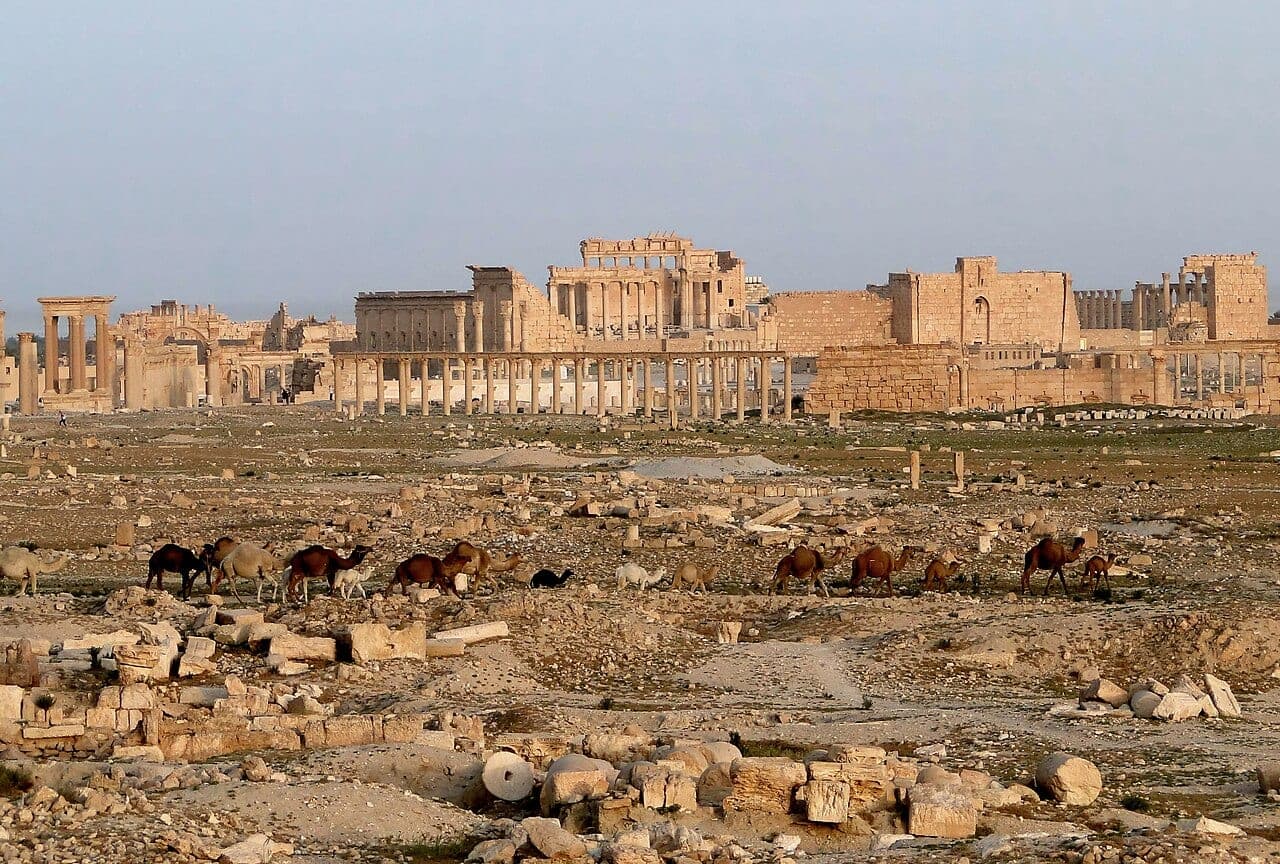
Palmyra (Tadmur). In the central desert, the modern town of Tadmur lies beside the colonnades of ancient Palmyra, the oasis that grew wealthy taxing the caravans between Rome and the East. The ruins are Syria's most famous archaeological site and a focus of both loss and recovery.
Syria's written record begins earlier than almost anywhere. At Ebla (Tell Mardikh), Italian excavators found a palace archive of thousands of clay tablets dating to about 2500 to 2250 BC, documenting a Bronze Age kingdom that governed much of northern Syria. On the Euphrates at Mari (Tell Hariri), a comparable royal archive lit up the diplomacy and daily life of the early second millennium BC before the city fell to Babylon. On the coast at Ugarit, scribes of the fourteenth and thirteenth centuries BC wrote in a cuneiform alphabet of some thirty signs, one of the earliest alphabetic systems known and an ancestor of the scripts later used from Phoenicia to Greece.
 The Temple of Bel at Palmyra, photographed before 2015. Islamic State blew up the cella and most of the colonnade that August. Photograph by isawnyu, CC BY 2.0, via Wikimedia Commons.
After the Late Bronze Age collapse, the Aramaeans spread through the interior, and their language, Aramaic, became the common speech of the Near East for more than a thousand years. Syria then passed under the great empires in turn: Assyrian and Babylonian, then Persian, and, after the conquests of Alexander, the Hellenistic kingdom of the Seleucids, who founded Antioch and Latakia. Under Rome the province prospered, and in the desert Palmyra rose to remarkable power; in the years 267 to 272 its queen, Zenobia, ruled an empire reaching into Egypt and Anatolia before the emperor Aurelian defeated her and took the city. The early Christian centuries left deep marks too: the road to Damascus is the setting of the conversion of Saint Paul, and the limestone hills of the north filled with churches and monasteries.
In 636 the region came under Muslim rule, and from 661 to 750 Damascus was the capital of the Umayyad Caliphate, the first great Islamic dynasty, whose reach ran from Spain to Central Asia. Later came the Crusades, when European knights built castles such as Krak des Chevaliers, and the counter-campaigns of Saladin and the Ayyubids, followed by the Mamluk sultans who finally expelled the Crusaders. From 1516 Syria was governed for four centuries as provinces of the Ottoman Empire. After the First World War it passed under a French Mandate, gained a distinct national movement, and became fully independent in 1946. The decades since have included union and separation with Egypt, changes of government, and, from 2011, a civil war that caused great loss of life, mass displacement and widespread damage to the country's monuments; the long-ruling government fell in December 2024.
The official and everyday language is Arabic, spoken in a distinctive Levantine dialect that varies between the coast, Damascus, Aleppo and the Euphrates. Beneath it lies a far older linguistic layer. Aramaic, the language of much of the ancient Near East and of Jesus in the first century, still survives as a mother tongue in a handful of places, above all the mountain village of Maaloula and its neighbours north of Damascus, where a Western form of the language is still spoken. Syriac, an eastern branch of Aramaic, remains the liturgical and often the spoken language of Assyrian and Syriac Christian communities. Kurdish, Armenian, Turkmen and Circassian are spoken by their respective communities.
The name Syria itself is ancient and widely held to descend from Assyria. Greek writers, Herodotus among them in the fifth century BC, used "Syrians" for the peoples of the Levant, and a bilingual inscription of the eighth century BC helped confirm that "Syria" and "Assyria" were understood as related names. Over the centuries the term settled on this land at the eastern end of the Mediterranean, and it has been in continuous use for the region longer than almost any other country name.
Syrian craft traditions are among the finest in the Arab world, and many carry the memory of Damascus and Aleppo in their very names. Damascene metalwork, brass and copper hammered and inlaid with silver and gold, gave English the word "damascening." The lustrous patterned silk called damask likewise takes its name from Damascus, whose weavers produced brocade of extraordinary detail; the city and Aleppo were also known for mosaic woodwork inlaid with mother-of-pearl, hand-blown glass, and the delicate Aghabani embroidery used on table linens and festive cloth. Aleppo gave the world its famous laurel-and-olive soap, cured for months in the open air. In cooking, Syrian tables are celebrated across the region: Aleppo contributes muhammara, cherry kebab and dishes built on peppers, pomegranate and nuts, while mezze such as hummus, tabbouleh and stuffed vine leaves are shared across the country, and sweets such as baklava and the stretched ice cream of the old Damascus markets close the meal.
The country's musical inheritance centres on the classical Arab tradition of tarab, the muwashshah song form, and the qudud Halabiyya of Aleppo, long a school of vocal art whose master Sabah Fakhri was known throughout the Arab world. Poetry holds a special place in Syrian identity. Damascus was the home of Nizar Qabbani, widely regarded as the country's national poet, whose verse moved between love, the streets and jasmine of his native city, and public life. The poet Adonis, born on the coast, reshaped modern Arabic verse and became one of its most influential figures.
Islam is the faith of most Syrians, the majority of them Sunni, and the country's mosques include some of the most important in the Islamic world. Within Islam, Syria is also home to the Alawites, a community with roots in Shia Islam concentrated in the coastal mountains, and to Ismaili and Twelver Shia Muslims; the shrine of Sayyida Zaynab near Damascus is a major site of Shia pilgrimage. Christianity in Syria is ancient and varied, with Greek Orthodox, Greek Catholic, Syriac Orthodox, Armenian, Maronite and Assyrian churches among others; Christians have lived here without interruption since the first century, and towns such as Maaloula preserve monasteries and the language of the early church.
The Druze form a distinct religious community whose faith grew from Ismaili Islam in the eleventh century and developed its own beliefs and closed tradition; in Syria they are concentrated in the southern highland of Jabal al-Druze around the city of Suwayda. The Umayyad Mosque of Damascus captures this long layering of belief in a single building: the site held an Aramaean temple, then a Roman temple, then a church of Saint John the Baptist, before the caliph al-Walid raised the present mosque between 705 and 715, and it still contains a shrine honoured as the resting place of the head of John the Baptist, a prophet to Christians and Muslims alike.
Muslim funerals in Syria follow the common practice of Islam, carried out quickly and communally. The body is washed by relatives of the same sex, wrapped in a plain white shroud, and taken for the funeral prayer at the mosque, then buried the same day or the next, laid on its right side facing Mecca beneath a simple grave. A condolence gathering, the aza or ta'ziya, follows for three days, with men and women received separately; neighbours bring food so the bereaved household need not cook, the Qur'an is recited, and the refrain that all belong to God and to Him return is repeated over bitter coffee. A widow observes the waiting period of four months and ten days. Many families mark the fortieth day after a death with further recitation and a shared meal, and give charity in the name of the deceased.
Christian funerary customs in Syria follow the ancient Eastern rites. The dead are watched and prayed over, and the funeral liturgy is held in church before burial, since these churches do not practise cremation. Memorial services on the third, ninth and fortieth days, and through the first year, keep the departed present to the community; among the Orthodox, boiled wheat is prepared and blessed as a sign of resurrection. Across both faiths, visiting and tending the graves of relatives at feast days, whether the two Eids or the great Christian festivals, remains a shared Syrian custom, an act that ties the living to the family dead. The scale of loss during the recent war has given this care new weight, as families search for the missing and seek to give each person a known grave and a spoken name.
Syria's civil registry is one of the better systems in the region and it has been comprehensively broken by the war.
The Ottoman nüfus registers, the French mandate's état civil and the Syrian republic's own registration built a functioning record held by district registry offices. Sharia court registers hold marriage and inheritance and reach back centuries in Damascus and Aleppo. Church registers cover the Christian communities, some of which have been here since the first centuries of the faith.
Since 2011 registry offices have been shelled, burned, captured and in some cases relocated by whichever authority held the ground. Millions of people left without documents. Children born in exile were often not registered anywhere, because registering a Syrian birth abroad required papers the parents did not have, and the result is a generation whose nationality is difficult to prove. Marriages conducted in camps by religious authorities and never registered compound it.
The missing are the other archive. More than a hundred thousand people are estimated to have been detained and disappeared, and the record of them is being built outside the country: by the Syrian Archive and similar projects gathering documentation, by families keeping photographs and last-seen dates, and by the smuggled prison photographs known as the Caesar files, which showed thousands of bodies and by which some families identified their dead.
Reconstructing a national record will be one of the largest administrative tasks any country has faced.
Syria holds six UNESCO World Heritage sites, inscribed for their outstanding value to human history: the Ancient City of Damascus, the Ancient City of Aleppo, the Site of Palmyra, the Ancient City of Bosra with its great Roman theatre in the south, the pair of medieval castles at Crac des Chevaliers and Qal'at Salah El-Din, and the Ancient Villages of Northern Syria, the abandoned limestone settlements and early churches often called the Dead Cities. In 2013 all six were placed together on the List of World Heritage in Danger as the conflict spread.
The Temple of Bel at Palmyra, photographed before 2015. Islamic State blew up the cella and most of the colonnade that August. Photograph by isawnyu, CC BY 2.0, via Wikimedia Commons.
After the Late Bronze Age collapse, the Aramaeans spread through the interior, and their language, Aramaic, became the common speech of the Near East for more than a thousand years. Syria then passed under the great empires in turn: Assyrian and Babylonian, then Persian, and, after the conquests of Alexander, the Hellenistic kingdom of the Seleucids, who founded Antioch and Latakia. Under Rome the province prospered, and in the desert Palmyra rose to remarkable power; in the years 267 to 272 its queen, Zenobia, ruled an empire reaching into Egypt and Anatolia before the emperor Aurelian defeated her and took the city. The early Christian centuries left deep marks too: the road to Damascus is the setting of the conversion of Saint Paul, and the limestone hills of the north filled with churches and monasteries.
In 636 the region came under Muslim rule, and from 661 to 750 Damascus was the capital of the Umayyad Caliphate, the first great Islamic dynasty, whose reach ran from Spain to Central Asia. Later came the Crusades, when European knights built castles such as Krak des Chevaliers, and the counter-campaigns of Saladin and the Ayyubids, followed by the Mamluk sultans who finally expelled the Crusaders. From 1516 Syria was governed for four centuries as provinces of the Ottoman Empire. After the First World War it passed under a French Mandate, gained a distinct national movement, and became fully independent in 1946. The decades since have included union and separation with Egypt, changes of government, and, from 2011, a civil war that caused great loss of life, mass displacement and widespread damage to the country's monuments; the long-ruling government fell in December 2024.
The official and everyday language is Arabic, spoken in a distinctive Levantine dialect that varies between the coast, Damascus, Aleppo and the Euphrates. Beneath it lies a far older linguistic layer. Aramaic, the language of much of the ancient Near East and of Jesus in the first century, still survives as a mother tongue in a handful of places, above all the mountain village of Maaloula and its neighbours north of Damascus, where a Western form of the language is still spoken. Syriac, an eastern branch of Aramaic, remains the liturgical and often the spoken language of Assyrian and Syriac Christian communities. Kurdish, Armenian, Turkmen and Circassian are spoken by their respective communities.
The name Syria itself is ancient and widely held to descend from Assyria. Greek writers, Herodotus among them in the fifth century BC, used "Syrians" for the peoples of the Levant, and a bilingual inscription of the eighth century BC helped confirm that "Syria" and "Assyria" were understood as related names. Over the centuries the term settled on this land at the eastern end of the Mediterranean, and it has been in continuous use for the region longer than almost any other country name.
Syrian craft traditions are among the finest in the Arab world, and many carry the memory of Damascus and Aleppo in their very names. Damascene metalwork, brass and copper hammered and inlaid with silver and gold, gave English the word "damascening." The lustrous patterned silk called damask likewise takes its name from Damascus, whose weavers produced brocade of extraordinary detail; the city and Aleppo were also known for mosaic woodwork inlaid with mother-of-pearl, hand-blown glass, and the delicate Aghabani embroidery used on table linens and festive cloth. Aleppo gave the world its famous laurel-and-olive soap, cured for months in the open air. In cooking, Syrian tables are celebrated across the region: Aleppo contributes muhammara, cherry kebab and dishes built on peppers, pomegranate and nuts, while mezze such as hummus, tabbouleh and stuffed vine leaves are shared across the country, and sweets such as baklava and the stretched ice cream of the old Damascus markets close the meal.
The country's musical inheritance centres on the classical Arab tradition of tarab, the muwashshah song form, and the qudud Halabiyya of Aleppo, long a school of vocal art whose master Sabah Fakhri was known throughout the Arab world. Poetry holds a special place in Syrian identity. Damascus was the home of Nizar Qabbani, widely regarded as the country's national poet, whose verse moved between love, the streets and jasmine of his native city, and public life. The poet Adonis, born on the coast, reshaped modern Arabic verse and became one of its most influential figures.
Islam is the faith of most Syrians, the majority of them Sunni, and the country's mosques include some of the most important in the Islamic world. Within Islam, Syria is also home to the Alawites, a community with roots in Shia Islam concentrated in the coastal mountains, and to Ismaili and Twelver Shia Muslims; the shrine of Sayyida Zaynab near Damascus is a major site of Shia pilgrimage. Christianity in Syria is ancient and varied, with Greek Orthodox, Greek Catholic, Syriac Orthodox, Armenian, Maronite and Assyrian churches among others; Christians have lived here without interruption since the first century, and towns such as Maaloula preserve monasteries and the language of the early church.
The Druze form a distinct religious community whose faith grew from Ismaili Islam in the eleventh century and developed its own beliefs and closed tradition; in Syria they are concentrated in the southern highland of Jabal al-Druze around the city of Suwayda. The Umayyad Mosque of Damascus captures this long layering of belief in a single building: the site held an Aramaean temple, then a Roman temple, then a church of Saint John the Baptist, before the caliph al-Walid raised the present mosque between 705 and 715, and it still contains a shrine honoured as the resting place of the head of John the Baptist, a prophet to Christians and Muslims alike.
Muslim funerals in Syria follow the common practice of Islam, carried out quickly and communally. The body is washed by relatives of the same sex, wrapped in a plain white shroud, and taken for the funeral prayer at the mosque, then buried the same day or the next, laid on its right side facing Mecca beneath a simple grave. A condolence gathering, the aza or ta'ziya, follows for three days, with men and women received separately; neighbours bring food so the bereaved household need not cook, the Qur'an is recited, and the refrain that all belong to God and to Him return is repeated over bitter coffee. A widow observes the waiting period of four months and ten days. Many families mark the fortieth day after a death with further recitation and a shared meal, and give charity in the name of the deceased.
Christian funerary customs in Syria follow the ancient Eastern rites. The dead are watched and prayed over, and the funeral liturgy is held in church before burial, since these churches do not practise cremation. Memorial services on the third, ninth and fortieth days, and through the first year, keep the departed present to the community; among the Orthodox, boiled wheat is prepared and blessed as a sign of resurrection. Across both faiths, visiting and tending the graves of relatives at feast days, whether the two Eids or the great Christian festivals, remains a shared Syrian custom, an act that ties the living to the family dead. The scale of loss during the recent war has given this care new weight, as families search for the missing and seek to give each person a known grave and a spoken name.
Syria's civil registry is one of the better systems in the region and it has been comprehensively broken by the war.
The Ottoman nüfus registers, the French mandate's état civil and the Syrian republic's own registration built a functioning record held by district registry offices. Sharia court registers hold marriage and inheritance and reach back centuries in Damascus and Aleppo. Church registers cover the Christian communities, some of which have been here since the first centuries of the faith.
Since 2011 registry offices have been shelled, burned, captured and in some cases relocated by whichever authority held the ground. Millions of people left without documents. Children born in exile were often not registered anywhere, because registering a Syrian birth abroad required papers the parents did not have, and the result is a generation whose nationality is difficult to prove. Marriages conducted in camps by religious authorities and never registered compound it.
The missing are the other archive. More than a hundred thousand people are estimated to have been detained and disappeared, and the record of them is being built outside the country: by the Syrian Archive and similar projects gathering documentation, by families keeping photographs and last-seen dates, and by the smuggled prison photographs known as the Caesar files, which showed thousands of bodies and by which some families identified their dead.
Reconstructing a national record will be one of the largest administrative tasks any country has faced.
Syria holds six UNESCO World Heritage sites, inscribed for their outstanding value to human history: the Ancient City of Damascus, the Ancient City of Aleppo, the Site of Palmyra, the Ancient City of Bosra with its great Roman theatre in the south, the pair of medieval castles at Crac des Chevaliers and Qal'at Salah El-Din, and the Ancient Villages of Northern Syria, the abandoned limestone settlements and early churches often called the Dead Cities. In 2013 all six were placed together on the List of World Heritage in Danger as the conflict spread.
 Krak des Chevaliers, shelled during the civil war and placed on the List of World Heritage in Danger along with every other Syrian site. Photograph by Xvlun, CC BY-SA 2.5, via Wikimedia Commons.
The losses of those years were real and painful. At Palmyra, the group that held the site in 2015 and 2016 destroyed the Temple of Bel, the Temple of Baalshamin and the monumental arch, some of the best-preserved classical architecture in the world. In Aleppo, the eleventh-century minaret of the Great Mosque fell during fighting in 2013, and parts of the old souks were burned. Bosra, Homs and the old city of Damascus also suffered damage. Yet Syrian and international teams have worked steadily on recovery. The Directorate-General of Antiquities and Museums safeguarded museum collections through the worst years, and conservation has advanced with partners including UNESCO and the Aga Khan Trust for Culture, using surviving fragments and archival records to guide the work.
Because access to Syrian sites has often been impossible, digital documentation has carried much of the preservation effort. Satellite monitoring, used by UNESCO and by projects such as the Endangered Archaeology in the Middle East and North Africa initiative based at Oxford, tracked damage across the country when ground missions could not travel. The American Society of Overseas Research ran a cultural heritage initiative that recorded harm to sites in near real time, and the Syrian Heritage Archive Project, based in Berlin with Syrian partners, digitised decades of records, photographs and plans for the future.
Three-dimensional scanning has become central to the future of Syrian monuments. Teams have produced detailed digital models of Palmyra and other sites to preserve their memory and to guide future rebuilding, and a full-scale replica of Palmyra's monumental arch, created from photographs, was displayed in London and other cities. Even where stone has been lost, the knowledge needed to study and restore it has been kept.
Syrian culture reaches the wider world through its people as much as its monuments. The country was long a centre of Arabic television drama and music, and its singers, actors and composers are known across the region. The poetry of Nizar Qabbani and Adonis continues to shape modern Arabic letters, and Syrian food, from Aleppo's kitchens to the sweets of Damascus, has spread through restaurants far beyond the country.
Since 2011 the diaspora has become a powerful carrier of that heritage. Syrian communities in Turkey, Lebanon, Jordan, Germany and across Europe and the Americas have opened bakeries, workshops and cultural centres, taught children the dialect and the old crafts, and produced a generation of artists, film-makers and scholars whose work addresses memory, displacement and home. In this way the recent scattering of Syrians, for all its hardship, has widened the reach of their inheritance.
The National Museum of Damascus reopens. After years of closure during which its collections were packed away for safety, the country's principal museum reopened part of its galleries to the public in 2018, returning some of the region's most important antiquities to view.
Aleppo's souks come back to life. With support from the Aga Khan Trust for Culture and local craftspeople, sections of the historic covered markets, including the Saqatiyya souk, were restored and reopened, and traders returned to lanes that had been burned and abandoned.
Palmyra recorded and reassembled. Even after severe destruction, conservators have reassembled damaged sculpture and produced detailed digital and physical models of Palmyra's lost monuments, keeping the knowledge needed to study and one day rebuild them.
A living language holds on. In Maaloula and its neighbouring villages, families and scholars continue to teach and record Western Aramaic, one of the last places on earth where a form of the language of the ancient Levant is still spoken at home.
Krak des Chevaliers, shelled during the civil war and placed on the List of World Heritage in Danger along with every other Syrian site. Photograph by Xvlun, CC BY-SA 2.5, via Wikimedia Commons.
The losses of those years were real and painful. At Palmyra, the group that held the site in 2015 and 2016 destroyed the Temple of Bel, the Temple of Baalshamin and the monumental arch, some of the best-preserved classical architecture in the world. In Aleppo, the eleventh-century minaret of the Great Mosque fell during fighting in 2013, and parts of the old souks were burned. Bosra, Homs and the old city of Damascus also suffered damage. Yet Syrian and international teams have worked steadily on recovery. The Directorate-General of Antiquities and Museums safeguarded museum collections through the worst years, and conservation has advanced with partners including UNESCO and the Aga Khan Trust for Culture, using surviving fragments and archival records to guide the work.
Because access to Syrian sites has often been impossible, digital documentation has carried much of the preservation effort. Satellite monitoring, used by UNESCO and by projects such as the Endangered Archaeology in the Middle East and North Africa initiative based at Oxford, tracked damage across the country when ground missions could not travel. The American Society of Overseas Research ran a cultural heritage initiative that recorded harm to sites in near real time, and the Syrian Heritage Archive Project, based in Berlin with Syrian partners, digitised decades of records, photographs and plans for the future.
Three-dimensional scanning has become central to the future of Syrian monuments. Teams have produced detailed digital models of Palmyra and other sites to preserve their memory and to guide future rebuilding, and a full-scale replica of Palmyra's monumental arch, created from photographs, was displayed in London and other cities. Even where stone has been lost, the knowledge needed to study and restore it has been kept.
Syrian culture reaches the wider world through its people as much as its monuments. The country was long a centre of Arabic television drama and music, and its singers, actors and composers are known across the region. The poetry of Nizar Qabbani and Adonis continues to shape modern Arabic letters, and Syrian food, from Aleppo's kitchens to the sweets of Damascus, has spread through restaurants far beyond the country.
Since 2011 the diaspora has become a powerful carrier of that heritage. Syrian communities in Turkey, Lebanon, Jordan, Germany and across Europe and the Americas have opened bakeries, workshops and cultural centres, taught children the dialect and the old crafts, and produced a generation of artists, film-makers and scholars whose work addresses memory, displacement and home. In this way the recent scattering of Syrians, for all its hardship, has widened the reach of their inheritance.
The National Museum of Damascus reopens. After years of closure during which its collections were packed away for safety, the country's principal museum reopened part of its galleries to the public in 2018, returning some of the region's most important antiquities to view.
Aleppo's souks come back to life. With support from the Aga Khan Trust for Culture and local craftspeople, sections of the historic covered markets, including the Saqatiyya souk, were restored and reopened, and traders returned to lanes that had been burned and abandoned.
Palmyra recorded and reassembled. Even after severe destruction, conservators have reassembled damaged sculpture and produced detailed digital and physical models of Palmyra's lost monuments, keeping the knowledge needed to study and one day rebuild them.
A living language holds on. In Maaloula and its neighbouring villages, families and scholars continue to teach and record Western Aramaic, one of the last places on earth where a form of the language of the ancient Levant is still spoken at home.
National Overview
Notable Cities
Historical Foundations
Linguistic and Etymological Roots
Cultural Identity
Religion and Spirituality
Remembrance and Mourning Traditions
Tracing a Family in Syria
Heritage Preservation Efforts
Digital Heritage
Contemporary Cultural Influences
Success Stories
References and resources
- UNESCO World Heritage Centre: Syrian Arab Republic state party page
- UNESCO: Syria's six World Heritage sites placed on the List of World Heritage in Danger (2013)
- UNESCO World Heritage Centre: Ancient City of Damascus
- UNESCO World Heritage Centre: Ancient City of Aleppo
- UNESCO World Heritage Centre: Site of Palmyra
- UNESCO World Heritage Centre: Crac des Chevaliers and Qal'at Salah El-Din
- Encyclopaedia Britannica: Damascus
- Encyclopaedia Britannica: Ugarit
- Encyclopaedia Britannica: Ebla
- Encyclopaedia Britannica: Zenobia
- Encyclopaedia Britannica: Great Mosque of Damascus
- Encyclopaedia Britannica: Krak des Chevaliers
- Encyclopaedia Britannica: Maaloula
- Wikipedia: Name of Syria
- Wikipedia: Nizar Qabbani