Heritage · Country
Iraq Culture and Heritage
Between the Tigris and Euphrates, Iraq gave the world its first cities, its first writing, and its first written laws. This guide traces that Mesopotamian inheritance, the learning of Abbasid Baghdad, the Shia commemorations of Najaf and Karbala, and the work of carrying a wounded heritage into the digital age.Written to last.
By Confinity Heritage Editorial · Updated 2026-07-31 · 8-minute readQuiet tools, kept out of the way.
Iraq keeps the memory of the world's beginnings. On the plain the Greeks called Mesopotamia, the land between the rivers, the Sumerians raised the first cities around 4000 BC, pressed the first writing into wet clay, and drew up the first written laws. Clay tablets, unlike papyrus or parchment, survive fire and flood, so the earliest human record of harvests, prayers, letters and grief is still legible after five thousand years. When a scribe at Uruk drew a stylus across a tablet, he began the human habit of writing things down against forgetting, where remembrance itself begins.
That inheritance runs unbroken through Akkad and Babylon, the palaces of Assyria, and the libraries of Abbasid Baghdad, where the learning of Greece, Persia and India was carried forward. It also runs through a harder recent history: in the years of conflict after 2003, and above all during the occupation of the north by the group calling itself Islamic State between 2014 and 2017, museums were looted and ancient sites were bulldozed, though much has since been recovered, rebuilt or returned.
Iraq occupies the heart of the Fertile Crescent in western Asia, bordered by Turkey, Iran, Kuwait, Saudi Arabia, Jordan and Syria, with a short coastline on the Persian Gulf. Its life is organised by two rivers: the Tigris and the Euphrates rise in the mountains of Turkey, run the length of the country, and join near al-Qurnah to form the Shatt al-Arab before reaching the Gulf. Between them lies the alluvial plain that fed the first civilisations; to the north rise the mountains of Iraqi Kurdistan, and to the west stretches desert (Britannica).
The population is more than 45 million, most of it along the two rivers and gathered above all in Baghdad, a metropolitan area of some seven and a half million. Arabs form the majority and Kurds the largest minority, roughly a fifth of the population, with smaller communities of Turkmen, Assyrians, Yazidis, Shabak and Mandaeans. Most Iraqis are Muslim, with a Shia majority and a large Sunni minority; Arabic and Kurdish are the two official languages. Iraq is a federal parliamentary republic, with an autonomous Kurdistan Region in the north.
Baghdad. Founded in 762 by the Abbasid caliph al-Mansur as a planned round city on the Tigris, Baghdad grew into the leading centre of learning in the medieval world before the Mongols sacked it in 1258. It holds the National Museum of Iraq and al-Mutanabbi Street, the historic booksellers' quarter named for the poet.
Mosul. On the Tigris opposite ancient Nineveh, Mosul is one of Iraq's oldest cities and long a meeting place of Arab, Kurdish, Turkmen and Assyrian Christian communities. Its old city, its churches and the al-Nuri Mosque with its leaning al-Hadba minaret suffered heavily during the occupation of 2014 to 2017 and are now being rebuilt.
Basra. The southern port near the Shatt al-Arab was founded in 638 as a garrison town and became a centre of Arabic grammar, theology and commerce, and Iraq's outlet to the Gulf amid its date orchards.
Najaf. Home to the shrine of Imam Ali, the first Shia imam, Najaf is one of the two holiest cities of Shia Islam and seat of the hawza, a centre of religious scholarship for more than a thousand years. Beside it lies Wadi al-Salam, among the largest cemeteries on earth.
Karbala. The city holds the shrine of Imam Husayn, grandson of the Prophet, killed here in 680, and is the focus of the Ashura and Arbaeen commemorations that draw millions of pilgrims each year.
Erbil. The capital of the Kurdistan Region is built around its ancient citadel, a tell settled continuously for thousands of years and inscribed by UNESCO in 2014.
Iraq's history opens in Sumer, in the marshy south, where by the fourth millennium BC settlements such as Eridu, Uruk and Ur had grown into the world's first cities. At Uruk, around 3200 BC, scribes developed cuneiform, the earliest known writing system, first to keep accounts and then to record law, prayer and story. The same civilisation gave early form to the wheel, large-scale irrigation and mathematics, and produced the Epic of Gilgamesh, one of the oldest works of literature, whose account of a great flood survived on clay for millennia.
 The ziggurat at Ur, built around 2100 BC for the moon god Nanna, and now standing beside a military airbase. Photograph by Hardnfast, CC BY 3.0, via Wikimedia Commons.
Around 2334 BC Sargon of Akkad united the region into what is often called the first empire. Power later settled on Babylon, where King Hammurabi (about 1792 to 1750 BC) issued a code of 282 laws, inscribed on a stele now in the Louvre (Louvre). Under Nebuchadnezzar II (605 to 562 BC) Babylon reached its height, with the blue-tiled Ishtar Gate and gardens later counted among the wonders of the ancient world. To the north, Assyria ruled from Ashur, Nimrud and Nineveh, and the library of King Ashurbanipal at Nineveh, excavated in the 1850s, yielded the Gilgamesh tablets that first let the modern world read Mesopotamian literature.
Babylon fell to Cyrus the Great of Persia in 539 BC, drawing Mesopotamia into the Achaemenid Empire. Alexander the Great defeated the Persians at Gaugamela, near modern Mosul, in 331 BC and died in Babylon in 323 BC; his Seleucid successors, then the Parthians and Sasanians, ruled from Ctesiphon on the Tigris, whose vast brick arch still stands, and built the caravan city of Hatra.
The Arab Muslim conquest came in the 630s, and the garrison towns of Kufa and Basra grew into centres of Islamic learning. The Abbasids founded Baghdad in 762 as capital of a caliphate reaching from North Africa to Central Asia, and there the House of Wisdom gathered scholars who translated Greek, Persian and Indian works into Arabic and advanced mathematics, astronomy and medicine, in a golden age lasting from roughly the eighth to the fourteenth centuries (Britannica). The Mongol sack of Baghdad in 1258 ended that age. From 1534 the Ottomans governed the region as the provinces of Mosul, Baghdad and Basra for nearly four centuries. After the First World War the area became the British-mandated, then independent, Kingdom of Iraq in 1932, and a republic followed in 1958. The decades since have brought war and hardship, including the Iran-Iraq War of the 1980s, the conflicts of 1991 and 2003, and the occupation of the north by Islamic State from 2014 to 2017, with recovery under way since.
Modern Iraq has two official languages: Arabic, a Semitic language spoken in a distinctive Mesopotamian dialect across most of the country, and Kurdish, an Indo-European language of the Iranian family spoken in the north. Turkmen and the Neo-Aramaic of the Assyrian and Chaldean Christians add further layers.
Beneath them lie the ancient languages that cuneiform recorded. Sumerian, a language isolate unrelated to any living tongue, was the first to be written; Akkadian, the Semitic language of the Babylonians and Assyrians, followed; and Aramaic later became the common speech of the whole region, a role it kept into the Islamic period. The name Iraq itself is usually traced to the Arabic al-Iraq, which by early Islamic times meant the fertile lowlands along the lower Tigris and Euphrates. Some scholars connect it to an Arabic root suggesting land that is deeply rooted or well watered, others to the ancient city of Uruk, and others to the Middle Persian Erag. The older Greek name Mesopotamia simply means the land between the rivers.
Poetry holds a central place in Iraqi life. Al-Mutanabbi, born in Kufa in 915, is regarded by many as the greatest poet in the Arabic language, and Baghdad's al-Mutanabbi Street, with its bookshops and the historic Shahbandar café, still carries his name. In the 1940s the Iraqi poets Nazik al-Malaika and Badr Shakir al-Sayyab broke with centuries of fixed metre to pioneer Arabic free verse across the Arab world.
Music runs just as deep. The Iraqi maqam, a classical vocal tradition in which a singer performs classical or colloquial poetry with a small ensemble of santur, joza and drum, was recognised by UNESCO, proclaimed a masterpiece in 2003 and inscribed on its Representative List in 2008 (UNESCO). Kurdish song and the oud playing of masters such as Naseer Shamma draw on the same inheritance. At the table, the national dish is masgouf, river carp split open and slowly grilled beside the Tigris; dolma, kebab, tashreeb and the dates famous since Sumerian times complete the meal, with strongly brewed sweet tea throughout.
Islam shapes most of Iraqi life, and the country holds sites sacred to both of its main branches. Najaf and Karbala, with the shrines of Imam Ali and Imam Husayn, are among the holiest cities of Shia Islam; the al-Askari shrine at Samarra, holding two further imams, is likewise revered (Imam Husayn Shrine). Sunni communities are strong in the centre, west and Kurdish north.
Iraq also shelters some of the oldest religious minorities in the world. Its Assyrian, Chaldean and Syriac Christians trace their communities to the first centuries of Christianity and still pray in dialects of Aramaic. The Yazidis, a Kurdish-speaking people whose ancient faith centres on the sacred valley of Lalish, endured grave persecution during the events of 2014 and after, a suffering their community continues to mourn and document. The Mandaeans, who honour John the Baptist and baptise in running water, are among the smallest and most ancient of these communities, making Iraq one of the most religiously layered lands in the region.
Islamic funerary custom shapes most Iraqi mourning. The dead are washed, wrapped in a plain shroud, and buried quickly, usually within a day, laid to face Mecca after the communal funeral prayer, the salat al-janazah. Grief is shared rather than private: a mourning gathering, the majlis aza or fatiha, brings relatives and neighbours together for three days of condolence and Quran recitation, with further remembrance on the fortieth day and at the anniversary. Many Shia families seek burial near Imam Ali in Najaf, whose Wadi al-Salam cemetery, the Valley of Peace, has grown over centuries into one of the largest burial grounds on earth.
The deepest current in Iraqi remembrance is the mourning of Imam Husayn. Ashura, on the tenth day of the month of Muharram, marks his death at Karbala in 680 and is observed with public grief: recitations of Karbala in gatherings called majalis, elegies and rhythmic chest-beating, black banners, and dramatic re-enactments known as taziya. Forty days later comes Arbaeen, when pilgrims walk to Karbala in numbers that make it one of the largest annual gatherings anywhere, turning a single act of loss into a shared, renewed act of memory across generations.
Iraq's burial heritage reaches back to the beginning of history. At Ur, the royal tombs excavated in the 1920s, including that of Queen Puabi, revealed how carefully the earliest Mesopotamians equipped and remembered their dead. The impulse to record a name against forgetting, first pressed into clay at Uruk, and the pilgrimages that gather the living around the honoured dead are two ends of one long tradition of remembrance.
Iraq's archives have been seized, flooded, burned and shipped abroad, and every one of those verbs is literal.
The Ottoman administration kept nüfus population registers and sharia court sijills, and the British Mandate and the monarchy added an état civil that became a functioning national registration system. Then the Ba'ath state built an apparatus that documented its own repression obsessively: party membership files, security service reports, the paperwork of the Anfal campaign against the Kurds. Kurdish forces captured several tonnes of those documents in 1991, and further millions of pages were taken after 2003; a large part is held outside Iraq, which is a legal and political dispute as much as an archival one.
The Iraqi Jewish Archive is the strangest case. In 2003 American forces found the records of Baghdad's Jewish community, a community with a continuous history of more than two and a half millennia, in the flooded basement of the intelligence service headquarters. Registers, school records, Torah scrolls and community papers were frozen, shipped to the United States and conserved. Iraq wants them back; Iraqi Jews, almost all of whom left between 1950 and 1952, largely do not want them returned to a country none of them live in.
For families now, the practical record is the civil identity document and the nationality certificate, and their reconstruction after the destruction of the registry offices in 2003 has been one of the quieter administrative crises of the last two decades.
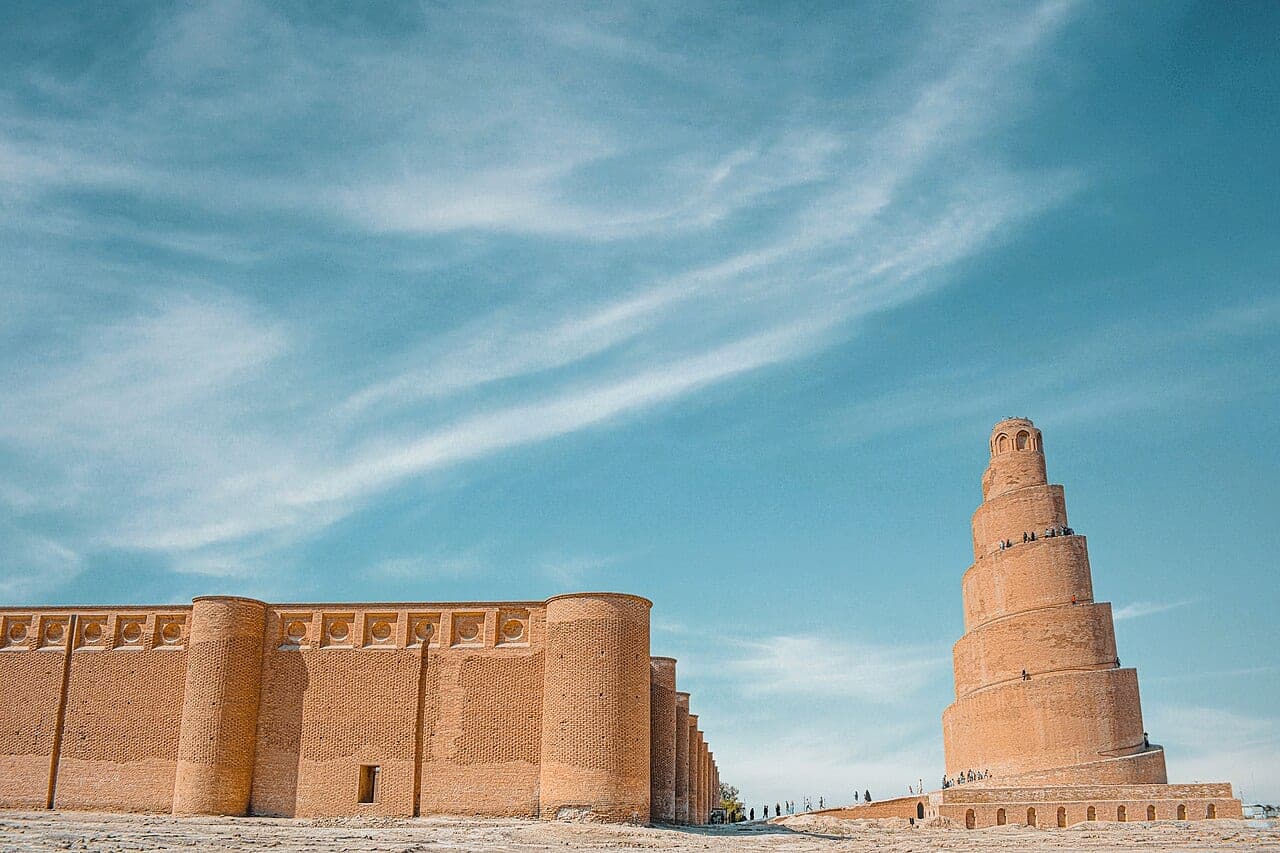
Iraq holds six UNESCO World Heritage Sites spanning nearly every chapter of its past. Hatra, the Parthian caravan city, was inscribed in 1985; Ashur, first Assyrian capital, in 2003; the Abbasid city of Samarra, with its great spiral minaret, in 2007; the citadel of Erbil in 2014; and Babylon, capital of Hammurabi and Nebuchadnezzar, in 2019 (UNESCO). The Ahwar of Southern Iraq, inscribed in 2016, is a mixed site combining the marshlands with the Sumerian ruins of Uruk, Ur and Eridu (UNESCO). Several of these remain on the List of World Heritage in Danger.
The ziggurat at Ur, built around 2100 BC for the moon god Nanna, and now standing beside a military airbase. Photograph by Hardnfast, CC BY 3.0, via Wikimedia Commons.
Around 2334 BC Sargon of Akkad united the region into what is often called the first empire. Power later settled on Babylon, where King Hammurabi (about 1792 to 1750 BC) issued a code of 282 laws, inscribed on a stele now in the Louvre (Louvre). Under Nebuchadnezzar II (605 to 562 BC) Babylon reached its height, with the blue-tiled Ishtar Gate and gardens later counted among the wonders of the ancient world. To the north, Assyria ruled from Ashur, Nimrud and Nineveh, and the library of King Ashurbanipal at Nineveh, excavated in the 1850s, yielded the Gilgamesh tablets that first let the modern world read Mesopotamian literature.
Babylon fell to Cyrus the Great of Persia in 539 BC, drawing Mesopotamia into the Achaemenid Empire. Alexander the Great defeated the Persians at Gaugamela, near modern Mosul, in 331 BC and died in Babylon in 323 BC; his Seleucid successors, then the Parthians and Sasanians, ruled from Ctesiphon on the Tigris, whose vast brick arch still stands, and built the caravan city of Hatra.
The Arab Muslim conquest came in the 630s, and the garrison towns of Kufa and Basra grew into centres of Islamic learning. The Abbasids founded Baghdad in 762 as capital of a caliphate reaching from North Africa to Central Asia, and there the House of Wisdom gathered scholars who translated Greek, Persian and Indian works into Arabic and advanced mathematics, astronomy and medicine, in a golden age lasting from roughly the eighth to the fourteenth centuries (Britannica). The Mongol sack of Baghdad in 1258 ended that age. From 1534 the Ottomans governed the region as the provinces of Mosul, Baghdad and Basra for nearly four centuries. After the First World War the area became the British-mandated, then independent, Kingdom of Iraq in 1932, and a republic followed in 1958. The decades since have brought war and hardship, including the Iran-Iraq War of the 1980s, the conflicts of 1991 and 2003, and the occupation of the north by Islamic State from 2014 to 2017, with recovery under way since.
Modern Iraq has two official languages: Arabic, a Semitic language spoken in a distinctive Mesopotamian dialect across most of the country, and Kurdish, an Indo-European language of the Iranian family spoken in the north. Turkmen and the Neo-Aramaic of the Assyrian and Chaldean Christians add further layers.
Beneath them lie the ancient languages that cuneiform recorded. Sumerian, a language isolate unrelated to any living tongue, was the first to be written; Akkadian, the Semitic language of the Babylonians and Assyrians, followed; and Aramaic later became the common speech of the whole region, a role it kept into the Islamic period. The name Iraq itself is usually traced to the Arabic al-Iraq, which by early Islamic times meant the fertile lowlands along the lower Tigris and Euphrates. Some scholars connect it to an Arabic root suggesting land that is deeply rooted or well watered, others to the ancient city of Uruk, and others to the Middle Persian Erag. The older Greek name Mesopotamia simply means the land between the rivers.
Poetry holds a central place in Iraqi life. Al-Mutanabbi, born in Kufa in 915, is regarded by many as the greatest poet in the Arabic language, and Baghdad's al-Mutanabbi Street, with its bookshops and the historic Shahbandar café, still carries his name. In the 1940s the Iraqi poets Nazik al-Malaika and Badr Shakir al-Sayyab broke with centuries of fixed metre to pioneer Arabic free verse across the Arab world.
Music runs just as deep. The Iraqi maqam, a classical vocal tradition in which a singer performs classical or colloquial poetry with a small ensemble of santur, joza and drum, was recognised by UNESCO, proclaimed a masterpiece in 2003 and inscribed on its Representative List in 2008 (UNESCO). Kurdish song and the oud playing of masters such as Naseer Shamma draw on the same inheritance. At the table, the national dish is masgouf, river carp split open and slowly grilled beside the Tigris; dolma, kebab, tashreeb and the dates famous since Sumerian times complete the meal, with strongly brewed sweet tea throughout.
Islam shapes most of Iraqi life, and the country holds sites sacred to both of its main branches. Najaf and Karbala, with the shrines of Imam Ali and Imam Husayn, are among the holiest cities of Shia Islam; the al-Askari shrine at Samarra, holding two further imams, is likewise revered (Imam Husayn Shrine). Sunni communities are strong in the centre, west and Kurdish north.
Iraq also shelters some of the oldest religious minorities in the world. Its Assyrian, Chaldean and Syriac Christians trace their communities to the first centuries of Christianity and still pray in dialects of Aramaic. The Yazidis, a Kurdish-speaking people whose ancient faith centres on the sacred valley of Lalish, endured grave persecution during the events of 2014 and after, a suffering their community continues to mourn and document. The Mandaeans, who honour John the Baptist and baptise in running water, are among the smallest and most ancient of these communities, making Iraq one of the most religiously layered lands in the region.
Islamic funerary custom shapes most Iraqi mourning. The dead are washed, wrapped in a plain shroud, and buried quickly, usually within a day, laid to face Mecca after the communal funeral prayer, the salat al-janazah. Grief is shared rather than private: a mourning gathering, the majlis aza or fatiha, brings relatives and neighbours together for three days of condolence and Quran recitation, with further remembrance on the fortieth day and at the anniversary. Many Shia families seek burial near Imam Ali in Najaf, whose Wadi al-Salam cemetery, the Valley of Peace, has grown over centuries into one of the largest burial grounds on earth.
The deepest current in Iraqi remembrance is the mourning of Imam Husayn. Ashura, on the tenth day of the month of Muharram, marks his death at Karbala in 680 and is observed with public grief: recitations of Karbala in gatherings called majalis, elegies and rhythmic chest-beating, black banners, and dramatic re-enactments known as taziya. Forty days later comes Arbaeen, when pilgrims walk to Karbala in numbers that make it one of the largest annual gatherings anywhere, turning a single act of loss into a shared, renewed act of memory across generations.
Iraq's burial heritage reaches back to the beginning of history. At Ur, the royal tombs excavated in the 1920s, including that of Queen Puabi, revealed how carefully the earliest Mesopotamians equipped and remembered their dead. The impulse to record a name against forgetting, first pressed into clay at Uruk, and the pilgrimages that gather the living around the honoured dead are two ends of one long tradition of remembrance.
Iraq's archives have been seized, flooded, burned and shipped abroad, and every one of those verbs is literal.
The Ottoman administration kept nüfus population registers and sharia court sijills, and the British Mandate and the monarchy added an état civil that became a functioning national registration system. Then the Ba'ath state built an apparatus that documented its own repression obsessively: party membership files, security service reports, the paperwork of the Anfal campaign against the Kurds. Kurdish forces captured several tonnes of those documents in 1991, and further millions of pages were taken after 2003; a large part is held outside Iraq, which is a legal and political dispute as much as an archival one.
The Iraqi Jewish Archive is the strangest case. In 2003 American forces found the records of Baghdad's Jewish community, a community with a continuous history of more than two and a half millennia, in the flooded basement of the intelligence service headquarters. Registers, school records, Torah scrolls and community papers were frozen, shipped to the United States and conserved. Iraq wants them back; Iraqi Jews, almost all of whom left between 1950 and 1952, largely do not want them returned to a country none of them live in.
For families now, the practical record is the civil identity document and the nationality certificate, and their reconstruction after the destruction of the registry offices in 2003 has been one of the quieter administrative crises of the last two decades.
Iraq holds six UNESCO World Heritage Sites spanning nearly every chapter of its past. Hatra, the Parthian caravan city, was inscribed in 1985; Ashur, first Assyrian capital, in 2003; the Abbasid city of Samarra, with its great spiral minaret, in 2007; the citadel of Erbil in 2014; and Babylon, capital of Hammurabi and Nebuchadnezzar, in 2019 (UNESCO). The Ahwar of Southern Iraq, inscribed in 2016, is a mixed site combining the marshlands with the Sumerian ruins of Uruk, Ur and Eridu (UNESCO). Several of these remain on the List of World Heritage in Danger.
 Babylon photographed near the Ishtar Gate before the reconstructions, the excavations and the military occupation of the site. Matson Collection, public domain, via Wikimedia Commons.
The losses of recent conflict have been severe. Museum collections in Mosul were smashed, and the Assyrian sites of Nimrud and Nineveh, along with parts of Hatra, were bulldozed or dynamited between 2014 and 2017, when the al-Nuri Mosque and its al-Hadba minaret were also destroyed. Recovery has followed: the UNESCO campaign Revive the Spirit of Mosul reconstructed the mosque, the minaret and neighbouring churches, with more than a hundred heritage houses, work completed by the end of 2024 (UNESCO). The National Museum of Iraq reopened in 2015, and the State Board of Antiquities and Heritage and international partners continue to conserve sites and pursue looted objects. The southern marshes, largely drained in the 1990s, have been substantially reflooded and now form part of the protected Ahwar site.
Digital tools have become central to protecting and sharing Iraqi heritage, especially where the physical record has been damaged. The Cuneiform Digital Library Initiative has placed images and transcriptions of hundreds of thousands of clay tablets online, opening the oldest written archive in the world, while the electronic Babylonian Library project uses digital methods and artificial intelligence to reassemble scattered fragments of works such as the Epic of Gilgamesh. Where objects were lost, three-dimensional reconstruction has recovered something of their form: crowdsourced projects rebuilt destroyed Mosul Museum statues from tourists' photographs, and conservation foundations have produced precise facsimiles of Assyrian reliefs.
Iraqi creativity continues to reach a wide world. The architect Zaha Hadid, born in Baghdad in 1950, became one of the most influential designers of her era, and the sculptor Jawad Salim gave modern Baghdad its Freedom Monument, a defining work of twentieth-century Arab art. In fiction, Ahmed Saadawi won the International Prize for Arabic Fiction in 2014 for Frankenstein in Baghdad, while writers of the diaspora such as Sinan Antoon carry Iraqi memory into other languages. Across a large diaspora in the Gulf, Europe, North America and Australia, Iraqi families keep language, cuisine and the commemorations of Muharram in daily use, carrying the culture far beyond the country's borders.
Mosul rebuilt. The al-Nuri Mosque and its al-Hadba minaret, destroyed in 2017, were reconstructed under the UNESCO campaign Revive the Spirit of Mosul, with the minaret and neighbouring churches completed by the end of 2024, alongside more than a hundred restored heritage houses.
Gilgamesh comes home. The Gilgamesh Dream Tablet, one of the oldest surviving pieces of literature, was returned to Iraq in December 2021 after decades on the illicit market, part of a wider recovery of roughly 17,900 artifacts from several countries (UN News).
The marshes revived. Largely drained in the 1990s, the southern marshlands were substantially reflooded, Marsh Arab communities returned, and in 2016 the Ahwar of Southern Iraq was inscribed as a UNESCO World Heritage Site.
Babylon recognised. In 2019, after decades of effort, UNESCO added the ancient city of Babylon to the World Heritage List, giving one of history's most famous names formal international protection.
Babylon photographed near the Ishtar Gate before the reconstructions, the excavations and the military occupation of the site. Matson Collection, public domain, via Wikimedia Commons.
The losses of recent conflict have been severe. Museum collections in Mosul were smashed, and the Assyrian sites of Nimrud and Nineveh, along with parts of Hatra, were bulldozed or dynamited between 2014 and 2017, when the al-Nuri Mosque and its al-Hadba minaret were also destroyed. Recovery has followed: the UNESCO campaign Revive the Spirit of Mosul reconstructed the mosque, the minaret and neighbouring churches, with more than a hundred heritage houses, work completed by the end of 2024 (UNESCO). The National Museum of Iraq reopened in 2015, and the State Board of Antiquities and Heritage and international partners continue to conserve sites and pursue looted objects. The southern marshes, largely drained in the 1990s, have been substantially reflooded and now form part of the protected Ahwar site.
Digital tools have become central to protecting and sharing Iraqi heritage, especially where the physical record has been damaged. The Cuneiform Digital Library Initiative has placed images and transcriptions of hundreds of thousands of clay tablets online, opening the oldest written archive in the world, while the electronic Babylonian Library project uses digital methods and artificial intelligence to reassemble scattered fragments of works such as the Epic of Gilgamesh. Where objects were lost, three-dimensional reconstruction has recovered something of their form: crowdsourced projects rebuilt destroyed Mosul Museum statues from tourists' photographs, and conservation foundations have produced precise facsimiles of Assyrian reliefs.
Iraqi creativity continues to reach a wide world. The architect Zaha Hadid, born in Baghdad in 1950, became one of the most influential designers of her era, and the sculptor Jawad Salim gave modern Baghdad its Freedom Monument, a defining work of twentieth-century Arab art. In fiction, Ahmed Saadawi won the International Prize for Arabic Fiction in 2014 for Frankenstein in Baghdad, while writers of the diaspora such as Sinan Antoon carry Iraqi memory into other languages. Across a large diaspora in the Gulf, Europe, North America and Australia, Iraqi families keep language, cuisine and the commemorations of Muharram in daily use, carrying the culture far beyond the country's borders.
Mosul rebuilt. The al-Nuri Mosque and its al-Hadba minaret, destroyed in 2017, were reconstructed under the UNESCO campaign Revive the Spirit of Mosul, with the minaret and neighbouring churches completed by the end of 2024, alongside more than a hundred restored heritage houses.
Gilgamesh comes home. The Gilgamesh Dream Tablet, one of the oldest surviving pieces of literature, was returned to Iraq in December 2021 after decades on the illicit market, part of a wider recovery of roughly 17,900 artifacts from several countries (UN News).
The marshes revived. Largely drained in the 1990s, the southern marshlands were substantially reflooded, Marsh Arab communities returned, and in 2016 the Ahwar of Southern Iraq was inscribed as a UNESCO World Heritage Site.
Babylon recognised. In 2019, after decades of effort, UNESCO added the ancient city of Babylon to the World Heritage List, giving one of history's most famous names formal international protection.
National Overview
Notable Cities
Historical Foundations
Linguistic and Etymological Roots
Cultural Identity
Religion and Spirituality
Remembrance and Mourning Traditions
Tracing a Family in Iraq
Heritage Preservation Efforts
Digital Heritage
Contemporary Cultural Influences
Success Stories
References and resources
- Encyclopaedia Britannica: Iraq. Geography, history and government.
- UNESCO World Heritage Centre: Babylon. The 2019 inscription.
- UNESCO World Heritage Centre: Ahwar of Southern Iraq. Marshlands and Sumerian cities, 2016.
- UNESCO: Revive the Spirit of Mosul. Rebuilding Mosul's old city.
- UNESCO Intangible Cultural Heritage: Iraqi Maqam. The classical vocal tradition.
- Encyclopaedia Britannica: Bayt al-Hikmah. Abbasid Baghdad's House of Wisdom.
- Louvre: The Code of Hammurabi. The Babylonian law code.
- UN News: Return of the looted Gilgamesh tablet. The 2021 repatriation.
- Imam Husayn Shrine. The Karbala shrine and Ashura.
- World History Encyclopedia: Ur. The Sumerian city and its royal cemetery.