Heritage · Country
Lebanon Culture and Heritage
Lebanon's coast gave the world its alphabet, and its mountains have sheltered monks, poets and a mosaic of faiths for millennia. A guide to the Phoenician ports, the Roman temples of Baalbek, the Cedars of God, and the ways Lebanese communities keep their dead in memory.Written to last.
By Confinity Heritage Editorial · Updated 2026-07-31 · 8-minute readQuiet tools, kept out of the way.
No stretch of coast has done more to shape how the world writes than the shore of Lebanon. From the harbours of Byblos, Tyre and Sidon, Phoenician merchants carried cedar, glass and purple dye across the Mediterranean, and with their cargo they spread a compact set of letters that Greeks, Romans and eventually most of humanity would adapt into the alphabet. Behind the ports rise the mountains that gave the country its name, their slopes once dark with the cedars prized by pharaohs and Assyrian kings, their valleys cut with the caves and chapels of the earliest Christian hermits.
This small country holds an unusually dense record of the human past: five UNESCO World Heritage sites, the monumental Roman temples of Baalbek, and a religious mosaic of Christians, Sunni, Shia and Druze with few parallels anywhere. It has also known hard passages, among them a civil war from 1975 to 1990 and the explosion at the port of Beirut in August 2020, both now part of how Lebanese families remember.
Lebanon occupies a narrow strip on the eastern Mediterranean, bordered by Syria to the north and east and by Israel to the south, and at roughly 10,452 square kilometres it is among the most compact countries in the region (Britannica). Two ranges run parallel to the coast, Mount Lebanon and the Anti-Lebanon, separated by the fertile Bekaa valley; the higher peaks keep their snow into spring, and that whiteness lies behind the country's name. Around five and a half million people live within its borders, while a diaspora often estimated to be larger than the resident population lives abroad, from Brazil to West Africa, the Gulf and North America.
Lebanon has held no official census since 1932, a silence that is itself political, because public office is shared out by religious community. Under the arrangement worked out at independence, the president is a Maronite Christian, the prime minister a Sunni Muslim and the speaker of parliament a Shia Muslim, with posts distributed among eighteen recognised confessions (Britannica). Recent independent estimates put the population at roughly 30 percent Christian and 69 percent Muslim, the latter split fairly evenly between Sunni and Shia with a Druze minority of about 5 percent (U.S. State Department). The result is a country at once Arab and Mediterranean.
Beirut. The capital has been settled for some five thousand years. As Roman Berytus it held the empire's leading school of law, until an earthquake and tsunami levelled the city on 9 July 551 and scattered its jurists to Sidon (Britannica). Rebuilt many times, Beirut carries its layers openly: Ottoman and French-era facades, a downtown reconstructed after the civil war, and the coastal quarters of Gemmayzeh and Mar Mikhael, much of which the 2020 port explosion damaged.
 Byblos has been lived in for some seven thousand years, and gave its name to the book. Photograph by xiquinhosilva, CC BY 4.0, via Wikimedia Commons.
Byblos. Known in Arabic as Jbeil, Byblos is among the oldest continuously inhabited cities on earth, occupied for some seven thousand years (Britannica). It gave its name, through Greek, to the papyrus book and the Bible, and it was here that the Phoenician alphabet took shape; the tenth-century BC sarcophagus of King Ahiram carries one of the earliest known inscriptions in that script (UNESCO). A Crusader castle crowns the ancient mound.
Tyre. A great Phoenician seaport from the second millennium BC, Tyre founded colonies across the Mediterranean, Carthage among them, and grew wealthy on murex purple. Its Roman remains include one of the largest hippodromes of the ancient world, and the city was inscribed by UNESCO in 1984 (UNESCO).
Sidon. The modern Saida, one of the oldest Phoenician cities, is remembered for its glass and dye trades and for the Temple of Eshmun nearby. A Crusader sea castle guards its harbour, and its covered souks preserve the plan of the medieval town (Britannica).
Tripoli. Lebanon's second city holds the country's finest ensemble of Mamluk architecture, with mosques, madrasas and hammams gathered beneath the Crusader citadel of Saint-Gilles, and it remains known for its traditional soap and sweets.
Lebanon's recorded story begins with the Phoenicians, the Canaanite seafarers whose coastal cities built a trading network from Cyprus to Iberia between roughly 1500 and 300 BC. Their most far-reaching export was a technology of writing: some twenty-two consonantal signs, simpler than the cuneiform and hieroglyphic systems around them, which the Greeks borrowed and fitted with vowels and which underlies most alphabets today (UNESCO). Byblos traded cedar and papyrus with Egypt, while Tyre and Sidon spun the murex-purple that clothed emperors.
Byblos has been lived in for some seven thousand years, and gave its name to the book. Photograph by xiquinhosilva, CC BY 4.0, via Wikimedia Commons.
Byblos. Known in Arabic as Jbeil, Byblos is among the oldest continuously inhabited cities on earth, occupied for some seven thousand years (Britannica). It gave its name, through Greek, to the papyrus book and the Bible, and it was here that the Phoenician alphabet took shape; the tenth-century BC sarcophagus of King Ahiram carries one of the earliest known inscriptions in that script (UNESCO). A Crusader castle crowns the ancient mound.
Tyre. A great Phoenician seaport from the second millennium BC, Tyre founded colonies across the Mediterranean, Carthage among them, and grew wealthy on murex purple. Its Roman remains include one of the largest hippodromes of the ancient world, and the city was inscribed by UNESCO in 1984 (UNESCO).
Sidon. The modern Saida, one of the oldest Phoenician cities, is remembered for its glass and dye trades and for the Temple of Eshmun nearby. A Crusader sea castle guards its harbour, and its covered souks preserve the plan of the medieval town (Britannica).
Tripoli. Lebanon's second city holds the country's finest ensemble of Mamluk architecture, with mosques, madrasas and hammams gathered beneath the Crusader citadel of Saint-Gilles, and it remains known for its traditional soap and sweets.
Lebanon's recorded story begins with the Phoenicians, the Canaanite seafarers whose coastal cities built a trading network from Cyprus to Iberia between roughly 1500 and 300 BC. Their most far-reaching export was a technology of writing: some twenty-two consonantal signs, simpler than the cuneiform and hieroglyphic systems around them, which the Greeks borrowed and fitted with vowels and which underlies most alphabets today (UNESCO). Byblos traded cedar and papyrus with Egypt, while Tyre and Sidon spun the murex-purple that clothed emperors.
 Baalbek, where the Romans raised temples on a scale they never attempted at home, on foundation stones weighing hundreds of tonnes. Matson Collection, public domain, via Wikimedia Commons.
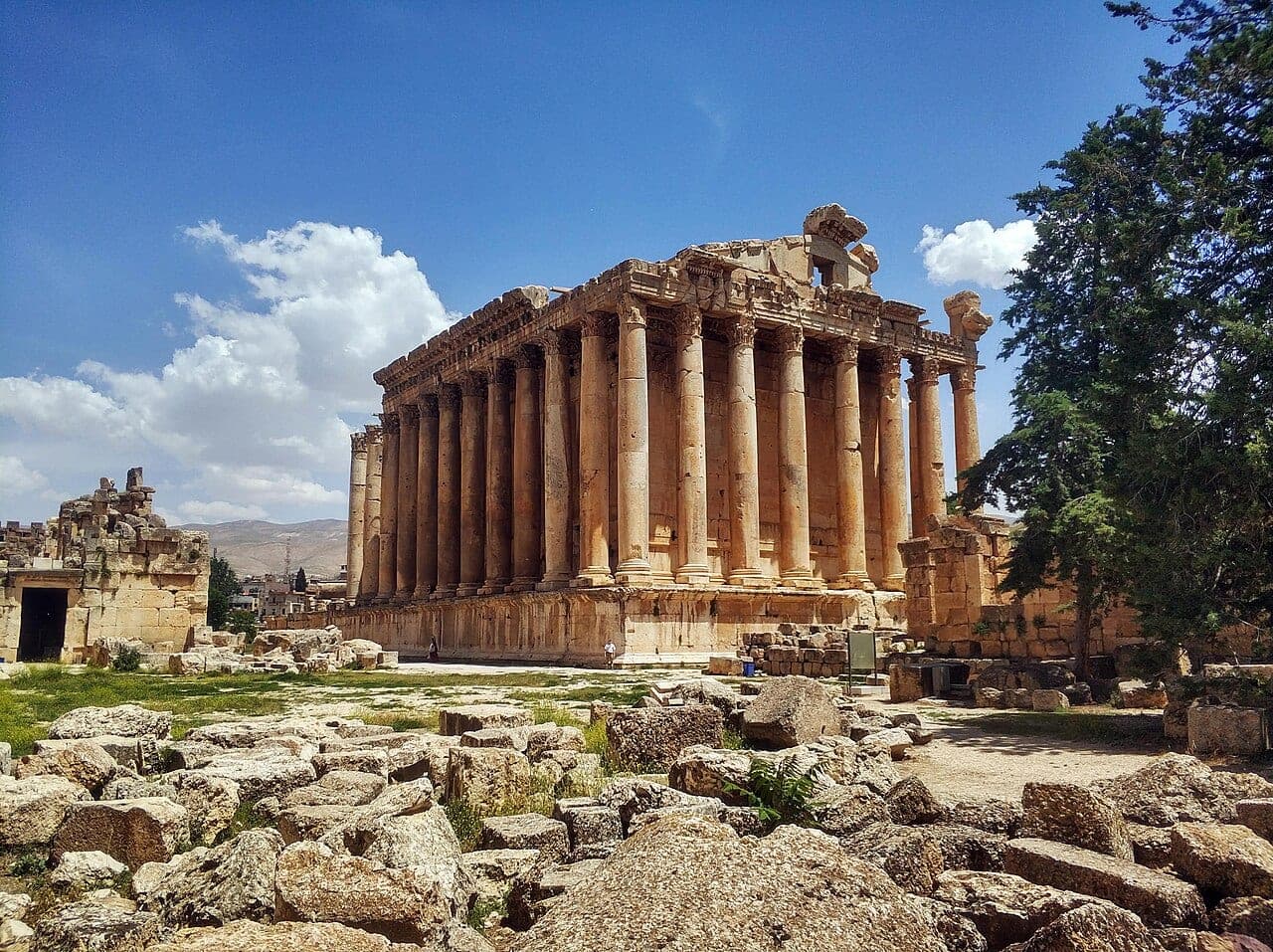
Persian and then Greek rule followed, Alexander taking Tyre after a famous siege in 332 BC. Under Rome the region flourished. At Baalbek, ancient Heliopolis in the Bekaa, the Romans raised temples of colossal scale: the Temple of Jupiter, the largest they ever built, of which six of fifty-four columns still stand, and the neighbouring Temple of Bacchus, among the best-preserved of the classical world (UNESCO). Coastal Berytus trained the empire's lawyers until an earthquake destroyed it in 551.
Christianity took early root in Mount Lebanon, where the Maronites, followers of the fifth-century hermit Saint Maron, made the Qadisha gorges a centre of monastic life. After the Arab conquests of the seventh century the region entered the Islamic world, and the Umayyads laid out the inland city of Anjar, a rare surviving example of early Islamic town planning (UNESCO). The mountains gathered a distinctive population of Maronites, Druze and, in the south, Shia.
The Ottomans ruled from 1516 to 1918. Mount Lebanon kept considerable autonomy under local emirs, notably Fakhr al-Din II in the seventeenth century, and after communal conflict the powers created the autonomous Mount Lebanon Mutasarrifate (1861 to 1918) (Britannica). With the empire's collapse after the First World War, France took a League of Nations mandate and in 1920 proclaimed Greater Lebanon, adding the coastal cities and the Bekaa to the mountain heartland. Full independence came on 22 November 1943, secured by the National Pact that shared the highest offices among the main communities (Britannica).
The young state prospered as a regional centre of banking and culture, but its confessional balance proved fragile. A civil war ran from 1975 to 1990, drawing in Lebanese factions and outside powers and leaving well over a hundred thousand dead and many displaced. It was closed by the Taif Agreement of 1989, which adjusted the sharing of power between Christians and Muslims (Britannica). The war remains a defining reference in national life, and its human accounting, including thousands still recorded as missing, is unfinished.
Arabic is the official language of Lebanon, spoken in a distinctive Levantine dialect that differs markedly from the formal written standard. French, a legacy of the mandate and of long educational ties, remains in wide use in schools, business and government, and English has grown steadily as a second or third language, so that many Lebanese move easily among all three, often within a single sentence.
The name Lebanon is among the oldest recorded place-names on earth. It derives from the Semitic root l-b-n, meaning white, a reference generally taken to be the snow that caps Mount Lebanon, though some link it to the pale limestone of its cliffs (Wiktionary). The same root gives the Arabic word for milk, laban. The mountain appears in the Epic of Gilgamesh and dozens of times in the Hebrew Bible, so the word has named this coast, without interruption, for well over four thousand years.
The Lebanese table is one of the country's best-loved exports. Meals often open with mezze, a spread of small dishes: hummus, baba ghanoush, labneh, stuffed vine leaves, and above all tabbouleh, the parsley and bulgur salad, and kibbeh, the spiced meat-and-bulgur croquette often called a national dish (Britannica). Olive oil, lemon, garlic and fresh herbs define the flavour, and arak, the aniseed spirit, accompanies the long shared lunch.
In music, the singer Fairuz, working with the composer-brothers Rahbani, became one of the most beloved voices of the Arab world, her recordings woven into the daily life of Lebanese homes. Traditional forms centre on the oud, qanun and ney and on the dabke, the communal line dance performed at weddings and festivals. Lebanon also holds an outsized place in modern Arabic letters. Its early twentieth-century emigrant writers, the al-Mahjar or emigrant school, reshaped the language from abroad; the foremost among them, Khalil Gibran, born in Bsharri in 1883, wrote The Prophet in 1923, since translated into more than a hundred languages (L'Orient Today). Later poets such as Said Akl and Adonis carried it forward, while crafts endure alongside the arts: glassblowing on the coast, the olive-oil soap of Tripoli and Sidon, and silk and copperwork in the mountain villages.
Few societies contain as many living religious communities in so small a space. The largest Christian body is the Maronite Church, an Eastern Catholic communion in union with Rome that keeps a Syriac liturgy and whose patriarch sits at Bkerke; alongside it are Greek Orthodox, Melkite Greek Catholic and Armenian Christians (Britannica). The Muslim population is divided chiefly between Sunnis, concentrated in the coastal cities, and Shia, long established in the south and the northern Bekaa. The Druze, whose faith emerged from Ismaili Islam in the eleventh century and holds its teachings closely, are settled mainly in the Chouf mountains southeast of Beirut (Wikipedia).
This mosaic is more than a matter of census categories. It shapes law, since marriage, inheritance and burial fall to each community's own religious courts, and it shapes the landscape, where church bells and the call to prayer sound across the same valleys. Coexistence has at times been strained, but the sharing of feasts, saints and mountains across confessional lines remains a marked feature of everyday Lebanese life.
Because Lebanon's communities bury their dead by their own rites, the country holds several mourning traditions at once. Muslim custom, Sunni and Shia alike, calls for burial as soon as possible, usually within a day; after the funeral prayer the body is washed, wrapped in a plain shroud and laid in the grave on its right side facing Mecca. Shia families place particular weight on the fortieth-day commemoration, the arbaeen, and the wider Shia calendar centres on Ashura, the remembrance of Imam Husayn (Anera).
Christian communities hold a funeral Mass or liturgy followed by burial, with memorial services marking the fortieth day and the first anniversary. The Druze, who believe in the immediate rebirth of the soul into a new body, keep their funerals notably restrained and swift, since death is understood as a passage rather than an ending (New Lines Magazine).
For all the differences, the shape of Lebanese mourning is widely recognisable. After a death the family receives condolences for several days at a gathering known as the azza, where mourners are served a thick, unsweetened coffee whose bitterness openly mirrors the loss (365 Days of Lebanon). Black is worn, printed death notices go up in the neighbourhood, and food is brought to the bereaved household, so that grief here is public and collective rather than private.
Two shared national wounds shadow these private rites. The civil war of 1975 to 1990 left thousands unaccounted for, and the search for the missing still gives many families a grief without a grave. Each 4 August, relatives of those killed in the 2020 port explosion gather near the ruined silos in Beirut to read the names of the dead. Both are observed soberly, as common losses that cross every communal line.
Lebanese family records are kept by religion, and there are eighteen recognised communities keeping them.
Personal status in Lebanon is administered by the confession rather than the state: marriage, divorce, inheritance and legitimacy go through Maronite, Greek Orthodox, Greek Catholic, Armenian, Sunni, Shia, Druze and other courts, each with its own registers. So the vital record of a Lebanese family sits with its church or its religious court, and the state's civil registry records the outcome. Many of those ecclesiastical registers run back centuries, and Maronite parish books in the mountain villages are among the oldest continuous records in the Levant.
The Ottoman nüfus registers cover the nineteenth century, and the French mandate built the civil registry that the republic inherited. The registry is organised by village of origin, not residence, so a Beirut family's file is in the mountain village its ancestors left, and that is where a search begins.
The great Lebanese fact is emigration. Far more people of Lebanese descent live abroad than in Lebanon, in Brazil, Argentina, the United States, West Africa and Australia, and the emigration began in the 1880s. Many left as Ottoman subjects and were recorded on arrival as Syrian or Turkish, which is why so many families in São Paulo trace a village they cannot name.
The civil war's missing, around seventeen thousand people, remain unaccounted for, and a national commission to investigate them was established only in 2018.
Lebanon's antiquities are overseen by the Directorate General of Antiquities, and the country holds five UNESCO World Heritage sites. Four were inscribed together in 1984: Byblos, for its role in the alphabet and its seven millennia of settlement; Baalbek, for the grandest Roman temple complex in the Near East; Tyre, for its Phoenician and Roman remains; and Anjar, for its early Islamic city plan (UNESCO). The fifth, added in 1998, joins the Qadisha valley, one of the world's earliest monastic landscapes, with the nearby Forest of the Cedars of God on Mount Makmel, the surviving grove of the trees once felled for temples and ships (UNESCO).
Preservation has often had to contend with instability. In July 2026 UNESCO placed Tyre on its List of World Heritage in Danger after damage during regional conflict, a step meant to focus protection on the site (France 24). After the 2020 port explosion, which damaged historic quarters of Beirut, UNESCO launched its Li Beirut initiative to rehabilitate the city's schools, museums and heritage buildings, working with donors including Italy and France and with ALIPH, the International Alliance for the Protection of Heritage in Conflict Areas (UNESCO).
The most concentrated digital-heritage effort in Lebanon grew directly out of the 2020 disaster. In its aftermath UNESCO, the Directorate General of Antiquities and the studio Iconem carried out a large-scale three-dimensional survey of the damaged historic districts, from the port through Medawar, Gemmayzeh and Mar Mikhael, capturing tens of thousands of images to guide reconstruction and record buildings at risk (UNESCO). Volunteers with CIPA Heritage Documentation added photogrammetric surveys of monuments such as the Sursock and Bustros palaces (CIPA).
The same techniques have been applied further afield, from Byblos to old Tripoli, and Lebanon's universities and museums have steadily brought archives, photographs and library collections online. For a country with so large a diaspora these records serve a double purpose: they safeguard fragile sites and bring Lebanese heritage within reach of the millions who trace their origins to the coast.
Modern Lebanon continues to project its culture well beyond its borders, often through its emigrant communities. Its cinema has drawn wide attention, notably the director Nadine Labaki, whose Capernaum was nominated for an Academy Award, and its independent music, from Mashrou' Leila onward, has found audiences across the Arab world and Europe. Beirut has long been a hub of Arabic publishing, and Lebanese designers, the couturier Elie Saab foremost among them, are fixtures of the international fashion houses.
Lebanese food has become a global category, on menus from Sao Paulo to Sydney. And the voice of Fairuz, still played in cafes and kitchens every morning, links the country at home to its far larger family abroad.
The Sursock Museum reborn. Beirut's museum of modern art, in a Venetian-Ottoman villa near the port, was gutted by the 2020 blast, which shattered its windows and damaged dozens of works. After a UNESCO-led restoration funded largely by Italy through the Li Beirut initiative, it reopened in May 2023 (UNESCO).
The cedars replanted. The ancient grove that gave Lebanon its emblem, reduced over millennia to a few surviving stands, is now protected within the Qadisha and Cedars World Heritage site, and local committees and the Al-Shouf Cedar Nature Reserve have planted hundreds of thousands of young trees (UNESCO).
Byblos, still inhabited. After seven thousand years, the birthplace of the alphabet remains a living community rather than a ruin, its ancient harbour, Crusader castle and Roman remains part of a working seaside town (Britannica).
A poet's house kept. The eighteenth-century monastery above Bsharri where Khalil Gibran is buried has served since his death as the Gibran Museum, holding around 150 of his paintings, and in 2023 it marked the centenary of The Prophet (L'Orient Today).
Baalbek, where the Romans raised temples on a scale they never attempted at home, on foundation stones weighing hundreds of tonnes. Matson Collection, public domain, via Wikimedia Commons.
Persian and then Greek rule followed, Alexander taking Tyre after a famous siege in 332 BC. Under Rome the region flourished. At Baalbek, ancient Heliopolis in the Bekaa, the Romans raised temples of colossal scale: the Temple of Jupiter, the largest they ever built, of which six of fifty-four columns still stand, and the neighbouring Temple of Bacchus, among the best-preserved of the classical world (UNESCO). Coastal Berytus trained the empire's lawyers until an earthquake destroyed it in 551.
Christianity took early root in Mount Lebanon, where the Maronites, followers of the fifth-century hermit Saint Maron, made the Qadisha gorges a centre of monastic life. After the Arab conquests of the seventh century the region entered the Islamic world, and the Umayyads laid out the inland city of Anjar, a rare surviving example of early Islamic town planning (UNESCO). The mountains gathered a distinctive population of Maronites, Druze and, in the south, Shia.
The Ottomans ruled from 1516 to 1918. Mount Lebanon kept considerable autonomy under local emirs, notably Fakhr al-Din II in the seventeenth century, and after communal conflict the powers created the autonomous Mount Lebanon Mutasarrifate (1861 to 1918) (Britannica). With the empire's collapse after the First World War, France took a League of Nations mandate and in 1920 proclaimed Greater Lebanon, adding the coastal cities and the Bekaa to the mountain heartland. Full independence came on 22 November 1943, secured by the National Pact that shared the highest offices among the main communities (Britannica).
The young state prospered as a regional centre of banking and culture, but its confessional balance proved fragile. A civil war ran from 1975 to 1990, drawing in Lebanese factions and outside powers and leaving well over a hundred thousand dead and many displaced. It was closed by the Taif Agreement of 1989, which adjusted the sharing of power between Christians and Muslims (Britannica). The war remains a defining reference in national life, and its human accounting, including thousands still recorded as missing, is unfinished.
Arabic is the official language of Lebanon, spoken in a distinctive Levantine dialect that differs markedly from the formal written standard. French, a legacy of the mandate and of long educational ties, remains in wide use in schools, business and government, and English has grown steadily as a second or third language, so that many Lebanese move easily among all three, often within a single sentence.
The name Lebanon is among the oldest recorded place-names on earth. It derives from the Semitic root l-b-n, meaning white, a reference generally taken to be the snow that caps Mount Lebanon, though some link it to the pale limestone of its cliffs (Wiktionary). The same root gives the Arabic word for milk, laban. The mountain appears in the Epic of Gilgamesh and dozens of times in the Hebrew Bible, so the word has named this coast, without interruption, for well over four thousand years.
The Lebanese table is one of the country's best-loved exports. Meals often open with mezze, a spread of small dishes: hummus, baba ghanoush, labneh, stuffed vine leaves, and above all tabbouleh, the parsley and bulgur salad, and kibbeh, the spiced meat-and-bulgur croquette often called a national dish (Britannica). Olive oil, lemon, garlic and fresh herbs define the flavour, and arak, the aniseed spirit, accompanies the long shared lunch.
In music, the singer Fairuz, working with the composer-brothers Rahbani, became one of the most beloved voices of the Arab world, her recordings woven into the daily life of Lebanese homes. Traditional forms centre on the oud, qanun and ney and on the dabke, the communal line dance performed at weddings and festivals. Lebanon also holds an outsized place in modern Arabic letters. Its early twentieth-century emigrant writers, the al-Mahjar or emigrant school, reshaped the language from abroad; the foremost among them, Khalil Gibran, born in Bsharri in 1883, wrote The Prophet in 1923, since translated into more than a hundred languages (L'Orient Today). Later poets such as Said Akl and Adonis carried it forward, while crafts endure alongside the arts: glassblowing on the coast, the olive-oil soap of Tripoli and Sidon, and silk and copperwork in the mountain villages.
Few societies contain as many living religious communities in so small a space. The largest Christian body is the Maronite Church, an Eastern Catholic communion in union with Rome that keeps a Syriac liturgy and whose patriarch sits at Bkerke; alongside it are Greek Orthodox, Melkite Greek Catholic and Armenian Christians (Britannica). The Muslim population is divided chiefly between Sunnis, concentrated in the coastal cities, and Shia, long established in the south and the northern Bekaa. The Druze, whose faith emerged from Ismaili Islam in the eleventh century and holds its teachings closely, are settled mainly in the Chouf mountains southeast of Beirut (Wikipedia).
This mosaic is more than a matter of census categories. It shapes law, since marriage, inheritance and burial fall to each community's own religious courts, and it shapes the landscape, where church bells and the call to prayer sound across the same valleys. Coexistence has at times been strained, but the sharing of feasts, saints and mountains across confessional lines remains a marked feature of everyday Lebanese life.
Because Lebanon's communities bury their dead by their own rites, the country holds several mourning traditions at once. Muslim custom, Sunni and Shia alike, calls for burial as soon as possible, usually within a day; after the funeral prayer the body is washed, wrapped in a plain shroud and laid in the grave on its right side facing Mecca. Shia families place particular weight on the fortieth-day commemoration, the arbaeen, and the wider Shia calendar centres on Ashura, the remembrance of Imam Husayn (Anera).
Christian communities hold a funeral Mass or liturgy followed by burial, with memorial services marking the fortieth day and the first anniversary. The Druze, who believe in the immediate rebirth of the soul into a new body, keep their funerals notably restrained and swift, since death is understood as a passage rather than an ending (New Lines Magazine).
For all the differences, the shape of Lebanese mourning is widely recognisable. After a death the family receives condolences for several days at a gathering known as the azza, where mourners are served a thick, unsweetened coffee whose bitterness openly mirrors the loss (365 Days of Lebanon). Black is worn, printed death notices go up in the neighbourhood, and food is brought to the bereaved household, so that grief here is public and collective rather than private.
Two shared national wounds shadow these private rites. The civil war of 1975 to 1990 left thousands unaccounted for, and the search for the missing still gives many families a grief without a grave. Each 4 August, relatives of those killed in the 2020 port explosion gather near the ruined silos in Beirut to read the names of the dead. Both are observed soberly, as common losses that cross every communal line.
Lebanese family records are kept by religion, and there are eighteen recognised communities keeping them.
Personal status in Lebanon is administered by the confession rather than the state: marriage, divorce, inheritance and legitimacy go through Maronite, Greek Orthodox, Greek Catholic, Armenian, Sunni, Shia, Druze and other courts, each with its own registers. So the vital record of a Lebanese family sits with its church or its religious court, and the state's civil registry records the outcome. Many of those ecclesiastical registers run back centuries, and Maronite parish books in the mountain villages are among the oldest continuous records in the Levant.
The Ottoman nüfus registers cover the nineteenth century, and the French mandate built the civil registry that the republic inherited. The registry is organised by village of origin, not residence, so a Beirut family's file is in the mountain village its ancestors left, and that is where a search begins.
The great Lebanese fact is emigration. Far more people of Lebanese descent live abroad than in Lebanon, in Brazil, Argentina, the United States, West Africa and Australia, and the emigration began in the 1880s. Many left as Ottoman subjects and were recorded on arrival as Syrian or Turkish, which is why so many families in São Paulo trace a village they cannot name.
The civil war's missing, around seventeen thousand people, remain unaccounted for, and a national commission to investigate them was established only in 2018.
Lebanon's antiquities are overseen by the Directorate General of Antiquities, and the country holds five UNESCO World Heritage sites. Four were inscribed together in 1984: Byblos, for its role in the alphabet and its seven millennia of settlement; Baalbek, for the grandest Roman temple complex in the Near East; Tyre, for its Phoenician and Roman remains; and Anjar, for its early Islamic city plan (UNESCO). The fifth, added in 1998, joins the Qadisha valley, one of the world's earliest monastic landscapes, with the nearby Forest of the Cedars of God on Mount Makmel, the surviving grove of the trees once felled for temples and ships (UNESCO).
Preservation has often had to contend with instability. In July 2026 UNESCO placed Tyre on its List of World Heritage in Danger after damage during regional conflict, a step meant to focus protection on the site (France 24). After the 2020 port explosion, which damaged historic quarters of Beirut, UNESCO launched its Li Beirut initiative to rehabilitate the city's schools, museums and heritage buildings, working with donors including Italy and France and with ALIPH, the International Alliance for the Protection of Heritage in Conflict Areas (UNESCO).
The most concentrated digital-heritage effort in Lebanon grew directly out of the 2020 disaster. In its aftermath UNESCO, the Directorate General of Antiquities and the studio Iconem carried out a large-scale three-dimensional survey of the damaged historic districts, from the port through Medawar, Gemmayzeh and Mar Mikhael, capturing tens of thousands of images to guide reconstruction and record buildings at risk (UNESCO). Volunteers with CIPA Heritage Documentation added photogrammetric surveys of monuments such as the Sursock and Bustros palaces (CIPA).
The same techniques have been applied further afield, from Byblos to old Tripoli, and Lebanon's universities and museums have steadily brought archives, photographs and library collections online. For a country with so large a diaspora these records serve a double purpose: they safeguard fragile sites and bring Lebanese heritage within reach of the millions who trace their origins to the coast.
Modern Lebanon continues to project its culture well beyond its borders, often through its emigrant communities. Its cinema has drawn wide attention, notably the director Nadine Labaki, whose Capernaum was nominated for an Academy Award, and its independent music, from Mashrou' Leila onward, has found audiences across the Arab world and Europe. Beirut has long been a hub of Arabic publishing, and Lebanese designers, the couturier Elie Saab foremost among them, are fixtures of the international fashion houses.
Lebanese food has become a global category, on menus from Sao Paulo to Sydney. And the voice of Fairuz, still played in cafes and kitchens every morning, links the country at home to its far larger family abroad.
The Sursock Museum reborn. Beirut's museum of modern art, in a Venetian-Ottoman villa near the port, was gutted by the 2020 blast, which shattered its windows and damaged dozens of works. After a UNESCO-led restoration funded largely by Italy through the Li Beirut initiative, it reopened in May 2023 (UNESCO).
The cedars replanted. The ancient grove that gave Lebanon its emblem, reduced over millennia to a few surviving stands, is now protected within the Qadisha and Cedars World Heritage site, and local committees and the Al-Shouf Cedar Nature Reserve have planted hundreds of thousands of young trees (UNESCO).
Byblos, still inhabited. After seven thousand years, the birthplace of the alphabet remains a living community rather than a ruin, its ancient harbour, Crusader castle and Roman remains part of a working seaside town (Britannica).
A poet's house kept. The eighteenth-century monastery above Bsharri where Khalil Gibran is buried has served since his death as the Gibran Museum, holding around 150 of his paintings, and in 2023 it marked the centenary of The Prophet (L'Orient Today).
National Overview
Notable Cities
Historical Foundations
Linguistic and Etymological Roots
Cultural Identity
Religion and Spirituality
Remembrance and Mourning Traditions
Tracing a Family in Lebanon
Heritage Preservation Efforts
Digital Heritage
Contemporary Cultural Influences
Success Stories
References and resources
- Encyclopaedia Britannica: Lebanon. Geography, society, religion and political background.
- Encyclopaedia Britannica: History of Lebanon. Ottoman rule, the Mutasarrifate, the mandate and independence.
- UNESCO World Heritage Centre: Lebanon. The state-party page for all five World Heritage sites.
- UNESCO World Heritage Centre: Byblos. The ancient port and the origin of the alphabet.
- UNESCO World Heritage Centre: Baalbek. The Roman temples of Jupiter and Bacchus.
- UNESCO World Heritage Centre: Tyre. The Phoenician and Roman city.
- UNESCO World Heritage Centre: Ouadi Qadisha and the Cedars of God. The holy valley, its monasteries and the cedar forest.
- France 24: UNESCO places Tyre on heritage danger list (2026). The 2026 danger listing.
- UNESCO: Rehabilitation of the Sursock Museum. The Li Beirut initiative and the museum's reopening.
- UNESCO: 60,000 images to save Beirut's architectural heritage. The post-blast three-dimensional documentation of the historic districts.
- Britannica: 2020 Beirut explosion. The facts, causes and toll of the port explosion.
- U.S. State Department: Report on International Religious Freedom in Lebanon. The country's confessional composition and system.