Heritage · Country
Jordan Culture and Heritage
Jordan keeps the memory of the ancient world in stone: the rose-carved facades of Petra, the colonnaded streets of Roman Jerash, and the sixth-century map-mosaic of Madaba. This guide follows that inheritance from Nabataean caravan cities and biblical riverbanks to the Bedouin customs of hospitality and remembrance that still shape how Jordanians gather, host, and mourn.Written to last.
By Confinity Heritage Editorial · Updated 2026-07-31 · 8-minute readQuiet tools, kept out of the way.
Few small countries hold so much of the ancient world within their borders as Jordan. In the south, an Arab people called the Nabataeans carved a caravan capital into rose and ochre sandstone at Petra, one of the New Seven Wonders of the world. To the north stand the colonnaded streets of Roman Jerash, and between them the town of Madaba preserves a sixth-century floor mosaic that is the oldest surviving map of the Holy Land. Along the river that gives the kingdom its name lie sites central to Judaism, Christianity and Islam, and to the east the early caliphs left painted pleasure palaces at the desert's edge.
Yet Jordan is not only a country of ruins. It is a modern Arab state built in a single century on Bedouin foundations, where a shared meal called mansaf can settle a dispute, where a cup of cardamom coffee is a small ceremony of welcome, and where the mourning tent raised outside a family home remains one of the strongest institutions of social life. Jordan has also, factually, become one of the world's largest hosts of refugees, from Palestinians after 1948 to Iraqis and Syrians in more recent decades.
The Hashemite Kingdom of Jordan sits at the meeting point of the Arabian Peninsula, the Levant and the desert corridor toward Iraq. It borders Saudi Arabia to the south and east, Iraq to the north-east, Syria to the north, and Israel and the West Bank to the west, with a short coastline on the Red Sea at Aqaba. Most of the country is arid plateau and desert; the fertile highlands and the deep rift of the Jordan Valley, running down to the Dead Sea, hold the bulk of a population of roughly eleven million people. The Dead Sea shore is the lowest dry land on the planet, more than 430 metres below sea level, and it is falling by about a metre a year as the river that feeds it is diverted upstream.
Jordan is a constitutional monarchy under the Hashemite dynasty, which traces its descent from the Prophet Muhammad. Arabic is the official language and Sunni Islam the faith of the large majority, with a long-established Christian minority. The capital, Amman, is home to a large share of the population and to the country's cultural and economic life. Jordan holds seven UNESCO World Heritage sites, a total that places it among the most densely storied countries of the Middle East.
Amman. The capital rises across a cluster of steep hills at the site of ancient Rabbath Ammon, later the Greco-Roman city of Philadelphia. Its central landmarks span the ages: the hilltop Citadel (Jabal al-Qal'a), with its Temple of Hercules and Umayyad palace, looks down on a well-preserved Roman theatre built around AD 140 to seat some six thousand spectators, according to History Hit. Modern Amman grew rapidly in the twentieth century, a young Arab capital layered over deep antiquity.
Petra. In the mountains of the south lies the caravan city of the Nabataeans, half-built and half-carved into rose-coloured rock. Reached through a narrow gorge, the Siq, it opens onto the great facade known as the Treasury and continues past tombs, a theatre and a monastery cut high into the cliffs. Petra was named one of the New Seven Wonders of the world in 2007 and remains Jordan's best-known destination.
Jerash. Thirty miles north of Amman stands Gerasa, among the best-preserved provincial Roman cities of the Near East, with an oval forum, colonnaded main street, temples, theatres and triumphal arch. Settled since the Neolithic period, it flourished as one of the cities of the Decapolis, as the World History Encyclopedia records.
Madaba. A historically Christian town on the ancient King's Highway, celebrated for its Byzantine and Umayyad mosaics, above all the sixth-century map of the Holy Land laid into the floor of the Greek Orthodox Church of St George.
Aqaba. Jordan's only seaport, on the Red Sea, was a trading harbour in antiquity as ancient Ayla. It joined the emirate in 1924, giving the young state its single outlet to the sea, and today combines a port and free-trade zone with coral-reef diving.
The land east of the Jordan River carried organised kingdoms early. In the Iron Age it was divided among three peoples known from both archaeology and the Hebrew Bible: Ammon, whose capital Rabbath Ammon is today's Amman; Moab, centred on Kir, the modern Karak; and Edom to the south, with its stronghold at Bozrah in the present Tafila region, as Britannica sets out.
 Al-Khazneh at Petra is a tomb, carved into the cliff by the Nabataeans and named the Treasury by people who assumed it must hold gold. Photograph by Vyacheslav Argenberg, CC BY 4.0, via Wikimedia Commons.
Southern Jordan then became the heartland of the Nabataeans, an Arab people who grew wealthy controlling the incense and spice routes and built Petra as their capital. At its height the kingdom reached from the Hijaz toward Damascus, and Petra's population is estimated at between 10,000 and 30,000. Rome annexed the kingdom in AD 106, after which changing trade routes brought Petra's slow decline. Under Rome and Byzantium the region prospered, its Decapolis cities such as Jerash flourishing and its towns filling churches with the mosaics for which Madaba and Um er-Rasas remain famous.
Arab-Muslim armies brought Islam in the seventh century, and under the Umayyad caliphs (661 to 750) the desert fringe east of Amman was dotted with fortified estates and bathhouses, the so-called desert castles. Later centuries saw Abbasid, Fatimid, Crusader, Ayyubid and Mamluk rule, the Crusaders leaving the great hilltop castle of Karak. From the sixteenth century the region formed part of the Ottoman Empire as a district of Greater Syria, crossed by the pilgrimage road to Mecca and, from 1908, the Hejaz Railway.
The modern kingdom was born from the Great Arab Revolt of 1916, when Sharif Hussein of Mecca and his sons rose against Ottoman rule during the First World War. After the war the territory became the British-administered Emirate of Transjordan, established in 1921 with Abdullah I as emir. Full independence came in 1946 as the Hashemite Kingdom of Jordan. The decades since have been shaped by regional conflict and by the arrival of large refugee populations, matters on which this profile takes no political side.
Arabic is Jordan's official language, spoken in a Levantine dialect with Bedouin and Palestinian registers, while Modern Standard Arabic serves formal, written and broadcast use. English is widely taught and common in business and higher education.
The country takes its name from the Jordan River, in Arabic Nahr al-Urdunn. The name is ancient: it appears in Egyptian sources of the Late Bronze Age and passed through Hebrew, Greek and Arabic usage. The most widely cited derivation links it to a Semitic root meaning to descend or to flow down, fitting a river that drops steeply from the highlands into the deep rift of the Dead Sea, as Wiktionary notes. In the early Islamic period the administrative district of the northern region was called Jund al-Urdunn, "the military province of the Jordan," carrying the name forward into medieval geography before it was adopted by the emirate and the kingdom of the twentieth century.
Jordanian identity is grounded in Bedouin heritage. The tribes of the badia, the semi-desert steppe, contributed the codes of honour, kinship, poetry and hospitality that remain touchstones of national culture, even for a population that is now overwhelmingly urban. Hospitality is close to a moral duty: a guest is received with cardamom-scented coffee from a long-spouted pot, and turning away a visitor without food is a matter of shame.
That ethic finds its fullest expression in mansaf, the national dish and the centrepiece of weddings, funerals, feasts and tribal gatherings. Lamb is slow-cooked in jameed, a tangy sauce of fermented dried yoghurt, then heaped over rice and thin shrak bread on a wide communal platter, eaten by hand from a shared dish. UNESCO added mansaf to its Representative List of the Intangible Cultural Heritage of Humanity in 2022, recognising a practice that binds families and communities rather than simply a recipe. Everyday food ranges from falafel, hummus and the herb-and-sumac mix zaatar to the layered chicken-and-onion dish musakhan shared with Palestinian cuisine.
Craft traditions carry the same desert roots: Bedouin weaving of goat-hair tents and rugs, silver jewellery, and the bottled sand art of Petra and Aqaba. Oral poetry sung to the rebaba, a single-stringed fiddle, and the line dance called dabke keep older forms alive alongside a lively music and film scene in Amman.
The great majority of Jordanians are Sunni Muslims, and Islam shapes the rhythm of daily and public life, from the call to prayer to the fasting month of Ramadan and the two Eid festivals. The Hashemite monarchy's descent from the Prophet gives the crown a custodial role, expressed in its guardianship of Muslim and Christian holy places in Jerusalem and in interfaith initiatives.
Jordan also has one of the older continuous Christian communities in the world, a minority of a few percent that includes Greek Orthodox, Melkite Catholic, Roman Catholic and various Protestant churches. Christian families are long established in Madaba, Fuheis, As-Salt, Karak and Ajloun, and the country holds sites central to the Bible. On Mount Nebo, Moses is said to have looked out over the Promised Land, and the Franciscan memorial church there preserves fine sixth-century mosaics. At al-Maghtas on the east bank of the Jordan, identified as Bethany beyond the Jordan, tradition places the baptism of Jesus by John the Baptist; excavations between 1996 and 2002 uncovered Byzantine churches and baptismal pools, and the site is a place of Christian pilgrimage. The nearby Madaba map itself once helped scholars locate such places, depicting the Holy Land in some two million pieces of coloured stone.
Death in Jordan is met quickly, simply and in community, following Islamic practice. The body is washed by relatives or attendants of the same sex, wrapped in a plain white shroud, and buried, usually within a day, after the funeral prayer, the salat al-janazah. The deceased is laid on the right side facing Mecca in a modest grave. Elaborate monuments are traditionally avoided, in keeping with an emphasis on equality before God.
What follows is the aza, the condolence gathering, one of the firmest institutions of Jordanian life. For three days the bereaved family receives visitors, men and women in separate spaces, often under a large tent, the bayt al-aza, raised in the street outside the home. Neighbours and relatives take over the cooking, and mansaf is frequently served to those who come. Visitors offer set phrases of condolence, recite or hear passages of the Qur'an, and repeat the belief that the dead belong to God and to Him they return. A widow observes the iddah, the Qur'anic waiting period of four months and ten days. Charity given in the name of the deceased, and complete recitations of the Qur'an dedicated to them, extend remembrance well beyond the burial.
Among Bedouin communities these customs carry an added layer of tribal expression. Elegy, the marthiya, has long been a respected form of desert poetry, and the diwan or guest tent becomes the place where a clan gathers to honour the dead, share memory and reaffirm the bonds of kinship. Reconciliation between families, including the settlement of grievances, is often sealed at such gatherings with a shared meal, so that mourning becomes an act of communal repair as much as of grief.
Jordan's registers are small, well kept and full of other countries' populations.
Ottoman nüfus registers and sharia court sijills cover the territory before 1918. The Emirate of Transjordan built a civil registration system under British mandate, and the modern Civil Status and Passports Department maintains a national register that is unusually complete for the region, tied to the national number every Jordanian carries.
Tribal genealogy is the framework. Jordanian families place themselves by tribe and clan, the recitation is exact, and it does real work in politics, marriage and land.
The demographic fact is refuge. Jordan absorbed Palestinians in 1948 and again in 1967, and the descendants of those families are a very large share of the population. UNRWA's registration records, which begin in 1950 and record families by place of origin in Palestine, are for many households the most important genealogical document they have, because they name the village the family came from and the date it left. Those records have been maintained continuously for three generations and are updated as families grow.
Later arrivals brought their own files: Iraqis after 1990 and 2003, and around 650,000 registered Syrians since 2011, documented by UNHCR rather than by any state.
The result is a country where a great many families have a Jordanian civil record covering the last seventy years and an older record that sits in an archive belonging to a place they can describe precisely and cannot visit.
Jordan's antiquities are overseen by the Department of Antiquities and the Ministry of Tourism and Antiquities, working alongside site-specific bodies and international partners. The kingdom's seven UNESCO World Heritage sites anchor this effort. Petra was inscribed in 1985, together with the Umayyad bathhouse of Quseir Amra, whose early Islamic frescoes of hunting, bathing, musicians and a domed zodiac ceiling are among the finest to survive from the period. Um er-Rasas, inscribed in 2004, grew from a Roman camp into a Byzantine and early Islamic town and preserves the mosaic floor of the Church of St Stephen, dated by inscription to 785, along with a unique surviving stylite tower.
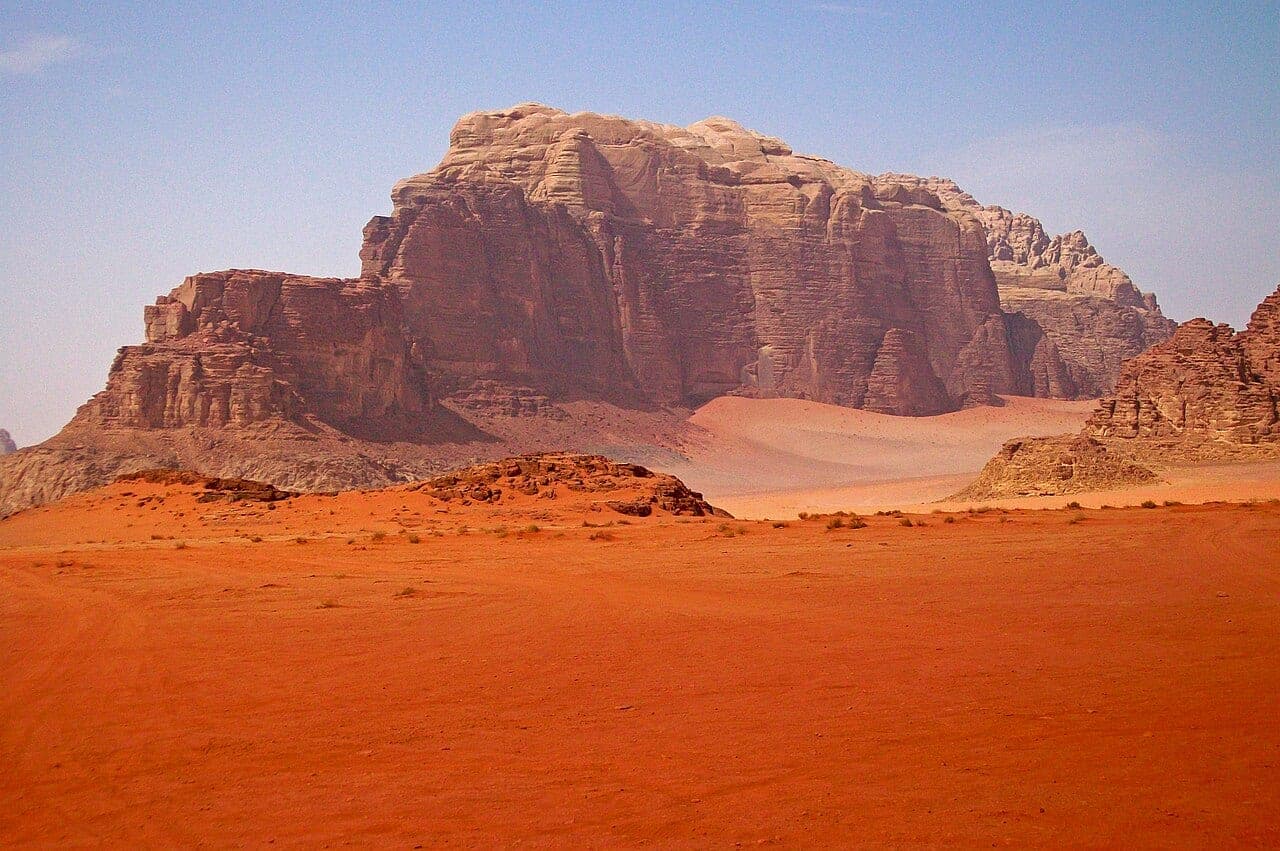
The Wadi Rum Protected Area, a mixed cultural and natural site, was added in 2011, recognised both for its desert landscape and for the tens of thousands of petroglyphs and inscriptions, in Thamudic, Nabataean and early Arabic scripts, left across its cliffs. The Baptism Site, Bethany beyond the Jordan (al-Maghtas), followed in 2015, and As-Salt, the Place of Tolerance and Urban Hospitality, an Ottoman-era hill town of golden limestone, in 2021. The most recent inscription, in 2024, is Umm al-Jimal, a black-basalt settlement in the north built over a Roman military camp. Conservation challenges are real: flash flooding and salt weathering threaten Petra's carved facades, and heavy visitor numbers press on fragile sites.
Because Jordan's monuments face erosion, flooding and the wear of tourism, digital documentation has become central to protecting them. At Petra the CyArk organisation has produced detailed three-dimensional records of the Monastery, Ad-Deir, and in 2025 published an online experience highlighting the threats posed to it by climate change and flash flooding. The Zamani Project has carried out laser scanning of Petra's structures, and Global Digital Heritage has released open three-dimensional models of the archaeological park.
Institutional stewardship supports this work. The Petra National Trust, founded in 1989, has coordinated studies of the Nabataean water system, the stability of the Siq, and the rare Nabataean wall paintings at nearby Beidha. Regional programmes such as Endangered Archaeology in the Middle East and North Africa (EAMENA) use satellite imagery to monitor threatened sites in an open database, while virtual tours and photographic archives put the country's heritage within reach of those who cannot travel to it.
Jordan projects its heritage outward through culture and screen. The desert of Wadi Rum has become one of the most sought-after film locations on earth, standing in for other worlds in productions from the classic Lawrence of Arabia to recent science-fiction cinema, work coordinated through the Royal Film Commission. Petra's Treasury has appeared in films known worldwide and remains a global emblem of the country.
At home, Amman supports a growing scene of galleries, independent cinema, publishing and music, and the annual Jerash Festival of Culture and Arts fills the Roman ruins with concerts and performance each summer. Members of the royal family, notably Queen Rania, have been active advocates for education, crafts and cultural preservation. The country's role as a host to large Palestinian, Iraqi and Syrian communities has, factually, woven their culinary, musical and artistic traditions into daily life, widening the range of cultural expression found in its cities.
Mansaf recognised by UNESCO. In 2022 the communal lamb-and-jameed dish was inscribed on the Representative List of the Intangible Cultural Heritage of Humanity, formal recognition of a practice that carries Bedouin values of generosity and shared identity.
As-Salt inscribed as a place of hospitality. In 2021 the Ottoman-era town joined the World Heritage List for its architecture and its long tradition of coexistence and welcome, a rare inscription centred on social heritage rather than monuments alone.
Umm al-Jimal joins the list. The northern basalt town was inscribed in 2024, extending international recognition to Jordan's Roman, Byzantine and early Islamic countryside beyond the famous southern sites.
Petra documented in three dimensions. Laser scanning and photogrammetry by CyArk, the Zamani Project and others have produced a precise digital record of Petra's most vulnerable monuments, so that knowledge of them is preserved even as the sandstone weathers.
Al-Khazneh at Petra is a tomb, carved into the cliff by the Nabataeans and named the Treasury by people who assumed it must hold gold. Photograph by Vyacheslav Argenberg, CC BY 4.0, via Wikimedia Commons.
Southern Jordan then became the heartland of the Nabataeans, an Arab people who grew wealthy controlling the incense and spice routes and built Petra as their capital. At its height the kingdom reached from the Hijaz toward Damascus, and Petra's population is estimated at between 10,000 and 30,000. Rome annexed the kingdom in AD 106, after which changing trade routes brought Petra's slow decline. Under Rome and Byzantium the region prospered, its Decapolis cities such as Jerash flourishing and its towns filling churches with the mosaics for which Madaba and Um er-Rasas remain famous.
Arab-Muslim armies brought Islam in the seventh century, and under the Umayyad caliphs (661 to 750) the desert fringe east of Amman was dotted with fortified estates and bathhouses, the so-called desert castles. Later centuries saw Abbasid, Fatimid, Crusader, Ayyubid and Mamluk rule, the Crusaders leaving the great hilltop castle of Karak. From the sixteenth century the region formed part of the Ottoman Empire as a district of Greater Syria, crossed by the pilgrimage road to Mecca and, from 1908, the Hejaz Railway.
The modern kingdom was born from the Great Arab Revolt of 1916, when Sharif Hussein of Mecca and his sons rose against Ottoman rule during the First World War. After the war the territory became the British-administered Emirate of Transjordan, established in 1921 with Abdullah I as emir. Full independence came in 1946 as the Hashemite Kingdom of Jordan. The decades since have been shaped by regional conflict and by the arrival of large refugee populations, matters on which this profile takes no political side.
Arabic is Jordan's official language, spoken in a Levantine dialect with Bedouin and Palestinian registers, while Modern Standard Arabic serves formal, written and broadcast use. English is widely taught and common in business and higher education.
The country takes its name from the Jordan River, in Arabic Nahr al-Urdunn. The name is ancient: it appears in Egyptian sources of the Late Bronze Age and passed through Hebrew, Greek and Arabic usage. The most widely cited derivation links it to a Semitic root meaning to descend or to flow down, fitting a river that drops steeply from the highlands into the deep rift of the Dead Sea, as Wiktionary notes. In the early Islamic period the administrative district of the northern region was called Jund al-Urdunn, "the military province of the Jordan," carrying the name forward into medieval geography before it was adopted by the emirate and the kingdom of the twentieth century.
Jordanian identity is grounded in Bedouin heritage. The tribes of the badia, the semi-desert steppe, contributed the codes of honour, kinship, poetry and hospitality that remain touchstones of national culture, even for a population that is now overwhelmingly urban. Hospitality is close to a moral duty: a guest is received with cardamom-scented coffee from a long-spouted pot, and turning away a visitor without food is a matter of shame.
That ethic finds its fullest expression in mansaf, the national dish and the centrepiece of weddings, funerals, feasts and tribal gatherings. Lamb is slow-cooked in jameed, a tangy sauce of fermented dried yoghurt, then heaped over rice and thin shrak bread on a wide communal platter, eaten by hand from a shared dish. UNESCO added mansaf to its Representative List of the Intangible Cultural Heritage of Humanity in 2022, recognising a practice that binds families and communities rather than simply a recipe. Everyday food ranges from falafel, hummus and the herb-and-sumac mix zaatar to the layered chicken-and-onion dish musakhan shared with Palestinian cuisine.
Craft traditions carry the same desert roots: Bedouin weaving of goat-hair tents and rugs, silver jewellery, and the bottled sand art of Petra and Aqaba. Oral poetry sung to the rebaba, a single-stringed fiddle, and the line dance called dabke keep older forms alive alongside a lively music and film scene in Amman.
The great majority of Jordanians are Sunni Muslims, and Islam shapes the rhythm of daily and public life, from the call to prayer to the fasting month of Ramadan and the two Eid festivals. The Hashemite monarchy's descent from the Prophet gives the crown a custodial role, expressed in its guardianship of Muslim and Christian holy places in Jerusalem and in interfaith initiatives.
Jordan also has one of the older continuous Christian communities in the world, a minority of a few percent that includes Greek Orthodox, Melkite Catholic, Roman Catholic and various Protestant churches. Christian families are long established in Madaba, Fuheis, As-Salt, Karak and Ajloun, and the country holds sites central to the Bible. On Mount Nebo, Moses is said to have looked out over the Promised Land, and the Franciscan memorial church there preserves fine sixth-century mosaics. At al-Maghtas on the east bank of the Jordan, identified as Bethany beyond the Jordan, tradition places the baptism of Jesus by John the Baptist; excavations between 1996 and 2002 uncovered Byzantine churches and baptismal pools, and the site is a place of Christian pilgrimage. The nearby Madaba map itself once helped scholars locate such places, depicting the Holy Land in some two million pieces of coloured stone.
Death in Jordan is met quickly, simply and in community, following Islamic practice. The body is washed by relatives or attendants of the same sex, wrapped in a plain white shroud, and buried, usually within a day, after the funeral prayer, the salat al-janazah. The deceased is laid on the right side facing Mecca in a modest grave. Elaborate monuments are traditionally avoided, in keeping with an emphasis on equality before God.
What follows is the aza, the condolence gathering, one of the firmest institutions of Jordanian life. For three days the bereaved family receives visitors, men and women in separate spaces, often under a large tent, the bayt al-aza, raised in the street outside the home. Neighbours and relatives take over the cooking, and mansaf is frequently served to those who come. Visitors offer set phrases of condolence, recite or hear passages of the Qur'an, and repeat the belief that the dead belong to God and to Him they return. A widow observes the iddah, the Qur'anic waiting period of four months and ten days. Charity given in the name of the deceased, and complete recitations of the Qur'an dedicated to them, extend remembrance well beyond the burial.
Among Bedouin communities these customs carry an added layer of tribal expression. Elegy, the marthiya, has long been a respected form of desert poetry, and the diwan or guest tent becomes the place where a clan gathers to honour the dead, share memory and reaffirm the bonds of kinship. Reconciliation between families, including the settlement of grievances, is often sealed at such gatherings with a shared meal, so that mourning becomes an act of communal repair as much as of grief.
Jordan's registers are small, well kept and full of other countries' populations.
Ottoman nüfus registers and sharia court sijills cover the territory before 1918. The Emirate of Transjordan built a civil registration system under British mandate, and the modern Civil Status and Passports Department maintains a national register that is unusually complete for the region, tied to the national number every Jordanian carries.
Tribal genealogy is the framework. Jordanian families place themselves by tribe and clan, the recitation is exact, and it does real work in politics, marriage and land.
The demographic fact is refuge. Jordan absorbed Palestinians in 1948 and again in 1967, and the descendants of those families are a very large share of the population. UNRWA's registration records, which begin in 1950 and record families by place of origin in Palestine, are for many households the most important genealogical document they have, because they name the village the family came from and the date it left. Those records have been maintained continuously for three generations and are updated as families grow.
Later arrivals brought their own files: Iraqis after 1990 and 2003, and around 650,000 registered Syrians since 2011, documented by UNHCR rather than by any state.
The result is a country where a great many families have a Jordanian civil record covering the last seventy years and an older record that sits in an archive belonging to a place they can describe precisely and cannot visit.
Jordan's antiquities are overseen by the Department of Antiquities and the Ministry of Tourism and Antiquities, working alongside site-specific bodies and international partners. The kingdom's seven UNESCO World Heritage sites anchor this effort. Petra was inscribed in 1985, together with the Umayyad bathhouse of Quseir Amra, whose early Islamic frescoes of hunting, bathing, musicians and a domed zodiac ceiling are among the finest to survive from the period. Um er-Rasas, inscribed in 2004, grew from a Roman camp into a Byzantine and early Islamic town and preserves the mosaic floor of the Church of St Stephen, dated by inscription to 785, along with a unique surviving stylite tower.
The Wadi Rum Protected Area, a mixed cultural and natural site, was added in 2011, recognised both for its desert landscape and for the tens of thousands of petroglyphs and inscriptions, in Thamudic, Nabataean and early Arabic scripts, left across its cliffs. The Baptism Site, Bethany beyond the Jordan (al-Maghtas), followed in 2015, and As-Salt, the Place of Tolerance and Urban Hospitality, an Ottoman-era hill town of golden limestone, in 2021. The most recent inscription, in 2024, is Umm al-Jimal, a black-basalt settlement in the north built over a Roman military camp. Conservation challenges are real: flash flooding and salt weathering threaten Petra's carved facades, and heavy visitor numbers press on fragile sites.
Because Jordan's monuments face erosion, flooding and the wear of tourism, digital documentation has become central to protecting them. At Petra the CyArk organisation has produced detailed three-dimensional records of the Monastery, Ad-Deir, and in 2025 published an online experience highlighting the threats posed to it by climate change and flash flooding. The Zamani Project has carried out laser scanning of Petra's structures, and Global Digital Heritage has released open three-dimensional models of the archaeological park.
Institutional stewardship supports this work. The Petra National Trust, founded in 1989, has coordinated studies of the Nabataean water system, the stability of the Siq, and the rare Nabataean wall paintings at nearby Beidha. Regional programmes such as Endangered Archaeology in the Middle East and North Africa (EAMENA) use satellite imagery to monitor threatened sites in an open database, while virtual tours and photographic archives put the country's heritage within reach of those who cannot travel to it.
Jordan projects its heritage outward through culture and screen. The desert of Wadi Rum has become one of the most sought-after film locations on earth, standing in for other worlds in productions from the classic Lawrence of Arabia to recent science-fiction cinema, work coordinated through the Royal Film Commission. Petra's Treasury has appeared in films known worldwide and remains a global emblem of the country.
At home, Amman supports a growing scene of galleries, independent cinema, publishing and music, and the annual Jerash Festival of Culture and Arts fills the Roman ruins with concerts and performance each summer. Members of the royal family, notably Queen Rania, have been active advocates for education, crafts and cultural preservation. The country's role as a host to large Palestinian, Iraqi and Syrian communities has, factually, woven their culinary, musical and artistic traditions into daily life, widening the range of cultural expression found in its cities.
Mansaf recognised by UNESCO. In 2022 the communal lamb-and-jameed dish was inscribed on the Representative List of the Intangible Cultural Heritage of Humanity, formal recognition of a practice that carries Bedouin values of generosity and shared identity.
As-Salt inscribed as a place of hospitality. In 2021 the Ottoman-era town joined the World Heritage List for its architecture and its long tradition of coexistence and welcome, a rare inscription centred on social heritage rather than monuments alone.
Umm al-Jimal joins the list. The northern basalt town was inscribed in 2024, extending international recognition to Jordan's Roman, Byzantine and early Islamic countryside beyond the famous southern sites.
Petra documented in three dimensions. Laser scanning and photogrammetry by CyArk, the Zamani Project and others have produced a precise digital record of Petra's most vulnerable monuments, so that knowledge of them is preserved even as the sandstone weathers.
National Overview
Notable Cities
Historical Foundations
Linguistic and Etymological Roots
Cultural Identity
Religion and Spirituality
Remembrance and Mourning Traditions
Tracing a Family in Jordan
Heritage Preservation Efforts
Digital Heritage
Contemporary Cultural Influences
Success Stories
References and resources
- Encyclopaedia Britannica: Jordan, History
- Encyclopaedia Britannica: Petra, ancient city
- UNESCO World Heritage Centre: Jordan state party page
- UNESCO World Heritage Centre: Petra
- UNESCO World Heritage Centre: Um er-Rasas (Kastrom Mefa'a)
- World History Encyclopedia: Jerash
- Madain Project: Madaba Map and Mount Nebo
- Biblical Archaeology Society: Bethany beyond the Jordan added to the World Heritage List
- National Dish: Mansaf, the national dish of Jordan
- CyArk: Petra, Ad-Deir (the Monastery)
- Wikipedia: List of extreme points of Jordan (Dead Sea elevation)
- UNHCR Jordan: refugee camps and country data