Heritage · Country
Ethiopia Culture and Heritage
Ethiopia holds twelve World Heritage sites, a manuscript tradition older than most European libraries, and mourning institutions, from the leqso house to the edir association, that organise grief as a community duty. A guide to how the country keeps three thousand years of memory.Written to last.
By Confinity Heritage Editorial · 2026-07-10 · 8-minute readQuiet tools, kept out of the way.
Few countries remember as long, or in as many registers, as Ethiopia. The bones of Lucy, three million years old, lie in the National Museum in Addis Ababa; the granite stelae of Aksum mark the graves of kings who minted their own coins while Rome still ruled the Mediterranean; the churches of Lalibela were cut whole out of living rock as a New Jerusalem; and in monastery libraries across the highlands, parchment manuscripts in the ancient Ge'ez script have been copied, read and sung from for over 1,500 years, the Garima Gospels among them, radiocarbon-dated to Late Antiquity and possibly the oldest illuminated Christian books in existence.
Ethiopia's memory is not only monumental. It is carried in the coffee ceremony's three unhurried rounds, in the Gadaa generational system of the Oromo, and, above all, in the way Ethiopians mourn: the leqso house of shared grief, the das tent raised in the street, the tazkar memorial feast, and the edir, the neighbourhood funeral association that may be the world's most complete community answer to bereavement.
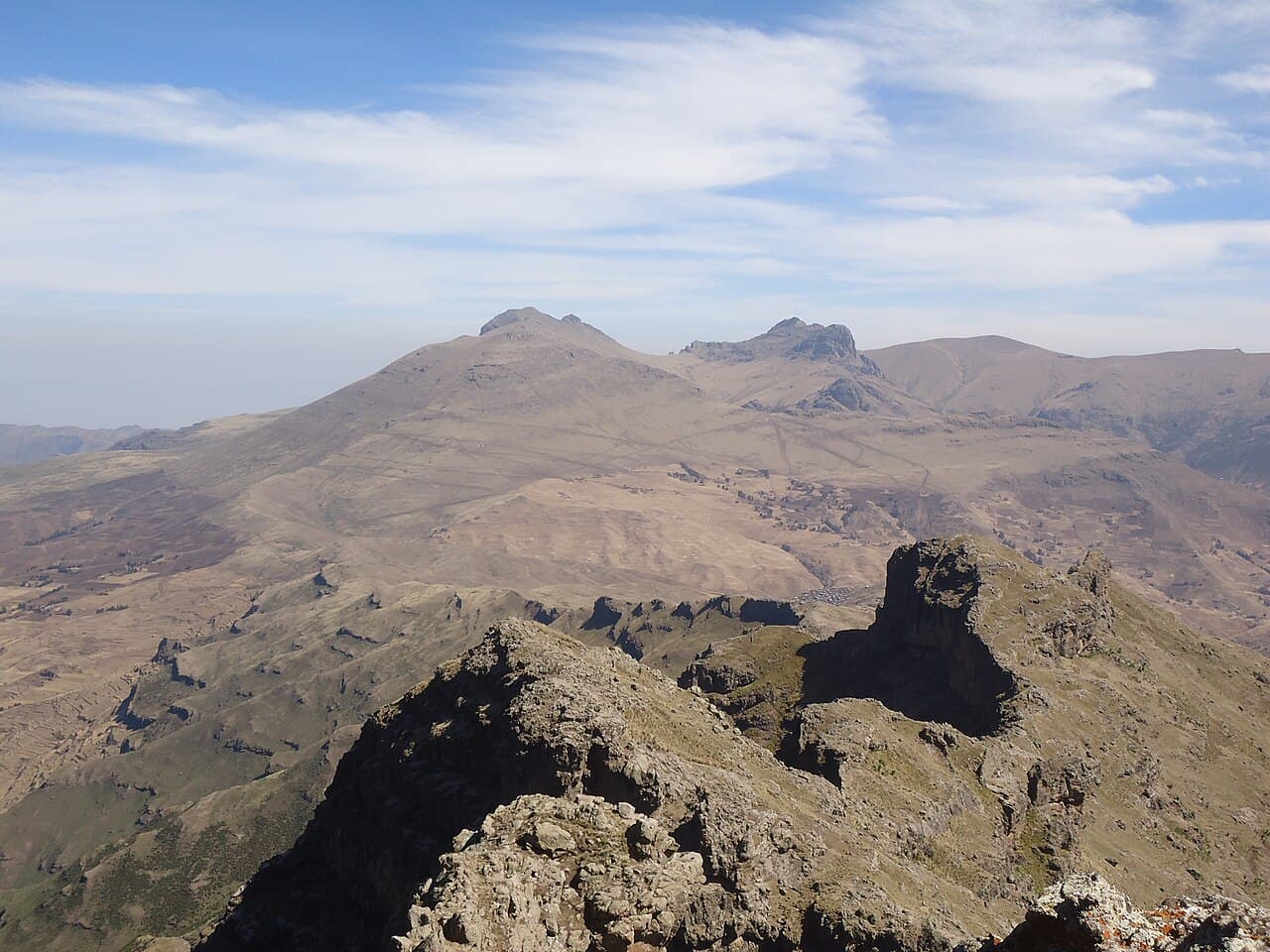
Ethiopia occupies the heart of the Horn of Africa, bordered by Eritrea, Djibouti, Somalia, Kenya, South Sudan and Sudan, and landlocked since Eritrea's independence in 1993. Its geography is built on drama: the Ethiopian Highlands, the largest continuous mountain mass in Africa, rise past 4,500 metres at Ras Dashen in the Simien range, and the Great Rift Valley splits the country diagonally, dropping through a chain of lakes to the Danakil Depression, one of the hottest and lowest places on earth. The Blue Nile begins at Lake Tana and thunders over the Tis Issat falls on its way to Sudan.
With a population of roughly 130 million, Ethiopia is Africa's second most populous state and one of its youngest societies. More than eighty peoples share the federation, the Oromo and Amhara largest among them, followed by Somali, Tigrayan, Sidama, Gurage, Welayta, Afar, Harari and many others, organised since the 1990s into a federal system drawn largely along linguistic lines. Around two-fifths of Ethiopians belong to the Ethiopian Orthodox Tewahedo Church, roughly a third are Muslim, and Protestant Christianity has grown quickly to nearly a fifth. Addis Ababa, seat of the African Union, styles itself the continent's diplomatic capital. Ethiopia keeps its own calendar of thirteen months, seven to eight years behind the Gregorian reckoning, and its own clock counted from dawn: even time, here, is heritage.
Addis Ababa. Founded in 1886 by Emperor Menelik II and Empress Taytu around the hot springs of Finfinne, the "new flower" is the political and cultural engine of the country. It holds the National Museum, home of Lucy; the Holy Trinity Cathedral, burial place of Haile Selassie; the vast open-air Merkato; and a music and arts scene that gave the world Ethio-jazz.
Aksum. The ancient capital in Tigray is Ethiopia's holiest ground. Its field of carved granite stelae, the tallest ever quarried weighing hundreds of tonnes, marks the graves of the Aksumite kings, and the Church of Our Lady Mary of Zion is held by Ethiopian tradition to shelter the Ark of the Covenant. The site was inscribed on the World Heritage List in 1980.
Lalibela. In the mountains of Lasta, eleven medieval churches were hewn downward into the volcanic rock, attributed to King Lalibela around the turn of the thirteenth century and conceived as a New Jerusalem for pilgrims who could not reach the original. Still fully in use, thronged with white-robed worshippers at Genna (Christmas) and Timket, Lalibela was among the first twelve sites inscribed by UNESCO in 1978.
Gondar. Founded by Emperor Fasilides around 1636, Gondar served as the imperial capital for two centuries. Its walled royal compound, the Fasil Ghebbi, holds a unique ensemble of castles, and each January the Fasilides Bath fills with water and worshippers for one of the most spectacular Timket celebrations in the country.
Harar. The walled city of Harar Jugol in the east, often described as the fourth-holiest city of Islam, packs dozens of mosques and shrines into its lanes. A centre of Islamic learning and trade for centuries, and briefly home to the poet Arthur Rimbaud, it was inscribed on the World Heritage List in 2006.
Ethiopia's claim on human memory begins before humanity itself. The fossil beds of the lower Awash and Omo valleys have yielded Lucy (known in Ethiopia as Dinkinesh, "you are marvellous"), discovered in 1974 and some 3.2 million years old, along with some of the earliest remains of Homo sapiens; the stone-tool sites of Melka Kunture on the upper Awash, inscribed by UNESCO in 2024, record two million years of toolmaking.
 The castles at Gondar, raised from the seventeenth century when the Ethiopian court finally stopped moving and settled in one place. Photograph by Chuck Moravec, CC BY 2.0, via Wikimedia Commons.
Recorded history opens with the kingdom of D'mt and then Aksum, which from roughly the first to the seventh century AD ruled trade between Rome and India through the port of Adulis, raised the great stelae, minted gold coinage and, under King Ezana in the early fourth century, adopted Christianity as the state religion, among the first kingdoms on earth to do so. After Aksum's decline, the Zagwe dynasty carved Lalibela; in 1270 the Solomonic dynasty took the throne, tracing its lineage, through the national narrative set down in the Kebra Nagast, to King Solomon and the Queen of Sheba. Gondar's castles, the rise of the Oromo Gadaa confederacies, and the warlord era of the Zemene Mesafint carried the story to the modern age. At Adwa in 1896 Menelik II's army defeated an invading Italian force, a victory that preserved Ethiopia as the only African state never colonised and made it a symbol of Black sovereignty worldwide, though Italy occupied the country brutally from 1936 to 1941. Haile Selassie's long reign ended in the 1974 revolution; the Derg military regime brought terror, famine and civil war until 1991; and the federal republic that followed has known both rapid growth and renewed conflict. Through every convulsion, the deep institutions, church, mosque, Gadaa, edir, have carried on.
The name Ethiopia descends from the Greek Aithiopia, conventionally read as "land of burnt faces", the term Homer and Herodotus used for the peoples south of Egypt; Ethiopian tradition prefers a descent from the ancestral king Ethiopis. The older European name Abyssinia comes, through Arabic, from Habash, the root that also gives Ethiopians and Eritreans their shared self-description habesha. Addis Ababa means "new flower" in Amharic, a name chosen by Empress Taytu.
Ethiopia speaks between eighty and ninety languages across the Afroasiatic and Nilo-Saharan families. Amharic, a Semitic language, serves as the federal working language; Afaan Oromoo, a Cushitic language written since 1991 in the Latin-based qubee alphabet, has the most speakers; Tigrinya, Somali, Afar, Sidama and Wolaytta lead a long roll of regional tongues, while small languages such as Ongota stand at the edge of extinction. Above them all, historically, sits Ge'ez, the language of Aksum. No longer spoken, it remains the liturgical language of the Ethiopian Orthodox Church and the vehicle of a vast literature, written in the fidel script, an alphabet-syllabary of some two hundred forms that Ethiopians have used continuously for over 1,600 years and that today writes Amharic and Tigrinya. The learned art of qene, improvised Ge'ez poetry built on the double meaning of "wax and gold", still trains church scholars in saying two things at once.
Ethiopian identity is braided from many peoples, but certain threads run through nearly all of them. The first is coffee. Ethiopia is the birthplace of Coffea arabica, wrapped in the legend of the goatherd Kaldi and his dancing goats, and the coffee ceremony, buna, is the daily liturgy of hospitality: green beans roasted over coals, pounded, and brewed in the clay jebena, poured in three rounds, abol, tona and baraka, with grass strewn on the floor and incense in the air. To be invited is to be made kin for an hour.
The table binds equally. Injera, the sour teff flatbread, is plate, utensil and food at once; doro wat, the slow red chicken stew, crowns feast days; and eating from the shared platter, even placing a choice morsel in a companion's mouth in the gesture called gursha, makes every meal communal. Dress for holy days is the white cotton shema cloth, woven at the edges with coloured borders, the habesha kemis for women and the netela shawl draped in ways that themselves carry meaning, festive, ordinary or mourning. Music moves from the shoulder-shaking eskista dance of the north to the massed horns of southern festivals; the azmari, the wandering minstrel with a one-string masenqo fiddle, still improvises praise and satire in verse. The year turns on great public festivals, Enkutatash (New Year) in September, Meskel's bonfires, Timket's processions, Irreecha's thanksgiving at the water's edge, and on the long-distance runners, from Abebe Bikila to Tirunesh Dibaba and Kenenisa Bekele, who made endurance itself a national art form.
Ethiopia's Christianity is among the oldest state traditions in the world, rooted in Ezana's fourth-century conversion under the influence of Frumentius, the first bishop. The Ethiopian Orthodox Tewahedo Church keeps distinctive observances, the ark-replica tabot at the heart of every church, Sabbath-keeping and dietary laws that echo its deep engagement with the Hebrew scriptures, exuberant fasting calendars, and a monastic tradition reaching from the island monasteries of Lake Tana to the cliff-top abbey of Debre Damo, reached only by rope. Around thousands of churches in the northern highlands survive "church forests", islands of old-growth trees protected as sacred groves, a rare fusion of ecological and spiritual conservation.
The castles at Gondar, raised from the seventeenth century when the Ethiopian court finally stopped moving and settled in one place. Photograph by Chuck Moravec, CC BY 2.0, via Wikimedia Commons.
Recorded history opens with the kingdom of D'mt and then Aksum, which from roughly the first to the seventh century AD ruled trade between Rome and India through the port of Adulis, raised the great stelae, minted gold coinage and, under King Ezana in the early fourth century, adopted Christianity as the state religion, among the first kingdoms on earth to do so. After Aksum's decline, the Zagwe dynasty carved Lalibela; in 1270 the Solomonic dynasty took the throne, tracing its lineage, through the national narrative set down in the Kebra Nagast, to King Solomon and the Queen of Sheba. Gondar's castles, the rise of the Oromo Gadaa confederacies, and the warlord era of the Zemene Mesafint carried the story to the modern age. At Adwa in 1896 Menelik II's army defeated an invading Italian force, a victory that preserved Ethiopia as the only African state never colonised and made it a symbol of Black sovereignty worldwide, though Italy occupied the country brutally from 1936 to 1941. Haile Selassie's long reign ended in the 1974 revolution; the Derg military regime brought terror, famine and civil war until 1991; and the federal republic that followed has known both rapid growth and renewed conflict. Through every convulsion, the deep institutions, church, mosque, Gadaa, edir, have carried on.
The name Ethiopia descends from the Greek Aithiopia, conventionally read as "land of burnt faces", the term Homer and Herodotus used for the peoples south of Egypt; Ethiopian tradition prefers a descent from the ancestral king Ethiopis. The older European name Abyssinia comes, through Arabic, from Habash, the root that also gives Ethiopians and Eritreans their shared self-description habesha. Addis Ababa means "new flower" in Amharic, a name chosen by Empress Taytu.
Ethiopia speaks between eighty and ninety languages across the Afroasiatic and Nilo-Saharan families. Amharic, a Semitic language, serves as the federal working language; Afaan Oromoo, a Cushitic language written since 1991 in the Latin-based qubee alphabet, has the most speakers; Tigrinya, Somali, Afar, Sidama and Wolaytta lead a long roll of regional tongues, while small languages such as Ongota stand at the edge of extinction. Above them all, historically, sits Ge'ez, the language of Aksum. No longer spoken, it remains the liturgical language of the Ethiopian Orthodox Church and the vehicle of a vast literature, written in the fidel script, an alphabet-syllabary of some two hundred forms that Ethiopians have used continuously for over 1,600 years and that today writes Amharic and Tigrinya. The learned art of qene, improvised Ge'ez poetry built on the double meaning of "wax and gold", still trains church scholars in saying two things at once.
Ethiopian identity is braided from many peoples, but certain threads run through nearly all of them. The first is coffee. Ethiopia is the birthplace of Coffea arabica, wrapped in the legend of the goatherd Kaldi and his dancing goats, and the coffee ceremony, buna, is the daily liturgy of hospitality: green beans roasted over coals, pounded, and brewed in the clay jebena, poured in three rounds, abol, tona and baraka, with grass strewn on the floor and incense in the air. To be invited is to be made kin for an hour.
The table binds equally. Injera, the sour teff flatbread, is plate, utensil and food at once; doro wat, the slow red chicken stew, crowns feast days; and eating from the shared platter, even placing a choice morsel in a companion's mouth in the gesture called gursha, makes every meal communal. Dress for holy days is the white cotton shema cloth, woven at the edges with coloured borders, the habesha kemis for women and the netela shawl draped in ways that themselves carry meaning, festive, ordinary or mourning. Music moves from the shoulder-shaking eskista dance of the north to the massed horns of southern festivals; the azmari, the wandering minstrel with a one-string masenqo fiddle, still improvises praise and satire in verse. The year turns on great public festivals, Enkutatash (New Year) in September, Meskel's bonfires, Timket's processions, Irreecha's thanksgiving at the water's edge, and on the long-distance runners, from Abebe Bikila to Tirunesh Dibaba and Kenenisa Bekele, who made endurance itself a national art form.
Ethiopia's Christianity is among the oldest state traditions in the world, rooted in Ezana's fourth-century conversion under the influence of Frumentius, the first bishop. The Ethiopian Orthodox Tewahedo Church keeps distinctive observances, the ark-replica tabot at the heart of every church, Sabbath-keeping and dietary laws that echo its deep engagement with the Hebrew scriptures, exuberant fasting calendars, and a monastic tradition reaching from the island monasteries of Lake Tana to the cliff-top abbey of Debre Damo, reached only by rope. Around thousands of churches in the northern highlands survive "church forests", islands of old-growth trees protected as sacred groves, a rare fusion of ecological and spiritual conservation.
 Bete Giyorgis at Lalibela was not built but excavated, cut downward out of solid rock in the shape of a cross. Photograph by Tmanahan344, CC BY-SA 3.0, via Wikimedia Commons.
Islam in Ethiopia is nearly as old as Islam itself. When the first Muslims fled persecution in Mecca around 615, the Prophet directed them to the just Christian king of Aksum; the village of Negash in Tigray, associated with those first companions, remains a pilgrimage site, and Harar grew into one of Islam's great centres of learning, its Shuwalid festival inscribed by UNESCO in 2023. The Beta Israel, Ethiopia's ancient Jewish community, maintained their faith in the Gondar highlands for centuries before mass emigration to Israel. Among the Oromo, the traditional religion of Waaqeffanna, centred on the creator Waaqa, flows into the Irreecha thanksgiving festival and the moral order of Gadaa, while many southern peoples keep their own ritual systems. Coexistence is imperfect but everyday: in most towns, Meskel bonfires and Eid prayers draw the same neighbours into the streets in different months.
Grief in Ethiopia is nobody's private property. When someone dies, the news moves fast, and the response is immediate and physical: the leqso, the gathered mourning, begins as relatives, neighbours and colleagues converge on the house. Because no home can hold them all, a das, a tent of poles and cloth, often stark white, rises in the yard or street, and for days it shelters a rotating congregation of mourners. Wailing is expected and articulate; women may cry out the dead person's name and virtues in improvised laments, and in the older tradition professional mourners sharpened grief into performance. Visitors are not entertained; they simply sit, and their sitting is the point. Families measure love by who came, and how long they stayed.
The Orthodox funeral follows quickly, usually within a day, with the fithat, the prayer of absolution, sung over the body. Mourning dress is black, worn by close kin for months and sometimes a year; women may shave their heads or bind them in black scarves, and men let their beards grow. The calendar of remembrance then unfolds with liturgical precision: commemorations on the third, seventh and twelfth days, the great memorial of the fortieth day, when the soul's passage is prayed for, another at eighty days, and the tazkar feast on the anniversary, when the family, helped by kin and neighbours, feeds a crowd that can run to hundreds, with a portion given to the church and to the poor for the merit of the departed. Muslim Ethiopians bury their dead before sundown where possible, receive condolences for three days of prayer and recitation, and observe the widow's iddah; the emphasis on patience mirrors, in a different key, the Orthodox insistence that grief must be shared to be survivable.
What makes Ethiopian mourning institutionally remarkable is the edir. An edir is a neighbourhood or workplace funeral association: members pay small monthly dues, and when death strikes any member's household the edir acts at once, paying out cash for expenses, erecting the das, providing the dishes, chairs and coffee pots, cooking, digging the grave, and formally assigning members to sit with the family through the mourning days. Edirs keep written rules and rosters, fine absentees, and in many places have widened into general mutual-aid societies; they operate wherever Ethiopians live, from Addis Ababa taxi ranks to diaspora edirs in Washington and Toronto that fly bodies home and fill distant living rooms with the leqso's crowd. It is community insurance against the loneliness of grief, built and run entirely by ordinary people, and for a platform concerned with how societies keep their dead close, there are few institutions anywhere more instructive.
Ethiopia has one of the longest documented histories in the world and one of the newest systems for recording births and deaths, and both statements are true at once.
Universal civil registration began on 4 August 2016. Before that there was no comprehensive national system, and at launch only about three per cent of children under five had a birth registered. That figure has risen, but for anyone tracing a family through the twentieth century the state record is largely absent.
What exists instead is the church and the land. Ethiopian Orthodox monasteries hold manuscript collections of great age, and the genealogies in them are mostly those of rulers and noble houses rather than ordinary families. Land documents are more useful for everyone else: the rist system tied a claim on land to descent from an ancestor who held it, so establishing a right meant reciting a line, and the paperwork of land disputes preserves those recitations.
Ordinary Ethiopians keep the record in the edir, the burial association, which registers members, collects contributions and organises the funeral and the days of mourning that follow. It is a membership record, not a genealogy, but it is one of the few written records of ordinary urban life across the last century.
For families dispersed by the Derg, the famines and the wars, the record is often abroad, in the refugee files and resettlement papers of other countries.
Ethiopia's heritage is managed by the Ethiopian Heritage Authority, heir to a succession of antiquities services, under a legal framework that ties heritage to research and education. The country's World Heritage roster is the largest in Africa: twelve sites, ten cultural, Aksum, Lalibela, Gondar's Fasil Ghebbi, Harar Jugol, the Konso cultural landscape, Tiya's carved stelae, the lower Awash and lower Omo fossil valleys, the Gedeo cultural landscape (2023) and Melka Kunture (2024), and two natural, the Simien Mountains and the Bale Mountains (2023). Conservation is a live struggle: Lalibela's churches shelter under temporary canopies awaiting permanent answers, war in the north put monuments and museums at risk, and restitution claims, from Maqdala manuscripts in Britain to tabots held abroad, are pressed with growing success.
On the intangible side, Ethiopia has inscribed a run of elements on UNESCO's Representative List: the Meskel commemoration of the finding of the True Cross (2013), the Fichee-Chambalaalla New Year of the Sidama (2015), the Gada system of the Oromo (2016), a full indigenous constitutional order in which authority passes between generational classes every eight years, the Ethiopian Epiphany, Timket (2019), and Harar's Shuwalid festival (2023), with the Gifaataa new year of the Wolayta people joining most recently. Each inscription obliges inventories, transmission and safeguarding plans, and festivals such as Irreecha and Ashenda have become focal points of cultural confidence for a young population.
Ethiopia's manuscript culture has made it a world centre of digitisation. Between 1973 and 1994 the Ethiopian Manuscript Microfilm Library (EMML), a partnership between the Ethiopian Orthodox Church and the Hill Museum and Manuscript Library (HMML) in Minnesota, microfilmed around 9,000 manuscripts from churches, monasteries and archives, the first comprehensive window onto Ge'ez literature. From 2004 HMML digitised the entire film archive, completing the work in 2025 and serving the images through its online reading room, where cataloguing continues; it now holds the largest collection of digitised Ethiopian and Eritrean manuscripts in the world. The British Library's Endangered Archives Programme has funded Ethiopian teams to digitise monastic libraries in situ, from May Wayni and the Shire monasteries in Tigray to the written heritage of East Gojjam, and Princeton's Ethiopian miracles of Mary project links thousands of manuscript records for a single beloved text tradition.
Inside the country, the Institute of Ethiopian Studies at Addis Ababa University digitises its manuscript and photographic collections, and the national Digital Ethiopia 2025 strategy has pushed records, broadcasting and tourism promotion online, including virtual tours of the great sites. The informal archive is vast: Timket processions, eskista battles, azmari sessions and diaspora memorial services stream daily across social platforms, and Amharic, Tigrinya and Afaan Oromoo content online grows year on year, the fidel script thriving on screens it was never designed for.
Modern Ethiopian culture exports remarkably well for a country so rooted. Ethio-jazz, invented by Mulatu Astatke in the late 1960s by folding the pentatonic modes of Ethiopian music into jazz and Latin forms, has a devoted global audience, renewed by the Éthiopiques reissue series and by singers from Aster Aweke to Teddy Afro, whose anthems fill stadiums. In letters, the laureate Tsegaye Gabre-Medhin shaped the national theatre; more recently Maaza Mengiste's The Shadow King, shortlisted for the 2020 Booker Prize, retold the Italian war through the women who fought it, and Dinaw Mengestu carries Ethiopian-American memory into the American novel. In the visual arts, Julie Mehretu's monumental abstractions and Elias Sime's reclaimed-electronics reliefs command international attention, both artists born in Addis Ababa.
Ethiopian distance running remains the most visible face of the nation, six decades of champions descending from Abebe Bikila's barefoot marathon in Rome. The diaspora, millions strong from Washington's "Little Ethiopia" to Stockholm and Nairobi, sustains Orthodox parishes, mosques, edirs and injera bakeries on every continent, and remittances and return investment tie it tightly to home. Meanwhile the coffee ceremony has quietly become one of Africa's most successful cultural ambassadors: wherever Ethiopians settle, the jebena follows, and the neighbours are invited.
The obelisk comes home. Looted on Mussolini's orders in 1937, the 24-metre, 160-tonne second stele of Aksum was returned from Rome in three airlifted pieces in April 2005 and re-erected among its sisters in 2008 under a UNESCO-led engineering project, one of the most significant repatriations of cultural property ever completed, and a template for the restitution claims Ethiopia continues to win.
A manuscript ocean, preserved twice. The EMML project microfilmed some 9,000 manuscripts before war and time could claim them; fifty years later HMML finished digitising every reel, so that a scholar in Addis Ababa, or a parish deacon anywhere, can read books that once required a mule track and a letter of introduction.
Gadaa recognised as governance. UNESCO's 2016 inscription of the Gada system acknowledged what Oromo communities had maintained through a century of suppression: that an African oral institution of rotating, accountable, generational authority belongs on any list of humanity's constitutional achievements.
Barefoot into history. At Rome in 1960, Abebe Bikila ran the marathon unshod past the very obelisk taken from Aksum and won, the first Black African Olympic champion. He won again in Tokyo four years later, and the lineage he founded still sets world records.
Bete Giyorgis at Lalibela was not built but excavated, cut downward out of solid rock in the shape of a cross. Photograph by Tmanahan344, CC BY-SA 3.0, via Wikimedia Commons.
Islam in Ethiopia is nearly as old as Islam itself. When the first Muslims fled persecution in Mecca around 615, the Prophet directed them to the just Christian king of Aksum; the village of Negash in Tigray, associated with those first companions, remains a pilgrimage site, and Harar grew into one of Islam's great centres of learning, its Shuwalid festival inscribed by UNESCO in 2023. The Beta Israel, Ethiopia's ancient Jewish community, maintained their faith in the Gondar highlands for centuries before mass emigration to Israel. Among the Oromo, the traditional religion of Waaqeffanna, centred on the creator Waaqa, flows into the Irreecha thanksgiving festival and the moral order of Gadaa, while many southern peoples keep their own ritual systems. Coexistence is imperfect but everyday: in most towns, Meskel bonfires and Eid prayers draw the same neighbours into the streets in different months.
Grief in Ethiopia is nobody's private property. When someone dies, the news moves fast, and the response is immediate and physical: the leqso, the gathered mourning, begins as relatives, neighbours and colleagues converge on the house. Because no home can hold them all, a das, a tent of poles and cloth, often stark white, rises in the yard or street, and for days it shelters a rotating congregation of mourners. Wailing is expected and articulate; women may cry out the dead person's name and virtues in improvised laments, and in the older tradition professional mourners sharpened grief into performance. Visitors are not entertained; they simply sit, and their sitting is the point. Families measure love by who came, and how long they stayed.
The Orthodox funeral follows quickly, usually within a day, with the fithat, the prayer of absolution, sung over the body. Mourning dress is black, worn by close kin for months and sometimes a year; women may shave their heads or bind them in black scarves, and men let their beards grow. The calendar of remembrance then unfolds with liturgical precision: commemorations on the third, seventh and twelfth days, the great memorial of the fortieth day, when the soul's passage is prayed for, another at eighty days, and the tazkar feast on the anniversary, when the family, helped by kin and neighbours, feeds a crowd that can run to hundreds, with a portion given to the church and to the poor for the merit of the departed. Muslim Ethiopians bury their dead before sundown where possible, receive condolences for three days of prayer and recitation, and observe the widow's iddah; the emphasis on patience mirrors, in a different key, the Orthodox insistence that grief must be shared to be survivable.
What makes Ethiopian mourning institutionally remarkable is the edir. An edir is a neighbourhood or workplace funeral association: members pay small monthly dues, and when death strikes any member's household the edir acts at once, paying out cash for expenses, erecting the das, providing the dishes, chairs and coffee pots, cooking, digging the grave, and formally assigning members to sit with the family through the mourning days. Edirs keep written rules and rosters, fine absentees, and in many places have widened into general mutual-aid societies; they operate wherever Ethiopians live, from Addis Ababa taxi ranks to diaspora edirs in Washington and Toronto that fly bodies home and fill distant living rooms with the leqso's crowd. It is community insurance against the loneliness of grief, built and run entirely by ordinary people, and for a platform concerned with how societies keep their dead close, there are few institutions anywhere more instructive.
Ethiopia has one of the longest documented histories in the world and one of the newest systems for recording births and deaths, and both statements are true at once.
Universal civil registration began on 4 August 2016. Before that there was no comprehensive national system, and at launch only about three per cent of children under five had a birth registered. That figure has risen, but for anyone tracing a family through the twentieth century the state record is largely absent.
What exists instead is the church and the land. Ethiopian Orthodox monasteries hold manuscript collections of great age, and the genealogies in them are mostly those of rulers and noble houses rather than ordinary families. Land documents are more useful for everyone else: the rist system tied a claim on land to descent from an ancestor who held it, so establishing a right meant reciting a line, and the paperwork of land disputes preserves those recitations.
Ordinary Ethiopians keep the record in the edir, the burial association, which registers members, collects contributions and organises the funeral and the days of mourning that follow. It is a membership record, not a genealogy, but it is one of the few written records of ordinary urban life across the last century.
For families dispersed by the Derg, the famines and the wars, the record is often abroad, in the refugee files and resettlement papers of other countries.
Ethiopia's heritage is managed by the Ethiopian Heritage Authority, heir to a succession of antiquities services, under a legal framework that ties heritage to research and education. The country's World Heritage roster is the largest in Africa: twelve sites, ten cultural, Aksum, Lalibela, Gondar's Fasil Ghebbi, Harar Jugol, the Konso cultural landscape, Tiya's carved stelae, the lower Awash and lower Omo fossil valleys, the Gedeo cultural landscape (2023) and Melka Kunture (2024), and two natural, the Simien Mountains and the Bale Mountains (2023). Conservation is a live struggle: Lalibela's churches shelter under temporary canopies awaiting permanent answers, war in the north put monuments and museums at risk, and restitution claims, from Maqdala manuscripts in Britain to tabots held abroad, are pressed with growing success.
On the intangible side, Ethiopia has inscribed a run of elements on UNESCO's Representative List: the Meskel commemoration of the finding of the True Cross (2013), the Fichee-Chambalaalla New Year of the Sidama (2015), the Gada system of the Oromo (2016), a full indigenous constitutional order in which authority passes between generational classes every eight years, the Ethiopian Epiphany, Timket (2019), and Harar's Shuwalid festival (2023), with the Gifaataa new year of the Wolayta people joining most recently. Each inscription obliges inventories, transmission and safeguarding plans, and festivals such as Irreecha and Ashenda have become focal points of cultural confidence for a young population.
Ethiopia's manuscript culture has made it a world centre of digitisation. Between 1973 and 1994 the Ethiopian Manuscript Microfilm Library (EMML), a partnership between the Ethiopian Orthodox Church and the Hill Museum and Manuscript Library (HMML) in Minnesota, microfilmed around 9,000 manuscripts from churches, monasteries and archives, the first comprehensive window onto Ge'ez literature. From 2004 HMML digitised the entire film archive, completing the work in 2025 and serving the images through its online reading room, where cataloguing continues; it now holds the largest collection of digitised Ethiopian and Eritrean manuscripts in the world. The British Library's Endangered Archives Programme has funded Ethiopian teams to digitise monastic libraries in situ, from May Wayni and the Shire monasteries in Tigray to the written heritage of East Gojjam, and Princeton's Ethiopian miracles of Mary project links thousands of manuscript records for a single beloved text tradition.
Inside the country, the Institute of Ethiopian Studies at Addis Ababa University digitises its manuscript and photographic collections, and the national Digital Ethiopia 2025 strategy has pushed records, broadcasting and tourism promotion online, including virtual tours of the great sites. The informal archive is vast: Timket processions, eskista battles, azmari sessions and diaspora memorial services stream daily across social platforms, and Amharic, Tigrinya and Afaan Oromoo content online grows year on year, the fidel script thriving on screens it was never designed for.
Modern Ethiopian culture exports remarkably well for a country so rooted. Ethio-jazz, invented by Mulatu Astatke in the late 1960s by folding the pentatonic modes of Ethiopian music into jazz and Latin forms, has a devoted global audience, renewed by the Éthiopiques reissue series and by singers from Aster Aweke to Teddy Afro, whose anthems fill stadiums. In letters, the laureate Tsegaye Gabre-Medhin shaped the national theatre; more recently Maaza Mengiste's The Shadow King, shortlisted for the 2020 Booker Prize, retold the Italian war through the women who fought it, and Dinaw Mengestu carries Ethiopian-American memory into the American novel. In the visual arts, Julie Mehretu's monumental abstractions and Elias Sime's reclaimed-electronics reliefs command international attention, both artists born in Addis Ababa.
Ethiopian distance running remains the most visible face of the nation, six decades of champions descending from Abebe Bikila's barefoot marathon in Rome. The diaspora, millions strong from Washington's "Little Ethiopia" to Stockholm and Nairobi, sustains Orthodox parishes, mosques, edirs and injera bakeries on every continent, and remittances and return investment tie it tightly to home. Meanwhile the coffee ceremony has quietly become one of Africa's most successful cultural ambassadors: wherever Ethiopians settle, the jebena follows, and the neighbours are invited.
The obelisk comes home. Looted on Mussolini's orders in 1937, the 24-metre, 160-tonne second stele of Aksum was returned from Rome in three airlifted pieces in April 2005 and re-erected among its sisters in 2008 under a UNESCO-led engineering project, one of the most significant repatriations of cultural property ever completed, and a template for the restitution claims Ethiopia continues to win.
A manuscript ocean, preserved twice. The EMML project microfilmed some 9,000 manuscripts before war and time could claim them; fifty years later HMML finished digitising every reel, so that a scholar in Addis Ababa, or a parish deacon anywhere, can read books that once required a mule track and a letter of introduction.
Gadaa recognised as governance. UNESCO's 2016 inscription of the Gada system acknowledged what Oromo communities had maintained through a century of suppression: that an African oral institution of rotating, accountable, generational authority belongs on any list of humanity's constitutional achievements.
Barefoot into history. At Rome in 1960, Abebe Bikila ran the marathon unshod past the very obelisk taken from Aksum and won, the first Black African Olympic champion. He won again in Tokyo four years later, and the lineage he founded still sets world records.
National Overview
Notable Cities
Historical Foundations
Linguistic and Etymological Roots
Cultural Identity
Religion and Spirituality
Remembrance and Mourning Traditions
Tracing a Family in Ethiopia
Heritage Preservation Efforts
Digital Heritage
Contemporary Cultural Influences
Success Stories
References and resources
- UNESCO World Heritage Centre, Ethiopia, state-party page listing all twelve World Heritage sites.
- UNESCO World Heritage Centre, Rock-Hewn Churches, Lalibela, inscription record for the eleven churches.
- UNESCO World Heritage Centre, Aksum obelisk returns to Ethiopia, the 2005 repatriation and reintegration project.
- UNESCO Intangible Cultural Heritage, Ethiopia, Meskel, Gada, Timket, Fichee-Chambalaalla and Shuwalid inscriptions.
- HMML, Cataloging progress on the Ethiopian Manuscript Microfilm Library (EMML), the microfilming and digitisation of some 9,000 manuscripts.
- British Library Endangered Archives Programme, Digitisation of the endangered monastic archive at May Wäyni, in-situ digitisation of a Tigray monastic library.
- "Creating community: Burials, cooperation and exclusion in the Amhara eder (iddir)", History and Anthropology, scholarship on the edir funeral association.
- Addis Fortune, Ethiopian Funerals, a Way of Life, reportage on leqso, the das tent and the social weight of mourning.
- Encyclopaedia Britannica, Ethiopia, geography, history and political background.