Heritage · Country
Morocco Culture and Heritage
From the earthen kasbahs of the pre-Sahara to the mosaic streets of Fez, Morocco holds nine World Heritage sites and a memory shaped by Amazigh, Arab, Andalusi and Jewish life. This guide follows that layered past and the customs, moussems and archives that keep it present.Written to last.
By Confinity Heritage Editorial · Updated 2026-07-31 · 8-minute readQuiet tools, kept out of the way.
Morocco occupies the far north-western corner of Africa, where the Atlas Mountains rise between the Atlantic, the Mediterranean and the edge of the Sahara. Its oldest foundation is Amazigh, the language and life of the Berber peoples who have farmed these valleys and herded these highlands for thousands of years. Onto that foundation came Phoenician traders and Roman administration, then Arab armies bearing Islam, then the Andalusi families who crossed from Spain, the sub-Saharan communities carried north along caravan routes, and Jewish congregations settled here since antiquity. The imperial cities of Fez, Marrakesh, Meknes and Rabat still carry the layers of that history in stone and plaster.
Memory in Morocco is not confined to museums. It lives in the annual moussems that gather families at the tombs of saints, in the mellahs and cemeteries that record Jewish life, in the recited genealogies of Amazigh villages, and in the storytellers and musicians who still hold a crowd in the great square of Marrakesh. This guide follows both threads at once: the built and archived heritage of a country with nine UNESCO World Heritage sites, and the customs of remembrance through which Moroccans keep their dead, their ancestors and their traditions close.
Morocco is a constitutional monarchy of roughly 37 million people, with Rabat as its capital and Casablanca as its largest city and economic centre, according to Encyclopaedia Britannica. The land divides into distinct zones: the Atlantic coastal plains where most of the population and industry sit, the Rif range along the Mediterranean north, the Middle Atlas, High Atlas and Anti-Atlas that cross the interior, and the pre-Saharan valleys and oases that fall away to the south and east. The High Atlas reaches above 4,000 metres at Toubkal, and its snowmelt feeds the oasis strings and palm groves that made desert trade possible.
The population is Arab and Amazigh, with these identities long intermixed rather than sharply divided, alongside communities of sub-Saharan and Andalusi descent. Sunni Islam is the state religion and the faith of nearly the whole population, and the king holds the religious title Amir al-Mu'minin, Commander of the Faithful. The territory of Western Sahara, to the south, is subject to a long-running sovereignty dispute; this profile concerns cultural heritage and does not take a position on that question. The national currency is the dirham, and the economy rests on agriculture, phosphates, tourism, manufacturing and remittances from a large diaspora in Europe.
Fez. The oldest of the imperial capitals, founded by the Idrisids around 789, Fez grew into the intellectual heart of the country. Its walled medina, Fes el-Bali, is one of the largest car-free urban areas in the world and holds the University of al-Qarawiyyin, recognised by Guinness World Records as the oldest continuously operating degree-granting institution, founded in 859 by Fatima al-Fihri. The Chouara tanneries, working since roughly the eleventh century, and the workshops of zellige tilework make Fez the country's centre of traditional craft.
 Bab Bou Jeloud, the western gate into the medina of Fes. Photograph by Timothy A. Gonsalves, CC BY-SA 4.0, via Wikimedia Commons.
Marrakesh. Founded by the Almoravids around 1070, the "red city" of pisé walls sits below the High Atlas. Its Almohad Koutoubia minaret, the Saadian Tombs, the ruined El Badi Palace and the Ben Youssef Madrasa mark successive dynasties. At its heart the square of Jemaa el-Fnaa fills each evening with storytellers, musicians, healers and food stalls, a gathering UNESCO recognised as a space of oral and intangible heritage.
Meknes. Chosen by the Alaouite sultan Moulay Ismail (reigned 1672–1727) as his capital, Meknes keeps the scale of his ambition in kilometres of rampart, monumental gates such as Bab Mansour, and vast granaries, stables and a reservoir built to withstand siege and drought.
Rabat. The administrative capital pairs a modern twentieth-century city with older monuments: the unfinished Almohad Hassan Tower, the Kasbah of the Udayas above the river mouth, and the Chellah, a medieval Marinid necropolis raised on a Roman site.
Tetouan, Essaouira and Chefchaouen. Tetouan in the north was rebuilt by Andalusi refugees and is often called "little Jerusalem" for its once large Jewish population. Essaouira, the Atlantic port formerly known as Mogador, was laid out in the eighteenth century as a cosmopolitan trading harbour. Chefchaouen, its lanes washed in blue, draws on the same Andalusi settlement history.
The Amazigh peoples are the indigenous population of the region, with a presence documented far into prehistory; the Iberomaurusian remains at Taforalt are among the oldest in North Africa. Phoenician and later Carthaginian traders established coastal posts from around the first millennium BC, and the interior formed the Berber kingdom of Mauretania. At Volubilis, near Meknes, the kingdom's western capital passed into Roman control in the first century AD and became a prosperous provincial town whose mosaics and street plan survive in unusual completeness.
Bab Bou Jeloud, the western gate into the medina of Fes. Photograph by Timothy A. Gonsalves, CC BY-SA 4.0, via Wikimedia Commons.
Marrakesh. Founded by the Almoravids around 1070, the "red city" of pisé walls sits below the High Atlas. Its Almohad Koutoubia minaret, the Saadian Tombs, the ruined El Badi Palace and the Ben Youssef Madrasa mark successive dynasties. At its heart the square of Jemaa el-Fnaa fills each evening with storytellers, musicians, healers and food stalls, a gathering UNESCO recognised as a space of oral and intangible heritage.
Meknes. Chosen by the Alaouite sultan Moulay Ismail (reigned 1672–1727) as his capital, Meknes keeps the scale of his ambition in kilometres of rampart, monumental gates such as Bab Mansour, and vast granaries, stables and a reservoir built to withstand siege and drought.
Rabat. The administrative capital pairs a modern twentieth-century city with older monuments: the unfinished Almohad Hassan Tower, the Kasbah of the Udayas above the river mouth, and the Chellah, a medieval Marinid necropolis raised on a Roman site.
Tetouan, Essaouira and Chefchaouen. Tetouan in the north was rebuilt by Andalusi refugees and is often called "little Jerusalem" for its once large Jewish population. Essaouira, the Atlantic port formerly known as Mogador, was laid out in the eighteenth century as a cosmopolitan trading harbour. Chefchaouen, its lanes washed in blue, draws on the same Andalusi settlement history.
The Amazigh peoples are the indigenous population of the region, with a presence documented far into prehistory; the Iberomaurusian remains at Taforalt are among the oldest in North Africa. Phoenician and later Carthaginian traders established coastal posts from around the first millennium BC, and the interior formed the Berber kingdom of Mauretania. At Volubilis, near Meknes, the kingdom's western capital passed into Roman control in the first century AD and became a prosperous provincial town whose mosaics and street plan survive in unusual completeness.
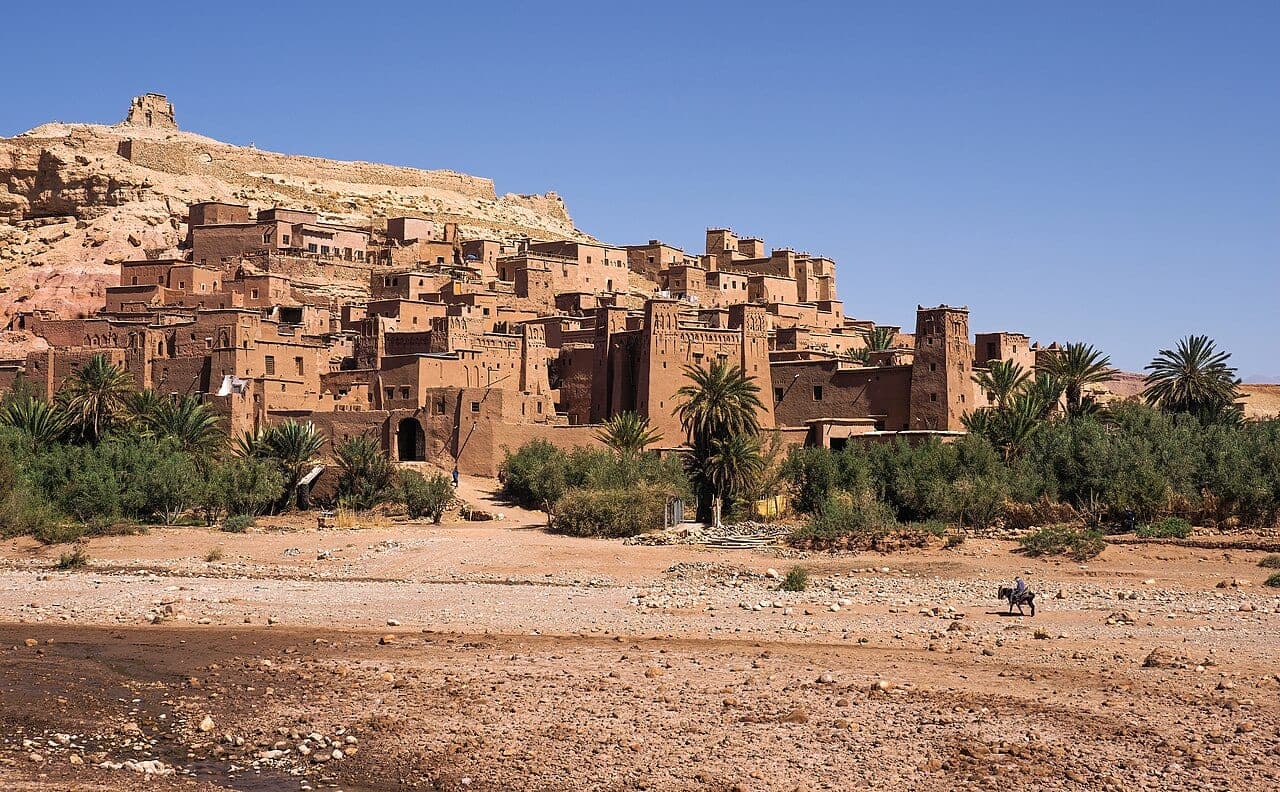
 Ait Benhaddou, built of rammed earth on the old caravan route to the Sahara, and rebuilt continuously because earth does not last. Photograph by C messier, CC BY-SA 4.0, via Wikimedia Commons.
Islam arrived with Arab expansion in the seventh and eighth centuries. The Idrisid dynasty (788–974) founded Fez and established the first Muslim state centred on Morocco. Successive Amazigh-led empires followed: the Almoravids (1040–1147), who founded Marrakesh and ruled into Muslim Spain; the Almohads (1121–1269), who built the Koutoubia and the Hassan Tower and held a domain from Iberia to Tunisia; and the Marinids (1244–1465), who endowed Fez with the finely carved madrasas that define Moroccan architecture. The Saadis (1549–1659), an Arab dynasty from the Draa valley, repelled the Portuguese at the Battle of the Three Kings in 1578 and enriched Marrakesh, while the Alaouites, ruling since the mid-seventeenth century, remain the reigning dynasty and one of the oldest in the world.
European pressure grew through the nineteenth century, and the Treaty of Fez in 1912 placed most of the country under a French protectorate, with Spain administering zones in the northern Rif and the far south and Tangier held as an international zone. Sustained nationalist resistance and the popular standing of Sultan Mohammed V brought independence in 1956, when France and Spain relinquished their protectorates and the sultan became king. The monarchy passed to Hassan II in 1961 and to the current king, Mohammed VI, in 1999.
Morocco has two official languages. Modern Standard Arabic serves formal and religious life, while everyday speech is Moroccan Arabic, known as Darija, layered with Amazigh, French and Spanish borrowings. Tamazight became an official language under the 2011 constitution, and its main varieties are Tashelhit in the south, Central Atlas Tamazight in the interior and Tarifit in the Rif. Tamazight can be written in the ancient Tifinagh script, now taught in schools and used on public signage. French remains widely used in business, higher education and government, a legacy of the protectorate, and Spanish persists in the north.
The English name Morocco derives, through the Spanish Marruecos, from Marrakesh, whose Amazigh name is often read as "land of God." Moroccans call their country al-Maghrib, "the west" or "the place of sunset," a term the medieval Arab world used for the far western lands of the Muslim map. The full official name is al-Mamlaka al-Maghribiyya, the Kingdom of the West.
Moroccan craft carries the country's identity in material form. Zellige, the hand-cut geometric mosaic of Fez, sheathes fountains, courtyards and mihrabs; tadelakt lime plaster gives interiors their polished glow; and the tanneries of Fez still dye leather in stone vats with pomegranate, indigo and mint. Amazigh weavers of the Atlas knot carpets whose motifs once recorded a family's lineage, silversmiths work Berber jewellery, and the thuya wood of Essaouira is turned into inlaid boxes. The blending of Amazigh weaving, Arab calligraphy and Andalusi refinement gives these arts their character.
Music divides into several living traditions. Al-Ala, the Andalusi classical suite, was carried across the strait by refugees from Iberia and is performed at weddings and religious feasts. Gnawa music, rooted in the sub-Saharan communities brought to Morocco over centuries, joins the sacred and the secular in the all-night lila ceremony of trance and healing; UNESCO inscribed it as Intangible Cultural Heritage in 2019. Amazigh village music such as ahwash and ahidous, the sung poetry of malhun, and popular chaabi round out the range. In the kitchen, the slow-cooked tagine, the seven-vegetable couscous of Friday gatherings, the pigeon or chicken pastilla, the Ramadan soup harira, and the ceremony of sweet mint tea define hospitality. Couscous was jointly inscribed by Morocco, Algeria, Tunisia and Mauritania on the UNESCO intangible heritage list in 2020, and the practices around the argan tree of the south-west were recognised in 2014.
The great majority of Moroccans are Sunni Muslims of the Maliki school, and Islam frames the calendar, the family and the state. Alongside formal orthodoxy, Sufism has deep roots. Brotherhoods such as the Shadhiliyya and its offshoot the Jazuliyya, the Qadiriyya Boutchichiyya, the Darqawiyya and the Tijaniyya, founded in Fez in 1784, organise devotional life around a zawiya, a lodge that combines a shrine, a school and a place of assembly. Each order preserves a silsila, a documented chain of transmission from master to disciple reaching back through the centuries, which is itself a form of remembered lineage.
Morocco's Jewish community is one of the oldest in the world, present since Roman times and expanded by two later waves: the Toshavim, long-settled Moroccan Jews, and the Megorashim, families expelled from Spain and Portugal after 1492 who resettled in Fez, Tetouan, Marrakesh and other cities. The sage Maimonides lived in Fez in the 1160s. Jewish quarters, the mellahs, first appeared in Fez in the fifteenth century and later in other cities, and synagogues such as Ibn Danan in Fez and Slat al-Azama in Marrakesh survive as monuments. A community once numbering in the hundreds of thousands emigrated largely to Israel, France and Canada after 1948, yet its synagogues, cemeteries and memory remain a recognised part of Moroccan heritage, a plurality named in the 2011 constitution.
Muslim burial in Morocco follows the shared practice of the faith and is met quickly and communally. The body is washed by relatives or attendants of the same sex, wrapped in a plain white shroud, and carried to the mosque or graveside for the funeral prayer, the salat al-janaza. Burial normally takes place on the day of death or the next morning, the deceased laid on the right side facing Mecca in a simple grave. Extravagance is discouraged: the plain shroud and simple grave express the equality of rich and poor before God.
Mourning then gathers the community. Family and neighbours visit through the first three days, receiving condolence with the refrain that all belong to God and to Him return, while Qur'an readers may complete a full recitation, a khatma, dedicated to the dead. Charity, sadaqa, is given in the deceased's name, and many families mark the fortieth day and the anniversary with further recitation and a shared meal. A widow observes the Qur'anic waiting period, the iddah, of four months and ten days. Visiting cemeteries on the mornings of the two Eids to tidy graves, recite verses and give alms to the poor is a widespread custom.
Beyond the household, remembrance takes public form in the moussem, an annual pilgrimage and festival at the tomb of a saint. The moussem of Moulay Idriss Zerhoun honours the founder of the first Moroccan Muslim state, while the Moussem of Tan-Tan in the south, a gathering of nomadic tribes, was inscribed by UNESCO in 2008. Gnawa communities hold their own commemorative nights of music and trance. Jewish Moroccans keep the hiloula, the pilgrimage to the tombs of revered rabbis such as Rabbi Amram ben Diwan and Rabbi Haim Pinto at Essaouira, which continues to draw the diaspora home each year. Across faiths, the visit to the grave of a holy person binds personal grief to a wider, inherited memory.
Moroccan records are makhzen records, religious records and, for one community, records that are now in other countries.
The sultanate's administration produced land, tax and appointment documents going back centuries, held in the royal archives and the Bibliothèque Nationale in Rabat. Sharia court registers, the adoul notaries' books, and the deeds of habous endowments hold marriage, inheritance and property, and the notarial record is the richest genealogical source available to most Moroccan families.
The zawiya archives are the other deep layer. Sufi lodges kept their own records, and the shurfa families, who trace descent from the Prophet, maintain written genealogies validated by the Ministry of Islamic Affairs, which still registers them.
The état civil arrived in stages: for Europeans under the French and Spanish protectorates from the 1910s, and for Moroccans generally around the middle of the century, becoming compulsory much later. Amazigh families in the Atlas and the Rif kept descent orally through the tribe and the fraction, and the surname system imposed by the état civil often cut across it.
The Jewish record left with the community. Morocco had the largest Jewish population in the Arab world, and almost all of it emigrated between 1948 and the 1970s. The community registers, the cemetery records and the rabbinical court files are now largely in Israel and France, though the Moroccan state has restored synagogues and cemeteries and the Jewish Museum in Casablanca is the only one of its kind in the Arab world.
Morocco has nine cultural sites on the UNESCO World Heritage List, according to the World Heritage Centre. They are, in order of inscription, the Medina of Fez (1981), the Medina of Marrakesh (1985), the Ksar of Ait-Ben-Haddou (1987), the Historic City of Meknes (1996), the Archaeological Site of Volubilis (1997), the Medina of Tetouan (1997), the Medina of Essaouira (2001), the Portuguese City of Mazagan at El Jadida (2004), and Rabat, Modern Capital and Historic City, inscribed in 2012 as a shared heritage of the Islamic and colonial eras. Ait-Ben-Haddou, the earthen ksar on the old caravan route between Marrakesh and the Sahara, is the emblem of the country's mud-brick architecture and has appeared in many films, which has helped fund its upkeep while raising the challenge of preserving pisé walls against rain and time.
Custody of these sites rests with the Ministry of Culture and the National Foundation of Museums. Conservation has combined Moroccan and international expertise, from the restoration of Fez's tanneries and madrasas to the stabilisation of Volubilis. Living heritage receives parallel attention through the UNESCO intangible lists, which now include Gnawa, couscous, the argan practices, the Moussem of Tan-Tan, the Cherry Festival of Sefrou and the equestrian art of tbourida. The care of the mellahs and Jewish cemeteries, supported at times by the state, reflects a policy of protecting the country's plural past.
Digital tools have widened access to Morocco's fragile archives. The restoration of the library of al-Qarawiyyin in Fez, led by the architect Aziza Chaouni and completed in 2016, paired physical conservation with the digitisation of manuscripts that had survived more than a millennium, including a ninth-century Qur'an. Google Arts and Culture has partnered with Moroccan institutions to publish high-resolution images and virtual tours of medinas, monuments and collections, letting distant audiences and the diaspora walk sites they cannot easily reach.
Jewish heritage has been a particular focus of documentation. The Museum of Moroccan Judaism in Casablanca, the only museum of its kind in the Arab world, records community life, and the Bayt Dakira, or House of Memory, opened in Essaouira in 2020 to preserve the shared Jewish and Muslim heritage of the port through archives and digital displays. Genealogical and cemetery databases, built with community groups abroad, help descendants trace family graves, extending the work of remembrance into online form.
Morocco reaches a wide audience through its writers, film-makers and musicians. Authors such as Tahar Ben Jelloun, Fatima Mernissi, Abdellatif Laabi and, more recently, Leila Slimani have brought Moroccan themes to a global readership in French and Arabic. The studios around Ouarzazate, near Ait-Ben-Haddou, have made the pre-Saharan south a standing set for international cinema, giving local crews decades of experience. Festivals carry the country's music outward, from the Gnaoua Festival in Essaouira to the Fes Festival of World Sacred Music and Rabat's Mawazine gathering.
The Moroccan diaspora, concentrated in France, Spain, Belgium, the Netherlands and Italy, keeps heritage active through associations, cuisine and return visits. The Mohammed VI Museum of Modern and Contemporary Art, opened in Rabat in 2014, anchors a growing art scene, and the national football team's run to the semi-finals of the 2022 World Cup, a first for an African and Arab side, became a moment of shared pride at home and across the diaspora.
The al-Qarawiyyin library reborn. The restoration completed in 2016 rescued one of the oldest libraries in the world, digitising manuscripts so scholars can consult a millennium of records without endangering the originals.
A house of shared memory in Essaouira. The Bayt Dakira, opened in 2020, preserves the intertwined Jewish and Muslim history of the port, turning a restored synagogue and archive into a working centre of remembrance and research.
Living heritage recognised. The inscription of Gnawa in 2019 and of couscous in 2020 gave international standing to practices once treated as merely local, supporting the communities that sustain them.
A monument that pays for its own upkeep. The film industry drawn to Ait-Ben-Haddou and Ouarzazate provides income that helps maintain the earthen ksar and support the community that guards it.
Ait Benhaddou, built of rammed earth on the old caravan route to the Sahara, and rebuilt continuously because earth does not last. Photograph by C messier, CC BY-SA 4.0, via Wikimedia Commons.
Islam arrived with Arab expansion in the seventh and eighth centuries. The Idrisid dynasty (788–974) founded Fez and established the first Muslim state centred on Morocco. Successive Amazigh-led empires followed: the Almoravids (1040–1147), who founded Marrakesh and ruled into Muslim Spain; the Almohads (1121–1269), who built the Koutoubia and the Hassan Tower and held a domain from Iberia to Tunisia; and the Marinids (1244–1465), who endowed Fez with the finely carved madrasas that define Moroccan architecture. The Saadis (1549–1659), an Arab dynasty from the Draa valley, repelled the Portuguese at the Battle of the Three Kings in 1578 and enriched Marrakesh, while the Alaouites, ruling since the mid-seventeenth century, remain the reigning dynasty and one of the oldest in the world.
European pressure grew through the nineteenth century, and the Treaty of Fez in 1912 placed most of the country under a French protectorate, with Spain administering zones in the northern Rif and the far south and Tangier held as an international zone. Sustained nationalist resistance and the popular standing of Sultan Mohammed V brought independence in 1956, when France and Spain relinquished their protectorates and the sultan became king. The monarchy passed to Hassan II in 1961 and to the current king, Mohammed VI, in 1999.
Morocco has two official languages. Modern Standard Arabic serves formal and religious life, while everyday speech is Moroccan Arabic, known as Darija, layered with Amazigh, French and Spanish borrowings. Tamazight became an official language under the 2011 constitution, and its main varieties are Tashelhit in the south, Central Atlas Tamazight in the interior and Tarifit in the Rif. Tamazight can be written in the ancient Tifinagh script, now taught in schools and used on public signage. French remains widely used in business, higher education and government, a legacy of the protectorate, and Spanish persists in the north.
The English name Morocco derives, through the Spanish Marruecos, from Marrakesh, whose Amazigh name is often read as "land of God." Moroccans call their country al-Maghrib, "the west" or "the place of sunset," a term the medieval Arab world used for the far western lands of the Muslim map. The full official name is al-Mamlaka al-Maghribiyya, the Kingdom of the West.
Moroccan craft carries the country's identity in material form. Zellige, the hand-cut geometric mosaic of Fez, sheathes fountains, courtyards and mihrabs; tadelakt lime plaster gives interiors their polished glow; and the tanneries of Fez still dye leather in stone vats with pomegranate, indigo and mint. Amazigh weavers of the Atlas knot carpets whose motifs once recorded a family's lineage, silversmiths work Berber jewellery, and the thuya wood of Essaouira is turned into inlaid boxes. The blending of Amazigh weaving, Arab calligraphy and Andalusi refinement gives these arts their character.
Music divides into several living traditions. Al-Ala, the Andalusi classical suite, was carried across the strait by refugees from Iberia and is performed at weddings and religious feasts. Gnawa music, rooted in the sub-Saharan communities brought to Morocco over centuries, joins the sacred and the secular in the all-night lila ceremony of trance and healing; UNESCO inscribed it as Intangible Cultural Heritage in 2019. Amazigh village music such as ahwash and ahidous, the sung poetry of malhun, and popular chaabi round out the range. In the kitchen, the slow-cooked tagine, the seven-vegetable couscous of Friday gatherings, the pigeon or chicken pastilla, the Ramadan soup harira, and the ceremony of sweet mint tea define hospitality. Couscous was jointly inscribed by Morocco, Algeria, Tunisia and Mauritania on the UNESCO intangible heritage list in 2020, and the practices around the argan tree of the south-west were recognised in 2014.
The great majority of Moroccans are Sunni Muslims of the Maliki school, and Islam frames the calendar, the family and the state. Alongside formal orthodoxy, Sufism has deep roots. Brotherhoods such as the Shadhiliyya and its offshoot the Jazuliyya, the Qadiriyya Boutchichiyya, the Darqawiyya and the Tijaniyya, founded in Fez in 1784, organise devotional life around a zawiya, a lodge that combines a shrine, a school and a place of assembly. Each order preserves a silsila, a documented chain of transmission from master to disciple reaching back through the centuries, which is itself a form of remembered lineage.
Morocco's Jewish community is one of the oldest in the world, present since Roman times and expanded by two later waves: the Toshavim, long-settled Moroccan Jews, and the Megorashim, families expelled from Spain and Portugal after 1492 who resettled in Fez, Tetouan, Marrakesh and other cities. The sage Maimonides lived in Fez in the 1160s. Jewish quarters, the mellahs, first appeared in Fez in the fifteenth century and later in other cities, and synagogues such as Ibn Danan in Fez and Slat al-Azama in Marrakesh survive as monuments. A community once numbering in the hundreds of thousands emigrated largely to Israel, France and Canada after 1948, yet its synagogues, cemeteries and memory remain a recognised part of Moroccan heritage, a plurality named in the 2011 constitution.
Muslim burial in Morocco follows the shared practice of the faith and is met quickly and communally. The body is washed by relatives or attendants of the same sex, wrapped in a plain white shroud, and carried to the mosque or graveside for the funeral prayer, the salat al-janaza. Burial normally takes place on the day of death or the next morning, the deceased laid on the right side facing Mecca in a simple grave. Extravagance is discouraged: the plain shroud and simple grave express the equality of rich and poor before God.
Mourning then gathers the community. Family and neighbours visit through the first three days, receiving condolence with the refrain that all belong to God and to Him return, while Qur'an readers may complete a full recitation, a khatma, dedicated to the dead. Charity, sadaqa, is given in the deceased's name, and many families mark the fortieth day and the anniversary with further recitation and a shared meal. A widow observes the Qur'anic waiting period, the iddah, of four months and ten days. Visiting cemeteries on the mornings of the two Eids to tidy graves, recite verses and give alms to the poor is a widespread custom.
Beyond the household, remembrance takes public form in the moussem, an annual pilgrimage and festival at the tomb of a saint. The moussem of Moulay Idriss Zerhoun honours the founder of the first Moroccan Muslim state, while the Moussem of Tan-Tan in the south, a gathering of nomadic tribes, was inscribed by UNESCO in 2008. Gnawa communities hold their own commemorative nights of music and trance. Jewish Moroccans keep the hiloula, the pilgrimage to the tombs of revered rabbis such as Rabbi Amram ben Diwan and Rabbi Haim Pinto at Essaouira, which continues to draw the diaspora home each year. Across faiths, the visit to the grave of a holy person binds personal grief to a wider, inherited memory.
Moroccan records are makhzen records, religious records and, for one community, records that are now in other countries.
The sultanate's administration produced land, tax and appointment documents going back centuries, held in the royal archives and the Bibliothèque Nationale in Rabat. Sharia court registers, the adoul notaries' books, and the deeds of habous endowments hold marriage, inheritance and property, and the notarial record is the richest genealogical source available to most Moroccan families.
The zawiya archives are the other deep layer. Sufi lodges kept their own records, and the shurfa families, who trace descent from the Prophet, maintain written genealogies validated by the Ministry of Islamic Affairs, which still registers them.
The état civil arrived in stages: for Europeans under the French and Spanish protectorates from the 1910s, and for Moroccans generally around the middle of the century, becoming compulsory much later. Amazigh families in the Atlas and the Rif kept descent orally through the tribe and the fraction, and the surname system imposed by the état civil often cut across it.
The Jewish record left with the community. Morocco had the largest Jewish population in the Arab world, and almost all of it emigrated between 1948 and the 1970s. The community registers, the cemetery records and the rabbinical court files are now largely in Israel and France, though the Moroccan state has restored synagogues and cemeteries and the Jewish Museum in Casablanca is the only one of its kind in the Arab world.
Morocco has nine cultural sites on the UNESCO World Heritage List, according to the World Heritage Centre. They are, in order of inscription, the Medina of Fez (1981), the Medina of Marrakesh (1985), the Ksar of Ait-Ben-Haddou (1987), the Historic City of Meknes (1996), the Archaeological Site of Volubilis (1997), the Medina of Tetouan (1997), the Medina of Essaouira (2001), the Portuguese City of Mazagan at El Jadida (2004), and Rabat, Modern Capital and Historic City, inscribed in 2012 as a shared heritage of the Islamic and colonial eras. Ait-Ben-Haddou, the earthen ksar on the old caravan route between Marrakesh and the Sahara, is the emblem of the country's mud-brick architecture and has appeared in many films, which has helped fund its upkeep while raising the challenge of preserving pisé walls against rain and time.
Custody of these sites rests with the Ministry of Culture and the National Foundation of Museums. Conservation has combined Moroccan and international expertise, from the restoration of Fez's tanneries and madrasas to the stabilisation of Volubilis. Living heritage receives parallel attention through the UNESCO intangible lists, which now include Gnawa, couscous, the argan practices, the Moussem of Tan-Tan, the Cherry Festival of Sefrou and the equestrian art of tbourida. The care of the mellahs and Jewish cemeteries, supported at times by the state, reflects a policy of protecting the country's plural past.
Digital tools have widened access to Morocco's fragile archives. The restoration of the library of al-Qarawiyyin in Fez, led by the architect Aziza Chaouni and completed in 2016, paired physical conservation with the digitisation of manuscripts that had survived more than a millennium, including a ninth-century Qur'an. Google Arts and Culture has partnered with Moroccan institutions to publish high-resolution images and virtual tours of medinas, monuments and collections, letting distant audiences and the diaspora walk sites they cannot easily reach.
Jewish heritage has been a particular focus of documentation. The Museum of Moroccan Judaism in Casablanca, the only museum of its kind in the Arab world, records community life, and the Bayt Dakira, or House of Memory, opened in Essaouira in 2020 to preserve the shared Jewish and Muslim heritage of the port through archives and digital displays. Genealogical and cemetery databases, built with community groups abroad, help descendants trace family graves, extending the work of remembrance into online form.
Morocco reaches a wide audience through its writers, film-makers and musicians. Authors such as Tahar Ben Jelloun, Fatima Mernissi, Abdellatif Laabi and, more recently, Leila Slimani have brought Moroccan themes to a global readership in French and Arabic. The studios around Ouarzazate, near Ait-Ben-Haddou, have made the pre-Saharan south a standing set for international cinema, giving local crews decades of experience. Festivals carry the country's music outward, from the Gnaoua Festival in Essaouira to the Fes Festival of World Sacred Music and Rabat's Mawazine gathering.
The Moroccan diaspora, concentrated in France, Spain, Belgium, the Netherlands and Italy, keeps heritage active through associations, cuisine and return visits. The Mohammed VI Museum of Modern and Contemporary Art, opened in Rabat in 2014, anchors a growing art scene, and the national football team's run to the semi-finals of the 2022 World Cup, a first for an African and Arab side, became a moment of shared pride at home and across the diaspora.
The al-Qarawiyyin library reborn. The restoration completed in 2016 rescued one of the oldest libraries in the world, digitising manuscripts so scholars can consult a millennium of records without endangering the originals.
A house of shared memory in Essaouira. The Bayt Dakira, opened in 2020, preserves the intertwined Jewish and Muslim history of the port, turning a restored synagogue and archive into a working centre of remembrance and research.
Living heritage recognised. The inscription of Gnawa in 2019 and of couscous in 2020 gave international standing to practices once treated as merely local, supporting the communities that sustain them.
A monument that pays for its own upkeep. The film industry drawn to Ait-Ben-Haddou and Ouarzazate provides income that helps maintain the earthen ksar and support the community that guards it.
National Overview
Notable Cities
Historical Foundations
Linguistic and Etymological Roots
Cultural Identity
Religion and Spirituality
Remembrance and Mourning Traditions
Tracing a Family in Morocco
Heritage Preservation Efforts
Digital Heritage
Contemporary Cultural Influences
Success Stories
References and resources
- Encyclopaedia Britannica: Morocco
- UNESCO World Heritage Centre: Morocco state party page
- Wikipedia: List of World Heritage Sites in Morocco
- UNESCO Intangible Cultural Heritage: Gnawa
- UNESCO Intangible Cultural Heritage: knowledge and practices pertaining to couscous
- UNESCO Intangible Cultural Heritage: Morocco national inventory
- Wikipedia: University of al-Qarawiyyin
- Wikipedia: Volubilis
- Wikipedia: History of the Jews in Morocco
- Wikipedia: Ait Benhaddou