Heritage · Country
Palestine Culture and Heritage
In the olive terraces of Battir, the grotto beneath Bethlehem's Church of the Nativity, and the eleven-thousand-year-old mound of Jericho, Palestine keeps one of the longest human records on earth. This is a guide to that heritage, to the embroidery and mourning customs that carry memory between generations, and to the archives working to preserve it.Written to last.
By Confinity Heritage Editorial · Updated 2026-07-31 · 8-minute readQuiet tools, kept out of the way.
Few landscapes hold as much remembered time as the hills between the Jordan Valley and the Mediterranean. A single day's walk here can pass a Neolithic tower older than writing, terraces watered by an ancient gravity-fed system, a church raised over a grotto in the fourth century, and olive groves a thousand years old. Palestinians have long treated this inheritance as something to be carried rather than merely kept, stitched into a bride's dress, sung at a wedding, pressed from each autumn's olives, and recited in poems learned by heart.
The formal record is substantial. The State of Palestine counts four UNESCO World Heritage sites and several elements on UNESCO's list of intangible cultural heritage, from the art of embroidery to the soap-making of Nablus. Contemporary and political questions surrounding the region are contested and fall outside the scope of a heritage profile, which keeps to culture, faith, and remembrance.
The State of Palestine comprises two separated areas, the West Bank, including East Jerusalem, and the Gaza Strip, together covering roughly 6,000 square kilometres between the Jordan River and the Mediterranean Sea. The land ranges from the fertile central highlands around Nablus, Ramallah, and Hebron down to the Jordan Valley, which holds Jericho at more than 250 metres below sea level, among the lowest inhabited places on earth (Britannica). The coastal plain of Gaza opens onto the Mediterranean.
The population is roughly 5.5 million, overwhelmingly Arab and predominantly Sunni Muslim, with historic Christian communities and a small, ancient community of Samaritans near Nablus. Arabic is the official language. A very large diaspora lives across the region and beyond, so that Palestinian heritage is sustained as much abroad as at home. Palestine was admitted to UNESCO as a member state in 2011 and recognised by the United Nations General Assembly as a non-member observer state in 2012.
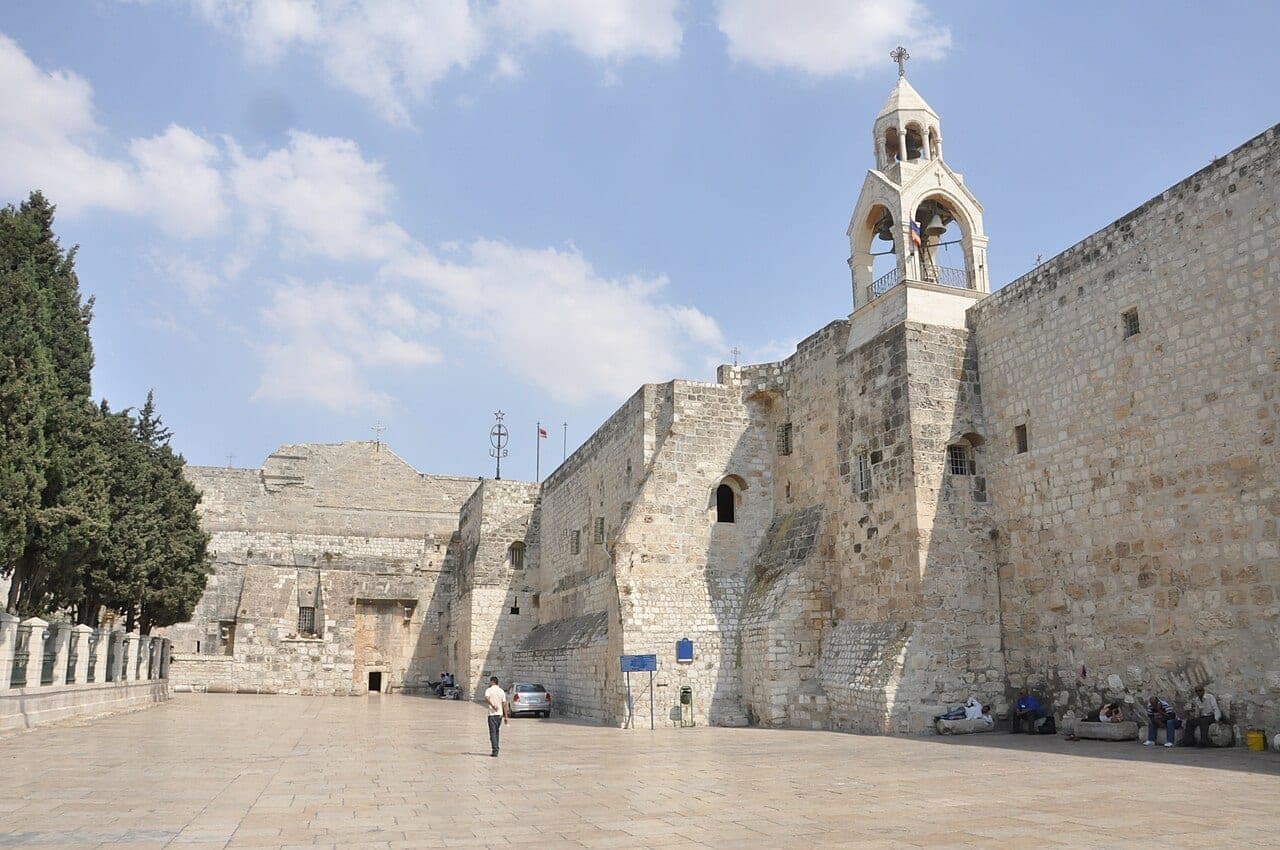
Bethlehem. A few miles south of Jerusalem, Bethlehem grew around the site venerated since at least the second century as the birthplace of Jesus. Its Church of the Nativity, begun under Constantine and his mother Helena around 327 to 333 and rebuilt under the emperor Justinian in the sixth century, is regarded as the oldest church in continuous use in the world (Britannica). Manger Square, the Milk Grotto, and the desert monastery of Mar Saba draw pilgrims through the year, and the town's Christian community is among the oldest anywhere.
Jericho. In the Jordan Valley, Jericho lays claim to being among the oldest continuously inhabited places on earth, with traces of settlement reaching back some 11,000 years. The mound of Tell es-Sultan preserves a stone tower and walls from the Neolithic period, built before pottery or writing (Britannica). The oasis city also holds the winter palaces of Herod and the eighth-century Umayyad complex of Hisham's Palace, known for its Tree of Life mosaic.
Hebron. One of the oldest cities in the region, Hebron, called Al-Khalil in Arabic, meaning "the friend" after Abraham, the friend of God, is built around the Ibrahimi Mosque, also known as the Tomb of the Patriarchs, revered by Muslims, Jews, and Christians as the burial place of Abraham and his family. Its Old Town is a dense quarter of Mamluk and Ottoman stone houses, covered markets, and workshops known for glass, ceramics, and leather.
Nablus. Set in a valley between Mount Gerizim and Mount Ebal, Nablus was founded by the Romans as Neapolis in the year 72. Its old town is known for Ottoman merchant houses, bathhouses, and two enduring crafts, the making of olive-oil soap, sabon nabulsi, and the cheese pastry knafeh nabulsieh.
Ramallah. Ramallah has become the administrative and cultural centre of the West Bank, home to government institutions, universities, and venues such as the Khalil Sakakini Cultural Center. The poet Mahmoud Darwish is buried in the city, where a museum and garden honour his work.
Gaza. An ancient Mediterranean port settled for more than three thousand years, Gaza City was a key stop on incense and trade routes. Its heritage includes the Great Omari Mosque, raised over successive earlier structures, and the Church of Saint Porphyrius, among the oldest churches in the world. UNESCO has been documenting and assessing damage to cultural sites in Gaza during recent conflict.
Human settlement here is among the deepest documented anywhere. At Jericho, permanent village life began in the ninth and eighth millennia BC, and by the Bronze Age the land known as Canaan held fortified city-states trading with Egypt and Mesopotamia. In the Iron Age it was home to Canaanite and neighbouring peoples, including the coastal Philistines, whose name would later attach to the land itself.
Successive empires left their mark. The area passed under Assyrian, Babylonian, Persian, and then Hellenistic rule after Alexander. Roman control from the first century BC brought cities such as Neapolis, the future Nablus, and, in the second century, the renaming of the province as Syria Palaestina. Under the Christian Byzantine Empire from the fourth century, Palestine became a land of churches and pilgrimage, and the first Church of the Nativity was built (Britannica).
The Muslim conquest of the 630s opened the early Islamic period. Under the Umayyad caliphate, based in nearby Damascus, the region prospered, and Hisham's Palace near Jericho dates from this time, while Jerusalem's Dome of the Rock was completed in 691. The Crusades brought a Latin kingdom from 1099 until Saladin regained the region, followed by Ayyubid and Mamluk rule, seen in much of the old-town architecture of Hebron and Nablus. From 1516 the land was part of the Ottoman Empire for four centuries.
After the First World War the region came under British administration as Mandatory Palestine, from 1920 to 1948. The events of the twentieth century that followed, and the competing national histories bound up with them, are deeply contested and lie outside the scope of this heritage profile, which keeps to culture, faith, and remembrance.
Arabic is the language of Palestine, spoken in a Levantine dialect close to those of Jordan, Lebanon, and Syria and carrying a deep vocabulary of farming, food, and proverb rooted in village life. Classical and Modern Standard Arabic serve writing, media, and worship, while the spoken dialect holds the idioms of everyday speech.
The name Palestine is itself a long inheritance. It descends through the Latin Palaestina and the Greek Palaistine, used by the historian Herodotus in the fifth century BC, from a Semitic root behind the Hebrew Peleshet and the Egyptian Peleset, a term recorded around 1150 BC for the Philistines of the southern coast (Timeline of the name). Assyrian inscriptions of the eighth and seventh centuries BC refer to Palashtu, and in the second century the Roman administration applied the name Syria Palaestina to the province, which gradually came to name the whole land.
Palestinian identity is expressed through shared arts and everyday practices recognised across the region and the diaspora. The best known is tatreez, the cross-stitch embroidery worked by women onto the thobe, the long dress, and other garments. Its motifs of cypress trees, birds, stars, and flowers, and its colours, once signalled a woman's village, region, and marital status, forming a visual language of belonging. In 2021 UNESCO inscribed the art of embroidery in Palestine on its Representative List of the Intangible Cultural Heritage of Humanity (UNESCO ICH).
At weddings and celebrations, dabke, a line dance of stamping, synchronised steps, brings families together, led by a dancer who improvises over the line's rhythm. The black-and-white checked keffiyeh, once the everyday headscarf of farmers, has become a widely recognised emblem of Palestinian identity, and the Hirbawi workshop in Hebron remains the last factory weaving it in Palestine.
Above all there is the olive. The harvest, mawsim al-zaytoun, each autumn gathers families to groves whose oldest trees are many centuries old, and the pressing yields oil for the table, for soap, and for gifting between households. The kitchen is heritage in its own right: musakhan, roasted chicken with sumac and onions on taboon bread, is often called the national dish; maqluba, an "upside-down" pot of rice, meat, and fried vegetables turned onto a platter, is a centrepiece of family gatherings; and knafeh, warm cheese pastry in syrup, is the celebrated sweet of Nablus.
Palestinian letters are led by poetry. Mahmoud Darwish, who lived from 1941 to 2008 and is widely regarded as the Palestinian national poet, gave the experience of exile and attachment to the land a language read across the Arab world (Britannica). He is joined by the poet Fadwa Tuqan of Nablus, the novelist Ghassan Kanafani, and the scholar Edward Said.
Palestine sits at the heart of the region long called the Holy Land, and religion runs through its heritage. Most Palestinians are Sunni Muslims, and Islamic devotion centres on daily prayer, the fast of Ramadan, and reverence for the sanctuaries of Jerusalem, above all the Al-Aqsa Mosque compound, known as al-Haram al-Sharif. Hebron's Ibrahimi Mosque, over the Tomb of the Patriarchs, is among the most venerated sites in the country.
 The Church of the Nativity was the first site inscribed under Palestine, in 2012, and went straight onto the danger list because the roof was failing. It came off in 2019 after the repairs were done. Photograph by Diego Delso, CC BY-SA 3.0, via Wikimedia Commons.
Palestine is also home to one of the oldest Christian communities in the world, present since the first century and including Greek Orthodox, Latin Catholic, Melkite, Armenian, and Syriac churches. Bethlehem's Church of the Nativity and Jerusalem's Church of the Holy Sepulchre anchor a pilgrimage that has continued for more than sixteen centuries. A small Samaritan community, one of the oldest religious groups on earth, keeps its ancient rites on Mount Gerizim above Nablus, where it observes Passover in its own tradition.
Mourning in Palestine follows the region's Muslim and Christian traditions and is, above all, communal. In Islamic practice the dead are washed (ghusl), wrapped in a simple white shroud (kafan), and buried, usually within a day, after the funeral prayer, salat al-janazah, with the body laid on its right side facing Mecca. A formal mourning period, the aza, follows, during which the family receives condolences in a gathering, often a tent or hall, where the Quran is recited. Bitter, unsweetened coffee, qahwa sada, is the customary drink of condolence, and many families mark the fortieth day, al-arba'in, with a further gathering.
Palestinian Christians observe the funeral rites of their own churches, with a liturgy, a burial, and memorial services on set days after death and on anniversaries, in customs close to those of the wider Orthodox and Catholic East.
Underlying both traditions is a distinctive weight given to memory, family, and place. Genealogy and the village of origin are carefully remembered and handed down, and the land itself, the family olive grove, the grandparents' house, the home village, carries the memory of those who came before. To keep a family's story, its trees, and its place-names is understood as a duty owed to the dead, which is one reason embroidery patterns, recipes, and songs are handed on so carefully between generations.
Palestinian family records are held in three places, and two of them are not in Palestine.
The Ottoman land registers, the tapu, and the population registers of the late nineteenth century are the deep record, held in Istanbul and in Amman. British Mandate administration added a land settlement programme, a population register and detailed village files, and those are divided between Israeli state archives, the British national archives and elsewhere.
The most consulted document is UNRWA's. Its registration records begin in 1950 and list refugee families by name and by village of origin in Palestine, updated continuously across three generations. For several million people that file is the official statement of where their family came from, and it is maintained by an international agency rather than a state.
The village is the organising fact. More than four hundred Palestinian villages were depopulated in 1948, and the documentation of them, done largely by Palestinian scholars and by village associations in exile, records who lived where, what the land was, and who owned it. Families kept deeds, and famously keys.
Inside the West Bank and Gaza the Palestinian Authority maintains a civil registry, though the population registry itself has been controlled by Israel since 1967, so changes of address and family reunification have been administered by an authority the family did not choose.
Church registers in Bethlehem, Jerusalem and Ramallah, some very old, hold the Christian community's record.
Palestine's four World Heritage sites trace its layered past. The first, inscribed in 2012, is the Birthplace of Jesus: Church of the Nativity and the Pilgrimage Route, Bethlehem, listing the basilica together with the road pilgrims walk into the town (UNESCO). In 2014 came Palestine: Land of Olives and Vines, the cultural landscape of Battir, whose stone terraces are still farmed and watered by an old gravity-fed irrigation system shared among local families (UNESCO). Hebron/Al-Khalil Old Town, with its Mamluk architecture and the Ibrahimi Mosque at its heart, was inscribed in 2017 (UNESCO), and Ancient Jericho/Tell es-Sultan, preserving one of the earliest known permanent settlements, in 2023 (UNESCO).
Living traditions are safeguarded too. The art of embroidery in Palestine was inscribed on UNESCO's intangible heritage list in 2021, and the tradition of Nabulsi soap making in 2024 (UNESCO ICH). The conservation group Riwaq has restored hundreds of historic buildings in villages across the West Bank, while other bodies document folklore, oral history, and craft. Battir's community-led conservation earned it the Melina Mercouri International Prize for the safeguarding of cultural landscapes in 2011.
Palestinian institutions have invested heavily in digital preservation, partly because the community and its records are dispersed. The Palestinian Museum, which opened near Birzeit in 2016, runs a Digital Archive of tens of thousands of documents, photographs, and objects contributed by families at home and abroad. Palestinian Journeys, a collaboration of the Institute for Palestine Studies, the Palestinian Museum, and Visualizing Palestine, presents an interactive timeline and encyclopaedia of history and culture.
The Palestinian Oral History Archive at the American University of Beirut preserves thousands of hours of recorded testimony, and the Palestine Open Maps project makes historical survey maps freely explorable online, letting users trace villages and landscapes as recorded decades ago.
Palestinian culture has a wide contemporary reach. In cinema, directors including Elia Suleiman and Hany Abu-Assad have brought Palestinian stories to international audiences, with Abu-Assad's Paradise Now and Omar both nominated for the Academy Award for best international feature. In music, the oud ensemble Le Trio Joubran, the hip-hop group DAM, and the singer Mohammed Assaf, who won the Arab Idol contest in 2013, have carried Palestinian sound abroad, while the painter Sliman Mansour has made olive groves and embroidery central images of modern Palestinian art.
The diaspora sustains this culture actively, through dabke troupes, tatreez circles, film festivals, and food, so that a wedding in Santiago or Chicago can look much like one in Ramallah. Tatreez in particular has seen a broad revival, taught in workshops and cooperatives and reinterpreted by contemporary designers, keeping an old visual language in daily use.
A church brought back from danger. Inscribed in 2012, the Church of the Nativity was placed at the same time on the List of World Heritage in Danger because of its fragile condition. A major restoration of the roof, mosaics, and facade followed, and in 2019 UNESCO removed it from the danger list, a rare reversal.
Embroidery on the world's list. The 2021 inscription of Palestinian embroidery recognised a craft carried by women for generations and helped spur cooperatives that keep regional patterns alive.
The oldest soap, newly honoured. In December 2024 UNESCO added the tradition of Nabulsi soap making to its intangible heritage list, recognising a craft practised in Nablus for centuries and still made from olive oil, water, and lye.
Jericho joins the list. In 2023 Ancient Jericho/Tell es-Sultan became Palestine's fourth World Heritage site, placing one of humanity's earliest towns under international protection.
The Church of the Nativity was the first site inscribed under Palestine, in 2012, and went straight onto the danger list because the roof was failing. It came off in 2019 after the repairs were done. Photograph by Diego Delso, CC BY-SA 3.0, via Wikimedia Commons.
Palestine is also home to one of the oldest Christian communities in the world, present since the first century and including Greek Orthodox, Latin Catholic, Melkite, Armenian, and Syriac churches. Bethlehem's Church of the Nativity and Jerusalem's Church of the Holy Sepulchre anchor a pilgrimage that has continued for more than sixteen centuries. A small Samaritan community, one of the oldest religious groups on earth, keeps its ancient rites on Mount Gerizim above Nablus, where it observes Passover in its own tradition.
Mourning in Palestine follows the region's Muslim and Christian traditions and is, above all, communal. In Islamic practice the dead are washed (ghusl), wrapped in a simple white shroud (kafan), and buried, usually within a day, after the funeral prayer, salat al-janazah, with the body laid on its right side facing Mecca. A formal mourning period, the aza, follows, during which the family receives condolences in a gathering, often a tent or hall, where the Quran is recited. Bitter, unsweetened coffee, qahwa sada, is the customary drink of condolence, and many families mark the fortieth day, al-arba'in, with a further gathering.
Palestinian Christians observe the funeral rites of their own churches, with a liturgy, a burial, and memorial services on set days after death and on anniversaries, in customs close to those of the wider Orthodox and Catholic East.
Underlying both traditions is a distinctive weight given to memory, family, and place. Genealogy and the village of origin are carefully remembered and handed down, and the land itself, the family olive grove, the grandparents' house, the home village, carries the memory of those who came before. To keep a family's story, its trees, and its place-names is understood as a duty owed to the dead, which is one reason embroidery patterns, recipes, and songs are handed on so carefully between generations.
Palestinian family records are held in three places, and two of them are not in Palestine.
The Ottoman land registers, the tapu, and the population registers of the late nineteenth century are the deep record, held in Istanbul and in Amman. British Mandate administration added a land settlement programme, a population register and detailed village files, and those are divided between Israeli state archives, the British national archives and elsewhere.
The most consulted document is UNRWA's. Its registration records begin in 1950 and list refugee families by name and by village of origin in Palestine, updated continuously across three generations. For several million people that file is the official statement of where their family came from, and it is maintained by an international agency rather than a state.
The village is the organising fact. More than four hundred Palestinian villages were depopulated in 1948, and the documentation of them, done largely by Palestinian scholars and by village associations in exile, records who lived where, what the land was, and who owned it. Families kept deeds, and famously keys.
Inside the West Bank and Gaza the Palestinian Authority maintains a civil registry, though the population registry itself has been controlled by Israel since 1967, so changes of address and family reunification have been administered by an authority the family did not choose.
Church registers in Bethlehem, Jerusalem and Ramallah, some very old, hold the Christian community's record.
Palestine's four World Heritage sites trace its layered past. The first, inscribed in 2012, is the Birthplace of Jesus: Church of the Nativity and the Pilgrimage Route, Bethlehem, listing the basilica together with the road pilgrims walk into the town (UNESCO). In 2014 came Palestine: Land of Olives and Vines, the cultural landscape of Battir, whose stone terraces are still farmed and watered by an old gravity-fed irrigation system shared among local families (UNESCO). Hebron/Al-Khalil Old Town, with its Mamluk architecture and the Ibrahimi Mosque at its heart, was inscribed in 2017 (UNESCO), and Ancient Jericho/Tell es-Sultan, preserving one of the earliest known permanent settlements, in 2023 (UNESCO).
Living traditions are safeguarded too. The art of embroidery in Palestine was inscribed on UNESCO's intangible heritage list in 2021, and the tradition of Nabulsi soap making in 2024 (UNESCO ICH). The conservation group Riwaq has restored hundreds of historic buildings in villages across the West Bank, while other bodies document folklore, oral history, and craft. Battir's community-led conservation earned it the Melina Mercouri International Prize for the safeguarding of cultural landscapes in 2011.
Palestinian institutions have invested heavily in digital preservation, partly because the community and its records are dispersed. The Palestinian Museum, which opened near Birzeit in 2016, runs a Digital Archive of tens of thousands of documents, photographs, and objects contributed by families at home and abroad. Palestinian Journeys, a collaboration of the Institute for Palestine Studies, the Palestinian Museum, and Visualizing Palestine, presents an interactive timeline and encyclopaedia of history and culture.
The Palestinian Oral History Archive at the American University of Beirut preserves thousands of hours of recorded testimony, and the Palestine Open Maps project makes historical survey maps freely explorable online, letting users trace villages and landscapes as recorded decades ago.
Palestinian culture has a wide contemporary reach. In cinema, directors including Elia Suleiman and Hany Abu-Assad have brought Palestinian stories to international audiences, with Abu-Assad's Paradise Now and Omar both nominated for the Academy Award for best international feature. In music, the oud ensemble Le Trio Joubran, the hip-hop group DAM, and the singer Mohammed Assaf, who won the Arab Idol contest in 2013, have carried Palestinian sound abroad, while the painter Sliman Mansour has made olive groves and embroidery central images of modern Palestinian art.
The diaspora sustains this culture actively, through dabke troupes, tatreez circles, film festivals, and food, so that a wedding in Santiago or Chicago can look much like one in Ramallah. Tatreez in particular has seen a broad revival, taught in workshops and cooperatives and reinterpreted by contemporary designers, keeping an old visual language in daily use.
A church brought back from danger. Inscribed in 2012, the Church of the Nativity was placed at the same time on the List of World Heritage in Danger because of its fragile condition. A major restoration of the roof, mosaics, and facade followed, and in 2019 UNESCO removed it from the danger list, a rare reversal.
Embroidery on the world's list. The 2021 inscription of Palestinian embroidery recognised a craft carried by women for generations and helped spur cooperatives that keep regional patterns alive.
The oldest soap, newly honoured. In December 2024 UNESCO added the tradition of Nabulsi soap making to its intangible heritage list, recognising a craft practised in Nablus for centuries and still made from olive oil, water, and lye.
Jericho joins the list. In 2023 Ancient Jericho/Tell es-Sultan became Palestine's fourth World Heritage site, placing one of humanity's earliest towns under international protection.
National Overview
Notable Cities
Historical Foundations
Linguistic and Etymological Roots
Cultural Identity
Religion and Spirituality
Remembrance and Mourning Traditions
Tracing a Family in Palestine
Heritage Preservation Efforts
Digital Heritage
Contemporary Cultural Influences
Success Stories
References and resources
- UNESCO World Heritage Centre, State of Palestine. State-party page listing all four World Heritage sites.
- UNESCO, Birthplace of Jesus: Church of the Nativity and the Pilgrimage Route, Bethlehem. The 2012 inscription and its history.
- UNESCO, Palestine: Land of Olives and Vines, Battir. The terraced cultural landscape inscribed in 2014.
- UNESCO, Hebron/Al-Khalil Old Town. The 2017 inscription of the Mamluk-era Old Town.
- UNESCO, Ancient Jericho/Tell es-Sultan. The 2023 inscription of one of the world's oldest towns.
- UNESCO Intangible Heritage, The art of embroidery in Palestine. Tatreez, inscribed 2021.
- UNESCO Intangible Heritage, Tradition of Nabulsi soap making in Palestine. Inscribed 2024.
- Encyclopaedia Britannica, Palestine. Geography, history, and cultural background.
- Encyclopaedia Britannica, Mahmoud Darwish. The life and work of the poet.
- The Palestinian Museum. The Birzeit museum and its Digital Archive.