Heritage · Country
Equatorial Guinea Culture and Heritage
Off the coast of Central Africa, Equatorial Guinea holds a volcanic island where Spanish cathedrals face an Atlantic once crossed by slave ships and a mainland forest where Fang carvers still guard the bones of their ancestors. It is the one African republic that answers in Spanish, folding Bantu reliquary and Catholic rite into a single long act of remembrance.Written to last.
By Confinity Heritage Editorial · Updated 2026-07-31 · 8-minute readQuiet tools, kept out of the way.
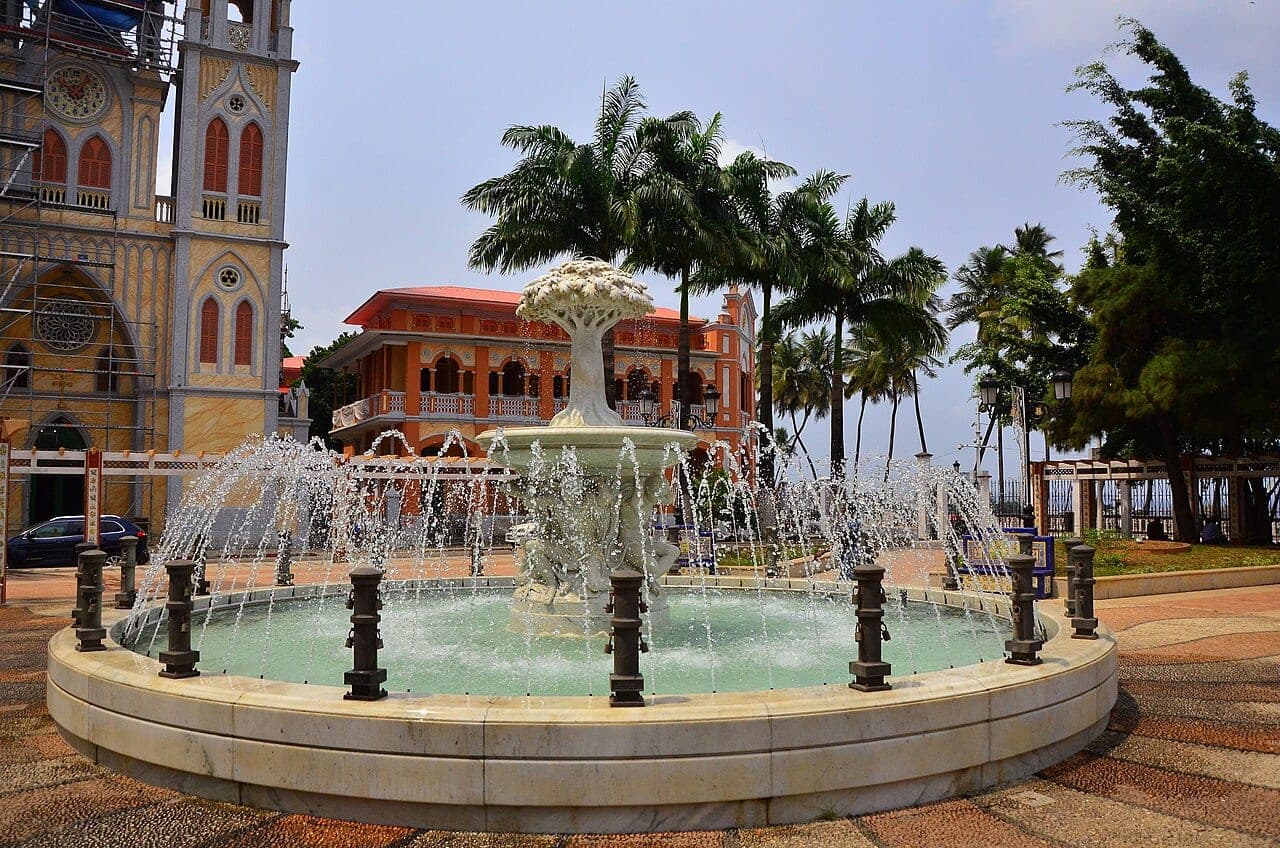
The Republic of Equatorial Guinea is a small country of two very different halves, and it carries a distinction held by no other sovereign state on the continent: Spanish is one of its official languages (Britannica). A mainland district called Río Muni faces the Atlantic between Cameroon and Gabon, while a scatter of islands sits offshore, chief among them Bioko, once named Fernando Pó, and the far southern speck of Annobón. On Bioko the streets of the capital, Malabo, are lined with the shuttered facades and iron balconies of Spanish colonial building, and above the town rises the dark cone of Pico Basile, the highest point in the country. Between the island and the mainland lie two ancestries, Bubi and Fang, and a history that runs from Bantu settlement through Portuguese and Spanish claim to independence in 1968.
Heritage here is inseparable from memory of the dead. Long before the churches came, the peoples of these islands and forests kept their ancestors close, and among the Fang that keeping took physical form in the byeri, the carved wooden guardian set above a bark box of ancestral bone. The rituals have changed and the churches now hold most of the funerals, yet the older instinct persists: that the departed are not gone but present, owed remembrance, and answerable when the living call. This page gathers the country's cities, its ethnic and linguistic layers, its art and belief, and the ways its communities mourn and remember.
Equatorial Guinea is one of the smaller states of Central Africa, and it is unusual in being split between an insular and a mainland region. The larger part of the land and most of the population belong to Río Muni, the rectangular block of coast and rainforest wedged between Cameroon to the north and Gabon to the south and east. The islands account for the rest: Bioko in the Gulf of Guinea, close to the Cameroonian shore; the tiny, remote Annobón far to the south, below the Equator; and a few smaller isles such as Corisco and the Elobeys near the Muni estuary (Wikipedia).
For most of the twentieth century the territory was known as Spanish Guinea, and it took its present form at independence. Bioko is volcanic and fertile, dominated by Pico Basile at just over three thousand metres, while the mainland is low, forested and threaded with rivers. Population is concentrated on Bioko and along the Río Muni coast, with the Fang forming a large majority nationally and the Bubi rooted on the island.
Malabo, on the northern rim of Bioko, was the country's capital for its first decades and remains its historic and administrative heart. Founded by the British in the nineteenth century as Port Clarence and later renamed Santa Isabel under Spain, it took the name Malabo in 1973 in honour of a Bubi king (Wikipedia). Its old quarter preserves the densest run of Spanish colonial architecture in the country, from the twin-towered neo-Gothic cathedral of Santa Isabel, consecrated in 1916, to the green-painted timber landmark known as the Casa Verde. In January 2026 the seat of government formally passed to the purpose-built inland city of Ciudad de la Paz, planned in the forests near Djibloho, though Malabo keeps its cultural weight.
Bata is the largest city of the mainland and the principal town of Río Muni. A working seaport that has long shipped timber and coffee, it has grown quickly in recent decades and mixes new construction with older markets. It serves as the gateway to the interior and to the forests of Monte Alén.
Ebebiyín lies in the far northeastern corner of the mainland, near the meeting of the Cameroonian and Gabonese borders, in the Fang heartland. Nearby, at Biyabiyán, a small museum shows traditional Fang sculpture and craft, a reminder that this frontier zone is a centre of mainland artistry.
Luba, on the western coast of Bioko south of Malabo, is the island's second town. Once a plantation port, it retains a cluster of colonial buildings and sits below the Gran Caldera de Luba, the wild volcanic bowl that shelters some of the region's richest wildlife.
The oldest human layer belongs to Bantu-speaking peoples. Bioko was settled by the ancestors of the Bubi, who crossed from the mainland in successive waves and developed on the island in relative isolation, while the forests of the interior became home to the Fang, part of the wider Bantu movement through Central Africa (Britannica). Coastal groups now grouped as the Ndowe, along with the people of Annobón and others, occupied the shoreline and the smaller islands.
European contact began at sea. The Portuguese navigator Fernão do Pó sighted Bioko in 1472 and gave the island the name it carried for centuries, Fernando Pó; Annobón was reached around the same era and named for the season of its discovery (Wikipedia). Portugal held a formal claim for generations without deep settlement. Under the Treaty of El Pardo in 1778, Portugal ceded Bioko, Annobón and rights on the facing mainland to Spain, opening the long Spanish chapter, though effective Spanish presence developed only slowly and unevenly over the following century.
The Atlantic slave trade shadows this coast, and it should be named plainly. The waters of the Gulf of Guinea were part of the wider traffic in enslaved Africans, and the island's harbours saw that trade before they saw its suppression. From 1827 to 1843 the British operated an anti-slavery base at Port Clarence on Bioko, where naval patrols brought captured slave ships and where liberated Africans were resettled; their descendants, together with settlers from Sierra Leone and elsewhere, formed the Krio-speaking Fernandino community (Wikipedia). This history of forced movement and its aftermath is part of the island's memory and is remembered soberly rather than displayed.
Under Spain the island turned to plantation agriculture. Fernando Pó became a producer of cocoa, worked on estates that depended on imported contract labour, much of it recruited from Liberia and later in large numbers from Nigeria; the plantation economy shaped the island's demography and its ports. The mainland of Río Muni was consolidated under Spanish control later, and by the mid-twentieth century the whole territory was administered together as Spanish Guinea.
Independence came on 12 October 1968, when Spanish Guinea became the Republic of Equatorial Guinea. The years since have been governed first under the presidency of Francisco Macías Nguema and, from 1979, under that of Teodoro Obiang Nguema Mbasogo (Britannica). From the mid-1990s the discovery and export of offshore petroleum reshaped the national economy, making oil and gas the dominant sector and drawing new investment to Malabo and Bata.
Equatorial Guinea is officially trilingual in European languages. Spanish is the language of administration, education and much of public life, and it is the feature that sets the country apart on the continent; French and Portuguese were later added as official languages, reflecting the country's ties to its Francophone neighbours and to the Portuguese-speaking world (Wikipedia). Alongside these, the everyday languages of the country are African. Fang is the most widely spoken indigenous tongue, dominant on the mainland; Bubi is the language of Bioko's indigenous people; and on Annobón the community speaks Fá d'Ambô, a Portuguese-based creole that carries the island's distinct identity. A Krio, or Pichinglis, English creole is also heard on Bioko among the Fernandino population.
The place names hold their own history. "Guinea" was a broad European term for the West and Central African coast, and "Equatorial" marks the country's position astride the Equator, the two words together forming a plainly geographic name that separates this Guinea from the others. Río Muni takes its name from the Muni estuary on the mainland. Annobón is generally read as a form of the Spanish or Portuguese for a good or new year, a memory of a discovery said to have fallen at the turn of the year. Bioko and Malabo both carry indigenous honours: the island was renamed in 1979 after a national figure, and the capital in 1973 after a Bubi king, replacing the earlier colonial names of Fernando Pó and Santa Isabel.
The country's most internationally recognised art belongs to the Fang. Central to it is the byeri, the reliquary tradition in which a carved wooden figure, serene and compact in its proportions, was set to guard a cylindrical box holding the skulls and bones of important lineage ancestors (The Met). The figures were not idols but protectors, keeping the relics from harm and standing for the continuity of the family across the living and the dead. Distinct from these are the ngil masks, elongated whitened faces worn by members of the ngil society, a body once associated with initiation and the keeping of order within the community. Both forms later influenced modern European artists who encountered them.
Fang oral art centres on the mvet, at once a stringed harp-lute and the name of the epic performed with it. A master bard, the mbomo mvet, chants long cycles of heroic and cosmological narrative, moving between villages and holding audiences through the night while listeners keep the rhythm (101 Last Tribes). Dance is equally central across the country. The balele is danced on Bioko, appearing around Christmas as lines of dancers move to drums along the coast, while the ivanga is a celebrated dance of the Ndowe of the mainland shore. The Bubi carry their own heritage of ritual, kingship and song rooted in the island. Across all of this runs a Spanish-African blend that is audible and visible everywhere, from creole speech to church festival to the mix of Iberian and Central African form in music and food.
The kitchen reflects the same fusion. The national dish is a succotash of beans, corn and vegetables served with meat or fish, and a signature everyday plate is pepesup, a spicy pepper soup of fish (Chef's Pencil). Plantains, cassava, yam and palm feature heavily, and Annobón keeps its own island cooking of simple fish stews and a yucca bread, evidence of how far the country's food carries its layered history.
Roman Catholicism is the majority faith, a lasting mark of the Spanish era, and its calendar, saints and sacraments structure much of public and family life. Yet for many the church coexists with older belief rather than replacing it. Traditional spirituality across the Fang, Bubi and coastal peoples holds that ancestors remain active participants in the affairs of the living, that the family is a chain reaching back through the dead, and that well-being depends on right relations with those who have gone before. Catholic and traditional frames are often held together, so that a family may honour a saint and an ancestor in the same season without contradiction. Smaller Protestant communities and the religious life of Annobón and the Fernandino community add further texture.
 Malabo's cathedral was built by Spanish Claretians in the early twentieth century on an island that had been British, then Spanish, and is the only Spanish-speaking country in Africa. Photograph by Denis Barthel, CC BY-SA 3.0, via Wikimedia Commons.
Remembrance in Equatorial Guinea rests on the ancestral principle: the dead are owed presence, and their continued regard protects the household. In the Fang byeri tradition this belief took its clearest material form, the reliquary figure standing watch over the bones of the honoured dead, keeper of the family's continuity and a point of appeal in times of need (Smarthistory). Traditional funerary custom across the country's peoples treated burial and mourning as communal acts, with the wider family and village gathering, the observance of periods of mourning, and rites intended to settle the deceased among the ancestors. Among the Bubi, remembrance of the dead has included protective rituals set apart from the village. Along the coast, dance and drumming that mark the great passages of life extend to the marking of death.
Over these older layers lie the Catholic rites now common at most funerals: the requiem Mass, the burial in consecrated ground, the novena of prayer in the days after a death, and the observance of All Souls and the anniversary of the departed. In practice the two registers meet. A family may keep the Christian calendar of the dead while also holding to the sense, older than the church, that an ancestor watches and must be remembered by name. This layering, more than any single ceremony, is the country's characteristic way of mourning.
Equatorial Guinea has a Spanish colonial archive and a twelve-year hole in the middle of its national record.
Spain governed Fernando Po and Río Muni into the twentieth century, and the Catholic missions, mainly Claretian, kept baptism, marriage and burial registers that are the primary written source for families on both the island and the mainland. Colonial administrative papers are largely in Spain, at the Archivo General de la Administración in Alcalá de Henares.
Independence came in 1968 and was followed by the rule of Francisco Macías Nguema until 1979. Estimates of how many people were killed or driven out run into the tens of thousands out of a population of a few hundred thousand, and something close to a third of the country left. The state's own records for that period were not maintained in any usable way, and the educated class that would have kept them was a particular target. For families who fled to Spain, Cameroon, Gabon and Nigeria, the record of those years is in the receiving country's paperwork.
Older than any of it is the Fang oral genealogy. Fang lineages are recited through a chain of fathers and are the basis for placing a person within clan and village, and the mvet epic tradition carries the collective version of the same thing.
Bubi families on Bioko, whose population fell sharply under both Spanish rule and after it, hold their own genealogical tradition, and its documentation is largely the work of Bubi communities abroad.
The most visible built heritage is the Spanish colonial fabric of Malabo. The old town's cathedral, the timber Casa Verde, the plaza and the run of shuttered merchant houses form a coherent early-twentieth-century townscape that gives the capital its recognisable character, and colonial building survives too in Luba and elsewhere on Bioko. Cultural life is supported by the National Museum, which gathers artefacts of the country's history and culture, and by the Spanish cultural centres in Malabo and Bata that host exhibitions, film and performance. On the mainland the small museum near Ebebiyín preserves Fang sculpture close to its source.
Natural heritage is a preservation story in its own right. Bioko is a centre of biological richness, its volcanic heights and the remote Gran Caldera de Luba sheltering primates, including the threatened drill, and its southern beaches serving as major nesting grounds for sea turtles, the focus of long-running conservation work. Pico Basile stands within a protected area, and on the mainland Monte Alén National Park, established in 1990 and covering some two thousand square kilometres, protects lowland forest and its gorillas, chimpanzees and forest elephants (Wikipedia). These reserves hold heritage that predates any human settlement.
Equatorial Guinea's heritage reaches a global audience largely through collections held abroad and through digital reference. Fang byeri figures and ngil masks are documented online by major museums, so that a carving whose kin still stands in Central African memory can be studied in high resolution from anywhere (The Met). Recordings of mvet performance and of balele and ivanga dance preserve living forms in sound and image. For a country whose material heritage is dispersed and whose oral traditions are carried by relatively few masters, this digital layer is an important thread of continuity, the same instinct that a personal remembrance archive serves: to keep what matters findable and safe across time.
Modern Equatorial Guinea is shaped by its Spanish-language singularity and by the wealth and disruption of the oil era. Its writers form a small but distinct current within Spanish-language African literature, a rare voice on the continent, while its musicians blend Central African rhythm with Spanish, Latin and wider African popular styles. The population is young and increasingly urban, drawn to Malabo, Bata and the new inland capital, and cultural life negotiates between imported influence and the deep Fang, Bubi and coastal inheritance.
The clearest success is preservation of the natural inheritance of Bioko, where sustained scientific and conservation partnerships have made the island's primates and its turtle nesting beaches a focus of documented protection. The survival and continued study of Fang art is another: the byeri and ngil forms, once at risk of being lost as ritual practice changed, are now conserved, exhibited and taught, their meaning recorded rather than forgotten. And the endurance of the Spanish language and its literature gives the country a cultural identity that no other African state shares.
Malabo's cathedral was built by Spanish Claretians in the early twentieth century on an island that had been British, then Spanish, and is the only Spanish-speaking country in Africa. Photograph by Denis Barthel, CC BY-SA 3.0, via Wikimedia Commons.
Remembrance in Equatorial Guinea rests on the ancestral principle: the dead are owed presence, and their continued regard protects the household. In the Fang byeri tradition this belief took its clearest material form, the reliquary figure standing watch over the bones of the honoured dead, keeper of the family's continuity and a point of appeal in times of need (Smarthistory). Traditional funerary custom across the country's peoples treated burial and mourning as communal acts, with the wider family and village gathering, the observance of periods of mourning, and rites intended to settle the deceased among the ancestors. Among the Bubi, remembrance of the dead has included protective rituals set apart from the village. Along the coast, dance and drumming that mark the great passages of life extend to the marking of death.
Over these older layers lie the Catholic rites now common at most funerals: the requiem Mass, the burial in consecrated ground, the novena of prayer in the days after a death, and the observance of All Souls and the anniversary of the departed. In practice the two registers meet. A family may keep the Christian calendar of the dead while also holding to the sense, older than the church, that an ancestor watches and must be remembered by name. This layering, more than any single ceremony, is the country's characteristic way of mourning.
Equatorial Guinea has a Spanish colonial archive and a twelve-year hole in the middle of its national record.
Spain governed Fernando Po and Río Muni into the twentieth century, and the Catholic missions, mainly Claretian, kept baptism, marriage and burial registers that are the primary written source for families on both the island and the mainland. Colonial administrative papers are largely in Spain, at the Archivo General de la Administración in Alcalá de Henares.
Independence came in 1968 and was followed by the rule of Francisco Macías Nguema until 1979. Estimates of how many people were killed or driven out run into the tens of thousands out of a population of a few hundred thousand, and something close to a third of the country left. The state's own records for that period were not maintained in any usable way, and the educated class that would have kept them was a particular target. For families who fled to Spain, Cameroon, Gabon and Nigeria, the record of those years is in the receiving country's paperwork.
Older than any of it is the Fang oral genealogy. Fang lineages are recited through a chain of fathers and are the basis for placing a person within clan and village, and the mvet epic tradition carries the collective version of the same thing.
Bubi families on Bioko, whose population fell sharply under both Spanish rule and after it, hold their own genealogical tradition, and its documentation is largely the work of Bubi communities abroad.
The most visible built heritage is the Spanish colonial fabric of Malabo. The old town's cathedral, the timber Casa Verde, the plaza and the run of shuttered merchant houses form a coherent early-twentieth-century townscape that gives the capital its recognisable character, and colonial building survives too in Luba and elsewhere on Bioko. Cultural life is supported by the National Museum, which gathers artefacts of the country's history and culture, and by the Spanish cultural centres in Malabo and Bata that host exhibitions, film and performance. On the mainland the small museum near Ebebiyín preserves Fang sculpture close to its source.
Natural heritage is a preservation story in its own right. Bioko is a centre of biological richness, its volcanic heights and the remote Gran Caldera de Luba sheltering primates, including the threatened drill, and its southern beaches serving as major nesting grounds for sea turtles, the focus of long-running conservation work. Pico Basile stands within a protected area, and on the mainland Monte Alén National Park, established in 1990 and covering some two thousand square kilometres, protects lowland forest and its gorillas, chimpanzees and forest elephants (Wikipedia). These reserves hold heritage that predates any human settlement.
Equatorial Guinea's heritage reaches a global audience largely through collections held abroad and through digital reference. Fang byeri figures and ngil masks are documented online by major museums, so that a carving whose kin still stands in Central African memory can be studied in high resolution from anywhere (The Met). Recordings of mvet performance and of balele and ivanga dance preserve living forms in sound and image. For a country whose material heritage is dispersed and whose oral traditions are carried by relatively few masters, this digital layer is an important thread of continuity, the same instinct that a personal remembrance archive serves: to keep what matters findable and safe across time.
Modern Equatorial Guinea is shaped by its Spanish-language singularity and by the wealth and disruption of the oil era. Its writers form a small but distinct current within Spanish-language African literature, a rare voice on the continent, while its musicians blend Central African rhythm with Spanish, Latin and wider African popular styles. The population is young and increasingly urban, drawn to Malabo, Bata and the new inland capital, and cultural life negotiates between imported influence and the deep Fang, Bubi and coastal inheritance.
The clearest success is preservation of the natural inheritance of Bioko, where sustained scientific and conservation partnerships have made the island's primates and its turtle nesting beaches a focus of documented protection. The survival and continued study of Fang art is another: the byeri and ngil forms, once at risk of being lost as ritual practice changed, are now conserved, exhibited and taught, their meaning recorded rather than forgotten. And the endurance of the Spanish language and its literature gives the country a cultural identity that no other African state shares.
National Overview
Notable Cities
Historical Foundations
Linguistic and Etymological Roots
Cultural Identity
Religion and Spirituality
Remembrance and Mourning Traditions
Tracing a Family in Equatorial Guinea
Heritage Preservation Efforts
Digital Heritage
Contemporary Cultural Influences
Success Stories
References and resources
- Encyclopaedia Britannica, "Equatorial Guinea
- Wikipedia, "Equatorial Guinea
- Wikipedia, "Bioko
- Wikipedia, "Malabo
- Wikipedia, "Monte Alén National Park
- The Metropolitan Museum of Art, Fang reliquary figures (byeri)
- Smarthistory, "Male Reliquary Guardian Figure (Fang peoples)
- 101 Last Tribes, "Fang people
- Chef's Pencil, "Most Popular Foods in Equatorial Guinea