Heritage · Country
Cameroon Culture and Heritage
Cameroon folds coast, Sahel, rainforest and a volcano over 4,000 metres into one country, and more than 250 peoples into a single bilingual nation. A guide to the grassfields Fondoms, the script a king invented, and the ancestor customs that keep the dead among the living.Written to last.
By Confinity Heritage Editorial · Updated 2026-07-31 · 8-minute readQuiet tools, kept out of the way.
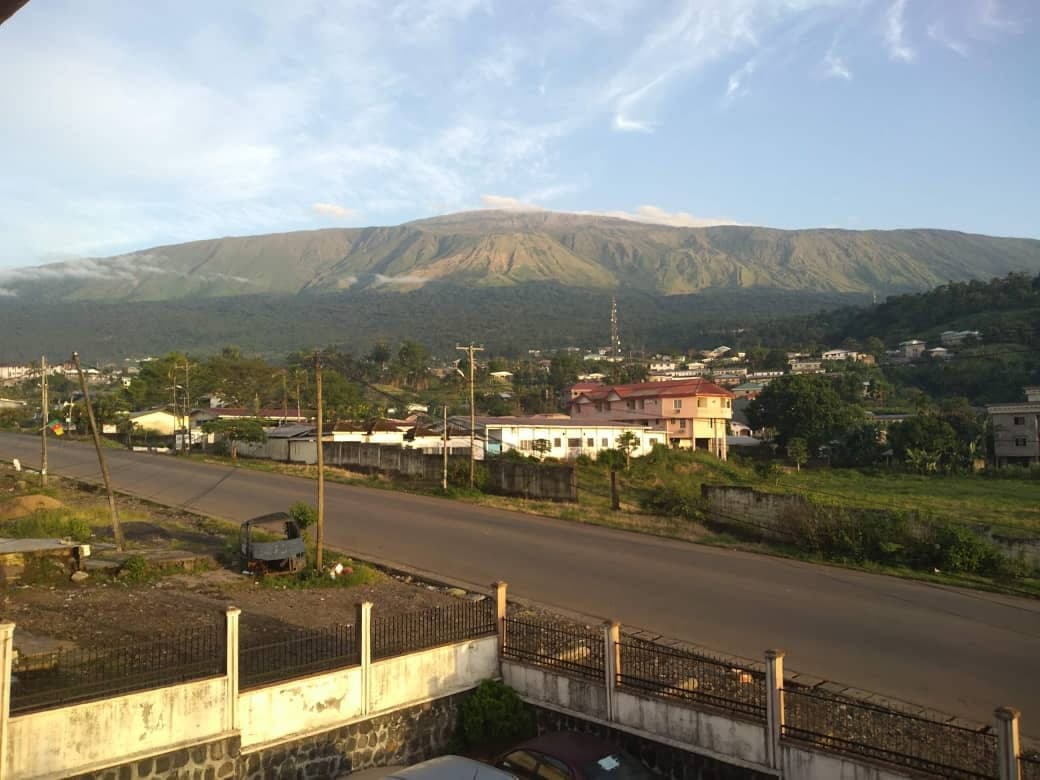
Cameroon is often called "Africa in miniature," and the phrase is closer to a map than a slogan. Over a few hundred kilometres it moves from Atlantic beaches at the foot of an active volcano, up through rainforest and the high western grasslands, into savanna, and on to the dry Sahel that touches Lake Chad. The nickname holds because the land shows almost every major climate of the continent at once, and the people match it: more than 250 groups speak more than 250 languages, and two European tongues, French and English, sit over them as the legacy of a divided colonial past.
The country's memory lives less in its climates than in specific institutions: the grassfields kingdoms of the west, the Fondoms, whose rulers still hold court in palaces of carved wood; the palace and museum at Foumban, seat of the Bamoun kings, and the script one of them invented from nothing; the ancestor skulls kept and fed in family compounds; and the makossa and bikutsi rhythms that carried Cameroon's name onto distant dance floors.
Cameroon lies at the hinge of West and Central Africa, its coastline on the Gulf of Guinea and its interior wedged among Nigeria, Chad, the Central African Republic, the Republic of Congo, Gabon and Equatorial Guinea. It covers about 475,442 square kilometres and holds roughly 31 million people, from rainforest in the humid south to high grasslands on the western plateaus and the flat Sahel of the Far North.
Its most commanding feature is Mount Cameroon, an active volcano reaching 4,095 metres, the highest point in West Africa and, along its seaward flank, one of the wettest places on earth; Bakweri tradition treats it as the home of a god, Efasa Moto. The country is bilingual by law: French across eight of its ten regions, English in the two western regions inherited from British rule, a division that shapes schooling and courts. Yaounde is the political capital; Douala, on the Wouri estuary, is the largest city and economic engine.
Yaounde. The federal capital sits on seven hills in the forested centre of the country, founded as a German post in 1888 on land of the Ewondo, a Beti people. It holds the seat of government, the national museum in the former presidential palace, and the home ground of the bikutsi rhythm.
Douala. Cameroon's port and commercial heart grew on the Wouri estuary the Portuguese named for its prawns. Home of the Duala people, it is the birthplace of makossa and of Manu Dibango, and its harbour handles most of the trade of Cameroon and several landlocked neighbours.
Foumban. The historic capital of the Bamoun kingdom, in the western grassfields, is the country's densest single site of royal art, from bronze casting to beadwork and embroidery, centred on the Sultan's Palace, the Rue des Artisans and the new Museum of the Bamoun Kings.
Bamenda. The chief city of the Northwest, high in the grassfields, is a hub of Anglophone life and Grassfields chieftaincy, ringed by Fondoms such as Bafut and Mankon whose palaces preserve the region's building traditions.
Buea. At the foot of Mount Cameroon, Buea was the capital of German Kamerun from 1901 to 1919 and keeps colonial-era buildings, including the old governor's residence. It is the base for climbers and for the annual Mount Cameroon Race of Hope.
Cameroon's recorded past begins near Lake Chad, where the Sao civilization flourished in the first millennium, leaving fortified towns and fine terracotta and bronze work whose heirs include the Kotoko peoples. The north lay within the orbit of the Kanem-Bornu empire, and in the early nineteenth century the Fulani jihad reached it: Modibo Adama, under the Sokoto Caliphate, founded the Adamawa Emirate around 1809, spreading Islam and a network of lamidats, or emirates, that still shape northern custom.
 The Bamun palace at Foumban holds the dynasty's regalia and archive, including material written in the script Sultan Njoya devised for his own language around 1896. CC BY-SA 3.0, via Wikimedia Commons.
In the western highlands a different order took shape. The grassfields filled with dozens of kingdoms and chiefdoms, the Fondoms, each led by a sacred ruler, the fon, and organised through regulatory societies and court art. The largest, the Kingdom of Bamum, was founded around 1394 by the conqueror Nchare Yen, with its capital at Foumban; its Bamileke neighbours developed their own dense traditions of masking and ancestral veneration.
European contact came by sea. Portuguese navigators reached the Wouri estuary in 1472 and, struck by the prawns in its waters, named it Rio dos Camaroes, the river of prawns, from which "Cameroon" descends. The coast became a zone of trade, including the slave trade, before Germany declared the protectorate of Kamerun in 1884 and pushed inland, meeting fierce resistance and, with the Bamoun, alliance under King Njoya. After Germany's defeat in the First World War, the territory was split under League of Nations mandates, the larger eastern share to France and two strips along the Nigerian border to Britain.
Independence came in two movements. French Cameroun became the Republic of Cameroon on 1 January 1960, and on 1 October 1961, after a United Nations plebiscite, the British-ruled Southern Cameroons joined it to form a federal republic, while the Northern Cameroons chose Nigeria. A unitary state followed in 1972. The bilingual settlement has held for decades, though grievances in the two English-speaking regions grew into open conflict from 2016; the situation remains unresolved, and this profile treats it only as context for a shared heritage.
Cameroon may be the most linguistically concentrated country in Africa. Alongside French and English, its people speak more than 250 indigenous languages from three of the continent's great families: Niger-Congo tongues (including the Bantu and Grassfields Bantu languages of the centre, south and west), Afro-Asiatic languages (Fulfulde, Hausa and the Chadic languages of the north), and Nilo-Saharan speech near Lake Chad. In the towns a French-based slang, Camfranglais, and Cameroonian Pidgin English braid these worlds together.
The name of the country carries its coastal origin: the Portuguese camaroes, prawns, applied to the Wouri estuary and later stretched over the whole territory, passing through German Kamerun and French Cameroun into English Cameroon. The most singular achievement belongs to the grassfields. Around 1896 King Ibrahim Njoya of Bamoun set out to give his kingdom a written record and devised, largely alone, an original script now known by its later syllabary, a-ka-u-ku. He refined it from a pictographic system of hundreds of signs toward a syllabary of roughly eighty characters, and used it for a chronicle of his people, a legal code, and medical texts. French administrators closed his palace school and suppressed the script after deposing him, but it survived, and its revival is now one of the more remarkable stories in African heritage.
The visual signature of Cameroon comes from the grassfields court arts, and Foumban is their capital. The Bamoun Sultan's Palace and its workshops produce brass and bronze figures cast by the lost-wax method, carved wooden thrones sheathed in glass beads and cowrie shells, and the great crest masks worn at royal festivals. Beaded double-headed serpents, elephants and spiders recur as royal emblems: the serpent for striking on two fronts, the spider for wisdom. Among the Bamileke and other grassfields peoples, elephant masks and feather headdresses appear at the dances of the regulatory societies, alongside the ancestral figures and carved house-posts of the fon's compound.
Music is the other great export. Makossa, born in Douala among the Duala in the mid-twentieth century, fuses local dance rhythm with jazz and Latin horns; the saxophonist Manu Dibango carried it worldwide with "Soul Makossa" in 1972. Bikutsi, whose name means roughly "beat the earth," grew from the music of the Beti and Ewondo peoples around Yaounde. The national dish is ndole, a stew of bitterleaf and ground peanuts with meat or fish, in a cooking that runs from grilled suya in the Muslim north to the palm-oil dishes of the forest south. And in a country of many divisions, football is the shared language: the Indomitable Lions, powered by Roger Milla in 1990 and later Samuel Eto'o, were the first African side to reach a World Cup quarter-final and won Olympic gold in 2000.
Cameroon is majority Christian, with roughly two thirds of the population divided between Roman Catholics and a range of Protestant churches, the fruit of European and American missions and, increasingly, home-grown Pentecostal movements. Islam accounts for about three in ten Cameroonians and predominates in the north, where the Fulani lamidats carried it from the early nineteenth century and Ramadan and Eid order the calendar of the emirates.
Beneath and beside both religions run the traditional beliefs of the many peoples, held outright by a small share of Cameroonians but woven through the practice of many more. Grassfields cosmology centres on the fon as intermediary between the living and the ancestors, on sacred forests and lakes, on spider divination, and above all on the continued presence of the dead. For many families, Christian or Muslim observance and older ancestral duties are felt not as a contradiction but as layers of the same life, most visibly at the moment of death.
In the western grassfields, death is not an exit but a change of address, and the customs surrounding it are among the most developed in Africa. Among the Bamileke and neighbouring peoples the burial is followed by the "cry-die," a period of public mourning, often about a week, in which close relatives shave their heads, wear dark or indigo cloth, and receive a stream of visitors who come to sit, weep and drum. Months or years later comes the far larger death celebration, a festival that formally raises the deceased to the rank of ancestor, with masked dances, gun salutes and feasting. These traditions are described here with respect, as living practices central to identity.
At the heart of grassfields remembrance is the veneration of ancestral skulls. Some time after the death celebration the designated heir may exhume the skull of a parent or grandparent and keep it in the family compound, in a clay pot or a small house-like shrine, as the permanent seat of that ancestor's presence. The skulls are cared for, consulted at important moments, and honoured with offerings of salt and palm oil; neglect is believed to bring misfortune, and their keeping is understood as the highest duty a descendant owes the dead.
Christian and Muslim rites overlay these older forms. Catholic and Protestant Cameroonians hold requiem masses, and the death celebration is often merged with a memorial mass a year on. Muslim Cameroonians in the north follow Islamic practice: the body is washed, shrouded and buried facing Mecca, ideally before the next sundown, and the family receives condolences over three days of prayer and Quran recitation. Across religions the pattern is the same in spirit: mourning is public and prolonged, and the great gatherings of the death celebration are frankly a celebration of a life.
Cameroon's archive is split three ways, and the reason is that three colonial powers governed it in succession.
Germany held Kamerun from 1884 to the First World War, and the German administrative record, including the plantation labour registers of the coastal estates, is largely in Berlin and Potsdam. After 1919 the territory was divided under League of Nations mandate between France and Britain, so the interwar and post-war record splits again: French files in Yaoundé and at Aix-en-Provence, British files for the Southern Cameroons in Buea and at Kew, administered as part of Nigeria. A family from Bamenda and a family from Douala therefore have their twentieth century documented in different countries, different languages and different systems, which is also, not coincidentally, the root of the anglophone crisis.
Mission registers are the most usable vital records: Basel, Baptist, Presbyterian and Catholic missions kept baptism and marriage books from the nineteenth century.
The Grassfields kingdoms are the older record. The fon of each chiefdom holds the succession, the palace keeps its regalia and its history, and the Kom, Bamum and Bamileke lineages are recited rather than filed. Bamum is the exception that proves the point: King Njoya devised a script for his language around 1896 and had the kingdom's history, laws and pharmacopoeia written down in it. Much of that archive was destroyed under French administration, and what remains is at Foumban.
The most concentrated effort surrounds the Bamoun heritage at Foumban. The Sultan's Palace, built in 1917 by King Njoya, has long housed a museum of the dynasty's regalia, and in April 2024 it was joined by the new Museum of the Bamoun Kings, a building shaped by the royal emblems of the two-headed serpent and the spider. Begun in 2013 under the late Sultan Ibrahim Mbombo Njoya, it gathers a reported ten thousand objects spanning more than six hundred years, from thrones and war regalia to musical instruments and manuscripts in Njoya's script.
Cameroon's two World Heritage sites are both natural: the Dja Faunal Reserve, inscribed in 1987, one of Africa's largest protected rainforests, home to gorillas, forest elephants and the Baka people who live within it; and the transboundary Sangha Trinational, inscribed in 2012, which joins Cameroon's Lobeke National Park to protected areas in the Central African Republic and the Republic of Congo. On the cultural side, several grassfields palaces sit on the UNESCO tentative list: the Bafut Chiefdom since 2006, and a wider nomination grouping the palaces of Bafut, Bandjoun, Bapa, Batoufam and Mankon as a serial site of the Fondoms.
Njoya's script has become an unlikely pioneer of digital preservation. From the early 2000s the Bamum Scripts and Archives Project, led by the historian Konrad Tuchscherer with the palace at Foumban, worked to conserve and digitise the king's manuscripts and teach the a-ka-u-ku syllabary anew; the Bamum script joined the Unicode standard in 2009, so it can be typed and read on ordinary devices.
More broadly, Cameroon's heritage circulates online through the catalogue of the new Museum of the Bamoun Kings, the recordings that keep makossa and bikutsi in global rotation, and a diaspora that documents death celebrations, festivals and family history online. For grassfields families scattered across France, Belgium and North America, video calls and shared archives increasingly carry duties of remembrance that once required a return home.
Cameroon's cultural reach outruns its size. "Soul Makossa" became one of the most sampled African recordings ever made, its hook resurfacing in global pop for half a century, and later artists, from the bassist Richard Bona to the singer Charlotte Dipanda, keep the country present in African music. In letters, Cameroon produced two founding figures of the francophone African novel, Mongo Beti and Ferdinand Oyono, and more recently Imbolo Mbue, whose debut "Behold the Dreamers" won the PEN/Faulkner Award in 2017.
The Indomitable Lions remain the most visible national symbol abroad. At home, festivals such as the Nguon of the Bamoun, inscribed by UNESCO in 2024, and the grassfields death celebrations draw the diaspora back each year, turning remembrance into a season of homecoming.
A king's alphabet, saved twice. Suppressed by colonial officials and nearly lost, the Bamum script was rescued by the palace and outside scholars, taught again at Foumban, and encoded into Unicode in 2009, so a script one man devised around 1896 can now travel on any phone.
Ten thousand objects, a purpose-built home. The 2024 Museum of the Bamoun Kings gave the dynasty's regalia a home built in the shape of its own emblems, one of the largest museum projects led by an African royal house in recent memory.
A dance seen by the world. Roger Milla's goals and corner-flag dance at the 1990 World Cup carried Cameroon into the quarter-finals, the first African team to reach that stage, and made the Indomitable Lions a lasting emblem of the game.
Rainforest held across three borders. The Sangha Trinational showed that neighbouring states could jointly protect one Congo Basin ecosystem, and Cameroon's Dja Reserve remains among Africa's most intact forests.
The Bamun palace at Foumban holds the dynasty's regalia and archive, including material written in the script Sultan Njoya devised for his own language around 1896. CC BY-SA 3.0, via Wikimedia Commons.
In the western highlands a different order took shape. The grassfields filled with dozens of kingdoms and chiefdoms, the Fondoms, each led by a sacred ruler, the fon, and organised through regulatory societies and court art. The largest, the Kingdom of Bamum, was founded around 1394 by the conqueror Nchare Yen, with its capital at Foumban; its Bamileke neighbours developed their own dense traditions of masking and ancestral veneration.
European contact came by sea. Portuguese navigators reached the Wouri estuary in 1472 and, struck by the prawns in its waters, named it Rio dos Camaroes, the river of prawns, from which "Cameroon" descends. The coast became a zone of trade, including the slave trade, before Germany declared the protectorate of Kamerun in 1884 and pushed inland, meeting fierce resistance and, with the Bamoun, alliance under King Njoya. After Germany's defeat in the First World War, the territory was split under League of Nations mandates, the larger eastern share to France and two strips along the Nigerian border to Britain.
Independence came in two movements. French Cameroun became the Republic of Cameroon on 1 January 1960, and on 1 October 1961, after a United Nations plebiscite, the British-ruled Southern Cameroons joined it to form a federal republic, while the Northern Cameroons chose Nigeria. A unitary state followed in 1972. The bilingual settlement has held for decades, though grievances in the two English-speaking regions grew into open conflict from 2016; the situation remains unresolved, and this profile treats it only as context for a shared heritage.
Cameroon may be the most linguistically concentrated country in Africa. Alongside French and English, its people speak more than 250 indigenous languages from three of the continent's great families: Niger-Congo tongues (including the Bantu and Grassfields Bantu languages of the centre, south and west), Afro-Asiatic languages (Fulfulde, Hausa and the Chadic languages of the north), and Nilo-Saharan speech near Lake Chad. In the towns a French-based slang, Camfranglais, and Cameroonian Pidgin English braid these worlds together.
The name of the country carries its coastal origin: the Portuguese camaroes, prawns, applied to the Wouri estuary and later stretched over the whole territory, passing through German Kamerun and French Cameroun into English Cameroon. The most singular achievement belongs to the grassfields. Around 1896 King Ibrahim Njoya of Bamoun set out to give his kingdom a written record and devised, largely alone, an original script now known by its later syllabary, a-ka-u-ku. He refined it from a pictographic system of hundreds of signs toward a syllabary of roughly eighty characters, and used it for a chronicle of his people, a legal code, and medical texts. French administrators closed his palace school and suppressed the script after deposing him, but it survived, and its revival is now one of the more remarkable stories in African heritage.
The visual signature of Cameroon comes from the grassfields court arts, and Foumban is their capital. The Bamoun Sultan's Palace and its workshops produce brass and bronze figures cast by the lost-wax method, carved wooden thrones sheathed in glass beads and cowrie shells, and the great crest masks worn at royal festivals. Beaded double-headed serpents, elephants and spiders recur as royal emblems: the serpent for striking on two fronts, the spider for wisdom. Among the Bamileke and other grassfields peoples, elephant masks and feather headdresses appear at the dances of the regulatory societies, alongside the ancestral figures and carved house-posts of the fon's compound.
Music is the other great export. Makossa, born in Douala among the Duala in the mid-twentieth century, fuses local dance rhythm with jazz and Latin horns; the saxophonist Manu Dibango carried it worldwide with "Soul Makossa" in 1972. Bikutsi, whose name means roughly "beat the earth," grew from the music of the Beti and Ewondo peoples around Yaounde. The national dish is ndole, a stew of bitterleaf and ground peanuts with meat or fish, in a cooking that runs from grilled suya in the Muslim north to the palm-oil dishes of the forest south. And in a country of many divisions, football is the shared language: the Indomitable Lions, powered by Roger Milla in 1990 and later Samuel Eto'o, were the first African side to reach a World Cup quarter-final and won Olympic gold in 2000.
Cameroon is majority Christian, with roughly two thirds of the population divided between Roman Catholics and a range of Protestant churches, the fruit of European and American missions and, increasingly, home-grown Pentecostal movements. Islam accounts for about three in ten Cameroonians and predominates in the north, where the Fulani lamidats carried it from the early nineteenth century and Ramadan and Eid order the calendar of the emirates.
Beneath and beside both religions run the traditional beliefs of the many peoples, held outright by a small share of Cameroonians but woven through the practice of many more. Grassfields cosmology centres on the fon as intermediary between the living and the ancestors, on sacred forests and lakes, on spider divination, and above all on the continued presence of the dead. For many families, Christian or Muslim observance and older ancestral duties are felt not as a contradiction but as layers of the same life, most visibly at the moment of death.
In the western grassfields, death is not an exit but a change of address, and the customs surrounding it are among the most developed in Africa. Among the Bamileke and neighbouring peoples the burial is followed by the "cry-die," a period of public mourning, often about a week, in which close relatives shave their heads, wear dark or indigo cloth, and receive a stream of visitors who come to sit, weep and drum. Months or years later comes the far larger death celebration, a festival that formally raises the deceased to the rank of ancestor, with masked dances, gun salutes and feasting. These traditions are described here with respect, as living practices central to identity.
At the heart of grassfields remembrance is the veneration of ancestral skulls. Some time after the death celebration the designated heir may exhume the skull of a parent or grandparent and keep it in the family compound, in a clay pot or a small house-like shrine, as the permanent seat of that ancestor's presence. The skulls are cared for, consulted at important moments, and honoured with offerings of salt and palm oil; neglect is believed to bring misfortune, and their keeping is understood as the highest duty a descendant owes the dead.
Christian and Muslim rites overlay these older forms. Catholic and Protestant Cameroonians hold requiem masses, and the death celebration is often merged with a memorial mass a year on. Muslim Cameroonians in the north follow Islamic practice: the body is washed, shrouded and buried facing Mecca, ideally before the next sundown, and the family receives condolences over three days of prayer and Quran recitation. Across religions the pattern is the same in spirit: mourning is public and prolonged, and the great gatherings of the death celebration are frankly a celebration of a life.
Cameroon's archive is split three ways, and the reason is that three colonial powers governed it in succession.
Germany held Kamerun from 1884 to the First World War, and the German administrative record, including the plantation labour registers of the coastal estates, is largely in Berlin and Potsdam. After 1919 the territory was divided under League of Nations mandate between France and Britain, so the interwar and post-war record splits again: French files in Yaoundé and at Aix-en-Provence, British files for the Southern Cameroons in Buea and at Kew, administered as part of Nigeria. A family from Bamenda and a family from Douala therefore have their twentieth century documented in different countries, different languages and different systems, which is also, not coincidentally, the root of the anglophone crisis.
Mission registers are the most usable vital records: Basel, Baptist, Presbyterian and Catholic missions kept baptism and marriage books from the nineteenth century.
The Grassfields kingdoms are the older record. The fon of each chiefdom holds the succession, the palace keeps its regalia and its history, and the Kom, Bamum and Bamileke lineages are recited rather than filed. Bamum is the exception that proves the point: King Njoya devised a script for his language around 1896 and had the kingdom's history, laws and pharmacopoeia written down in it. Much of that archive was destroyed under French administration, and what remains is at Foumban.
The most concentrated effort surrounds the Bamoun heritage at Foumban. The Sultan's Palace, built in 1917 by King Njoya, has long housed a museum of the dynasty's regalia, and in April 2024 it was joined by the new Museum of the Bamoun Kings, a building shaped by the royal emblems of the two-headed serpent and the spider. Begun in 2013 under the late Sultan Ibrahim Mbombo Njoya, it gathers a reported ten thousand objects spanning more than six hundred years, from thrones and war regalia to musical instruments and manuscripts in Njoya's script.
Cameroon's two World Heritage sites are both natural: the Dja Faunal Reserve, inscribed in 1987, one of Africa's largest protected rainforests, home to gorillas, forest elephants and the Baka people who live within it; and the transboundary Sangha Trinational, inscribed in 2012, which joins Cameroon's Lobeke National Park to protected areas in the Central African Republic and the Republic of Congo. On the cultural side, several grassfields palaces sit on the UNESCO tentative list: the Bafut Chiefdom since 2006, and a wider nomination grouping the palaces of Bafut, Bandjoun, Bapa, Batoufam and Mankon as a serial site of the Fondoms.
Njoya's script has become an unlikely pioneer of digital preservation. From the early 2000s the Bamum Scripts and Archives Project, led by the historian Konrad Tuchscherer with the palace at Foumban, worked to conserve and digitise the king's manuscripts and teach the a-ka-u-ku syllabary anew; the Bamum script joined the Unicode standard in 2009, so it can be typed and read on ordinary devices.
More broadly, Cameroon's heritage circulates online through the catalogue of the new Museum of the Bamoun Kings, the recordings that keep makossa and bikutsi in global rotation, and a diaspora that documents death celebrations, festivals and family history online. For grassfields families scattered across France, Belgium and North America, video calls and shared archives increasingly carry duties of remembrance that once required a return home.
Cameroon's cultural reach outruns its size. "Soul Makossa" became one of the most sampled African recordings ever made, its hook resurfacing in global pop for half a century, and later artists, from the bassist Richard Bona to the singer Charlotte Dipanda, keep the country present in African music. In letters, Cameroon produced two founding figures of the francophone African novel, Mongo Beti and Ferdinand Oyono, and more recently Imbolo Mbue, whose debut "Behold the Dreamers" won the PEN/Faulkner Award in 2017.
The Indomitable Lions remain the most visible national symbol abroad. At home, festivals such as the Nguon of the Bamoun, inscribed by UNESCO in 2024, and the grassfields death celebrations draw the diaspora back each year, turning remembrance into a season of homecoming.
A king's alphabet, saved twice. Suppressed by colonial officials and nearly lost, the Bamum script was rescued by the palace and outside scholars, taught again at Foumban, and encoded into Unicode in 2009, so a script one man devised around 1896 can now travel on any phone.
Ten thousand objects, a purpose-built home. The 2024 Museum of the Bamoun Kings gave the dynasty's regalia a home built in the shape of its own emblems, one of the largest museum projects led by an African royal house in recent memory.
A dance seen by the world. Roger Milla's goals and corner-flag dance at the 1990 World Cup carried Cameroon into the quarter-finals, the first African team to reach that stage, and made the Indomitable Lions a lasting emblem of the game.
Rainforest held across three borders. The Sangha Trinational showed that neighbouring states could jointly protect one Congo Basin ecosystem, and Cameroon's Dja Reserve remains among Africa's most intact forests.
National Overview
Notable Cities
Historical Foundations
Linguistic and Etymological Roots
Cultural Identity
Religion and Spirituality
Remembrance and Mourning Traditions
Tracing a Family in Cameroon
Heritage Preservation Efforts
Digital Heritage
Contemporary Cultural Influences
Success Stories
References and resources
- Encyclopaedia Britannica: Cameroon. Geography, peoples, history and government.
- Encyclopaedia Britannica: Bamum. The kingdom, King Njoya and the court arts.
- Library of Congress: Bamum Script, An African Writing System. Njoya's invention and the a-ka-u-ku syllabary.
- UNESCO World Heritage Centre: Cameroon. The state-party page with inscribed and tentative sites.
- UNESCO World Heritage Centre: Dja Faunal Reserve. The 1987 rainforest inscription.
- UNESCO World Heritage Centre: Sangha Trinational. The 2012 transboundary forest inscription.
- UNESCO World Heritage Centre: La Chefferie de Bafut. A grassfields palace on the tentative list.
- The Conversation: Museum of the Bamoun Kings. The 2024 museum at Foumban and its collection.
- Britannica: Buea. The former German capital at the foot of Mount Cameroon.