Heritage · Country
Croatia Culture and Heritage
When someone dies in a Croatian town, the news goes up on the walls: black-bordered death notices, the osmrtnice, pasted on kiosks and lamp posts so the whole community learns at once. A guide to the country's heritage, from a Roman emperor's palace still lived in after seventeen centuries to the water tower left in ruins as Vukovar's memorial to the siege.Written to last.
By Confinity Heritage Editorial · 2026-07-11 · 8-minute readQuiet tools, kept out of the way.
In a Croatian town a death is announced on the walls. Within hours of someone dying, printed notices with a black border, the osmrtnice, appear on kiosks, lamp posts and the special notice boards kept for the purpose, giving the name, the dates, the family and the time of the funeral, so that neighbours who never read a newspaper learn of the loss on their way to the shop. The custom turns mourning into a public act shared by a whole community, and it sits alongside a wider Croatian habit of keeping the dead close: the candle-lit cemeteries of All Saints' Day, the arcaded resting place at Mirogoj where Catholics, Orthodox, Muslims and Jews lie side by side, and, in the town of Vukovar, an entire war memory built around a shattered water tower left deliberately unrepaired.
Croatia is a small country with an unusually deep and layered inheritance. Its coast carries Greek colonies and Roman cities, one of which, the palace the emperor Diocletian built to retire in, still forms the living centre of Split seventeen centuries later. Its people held an independent merchant republic at Dubrovnik for more than four hundred years, fought a war of independence in the 1990s that scarred and then rebuilt their towns, and today safeguard one of the richest bodies of intangible heritage in Europe, from Dalmatian close-harmony singing to the lace of three separate towns.
.jpg%2F1280px-Old_Port_and_historical_center_of_Dubrovnik%252C_Croatia%252C_a_view_from_the_south_(48613003236).jpg&w=3840&q=75) The walled old town of Dubrovnik, the "Pearl of the Adriatic", a UNESCO World Heritage Site since 1979. CC BY 2.0, via Wikimedia Commons.
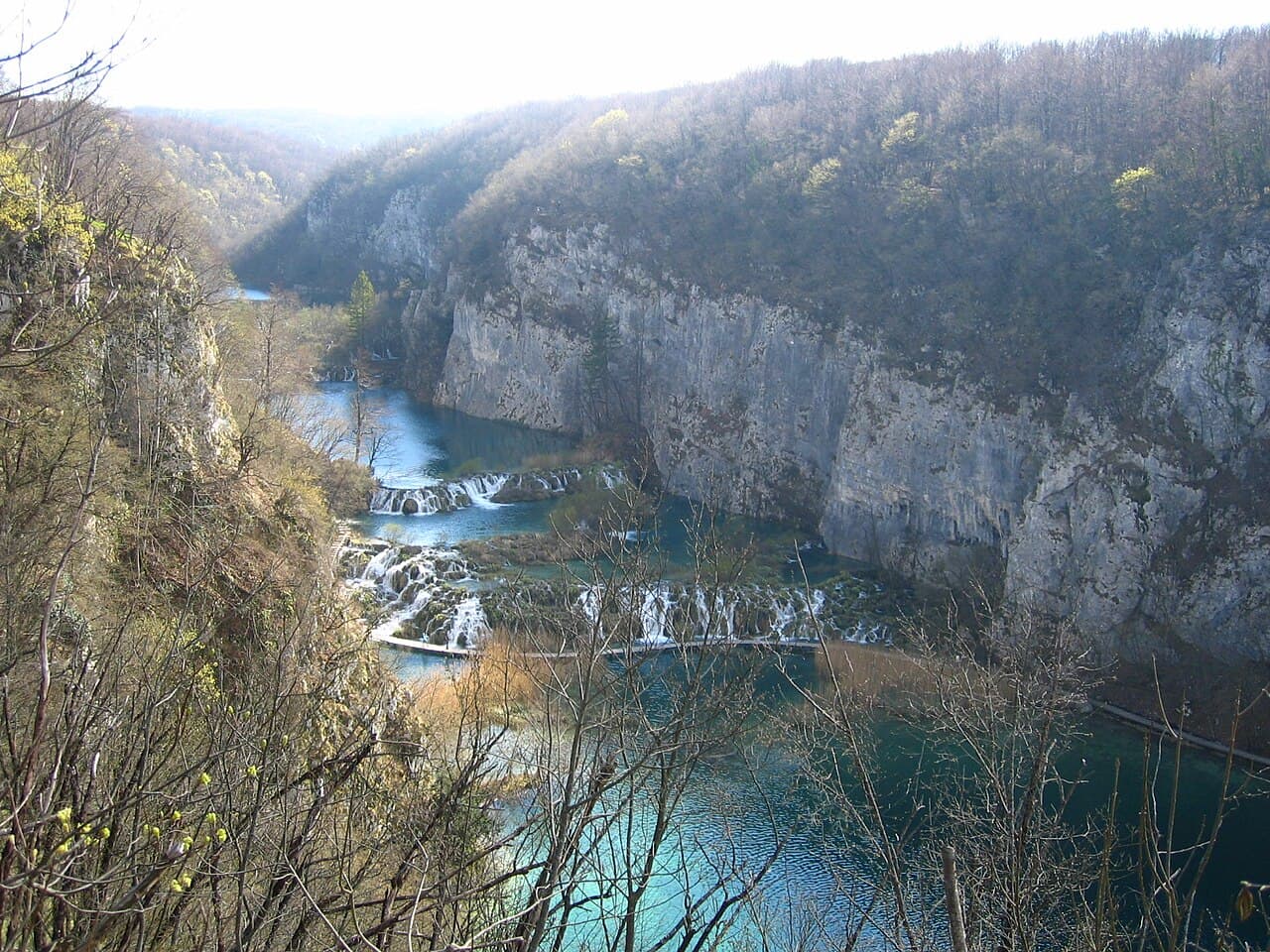
Croatia curves like a crescent across the meeting point of Central Europe, the Mediterranean and the Balkans, some 56,600 square kilometres wrapped around neighbouring Bosnia and Herzegovina. Its geography falls into three worlds: the flat, fertile Pannonian plain of Slavonia in the east, drained by the Sava, Drava and Danube; the rugged Dinaric mountains through the middle, where Dinara rises to 1,831 metres; and the long, indented Adriatic coast, one of the most beautiful in Europe, fringed by more than a thousand islands and islets. That coastline, with its clear water and Roman and Venetian towns, has made tourism a pillar of the modern economy, while inland the karst has carved wonders such as the terraced lakes and waterfalls of Plitvice.
The walled old town of Dubrovnik, the "Pearl of the Adriatic", a UNESCO World Heritage Site since 1979. CC BY 2.0, via Wikimedia Commons.
Croatia curves like a crescent across the meeting point of Central Europe, the Mediterranean and the Balkans, some 56,600 square kilometres wrapped around neighbouring Bosnia and Herzegovina. Its geography falls into three worlds: the flat, fertile Pannonian plain of Slavonia in the east, drained by the Sava, Drava and Danube; the rugged Dinaric mountains through the middle, where Dinara rises to 1,831 metres; and the long, indented Adriatic coast, one of the most beautiful in Europe, fringed by more than a thousand islands and islets. That coastline, with its clear water and Roman and Venetian towns, has made tourism a pillar of the modern economy, while inland the karst has carved wonders such as the terraced lakes and waterfalls of Plitvice.
.jpg%2F1280px-Mali_Prstavac_Waterfall_at_Gradinsko_Lake_in_Plitvice_Lakes_National_Park%252C_Croatia_(48669954983).jpg&w=3840&q=75) A waterfall in Plitvice Lakes National Park, Croatia's oldest national park and a UNESCO natural World Heritage Site since 1979. CC BY 2.0, via Wikimedia Commons.
Croatia's population, 3.87 million at the 2021 census, is falling and ageing, thinned by emigration since the country joined the European Union, and it is overwhelmingly Croat, about 92 per cent, with a Serb minority of just over 3 per cent and smaller Bosniak, Italian, Hungarian, Roma and Czech communities. The capital and largest city is Zagreb, in the north; Split, Rijeka and Osijek anchor the other regions. Croatia is a parliamentary republic that declared independence from Yugoslavia in 1991, fought a four-year war to secure it, joined the EU in 2013, and at the start of 2023 adopted the euro and entered the Schengen area, completing its integration into Western Europe within a single generation of independence.
Zagreb. The capital, a city of Austro-Hungarian avenues, is really two medieval hilltop towns, Gradec and Kaptol, that grew together around the cathedral. Its heritage institutions, the Croatian History Museum, the Mimara, the Museum of Broken Relationships, and its great arcaded cemetery at Mirogoj, make it the country's centre of memory as well as government, and the annual candle-lighting there on 1 November is one of the most moving public rituals in Croatia.
Split. Split grew, uniquely, inside a building. When the Roman emperor Diocletian retired around AD 305 he built a vast fortified palace on the Dalmatian coast, and when nearby Salona fell to invaders its refugees moved into the palace and never left; today some three thousand people live and trade within its ancient walls, the emperor's mausoleum long since turned into the cathedral. The Historical Complex of Split with the Palace of Diocletian has been a UNESCO World Heritage Site since 1979.
A waterfall in Plitvice Lakes National Park, Croatia's oldest national park and a UNESCO natural World Heritage Site since 1979. CC BY 2.0, via Wikimedia Commons.
Croatia's population, 3.87 million at the 2021 census, is falling and ageing, thinned by emigration since the country joined the European Union, and it is overwhelmingly Croat, about 92 per cent, with a Serb minority of just over 3 per cent and smaller Bosniak, Italian, Hungarian, Roma and Czech communities. The capital and largest city is Zagreb, in the north; Split, Rijeka and Osijek anchor the other regions. Croatia is a parliamentary republic that declared independence from Yugoslavia in 1991, fought a four-year war to secure it, joined the EU in 2013, and at the start of 2023 adopted the euro and entered the Schengen area, completing its integration into Western Europe within a single generation of independence.
Zagreb. The capital, a city of Austro-Hungarian avenues, is really two medieval hilltop towns, Gradec and Kaptol, that grew together around the cathedral. Its heritage institutions, the Croatian History Museum, the Mimara, the Museum of Broken Relationships, and its great arcaded cemetery at Mirogoj, make it the country's centre of memory as well as government, and the annual candle-lighting there on 1 November is one of the most moving public rituals in Croatia.
Split. Split grew, uniquely, inside a building. When the Roman emperor Diocletian retired around AD 305 he built a vast fortified palace on the Dalmatian coast, and when nearby Salona fell to invaders its refugees moved into the palace and never left; today some three thousand people live and trade within its ancient walls, the emperor's mausoleum long since turned into the cathedral. The Historical Complex of Split with the Palace of Diocletian has been a UNESCO World Heritage Site since 1979.
.jpg%2F1280px-Aerial_view_of_Diocletian's_Palace_in_Split%252C_Croatia_(48608247353).jpg&w=3840&q=75) Diocletian's Palace, built around AD 305 and still the living centre of Split seventeen centuries later. CC BY 2.0, via Wikimedia Commons.
Dubrovnik. The "Pearl of the Adriatic" was for centuries the Republic of Ragusa, an independent maritime city-state that rivalled Venice, ran a sophisticated diplomacy across the Mediterranean, and abolished the slave trade as early as 1416. Its complete circuit of walls, its marble Stradun and its Baroque churches survived a great earthquake in 1667 and then the shelling of 1991 and 1992, and it has been a World Heritage Site since 1979.
Vukovar. On the Danube in the east, Vukovar was a prosperous Baroque town until the Croatian War of Independence, when it endured an 87-day siege in 1991 that all but destroyed it and ended in a massacre of patients taken from its hospital. Rebuilt but forever marked, Vukovar has become the country's chief place of war remembrance, its ruined water tower preserved as a national memorial.
Zadar. An ancient Dalmatian port with a Roman forum at its heart, Zadar layers three thousand years of history and adds a contemporary note: the Sea Organ, an installation built into the waterfront steps that turns the movement of the waves into music, has made the old city a place where heritage and invention meet.
The Croatian coast was old before the Croats arrived. Greek sailors founded colonies on the islands of Vis and Hvar in the fourth century BC, and the plain of Stari Grad on Hvar still carries the field divisions those Greek settlers laid out, farmed continuously for some twenty-four centuries and inscribed by UNESCO in 2008. Rome absorbed the region as the provinces of Dalmatia and Pannonia, built cities such as Salona and the amphitheatre at Pula, and gave the coast the emperor Diocletian's palace. Slavic Croats settled the land in the seventh century, accepted Christianity, and by the early tenth century had a kingdom of their own, traditionally dated to the coronation of King Tomislav around 925.
In 1102 the Croatian nobility entered a union with the crown of Hungary that would shape the next eight centuries, while the Dalmatian coastal towns came under the long domination of Venice and Dubrovnik held its independence as the Republic of Ragusa. The Ottoman advance from the sixteenth century turned much of Croatia into a militarised frontier, the Military Frontier, and left a lasting borderland culture. After 1527 the Habsburgs ruled the Croatian lands, and a nineteenth-century national revival, the Illyrian movement led by figures such as Ljudevit Gaj, revived the language and the idea of a South Slavic future. That idea produced, after the First World War, the Kingdom of Serbs, Croats and Slovenes, later Yugoslavia. The Second World War was catastrophic and divisive: a fascist puppet state, the Ustaše regime, ran the Jasenovac concentration camp where tens of thousands of Serbs, Jews, Roma and antifascist Croats were murdered, while the communist-led Partisans fought a resistance that carried Croatia into socialist Yugoslavia under Tito. Croatia declared independence in 1991, survived the Homeland War of 1991 to 1995, and joined the European Union in 2013.
Croatian is a South Slavic language written, since Gaj's nineteenth-century reform, in a Latin alphabet with distinctive diacritics. It is unusual in the depth of its internal variety, divided into three dialect groups named for their word for "what": Štokavian, which underlies the standard language, Čakavian, spoken along much of the coast and the islands, and Kajkavian, the speech of the Zagreb region and the north-west. Before the Latin script took hold, medieval Croatian was written in the Glagolitic alphabet, the oldest known Slavic script, and Croatia preserved a Glagolitic liturgical and legal tradition longer than anywhere else; the Baška tablet, carved around 1100 on the island of Krk, is one of the oldest monuments of the Croatian language and names a Croatian king.
The country's own name, Hrvatska, comes from the ethnonym Hrvat, "Croat", whose ultimate origin is uncertain and much debated among scholars. The map layers the region's rulers: Latin and Venetian names cluster on the coast, where Split was the Roman Spalatum and Zadar the Venetian Zara; Hungarian and German traces mark the interior; and Ottoman Turkish words survive in the eastern borderlands. Croatian also gave one small word to the wider world: the necktie descends from the scarves worn by Croatian soldiers in the seventeenth century, which the French adopted as the cravate, so that a piece of Croatian military dress became a global item of formal clothing.
Croatia's cultural identity is carried above all by its intangible heritage, in which it is one of the most richly represented countries in Europe on UNESCO's lists. Along the Dalmatian coast, klapa singing, unaccompanied close-harmony song traditionally performed by groups of men, was inscribed in 2012 and remains a living popular art. The inland town of Sinj holds the Sinjska alka each August, a knights' tournament in which riders lance a small iron ring at the gallop, commemorating a victory over the Ottomans in 1715. Three separate towns, Lepoglava, Pag and the island of Hvar, keep distinct traditions of lacemaking recognised by UNESCO, and the sweet, painted gingerbread hearts of the north, the licitar, are a craft and a courtship gift inscribed in 2010.
Food and sport complete the picture. The coast eats Mediterranean, with olive oil, wine, cured pršut ham, fresh fish and dishes cooked under the peka, a bell-shaped lid heaped with embers; the continental interior turns to hearty stews, freshwater fish and paprika-rich cooking near the Hungarian border. Football is a national passion out of proportion to the country's size: Croatia reached the World Cup final in 2018 and took third place in 2022, and the achievements of players such as Luka Modrić are woven into national pride. The country also claims a striking roster of inventors and thinkers, from Nikola Tesla, born to a Serb family in the Croatian village of Smiljan, to the Nobel laureates Lavoslav Ružička and Vladimir Prelog, and it keeps a firm, if contested, claim to the explorer Marco Polo through the island of Korčula.
Croatia is one of the most strongly Catholic countries in Europe, and Roman Catholicism has been central to Croatian identity for more than a thousand years, ever since the early medieval kingdom aligned itself with Rome rather than Byzantium; at the 2021 census about 79 per cent of the population identified as Catholic. The faith is bound up with nationhood, and its calendar shapes the year, from Christmas and Easter to the patron-saint festivals of the towns. The greatest of these is the Feast of St Blaise, Sveti Vlaho, the patron of Dubrovnik, celebrated each 3 February with processions and the display of relics in a tradition inscribed by UNESCO in 2009; Marija Bistrica, north of Zagreb, is the national Marian shrine, drawing pilgrims to its Black Madonna.
The religious landscape is not uniform. A Serbian Orthodox minority, historically concentrated in the former Military Frontier, maintains its own churches and monasteries; there is a long-established Muslim community, mostly Bosniak, served by the striking modern mosque and Islamic centre in Zagreb; and small Jewish and Protestant communities complete the picture. Croatia's spiritual heritage is also distinctively material and dramatic. On the island of Hvar, six villages hold the Za Križen, the "Following the Cross" procession, through the night of Maundy Thursday into Good Friday, a five-century-old penitential walk led by a barefoot cross-bearer, inscribed by UNESCO in 2009. The Glagolitic liturgical tradition, sung in Old Church Slavonic, survived on the Adriatic islands into modern times and remains a point of pride in the country's religious memory.
Croatian mourning combines Catholic ritual with customs that are strongly public and communal. Death is announced on the walls of the town through the black-bordered osmrtnice, the printed notices that give the community the news and the funeral time; a wake and vigil follow, then a Requiem Mass and burial, for Croatia, unlike much of Western Europe, still buries far more of its dead than it cremates. The family gathers afterward for a meal, and prayers and Masses are offered again at set intervals, particularly the seventh day and the first anniversary. The strongest day of collective remembrance is All Saints' Day, Svi sveti, on 1 November, when Croatians travel to their family graves, lay chrysanthemums and light candles, and whole cemeteries glow after dark; the day before, All Souls', extends the remembrance of the departed.
Nowhere is this material culture of death more concentrated than at Mirogoj, the great cemetery of Zagreb. Laid out from 1876 and given its monumental neo-Renaissance arcades, cupolas and entrance church by the architect Herman Bollé, whose 500-metre arcade with its twenty domes was finished only in 1929, Mirogoj is a deliberately non-denominational resting place where the graves of Catholics, Orthodox Christians, Muslims, Jews and the non-religious stand together, and where much of the Croatian national pantheon is buried, from the writer and politician Stjepan Radić to the country's first president, Franjo Tuđman. It functions as an open-air gallery of Croatian sculpture and a statement, in stone, that the nation's dead belong together.
Diocletian's Palace, built around AD 305 and still the living centre of Split seventeen centuries later. CC BY 2.0, via Wikimedia Commons.
Dubrovnik. The "Pearl of the Adriatic" was for centuries the Republic of Ragusa, an independent maritime city-state that rivalled Venice, ran a sophisticated diplomacy across the Mediterranean, and abolished the slave trade as early as 1416. Its complete circuit of walls, its marble Stradun and its Baroque churches survived a great earthquake in 1667 and then the shelling of 1991 and 1992, and it has been a World Heritage Site since 1979.
Vukovar. On the Danube in the east, Vukovar was a prosperous Baroque town until the Croatian War of Independence, when it endured an 87-day siege in 1991 that all but destroyed it and ended in a massacre of patients taken from its hospital. Rebuilt but forever marked, Vukovar has become the country's chief place of war remembrance, its ruined water tower preserved as a national memorial.
Zadar. An ancient Dalmatian port with a Roman forum at its heart, Zadar layers three thousand years of history and adds a contemporary note: the Sea Organ, an installation built into the waterfront steps that turns the movement of the waves into music, has made the old city a place where heritage and invention meet.
The Croatian coast was old before the Croats arrived. Greek sailors founded colonies on the islands of Vis and Hvar in the fourth century BC, and the plain of Stari Grad on Hvar still carries the field divisions those Greek settlers laid out, farmed continuously for some twenty-four centuries and inscribed by UNESCO in 2008. Rome absorbed the region as the provinces of Dalmatia and Pannonia, built cities such as Salona and the amphitheatre at Pula, and gave the coast the emperor Diocletian's palace. Slavic Croats settled the land in the seventh century, accepted Christianity, and by the early tenth century had a kingdom of their own, traditionally dated to the coronation of King Tomislav around 925.
In 1102 the Croatian nobility entered a union with the crown of Hungary that would shape the next eight centuries, while the Dalmatian coastal towns came under the long domination of Venice and Dubrovnik held its independence as the Republic of Ragusa. The Ottoman advance from the sixteenth century turned much of Croatia into a militarised frontier, the Military Frontier, and left a lasting borderland culture. After 1527 the Habsburgs ruled the Croatian lands, and a nineteenth-century national revival, the Illyrian movement led by figures such as Ljudevit Gaj, revived the language and the idea of a South Slavic future. That idea produced, after the First World War, the Kingdom of Serbs, Croats and Slovenes, later Yugoslavia. The Second World War was catastrophic and divisive: a fascist puppet state, the Ustaše regime, ran the Jasenovac concentration camp where tens of thousands of Serbs, Jews, Roma and antifascist Croats were murdered, while the communist-led Partisans fought a resistance that carried Croatia into socialist Yugoslavia under Tito. Croatia declared independence in 1991, survived the Homeland War of 1991 to 1995, and joined the European Union in 2013.
Croatian is a South Slavic language written, since Gaj's nineteenth-century reform, in a Latin alphabet with distinctive diacritics. It is unusual in the depth of its internal variety, divided into three dialect groups named for their word for "what": Štokavian, which underlies the standard language, Čakavian, spoken along much of the coast and the islands, and Kajkavian, the speech of the Zagreb region and the north-west. Before the Latin script took hold, medieval Croatian was written in the Glagolitic alphabet, the oldest known Slavic script, and Croatia preserved a Glagolitic liturgical and legal tradition longer than anywhere else; the Baška tablet, carved around 1100 on the island of Krk, is one of the oldest monuments of the Croatian language and names a Croatian king.
The country's own name, Hrvatska, comes from the ethnonym Hrvat, "Croat", whose ultimate origin is uncertain and much debated among scholars. The map layers the region's rulers: Latin and Venetian names cluster on the coast, where Split was the Roman Spalatum and Zadar the Venetian Zara; Hungarian and German traces mark the interior; and Ottoman Turkish words survive in the eastern borderlands. Croatian also gave one small word to the wider world: the necktie descends from the scarves worn by Croatian soldiers in the seventeenth century, which the French adopted as the cravate, so that a piece of Croatian military dress became a global item of formal clothing.
Croatia's cultural identity is carried above all by its intangible heritage, in which it is one of the most richly represented countries in Europe on UNESCO's lists. Along the Dalmatian coast, klapa singing, unaccompanied close-harmony song traditionally performed by groups of men, was inscribed in 2012 and remains a living popular art. The inland town of Sinj holds the Sinjska alka each August, a knights' tournament in which riders lance a small iron ring at the gallop, commemorating a victory over the Ottomans in 1715. Three separate towns, Lepoglava, Pag and the island of Hvar, keep distinct traditions of lacemaking recognised by UNESCO, and the sweet, painted gingerbread hearts of the north, the licitar, are a craft and a courtship gift inscribed in 2010.
Food and sport complete the picture. The coast eats Mediterranean, with olive oil, wine, cured pršut ham, fresh fish and dishes cooked under the peka, a bell-shaped lid heaped with embers; the continental interior turns to hearty stews, freshwater fish and paprika-rich cooking near the Hungarian border. Football is a national passion out of proportion to the country's size: Croatia reached the World Cup final in 2018 and took third place in 2022, and the achievements of players such as Luka Modrić are woven into national pride. The country also claims a striking roster of inventors and thinkers, from Nikola Tesla, born to a Serb family in the Croatian village of Smiljan, to the Nobel laureates Lavoslav Ružička and Vladimir Prelog, and it keeps a firm, if contested, claim to the explorer Marco Polo through the island of Korčula.
Croatia is one of the most strongly Catholic countries in Europe, and Roman Catholicism has been central to Croatian identity for more than a thousand years, ever since the early medieval kingdom aligned itself with Rome rather than Byzantium; at the 2021 census about 79 per cent of the population identified as Catholic. The faith is bound up with nationhood, and its calendar shapes the year, from Christmas and Easter to the patron-saint festivals of the towns. The greatest of these is the Feast of St Blaise, Sveti Vlaho, the patron of Dubrovnik, celebrated each 3 February with processions and the display of relics in a tradition inscribed by UNESCO in 2009; Marija Bistrica, north of Zagreb, is the national Marian shrine, drawing pilgrims to its Black Madonna.
The religious landscape is not uniform. A Serbian Orthodox minority, historically concentrated in the former Military Frontier, maintains its own churches and monasteries; there is a long-established Muslim community, mostly Bosniak, served by the striking modern mosque and Islamic centre in Zagreb; and small Jewish and Protestant communities complete the picture. Croatia's spiritual heritage is also distinctively material and dramatic. On the island of Hvar, six villages hold the Za Križen, the "Following the Cross" procession, through the night of Maundy Thursday into Good Friday, a five-century-old penitential walk led by a barefoot cross-bearer, inscribed by UNESCO in 2009. The Glagolitic liturgical tradition, sung in Old Church Slavonic, survived on the Adriatic islands into modern times and remains a point of pride in the country's religious memory.
Croatian mourning combines Catholic ritual with customs that are strongly public and communal. Death is announced on the walls of the town through the black-bordered osmrtnice, the printed notices that give the community the news and the funeral time; a wake and vigil follow, then a Requiem Mass and burial, for Croatia, unlike much of Western Europe, still buries far more of its dead than it cremates. The family gathers afterward for a meal, and prayers and Masses are offered again at set intervals, particularly the seventh day and the first anniversary. The strongest day of collective remembrance is All Saints' Day, Svi sveti, on 1 November, when Croatians travel to their family graves, lay chrysanthemums and light candles, and whole cemeteries glow after dark; the day before, All Souls', extends the remembrance of the departed.
Nowhere is this material culture of death more concentrated than at Mirogoj, the great cemetery of Zagreb. Laid out from 1876 and given its monumental neo-Renaissance arcades, cupolas and entrance church by the architect Herman Bollé, whose 500-metre arcade with its twenty domes was finished only in 1929, Mirogoj is a deliberately non-denominational resting place where the graves of Catholics, Orthodox Christians, Muslims, Jews and the non-religious stand together, and where much of the Croatian national pantheon is buried, from the writer and politician Stjepan Radić to the country's first president, Franjo Tuđman. It functions as an open-air gallery of Croatian sculpture and a statement, in stone, that the nation's dead belong together.
.jpg%2F1280px-Zagreb_-_Mirogoj_(44703469075).jpg&w=3840&q=75) The arcades of Mirogoj cemetery in Zagreb, designed by Herman Bollé, where Croatians of every faith are buried together. CC BY 2.0, via Wikimedia Commons.
The deepest wound in modern Croatian memory is the Homeland War, and its rituals centre on Vukovar. Each 18 November, Remembrance Day for the Victims of Vukovar, tens of thousands of people walk the Column of Remembrance from the town's hospital to the Memorial Cemetery, its field of white crosses marking those killed in the 1991 siege and the massacre of patients taken from the hospital to Ovčara. The town's water tower, left standing in ruins and floodlit at night, has been preserved as a national memorial to the siege, and reopened in 2020 with an interior exhibition. Older layers of remembrance survive alongside: the medieval carved tombstones called stećci, scattered across the Cetina hinterland and shared with Bosnia and neighbouring states, were jointly inscribed by UNESCO in 2016, and the Jasenovac Memorial Site marks the victims of the wartime camp, each a reminder that Croatia's ground, like so much of Central Europe, is thick with the dead of the twentieth century.
Croatian parish registers are old, well kept and, since the State Archives digitised them, free.
Matične knjige, the registers of baptism, marriage and death, survive from the sixteenth century in parts of Dalmatia and Istria and from the seventeenth and eighteenth almost everywhere else. The Croatian State Archives publish scans, and because the Catholic Church kept civil registration duties until 1946 in most of the country, those books are the vital record for the whole period rather than only the religious one.
The complication is which empire. Coastal Dalmatia was Venetian, then Austrian; the interior was Habsburg; Slavonia and the Military Frontier had their own administration; parts were Ottoman for a long period; and Istria and the islands passed through Italian hands in the twentieth century. Records are correspondingly in Latin, Italian, German, Hungarian and Croatian, and some are in Vienna, Budapest, Venice or Trieste.
The Military Frontier records deserve their own mention. For centuries a militarised strip along the Ottoman border was administered directly by Vienna, and every household in it owed military service, so the army kept detailed household registers of the population. For families from that zone the military record is better than the civil one.
Emigration is the modern layer: substantial Croatian communities in the United States, Chile, Argentina, Australia and New Zealand, whose passenger and naturalisation records complete lines that stop at a village.
Croatia protects its heritage through the Ministry of Culture and Media, which maintains the register of cultural goods, and through the Croatian Conservation Institute, whose restorers work on everything from Roman mosaics to Baroque altarpieces. The country holds ten UNESCO World Heritage Sites, among the highest tallies in the region relative to its size: the historic cores of Dubrovnik, Split and Trogir; the Euphrasian Basilica in Poreč and the Cathedral of St James in Šibenik; the Stari Grad Plain on Hvar; the stećci tombstones; and, on the natural side, the Plitvice Lakes and, shared with other countries, the ancient beech forests and the Venetian defensive works that include the fortifications of Zadar and Šibenik. Croatia is also a leader in intangible heritage, with more than a dozen elements on UNESCO's lists, from klapa and lacemaking to the bell-ringers of the Kastav carnival.
The country's defining conservation achievement is the restoration of Dubrovnik. When the walled city was bombarded during the siege of 1991 and 1992, more than half of its buildings were hit and many roofs and monuments damaged; UNESCO placed the site on its List of World Heritage in Danger and coordinated an international rescue. Working to strict conservation standards, using the traditional stone and tile of the region, Croatian and international restorers repaired the city so thoroughly that it was removed from the danger list in 1998, and Dubrovnik became a case study in how to heal a bombarded historic town. Similar care has gone into the reconstruction of Vukovar's Baroque centre and the ongoing conservation of Diocletian's Palace, where the challenge is not war but the pressure of tourism on a living monument.
Croatia has moved steadily to put its documentary heritage online. The National and University Library in Zagreb runs the country's digital library and portals that gather digitised books, manuscripts, newspapers and the Glagolitic and other early written treasures of the Croatian tradition, while the Croatian State Archives and the network of county archives hold the registers on which family history depends. For genealogists, the great resource is the parish and civil registers, the matične knjige of births, marriages and deaths, many of which have been microfilmed and digitised in partnership with FamilySearch, opening the records of Dalmatian, Slavonian and Istrian villages to descendants scattered across the Americas and Australia.
War and memory have their own digital projects. The documentation of the Homeland War, including the events at Vukovar and Ovčara, has been gathered by memorial institutions and by the courts that tried the crimes, creating a searchable record for a generation that did not live through the 1990s. Museums have digitised too: Zagreb's unusual Museum of Broken Relationships, which began as a travelling art project and became a permanent institution, keeps an online collection of donated objects and the stories of lost love attached to them, an idiosyncratic but genuine archive of ordinary emotional life. Croatian cultural portals aggregate the collections of dozens of museums and galleries, bringing the country's dispersed heritage into a single searchable space.
For a country of under four million, Croatia projects a large cultural footprint, and much of it now travels through the diaspora and through the screen. Croatian communities abroad are enormous relative to the homeland, with large populations in the United States, Canada, Australia, Chile, Argentina and Germany, many descended from waves of economic emigration and from the upheavals of the twentieth century; these communities keep folklore ensembles, tamburica orchestras, churches and heritage societies, and they remain closely tied to the towns and islands their families left. Their remittances, visits and cultural work make the diaspora a second Croatia, and a living guardian of custom.
At home, contemporary Croatia has become a stage for the world. Dubrovnik's walls stood in for King's Landing in the television series Game of Thrones, and Diocletian's Palace and other sites have drawn film crews and the tourists who follow them, forcing the country to balance the economic pull of the screen against the wear on fragile monuments. Croatian music runs from the klapa revival and the tamburica tradition to pop and electronic acts that tour Europe, and the country's writers and filmmakers increasingly examine the war of the 1990s and its long aftermath. Public debate turns, as in much of the region, on how to remember a contested twentieth century, from the crimes of the Ustaše state to the Homeland War, and Croatia argues, sometimes fiercely, about which monuments, names and narratives its heritage should carry forward.
The healing of Dubrovnik. After the shelling of 1991 and 1992 left more than half its buildings damaged, the walled city of Dubrovnik was restored to UNESCO's exacting standards, using traditional materials and techniques, and removed from the List of World Heritage in Danger in 1998. It is one of the clearest demonstrations anywhere that a bombarded historic town can be brought back with its authenticity intact.
A palace that never emptied. Diocletian's Palace in Split has been continuously inhabited for some seventeen centuries, its Roman halls and temples adapted into cathedral, houses, shops and squares by every generation since Salona's refugees moved in. Its survival as a living settlement, rather than a ruin behind a fence, is a rare example of heritage kept alive by simply never abandoning it.
The tower that stayed broken. Vukovar's water tower, shattered by hundreds of shell hits during the 1991 siege, was deliberately left unrepaired and stabilised as a ruin, then reopened in 2020 with a memorial exhibition inside. It has become the emblem of Croatian war remembrance, a monument whose damage is the point.
Twenty-four centuries of the same fields. The Stari Grad Plain on the island of Hvar preserves the agricultural landscape that Greek colonists divided into geometric plots in the fourth century BC, still worked for wine and olives today and inscribed by UNESCO in 2008, a continuity of land use almost unmatched in the Mediterranean.
A cemetery for everyone. Mirogoj in Zagreb, conceived in the nineteenth century as a resting place open to every faith and designed as a single monumental ensemble by Herman Bollé, remains a working cemetery and an open-air museum where Catholics, Orthodox Christians, Muslims, Jews and the non-religious of Croatia lie together, an enduring civic statement about who belongs to the nation's memory.
The arcades of Mirogoj cemetery in Zagreb, designed by Herman Bollé, where Croatians of every faith are buried together. CC BY 2.0, via Wikimedia Commons.
The deepest wound in modern Croatian memory is the Homeland War, and its rituals centre on Vukovar. Each 18 November, Remembrance Day for the Victims of Vukovar, tens of thousands of people walk the Column of Remembrance from the town's hospital to the Memorial Cemetery, its field of white crosses marking those killed in the 1991 siege and the massacre of patients taken from the hospital to Ovčara. The town's water tower, left standing in ruins and floodlit at night, has been preserved as a national memorial to the siege, and reopened in 2020 with an interior exhibition. Older layers of remembrance survive alongside: the medieval carved tombstones called stećci, scattered across the Cetina hinterland and shared with Bosnia and neighbouring states, were jointly inscribed by UNESCO in 2016, and the Jasenovac Memorial Site marks the victims of the wartime camp, each a reminder that Croatia's ground, like so much of Central Europe, is thick with the dead of the twentieth century.
Croatian parish registers are old, well kept and, since the State Archives digitised them, free.
Matične knjige, the registers of baptism, marriage and death, survive from the sixteenth century in parts of Dalmatia and Istria and from the seventeenth and eighteenth almost everywhere else. The Croatian State Archives publish scans, and because the Catholic Church kept civil registration duties until 1946 in most of the country, those books are the vital record for the whole period rather than only the religious one.
The complication is which empire. Coastal Dalmatia was Venetian, then Austrian; the interior was Habsburg; Slavonia and the Military Frontier had their own administration; parts were Ottoman for a long period; and Istria and the islands passed through Italian hands in the twentieth century. Records are correspondingly in Latin, Italian, German, Hungarian and Croatian, and some are in Vienna, Budapest, Venice or Trieste.
The Military Frontier records deserve their own mention. For centuries a militarised strip along the Ottoman border was administered directly by Vienna, and every household in it owed military service, so the army kept detailed household registers of the population. For families from that zone the military record is better than the civil one.
Emigration is the modern layer: substantial Croatian communities in the United States, Chile, Argentina, Australia and New Zealand, whose passenger and naturalisation records complete lines that stop at a village.
Croatia protects its heritage through the Ministry of Culture and Media, which maintains the register of cultural goods, and through the Croatian Conservation Institute, whose restorers work on everything from Roman mosaics to Baroque altarpieces. The country holds ten UNESCO World Heritage Sites, among the highest tallies in the region relative to its size: the historic cores of Dubrovnik, Split and Trogir; the Euphrasian Basilica in Poreč and the Cathedral of St James in Šibenik; the Stari Grad Plain on Hvar; the stećci tombstones; and, on the natural side, the Plitvice Lakes and, shared with other countries, the ancient beech forests and the Venetian defensive works that include the fortifications of Zadar and Šibenik. Croatia is also a leader in intangible heritage, with more than a dozen elements on UNESCO's lists, from klapa and lacemaking to the bell-ringers of the Kastav carnival.
The country's defining conservation achievement is the restoration of Dubrovnik. When the walled city was bombarded during the siege of 1991 and 1992, more than half of its buildings were hit and many roofs and monuments damaged; UNESCO placed the site on its List of World Heritage in Danger and coordinated an international rescue. Working to strict conservation standards, using the traditional stone and tile of the region, Croatian and international restorers repaired the city so thoroughly that it was removed from the danger list in 1998, and Dubrovnik became a case study in how to heal a bombarded historic town. Similar care has gone into the reconstruction of Vukovar's Baroque centre and the ongoing conservation of Diocletian's Palace, where the challenge is not war but the pressure of tourism on a living monument.
Croatia has moved steadily to put its documentary heritage online. The National and University Library in Zagreb runs the country's digital library and portals that gather digitised books, manuscripts, newspapers and the Glagolitic and other early written treasures of the Croatian tradition, while the Croatian State Archives and the network of county archives hold the registers on which family history depends. For genealogists, the great resource is the parish and civil registers, the matične knjige of births, marriages and deaths, many of which have been microfilmed and digitised in partnership with FamilySearch, opening the records of Dalmatian, Slavonian and Istrian villages to descendants scattered across the Americas and Australia.
War and memory have their own digital projects. The documentation of the Homeland War, including the events at Vukovar and Ovčara, has been gathered by memorial institutions and by the courts that tried the crimes, creating a searchable record for a generation that did not live through the 1990s. Museums have digitised too: Zagreb's unusual Museum of Broken Relationships, which began as a travelling art project and became a permanent institution, keeps an online collection of donated objects and the stories of lost love attached to them, an idiosyncratic but genuine archive of ordinary emotional life. Croatian cultural portals aggregate the collections of dozens of museums and galleries, bringing the country's dispersed heritage into a single searchable space.
For a country of under four million, Croatia projects a large cultural footprint, and much of it now travels through the diaspora and through the screen. Croatian communities abroad are enormous relative to the homeland, with large populations in the United States, Canada, Australia, Chile, Argentina and Germany, many descended from waves of economic emigration and from the upheavals of the twentieth century; these communities keep folklore ensembles, tamburica orchestras, churches and heritage societies, and they remain closely tied to the towns and islands their families left. Their remittances, visits and cultural work make the diaspora a second Croatia, and a living guardian of custom.
At home, contemporary Croatia has become a stage for the world. Dubrovnik's walls stood in for King's Landing in the television series Game of Thrones, and Diocletian's Palace and other sites have drawn film crews and the tourists who follow them, forcing the country to balance the economic pull of the screen against the wear on fragile monuments. Croatian music runs from the klapa revival and the tamburica tradition to pop and electronic acts that tour Europe, and the country's writers and filmmakers increasingly examine the war of the 1990s and its long aftermath. Public debate turns, as in much of the region, on how to remember a contested twentieth century, from the crimes of the Ustaše state to the Homeland War, and Croatia argues, sometimes fiercely, about which monuments, names and narratives its heritage should carry forward.
The healing of Dubrovnik. After the shelling of 1991 and 1992 left more than half its buildings damaged, the walled city of Dubrovnik was restored to UNESCO's exacting standards, using traditional materials and techniques, and removed from the List of World Heritage in Danger in 1998. It is one of the clearest demonstrations anywhere that a bombarded historic town can be brought back with its authenticity intact.
A palace that never emptied. Diocletian's Palace in Split has been continuously inhabited for some seventeen centuries, its Roman halls and temples adapted into cathedral, houses, shops and squares by every generation since Salona's refugees moved in. Its survival as a living settlement, rather than a ruin behind a fence, is a rare example of heritage kept alive by simply never abandoning it.
The tower that stayed broken. Vukovar's water tower, shattered by hundreds of shell hits during the 1991 siege, was deliberately left unrepaired and stabilised as a ruin, then reopened in 2020 with a memorial exhibition inside. It has become the emblem of Croatian war remembrance, a monument whose damage is the point.
Twenty-four centuries of the same fields. The Stari Grad Plain on the island of Hvar preserves the agricultural landscape that Greek colonists divided into geometric plots in the fourth century BC, still worked for wine and olives today and inscribed by UNESCO in 2008, a continuity of land use almost unmatched in the Mediterranean.
A cemetery for everyone. Mirogoj in Zagreb, conceived in the nineteenth century as a resting place open to every faith and designed as a single monumental ensemble by Herman Bollé, remains a working cemetery and an open-air museum where Catholics, Orthodox Christians, Muslims, Jews and the non-religious of Croatia lie together, an enduring civic statement about who belongs to the nation's memory.
National Overview
Notable Cities
Historical Foundations
Linguistic and Etymological Roots
Cultural Identity
Religion and Spirituality
Remembrance and Mourning Traditions
Tracing a Family in Croatia
Heritage Preservation Efforts
Digital Heritage
Contemporary Cultural Influences
Success Stories
References and resources
- UNESCO World Heritage Centre, Croatia, the state-party page listing Croatia's ten World Heritage sites.
- UNESCO Intangible Cultural Heritage, Croatia, klapa singing, lacemaking, the Sinjska alka and Croatia's other inscribed traditions.
- Ministry of Culture and Media of the Republic of Croatia, the national body for heritage protection and the register of cultural goods.
- Croatian State Archives, the national archives holding civil and church registers and historical records.
- Croatian Conservation Institute, the national institution for the restoration and conservation of heritage.
- Memorial Centre of the Homeland War, Vukovar, the museum and memorial complex documenting the 1991 siege and its victims.
- National and University Library in Zagreb, the country's principal library and digital heritage collections.
- Encyclopaedia Britannica, Croatia, geography, history and cultural background.