Heritage · Country
Bosnia and Herzegovina Culture and Heritage
In 1993 the Old Bridge of Mostar fell into the Neretva after standing for 427 years; in 2004 it rose again from the same stone. A guide to a country that has learned to mourn what it loses and, patiently, to put much of it back.Written to last.
By Confinity Heritage Editorial · Updated 2026-07-31 · 8-minute readQuiet tools, kept out of the way.
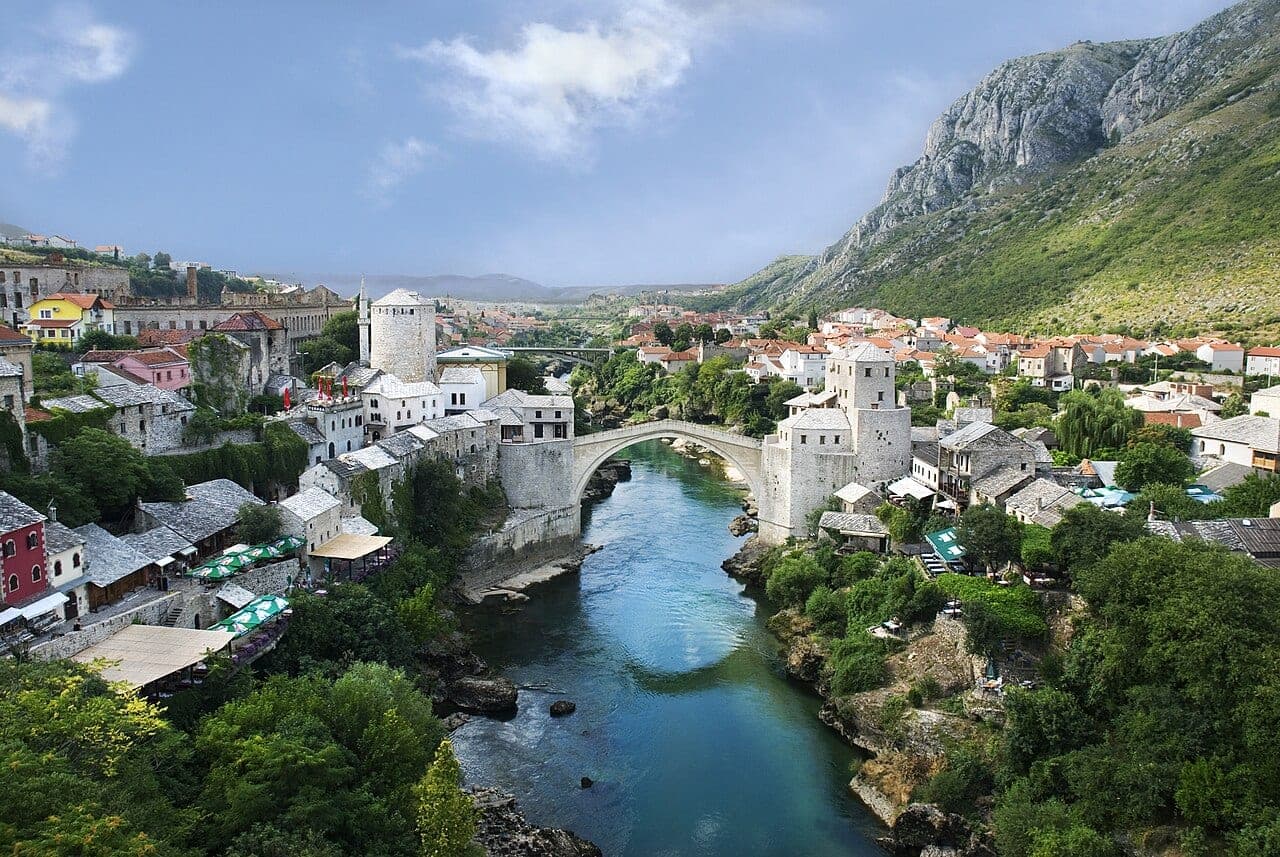
Few countries carry their memory as visibly as Bosnia and Herzegovina. On 9 November 1993 the Stari Most, the Old Bridge of Mostar, a single Ottoman arch that had leapt the green Neretva for 427 years, collapsed into the river under shellfire during the war between Croat and Bosniak forces. Eleven years later, in July 2004, it opened again, raised stone by stone from the same limestone quarry that Ottoman masons had used in the sixteenth century, under the technical oversight of UNESCO (Radio Free Europe). The bridge is now a World Heritage Site and the most recognised symbol of recovery in the Balkans. It shows how this country holds memory: what is lost is grieved openly, and, where it can be, it is patiently rebuilt.
Bosnia and Herzegovina has been a meeting place of Muslim, Orthodox, Catholic and Jewish communities for centuries, a plurality written into its bazaars, its minarets and bell towers, and its manuscripts, among them the Sarajevo Haggadah, one of the oldest Sephardic illuminated books in the world. Across the countryside stand the stećci, tens of thousands of medieval tombstones shared by every faith of the age. It treats the 1992–1995 war and the Srebrenica genocide soberly and factually, following the findings of the international courts, as part of a national mourning still under way.
Bosnia and Herzegovina lies in the western Balkans, a heart-shaped country of about 51,000 square kilometres bordered by Croatia, Serbia and Montenegro, with a short coastline at Neum on the Adriatic. Most of the land is mountainous, folded by the Dinaric Alps and cut by fast rivers: the Bosna, which gives the country its name, rises near Sarajevo and runs north to the Sava; the Neretva flows south through Mostar; and the Drina marks much of the eastern border with Serbia (Britannica).
The population is roughly 3.1 million. The constitution recognises three constituent peoples, Bosniaks, Serbs and Croats, alongside a category of "others" that includes the small but historic Jewish and Roma communities. The capital is Sarajevo. Since the Dayton Peace Agreement of 1995, the state has been organised into two entities, the Bosniak-and-Croat-majority Federation of Bosnia and Herzegovina and the Serb-majority Republika Srpska, together with the self-governing Brčko District, under a shared national presidency and an international High Representative (Britannica).
Sarajevo. Founded by the Ottomans in the fifteenth century, the capital grew around the Baščaršija, the old bazaar, whose coppersmiths, mosques and caravanserais still define the city's centre. Within a few streets a visitor passes the Gazi Husrev-beg Mosque, an Orthodox and a Catholic cathedral, and Europe's oldest working Sephardic community, a density that earned Sarajevo the nickname "the Jerusalem of Europe". It was here, on 28 June 1914, that Gavrilo Princip, a member of the Young Bosnia movement, shot Archduke Franz Ferdinand and his wife Sophie, the event that lit the fuse of the First World War (1914-1918 Online). From 1992 to 1996 the city endured the longest siege of a capital in modern warfare.
Mostar. The chief city of Herzegovina takes its name from the mostari, the keepers of the bridge, and its life still turns on the water. The Stari Most, built by the Ottoman architect Mimar Hayruddin and completed around 1566, divided and joined the town for four centuries before its destruction in 1993 and its reconstruction in 2004. Young divers still leap from its parapet into the Neretva, a tradition older than any living memory.
Banja Luka. The largest city of the north and the seat of Republika Srpska sits on the Vrbas river. Its sixteenth-century Ferhadija (Ferhat Pasha) Mosque, a masterwork of classical Ottoman architecture, was dynamited in 1993 and painstakingly rebuilt from recovered fragments, reopening in 2016 (Radio Free Europe). The city is also known for its Kastel fortress.
Višegrad. In the east, on the Drina, stands the Mehmed Paša Sokolović Bridge, built at the end of the sixteenth century by the imperial architect Mimar Sinan and inscribed by UNESCO in 2007. It gave the world Ivo Andrić's novel The Bridge on the Drina, which reads four centuries of Bosnian history through this one span. The same town saw grave crimes against Bosniak civilians in 1992, and it holds both stories at once.
The region was settled by Illyrian peoples, then Romanised, before Slavic migration in the early medieval period. A distinct Bosnian polity emerged under Ban Kulin (ruled 1180–1204), whose 1189 charter with the merchant republic of Dubrovnik is among the earliest documents in the region's history (Britannica). Under Tvrtko I, crowned king in 1377, the medieval Bosnian state reached its greatest extent. This was the age of the stećci, the great carved tombstones, and of the Bosnian Church, an independent Christian body long and inaccurately linked with the Bogomil movement; modern scholarship largely rejects that connection and treats the church on its own terms.
Ottoman conquest was completed in 1463 and lasted more than four centuries. It reshaped the country: Sarajevo and Mostar were built as Ottoman towns; Islam spread among the population; and mosques, bridges, bazaars and public baths gave Bosnia the form still visible today. In 1878 the Congress of Berlin placed Bosnia under Austro-Hungarian administration, which brought railways and the trappings of central Europe, with formal annexation in 1908. The Sarajevo assassination of 1914 ended that era and the empire itself. After the First World War, Bosnia joined the new Kingdom of Serbs, Croats and Slovenes, later Yugoslavia, and after 1945 became one of the six republics of socialist Yugoslavia under Josip Broz Tito. Sarajevo hosted the Winter Olympics in 1984.
The break-up of Yugoslavia brought war to Bosnia from 1992 to 1995. It was the deadliest conflict in Europe since 1945, marked by the siege of Sarajevo, mass displacement, and the destruction of heritage across every community: the National and University Library burned in August 1992, hundreds of mosques including Banja Luka's Ferhadija were demolished, and Catholic and Orthodox sites were damaged as well. The gravest single crime took place at Srebrenica in July 1995, when Bosnian Serb forces killed more than 7,000 Bosniak men and boys after capturing the town. The International Criminal Tribunal for the former Yugoslavia (ICTY) and the International Court of Justice (ICJ) both determined that these killings constituted genocide; the ICTY convicted senior figures including Radislav Krstić, Radovan Karadžić and Ratko Mladić, and the ICJ affirmed the finding in its judgment of 26 February 2007 (IRMCT; ICJ). The Dayton Peace Agreement, initialled in November 1995, ended the war and set the country's present shape. Recovery since has combined reconstruction of homes and monuments, the slow return of the displaced, and the identification and reburial of the missing.
The three constituent peoples speak closely related South Slavic varieties, Bosnian, Croatian and Serbian, all descended from the same Shtokavian base and mutually intelligible in daily use. They are written in both the Latin and Cyrillic alphabets; a distinctive medieval Cyrillic hand, bosančica, was used on charters and on some stećci. The name Bosnia derives from the Bosna river, itself of ancient, probably pre-Slavic origin. Herzegovina is younger and more traceable: it comes from the title herceg, meaning duke, adopted by the fifteenth-century nobleman Stjepan Vukčić Kosača, who styled himself "Herceg of Saint Sava"; his dukedom, herceg plus the land-suffix -ovina, gave the southern region its lasting name (Wiktionary).
Ottoman craft traditions remain part of everyday Bosnian life. Along Kazandžiluk, the coppersmiths' street in Sarajevo's Baščaršija, artisans still hammer džezve, the long-handled coffee pots, and engrave copper trays as their forebears did. Bosnian coffee is a ritual in itself, brewed in the džezva and served in a small handleless cup, the fildžan, with a cube of sugar and rahat lokum. The table is generous and mixed: ćevapi, small grilled beef sausages served in warm somun bread with onions and kajmak; burek and the other savoury pastries known collectively as pita; and Ottoman sweets such as baklava and tufahije.
The country's most distinctive music is sevdalinka, the melancholy urban love song sometimes called the Balkan blues. Dating to the sixteenth century, it fuses South Slavic verse with Ottoman melody, sung slowly and with restraint, traditionally to the saz or, later, the accordion. In December 2024 UNESCO inscribed sevdalinka on its Representative List of the Intangible Cultural Heritage of Humanity (UNESCO).
Bosnia and Herzegovina is one of the most religiously plural countries in Europe, and each community keeps a living presence. Islam, brought under Ottoman rule and predominantly Sunni of the Hanafi school, is the faith of most Bosniaks; the Gazi Husrev-beg Mosque of 1531 remains the country's principal Islamic monument. Serbian Orthodoxy is the tradition of most Serbs, with its cathedrals and monasteries. Roman Catholicism, long served by the Franciscan friars who stayed through the Ottoman centuries, is the faith of most Croats; the Herzegovinian village of Međugorje has drawn millions of pilgrims since reported Marian apparitions in 1981.
The Jewish heritage runs deep. Sephardic Jews expelled from Spain in 1492 settled in Sarajevo, forming a community that gave the city one of its languages, Judeo-Spanish, and one of its treasures, the Sarajevo Haggadah, made in Barcelona around 1350 and carried east after the expulsion. During the Second World War the manuscript was hidden from occupying forces by the museum's Muslim librarian, Derviš Korkut, and during the 1990s siege it survived in a bank vault; it is held today by the National Museum (UNESCO). The Jewish benevolent society La Benevolencija, founded in 1892, ran an interfaith relief operation during the siege of Sarajevo.
Funerary custom in Bosnia and Herzegovina follows the practice of each community, and the differences are held with respect. In the Muslim tradition, burial follows quickly, ideally on the day of death; the body is ritually washed and shrouded, the dženaza prayer is offered, and grief is expressed quietly, since loud wailing is discouraged. Women often gather for the tevhid, a collective recitation on behalf of the deceased, and families mark the passing again with a mevlud on set days and anniversaries. Orthodox and Catholic Christians keep their own rites: the Orthodox observe memorial services with boiled wheat, koljivo, on the third, ninth and fortieth days and yearly, while Catholic families hold requiem Masses and keep All Souls' Day. Jewish custom observes the seven days of shiva and the yearly yahrzeit. Across all these communities, tending the grave and lighting a candle or a lamp is a shared habit of care.
 Stecci are medieval gravestones carved with figures, weapons and inscriptions, and they are shared heritage: the same form was used by Catholic, Orthodox and Bosnian Church communities alike. Photograph by JYB Devot, CC BY-SA 4.0, via Wikimedia Commons.
The country's most solemn place of mourning is the Srebrenica-Potočari Memorial Centre and Cemetery, opened in 2003 near the site of the 1995 genocide. Each year on 11 July, families, survivors, religious leaders and foreign dignitaries gather there for a collective funeral, as newly identified remains recovered from mass graves are laid to rest; by July 2026 the number of victims interred at Potočari had reached 6,782 (Al Jazeera). Elsewhere, remembrance takes many forms: the rebuilt mosques of Banja Luka and Mostar, restored churches, war cemeteries and city memorials, and the roses of Sarajevo, shell craters filled with red resin that mark where people died during the siege.
Bosnia lost its written past twice in three years, and then rebuilt something else instead.
In May 1992 the Oriental Institute in Sarajevo was shelled and burned, destroying one of the great collections of Ottoman manuscripts in Europe, including the sicils, the court registers that documented Bosnian families through four centuries. In August the National and University Library in the old town hall burned with an estimated one and a half million volumes. Municipal registry offices across the country were destroyed or emptied during the war, so a great many families lost the civil record of their own existence and had to reconstruct it from testimony afterwards.
What survives of the older record is Ottoman tax and court material in Istanbul, Austro-Hungarian administrative files from 1878 to 1918 in Vienna as well as Sarajevo, and the registers of the Islamic Community, the Serbian Orthodox and Catholic churches, and the Jewish community, which are held by each.
Then there is the identification programme. The International Commission on Missing Persons, established in Bosnia after the war, developed DNA matching at a scale nobody had attempted, taking blood from tens of thousands of relatives and matching it to bone from mass graves that had been dug up and reburied to hide them. It has identified the great majority of the roughly 8,000 killed at Srebrenica and many thousands more. It is now the model used after disasters and conflicts worldwide, and it began as families asking to be given their dead back.
The Dayton Agreement created a national Commission to Preserve National Monuments, and international bodies have been closely involved in restoring what the war damaged. Three of the country's cultural sites are inscribed on the UNESCO World Heritage List. The Old Bridge Area of Mostar, listed in 2005, honours both the sixteenth-century townscape and its reconstruction as a symbol of reconciliation (UNESCO). The Mehmed Paša Sokolović Bridge in Višegrad, listed in 2007, preserves one of the masterpieces of Ottoman engineering. The Stećci Medieval Tombstone Graveyards, inscribed in 2016, form a serial site of 28 cemeteries shared across Bosnia and Herzegovina, Croatia, Montenegro and Serbia, protecting a selection of the tens of thousands of carved stones raised between the twelfth and sixteenth centuries by Orthodox, Catholic and Bosnian Church communities (UNESCO). Beyond the World Heritage list, the Sarajevo Haggadah was added to UNESCO's Memory of the World Register in 2017.
Stecci are medieval gravestones carved with figures, weapons and inscriptions, and they are shared heritage: the same form was used by Catholic, Orthodox and Bosnian Church communities alike. Photograph by JYB Devot, CC BY-SA 4.0, via Wikimedia Commons.
The country's most solemn place of mourning is the Srebrenica-Potočari Memorial Centre and Cemetery, opened in 2003 near the site of the 1995 genocide. Each year on 11 July, families, survivors, religious leaders and foreign dignitaries gather there for a collective funeral, as newly identified remains recovered from mass graves are laid to rest; by July 2026 the number of victims interred at Potočari had reached 6,782 (Al Jazeera). Elsewhere, remembrance takes many forms: the rebuilt mosques of Banja Luka and Mostar, restored churches, war cemeteries and city memorials, and the roses of Sarajevo, shell craters filled with red resin that mark where people died during the siege.
Bosnia lost its written past twice in three years, and then rebuilt something else instead.
In May 1992 the Oriental Institute in Sarajevo was shelled and burned, destroying one of the great collections of Ottoman manuscripts in Europe, including the sicils, the court registers that documented Bosnian families through four centuries. In August the National and University Library in the old town hall burned with an estimated one and a half million volumes. Municipal registry offices across the country were destroyed or emptied during the war, so a great many families lost the civil record of their own existence and had to reconstruct it from testimony afterwards.
What survives of the older record is Ottoman tax and court material in Istanbul, Austro-Hungarian administrative files from 1878 to 1918 in Vienna as well as Sarajevo, and the registers of the Islamic Community, the Serbian Orthodox and Catholic churches, and the Jewish community, which are held by each.
Then there is the identification programme. The International Commission on Missing Persons, established in Bosnia after the war, developed DNA matching at a scale nobody had attempted, taking blood from tens of thousands of relatives and matching it to bone from mass graves that had been dug up and reburied to hide them. It has identified the great majority of the roughly 8,000 killed at Srebrenica and many thousands more. It is now the model used after disasters and conflicts worldwide, and it began as families asking to be given their dead back.
The Dayton Agreement created a national Commission to Preserve National Monuments, and international bodies have been closely involved in restoring what the war damaged. Three of the country's cultural sites are inscribed on the UNESCO World Heritage List. The Old Bridge Area of Mostar, listed in 2005, honours both the sixteenth-century townscape and its reconstruction as a symbol of reconciliation (UNESCO). The Mehmed Paša Sokolović Bridge in Višegrad, listed in 2007, preserves one of the masterpieces of Ottoman engineering. The Stećci Medieval Tombstone Graveyards, inscribed in 2016, form a serial site of 28 cemeteries shared across Bosnia and Herzegovina, Croatia, Montenegro and Serbia, protecting a selection of the tens of thousands of carved stones raised between the twelfth and sixteenth centuries by Orthodox, Catholic and Bosnian Church communities (UNESCO). Beyond the World Heritage list, the Sarajevo Haggadah was added to UNESCO's Memory of the World Register in 2017.
 The bridge stood for 427 years, was shelled into the river in November 1993, and was rebuilt from stone cut at the original quarry and raised by the original method. Photograph by Bathory Peter, CC BY-SA 3.0, via Wikimedia Commons.
Bosnian institutions increasingly use digital tools to secure fragile collections and open them to a scattered public. The National Museum of Bosnia and Herzegovina (Zemaljski muzej) in Sarajevo, founded in 1888, closed for three years in a funding crisis before reopening in 2015; it has since documented its holdings and supported a high-resolution facsimile of the Sarajevo Haggadah, so the manuscript can be studied without handling the original. Digitisation of the museum's collections, alongside archival projects recording testimony and helping identify the missing from the war, has made the country's heritage far more reachable for researchers and for a diaspora that often cannot visit in person.
Bosnian culture has projected far beyond the country's borders, especially in film. The Sarajevo Film Festival, begun in 1995 while the city was still under siege, has grown into the leading cinema event of south-eastern Europe. Emir Kusturica won the Palme d'Or twice at Cannes; Danis Tanović's No Man's Land won the Academy Award for Best Foreign Language Film in 2002; and Jasmila Žbanić's Grbavica took the Golden Bear at Berlin in 2006, while her Quo Vadis, Aida?, about Srebrenica, earned an Oscar nomination. The sevdalinka, too, has found new audiences through performers who set the old songs against modern arrangements, and the diaspora keeps the language, cuisine and customs alive in cities from Vienna to St. Louis.
The Old Bridge rebuilt. Reconstructed in 2004 using the original techniques and stone, the Stari Most turned a symbol of destruction into the country's clearest emblem of recovery, recognised by UNESCO the following year (UNESCO).
Ivo Andrić's Nobel. In 1961 Andrić became the only writer from the former Yugoslavia to win the Nobel Prize in Literature, cited for "the epic force" with which he traced his country's history, above all in The Bridge on the Drina (Nobel Prize).
The Ferhadija restored. Banja Luka's Ferhat Pasha Mosque, destroyed in 1993, was rebuilt from thousands of recovered fragments and reopened in 2016, a quiet act of repair in the country's north.
A manuscript that outlived its enemies. The Sarajevo Haggadah, saved in the Second World War by a Muslim librarian and again during the 1990s siege, endures as a shared inheritance and was added to UNESCO's Memory of the World Register in 2017.
The bridge stood for 427 years, was shelled into the river in November 1993, and was rebuilt from stone cut at the original quarry and raised by the original method. Photograph by Bathory Peter, CC BY-SA 3.0, via Wikimedia Commons.
Bosnian institutions increasingly use digital tools to secure fragile collections and open them to a scattered public. The National Museum of Bosnia and Herzegovina (Zemaljski muzej) in Sarajevo, founded in 1888, closed for three years in a funding crisis before reopening in 2015; it has since documented its holdings and supported a high-resolution facsimile of the Sarajevo Haggadah, so the manuscript can be studied without handling the original. Digitisation of the museum's collections, alongside archival projects recording testimony and helping identify the missing from the war, has made the country's heritage far more reachable for researchers and for a diaspora that often cannot visit in person.
Bosnian culture has projected far beyond the country's borders, especially in film. The Sarajevo Film Festival, begun in 1995 while the city was still under siege, has grown into the leading cinema event of south-eastern Europe. Emir Kusturica won the Palme d'Or twice at Cannes; Danis Tanović's No Man's Land won the Academy Award for Best Foreign Language Film in 2002; and Jasmila Žbanić's Grbavica took the Golden Bear at Berlin in 2006, while her Quo Vadis, Aida?, about Srebrenica, earned an Oscar nomination. The sevdalinka, too, has found new audiences through performers who set the old songs against modern arrangements, and the diaspora keeps the language, cuisine and customs alive in cities from Vienna to St. Louis.
The Old Bridge rebuilt. Reconstructed in 2004 using the original techniques and stone, the Stari Most turned a symbol of destruction into the country's clearest emblem of recovery, recognised by UNESCO the following year (UNESCO).
Ivo Andrić's Nobel. In 1961 Andrić became the only writer from the former Yugoslavia to win the Nobel Prize in Literature, cited for "the epic force" with which he traced his country's history, above all in The Bridge on the Drina (Nobel Prize).
The Ferhadija restored. Banja Luka's Ferhat Pasha Mosque, destroyed in 1993, was rebuilt from thousands of recovered fragments and reopened in 2016, a quiet act of repair in the country's north.
A manuscript that outlived its enemies. The Sarajevo Haggadah, saved in the Second World War by a Muslim librarian and again during the 1990s siege, endures as a shared inheritance and was added to UNESCO's Memory of the World Register in 2017.
National Overview
Notable Cities
Historical Foundations
Linguistic and Etymological Roots
Cultural Identity
Religion and Spirituality
Remembrance and Mourning Traditions
Tracing a Family in Bosnia and Herzegovina
Heritage Preservation Efforts
Digital Heritage
Contemporary Cultural Influences
Success Stories
References and resources
- UNESCO World Heritage Centre, Old Bridge Area of Mostar: the 2005 inscription.
- UNESCO World Heritage Centre, Mehmed Paša Sokolović Bridge, Višegrad: the Ottoman bridge and Andrić's novel.
- UNESCO World Heritage Centre, Stećci Medieval Tombstone Graveyards: the serial site shared across four countries.
- UNESCO, The Secret Story of the Sarajevo Haggadah: the manuscript's rescue.
- UNESCO Intangible Cultural Heritage, Sevdalinka: the 2024 inscription.
- International Residual Mechanism for Criminal Tribunals, Srebrenica: the ICTY record and genocide finding.
- International Court of Justice, Summary of the Judgment of 26 February 2007: the ICJ's determination on Srebrenica.
- Srebrenica-Potočari Memorial and Cemetery, Remembering Srebrenica: the memorial and annual commemoration.
- Encyclopaedia Britannica, Bosnia and Herzegovina: history and background.
- The Nobel Prize, Ivo Andrić, Literature 1961: the laureate.