Heritage · Country
Montenegro Culture and Heritage
A country the size of a mountain range keeps its memory in stone: the walled towns of the Bay of Kotor, a poet-prince's tomb on the summit of Lovćen, and a monastery cut into a cliff. This is a guide to Montenegro's heritage, to the Orthodox, Catholic and Muslim rites that carry its dead, and to the epic verse that has remembered its battles for six centuries.Written to last.
By Confinity Heritage Editorial · Updated 2026-07-31 · 8-minute readQuiet tools, kept out of the way.
The country's own name is a fact about memory carved into geography. Crna Gora, "black mountain", was written down for the first time in 1276, in a charter of the Serbian king Stefan Uroš I, and it names the dark forests that once climbed Mount Lovćen above the Adriatic; Venice knew the same peak as monte negro, the form that became Montenegro in most of the world's languages (Britannica). Few nations wear their landscape as their name, and on that summit lies the tomb of the poet-prince who gave the country its literary voice.
For so small a country, Montenegro carries an unusually dense inheritance. Four World Heritage inscriptions fall within its borders, from the fortified bays of Kotor to the deepest river gorge in Europe. Its memory is layered by Orthodox, Catholic and Muslim communities who have buried and mourned their dead alongside one another for centuries, and it is sung in a decasyllabic epic verse older than the country's first printing press.
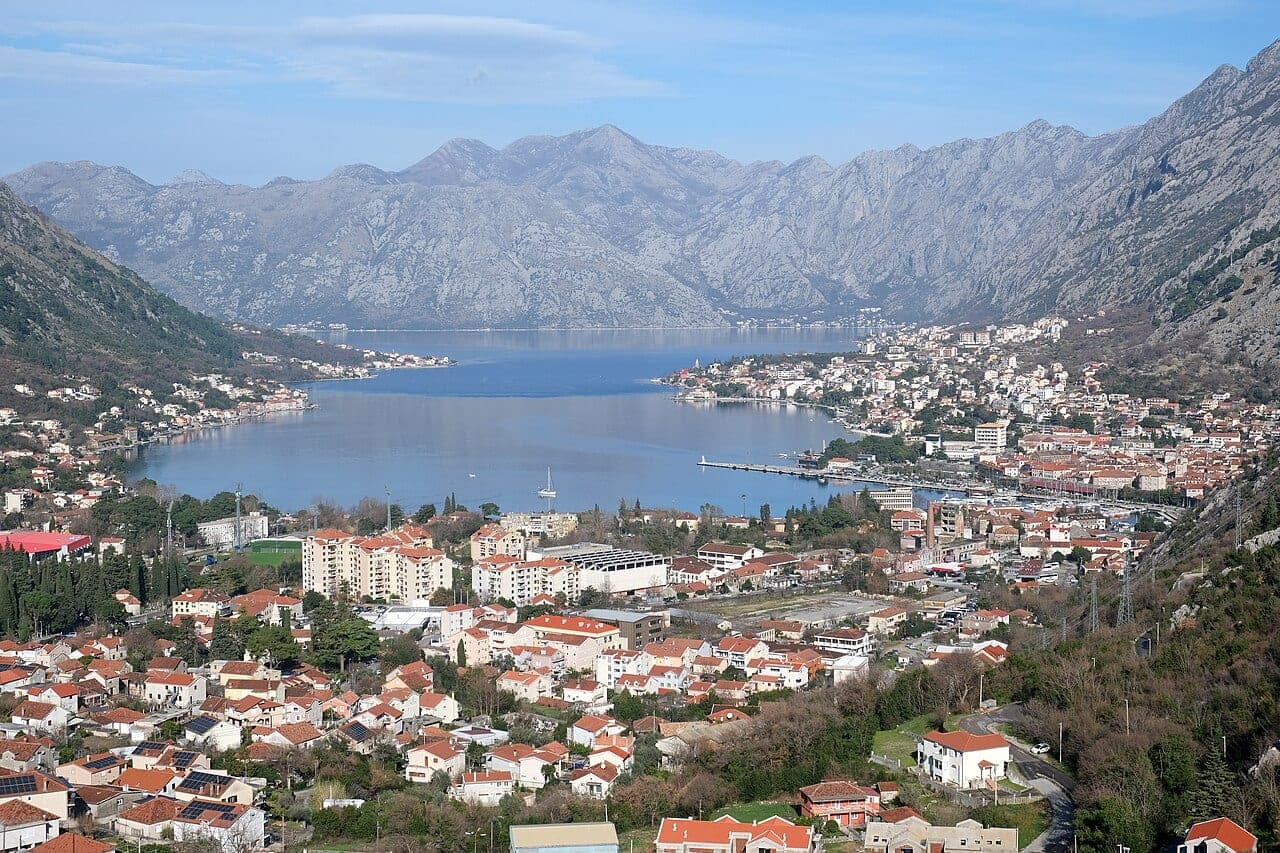
Montenegro sits on the southern Adriatic, bordered by Croatia, Bosnia and Herzegovina, Serbia, Kosovo and Albania, with a coastline of nearly 300 kilometres. Behind the shore the land rises fast into the Dinaric Alps, so that within an hour's drive the terrain climbs from beach to alpine peak. The Bay of Kotor cuts deep inland in basins ringed by mountains reaching almost 1,500 metres, a shape often likened to a fjord though it is a drowned river canyon (UNESCO). In the north the Durmitor massif carries some fifty summits above 2,000 metres, and to the south lies Lake Skadar, the largest lake in the Balkans, shared with Albania.
The 2023 census counted a population of about 623,000. Montenegrins made up 41.1 percent and Serbs 32.9 percent, with Bosniaks and other Muslims at 11.1 percent and Albanians at 5.0 percent (Britannica). Eastern Orthodoxy is the faith of about 71 percent of the population, with Muslims near 20 percent and Catholics around 3 percent. Podgorica is the administrative capital and largest city; Cetinje is the old royal capital and seat of Montenegrin statehood. Independent again since 2006, Montenegro joined NATO in 2017 and remains a candidate for European Union membership.
Podgorica. The capital lies inland where the Ribnica meets the Morača; the Roman city of Doclea, which gave the medieval realm of Duklja its name, stood just to the north. Under socialist Yugoslavia the city was renamed Titograd, from 1946 until 1992, when it recovered its historic name. Its older character survives in the Ottoman-era Stara Varoš, with its clock tower and stone Ribnica bridge, while the arched Millennium Bridge marks the modern city.
 Herceg Novi was Bosnian, then Ottoman, then Venetian, then Austrian, and each of them built a fort here. Photograph by Alexkom000, CC BY 4.0, via Wikimedia Commons.
Cetinje. Founded in 1482 by Ivan Crnojević beneath Mount Lovćen, Cetinje became the cradle of Montenegrin statehood and the residence of its prince-bishops. Its monastery, first built in 1484 and later rebuilt, guards relics revered across Orthodoxy, and nearby stand the Biljarda, the fortified residence Njegoš raised in 1838, and the former royal palace of King Nicholas I. In its years as a capital the town filled with foreign legations, whose embassy buildings still line its quiet streets.
Kotor. At the head of its bay, Kotor keeps one of the best-preserved fortified medieval towns on the Adriatic, its walls climbing the mountain behind to the fortress of San Giovanni. Its narrow lanes hold Romanesque, Gothic and Renaissance work reflecting ties to Rome, Byzantium and Venice, chief among them the Cathedral of Saint Tryphon, consecrated in 1166 (UNESCO). A centre of masonry and iconography, Kotor kept famous local schools, and its maritime guild is among the oldest in the region.
Budva. One of the oldest urban settlements on the Adriatic, Budva claims around 2,500 years of continuous life; Illyrians fortified the peninsula, Greeks recorded it in the 5th century BCE, and Rome absorbed it thereafter, leaving a necropolis of Hellenistic treasures and rare Illyrian helmets (Peter Sommer Travels). The Venetians walled the old town during their rule from 1443 to 1797, and though the earthquake of 15 April 1979 reduced much of it to rubble, it was rebuilt faithfully to its Venetian plan.
The earliest named inhabitants were the Illyrians, whose tribes held the coast and hinterland before Rome. The Romans built the city of Doclea near modern Podgorica, home of the Docleatae, and administered the region within the provinces of Dalmatia and later Praevalitana. After the empire divided in 395 CE the territory fell to the Byzantine sphere, and by the early Middle Ages a Slavic principality had formed here. This was Duklja, which grew into a kingdom in the 11th century, its ruler Mihailo recognised by the pope; later known as Zeta, it passed under the Serbian Nemanjić state before regaining autonomy under the Balšić and then the Crnojević lords.
Đurađ Crnojević, ruler of Zeta from 1490 to 1496, founded the printing house at Cetinje in 1493, the first state press among the South Slavs, before Ottoman pressure forced the dynasty out (Crnojević printing house, Wikipedia). From 1496 the Ottomans held much of the country, yet the mountain clans never submitted fully. In 1697 leadership passed to the House of Petrović-Njegoš in the form of the prince-bishop, the vladika, an office both spiritual and temporal that passed from uncle to nephew because its holders were celibate bishops, and under this line Montenegro resisted Ottoman power and slowly extended its territory.
Prince Danilo secularised the throne in 1852, ending the prince-bishopric, and in 1878 the Congress of Berlin recognised Montenegro's full independence. In 1910 Nicholas I proclaimed the Kingdom of Montenegro, only for the First World War to end it: in 1918 the Podgorica Assembly voted union with Serbia, and the country was folded into the new Kingdom of Serbs, Croats and Slovenes, later Yugoslavia. Under socialist Yugoslavia Montenegro was one of six constituent republics, and when the federation broke apart it remained joined to Serbia, first in the Federal Republic of Yugoslavia and then in the State Union of Serbia and Montenegro. On 21 May 2006 a referendum approved independence with 55.5 percent of the vote, clearing the 55 percent threshold on a turnout above 86 percent, and the parliament declared independence on 3 June 2006 (RFE/RL).
Montenegro's official language is Montenegrin, one of the standardised forms of the South Slavic dialect continuum that also underlies Serbian, Croatian and Bosnian; Serbian, Bosnian, Albanian and Croatian hold recognition as languages in use (Britannica). The spoken varieties belong overwhelmingly to the Shtokavian group and its Ijekavian pronunciation, so that mutual understanding across the former Yugoslav languages is near total, and the standards differ chiefly in vocabulary and spelling. Montenegrin is written in both Cyrillic and Latin scripts, a doubling that runs through the whole region.
The name of the country is itself an object of study. Crna Gora, literally "black mountain", was first attested in 1276 and is generally understood to describe the dense, dark forests that once cloaked Mount Lovćen and the surrounding heights (Britannica). The international name Montenegro descends not from the Slavic term but from the Venetian and wider Romance monte negro, carrying the same meaning into the languages of the West during the long centuries of Venetian influence along this coast. That one small country should carry two parallel names is a fitting emblem of a land that has always faced both the Slavic interior and the Latin sea.
The deepest layer of Montenegrin culture is the oral epic, sung to the gusle, a single-stringed instrument with a skin-covered wooden body and a bow of horsehair, held upright between the knees. The singer, the guslar, chants long narratives of heroes and battles in the ten-syllable line of South Slavic epic, a repertoire reaching back to the Battle of Kosovo of 1389 (Britannica). Shared across Montenegro, Serbia, Bosnia and beyond, singing to the gusle was inscribed on UNESCO's Representative List of the Intangible Cultural Heritage of Humanity in 2018. Alongside it survive the round dances known as oro and a tradition of crafts in silver, wood and wool.
The table divides between mountain and coast. In the highlands around Njeguši, below Lovćen, smoke-cured ham and hard cheese are still made much as they were generations ago, eaten with the clotted cream called kajmak and the air-dried mutton, kastradina, kept for winter. Along the Adriatic the cooking turns Mediterranean, built on fish, olive oil and the stew known as brodet. The red Vranac and white Krstač yield the country's wines, grown around Podgorica and Lake Skadar.
About seven in ten Montenegrins are Orthodox Christians, and the church has been bound up with Montenegrin identity since the medieval kingdom; for most of modern history the Serbian Orthodox Church has held the country's monasteries and dioceses, while a separate, unrecognised Montenegrin Orthodox Church has emerged since the 1990s, a division that touches politics as much as faith (Britannica). Its monasteries, from the historic seat at Cetinje to Ostrog, have long served as archives of manuscripts, relics and national memory.
Herceg Novi was Bosnian, then Ottoman, then Venetian, then Austrian, and each of them built a fort here. Photograph by Alexkom000, CC BY 4.0, via Wikimedia Commons.
Cetinje. Founded in 1482 by Ivan Crnojević beneath Mount Lovćen, Cetinje became the cradle of Montenegrin statehood and the residence of its prince-bishops. Its monastery, first built in 1484 and later rebuilt, guards relics revered across Orthodoxy, and nearby stand the Biljarda, the fortified residence Njegoš raised in 1838, and the former royal palace of King Nicholas I. In its years as a capital the town filled with foreign legations, whose embassy buildings still line its quiet streets.
Kotor. At the head of its bay, Kotor keeps one of the best-preserved fortified medieval towns on the Adriatic, its walls climbing the mountain behind to the fortress of San Giovanni. Its narrow lanes hold Romanesque, Gothic and Renaissance work reflecting ties to Rome, Byzantium and Venice, chief among them the Cathedral of Saint Tryphon, consecrated in 1166 (UNESCO). A centre of masonry and iconography, Kotor kept famous local schools, and its maritime guild is among the oldest in the region.
Budva. One of the oldest urban settlements on the Adriatic, Budva claims around 2,500 years of continuous life; Illyrians fortified the peninsula, Greeks recorded it in the 5th century BCE, and Rome absorbed it thereafter, leaving a necropolis of Hellenistic treasures and rare Illyrian helmets (Peter Sommer Travels). The Venetians walled the old town during their rule from 1443 to 1797, and though the earthquake of 15 April 1979 reduced much of it to rubble, it was rebuilt faithfully to its Venetian plan.
The earliest named inhabitants were the Illyrians, whose tribes held the coast and hinterland before Rome. The Romans built the city of Doclea near modern Podgorica, home of the Docleatae, and administered the region within the provinces of Dalmatia and later Praevalitana. After the empire divided in 395 CE the territory fell to the Byzantine sphere, and by the early Middle Ages a Slavic principality had formed here. This was Duklja, which grew into a kingdom in the 11th century, its ruler Mihailo recognised by the pope; later known as Zeta, it passed under the Serbian Nemanjić state before regaining autonomy under the Balšić and then the Crnojević lords.
Đurađ Crnojević, ruler of Zeta from 1490 to 1496, founded the printing house at Cetinje in 1493, the first state press among the South Slavs, before Ottoman pressure forced the dynasty out (Crnojević printing house, Wikipedia). From 1496 the Ottomans held much of the country, yet the mountain clans never submitted fully. In 1697 leadership passed to the House of Petrović-Njegoš in the form of the prince-bishop, the vladika, an office both spiritual and temporal that passed from uncle to nephew because its holders were celibate bishops, and under this line Montenegro resisted Ottoman power and slowly extended its territory.
Prince Danilo secularised the throne in 1852, ending the prince-bishopric, and in 1878 the Congress of Berlin recognised Montenegro's full independence. In 1910 Nicholas I proclaimed the Kingdom of Montenegro, only for the First World War to end it: in 1918 the Podgorica Assembly voted union with Serbia, and the country was folded into the new Kingdom of Serbs, Croats and Slovenes, later Yugoslavia. Under socialist Yugoslavia Montenegro was one of six constituent republics, and when the federation broke apart it remained joined to Serbia, first in the Federal Republic of Yugoslavia and then in the State Union of Serbia and Montenegro. On 21 May 2006 a referendum approved independence with 55.5 percent of the vote, clearing the 55 percent threshold on a turnout above 86 percent, and the parliament declared independence on 3 June 2006 (RFE/RL).
Montenegro's official language is Montenegrin, one of the standardised forms of the South Slavic dialect continuum that also underlies Serbian, Croatian and Bosnian; Serbian, Bosnian, Albanian and Croatian hold recognition as languages in use (Britannica). The spoken varieties belong overwhelmingly to the Shtokavian group and its Ijekavian pronunciation, so that mutual understanding across the former Yugoslav languages is near total, and the standards differ chiefly in vocabulary and spelling. Montenegrin is written in both Cyrillic and Latin scripts, a doubling that runs through the whole region.
The name of the country is itself an object of study. Crna Gora, literally "black mountain", was first attested in 1276 and is generally understood to describe the dense, dark forests that once cloaked Mount Lovćen and the surrounding heights (Britannica). The international name Montenegro descends not from the Slavic term but from the Venetian and wider Romance monte negro, carrying the same meaning into the languages of the West during the long centuries of Venetian influence along this coast. That one small country should carry two parallel names is a fitting emblem of a land that has always faced both the Slavic interior and the Latin sea.
The deepest layer of Montenegrin culture is the oral epic, sung to the gusle, a single-stringed instrument with a skin-covered wooden body and a bow of horsehair, held upright between the knees. The singer, the guslar, chants long narratives of heroes and battles in the ten-syllable line of South Slavic epic, a repertoire reaching back to the Battle of Kosovo of 1389 (Britannica). Shared across Montenegro, Serbia, Bosnia and beyond, singing to the gusle was inscribed on UNESCO's Representative List of the Intangible Cultural Heritage of Humanity in 2018. Alongside it survive the round dances known as oro and a tradition of crafts in silver, wood and wool.
The table divides between mountain and coast. In the highlands around Njeguši, below Lovćen, smoke-cured ham and hard cheese are still made much as they were generations ago, eaten with the clotted cream called kajmak and the air-dried mutton, kastradina, kept for winter. Along the Adriatic the cooking turns Mediterranean, built on fish, olive oil and the stew known as brodet. The red Vranac and white Krstač yield the country's wines, grown around Podgorica and Lake Skadar.
About seven in ten Montenegrins are Orthodox Christians, and the church has been bound up with Montenegrin identity since the medieval kingdom; for most of modern history the Serbian Orthodox Church has held the country's monasteries and dioceses, while a separate, unrecognised Montenegrin Orthodox Church has emerged since the 1990s, a division that touches politics as much as faith (Britannica). Its monasteries, from the historic seat at Cetinje to Ostrog, have long served as archives of manuscripts, relics and national memory.
 Ostrog is built into the rock nearly nine hundred metres up, and pilgrims of all three of the region's faiths come to it. Photograph by Diego Delso, CC BY-SA 3.0, via Wikimedia Commons.
Islam is the faith of roughly a fifth of the population, mainly the Bosniaks of the Sandžak region in the north-east and many of the ethnic Albanians of the south. Catholicism, at about three percent, is concentrated on the coast, a legacy of Venetian and earlier Latin rule, and among Albanians in the Malesija district near Podgorica. That the three have shared this ground for centuries is clearest at the shrine of Ostrog, where Orthodox, Catholic and Muslim pilgrims climb together to the relics of Saint Basil (Sacred Sites).
Orthodox mourning in Montenegro follows the wider Serbian Orthodox pattern. The funeral service, the opelo, is sung in the church or at the graveside, and at the grave the priest pours a mixture of red wine, water and oil over the coffin. Central to every rite of remembrance is koljivo, also called žito, a dish of boiled wheat sweetened with sugar and honey, the grain a symbol of resurrection from the parable of the dying seed (Serbian Orthodox Funerals). Memorial services, the parastos, are held at the third day, the ninth, the fortieth, at six months and at each anniversary, gathering family and community around the same plate of wheat. A memorial meal, the daća, follows the burial, and mourners keep to black and withdraw from festivity for forty days and often far longer, with widows sometimes in black for a year or for life.
Muslim families observe the janazah funeral prayer and bury their dead swiftly, before sunset where possible, without cremation, wrapped in a plain shroud and laid facing Mecca; in the days that follow, the community gathers for the tevhid, a shared prayer for the departed. Catholic Montenegrins keep the requiem and anniversary Masses, and remember their dead in common at All Souls in November. Across all three faiths the visit to the grave, to tend it, change the flowers and light a candle, remains part of ordinary life.
Two monuments concentrate the national practice of memory. On the summit of Lovćen, at Jezerski peak, lies the mausoleum of Petar II Petrović-Njegoš, the prince-bishop and poet who died in 1851; he chose the site himself, and the tomb visitors see today was designed by the sculptor Ivan Meštrović and completed in 1974 (Mausoleum of Njegoš, Wikipedia). Older and more mysterious are the stećci, the monolithic limestone tombstones of the 12th to 16th centuries, cut with reliefs of hunts, dances and raised hands, that Montenegro shares with its neighbours as a common medieval inheritance.
Montenegrin genealogy is organised by brotherhood, and the brotherhoods are still known.
A Montenegrin traditionally belongs to a bratstvo, a patrilineal group descended from a named ancestor, and the bratstva are grouped into tribes, the plemena, attached to particular districts of the highlands. The system organised feud, marriage, land and military obligation, and it was recorded orally and in the epic poetry that was sung to the gusle. Because the population was small and the tribes territorial, a Montenegrin surname will often place a family in a specific valley immediately.
The written record is Orthodox and princely. The metropolitanate at Cetinje kept registers, the monastery there holds the older documents, and the state that emerged in the nineteenth century produced its own administrative archive, now in the state archives at Cetinje. Catholic parishes on the coast, in Kotor and Bar, kept registers under Venetian rule that are older than most inland records, some running to the fifteenth century.
Coastal Montenegro is a different archive entirely: Venetian, then Austrian, in Italian and German, with the maritime records of Perast and Kotor documenting a seafaring population that sailed for the Republic.
Yugoslav-era civil registration covers the twentieth century. Emigration was heavy, to the United States and to Argentina, and a substantial Montenegrin diaspora carries family knowledge that the archives at home do not.
Montenegro carries four World Heritage inscriptions. The Natural and Culturo-Historical Region of Kotor, inscribed in 1979, was placed at once on the List of World Heritage in Danger after that year's earthquake; concerted restoration allowed its removal in 2003 (UNESCO). Durmitor National Park was inscribed in 1980 for its glaciated peaks, forests and lakes and for the canyon of the Tara, the deepest river gorge in Europe, with the Tara basin already a UNESCO biosphere reserve since 1976 (UNESCO).
Two later inscriptions are transnational. The Stećci Medieval Tombstone Graveyards were listed in 2016 as a serial property of 28 sites across Bosnia and Herzegovina, Croatia, Montenegro and Serbia, three of them in Montenegro, drawn from a wider field of more than 70,000 such stones (UNESCO). In 2017 the fortifications of Kotor were included in the Venetian Works of Defence between the 16th and 17th Centuries, a serial site of six components in Italy, Croatia and Montenegro that records the bastioned military architecture of the Venetian Republic (UNESCO). The museums of Cetinje and the national conservation authorities maintain these sites.
Montenegro's documentary memory has a fitting guardian in the National Library of Montenegro at Cetinje, named "Đurđe Crnojević" after the ruler whose press produced the Oktoih of 1494, the first incunabulum printed in Cyrillic in south-eastern Europe (National Library of Montenegro). Its digitisation of these early editions has brought some of the oldest Slavic printed heritage within reach of readers who will never handle the originals.
Beyond the library, Montenegrin institutions contribute records to Europeana, the European cultural platform, and museums and archives have begun placing their catalogues and documents online. Much of the coastal heritage was recorded in the mapping that accompanied the Kotor and Venetian-defence inscriptions, so that the fortifications above Kotor can now be studied stone by stone from anywhere.
Njegoš remains the reference point of Montenegrin letters. His verse drama Gorski vijenac, "The Mountain Wreath", written in Cetinje in 1846 and printed the following year, is read as the national epic and quoted in daily speech, while his philosophical poem Luča mikrokozma set the language on a metaphysical stage (The Mountain Wreath, Wikipedia). The gusle tradition he drew on is still performed, taught and recorded through the year.
Modern Montenegro projects its culture outward through film and tourism as much as through books; the bay of Kotor and the walled coast draw visitors and film crews, and Sveti Stefan, the fortified islet near Budva, has become an emblem of the country abroad. A wide diaspora in Serbia, the United States, Argentina and western Europe keeps Montenegrin memory alive at a distance, returning for family feasts and the anniversaries of the dead, and carrying the gusle and the recipes of Njeguši abroad.
Kotor comes back from the danger list. Inscribed in 1979 and imperilled by that year's earthquake, the Kotor region was restored through years of national and international effort and taken off the List of World Heritage in Danger in 2003, a rare recovery for a fortified medieval town (UNESCO).
A shared inheritance recognised. The listing of the stećci in 2016 united four states once at war around a common medieval heritage, treating the carved tombstones of the western Balkans as a single body of memory (UNESCO).
A living mountain of pilgrimage. Ostrog, the monastery set into a cliff face and dedicated to Saint Basil, receives on the order of a million visitors a year, drawing Orthodox, Catholic and Muslim pilgrims to one of the most visited sacred sites in the region (Sacred Sites).
Six centuries of a voice, safeguarded. The inscription of singing to the gusle on UNESCO's intangible heritage list in 2018 gave international protection to an oral epic tradition that has carried Montenegrin history in verse since the Middle Ages (Britannica).
Ostrog is built into the rock nearly nine hundred metres up, and pilgrims of all three of the region's faiths come to it. Photograph by Diego Delso, CC BY-SA 3.0, via Wikimedia Commons.
Islam is the faith of roughly a fifth of the population, mainly the Bosniaks of the Sandžak region in the north-east and many of the ethnic Albanians of the south. Catholicism, at about three percent, is concentrated on the coast, a legacy of Venetian and earlier Latin rule, and among Albanians in the Malesija district near Podgorica. That the three have shared this ground for centuries is clearest at the shrine of Ostrog, where Orthodox, Catholic and Muslim pilgrims climb together to the relics of Saint Basil (Sacred Sites).
Orthodox mourning in Montenegro follows the wider Serbian Orthodox pattern. The funeral service, the opelo, is sung in the church or at the graveside, and at the grave the priest pours a mixture of red wine, water and oil over the coffin. Central to every rite of remembrance is koljivo, also called žito, a dish of boiled wheat sweetened with sugar and honey, the grain a symbol of resurrection from the parable of the dying seed (Serbian Orthodox Funerals). Memorial services, the parastos, are held at the third day, the ninth, the fortieth, at six months and at each anniversary, gathering family and community around the same plate of wheat. A memorial meal, the daća, follows the burial, and mourners keep to black and withdraw from festivity for forty days and often far longer, with widows sometimes in black for a year or for life.
Muslim families observe the janazah funeral prayer and bury their dead swiftly, before sunset where possible, without cremation, wrapped in a plain shroud and laid facing Mecca; in the days that follow, the community gathers for the tevhid, a shared prayer for the departed. Catholic Montenegrins keep the requiem and anniversary Masses, and remember their dead in common at All Souls in November. Across all three faiths the visit to the grave, to tend it, change the flowers and light a candle, remains part of ordinary life.
Two monuments concentrate the national practice of memory. On the summit of Lovćen, at Jezerski peak, lies the mausoleum of Petar II Petrović-Njegoš, the prince-bishop and poet who died in 1851; he chose the site himself, and the tomb visitors see today was designed by the sculptor Ivan Meštrović and completed in 1974 (Mausoleum of Njegoš, Wikipedia). Older and more mysterious are the stećci, the monolithic limestone tombstones of the 12th to 16th centuries, cut with reliefs of hunts, dances and raised hands, that Montenegro shares with its neighbours as a common medieval inheritance.
Montenegrin genealogy is organised by brotherhood, and the brotherhoods are still known.
A Montenegrin traditionally belongs to a bratstvo, a patrilineal group descended from a named ancestor, and the bratstva are grouped into tribes, the plemena, attached to particular districts of the highlands. The system organised feud, marriage, land and military obligation, and it was recorded orally and in the epic poetry that was sung to the gusle. Because the population was small and the tribes territorial, a Montenegrin surname will often place a family in a specific valley immediately.
The written record is Orthodox and princely. The metropolitanate at Cetinje kept registers, the monastery there holds the older documents, and the state that emerged in the nineteenth century produced its own administrative archive, now in the state archives at Cetinje. Catholic parishes on the coast, in Kotor and Bar, kept registers under Venetian rule that are older than most inland records, some running to the fifteenth century.
Coastal Montenegro is a different archive entirely: Venetian, then Austrian, in Italian and German, with the maritime records of Perast and Kotor documenting a seafaring population that sailed for the Republic.
Yugoslav-era civil registration covers the twentieth century. Emigration was heavy, to the United States and to Argentina, and a substantial Montenegrin diaspora carries family knowledge that the archives at home do not.
Montenegro carries four World Heritage inscriptions. The Natural and Culturo-Historical Region of Kotor, inscribed in 1979, was placed at once on the List of World Heritage in Danger after that year's earthquake; concerted restoration allowed its removal in 2003 (UNESCO). Durmitor National Park was inscribed in 1980 for its glaciated peaks, forests and lakes and for the canyon of the Tara, the deepest river gorge in Europe, with the Tara basin already a UNESCO biosphere reserve since 1976 (UNESCO).
Two later inscriptions are transnational. The Stećci Medieval Tombstone Graveyards were listed in 2016 as a serial property of 28 sites across Bosnia and Herzegovina, Croatia, Montenegro and Serbia, three of them in Montenegro, drawn from a wider field of more than 70,000 such stones (UNESCO). In 2017 the fortifications of Kotor were included in the Venetian Works of Defence between the 16th and 17th Centuries, a serial site of six components in Italy, Croatia and Montenegro that records the bastioned military architecture of the Venetian Republic (UNESCO). The museums of Cetinje and the national conservation authorities maintain these sites.
Montenegro's documentary memory has a fitting guardian in the National Library of Montenegro at Cetinje, named "Đurđe Crnojević" after the ruler whose press produced the Oktoih of 1494, the first incunabulum printed in Cyrillic in south-eastern Europe (National Library of Montenegro). Its digitisation of these early editions has brought some of the oldest Slavic printed heritage within reach of readers who will never handle the originals.
Beyond the library, Montenegrin institutions contribute records to Europeana, the European cultural platform, and museums and archives have begun placing their catalogues and documents online. Much of the coastal heritage was recorded in the mapping that accompanied the Kotor and Venetian-defence inscriptions, so that the fortifications above Kotor can now be studied stone by stone from anywhere.
Njegoš remains the reference point of Montenegrin letters. His verse drama Gorski vijenac, "The Mountain Wreath", written in Cetinje in 1846 and printed the following year, is read as the national epic and quoted in daily speech, while his philosophical poem Luča mikrokozma set the language on a metaphysical stage (The Mountain Wreath, Wikipedia). The gusle tradition he drew on is still performed, taught and recorded through the year.
Modern Montenegro projects its culture outward through film and tourism as much as through books; the bay of Kotor and the walled coast draw visitors and film crews, and Sveti Stefan, the fortified islet near Budva, has become an emblem of the country abroad. A wide diaspora in Serbia, the United States, Argentina and western Europe keeps Montenegrin memory alive at a distance, returning for family feasts and the anniversaries of the dead, and carrying the gusle and the recipes of Njeguši abroad.
Kotor comes back from the danger list. Inscribed in 1979 and imperilled by that year's earthquake, the Kotor region was restored through years of national and international effort and taken off the List of World Heritage in Danger in 2003, a rare recovery for a fortified medieval town (UNESCO).
A shared inheritance recognised. The listing of the stećci in 2016 united four states once at war around a common medieval heritage, treating the carved tombstones of the western Balkans as a single body of memory (UNESCO).
A living mountain of pilgrimage. Ostrog, the monastery set into a cliff face and dedicated to Saint Basil, receives on the order of a million visitors a year, drawing Orthodox, Catholic and Muslim pilgrims to one of the most visited sacred sites in the region (Sacred Sites).
Six centuries of a voice, safeguarded. The inscription of singing to the gusle on UNESCO's intangible heritage list in 2018 gave international protection to an oral epic tradition that has carried Montenegrin history in verse since the Middle Ages (Britannica).
National Overview
Notable Cities
Historical Foundations
Linguistic and Etymological Roots
Cultural Identity
Religion and Spirituality
Remembrance and Mourning Traditions
Tracing a Family in Montenegro
Heritage Preservation Efforts
Digital Heritage
Contemporary Cultural Influences
Success Stories
References and resources
- UNESCO World Heritage Centre: Natural and Culturo-Historical Region of Kotor: the 1979 inscription, its earthquake damage and its removal from the danger list in 2003.
- UNESCO World Heritage Centre: Durmitor National Park: the 1980 natural inscription and the canyon of the Tara.
- UNESCO World Heritage Centre: Stećci Medieval Tombstone Graveyards: the 2016 transnational listing across four states.
- UNESCO World Heritage Centre: Venetian Works of Defence, 16th to 17th Centuries: the 2017 serial site including the fortifications of Kotor.
- Encyclopaedia Britannica: Montenegro: geography, population, religion and political history.
- Encyclopaedia Britannica: Guslar: the gusle, the singer and the South Slavic epic tradition.
- Radio Free Europe/Radio Liberty: Complete Vote Count Confirms Montenegro Independence: the 2006 referendum result and its aftermath.
- Mausoleum of Njegoš, Wikipedia: the tomb on Lovćen and its design by Ivan Meštrović.
- Crnojević printing house, Wikipedia: the 1493 press at Cetinje and the Oktoih of 1494.
- National Library of Montenegro "Đurđe Crnojević": the country's documentary heritage and its digitisation.
- Serbian Orthodox Funeral Services: rites and mourning: the opelo, koljivo and the parastos memorial cycle.
- Sacred Sites: Ostrog Monastery: the cliff monastery of Saint Basil and its cross-confessional pilgrimage.