Heritage · Country
Serbia Culture and Heritage
Every Serbian family keeps a saint. The slava, a single feast day handed down the male line for centuries, means a household's identity is a date on the church calendar. A guide to Serbia's heritage and to how Serbs mark their patron saints, mourn their dead and carry the memory of Kosovo.Written to last.
By Confinity Heritage Editorial · 2026-07-11 · 8-minute readQuiet tools, kept out of the way.
Ask a Serb which saint they belong to and you will get an answer, because in Serbia a family does not simply have a religion, it has a specific saint and a specific day. The slava is the annual celebration of a household's patron, inherited from father to son across generations, so that a family is Saint Nicholas or Saint George or the Archangel Michael the way it might elsewhere be a surname. On the appointed day a candle is lit, a round loaf is broken, a dish of boiled wheat is blessed, and the house opens to anyone who comes; the custom is old enough that UNESCO added it to its list of the world's intangible heritage in 2014, and personal enough that many families kept it alive quietly through decades of official atheism.
That instinct, to fix memory to a name and a date and a shared table, runs through the whole of Serbian culture. It is there in the parastos said for the dead at forty days and a year, in the Soul Saturdays when cemeteries fill with candles and food, and above all in Vidovdan, the June feast on which a nation remembers a battle it lost in 1389 as if it happened last week.
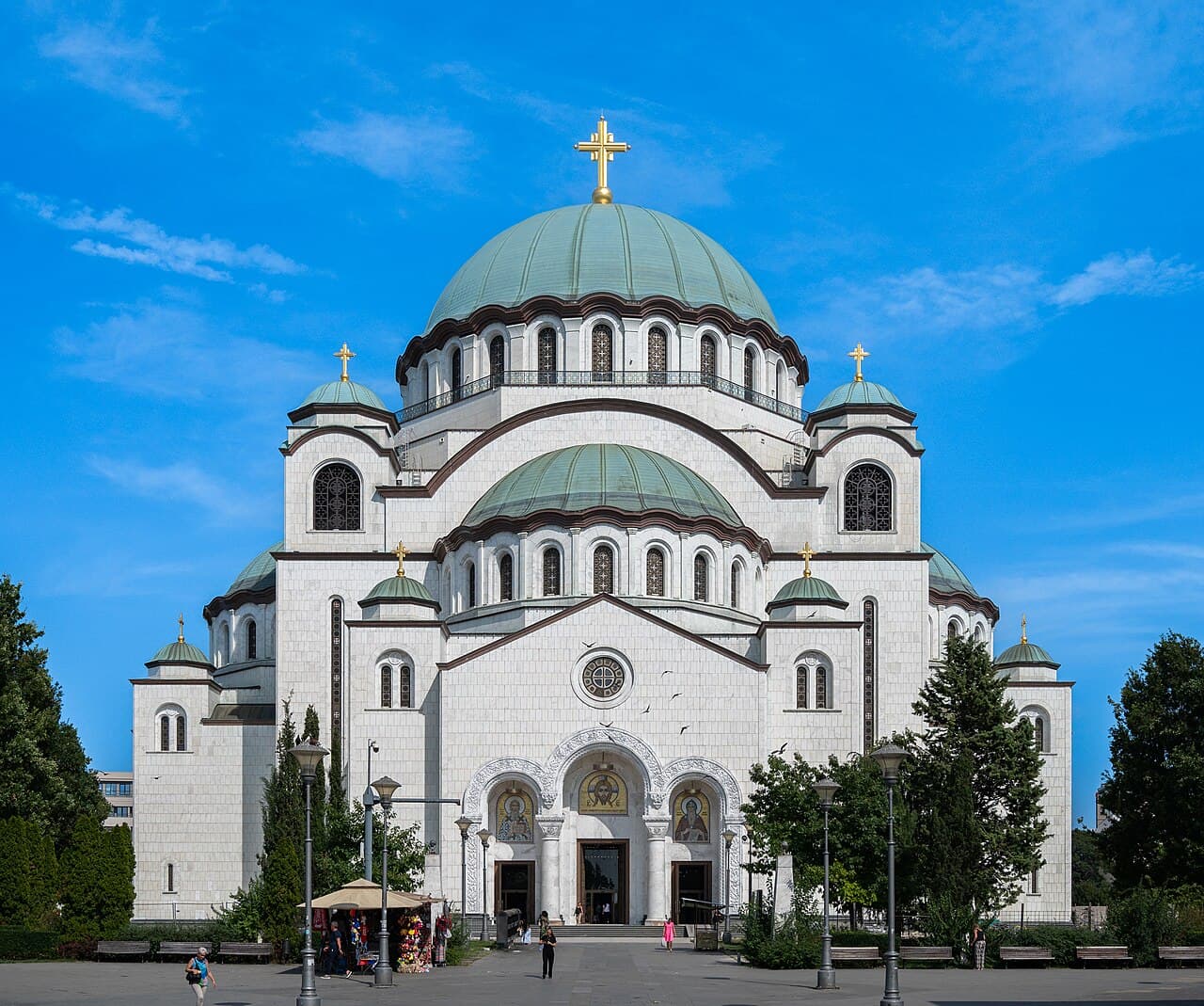
.jpg%2F1280px-Church_of_Saint_Sava%252C_the_largest_Orthodox_church_in_the_world_(13810407793).jpg&w=3840&q=75) The Church of Saint Sava in Belgrade, raised on the spot where the Ottomans burned the saint's relics in 1595. CC BY 2.0, via Wikimedia Commons.
Serbia is a landlocked country in the central Balkans, covering about 88,000 square kilometres including the disputed territory of Kosovo, and some 77,500 without it. It is a land of two halves. North of the Sava and Danube lies Vojvodina, a flat, fertile slice of the Pannonian Plain crossed by canals and dotted with the villages of a dozen nationalities; south of the rivers the ground rises into hills and then into the mountains of the Dinaric and Balkan ranges, cut by the Đerdap, the Iron Gates gorge where the Danube narrows between Serbia and Romania. The great rivers, the Danube, the Sava, the Morava and the Drina, have always been the country's roads and its borders.
The 2022 census counted about 6.6 million people, excluding Kosovo, a population that has been shrinking for years through low birth rates and heavy emigration. Serbs form the large majority, alongside Hungarians, Bosniaks, Roma, Croats, Albanians and others, with Vojvodina the most mixed region and the Sandžak in the south-west heavily Bosniak and Muslim. Serbia is a parliamentary republic with its capital at Belgrade; it declared independence in 2006 when its union with Montenegro dissolved, and it is a candidate for European Union membership while maintaining close ties to Russia. The status of Kosovo, which declared independence in 2008, remains the defining and unresolved question of Serbian politics.
Belgrade. The capital sits on the ridge where the Sava joins the Danube, a strategic point fought over so often that the city claims to have been destroyed and rebuilt more than forty times. Roman Singidunum, Byzantine, Serbian, Ottoman and Austrian in turn, it centres on the Kalemegdan fortress above the confluence, now a park full of memory, and on the vast white Church of Saint Sava on the Vračar plateau. Belgrade also carries its griefs in the open: the ruined former army headquarters bombed by NATO in 1999 still stands on Kneza Miloša street, deliberately left as it fell.
Novi Sad. The capital of Vojvodina, laid out in the eighteenth century beneath the Austrian Petrovaradin fortress on the Danube, is Serbia's second city and its most self-consciously multicultural, long home to Serbs, Hungarians, Slovaks and Germans. It hosts the summer EXIT music festival inside the fortress walls, and in 2022 it served as European Capital of Culture, the first city in an EU candidate country to hold the title.
The Church of Saint Sava in Belgrade, raised on the spot where the Ottomans burned the saint's relics in 1595. CC BY 2.0, via Wikimedia Commons.
Serbia is a landlocked country in the central Balkans, covering about 88,000 square kilometres including the disputed territory of Kosovo, and some 77,500 without it. It is a land of two halves. North of the Sava and Danube lies Vojvodina, a flat, fertile slice of the Pannonian Plain crossed by canals and dotted with the villages of a dozen nationalities; south of the rivers the ground rises into hills and then into the mountains of the Dinaric and Balkan ranges, cut by the Đerdap, the Iron Gates gorge where the Danube narrows between Serbia and Romania. The great rivers, the Danube, the Sava, the Morava and the Drina, have always been the country's roads and its borders.
The 2022 census counted about 6.6 million people, excluding Kosovo, a population that has been shrinking for years through low birth rates and heavy emigration. Serbs form the large majority, alongside Hungarians, Bosniaks, Roma, Croats, Albanians and others, with Vojvodina the most mixed region and the Sandžak in the south-west heavily Bosniak and Muslim. Serbia is a parliamentary republic with its capital at Belgrade; it declared independence in 2006 when its union with Montenegro dissolved, and it is a candidate for European Union membership while maintaining close ties to Russia. The status of Kosovo, which declared independence in 2008, remains the defining and unresolved question of Serbian politics.
Belgrade. The capital sits on the ridge where the Sava joins the Danube, a strategic point fought over so often that the city claims to have been destroyed and rebuilt more than forty times. Roman Singidunum, Byzantine, Serbian, Ottoman and Austrian in turn, it centres on the Kalemegdan fortress above the confluence, now a park full of memory, and on the vast white Church of Saint Sava on the Vračar plateau. Belgrade also carries its griefs in the open: the ruined former army headquarters bombed by NATO in 1999 still stands on Kneza Miloša street, deliberately left as it fell.
Novi Sad. The capital of Vojvodina, laid out in the eighteenth century beneath the Austrian Petrovaradin fortress on the Danube, is Serbia's second city and its most self-consciously multicultural, long home to Serbs, Hungarians, Slovaks and Germans. It hosts the summer EXIT music festival inside the fortress walls, and in 2022 it served as European Capital of Culture, the first city in an EU candidate country to hold the title.
.jpg%2F1280px-Belgrade_Fortress%252C_once_one_of_the_most_powerful_military_strongholds_of_Europe_(13810353553).jpg&w=3840&q=75) Belgrade Fortress and Kalemegdan park, guarding the meeting of the Sava and the Danube. CC BY 2.0, via Wikimedia Commons.
Niš. One of the oldest cities in the Balkans and the birthplace, in 272, of the Roman emperor Constantine the Great, Niš keeps two monuments that mark the extremes of its long history. The Ćele Kula, the Skull Tower, was built by the Ottomans in 1809 from the embedded skulls of Serbian rebels killed at the Battle of Čegar, a punishment that became a shrine. On the city's edge, the Crveni Krst camp preserved one of the few surviving Nazi concentration camps in the region.
Kragujevac. The first capital of the reborn Serbian state in the early nineteenth century, where the country's first constitution was proclaimed in 1835 and its first grammar school and printing press established. It is remembered above all for October 1941, when German forces shot thousands of civilians, including schoolboys taken from their classrooms, in reprisal killings now commemorated in the Šumarice memorial park.
Sremski Karlovci. A small town on the Danube of outsized importance to Serbian institutional memory: seat of the Serbian Orthodox metropolitanate under Habsburg rule, home to the first Serbian grammar school founded in 1791, and the place where much of the modern nation's cultural and clerical life was organised while Serbia proper lay under the Ottomans.
Human settlement here reaches deep into prehistory. On the banks of the Danube in the Iron Gates, the Mesolithic village of Lepenski Vir, inhabited from around 9500 BC, produced extraordinary sculpted sandstone heads and trapezoidal houses facing the river; nearby, the Neolithic Vinča culture near Belgrade left one of prehistoric Europe's largest settlements and hints of early copper metallurgy. In the Roman era the region was thickly urbanised: Sirmium, modern Sremska Mitrovica, was one of the empire's capitals under the Tetrarchy, Naissus gave Rome the emperor Constantine, and Galerius built his fortified palace of Felix Romuliana at Gamzigrad, now a World Heritage Site.
Serbia's golden age was medieval and dynastic. The Nemanjić family, beginning with Stefan Nemanja in the twelfth century, forged a kingdom and then, under Stefan Dušan, crowned tsar in 1346, a short-lived empire that reached the Aegean; Dušan's Code of 1349 is one of medieval Europe's most sophisticated legal texts. The dynasty's lasting monument is a chain of monasteries, Studenica, Žiča, Sopoćani, Gračanica, Dečani, whose architecture and frescoes are the summit of Serbian art. Then came 1389 and the Battle of Kosovo, where Prince Lazar and the Ottoman sultan Murad both died and the Serbian nobility was broken; within decades the medieval state was gone, and by 1459 Serbia was an Ottoman province. Two uprisings in the early nineteenth century, led by Karađorđe and then Miloš Obrenović, won autonomy and, by the Congress of Berlin in 1878, full independence. The twentieth century was brutal in the extreme: Serbia lost a devastating share of its population in the First World War, was occupied and its Jews and others murdered in the Second, spent decades as the largest republic of socialist Yugoslavia under Tito, and emerged from the wars of the 1990s and the NATO bombing of 1999 diminished, independent and still arguing over the meaning of it all.
The name Srbija comes from the Serbs, a Slavic people whose own name is of uncertain, probably very old, origin; they settled the Balkans in the early medieval migrations of the sixth and seventh centuries. The Serbian language belongs to the South Slavic branch and sits within the dialect continuum once called Serbo-Croatian, mutually intelligible with Croatian, Bosnian and Montenegrin. Its most distinctive feature is that it is written in two alphabets at once. Cyrillic, brought by the disciples of the ninth-century missionaries Cyril and Methodius, is the traditional and constitutionally official script; the Latin alphabet is used almost interchangeably in daily life, so that shop signs, newspapers and text messages switch between the two without comment.
The modern language is the work of one reformer above all. Vuk Stefanović Karadžić, in the first half of the nineteenth century, rebuilt Serbian Cyrillic on the principle "write as you speak, read as it is written", giving it a near-perfect one-letter-one-sound alphabet and adding the distinctive characters đ, lj, nj, ć and dž. He also collected the oral heroic poetry and folk tales that carried Serbian identity through the Ottoman centuries. The map of Serbia records its layered past in its place names: Slavic roots everywhere, Turkish words left by five centuries of Ottoman rule, Hungarian and German names across Vojvodina, and older Roman and Celtic traces beneath them.
The slava anchors the Serbian year, but the calendar is full of other communal rituals. The kolo, a circle dance in which linked dancers step and weave to the pull of an accordion or a brass band, is danced at every wedding and celebration and was itself inscribed by UNESCO in 2017; the heroic songs of the Kosovo cycle and the exploits of the outlaw hajduks are chanted to the single scraped string of the gusle, a tradition also recognised by UNESCO. Serbian food is generous and meat-forward, built on ćevapi and grilled meats, the soft dairy kajmak, the roasted-pepper relish ajvar, and rakija, the fruit brandy, above all šljivovica from plums, that opens every gathering. The slava itself is a culinary rite: a round decorated loaf, the slavski kolač, is turned and broken with the priest, a candle burns all day, and a bowl of koljivo, the same boiled wheat offered for the dead, sits on the table as a link between the family's living and its departed.
The arts run deep. Ivo Andrić won the Nobel Prize for Literature in 1961 for novels like The Bridge on the Drina that anatomise Bosnia and the Balkan past; Miloš Crnjanski, Danilo Kiš and Milorad Pavić, whose Dictionary of the Khazars is read worldwide, extended the tradition. Serbia is a sporting nation out of proportion to its size, producing the tennis champion Novak Đoković, formidable basketball, water polo and volleyball teams, and the Red Star Belgrade side that won the European Cup in 1991. Its music ranges from the Orthodox choral tradition and village singing to the exuberant Balkan brass of the Guča trumpet festival, where hundreds of thousands gather each summer in a small town in western Serbia to hear the bands play.
Serbian identity and the Serbian Orthodox Church are tightly bound. The church became independent in 1219, when Saint Sava, youngest son of Stefan Nemanja and the founder of Serbian literature and law, secured its autocephaly and became its first archbishop; he remains the patron of Serbian schools and is honoured each January. About four in five citizens identify as Orthodox, with a Catholic minority mostly among Vojvodina's Hungarians and Croats, Muslim communities among the Bosniaks of the Sandžak and Serbia's Albanians, and small Protestant and Jewish populations. The country's spiritual geography is written in its monasteries, from Studenica and Sopoćani in the heartland to the fortified Manasija and, on the wooded slopes of Fruška Gora in Vojvodina, a cluster of houses once called the Serbian Holy Mountain.
Belgrade Fortress and Kalemegdan park, guarding the meeting of the Sava and the Danube. CC BY 2.0, via Wikimedia Commons.
Niš. One of the oldest cities in the Balkans and the birthplace, in 272, of the Roman emperor Constantine the Great, Niš keeps two monuments that mark the extremes of its long history. The Ćele Kula, the Skull Tower, was built by the Ottomans in 1809 from the embedded skulls of Serbian rebels killed at the Battle of Čegar, a punishment that became a shrine. On the city's edge, the Crveni Krst camp preserved one of the few surviving Nazi concentration camps in the region.
Kragujevac. The first capital of the reborn Serbian state in the early nineteenth century, where the country's first constitution was proclaimed in 1835 and its first grammar school and printing press established. It is remembered above all for October 1941, when German forces shot thousands of civilians, including schoolboys taken from their classrooms, in reprisal killings now commemorated in the Šumarice memorial park.
Sremski Karlovci. A small town on the Danube of outsized importance to Serbian institutional memory: seat of the Serbian Orthodox metropolitanate under Habsburg rule, home to the first Serbian grammar school founded in 1791, and the place where much of the modern nation's cultural and clerical life was organised while Serbia proper lay under the Ottomans.
Human settlement here reaches deep into prehistory. On the banks of the Danube in the Iron Gates, the Mesolithic village of Lepenski Vir, inhabited from around 9500 BC, produced extraordinary sculpted sandstone heads and trapezoidal houses facing the river; nearby, the Neolithic Vinča culture near Belgrade left one of prehistoric Europe's largest settlements and hints of early copper metallurgy. In the Roman era the region was thickly urbanised: Sirmium, modern Sremska Mitrovica, was one of the empire's capitals under the Tetrarchy, Naissus gave Rome the emperor Constantine, and Galerius built his fortified palace of Felix Romuliana at Gamzigrad, now a World Heritage Site.
Serbia's golden age was medieval and dynastic. The Nemanjić family, beginning with Stefan Nemanja in the twelfth century, forged a kingdom and then, under Stefan Dušan, crowned tsar in 1346, a short-lived empire that reached the Aegean; Dušan's Code of 1349 is one of medieval Europe's most sophisticated legal texts. The dynasty's lasting monument is a chain of monasteries, Studenica, Žiča, Sopoćani, Gračanica, Dečani, whose architecture and frescoes are the summit of Serbian art. Then came 1389 and the Battle of Kosovo, where Prince Lazar and the Ottoman sultan Murad both died and the Serbian nobility was broken; within decades the medieval state was gone, and by 1459 Serbia was an Ottoman province. Two uprisings in the early nineteenth century, led by Karađorđe and then Miloš Obrenović, won autonomy and, by the Congress of Berlin in 1878, full independence. The twentieth century was brutal in the extreme: Serbia lost a devastating share of its population in the First World War, was occupied and its Jews and others murdered in the Second, spent decades as the largest republic of socialist Yugoslavia under Tito, and emerged from the wars of the 1990s and the NATO bombing of 1999 diminished, independent and still arguing over the meaning of it all.
The name Srbija comes from the Serbs, a Slavic people whose own name is of uncertain, probably very old, origin; they settled the Balkans in the early medieval migrations of the sixth and seventh centuries. The Serbian language belongs to the South Slavic branch and sits within the dialect continuum once called Serbo-Croatian, mutually intelligible with Croatian, Bosnian and Montenegrin. Its most distinctive feature is that it is written in two alphabets at once. Cyrillic, brought by the disciples of the ninth-century missionaries Cyril and Methodius, is the traditional and constitutionally official script; the Latin alphabet is used almost interchangeably in daily life, so that shop signs, newspapers and text messages switch between the two without comment.
The modern language is the work of one reformer above all. Vuk Stefanović Karadžić, in the first half of the nineteenth century, rebuilt Serbian Cyrillic on the principle "write as you speak, read as it is written", giving it a near-perfect one-letter-one-sound alphabet and adding the distinctive characters đ, lj, nj, ć and dž. He also collected the oral heroic poetry and folk tales that carried Serbian identity through the Ottoman centuries. The map of Serbia records its layered past in its place names: Slavic roots everywhere, Turkish words left by five centuries of Ottoman rule, Hungarian and German names across Vojvodina, and older Roman and Celtic traces beneath them.
The slava anchors the Serbian year, but the calendar is full of other communal rituals. The kolo, a circle dance in which linked dancers step and weave to the pull of an accordion or a brass band, is danced at every wedding and celebration and was itself inscribed by UNESCO in 2017; the heroic songs of the Kosovo cycle and the exploits of the outlaw hajduks are chanted to the single scraped string of the gusle, a tradition also recognised by UNESCO. Serbian food is generous and meat-forward, built on ćevapi and grilled meats, the soft dairy kajmak, the roasted-pepper relish ajvar, and rakija, the fruit brandy, above all šljivovica from plums, that opens every gathering. The slava itself is a culinary rite: a round decorated loaf, the slavski kolač, is turned and broken with the priest, a candle burns all day, and a bowl of koljivo, the same boiled wheat offered for the dead, sits on the table as a link between the family's living and its departed.
The arts run deep. Ivo Andrić won the Nobel Prize for Literature in 1961 for novels like The Bridge on the Drina that anatomise Bosnia and the Balkan past; Miloš Crnjanski, Danilo Kiš and Milorad Pavić, whose Dictionary of the Khazars is read worldwide, extended the tradition. Serbia is a sporting nation out of proportion to its size, producing the tennis champion Novak Đoković, formidable basketball, water polo and volleyball teams, and the Red Star Belgrade side that won the European Cup in 1991. Its music ranges from the Orthodox choral tradition and village singing to the exuberant Balkan brass of the Guča trumpet festival, where hundreds of thousands gather each summer in a small town in western Serbia to hear the bands play.
Serbian identity and the Serbian Orthodox Church are tightly bound. The church became independent in 1219, when Saint Sava, youngest son of Stefan Nemanja and the founder of Serbian literature and law, secured its autocephaly and became its first archbishop; he remains the patron of Serbian schools and is honoured each January. About four in five citizens identify as Orthodox, with a Catholic minority mostly among Vojvodina's Hungarians and Croats, Muslim communities among the Bosniaks of the Sandžak and Serbia's Albanians, and small Protestant and Jewish populations. The country's spiritual geography is written in its monasteries, from Studenica and Sopoćani in the heartland to the fortified Manasija and, on the wooded slopes of Fruška Gora in Vojvodina, a cluster of houses once called the Serbian Holy Mountain.
 The White Angel of Mileševa, around 1235, the angel telling the myrrh-bearers that Christ has risen. Public domain, via Wikimedia Commons.
The finest of the frescoes speak directly to how Serbs think about death. At Mileševa monastery, painted around 1235, the White Angel sits on the empty tomb and gestures to the women who came to anoint the body, delivering the Easter message that the grave is empty. It is among the most reproduced images in Serbian art, and its subject, the moment mourning turns to hope, is not incidental: the same resurrection theology shapes every Orthodox funeral. Saint Sava himself was so central to national memory that when the Ottomans wished to break Serbian resistance in 1595 they burned his relics on the Vračar hill in Belgrade, the very spot on which the enormous Church of Saint Sava now stands.
Serbian Orthodox mourning is precise and communal, a sequence of gatherings that keeps the dead present for years. The church has traditionally opposed cremation, so burial is the norm, preceded by a wake and a funeral liturgy. The dish that appears at every stage is žito or koljivo, boiled wheat sweetened and often mixed with ground walnuts, blessed by the priest and shared among mourners; the grain that is buried and rises again is a deliberate image of resurrection, drawn from the Gospel line about the seed that must die to bear fruit. After the funeral the family holds the daća, a memorial meal, and then marks the dead again with a parastos, a memorial service, at forty days, six months, a year and beyond, each time with fresh wheat, candles and the graveside gathering of relatives.
Several times a year the whole country turns to its cemeteries at once. The Zadušnice, the Soul Saturdays that fall before the great fasts, are days for visiting family graves, lighting candles, tidying the plots and leaving food and drink, so that on those mornings the graveyards glow and smell of beeswax and roasted coffee. Death itself is announced in public: the čitulja, a printed obituary notice bordered in black and carrying the photograph of the deceased, is pasted on walls, doors and lamp-posts in towns across Serbia and printed in the daily papers, a habit that makes private grief a matter of the whole street.
The White Angel of Mileševa, around 1235, the angel telling the myrrh-bearers that Christ has risen. Public domain, via Wikimedia Commons.
The finest of the frescoes speak directly to how Serbs think about death. At Mileševa monastery, painted around 1235, the White Angel sits on the empty tomb and gestures to the women who came to anoint the body, delivering the Easter message that the grave is empty. It is among the most reproduced images in Serbian art, and its subject, the moment mourning turns to hope, is not incidental: the same resurrection theology shapes every Orthodox funeral. Saint Sava himself was so central to national memory that when the Ottomans wished to break Serbian resistance in 1595 they burned his relics on the Vračar hill in Belgrade, the very spot on which the enormous Church of Saint Sava now stands.
Serbian Orthodox mourning is precise and communal, a sequence of gatherings that keeps the dead present for years. The church has traditionally opposed cremation, so burial is the norm, preceded by a wake and a funeral liturgy. The dish that appears at every stage is žito or koljivo, boiled wheat sweetened and often mixed with ground walnuts, blessed by the priest and shared among mourners; the grain that is buried and rises again is a deliberate image of resurrection, drawn from the Gospel line about the seed that must die to bear fruit. After the funeral the family holds the daća, a memorial meal, and then marks the dead again with a parastos, a memorial service, at forty days, six months, a year and beyond, each time with fresh wheat, candles and the graveside gathering of relatives.
Several times a year the whole country turns to its cemeteries at once. The Zadušnice, the Soul Saturdays that fall before the great fasts, are days for visiting family graves, lighting candles, tidying the plots and leaving food and drink, so that on those mornings the graveyards glow and smell of beeswax and roasted coffee. Death itself is announced in public: the čitulja, a printed obituary notice bordered in black and carrying the photograph of the deceased, is pasted on walls, doors and lamp-posts in towns across Serbia and printed in the daily papers, a habit that makes private grief a matter of the whole street.
.jpg%2F1280px-Josip_Broz_Tito's_tomb_inside_the_mausoleum_-_Museum_of_Yugoslav_History_(13808829365).jpg&w=3840&q=75) The tomb of Josip Broz Tito in the House of Flowers, Belgrade, still visited decades after his death in 1980. CC BY 2.0, via Wikimedia Commons.
Public remembrance in Serbia is dominated by two catastrophes and one medieval defeat. The Kosovo battle of 1389 is marked every 28 June on Vidovdan, Saint Vitus's Day, a date so charged that it also carries the 1914 assassination in Sarajevo and the constitution of 1921; the loss is mourned less as history than as a living wound and a promise. The First World War, in which Serbia lost roughly a quarter of its population, is remembered in ossuaries and in Ivan Meštrović's severe Monument to the Unknown Hero on Mount Avala, unveiled in 1938, while the Serbian military cemetery at Zejtinlik in Thessaloniki holds the men who died on the Salonika front. The Second World War left the massacre sites, Kragujevac's Šumarice, the Sajmište and Banjica camps in Belgrade, Kadinjača, marked by the sweeping abstract monuments of the Yugoslav era. And in Belgrade the House of Flowers still holds the grave of Tito, tended and visited long after the state he built dissolved, one more place where Serbs and their neighbours keep returning to the dead.
Serbian records are church records first, and the church kept them through periods when there was no Serbian state to keep anything.
Serbian Orthodox parish registers, the matične knjige, are the vital record before civil registration, and monastery archives, at Hilandar on Mount Athos, at Studenica and Dečani, hold charters and genealogies of medieval rulers and noble families. Under Ottoman rule the millet system left the church as the registering authority for its own community, so those books carry the population through several centuries when the state's records were Ottoman tax documents.
The Archives of Serbia in Belgrade hold the modern series, and the Vojvodina archives in Novi Sad hold the Habsburg material, which is in German, Hungarian and Latin and covers the substantial Serbian population that lived north of the Danube under Austria.
The Serbian family record has a distinctive social form: the slava, the household's patron saint's day, is inherited through the male line and is effectively a marker of lineage. Two families with the same slava may be related; a family that changes it usually did so for a reason worth finding.
The twentieth century's absences are the wars. The First World War killed a very large share of the male population; the Second brought occupation, the camps at Jasenovac and Banjica, and the destruction of the Jewish community; and the wars of the 1990s displaced hundreds of thousands and moved records with them.
Serbia's system of protection is centralised and old. The Institute for the Protection of Cultural Monuments of Serbia, founded in 1947, oversees a network of regional institutes that list and conserve monuments, from Roman ruins to the frescoed monasteries. The National Museum of Serbia in Belgrade, established in 1844, is the country's oldest and largest; it reopened in 2018 after a fifteen-year closure and reconstruction, restoring public access to collections that run from Vinča figurines to modern Serbian and European painting. Two learned societies underpin the whole enterprise: the Serbian Academy of Sciences and Arts, tracing its roots to 1841, and Matica srpska in Novi Sad, founded in 1826, the oldest Serbian literary, scientific and cultural institution and the keeper of one of the nation's great libraries.
Serbia has five World Heritage sites. Stari Ras and Sopoćani, inscribed in 1979, preserve the cradle of the medieval state; Studenica monastery followed in 1986; Gamzigrad-Romuliana, Galerius's palace, was added in 2007. The fourth listing, the Medieval Monuments in Kosovo, Dečani, the Patriarchate of Peć, Gračanica and the Church of the Virgin of Ljeviša, has been on UNESCO's list of World Heritage in Danger since 2006, a reflection of the political and physical insecurity of Serbian Orthodox sites in Kosovo. Alongside the monuments, the state and church have invested heavily in fresco conservation, and the recognition of the slava, the kolo and gusle-singing as intangible heritage has helped fund the transmission of living customs as deliberately as the repair of stone.
Serbia's central memory institution carries a wound that shapes its digital mission. The National Library of Serbia, founded in 1832, was destroyed on 6 April 1941 when German bombs and the fire that followed consumed the building and with it hundreds of medieval manuscripts and charters, one of the worst single losses of Serbian heritage. The rebuilt library now runs a digital collection that puts surviving manuscripts, old printed books, maps and periodicals online, and Serbian institutions contribute to the pan-European Europeana portal. Genealogists work from the church registers of births, marriages and deaths and the holdings of the Archives of Serbia, many of them progressively digitised.
The most striking digital project reaches back to the frescoes themselves. The Blago Fund, a non-profit founded by members of the Serbian diaspora, has spent years photographing the interiors of the great monasteries in high resolution, publishing complete, navigable records of the painted programmes of Dečani, Gračanica and others, so that walls under threat or hard to reach can be studied in full detail from anywhere. Taken together with the digitisation of the Miroslav Gospel, the oldest surviving Serbian Cyrillic manuscript, these efforts turn a heritage repeatedly damaged by war into something that can no longer be entirely destroyed.
Serbia's reach today runs largely through its people abroad. A large diaspora, built by the guest-worker migrations to Germany, Austria and Switzerland and by later waves of departure, sustains Serbian churches, folklore ensembles and slava celebrations from Chicago to Melbourne, and sends home both remittances and a steady traffic of returning summer visitors. Serbian names carry internationally: the filmmaker Emir Kusturica, twice a winner of the Palme d'Or at Cannes; the performance artist Marina Abramović, whose retrospectives fill museums worldwide; the composer and musician Goran Bregović; and, in sport, Novak Đoković, among the most successful tennis players in history.
At home the culture is lively and contested. The EXIT festival in Novi Sad and the brass bacchanal at Guča draw international crowds; a strong film, theatre and literary scene coexists with the loud turbo-folk that soundtracked the 1990s. The hardest arguments are about memory itself: how to reckon with the wars that broke Yugoslavia, what to say about the crimes committed in Serbia's name, how to hold both the genuine suffering of Serbs and the suffering inflicted on others. Those debates, over war-crimes trials, over commemorations, over what belongs in a museum, are among the most serious a European society is currently having.
The museum reopens. After fifteen years shuttered for reconstruction, dogged by delays and scandal, the National Museum of Serbia reopened in Belgrade in June 2018 with a fully renewed display of its collections. The reopening restored to the public everything from prehistoric Lepenski Vir sculpture to French Impressionist paintings, and returned the country its central cultural institution.
The Miroslav Gospel, recognised. The Miroslav Gospel, an illuminated manuscript written around 1180 for a Serbian prince and the oldest surviving book in Serbian Cyrillic, was inscribed on UNESCO's Memory of the World register in 2005. Held in the National Museum, its 296 miniatures are now among the most carefully guarded and widely studied objects in Serbian heritage.
Frescoes saved to the pixel. The Blago Fund's photographic archive has captured the endangered wall-paintings of Kosovo's medieval monasteries, including Dečani, in complete high-resolution surveys freely available online. For sites under armed guard and political threat, the project has created a durable record that cannot be burned or shelled.
A palace becomes World Heritage. Decades of excavation at Gamzigrad in eastern Serbia revealed Felix Romuliana, the fortified palace the emperor Galerius built around 300 and named for his mother; its scale, mosaics and imperial monuments earned it inscription as a UNESCO World Heritage Site in 2007, anchoring Serbia's Roman past in the international register.
A living custom, protected. The slava, the family patron-saint feast at the heart of Serbian domestic life, was added to UNESCO's Representative List of the Intangible Cultural Heritage of Humanity in 2014. The recognition affirmed a household ritual that survived Ottoman rule and communist discouragement and is now practised openly by millions.
The tomb of Josip Broz Tito in the House of Flowers, Belgrade, still visited decades after his death in 1980. CC BY 2.0, via Wikimedia Commons.
Public remembrance in Serbia is dominated by two catastrophes and one medieval defeat. The Kosovo battle of 1389 is marked every 28 June on Vidovdan, Saint Vitus's Day, a date so charged that it also carries the 1914 assassination in Sarajevo and the constitution of 1921; the loss is mourned less as history than as a living wound and a promise. The First World War, in which Serbia lost roughly a quarter of its population, is remembered in ossuaries and in Ivan Meštrović's severe Monument to the Unknown Hero on Mount Avala, unveiled in 1938, while the Serbian military cemetery at Zejtinlik in Thessaloniki holds the men who died on the Salonika front. The Second World War left the massacre sites, Kragujevac's Šumarice, the Sajmište and Banjica camps in Belgrade, Kadinjača, marked by the sweeping abstract monuments of the Yugoslav era. And in Belgrade the House of Flowers still holds the grave of Tito, tended and visited long after the state he built dissolved, one more place where Serbs and their neighbours keep returning to the dead.
Serbian records are church records first, and the church kept them through periods when there was no Serbian state to keep anything.
Serbian Orthodox parish registers, the matične knjige, are the vital record before civil registration, and monastery archives, at Hilandar on Mount Athos, at Studenica and Dečani, hold charters and genealogies of medieval rulers and noble families. Under Ottoman rule the millet system left the church as the registering authority for its own community, so those books carry the population through several centuries when the state's records were Ottoman tax documents.
The Archives of Serbia in Belgrade hold the modern series, and the Vojvodina archives in Novi Sad hold the Habsburg material, which is in German, Hungarian and Latin and covers the substantial Serbian population that lived north of the Danube under Austria.
The Serbian family record has a distinctive social form: the slava, the household's patron saint's day, is inherited through the male line and is effectively a marker of lineage. Two families with the same slava may be related; a family that changes it usually did so for a reason worth finding.
The twentieth century's absences are the wars. The First World War killed a very large share of the male population; the Second brought occupation, the camps at Jasenovac and Banjica, and the destruction of the Jewish community; and the wars of the 1990s displaced hundreds of thousands and moved records with them.
Serbia's system of protection is centralised and old. The Institute for the Protection of Cultural Monuments of Serbia, founded in 1947, oversees a network of regional institutes that list and conserve monuments, from Roman ruins to the frescoed monasteries. The National Museum of Serbia in Belgrade, established in 1844, is the country's oldest and largest; it reopened in 2018 after a fifteen-year closure and reconstruction, restoring public access to collections that run from Vinča figurines to modern Serbian and European painting. Two learned societies underpin the whole enterprise: the Serbian Academy of Sciences and Arts, tracing its roots to 1841, and Matica srpska in Novi Sad, founded in 1826, the oldest Serbian literary, scientific and cultural institution and the keeper of one of the nation's great libraries.
Serbia has five World Heritage sites. Stari Ras and Sopoćani, inscribed in 1979, preserve the cradle of the medieval state; Studenica monastery followed in 1986; Gamzigrad-Romuliana, Galerius's palace, was added in 2007. The fourth listing, the Medieval Monuments in Kosovo, Dečani, the Patriarchate of Peć, Gračanica and the Church of the Virgin of Ljeviša, has been on UNESCO's list of World Heritage in Danger since 2006, a reflection of the political and physical insecurity of Serbian Orthodox sites in Kosovo. Alongside the monuments, the state and church have invested heavily in fresco conservation, and the recognition of the slava, the kolo and gusle-singing as intangible heritage has helped fund the transmission of living customs as deliberately as the repair of stone.
Serbia's central memory institution carries a wound that shapes its digital mission. The National Library of Serbia, founded in 1832, was destroyed on 6 April 1941 when German bombs and the fire that followed consumed the building and with it hundreds of medieval manuscripts and charters, one of the worst single losses of Serbian heritage. The rebuilt library now runs a digital collection that puts surviving manuscripts, old printed books, maps and periodicals online, and Serbian institutions contribute to the pan-European Europeana portal. Genealogists work from the church registers of births, marriages and deaths and the holdings of the Archives of Serbia, many of them progressively digitised.
The most striking digital project reaches back to the frescoes themselves. The Blago Fund, a non-profit founded by members of the Serbian diaspora, has spent years photographing the interiors of the great monasteries in high resolution, publishing complete, navigable records of the painted programmes of Dečani, Gračanica and others, so that walls under threat or hard to reach can be studied in full detail from anywhere. Taken together with the digitisation of the Miroslav Gospel, the oldest surviving Serbian Cyrillic manuscript, these efforts turn a heritage repeatedly damaged by war into something that can no longer be entirely destroyed.
Serbia's reach today runs largely through its people abroad. A large diaspora, built by the guest-worker migrations to Germany, Austria and Switzerland and by later waves of departure, sustains Serbian churches, folklore ensembles and slava celebrations from Chicago to Melbourne, and sends home both remittances and a steady traffic of returning summer visitors. Serbian names carry internationally: the filmmaker Emir Kusturica, twice a winner of the Palme d'Or at Cannes; the performance artist Marina Abramović, whose retrospectives fill museums worldwide; the composer and musician Goran Bregović; and, in sport, Novak Đoković, among the most successful tennis players in history.
At home the culture is lively and contested. The EXIT festival in Novi Sad and the brass bacchanal at Guča draw international crowds; a strong film, theatre and literary scene coexists with the loud turbo-folk that soundtracked the 1990s. The hardest arguments are about memory itself: how to reckon with the wars that broke Yugoslavia, what to say about the crimes committed in Serbia's name, how to hold both the genuine suffering of Serbs and the suffering inflicted on others. Those debates, over war-crimes trials, over commemorations, over what belongs in a museum, are among the most serious a European society is currently having.
The museum reopens. After fifteen years shuttered for reconstruction, dogged by delays and scandal, the National Museum of Serbia reopened in Belgrade in June 2018 with a fully renewed display of its collections. The reopening restored to the public everything from prehistoric Lepenski Vir sculpture to French Impressionist paintings, and returned the country its central cultural institution.
The Miroslav Gospel, recognised. The Miroslav Gospel, an illuminated manuscript written around 1180 for a Serbian prince and the oldest surviving book in Serbian Cyrillic, was inscribed on UNESCO's Memory of the World register in 2005. Held in the National Museum, its 296 miniatures are now among the most carefully guarded and widely studied objects in Serbian heritage.
Frescoes saved to the pixel. The Blago Fund's photographic archive has captured the endangered wall-paintings of Kosovo's medieval monasteries, including Dečani, in complete high-resolution surveys freely available online. For sites under armed guard and political threat, the project has created a durable record that cannot be burned or shelled.
A palace becomes World Heritage. Decades of excavation at Gamzigrad in eastern Serbia revealed Felix Romuliana, the fortified palace the emperor Galerius built around 300 and named for his mother; its scale, mosaics and imperial monuments earned it inscription as a UNESCO World Heritage Site in 2007, anchoring Serbia's Roman past in the international register.
A living custom, protected. The slava, the family patron-saint feast at the heart of Serbian domestic life, was added to UNESCO's Representative List of the Intangible Cultural Heritage of Humanity in 2014. The recognition affirmed a household ritual that survived Ottoman rule and communist discouragement and is now practised openly by millions.
National Overview
Notable Cities
Historical Foundations
Linguistic and Etymological Roots
Cultural Identity
Religion and Spirituality
Remembrance and Mourning Traditions
Tracing a Family in Serbia
Heritage Preservation Efforts
Digital Heritage
Contemporary Cultural Influences
Success Stories
References and resources
- UNESCO World Heritage Centre, Serbia, the state-party page covering Studenica, Stari Ras and Sopoćani, Gamzigrad and the Kosovo monuments.
- UNESCO Intangible Cultural Heritage, Serbia, the slava, the kolo and gusle-accompanied heroic singing.
- National Museum of Serbia, the country's oldest museum, reopened in 2018, and home of the Miroslav Gospel.
- Institute for the Protection of Cultural Monuments of Serbia, the national body for listing and conserving monuments.
- Matica srpska, the oldest Serbian cultural and scientific institution, founded in 1826 in Novi Sad.
- Serbian Academy of Sciences and Arts (SANU), the national academy, tracing its origins to 1841.
- Blago Fund, Serbian medieval heritage, high-resolution digital archives of the frescoes of Dečani, Gračanica and other monasteries.
- National Library of Serbia, Digital collections, surviving manuscripts and printed heritage digitised after the 1941 destruction.
- Encyclopaedia Britannica, Serbia, geography, history and society.