Heritage · Country
Slovenia Culture and Heritage
A country the size of a small province holds a lake with an island church, the caves that gave science the word karst, and beehive fronts painted like miniature altarpieces. This guide follows Slovenia's heritage from Ljubljana's river to the Julian Alps, and the quiet, candlelit way Slovenes keep their dead in mind.Written to last.
By Confinity Heritage Editorial · Updated 2026-07-31 · 8-minute readQuiet tools, kept out of the way.
On the first evening of November, Slovenia glows. Across a country of about two million people, families walk to the cemeteries with armfuls of chrysanthemums and small coloured lamps, wash the marble they cleaned in the days before, and light a candle on every grave they can name, sometimes for relatives they never met. The evening the graveyards fill with flame is called the Day of Remembrance of the Dead, and it says something about how a nation caught between the Alps and the Adriatic has kept hold of itself: by tending, patiently and by hand, the things and the people it does not want to lose.
That instinct runs through the whole inheritance. It kept a single grapevine alive in Maribor for four centuries, covered thousands of beehive fronts with painted Bible scenes, and let one architect rebuild a capital along a river as though a city could be a work of memory. Slovenia holds five UNESCO World Heritage sites and gave the world the very word for a landscape of caves and sinkholes.
Slovenia sits where four of Europe's great landscapes meet: the Alps in the north, the Mediterranean on a short Adriatic coast, the Dinaric karst in the southwest and the Pannonian plain in the east. It borders Italy, Austria, Hungary and Croatia, yet the scenery changes completely within an hour's drive. Forests cover close to sixty percent of the land, and the Julian Alps rise to Mount Triglav at 2,864 metres, the highest peak and the national symbol on the flag and coat of arms. The name Triglav means "three heads," and climbing it is treated almost as a rite of citizenship.
The population is roughly 2.1 million, with around a quarter of a million in the capital, Ljubljana. Slovene is the official language. The country declared independence from Yugoslavia in 1991, joined the European Union in 2004 and adopted the euro in 2007. A large diaspora carries Slovene memory abroad, with historic communities in Cleveland and in Argentina. For so small a country, Slovenia is unusually dense with heritage and protected tradition.
Ljubljana. The capital grew on a river crossing the Romans knew as Emona, layered now with a castle hill, Baroque churches and Secessionist facades rebuilt after the 1895 earthquake. Above all it is the city of Jože Plečnik, the architect who between the world wars reshaped Ljubljana into a coherent whole, framing the Ljubljanica river with embankments, colonnades and bridges, among them the Triple Bridge and the National and University Library. His work was inscribed by UNESCO in 2021 as a model of human-centred urban design.
 Ljubljana was rebuilt after the earthquake of 1895 and then largely redesigned by one architect, Joze Plecnik, who gave the city its bridges, embankments and market. Photograph by Andrew Milligan Sumo, CC BY 2.0, via Wikimedia Commons.
Maribor. Slovenia's second city lies on the Drava at the foot of the Pohorje hills, in the Štajerska (Styrian) wine country. Its riverside Lent district holds the Old Vine, the world's oldest living grapevine, still fruiting after more than four centuries. Maribor was a European Capital of Culture in 2012 and remains a university town.
Piran. On the Adriatic coast, Piran is a peninsula of Venetian-Gothic houses packed around Tartini Square, named for the violinist Giuseppe Tartini, born here in 1692 and remembered for the "Devil's Trill" sonata. For centuries the town belonged to Venice, and its salt pans at nearby Sečovlje are still worked by hand.
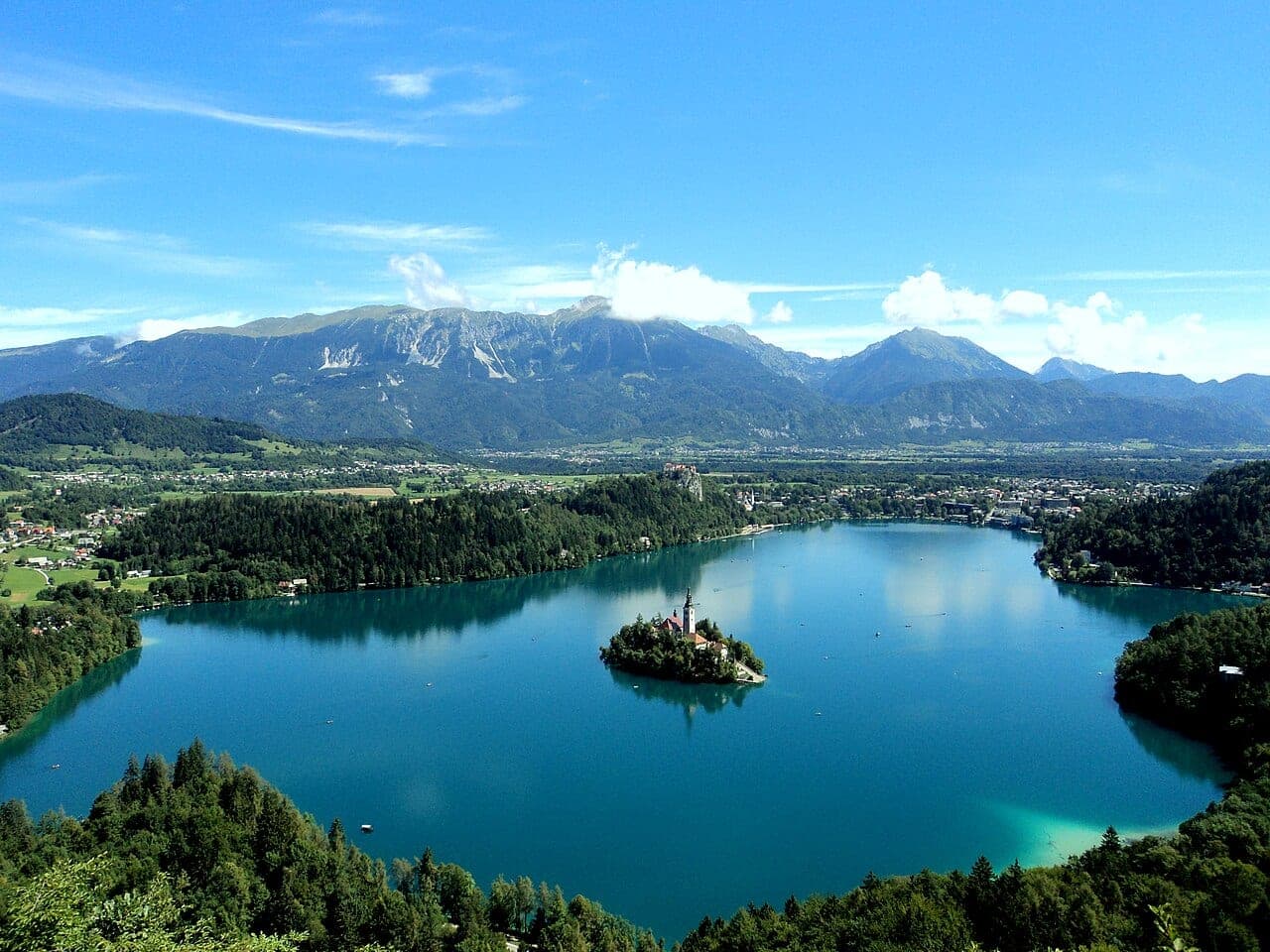
Bled. Set beneath the Julian Alps, Bled is Slovenia in miniature: a glacial lake with a single island at its centre, crowned by the Pilgrimage Church of the Assumption of Mary, reached by a stairway of ninety-nine steps and famous for its wishing bell. On a cliff about 130 metres above the water stands Bled Castle, first recorded in 1011 and the oldest in the country.
Slavic ancestors of the Slovenes settled the eastern Alps in the sixth century, and in the seventh they formed Carantania, often called the first Slavic principality, whose dukes were installed in a Slovene-language ceremony on the Prince's Stone. Carantania passed under Frankish rule and Christianity in the eighth century, and the Slovene lands were later organised into duchies, chief among them the Duchy of Carniola (Kranjska).
Ljubljana was rebuilt after the earthquake of 1895 and then largely redesigned by one architect, Joze Plecnik, who gave the city its bridges, embankments and market. Photograph by Andrew Milligan Sumo, CC BY 2.0, via Wikimedia Commons.
Maribor. Slovenia's second city lies on the Drava at the foot of the Pohorje hills, in the Štajerska (Styrian) wine country. Its riverside Lent district holds the Old Vine, the world's oldest living grapevine, still fruiting after more than four centuries. Maribor was a European Capital of Culture in 2012 and remains a university town.
Piran. On the Adriatic coast, Piran is a peninsula of Venetian-Gothic houses packed around Tartini Square, named for the violinist Giuseppe Tartini, born here in 1692 and remembered for the "Devil's Trill" sonata. For centuries the town belonged to Venice, and its salt pans at nearby Sečovlje are still worked by hand.
Bled. Set beneath the Julian Alps, Bled is Slovenia in miniature: a glacial lake with a single island at its centre, crowned by the Pilgrimage Church of the Assumption of Mary, reached by a stairway of ninety-nine steps and famous for its wishing bell. On a cliff about 130 metres above the water stands Bled Castle, first recorded in 1011 and the oldest in the country.
Slavic ancestors of the Slovenes settled the eastern Alps in the sixth century, and in the seventh they formed Carantania, often called the first Slavic principality, whose dukes were installed in a Slovene-language ceremony on the Prince's Stone. Carantania passed under Frankish rule and Christianity in the eighth century, and the Slovene lands were later organised into duchies, chief among them the Duchy of Carniola (Kranjska).
 The Skocjan Caves hold one of the largest underground canyons known, and the Karst region they sit in gave its name to the landform worldwide. Photograph by Ssamuel1010, CC BY-SA 4.0, via Wikimedia Commons.
From the late Middle Ages until 1918 these lands lay under the Habsburgs, shaped by Catholic reform, peasant revolts and slow modernisation. National feeling grew in the nineteenth century as a cultural movement before a political one. Its central figure was the Romantic poet France Prešeren (1800–1849), who raised Slovene to the level of high literature; the seventh stanza of his 1844 poem "Zdravljica," a toast to friendship among all peoples, later became the national anthem, and the anniversary of his death, 8 February, is now the country's cultural holiday.
The Habsburg empire fell in 1918, and Slovenia joined the new Kingdom of Serbs, Croats and Slovenes, later Yugoslavia. The Second World War brought a brutal occupation, the territory carved up among Germany, Italy and Hungary, followed by resistance and incorporation into socialist Yugoslavia. Independence, when it came, was reached with remarkable restraint. In a plebiscite on 23 December 1990, 88.5 percent of the electorate voted for a sovereign state, and on 25 June 1991 Slovenia declared independence. The Ten-Day War that followed, from 27 June to 7 July 1991, was brief; the Brioni Agreement halted the fighting and the last Yugoslav soldier left by late October. Statehood Day is marked each 25 June.
Slovene is a South Slavic language spoken by roughly two million people, and it preserves a grammatical feature most Indo-European languages lost long ago: the dual number, a distinct form for exactly two of anything, so that a pair of eyes or two lovers take endings all their own. For so small a speech community the language is astonishingly varied, splintering into dozens of dialects across seven major groups, some barely intelligible across a single mountain valley.
The written record runs deep. The Freising Manuscripts, copied around the turn of the first millennium, are the oldest known texts in Slovene and among the earliest in any Slavic language in the Latin alphabet. Printed Slovene began with the Protestant reformer Primož Trubar, who published the first Slovene books in 1550, and the language gained a full Bible with Jurij Dalmatin's translation of 1584. The name Slovenija, and the people's own name Slovenci, belong to the family of Slavic self-names thought to derive from slovo, meaning "word," so that to be a Slovene is, at root, to be one of the people of the word.
If one figure defines the country's visual culture it is Plečnik, whose columns, pyramids and river gates gave Ljubljana a face found nowhere else. But Slovene identity is rooted just as strongly in the countryside, and nowhere more so than in beekeeping, which Slovenes regard almost as a national vocation. The autochthonous Carniolan honeybee is now one of the most widely kept subspecies on earth, and the eighteenth-century beekeeper Anton Janša is honoured as a father of modern apiculture. Traditional apiaries display painted front boards, the panjske končnice, small folk paintings of saints, hunts and satirical scenes; one of the finest collections hangs in the Museum of Apiculture in Radovljica.
The table is its own heritage. Festive baking centres on potica, a rolled cake wound with walnut, honey or tarragon filling, and on the layered gibanica of the Prekmurje region. The Carniolan sausage, kranjska klobasa, carries protected status, and dishes of buckwheat, dumplings and štruklji speak to an Alpine farm kitchen. Slovenia is a serious wine country too, with a growing name for its orange, skin-contact whites. In music, the diatonic accordion and the polka of Slavko Avsenik carried Alpine Slovenia across the German-speaking world.
Slovenia is historically a Roman Catholic country, and the Church shaped its calendar, its architecture and its village life for more than a thousand years. Pilgrimage churches crown hilltops across the land, from Bled's island shrine to the Baroque basilica at Brezje. Observance has fallen sharply, and many Slovenes now describe themselves as non-practising or secular, yet the festivals, saints' days and roadside shrines remain woven into ordinary life.
Other traditions add texture. The Protestant Reformation left a lasting Lutheran community in the eastern Prekmurje region, and Trubar himself is honoured as a founder of the written language as much as a churchman. Small Orthodox and Muslim communities, the latter grown mainly through migration from the former Yugoslavia, worship in Ljubljana, whose mosque opened in 2020. A Jewish presence, medieval in origin and almost destroyed in the Holocaust, is remembered in the synagogue of Maribor, one of the oldest surviving in Europe.
Slovene mourning follows the Christian pattern, softened and deepened by folk custom. A death is usually followed within a few days by a funeral Mass and burial, the coffin carried to a churchyard or municipal cemetery where family plots are kept for generations. After the burial the mourners have traditionally gathered for a shared meal known as the sedmina, a name recalling the seventh day of grieving, at which the community eats together and begins, gently, to close the wound. Death notices printed on black-bordered paper, the osmrtnice, are still posted publicly in villages so that neighbours may pay their respects.
The great national act of remembrance is the first of November. Known before the war by its religious name, Vsi sveti (All Saints), renamed the Day of the Dead under socialism and now officially the Day of Remembrance of the Dead, it is a public holiday observed by believers and non-believers alike. In the days beforehand families clean and repair the graves; on the day itself they lay chrysanthemums and light grave candles, the nagrobne sveče, so that by nightfall entire cemeteries shimmer with thousands of small flames. The candle carries an old Christian meaning of light, hope and resurrection, and lighting one for a distant relative or a forgotten neighbour is understood as an act of ordinary kindness. Few images capture the Slovene attitude to memory more exactly than a hillside cemetery burning quietly against the November dark.
Slovenian parish registers are digitised, free and unusually complete, and the country's hardest record problem is thirty years old rather than three hundred.
Catholic parish registers run from the seventeenth century in most places and earlier in some, and the archdiocesan archives at Ljubljana, Maribor and Koper have published scans without charge. Because Slovenia was Habsburg, the registers follow the Austrian form, which is standardised and easy to read once learned, and the Franciscan land cadastre of the 1820s maps every plot with its holder, which places families precisely.
Civil registration dates from 1946; before that the church register was the civil record.
The archives at Ljubljana hold the provincial series for Carniola, Styria and Carinthia, and material for Slovenes who lived under Italy between the wars is in Trieste and Gorizia.
The modern absence is the izbrisani, the erased. In February 1992, after independence, more than twenty-five thousand permanent residents of Slovenia, mostly people from other Yugoslav republics, were removed from the register of residents without notification. They lost the legal right to live, work and receive healthcare in a country many had been born in, and some were deported. It took two decades of litigation, including judgments from the European Court of Human Rights, to establish that it had happened and to begin compensating people. For those families the state's record of them simply stopped, and proving continuity of residence became the work of a lifetime.
Slovenia's five World Heritage sites are protected under national heritage law. The oldest inscription is the Škocjan Caves, listed in 1986, where the Reka river has cut one of the largest underground river canyons on earth through the Classical Karst. The Heritage of Mercury at Idrija, shared with Almadén in Spain and inscribed in 2012, preserves the town, mine and machinery of the second-largest mercury operation in history, where the metal was first found in 1490. The prehistoric pile dwellings around the Alps, lakeside stilt villages of the Ljubljana Marsh, were added in 2011, and the works of Jože Plečnik in Ljubljana joined the list in 2021. Slovenia's stretch of the transnational ancient and primeval beech forests, in the Krokar and Snežnik-Ždrocle reserves, was inscribed in 2017.
The living traditions are guarded with equal seriousness. The country's beekeeping, entered on UNESCO's Representative List of Intangible Cultural Heritage in 2022 as "a way of life," is protected down to the requirement that only the native Carniolan bee be kept. Slovenia also entered the door-to-door rounds of the Kurenti, the bell-clad carnival figures of Ptuj, in 2017; bobbin lace-making in 2018; and, with partner countries, the breeding of the Lipizzan horse in 2022, the breed born at the Lipica stud farm founded in 1580. The wider Karst underground, including the show cave at Postojna and the cliff-mouth Predjama Castle nearby, is protected as natural and cultural heritage.
Slovenia has built a substantial digital memory around its national institutions. The National and University Library runs dLib.si, the Digital Library of Slovenia, a free portal of digitised books, newspapers, manuscripts, photographs and sound recordings reaching back to the earliest Slovene printing. The regional portal Kamra gathers local-history collections from libraries, museums and archives, while SIstory concentrates on historical scholarship. Slovenia contributes to Europeana and maintains a national register of intangible cultural heritage, documenting the beekeeping, lace-making, carnival and horse-breeding traditions in words, images and film so the knowledge behind them is not lost as its practitioners age.
For so small a nation, Slovenia's cultural reach is wide. Plečnik's ideas about the humane, walkable city are studied by architects worldwide, and his capital was recognised as European Green Capital in 2016 and a UNESCO World Book Capital in 2010. Slovenian thought travels through the philosopher Slavoj Žižek, while the band Laibach and the Neue Slowenische Kunst movement gave the country an outsized presence in the European avant-garde. In sport, Slovenes have reached the summit of their disciplines, from the cyclists Tadej Pogačar and Primož Roglič to the basketball player Luka Dončić.
Perhaps the most striking modern export is an old idea. On Slovenia's initiative, the United Nations proclaimed 20 May, the birthday of Anton Janša, as World Bee Day, first observed in 2018, turning a national vocation into a global call to protect pollinators. It is a fitting emblem for a country that understands heritage as something living, to be fed and passed on rather than merely displayed.
A national craft becomes a world day. Slovenia's campaign to make beekeeping a shared cause succeeded when the United Nations adopted World Bee Day in 2017, and the tradition joined UNESCO's intangible heritage list in 2022, carrying the memory of Anton Janša far beyond the Carniolan hills.
Plečnik's Ljubljana wins recognition. After decades in which his interwar vision was taken for granted, the works of Jože Plečnik were inscribed as a World Heritage site in 2021, confirming the river-city he designed as a landmark of modern urban design.
The Old Vine endures. The grapevine on the Lent embankment in Maribor, certified as the world's oldest still fruiting, has survived Ottoman raids, the phylloxera blight and wartime bombing, and its few litres of ceremonial wine are given each year as the city's most honoured gift.
Idrija reinvents itself. When mercury mining ended, the town turned its 500-year industrial memory into a museum landscape, and the shared inscription with Almadén in 2012 secured the galleries, theatre and lace the miners' families made.
The Skocjan Caves hold one of the largest underground canyons known, and the Karst region they sit in gave its name to the landform worldwide. Photograph by Ssamuel1010, CC BY-SA 4.0, via Wikimedia Commons.
From the late Middle Ages until 1918 these lands lay under the Habsburgs, shaped by Catholic reform, peasant revolts and slow modernisation. National feeling grew in the nineteenth century as a cultural movement before a political one. Its central figure was the Romantic poet France Prešeren (1800–1849), who raised Slovene to the level of high literature; the seventh stanza of his 1844 poem "Zdravljica," a toast to friendship among all peoples, later became the national anthem, and the anniversary of his death, 8 February, is now the country's cultural holiday.
The Habsburg empire fell in 1918, and Slovenia joined the new Kingdom of Serbs, Croats and Slovenes, later Yugoslavia. The Second World War brought a brutal occupation, the territory carved up among Germany, Italy and Hungary, followed by resistance and incorporation into socialist Yugoslavia. Independence, when it came, was reached with remarkable restraint. In a plebiscite on 23 December 1990, 88.5 percent of the electorate voted for a sovereign state, and on 25 June 1991 Slovenia declared independence. The Ten-Day War that followed, from 27 June to 7 July 1991, was brief; the Brioni Agreement halted the fighting and the last Yugoslav soldier left by late October. Statehood Day is marked each 25 June.
Slovene is a South Slavic language spoken by roughly two million people, and it preserves a grammatical feature most Indo-European languages lost long ago: the dual number, a distinct form for exactly two of anything, so that a pair of eyes or two lovers take endings all their own. For so small a speech community the language is astonishingly varied, splintering into dozens of dialects across seven major groups, some barely intelligible across a single mountain valley.
The written record runs deep. The Freising Manuscripts, copied around the turn of the first millennium, are the oldest known texts in Slovene and among the earliest in any Slavic language in the Latin alphabet. Printed Slovene began with the Protestant reformer Primož Trubar, who published the first Slovene books in 1550, and the language gained a full Bible with Jurij Dalmatin's translation of 1584. The name Slovenija, and the people's own name Slovenci, belong to the family of Slavic self-names thought to derive from slovo, meaning "word," so that to be a Slovene is, at root, to be one of the people of the word.
If one figure defines the country's visual culture it is Plečnik, whose columns, pyramids and river gates gave Ljubljana a face found nowhere else. But Slovene identity is rooted just as strongly in the countryside, and nowhere more so than in beekeeping, which Slovenes regard almost as a national vocation. The autochthonous Carniolan honeybee is now one of the most widely kept subspecies on earth, and the eighteenth-century beekeeper Anton Janša is honoured as a father of modern apiculture. Traditional apiaries display painted front boards, the panjske končnice, small folk paintings of saints, hunts and satirical scenes; one of the finest collections hangs in the Museum of Apiculture in Radovljica.
The table is its own heritage. Festive baking centres on potica, a rolled cake wound with walnut, honey or tarragon filling, and on the layered gibanica of the Prekmurje region. The Carniolan sausage, kranjska klobasa, carries protected status, and dishes of buckwheat, dumplings and štruklji speak to an Alpine farm kitchen. Slovenia is a serious wine country too, with a growing name for its orange, skin-contact whites. In music, the diatonic accordion and the polka of Slavko Avsenik carried Alpine Slovenia across the German-speaking world.
Slovenia is historically a Roman Catholic country, and the Church shaped its calendar, its architecture and its village life for more than a thousand years. Pilgrimage churches crown hilltops across the land, from Bled's island shrine to the Baroque basilica at Brezje. Observance has fallen sharply, and many Slovenes now describe themselves as non-practising or secular, yet the festivals, saints' days and roadside shrines remain woven into ordinary life.
Other traditions add texture. The Protestant Reformation left a lasting Lutheran community in the eastern Prekmurje region, and Trubar himself is honoured as a founder of the written language as much as a churchman. Small Orthodox and Muslim communities, the latter grown mainly through migration from the former Yugoslavia, worship in Ljubljana, whose mosque opened in 2020. A Jewish presence, medieval in origin and almost destroyed in the Holocaust, is remembered in the synagogue of Maribor, one of the oldest surviving in Europe.
Slovene mourning follows the Christian pattern, softened and deepened by folk custom. A death is usually followed within a few days by a funeral Mass and burial, the coffin carried to a churchyard or municipal cemetery where family plots are kept for generations. After the burial the mourners have traditionally gathered for a shared meal known as the sedmina, a name recalling the seventh day of grieving, at which the community eats together and begins, gently, to close the wound. Death notices printed on black-bordered paper, the osmrtnice, are still posted publicly in villages so that neighbours may pay their respects.
The great national act of remembrance is the first of November. Known before the war by its religious name, Vsi sveti (All Saints), renamed the Day of the Dead under socialism and now officially the Day of Remembrance of the Dead, it is a public holiday observed by believers and non-believers alike. In the days beforehand families clean and repair the graves; on the day itself they lay chrysanthemums and light grave candles, the nagrobne sveče, so that by nightfall entire cemeteries shimmer with thousands of small flames. The candle carries an old Christian meaning of light, hope and resurrection, and lighting one for a distant relative or a forgotten neighbour is understood as an act of ordinary kindness. Few images capture the Slovene attitude to memory more exactly than a hillside cemetery burning quietly against the November dark.
Slovenian parish registers are digitised, free and unusually complete, and the country's hardest record problem is thirty years old rather than three hundred.
Catholic parish registers run from the seventeenth century in most places and earlier in some, and the archdiocesan archives at Ljubljana, Maribor and Koper have published scans without charge. Because Slovenia was Habsburg, the registers follow the Austrian form, which is standardised and easy to read once learned, and the Franciscan land cadastre of the 1820s maps every plot with its holder, which places families precisely.
Civil registration dates from 1946; before that the church register was the civil record.
The archives at Ljubljana hold the provincial series for Carniola, Styria and Carinthia, and material for Slovenes who lived under Italy between the wars is in Trieste and Gorizia.
The modern absence is the izbrisani, the erased. In February 1992, after independence, more than twenty-five thousand permanent residents of Slovenia, mostly people from other Yugoslav republics, were removed from the register of residents without notification. They lost the legal right to live, work and receive healthcare in a country many had been born in, and some were deported. It took two decades of litigation, including judgments from the European Court of Human Rights, to establish that it had happened and to begin compensating people. For those families the state's record of them simply stopped, and proving continuity of residence became the work of a lifetime.
Slovenia's five World Heritage sites are protected under national heritage law. The oldest inscription is the Škocjan Caves, listed in 1986, where the Reka river has cut one of the largest underground river canyons on earth through the Classical Karst. The Heritage of Mercury at Idrija, shared with Almadén in Spain and inscribed in 2012, preserves the town, mine and machinery of the second-largest mercury operation in history, where the metal was first found in 1490. The prehistoric pile dwellings around the Alps, lakeside stilt villages of the Ljubljana Marsh, were added in 2011, and the works of Jože Plečnik in Ljubljana joined the list in 2021. Slovenia's stretch of the transnational ancient and primeval beech forests, in the Krokar and Snežnik-Ždrocle reserves, was inscribed in 2017.
The living traditions are guarded with equal seriousness. The country's beekeeping, entered on UNESCO's Representative List of Intangible Cultural Heritage in 2022 as "a way of life," is protected down to the requirement that only the native Carniolan bee be kept. Slovenia also entered the door-to-door rounds of the Kurenti, the bell-clad carnival figures of Ptuj, in 2017; bobbin lace-making in 2018; and, with partner countries, the breeding of the Lipizzan horse in 2022, the breed born at the Lipica stud farm founded in 1580. The wider Karst underground, including the show cave at Postojna and the cliff-mouth Predjama Castle nearby, is protected as natural and cultural heritage.
Slovenia has built a substantial digital memory around its national institutions. The National and University Library runs dLib.si, the Digital Library of Slovenia, a free portal of digitised books, newspapers, manuscripts, photographs and sound recordings reaching back to the earliest Slovene printing. The regional portal Kamra gathers local-history collections from libraries, museums and archives, while SIstory concentrates on historical scholarship. Slovenia contributes to Europeana and maintains a national register of intangible cultural heritage, documenting the beekeeping, lace-making, carnival and horse-breeding traditions in words, images and film so the knowledge behind them is not lost as its practitioners age.
For so small a nation, Slovenia's cultural reach is wide. Plečnik's ideas about the humane, walkable city are studied by architects worldwide, and his capital was recognised as European Green Capital in 2016 and a UNESCO World Book Capital in 2010. Slovenian thought travels through the philosopher Slavoj Žižek, while the band Laibach and the Neue Slowenische Kunst movement gave the country an outsized presence in the European avant-garde. In sport, Slovenes have reached the summit of their disciplines, from the cyclists Tadej Pogačar and Primož Roglič to the basketball player Luka Dončić.
Perhaps the most striking modern export is an old idea. On Slovenia's initiative, the United Nations proclaimed 20 May, the birthday of Anton Janša, as World Bee Day, first observed in 2018, turning a national vocation into a global call to protect pollinators. It is a fitting emblem for a country that understands heritage as something living, to be fed and passed on rather than merely displayed.
A national craft becomes a world day. Slovenia's campaign to make beekeeping a shared cause succeeded when the United Nations adopted World Bee Day in 2017, and the tradition joined UNESCO's intangible heritage list in 2022, carrying the memory of Anton Janša far beyond the Carniolan hills.
Plečnik's Ljubljana wins recognition. After decades in which his interwar vision was taken for granted, the works of Jože Plečnik were inscribed as a World Heritage site in 2021, confirming the river-city he designed as a landmark of modern urban design.
The Old Vine endures. The grapevine on the Lent embankment in Maribor, certified as the world's oldest still fruiting, has survived Ottoman raids, the phylloxera blight and wartime bombing, and its few litres of ceremonial wine are given each year as the city's most honoured gift.
Idrija reinvents itself. When mercury mining ended, the town turned its 500-year industrial memory into a museum landscape, and the shared inscription with Almadén in 2012 secured the galleries, theatre and lace the miners' families made.
National Overview
Notable Cities
Historical Foundations
Linguistic and Etymological Roots
Cultural Identity
Religion and Spirituality
Remembrance and Mourning Traditions
Tracing a Family in Slovenia
Heritage Preservation Efforts
Digital Heritage
Contemporary Cultural Influences
Success Stories
References and resources
- Encyclopaedia Britannica: Slovenia. Geography, history and political background.
- UNESCO World Heritage Centre: Slovenia. State-party page for all five Slovenian World Heritage sites.
- UNESCO World Heritage Centre: Škocjan Caves. The 1986 inscription and the Classical Karst.
- UNESCO World Heritage Centre: Heritage of Mercury, Almadén and Idrija. The 2012 mercury-mining inscription.
- UNESCO World Heritage Centre: Works of Jože Plečnik in Ljubljana. The 2021 inscription and its rationale.
- UNESCO Intangible Cultural Heritage: Beekeeping in Slovenia, a way of life. The 2022 inscription.
- Government of Slovenia: Slovenia and beekeeping / World Bee Day. The Carniolan bee and the origin of World Bee Day.
- Lipica Stud Farm. The 1580 foundation and the Lipizzan breed.
- Slovenia.si: Prešeren Day, the Slovenian cultural holiday. France Prešeren, the anthem and 8 February.
- Slovenia Times: All Saints' Day in Slovenia. Remembrance customs and the Day of the Dead.
- Digital Library of Slovenia (dLib.si). The national digital heritage portal run by the National and University Library.