Heritage · Country
Bulgaria Culture and Heritage
In Bulgaria the dead are announced on the walls. The necrolog, a black-bordered notice with the photograph of the deceased, is pasted on doors, fences and tree trunks, then reprinted at forty days and each anniversary, so a Bulgarian street is a running record of who has died. A guide to the country's heritage, its gift of the Cyrillic alphabet, and how Bulgarians mourn.Written to last.
By Confinity Heritage Editorial · 2026-07-11 · 8-minute readQuiet tools, kept out of the way.
Walk through any Bulgarian town and you will read its recent losses on the walls. The necrolog, a small printed sheet edged in black, carries a photograph, a name, the dates of a life and a few lines of verse or grief, and it is posted in public, on the door of the block of flats, on the lamp-post, on the trunk of a tree near the house. It goes up when someone dies, and then again at nine days, at forty days, at six months, at one year, and on the anniversary for years afterwards, so that the notice is not only an announcement but an act of continued mourning, renewed on schedule. A stranger walking the same street can watch a family's grief unfold over time in paper.
That habit of keeping the dead visible sits inside a much larger story of memory, because Bulgaria is the country that gave the Slavic world its alphabet. The Cyrillic script was assembled here in the late ninth century, in the literary schools of the first Bulgarian capitals, and from Bulgaria it spread to Serbia, the Rus and eventually a quarter of the writing world. A nation that has been erased from the map and restored, that spent five centuries under Ottoman rule and kept its language alive in monasteries, treats letters, saints and the marking of death with unusual seriousness.
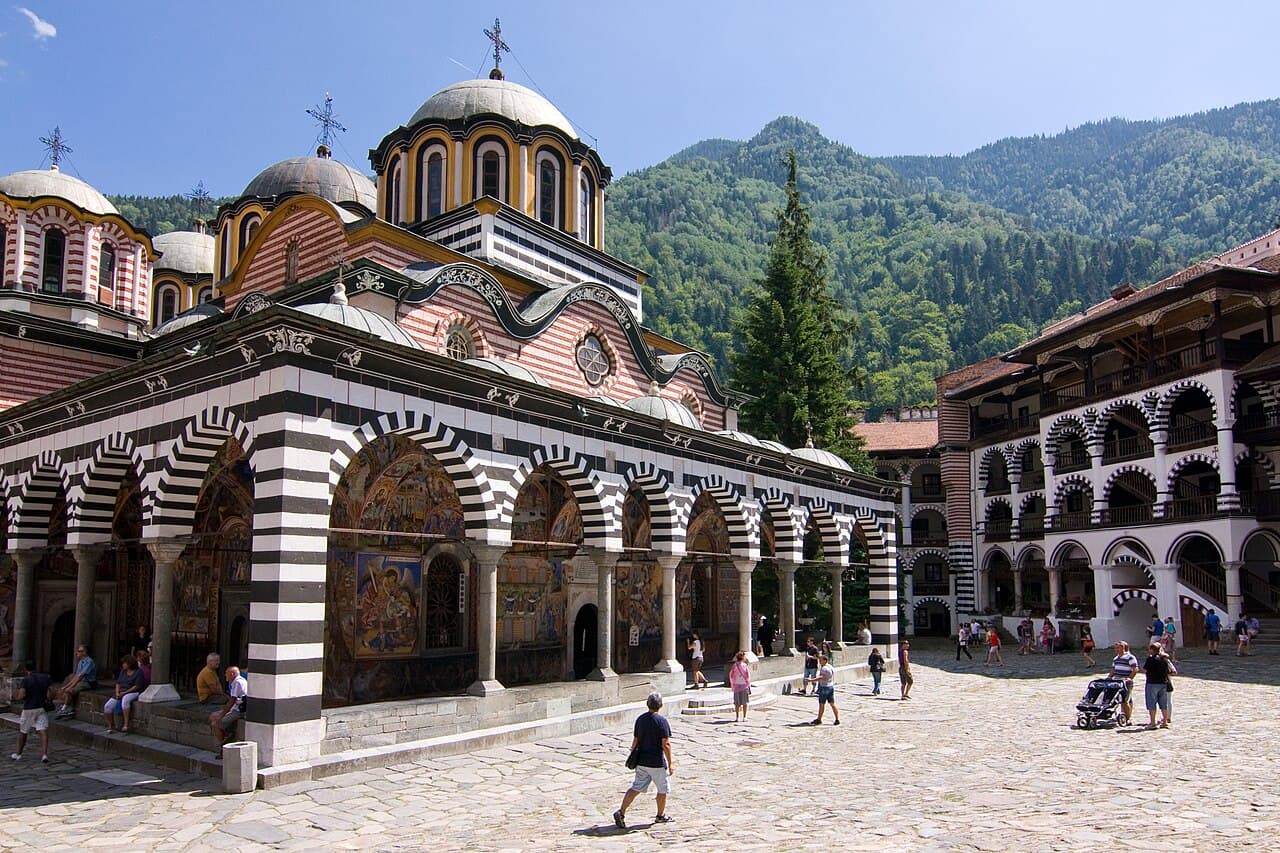
 The Rila Monastery, founded in the tenth century and rebuilt after an 1833 fire, the spiritual heart of Bulgaria. CC BY 2.0, via Wikimedia Commons.
Bulgaria occupies the eastern Balkans, some 111,000 square kilometres bounded by the Danube and Romania to the north, Serbia and North Macedonia to the west, Greece and Turkey to the south, and the Black Sea to the east. The land is mountainous through the middle and south: the Balkan range, the Stara Planina, runs east to west and gives the whole peninsula its name, while the Rila massif in the south-west rises to Musala at 2,925 metres, the highest peak anywhere in the Balkans. Between the ranges lie the fertile Danubian plain in the north and the Thracian lowlands of the south, and along the eastern edge run the beaches and old port towns of the Black Sea coast.
The 2021 census recorded about 6.5 million people, a figure falling steadily through emigration and low birth rates since the end of communism in 1989. Bulgarians make up the great majority, with a substantial ethnic Turkish minority, a large Roma population and smaller communities including the Pomaks, Bulgarian-speaking Muslims of the Rhodope mountains. The capital and largest city is Sofia. Bulgaria is a parliamentary republic that joined NATO in 2004 and the European Union in 2007, an accession that made Cyrillic the third official alphabet of the Union. It is one of the oldest states in Europe to have kept its name unchanged since its founding in 681.
Sofia. The capital lies in a plain beneath Mount Vitosha and is one of Europe's oldest cities, the Roman Serdica of which the emperor Constantine is said to have remarked that it was his Rome. Its layers are visible in the round fourth-century Church of Saint George, the excavated Roman streets beneath the metro, and the gold-domed Alexander Nevsky cathedral, built as a memorial to the soldiers who died freeing Bulgaria from Ottoman rule. On the city's outskirts stands the Boyana Church, its 1259 frescoes among the treasures of medieval European painting.
Plovdiv. Set on six hills in the Thracian plain, Plovdiv is one of the oldest continuously inhabited cities in the world, with roots reaching back some eight thousand years. Thracian Eumolpias, Philip of Macedon's Philippopolis and Roman Trimontium in turn, it keeps a magnificent Roman theatre still used for performances and an Old Town of timbered National Revival houses in ochre and blue. It was European Capital of Culture in 2019.
The Rila Monastery, founded in the tenth century and rebuilt after an 1833 fire, the spiritual heart of Bulgaria. CC BY 2.0, via Wikimedia Commons.
Bulgaria occupies the eastern Balkans, some 111,000 square kilometres bounded by the Danube and Romania to the north, Serbia and North Macedonia to the west, Greece and Turkey to the south, and the Black Sea to the east. The land is mountainous through the middle and south: the Balkan range, the Stara Planina, runs east to west and gives the whole peninsula its name, while the Rila massif in the south-west rises to Musala at 2,925 metres, the highest peak anywhere in the Balkans. Between the ranges lie the fertile Danubian plain in the north and the Thracian lowlands of the south, and along the eastern edge run the beaches and old port towns of the Black Sea coast.
The 2021 census recorded about 6.5 million people, a figure falling steadily through emigration and low birth rates since the end of communism in 1989. Bulgarians make up the great majority, with a substantial ethnic Turkish minority, a large Roma population and smaller communities including the Pomaks, Bulgarian-speaking Muslims of the Rhodope mountains. The capital and largest city is Sofia. Bulgaria is a parliamentary republic that joined NATO in 2004 and the European Union in 2007, an accession that made Cyrillic the third official alphabet of the Union. It is one of the oldest states in Europe to have kept its name unchanged since its founding in 681.
Sofia. The capital lies in a plain beneath Mount Vitosha and is one of Europe's oldest cities, the Roman Serdica of which the emperor Constantine is said to have remarked that it was his Rome. Its layers are visible in the round fourth-century Church of Saint George, the excavated Roman streets beneath the metro, and the gold-domed Alexander Nevsky cathedral, built as a memorial to the soldiers who died freeing Bulgaria from Ottoman rule. On the city's outskirts stands the Boyana Church, its 1259 frescoes among the treasures of medieval European painting.
Plovdiv. Set on six hills in the Thracian plain, Plovdiv is one of the oldest continuously inhabited cities in the world, with roots reaching back some eight thousand years. Thracian Eumolpias, Philip of Macedon's Philippopolis and Roman Trimontium in turn, it keeps a magnificent Roman theatre still used for performances and an Old Town of timbered National Revival houses in ochre and blue. It was European Capital of Culture in 2019.
 The old town of Nessebar, on its narrow Black Sea peninsula, inscribed by UNESCO in 1983. CC BY 2.0, via Wikimedia Commons.
Veliko Tarnovo. The capital of the Second Bulgarian Empire from 1185 to 1393 climbs the gorge of the Yantra river around the Tsarevets fortress, the seat of the medieval tsars and patriarchs. Known as the City of the Tsars, it was the centre of a flourishing school of manuscript and fresco painting before it fell to the Ottomans, and its restored citadel now stages a sound-and-light show over the river bends.
Varna. The largest city on the Black Sea and an ancient Greek colony, Varna holds a discovery that rewrote prehistory: the Varna Necropolis, excavated in the 1970s, yielded the oldest processed gold in the world, worked around 4,500 BC by a Copper Age society of startling sophistication. The find, more than three thousand gold objects concentrated in a handful of rich graves, showed that steep social hierarchy existed in Europe far earlier than scholars had believed.
Nessebar. A small town crowded onto a rocky Black Sea peninsula, Nessebar preserves an astonishing density of medieval Orthodox churches within an ancient street plan, the accumulation of Thracian, Greek, Roman, Byzantine and Bulgarian settlement. The old town has been a UNESCO World Heritage Site since 1983.
Bulgaria's deep past belongs first to the Thracians, the tribal peoples who left the gold treasures of Panagyurishte and Valchitran and the painted burial chambers of the Valley of the Thracian Kings, including the beehive tomb at Kazanlak with its fourth-century-BC frescoes. Greek colonists ringed the Black Sea coast, and Rome absorbed the whole region, building Serdica, Philippopolis and Nicopolis ad Istrum. The Bulgarian state itself was founded in 681, when Khan Asparukh led the Bulgars, a people of Turkic origin, across the Danube and settled among the local Slavs; the two fused into a single nation with its first capital at Pliska and then at Preslav.
The decisive turn came in 864, when Boris I accepted Christianity, and in the decades that followed, when the disciples of Cyril and Methodius, expelled from Moravia, were welcomed into Bulgaria and there developed the Cyrillic alphabet and a Slavic literary culture. Under Tsar Simeon the Great, who ruled until 927, the First Bulgarian Empire reached its cultural and territorial height. Byzantine conquest followed in 1018, then a second empire rose from the 1185 revolt of the brothers Asen and Peter, centred on Veliko Tarnovo, until the Ottomans overran it by 1396. Nearly five centuries of Ottoman rule followed, remembered as the yoke, during which the National Revival slowly rekindled Bulgarian language, schooling and self-confidence, culminating in the April Uprising of 1876 and its bloody suppression at Batak. The Russo-Turkish War of 1877 to 1878 liberated the country; a principality became a kingdom, endured the Balkan Wars and two world wars, spent four decades as a communist People's Republic under Todor Zhivkov, and turned toward Europe after 1989.
The country is named for the Bulgars, the horse people whose khans founded the state in 681 and gave their name to the Slavic majority they merged with. The Bulgarian language is South Slavic, and it holds a unique place: its medieval form, Old Church Slavonic, sometimes called Old Bulgarian, was the first Slavic language ever committed to writing and became the liturgical and literary language of Orthodox Slavs from the Adriatic to Russia. The Cyrillic alphabet in which it is written was created in Bulgaria's literary schools at the end of the ninth century, adapted by the students of Cyril and Methodius from an earlier script; Bulgaria gave the letters to the Slavic world and still celebrates the fact.
That celebration is a public holiday. Each 24 May Bulgarians mark the Day of Slavonic Alphabet, Bulgarian Enlightenment and Culture, honouring Saints Cyril and Methodius with processions of schoolchildren and teachers carrying the letters and portraits of the two brothers, one of the most beloved days in the national calendar. Modern Bulgarian is unusual among Slavic languages for having lost its noun cases and gained a definite article attached to the end of the word, changes that set it apart from Serbian or Russian. Place names across the country carry the sediment of its history: Slavic and Bulgar roots, Greek and Roman survivals along the coast, and Turkish names left by the Ottoman centuries, many of them officially Bulgarianised in the twentieth century.
Bulgarian folk culture is rich in ritual that marks the turning of the year. On the first of March people exchange the martenitsa, a twist of red and white yarn worn on the wrist or coat for health and the coming of spring until the wearer sees a stork or a blossoming tree, a custom UNESCO recognised in 2017. In villages of the Strandzha mountains, dancers still perform the nestinarstvo, walking barefoot across glowing embers on the feast of Saints Constantine and Helena, a fire ritual inscribed by UNESCO in 2009. Winter brings the kukeri, men in monstrous masks of fur and horn, each hung with heavy copper bells that clang as they leap through the streets to drive away evil spirits and bless the coming farming year, gathered in their thousands at the Surva festival in Pernik. Bulgaria's line dance, the horo, in which dancers link hands or belts and step through shifting rhythms, is danced at weddings and village fairs the length of the country and taught to schoolchildren as a matter of course.
Bulgarian music is famous for its irregular rhythms and its close, ringing harmonies. The women's choral tradition, packaged for the world as Le Mystère des Voix Bulgares, won a Grammy in 1990, and one Rhodope folk song, Valya Balkanska's rendition of "Izlel e Delyu Haydutin", was placed aboard the Voyager spacecraft in 1977 and is now travelling beyond the solar system as part of humanity's message to the stars. The country is the world's leading producer of rose oil, distilled from the damask roses of the Valley of the Roses around Kazanlak and celebrated each spring at the Rose Festival. The table offers banitsa, the coiled cheese pastry, the yoghurt whose bacterium is named Lactobacillus bulgaricus, grilled kebapche and the ubiquitous shopska salad, and sport has given Bulgaria the high-jumper Stefka Kostadinova, whose 1987 world record of 2.09 metres stood until 2024, and the footballer Hristo Stoichkov.
The Bulgarian Orthodox Church is one of the oldest in the Slavic world, its patriarchate first recognised in 927 and restored at Veliko Tarnovo in the Middle Ages; a little under three in five citizens identified as Orthodox in the 2021 census, with about a tenth Muslim, chiefly ethnic Turks and Pomaks. The faith's spiritual centre is the Rila Monastery, high in the mountains south of Sofia, founded in the tenth century around the hermitage of Saint John of Rila, the country's patron saint, whose relics it still holds; largely destroyed by fire in 1833 and rebuilt by National Revival craftsmen with its striped arcades and vivid frescoes, it became a refuge of Bulgarian language and identity under Ottoman rule and a World Heritage Site in 1983.
The old town of Nessebar, on its narrow Black Sea peninsula, inscribed by UNESCO in 1983. CC BY 2.0, via Wikimedia Commons.
Veliko Tarnovo. The capital of the Second Bulgarian Empire from 1185 to 1393 climbs the gorge of the Yantra river around the Tsarevets fortress, the seat of the medieval tsars and patriarchs. Known as the City of the Tsars, it was the centre of a flourishing school of manuscript and fresco painting before it fell to the Ottomans, and its restored citadel now stages a sound-and-light show over the river bends.
Varna. The largest city on the Black Sea and an ancient Greek colony, Varna holds a discovery that rewrote prehistory: the Varna Necropolis, excavated in the 1970s, yielded the oldest processed gold in the world, worked around 4,500 BC by a Copper Age society of startling sophistication. The find, more than three thousand gold objects concentrated in a handful of rich graves, showed that steep social hierarchy existed in Europe far earlier than scholars had believed.
Nessebar. A small town crowded onto a rocky Black Sea peninsula, Nessebar preserves an astonishing density of medieval Orthodox churches within an ancient street plan, the accumulation of Thracian, Greek, Roman, Byzantine and Bulgarian settlement. The old town has been a UNESCO World Heritage Site since 1983.
Bulgaria's deep past belongs first to the Thracians, the tribal peoples who left the gold treasures of Panagyurishte and Valchitran and the painted burial chambers of the Valley of the Thracian Kings, including the beehive tomb at Kazanlak with its fourth-century-BC frescoes. Greek colonists ringed the Black Sea coast, and Rome absorbed the whole region, building Serdica, Philippopolis and Nicopolis ad Istrum. The Bulgarian state itself was founded in 681, when Khan Asparukh led the Bulgars, a people of Turkic origin, across the Danube and settled among the local Slavs; the two fused into a single nation with its first capital at Pliska and then at Preslav.
The decisive turn came in 864, when Boris I accepted Christianity, and in the decades that followed, when the disciples of Cyril and Methodius, expelled from Moravia, were welcomed into Bulgaria and there developed the Cyrillic alphabet and a Slavic literary culture. Under Tsar Simeon the Great, who ruled until 927, the First Bulgarian Empire reached its cultural and territorial height. Byzantine conquest followed in 1018, then a second empire rose from the 1185 revolt of the brothers Asen and Peter, centred on Veliko Tarnovo, until the Ottomans overran it by 1396. Nearly five centuries of Ottoman rule followed, remembered as the yoke, during which the National Revival slowly rekindled Bulgarian language, schooling and self-confidence, culminating in the April Uprising of 1876 and its bloody suppression at Batak. The Russo-Turkish War of 1877 to 1878 liberated the country; a principality became a kingdom, endured the Balkan Wars and two world wars, spent four decades as a communist People's Republic under Todor Zhivkov, and turned toward Europe after 1989.
The country is named for the Bulgars, the horse people whose khans founded the state in 681 and gave their name to the Slavic majority they merged with. The Bulgarian language is South Slavic, and it holds a unique place: its medieval form, Old Church Slavonic, sometimes called Old Bulgarian, was the first Slavic language ever committed to writing and became the liturgical and literary language of Orthodox Slavs from the Adriatic to Russia. The Cyrillic alphabet in which it is written was created in Bulgaria's literary schools at the end of the ninth century, adapted by the students of Cyril and Methodius from an earlier script; Bulgaria gave the letters to the Slavic world and still celebrates the fact.
That celebration is a public holiday. Each 24 May Bulgarians mark the Day of Slavonic Alphabet, Bulgarian Enlightenment and Culture, honouring Saints Cyril and Methodius with processions of schoolchildren and teachers carrying the letters and portraits of the two brothers, one of the most beloved days in the national calendar. Modern Bulgarian is unusual among Slavic languages for having lost its noun cases and gained a definite article attached to the end of the word, changes that set it apart from Serbian or Russian. Place names across the country carry the sediment of its history: Slavic and Bulgar roots, Greek and Roman survivals along the coast, and Turkish names left by the Ottoman centuries, many of them officially Bulgarianised in the twentieth century.
Bulgarian folk culture is rich in ritual that marks the turning of the year. On the first of March people exchange the martenitsa, a twist of red and white yarn worn on the wrist or coat for health and the coming of spring until the wearer sees a stork or a blossoming tree, a custom UNESCO recognised in 2017. In villages of the Strandzha mountains, dancers still perform the nestinarstvo, walking barefoot across glowing embers on the feast of Saints Constantine and Helena, a fire ritual inscribed by UNESCO in 2009. Winter brings the kukeri, men in monstrous masks of fur and horn, each hung with heavy copper bells that clang as they leap through the streets to drive away evil spirits and bless the coming farming year, gathered in their thousands at the Surva festival in Pernik. Bulgaria's line dance, the horo, in which dancers link hands or belts and step through shifting rhythms, is danced at weddings and village fairs the length of the country and taught to schoolchildren as a matter of course.
Bulgarian music is famous for its irregular rhythms and its close, ringing harmonies. The women's choral tradition, packaged for the world as Le Mystère des Voix Bulgares, won a Grammy in 1990, and one Rhodope folk song, Valya Balkanska's rendition of "Izlel e Delyu Haydutin", was placed aboard the Voyager spacecraft in 1977 and is now travelling beyond the solar system as part of humanity's message to the stars. The country is the world's leading producer of rose oil, distilled from the damask roses of the Valley of the Roses around Kazanlak and celebrated each spring at the Rose Festival. The table offers banitsa, the coiled cheese pastry, the yoghurt whose bacterium is named Lactobacillus bulgaricus, grilled kebapche and the ubiquitous shopska salad, and sport has given Bulgaria the high-jumper Stefka Kostadinova, whose 1987 world record of 2.09 metres stood until 2024, and the footballer Hristo Stoichkov.
The Bulgarian Orthodox Church is one of the oldest in the Slavic world, its patriarchate first recognised in 927 and restored at Veliko Tarnovo in the Middle Ages; a little under three in five citizens identified as Orthodox in the 2021 census, with about a tenth Muslim, chiefly ethnic Turks and Pomaks. The faith's spiritual centre is the Rila Monastery, high in the mountains south of Sofia, founded in the tenth century around the hermitage of Saint John of Rila, the country's patron saint, whose relics it still holds; largely destroyed by fire in 1833 and rebuilt by National Revival craftsmen with its striped arcades and vivid frescoes, it became a refuge of Bulgarian language and identity under Ottoman rule and a World Heritage Site in 1983.
 The donors Sebastocrator Kaloyan and Desislava in the Boyana Church, painted in 1259, a century before the Renaissance. Public domain, via Wikimedia Commons.
Bulgaria's medieval churches hold some of the most advanced painting of their age. In the Boyana Church on the edge of Sofia, an unknown master painted a full cycle in 1259 whose portraits, above all the calm, individual faces of the donors Sebastocrator Kaloyan and his wife Desislava, are often described as anticipating the Renaissance by a century. Other monasteries, Bachkovo near Plovdiv, founded in 1083, Troyan in the Balkan mountains, and the rock-hewn churches of Ivanovo cut into cliffs above a river, extend the tradition. Islam left its own architecture, from the great mosques of Shumen and Sofia, and small Catholic, Protestant, Jewish and Armenian communities add to the mix, notably the Sephardic Jews whose ancestors Bulgaria conspicuously refused to hand over for deportation during the Second World War.
Bulgarian mourning follows the Orthodox pattern, but it does so with an unusually public face. When a person dies, the family posts the necrolog, the black-bordered obituary notice bearing a photograph, on the walls and doors of the neighbourhood, and reprints it at the fixed memorial points, the ninth day, the fortieth day, six months, a year, and each anniversary after that. The church has long discouraged cremation, so burial is the rule, and the memorial services, the panikhida, gather the family at the graveside and the table on those same dates. At the centre of every commemoration is kolivo, boiled wheat sweetened and dressed with walnuts and sugar, blessed and shared, the buried grain that stands for the resurrection of the body.
Several Saturdays of the year, the Zadushnitsa or Soul Saturdays before the great fasts, are set aside for the collective care of the dead. Families go to the cemeteries together to clean the graves, light candles and set out food and wine, pouring a little over the earth and handing portions to neighbours and passers-by so that the dead are remembered by many mouths. The graveside meal, the shared kolivo and the poured wine turn private loss into a communal obligation performed on the same days across the whole country.
Bulgaria's public remembrance is fixed above all on the men who died to make it free. Each 2 June, at noon, air-raid sirens sound across the entire country and people stop where they stand for a moment of silence in memory of the poet and freedom fighter Hristo Botev, killed in 1876, and of all who fell for Bulgaria's liberation and independence; the whole nation halts at once. The Russo-Turkish war that won that freedom is remembered on 3 March, the national day, and at the Shipka Pass in the Balkan mountains, where a memorial church with domes and a bell cast from spent cartridges stands over the ossuary of the dead, and where the Freedom Monument crowns the ridge the defenders held. The April Uprising is mourned at Batak, where the bones of the massacred are kept in the church, and the twentieth century added its own monuments, from the tomb of the unknown warrior beside the Alexander Nevsky cathedral to the vast, now-ruined Communist memorial house on the peak of Buzludzha.
The donors Sebastocrator Kaloyan and Desislava in the Boyana Church, painted in 1259, a century before the Renaissance. Public domain, via Wikimedia Commons.
Bulgaria's medieval churches hold some of the most advanced painting of their age. In the Boyana Church on the edge of Sofia, an unknown master painted a full cycle in 1259 whose portraits, above all the calm, individual faces of the donors Sebastocrator Kaloyan and his wife Desislava, are often described as anticipating the Renaissance by a century. Other monasteries, Bachkovo near Plovdiv, founded in 1083, Troyan in the Balkan mountains, and the rock-hewn churches of Ivanovo cut into cliffs above a river, extend the tradition. Islam left its own architecture, from the great mosques of Shumen and Sofia, and small Catholic, Protestant, Jewish and Armenian communities add to the mix, notably the Sephardic Jews whose ancestors Bulgaria conspicuously refused to hand over for deportation during the Second World War.
Bulgarian mourning follows the Orthodox pattern, but it does so with an unusually public face. When a person dies, the family posts the necrolog, the black-bordered obituary notice bearing a photograph, on the walls and doors of the neighbourhood, and reprints it at the fixed memorial points, the ninth day, the fortieth day, six months, a year, and each anniversary after that. The church has long discouraged cremation, so burial is the rule, and the memorial services, the panikhida, gather the family at the graveside and the table on those same dates. At the centre of every commemoration is kolivo, boiled wheat sweetened and dressed with walnuts and sugar, blessed and shared, the buried grain that stands for the resurrection of the body.
Several Saturdays of the year, the Zadushnitsa or Soul Saturdays before the great fasts, are set aside for the collective care of the dead. Families go to the cemeteries together to clean the graves, light candles and set out food and wine, pouring a little over the earth and handing portions to neighbours and passers-by so that the dead are remembered by many mouths. The graveside meal, the shared kolivo and the poured wine turn private loss into a communal obligation performed on the same days across the whole country.
Bulgaria's public remembrance is fixed above all on the men who died to make it free. Each 2 June, at noon, air-raid sirens sound across the entire country and people stop where they stand for a moment of silence in memory of the poet and freedom fighter Hristo Botev, killed in 1876, and of all who fell for Bulgaria's liberation and independence; the whole nation halts at once. The Russo-Turkish war that won that freedom is remembered on 3 March, the national day, and at the Shipka Pass in the Balkan mountains, where a memorial church with domes and a bell cast from spent cartridges stands over the ossuary of the dead, and where the Freedom Monument crowns the ridge the defenders held. The April Uprising is mourned at Batak, where the bones of the massacred are kept in the church, and the twentieth century added its own monuments, from the tomb of the unknown warrior beside the Alexander Nevsky cathedral to the vast, now-ruined Communist memorial house on the peak of Buzludzha.
.jpg%2F1280px-Three_of_the_five_gold_domes_and_its_53m_bell_tower_-_Alexander_Nevsky_Cathedral_(13338821494).jpg&w=3840&q=75) The Alexander Nevsky Cathedral in Sofia, built between 1882 and 1912 as a memorial to those who died liberating Bulgaria in 1877–78. CC BY 2.0, via Wikimedia Commons.
Bulgarian family records are good from the late nineteenth century and interesting before it.
Civil registration began after independence, and municipal registers of births, marriages and deaths are continuous through the twentieth century, held by the municipality where the event happened. Before that the Orthodox Church kept what records there were, and under Ottoman rule the millet system meant the church, not the state, registered its own community, so parish books and monastery records carry the older families.
The distinctive Bulgarian source is the necrolog. When someone dies the family prints a black-bordered notice with a photograph and pastes it up on doors, fences and poles, then reprints it at forty days, at six months, at a year and on each anniversary. A Bulgarian street carries a running record of its dead, with names, dates and faces, and families keep the sheets.
The hardest twentieth-century record is the Revival Process. In the mid-1980s the communist government forced the Turkish and Pomak minorities to change their names to Bulgarian ones, and around 340,000 people left for Turkey in 1989. Families in that group have a documentary break precisely where the name changes, and reconstructing a line means finding the register entry rather than following the surname.
The state security files, opened by a commission after 2006, are the other archive, and they name informers and the people they informed on, which has made them a family matter as much as a political one.
Bulgaria's heritage is administered through the Ministry of Culture and the National Institute of Immovable Cultural Heritage, which lists and protects monuments across the country, while the Bulgarian Academy of Sciences, whose origins reach back to 1869, houses the National Archaeological Institute and Museum in the heart of Sofia. The National Museum of History, one of the largest in the Balkans, keeps the Thracian gold and the treasures of the medieval empires, and the National Library, named for Saints Cyril and Methodius and founded in 1878, guards the manuscripts and the Ottoman-era archives.
The country's World Heritage sites are strikingly early and numerous. In 1979 alone UNESCO inscribed four Bulgarian sites, the Boyana Church, the Madara Rider rock relief, the rock-hewn churches of Ivanovo and the Thracian tomb of Kazanlak, followed by the Rila Monastery, the ancient city of Nessebar, the Srebarna nature reserve and the Pirin National Park in 1983, and the Thracian tomb of Sveshtari in 1985; in 2017 the country's beech forests were added as part of a transnational natural site. To protect the fragile painted tombs at Kazanlak and Sveshtari, the authorities built exact replicas for visitors while sealing the originals, a model of conservation that lets the public see what it may no longer safely enter. Living traditions receive the same care, with the martenitsa, the nestinarstvo fire dance and the region's rituals recognised on UNESCO's intangible heritage lists.
Bulgaria's memory institutions have carried their oldest treasures online. The National Library in Sofia has digitised medieval Slavonic manuscripts and its rich Oriental Department, which holds Ottoman documents covering centuries of the country's history, and the Bulgarian Archives State Agency has released large numbers of historical photographs and documents, including a substantial donation to Wikimedia Commons that has made images of Bulgarian history freely available worldwide. The country contributes to the pan-European Europeana platform, and manuscripts of world importance, among them the tenth-century Codex Suprasliensis, inscribed on UNESCO's Memory of the World register, have been reunited digitally though their physical pages are scattered across three countries.
Genealogy in Bulgaria rests on church registers and civil records held in the state and regional archives, increasingly consulted for the family research that has grown popular since 1989. Sound and image have their own projects: recordings of the village singers who made the Bulgarian choral sound, and the digitisation of the folk-music collections held by the academy, preserve the irregular rhythms and open harmonies that Valya Balkanska carried into space. The steady scanning of the National Revival press and the medieval libraries turns a heritage repeatedly threatened by conquest and fire into a record that can be studied from anywhere.
Bulgaria's largest cultural export since 1989 has been its people. Waves of emigration have carried perhaps two million Bulgarians to Spain, Germany, Britain, the United States and beyond, building diaspora communities that keep Orthodox parishes, folk-dance groups and Cyrillic Saturday schools alive far from home while the population at home continues to fall. Bulgarian-born figures have shaped the wider world out of proportion to the country's size: the artist Christo, who with Jeanne-Claude wrapped the Reichstag and islands and bridges, was born in Gabrovo; the physicist John Atanasoff, credited with building an early electronic computer, was of Bulgarian descent; and writers such as Kapka Kassabova and Georgi Gospodinov, whose novel Time Shelter won the International Booker Prize in 2023, have brought Bulgarian literature to a global readership.
At home the folk revival and the choral tradition remain a source of pride, and the ancient sites, Plovdiv's theatre, the Rila Monastery, the Black Sea towns, anchor a growing heritage tourism. The sharpest cultural arguments concern the communist past and how to treat its relics: the future of the crumbling Buzludzha monument, the memory of the labour camps, the removal or retention of Soviet-era statues, and, more quietly, the losses of depopulation and the place of the Turkish and Roma minorities in the national story. As across the region, Bulgaria is deciding in public what it wishes to remember and what it is ready to let fall.
The oldest gold, on display. The Varna Necropolis, excavated from 1972, revealed gold ornaments worked around 4,500 BC, the oldest processed gold ever found. Conserved and studied by Bulgarian archaeologists, the hoard is now the centrepiece of the Varna Archaeological Museum and has forced a rethinking of how early and how unequal Copper Age European society could be.
A voice sent to the stars. In 1977 NASA placed Valya Balkanska's recording of the Rhodope folk song "Izlel e Delyu Haydutin" on the Voyager Golden Record, alongside the greatest music of humanity. The choice made a Bulgarian village singer the carrier of her country's sound beyond the solar system, and it remains a point of national pride nearly half a century on.
The choir wins a Grammy. The album Le Mystère des Voix Bulgares, drawn from the state radio and television women's choir, won a Grammy Award in 1990 and introduced the ringing dissonances of Bulgarian women's singing to audiences across the world, turning a village tradition into an international genre still performed and recorded today.
A ruin gets a future. The abandoned Communist memorial house on Mount Buzludzha, its mosaics decaying since 1989, became the focus of an international conservation effort supported by the Getty Foundation from 2019, which has stabilised the structure and documented its mosaics, treating even a divisive monument as heritage worth saving.
A book that crossed borders. In 2023 Georgi Gospodinov's Time Shelter, translated by Angela Rodel, became the first Bulgarian novel to win the International Booker Prize, a recognition that placed contemporary Bulgarian writing, and its preoccupation with memory and the past, firmly on the world stage.
The Alexander Nevsky Cathedral in Sofia, built between 1882 and 1912 as a memorial to those who died liberating Bulgaria in 1877–78. CC BY 2.0, via Wikimedia Commons.
Bulgarian family records are good from the late nineteenth century and interesting before it.
Civil registration began after independence, and municipal registers of births, marriages and deaths are continuous through the twentieth century, held by the municipality where the event happened. Before that the Orthodox Church kept what records there were, and under Ottoman rule the millet system meant the church, not the state, registered its own community, so parish books and monastery records carry the older families.
The distinctive Bulgarian source is the necrolog. When someone dies the family prints a black-bordered notice with a photograph and pastes it up on doors, fences and poles, then reprints it at forty days, at six months, at a year and on each anniversary. A Bulgarian street carries a running record of its dead, with names, dates and faces, and families keep the sheets.
The hardest twentieth-century record is the Revival Process. In the mid-1980s the communist government forced the Turkish and Pomak minorities to change their names to Bulgarian ones, and around 340,000 people left for Turkey in 1989. Families in that group have a documentary break precisely where the name changes, and reconstructing a line means finding the register entry rather than following the surname.
The state security files, opened by a commission after 2006, are the other archive, and they name informers and the people they informed on, which has made them a family matter as much as a political one.
Bulgaria's heritage is administered through the Ministry of Culture and the National Institute of Immovable Cultural Heritage, which lists and protects monuments across the country, while the Bulgarian Academy of Sciences, whose origins reach back to 1869, houses the National Archaeological Institute and Museum in the heart of Sofia. The National Museum of History, one of the largest in the Balkans, keeps the Thracian gold and the treasures of the medieval empires, and the National Library, named for Saints Cyril and Methodius and founded in 1878, guards the manuscripts and the Ottoman-era archives.
The country's World Heritage sites are strikingly early and numerous. In 1979 alone UNESCO inscribed four Bulgarian sites, the Boyana Church, the Madara Rider rock relief, the rock-hewn churches of Ivanovo and the Thracian tomb of Kazanlak, followed by the Rila Monastery, the ancient city of Nessebar, the Srebarna nature reserve and the Pirin National Park in 1983, and the Thracian tomb of Sveshtari in 1985; in 2017 the country's beech forests were added as part of a transnational natural site. To protect the fragile painted tombs at Kazanlak and Sveshtari, the authorities built exact replicas for visitors while sealing the originals, a model of conservation that lets the public see what it may no longer safely enter. Living traditions receive the same care, with the martenitsa, the nestinarstvo fire dance and the region's rituals recognised on UNESCO's intangible heritage lists.
Bulgaria's memory institutions have carried their oldest treasures online. The National Library in Sofia has digitised medieval Slavonic manuscripts and its rich Oriental Department, which holds Ottoman documents covering centuries of the country's history, and the Bulgarian Archives State Agency has released large numbers of historical photographs and documents, including a substantial donation to Wikimedia Commons that has made images of Bulgarian history freely available worldwide. The country contributes to the pan-European Europeana platform, and manuscripts of world importance, among them the tenth-century Codex Suprasliensis, inscribed on UNESCO's Memory of the World register, have been reunited digitally though their physical pages are scattered across three countries.
Genealogy in Bulgaria rests on church registers and civil records held in the state and regional archives, increasingly consulted for the family research that has grown popular since 1989. Sound and image have their own projects: recordings of the village singers who made the Bulgarian choral sound, and the digitisation of the folk-music collections held by the academy, preserve the irregular rhythms and open harmonies that Valya Balkanska carried into space. The steady scanning of the National Revival press and the medieval libraries turns a heritage repeatedly threatened by conquest and fire into a record that can be studied from anywhere.
Bulgaria's largest cultural export since 1989 has been its people. Waves of emigration have carried perhaps two million Bulgarians to Spain, Germany, Britain, the United States and beyond, building diaspora communities that keep Orthodox parishes, folk-dance groups and Cyrillic Saturday schools alive far from home while the population at home continues to fall. Bulgarian-born figures have shaped the wider world out of proportion to the country's size: the artist Christo, who with Jeanne-Claude wrapped the Reichstag and islands and bridges, was born in Gabrovo; the physicist John Atanasoff, credited with building an early electronic computer, was of Bulgarian descent; and writers such as Kapka Kassabova and Georgi Gospodinov, whose novel Time Shelter won the International Booker Prize in 2023, have brought Bulgarian literature to a global readership.
At home the folk revival and the choral tradition remain a source of pride, and the ancient sites, Plovdiv's theatre, the Rila Monastery, the Black Sea towns, anchor a growing heritage tourism. The sharpest cultural arguments concern the communist past and how to treat its relics: the future of the crumbling Buzludzha monument, the memory of the labour camps, the removal or retention of Soviet-era statues, and, more quietly, the losses of depopulation and the place of the Turkish and Roma minorities in the national story. As across the region, Bulgaria is deciding in public what it wishes to remember and what it is ready to let fall.
The oldest gold, on display. The Varna Necropolis, excavated from 1972, revealed gold ornaments worked around 4,500 BC, the oldest processed gold ever found. Conserved and studied by Bulgarian archaeologists, the hoard is now the centrepiece of the Varna Archaeological Museum and has forced a rethinking of how early and how unequal Copper Age European society could be.
A voice sent to the stars. In 1977 NASA placed Valya Balkanska's recording of the Rhodope folk song "Izlel e Delyu Haydutin" on the Voyager Golden Record, alongside the greatest music of humanity. The choice made a Bulgarian village singer the carrier of her country's sound beyond the solar system, and it remains a point of national pride nearly half a century on.
The choir wins a Grammy. The album Le Mystère des Voix Bulgares, drawn from the state radio and television women's choir, won a Grammy Award in 1990 and introduced the ringing dissonances of Bulgarian women's singing to audiences across the world, turning a village tradition into an international genre still performed and recorded today.
A ruin gets a future. The abandoned Communist memorial house on Mount Buzludzha, its mosaics decaying since 1989, became the focus of an international conservation effort supported by the Getty Foundation from 2019, which has stabilised the structure and documented its mosaics, treating even a divisive monument as heritage worth saving.
A book that crossed borders. In 2023 Georgi Gospodinov's Time Shelter, translated by Angela Rodel, became the first Bulgarian novel to win the International Booker Prize, a recognition that placed contemporary Bulgarian writing, and its preoccupation with memory and the past, firmly on the world stage.
National Overview
Notable Cities
Historical Foundations
Linguistic and Etymological Roots
Cultural Identity
Religion and Spirituality
Remembrance and Mourning Traditions
Tracing a Family in Bulgaria
Heritage Preservation Efforts
Digital Heritage
Contemporary Cultural Influences
Success Stories
References and resources
- UNESCO World Heritage Centre, Bulgaria, the state-party page covering the Boyana Church, Kazanlak, Rila, Nessebar and the country's other inscribed sites.
- UNESCO Intangible Cultural Heritage, Bulgaria, the martenitsa, the nestinarstvo fire dance and other living traditions.
- National Museum of History (Bulgaria), the Thracian gold and the treasures of the medieval empires.
- St Cyril and Methodius National Library, Bulgaria's national library, founded in 1878, and its digitised manuscripts and Ottoman archives.
- Bulgarian Academy of Sciences, the parent body of the National Archaeological Institute and Museum.
- Rila Monastery, the official site of Bulgaria's principal monastery and World Heritage Site.
- Buzludzha Project, the international effort to conserve the Communist-era memorial and its mosaics.
- Europeana, Bulgaria, the European portal to which Bulgarian institutions contribute digitised heritage.
- Encyclopaedia Britannica, Bulgaria, geography, history and society.